REVIEW 3 major objections 5 minor 68 references
A two-channel deep network — fed both frequency-differenced and PCA-cleaned maps — keeps the 21-cm cross-power spectrum unbiased at large scales under a realistic cosine beam, where either preprocessing alone loses 5–8% or more.
Reviewed by Pith at T0; open to challenge. T0 means a machine referee read the full paper against a public rubric. the ladder, T0–T4 →
T0 review · deepseek-v4-flash
2026-08-03 21:26 UTC pith:JXHZPEOO
load-bearing objection The hybrid FD+PCA UNet is a real improvement under the cosine beam, but the abstract's mismatched-beam robustness claim has no experiment behind it. the 3 major comments →
Deep learning with hybrid frequency differencing and principal component analysis for 21-cm foreground and beam mitigation
The pith
A machine-rendered reading of the paper's core claim, the machinery that carries it, and where it could break.
Core claim
The central claim is that frequency differencing and PCA are not competing preprocessing options but complementary views: differencing preserves diffuse large-scale emission but adds striping artifacts at bright pixels, while PCA preserves compact bright structures but subtracts large-scale modes. Under the cosine beam, the UNet trained on either view alone systematically suppresses the recovered cross-power spectrum on large scales; the hybrid two-channel network does not, and the paper attributes this to the network learning to draw on FD's large-scale fidelity and PCA's small-scale fidelity simultaneously. The result is stated as a bias-free large-scale HI reconstruction, with the caveat
What carries the argument
The mechanism is a two-channel input cube for a 13-layer UNet: channel one is the frequency-differenced cube (adjacent 1 MHz channels subtracted after smoothing the higher-frequency map to the lower-frequency resolution), channel two is the cube after subtracting three principal components along frequency. The contrast between the channels — FD retaining diffuse large-scale structure, PCA retaining compact small-scale structure — is what gives the network the information to avoid the 5–8% large-scale bias each channel alone would bias it toward.
Load-bearing premise
The entire evaluation is in-distribution: training and test cubes come from the same simulation pipeline with the same foreground model and the same beam models, so the claimed accuracy and the abstract's assertion of robustness to imperfect beams have not been tested against genuinely different beam or foreground conditions.
What would settle it
Train the two-channel UNet on cosine-beam maps and test it on maps made with a different beam (e.g., a cosine beam with altered ripple amplitude/period, or a beam from real holographic measurements). If the large-scale cross-correlation ratio departs from unity beyond the 1σ band in that mismatched setting, the paper's robustness claim fails. A cheap version is to train on Gaussian-beam maps and test on cosine-beam maps; the abstract would predict near-unity recovery on large scales, but the body currently contains no such test.
If this is right
- Large-scale HI power, the part most affected by beam-induced spectral structure, can be recovered without the mode-subtraction cost of PCA-only cleaning.
- The hybrid advantage is specific to the realistic cosine beam: with a Gaussian beam all three U-Net variants are comparable, so chromatic sidelobe structure is the regime where the two-channel design matters.
- Because the network is trained on matched beam models in this work, the gain at k<0.1 h Mpc^-1 should be re-checked when the beam model is varied between training and inference.
- If this transfers to real data, it would reduce one systematic in 21-cm auto-power measurements, which currently depend heavily on cross-correlations with galaxy surveys.
- The 5–8% improvement at fixed network size and training cost suggests that other blind cleaning outputs, not just PCA, could be combined in the same two-channel way.
Where Pith is reading between the lines
- A natural reading is that any pair of spectral-smoothness filters with opposite scale biases could be combined this way; ICA and SVD variants are obvious candidates, though the paper does not test them.
- The abstract claims robustness to imperfect or mismatched beams, but the body only reports matched training/test conditions; this is the paper's gap to close, and it is directly testable.
- The fact that the hybrid gain appears only under the cosine beam hints that the network is using the FD channel as a 'large-scale anchor' that resists the sidelobe-induced mode mixing; that interpretation could be probed by ablating the FD channel at selected scales.
- The fixed 3-component PCA subtraction and fixed 1 MHz differencing are hyperparameters of the preprocessing; varying them in tandem with the loss function might push the residual large-scale bias even closer to zero, but no such exploration is reported.
Editorial analysis
A structured set of objections, weighed in public.
Referee Report
Summary. This paper develops a deep-learning foreground and beam mitigation pipeline for 21-cm intensity mapping, comparing three preprocessing strategies feeding a UNet: frequency differencing (FD), principal component analysis (PCA), and a hybrid two-channel combination. Using CRIME simulations of HI plus foregrounds, with optional Gaussian or Cosine beam convolution, the authors report that under the Cosine beam the single-channel FD+UNet and PCA+UNet underestimate the cross-correlation power spectrum by roughly 5–8% at k < 0.1 h Mpc^{-1} and by more than 20% at k ~ 0.2 h Mpc^{-1}, while the hybrid method remains consistent with unity within 1σ at large scales. The paper also claims in the abstract that the method is robust to imperfect or mismatched beams between training and testing, but this claim is not supported by any experiment in the body.
Significance. If the in-body results are correct, the hybrid two-channel preprocessing is a useful, practical contribution: it combines the large-scale fidelity of FD with the small-scale fidelity of PCA, and the improvement under a realistic Cosine beam is directly relevant to ongoing MeerKAT-era intensity mapping analyses. The paper is honest in its in-body comparison and reports concrete power-spectrum ratios with error bars. However, the advertised headline claim of robustness to train/test beam mismatch is absent from the experiments, and the evaluation is entirely in-distribution with respect to the simulation pipeline, so the significance of the paper as written is lower than the abstract suggests.
major comments (3)
- [Abstract and Sections IV–V] The abstract states that the method 'can robustly recover the HI signal even when the beam model is imperfect and differs between training and testing,' but no such experiment appears anywhere in Sections IV or V. All reported results train and test on the same beam model (no beam, Gaussian, or Cosine) in matched conditions. This is a load-bearing overclaim: the central advertised generalization is unsupported. The authors should either add an explicit mismatched-beam experiment (e.g., train on Gaussian, test on Cosine, or perturb the Cosine beam parameters between train and test) or soften the abstract and conclusions to describe matched-beam robustness only.
- [Section III.B.2, Eq. (8)] The mismatched-beam claim is not merely an untested extrapolation; the FD preprocessing itself depends on the assumed beam. Eq. (8) requires smoothing adjacent-frequency maps to a common resolution using Δθ_FWHM computed from the beam FWHM. If the test-time beam differs from the training beam, the FD channel will contain residual chromatic structure with statistics the network has not seen, and the PCA channel will also change. Thus the advertised robustness is coupled to a beam-dependent input construction. At minimum, the paper should quantify the sensitivity of the hybrid method to beam-model mismatch, or explicitly restrict the claim to the matched-beam case.
- [Section IV and Section III.B] The evaluation is entirely in-distribution with respect to the simulation pipeline: training and test samples come from the same CRIME lognormal HI fields, the same Haslam-based foreground model, and the same beam models. The held-out test set measures generalization across random realizations of the same process, not robustness to different foreground morphology, spectral-index variations, or beam systematics. The numbers of PCA modes (fixed at 3) and the FD spacing (fixed at 1 MHz) are free parameters, but no sensitivity analysis is provided. These choices may affect the magnitude of the hybrid improvement. The paper should at least discuss this limitation and, ideally, vary the number of PCA modes or the FD spacing in a robustness check.
minor comments (5)
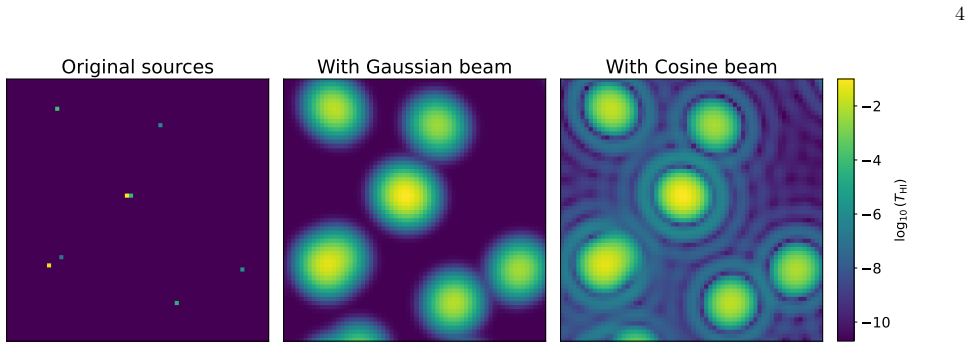
- [Figure 12 caption] The caption of Figure 12 says 'under Cosine beam convolution,' but the surrounding text (Section IV.B) and the third panel describe the Gaussian beam case; Figure 16 is the Cosine-beam counterpart. The caption should be corrected.
- [Section IV.C] The text 'which is already visible at large scales (k < hMpc^{-1})' appears to be missing a factor of 0.1; it should read k < 0.1 h Mpc^{-1} for consistency with the rest of the paper.
- [Figure 11 caption] The caption says 'correlation coefficient (left panel)' but the correlation coefficient is the right panel; the left panel is the temperature distribution.
- [Section III.B.1] The phrase 'Followingdeep21' should cite the deep21 paper (reference [51]) explicitly, as it currently appears as a plain text mention without a citation.
- [General] The polynomial coefficients in Eq. (6) are given with a very wide dynamic range; a table or scientific-notation formatting would improve readability.
Circularity Check
No circular derivation; the method is an empirical supervised comparison. The abstract's mismatched-beam robustness claim is unsupported, but under-support is not circularity.
full rationale
The central result (hybrid FD+PCA UNet outperforms single-channel FD/PCA under a Cosine beam) is an empirical comparison on held-out test cubes drawn from the same CRIME simulation pipeline, not a quantity enforced by construction. FD (Eq. 7) and PCA are preprocessing definitions, and the UNet is trained against the simulation's own HI truth in the standard supervised way; test cubes are disjoint from training cubes, so the comparison is not a fitted-input-called-prediction. The self-citations to Paper I (simulation pipeline, UNet structure, 1 MHz differencing choice) continue prior published work and are re-tested here rather than assumed as the conclusion. The abstract's claim that 'the method can robustly recover the HI signal even when the beam model is imperfect and differs between training and testing' is not substantiated: Sections IV.B and IV.C train and test with matched Gaussian or Cosine beams only, and no beam-mismatch experiment appears. This is a generalization/validity gap, aggravated by Eq. 8, where the frequency-differencing input is smoothed using the assumed beam FWHM; a different test-time beam would change the FD-channel statistics. But missing support is not a reduction of the result to its inputs, so it does not constitute circularity. The score reflects the normal self-citation and the in-sample evaluation caveat, not a circular derivation.
Axiom & Free-Parameter Ledger
free parameters (3)
- Number of PCA modes removed =
3
- Frequency-differencing spacing =
1 MHz
- UNet training hyperparameters =
not reported (deferred to Paper I)
axioms (3)
- domain assumption The CRIME simulation pipeline (lognormal HI + Haslam-based foregrounds + point-source models) is a faithful representation of low-redshift 21-cm observations.
- domain assumption The cosine beam model from Matshawule et al. [65] captures the relevant frequency-dependent beam distortions of MeerKAT.
- domain assumption A UNet trained with MSE loss on this simulated dataset will generalize to unseen patches and, by extension, real observations.
read the original abstract
Twenty-one-centimeter intensity mapping is a powerful probe of the large-scale distribution of neutral hydrogen (HI) and cosmological observables such as baryon acoustic oscillations. A major challenge is contamination from bright foregrounds and frequency-dependent beam effects, which can lead to signal loss in traditional methods such as principal component analysis (PCA). We develop a hybrid approach that trains a U-shaped convolutional neural network (UNet) on two input channels derived from frequency differencing (FD) and PCA cleaning, enabling it to exploit their complementary behavior across different scales. This two-channel strategy achieves improved performance, maintaining the cross-correlation power spectrum close to unity on large scales under a cosine beam and improving by 5\%-8\% relative to either FD- or PCA-based UNet alone. We further show that the method can robustly recover the HI signal even when the beam model is imperfect and differs between training and testing, with the large-scale cross-correlation remaining close to unity within the $1\sigma$ level. These results demonstrate that the proposed approach provides a robust framework for HI signal reconstruction under realistic observational conditions.
Figures


Reference graph
Works this paper leans on
-
[1]
In our case, PCA is applied to each of the 192 simulated sky patches, with each 643 data cube reshaped into a collection of one-dimensional spectra along the fre- 7 quency axis
Principal Component Analysis PCA is used to exploit the spectral smoothness of fore- grounds compared to the rapidly fluctuating cosmologi- cal signal. In our case, PCA is applied to each of the 192 simulated sky patches, with each 643 data cube reshaped into a collection of one-dimensional spectra along the fre- 7 quency axis. A frequency–frequency covar...
-
[2]
Frequency Differencing Frequency differencing is a model-independent tech- nique that exploits the spectral smoothness of fore- grounds relative to the cosmological 21-cm signal. By taking differences between adjacent frequency channels along each line of sight, the spectrally coherent fore- ground components, which vary slowly with frequency, are effecti...
-
[3]
We preprocess the input data cube inde- pendently using PCA and frequency differencing, yield- ing two separate residual maps
Hybrid Method: Dual-Channel PCA and Frequency Differencing To leverage the complementary strengths of PCA and frequency differencing, we construct a hybrid preprocess- ing approach in which the outputs of both methods are used in parallel. We preprocess the input data cube inde- pendently using PCA and frequency differencing, yield- ing two separate resid...
2021
-
[4]
F. Shi, H. Chang, L. Zhang, H. Shan, J. Zhang, S. Zhou, M. Jiang, and Z. Wang, 21-cm foreground removal using AI and the frequency-difference technique, Phys. Rev. D 109, 063509 (2024), arXiv:2310.06518 [astro-ph.CO]
Pith/arXiv arXiv 2024
-
[5]
S. Bharadwaj, B. B. Nath, and S. K. Sethi, Using HI to probe large scale structures at z∼3, Journal of As- trophysics and Astronomy22, 21 (2001), arXiv:astro- ph/0003200 [astro-ph]
arXiv 2001
-
[6]
R. A. Battye, R. D. Davies, and J. Weller, Neutral hydrogen surveys for high-redshift galaxy clusters and protoclusters, MNRAS355, 1339 (2004), arXiv:astro- ph/0401340 [astro-ph]
arXiv 2004
-
[7]
J. B. Peterson, R. Aleksan, R. Ansari, K. Ban- dura, D. Bond, J. Bunton, K. Carlson, T.-C. Chang, F. DeJongh, M. Dobbs, S. Dodelson, H. Darhmaoui, N. Gnedin, M. Halpern, C. Hogan, J.-M. Le Goff, T. T. Liu, A. Legrouri, A. Loeb, K. Loudiyi, C. Magneville, J. Marriner, D. P. McGinnis, B. McWilliams, M. Moniez, N. Palanque-Delabruille, R. J. Pasquinelli, U.-...
Pith/arXiv arXiv 2010
-
[8]
J. S. B. Wyithe and A. Loeb, The 21-cm power spec- trum after reionization, MNRAS397, 1926 (2009), arXiv:0808.2323 [astro-ph]
Pith/arXiv arXiv 1926
-
[9]
T.-C. Chang, U.-L. Pen, J. B. Peterson, and P. Mc- Donald, Baryon Acoustic Oscillation Intensity Mapping of Dark Energy, Phys. Rev. Lett.100, 091303 (2008), arXiv:0709.3672 [astro-ph]
Pith/arXiv arXiv 2008
-
[10]
H.-J. Seo, S. Dodelson, J. Marriner, D. Mcginnis, A. Stebbins, C. Stoughton, and A. Vallinotto, A Ground- based 21 cm Baryon Acoustic Oscillation Survey, Astro- phys. J.721, 164 (2010), arXiv:0910.5007 [astro-ph.CO]
Pith/arXiv arXiv 2010
-
[12]
P.-J. Wu, Y. Li, J.-F. Zhang, and X. Zhang, Prospects for measuring dark energy with 21 cm intensity map- ping experiments: A joint survey strategy, Science China Physics, Mechanics, and Astronomy66, 270413 (2023), arXiv:2212.07681 [astro-ph.CO]
Pith/arXiv arXiv 2023
-
[13]
M. Amiri, K. Bandura, T. Chen, M. Deng, M. Dobbs, M. Fandino, S. Foreman, M. Halpern, A. S. Hill, G. Hinshaw, C. H¨ ofer, J. Kania, T. L. Landecker, J. MacEachern, K. Masui, J. Mena-Parra, N. Miluti- novic, A. Mirhosseini, L. Newburgh, A. Ordog, U.-L. Pen, T. Pinsonneault-Marotte, A. Polzin, A. Reda, A. Re- nard, J. R. Shaw, S. R. Siegel, S. Singh, K. Van...
Pith/arXiv arXiv 2023
-
[14]
CHIME Collaboration, M. Amiri, K. Bandura, A. Boskovic, T. Chen, J.-F. Cliche, M. Deng, N. Den- man, M. Dobbs, M. Fandino, S. Foreman, M. Halpern, D. Hanna, A. S. Hill, G. Hinshaw, C. H¨ ofer, J. Ka- nia, P. Klages, T. L. Landecker, J. MacEachern, K. Masui, J. Mena-Parra, N. Milutinovic, A. Mirhos- seini, L. Newburgh, R. Nitsche, A. Ordog, U.-L. Pen, T. P...
Pith/arXiv arXiv 2022
-
[15]
Chen, Radio detection of dark energy—the Tianlai project, Scientia Sinica Physica, Mechanica & As- tronomica41, 1358 (2011)
X. Chen, Radio detection of dark energy—the Tianlai project, Scientia Sinica Physica, Mechanica & As- tronomica41, 1358 (2011)
2011
-
[16]
Y. Xu, X. Wang, and X. Chen, Forecasts on the Dark En- ergy and Primordial Non-Gaussianity Observations with the Tianlai Cylinder Array, Astrophys. J.798, 40 (2015), arXiv:1410.7794 [astro-ph.CO]
Pith/arXiv arXiv 2015
-
[17]
F. Wu, J. Li, S. Zuo, X. Chen, S. Das, J. P. Mar- riner, T. M. Oxholm, A. Phan, A. Stebbins, P. T. Tim- bie, R. Ansari, J.-E. Campagne, Z. Chen, Y. Cong, Q. Huang, J. Kwak, Y. Li, T. Liu, Y. Liu, C. Niu, C. Osinga, O. Perdereau, J. B. Peterson, J. Podczerwin- ski, H. Shi, G. Siebert, S. Sun, H. Tian, G. S. Tucker, Q. Wang, R. Wang, Y. Wang, Y. Wu, Y. Xu, ...
Pith/arXiv arXiv 2021
-
[18]
O. Perdereau, R. Ansari, A. Stebbins, P. T. Timbie, X. Chen, F. Wu, J. Li, J. P. Marriner, G. S. Tucker, Y. Cong, S. Das, Y. Li, Y. Liu, C. Magneville, J. B. Pe- terson, A. Phan, L. Robinthal, S. Sun, Y. Wang, Y. Wu, Y. Xu, K. Yu, Z. Yu, J. Zhang, J. Zhang, and S. Zuo, The Tianlai dish array low-z surveys forecasts, MNRAS 517, 4637 (2022), arXiv:2205.0608...
Pith/arXiv arXiv 2022
-
[19]
R. A. Battye, I. W. A. Browne, C. Dickinson, G. Heron, B. Maffei, and A. Pourtsidou, H I intensity mapping: a single dish approach, MNRAS434, 1239 (2013), arXiv:1209.0343 [astro-ph.CO]
Pith/arXiv arXiv 2013
-
[20]
E. Abdalla, E. G. M. Ferreira, R. G. Landim, A. A. Costa, K. S. F. Fornazier, F. B. Abdalla, L. Barosi, F. A. Brito, A. R. Queiroz, T. Villela, B. Wang, C. A. Wuen- sche, A. Marins, C. P. Novaes, V. Liccardo, C. Shan, J. Zhang, Z. Zhang, Z. Zhu, I. Browne, J. Delabrouille, L. Santos, M. V. dos Santos, H. Xu, S. Anton, R. Bat- tye, T. Chen, C. Dickinson, Y...
Pith/arXiv arXiv 2022
-
[21]
M. Santos, P. Bull, S. Camera, S. Chen, J. Fonseca, I. Heywood, M. Hilton, M. Jarvis, G. I. G. Jozsa, K. Knowles, L. Leeuw, R. Maartens, E. Malefahlo, K. McAlpine, K. Moodley, P. Patel, A. Pourtsidou, M. Prescott, K. Spekkens, R. Taylor, A. Witzemann, and I. H. Whittam, A Large Sky Survey with MeerKAT, in MeerKAT Science: On the Pathway to the SKA(2016) p...
Pith/arXiv arXiv 2016
-
[22]
J. Wang, M. G. Santos, P. Bull, K. Grainge, S. Cunning- ton, J. Fonseca, M. O. Irfan, Y. Li, A. Pourtsidou, P. S. Soares, M. Spinelli, G. Bernardi, and B. Engelbrecht, H I intensity mapping with MeerKAT: calibration pipeline for multidish autocorrelation observations, MNRAS505, 3698 (2021), arXiv:2011.13789 [astro-ph.CO]
Pith/arXiv arXiv 2021
-
[23]
L. B. Newburgh, K. Bandura, M. A. Bucher, T. C. Chang, H. C. Chiang, J. F. Cliche, R. Dav´ e, M. Dobbs, C. Clarkson, K. M. Ganga, T. Gogo, A. Gumba, N. Gupta, M. Hilton, B. Johnstone, A. Karastergiou, M. Kunz, D. Lokhorst, R. Maartens, S. Macpherson, M. Mdlalose, K. Moodley, L. Ngwenya, J. M. Parra, J. Peterson, O. Recnik, B. Saliwanchik, M. G. San- tos, ...
2016
-
[24]
M. Santos, P. Bull, D. Alonso, S. Camera, P. Fer- reira, G. Bernardi, R. Maartens, M. Viel, F. Villaescusa- Navarro, F. B. Abdalla, M. Jarvis, R. B. Metcalf, A. Pourtsidou, and L. Wolz, Cosmology from a SKA HI intensity mapping survey, inAdvancing Astrophysics with the Square Kilometre Array (AASKA14)(2015) p. 19, arXiv:1501.03989 [astro-ph.CO]
Pith/arXiv arXiv 2015
-
[25]
Chang, U.-L
T.-C. Chang, U.-L. Pen, K. Bandura, and J. B. Peterson, An intensity map of hydrogen 21-cm emission at redshift z˜0.8, Nature (London)466, 463 (2010)
2010
-
[26]
K. W. Masui, E. R. Switzer, N. Banavar, K. Bandura, C. Blake, L. M. Calin, T. C. Chang, X. Chen, Y. C. Li, Y. W. Liao, A. Natarajan, U. L. Pen, J. B. Peterson, J. R. Shaw, and T. C. Voytek, Measurement of 21 cm Brightness Fluctuations at z ˜0.8 in Cross-correlation, ApJL763, L20 (2013), arXiv:1208.0331 [astro-ph.CO]
Pith/arXiv arXiv 2013
-
[27]
L. Wolz, A. Pourtsidou, K. W. Masui, T.-C. Chang, J. E. Bautista, E.-M. M¨ uller, S. Avila, D. Bacon, W. J. Percival, S. Cunnington, C. Anderson, X. Chen, J.-P. Kneib, Y.-C. Li, Y.-W. Liao, U.-L. Pen, J. B. Peterson, G. Rossi, D. P. Schneider, J. Yadav, and G.-B. Zhao, H I constraints from the cross-correlation of eBOSS galaxies and Green Bank Telescope i...
Pith/arXiv arXiv 2022
-
[28]
C. J. Anderson, N. J. Luciw, Y. C. Li, C. Y. Kuo, J. Ya- dav, K. W. Masui, T. C. Chang, X. Chen, N. Opper- mann, Y. W. Liao, U. L. Pen, D. C. Price, L. Staveley- Smith, E. R. Switzer, P. T. Timbie, and L. Wolz, Low- amplitude clustering in low-redshift 21-cm intensity maps cross-correlated with 2dF galaxy densities, MNRAS476, 3382 (2018), arXiv:1710.00424...
Pith/arXiv arXiv 2018
-
[29]
S. Cunnington, Y. Li, M. G. Santos, J. Wang, I. P. Carucci, M. O. Irfan, A. Pourtsidou, M. Spinelli, L. Wolz, P. S. Soares, C. Blake, P. Bull, B. Engelbrecht, J. Fon- seca, K. Grainge, and Y.-Z. Ma, H I intensity map- ping with MeerKAT: power spectrum detection in cross- correlation with WiggleZ galaxies, MNRAS518, 6262 (2023), arXiv:2206.01579 [astro-ph.CO]
Pith/arXiv arXiv 2023
-
[30]
A. Mazumder, L. Wolz, Z. Chen, S. Paul, M. G. Santos, M. Jarvis, J. Townsend, S. Sekhar, and R. Taylor, HI intensity mapping with the MIGHTEE Survey: first re- sults of the HI power spectrum, MNRAS541, 476 (2025), arXiv:2501.17564 [astro-ph.CO]
Pith/arXiv arXiv 2025
-
[31]
T. Di Matteo, R. Perna, T. Abel, and M. J. Rees, Radio Foregrounds for the 21 Centimeter Tomography of the Neutral Intergalactic Medium at High Redshifts, Astro- phys. J.564, 576 (2002), arXiv:astro-ph/0109241 [astro- ph]
Pith/arXiv arXiv 2002
-
[32]
S. P. Oh and K. J. Mack, Foregrounds for 21-cm obser- vations of neutral gas at high redshift, MNRAS346, 871 (2003), arXiv:astro-ph/0302099 [astro-ph]
Pith/arXiv arXiv 2003
-
[33]
M. G. Santos, A. Cooray, and L. Knox, Multifrequency Analysis of 21 Centimeter Fluctuations from the Era of Reionization, Astrophys. J.625, 575 (2005), arXiv:astro- ph/0408515 [astro-ph]
arXiv 2005
-
[34]
A. de Oliveira-Costa, M. Tegmark, B. M. Gaensler, J. Jonas, T. L. Landecker, and P. Reich, A model of dif- fuse Galactic radio emission from 10 MHz to 100 GHz, MNRAS388, 247 (2008), arXiv:0802.1525 [astro-ph]
Pith/arXiv arXiv 2008
-
[35]
A. Liu and J. R. Shaw, Data Analysis for Precision 21 cm Cosmology, Publ. Astron. Soc. Pac.132, 062001 (2020), arXiv:1907.08211 [astro-ph.IM]
Pith/arXiv arXiv 2020
-
[36]
A. Liu and M. Tegmark, A method for 21 cm power spectrum estimation in the presence of foregrounds, Phys. Rev. D83, 103006 (2011), arXiv:1103.0281 [astro- ph.CO]
Pith/arXiv arXiv 2011
-
[37]
E. R. Switzer, T.-C. Chang, K. W. Masui, U.-L. Pen, and T. C. Voytek, Interpreting the unresolved intensity of cosmologically redshifted line radiation, Astrophys. J. 815, 51 (2015), arXiv:1504.07527 [astro-ph.CO]
Pith/arXiv arXiv 2015
-
[38]
S. Zuo, X. Chen, and Y. Mao, A Semiblind PCA-based Foreground Subtraction Method for 21 cm Intensity Mapping, Astrophys. J.945, 38 (2023), arXiv:2208.14675 [astro-ph.CO]
Pith/arXiv arXiv 2023
-
[39]
E. Chapman, F. B. Abdalla, G. Harker, V. Jeli´ c, P. Labropoulos, S. Zaroubi, M. A. Brentjens, A. G. de Bruyn, and L. V. E. Koopmans, Foreground removal us- ing F ASTICA: a showcase of LOF AR-EoR, MNRAS423, 2518 (2012), arXiv:1201.2190 [astro-ph.CO]
Pith/arXiv arXiv 2012
-
[40]
S. Cunnington, M. O. Irfan, I. P. Carucci, A. Pourtsidou, and J. Bobin, 21-cm foregrounds and polarization leak- age: cleaning and mitigation strategies, MNRAS504, 208 (2021), arXiv:2010.02907 [astro-ph.CO]
Pith/arXiv arXiv 2021
-
[41]
E. Chapman, F. B. Abdalla, J. Bobin, J. L. Starck, G. Harker, V. Jeli´ c, P. Labropoulos, S. Zaroubi, M. A. Brentjens, A. G. de Bruyn, and L. V. E. Koopmans, The scale of the problem: recovering images of reioniza- tion with Generalized Morphological Component Anal- ysis, MNRAS429, 165 (2013), arXiv:1209.4769 [astro- ph.CO]
Pith/arXiv arXiv 2013
-
[42]
L. C. Olivari, M. Remazeilles, and C. Dickinson, Ex- tracting H I cosmological signal with generalized needlet internal linear combination, MNRAS456, 2749 (2016), arXiv:1509.00742 [astro-ph.CO]. 17
Pith/arXiv arXiv 2016
-
[43]
A. Marins, F. B. Abdalla, K. S. F. Fornazier, E. Abdalla, L. H. F. Assis, M. Remazeilles, C. Alexandre Wuensche, L. Barosi, A. R. Queiroz, T. Villela, B. Wang, C. Feng, R. Landim, V. Liccardo, C. P. Novaes, L. Santos, M. V. dos Santos, and J. Zhang, Foreground removal and 21 cm signal estimates: comparing different blind methods for the BINGO Telescope, a...
arXiv 2022
-
[44]
N. Kern and A. Liu, Gaussian process foreground sub- traction and power spectrum estimation for 21 cm cos- mology, Mon. Not. Roy. Astron. Soc.501, 1463 (2021), arXiv:2010.15892 [astro-ph.CO]
Pith/arXiv arXiv 2021
-
[45]
J. R. Shaw, K. Sigurdson, U.-L. Pen, A. Stebbins, and M. Sitwell, All-Sky Interferometry with Spherical Har- monic Transit Telescopes, Astrophys. J.781, 57 (2014), arXiv:1302.0327 [astro-ph.CO]
Pith/arXiv arXiv 2014
-
[46]
A. Ghosh, L. V. E. Koopmans, E. Chapman, and V. Jeli´ c, A Bayesian analysis of redshifted 21-cm H I signal and foregrounds: simulations for LOF AR, Mon. Not. Roy. Astron. Soc.452, 1587 (2015), arXiv:1506.04982 [astro- ph.CO]
Pith/arXiv arXiv 2015
-
[47]
L. Zhang, E. F. Bunn, A. Karakci, A. Korotkov, P. M. Sutter, P. T. Timbie, G. S. Tucker, and B. D. Wandelt, Bayesian Semi-blind Component Separation for Fore- ground Removal in Interferometric 21 cm Observations, ApJS222, 3 (2016), arXiv:1505.04146 [astro-ph.CO]
Pith/arXiv arXiv 2016
-
[48]
P. H. Sims and J. C. Pober, Joint estimation of the Epoch of Reionization power spectrum and fore- grounds, Mon. Not. Roy. Astron. Soc.488, 2904 (2019), arXiv:1907.02608 [astro-ph.CO]
Pith/arXiv arXiv 2019
-
[49]
J. Burba, P. H. Sims, and J. C. Pober, All-sky mod- elling requirements for Bayesian 21 cm power spectrum estimation with BAYESEOR, MNRAS520, 4443 (2023), arXiv:2302.04058 [astro-ph.IM]
Pith/arXiv arXiv 2023
-
[50]
J. Ding, X. Wang, U.-L. Pen, and X.-D. Li, Correlation- based Beam Calibration of 21 cm Intensity Mapping, ApJS274, 44 (2024), arXiv:2408.06682 [astro-ph.CO]
Pith/arXiv arXiv 2024
-
[51]
J. Asorey, D. Parkinson, F. Shi, Y.-S. Song, K. Ahn, J. Kim, J. Yao, L. Zhang, and S. Zuo, HIR4: cosmology from a simulated neutral hydrogen full sky using Hori- zon Run 4, MNRAS495, 1788 (2020), arXiv:2001.00833 [astro-ph.CO]
Pith/arXiv arXiv 2020
-
[52]
F. Shi, Y.-S. Song, J. Asorey, D. Parkinson, K. Ahn, J. Yao, L. Zhang, and S. Zuo, HIR4: cosmological signa- tures imprinted on the cross-correlation between a 21-cm map and galaxy clustering, MNRAS499, 4613 (2020), arXiv:2006.01407 [astro-ph.CO]
Pith/arXiv arXiv 2020
-
[53]
W. Li, H. Xu, Z. Ma, R. Zhu, D. Hu, Z. Zhu, J. Gu, C. Shan, J. Zhu, and X.-P. Wu, Separating the EoR signal with a convolutional denoising autoencoder: a deep-learning-based method, MNRAS485, 2628 (2019), arXiv:1902.09278 [astro-ph.IM]
Pith/arXiv arXiv 2019
-
[54]
T. L. Makinen, L. Lancaster, F. Villaescusa-Navarro, P. Melchior, S. Ho, L. Perreault-Levasseur, and D. N. Spergel, deep21: a deep learning method for 21 cm foreground removal, JCAP2021, 081 (2021), arXiv:2010.15843 [astro-ph.CO]
Pith/arXiv arXiv 2021
-
[55]
S. Gagnon-Hartman, Y. Cui, A. Liu, and S. Ravan- bakhsh, Recovering the wedge modes lost to 21-cm fore- grounds, MNRAS504, 4716 (2021), arXiv:2102.08382 [astro-ph.CO]
Pith/arXiv arXiv 2021
-
[56]
S. Ni, Y. Li, L.-Y. Gao, and X. Zhang, Eliminating Pri- mary Beam Effect in Foreground Subtraction of Neutral Hydrogen Intensity Mapping Survey with Deep Learning, Astrophys. J.934, 83 (2022), arXiv:2204.02780 [astro- ph.IM]
Pith/arXiv arXiv 2022
-
[57]
J. Kennedy, J. C. Carr, S. Gagnon-Hartman, A. Liu, J. Mirocha, and Y. Cui, Machine-learning recovery of foreground wedge-removed 21-cm light cones for high-z galaxy mapping, MNRAS529, 3684 (2024), arXiv:2308.09740 [astro-ph.CO]
Pith/arXiv arXiv 2024
-
[58]
M. Bianco, S. K. Giri, D. Prelogovi´ c, T. Chen, F. G. Mertens, E. Tolley, A. Mesinger, and J.-P. Kneib, Deep learning approach for identification of H II regions during reionization in 21-cm observations - II. Foreground con- tamination, MNRAS528, 5212 (2024), arXiv:2304.02661 [astro-ph.IM]
Pith/arXiv arXiv 2024
-
[59]
M. Bianco, S. K. Giri, R. Sharma, T. Chen, S. P. Kr- ishna, C. Finlay, V. Nistane, P. Denzel, M. De Santis, and H. Ghorbel, Deep learning approach for identifica- tion of H II regions during reionization in 21-cm obser- vations – III. Image recovery, MNRAS541, 234 (2025), arXiv:2408.16814 [astro-ph.CO]
Pith/arXiv arXiv 2025
-
[60]
N. Sabti, R. Purandhar Reddy Sudha, J. B. Mu˜ noz, S. Mishra-Sharma, and T. Youn, A generative model- ing approach to reconstructing 21 cm tomographic data, Machine Learning: Science and Technology6, 015039 (2025), arXiv:2407.21097 [astro-ph.CO]
Pith/arXiv arXiv 2025
-
[61]
S.-F. Chen, K.-F. Chen, and C. Dvorkin, Field- level Reconstruction from Foreground-Contaminated 21- cm Maps, arXiv e-prints , arXiv:2508.13265 (2025), arXiv:2508.13265 [astro-ph.CO]
arXiv 2025
-
[62]
D. Alonso, P. G. Ferreira, and M. G. Santos, Fast simu- lations for intensity mapping experiments, MNRAS444, 3183 (2014), arXiv:1405.1751 [astro-ph.CO]
Pith/arXiv arXiv 2014
-
[63]
C. G. T. Haslam, C. J. Salter, H. Stoffel, and W. E. Wilson, A 408-MHZ All-Sky Continuum Survey. II. The Atlas of Contour Maps, A&AS47, 1 (1982)
1982
-
[64]
J. Delabrouille, M. Betoule, J. B. Melin, M. A. Miville- Deschˆ enes, J. Gonzalez-Nuevo, M. Le Jeune, G. Castex, G. de Zotti, S. Basak, M. Ashdown, J. Aumont, C. Bacci- galupi, A. J. Banday, J. P. Bernard, F. R. Bouchet, D. L. Clements, A. da Silva, C. Dickinson, F. Dodu, K. Dolag, F. Elsner, L. Fauvet, G. Fa¨ y, G. Giardino, S. Leach, J. Lesgourgues, M. ...
Pith/arXiv arXiv 2013
-
[65]
M. Remazeilles, C. Dickinson, A. J. Banday, M. A. Bigot- Sazy, and T. Ghosh, An improved source-subtracted and destriped 408-MHz all-sky map, MNRAS451, 4311 (2015), arXiv:1411.3628 [astro-ph.IM]
Pith/arXiv arXiv 2015
-
[66]
G. B. Rybicki and A. P. Lightman,Radiative Processes in Astrophysics(1986)
1986
-
[67]
K. M. G´ orski, E. Hivon, A. J. Banday, B. D. Wan- delt, F. K. Hansen, M. Reinecke, and M. Bartelmann, HEALPix: A Framework for High-Resolution Discretiza- tion and Fast Analysis of Data Distributed on the Sphere, Astrophys. J.622, 759 (2005), arXiv:astro-ph/0409513 [astro-ph]
Pith/arXiv arXiv 2005
-
[68]
S. D. Matshawule, M. Spinelli, M. G. Santos, and S. Ngobese, H I intensity mapping with MeerKAT: pri- mary beam effects on foreground cleaning, MNRAS506, 5075 (2021), arXiv:2011.10815 [astro-ph.CO]. 18
Pith/arXiv arXiv 2021
-
[69]
Y.-S. Song, Y. Zheng, and A. Taruya, Toward a more stringent test of gravity with the redshift space power spectrum: Simultaneous probe of growth and ampli- tude of large-scale structure, PhRvD104, 043528 (2021), arXiv:2102.01785 [astro-ph.CO]
Pith/arXiv arXiv 2021
discussion (0)
Sign in with ORCID, Apple, or X to comment. Anyone can read and Pith papers without signing in.