Stochastic unravelings for Heisenberg picture and trace-nonpreserving dynamics
Pith reviewed 2026-05-17 20:23 UTC · model grok-4.3
The pith
The paper introduces a general framework extending piecewise-deterministic unravelings to arbitrary trace-nonpreserving master equations requiring only positivity and Hermiticity of the dynamics.
A machine-rendered reading of the paper's core claim, the machinery that carries it, and where it could break.
Core claim
we introduce a general framework that extends piecewise-deterministic unravelings to arbitrary trace-nonpreserving master equations, requiring only positivity and Hermiticity of the dynamics.
Load-bearing premise
The master equations must satisfy positivity and Hermiticity; the extension is claimed to work under this condition alone, as stated in the abstract.
Figures

read the original abstract
Stochastic unravelings allow to efficiently simulate open system dynamics, yet their application has traditionally been restricted to master equations that preserve both Hermiticity and trace. In this work, we introduce a general framework that extends piecewise-deterministic unravelings to arbitrary trace-nonpreserving master equations, requiring only positivity and Hermiticity of the dynamics. Our approach includes, as special cases, unravelings of arbitrary dynamics in the Heisenberg picture, evolutions interpolating between fully Lindblad and non-Hermitian Hamiltonian generators, and equations employed in the derivation of full counting statistics, for which we show it can be used to obtain the moments of the associated probability distribution. The framework is suitable for both trace-decreasing and trace-increasing processes through stochastic disappearance and replication of the stochastic realizations, and it is compatible with different unraveling schemes and with reverse jumps in the non-Markovian regime. Thereby, our approach provides a powerful and versatile simulation method that significantly broadens the applicability of stochastic techniques for open system dynamics.
Editorial analysis
A structured set of objections, weighed in public.
Referee Report
Summary. The paper introduces a general framework extending piecewise-deterministic stochastic unravelings to arbitrary trace-nonpreserving master equations, requiring only positivity and Hermiticity of the dynamics. It encompasses unravelings in the Heisenberg picture, evolutions interpolating between Lindblad and non-Hermitian generators, and equations for full counting statistics (including moment extraction). Trace-decreasing and trace-increasing cases are handled via stochastic disappearance and replication of realizations, with compatibility for various unraveling schemes and reverse jumps in the non-Markovian regime.
Significance. If the framework is rigorously shown to admit a positive-rate jump decomposition that recovers the master equation for any positive Hermitian generator, the result would meaningfully expand the scope of stochastic simulation techniques beyond trace-preserving Lindblad dynamics. This could enable efficient Monte Carlo studies of non-Hermitian quantum optics, full counting statistics, and certain non-Markovian or open-system models that currently lack unraveling methods.
major comments (2)
- [Abstract and main construction (likely §2–3)] The central claim (abstract) that positivity and Hermiticity alone guarantee a valid positive-rate decomposition for piecewise-deterministic unravelings is load-bearing but not obviously true for arbitrary trace-nonpreserving maps. In particular, trace-increasing cases handled by replication may admit sign-changing rates for some positive Hermitian generators that lack a Lindblad-like structure. Please supply the explicit general construction (likely in §3 or the main theorem) together with a proof or counterexample test showing that non-negative rates always exist under the stated assumptions.
- [Section on full counting statistics] For the full-counting-statistics application, the claim that the unraveling yields the moments of the probability distribution needs an explicit derivation showing how the stochastic trajectories map onto the generating function or cumulants. If this is only sketched, the utility for that use case remains unverified.
minor comments (2)
- [Notation and preliminaries] Notation for the jump operators and rates should be introduced with a clear table or list of symbols early in the manuscript to aid readability across the different special cases.
- [Numerical examples] Figure captions for any numerical illustrations of the unraveling trajectories should explicitly state the master equation parameters and the number of realizations used.
Simulated Author's Rebuttal
We thank the referee for their careful reading of the manuscript and for the constructive comments, which help us improve the clarity and rigor of the presentation. We address each major comment below. Where appropriate, we have revised the manuscript to supply additional details and explicit derivations.
read point-by-point responses
-
Referee: [Abstract and main construction (likely §2–3)] The central claim (abstract) that positivity and Hermiticity alone guarantee a valid positive-rate decomposition for piecewise-deterministic unravelings is load-bearing but not obviously true for arbitrary trace-nonpreserving maps. In particular, trace-increasing cases handled by replication may admit sign-changing rates for some positive Hermitian generators that lack a Lindblad-like structure. Please supply the explicit general construction (likely in §3 or the main theorem) together with a proof or counterexample test showing that non-negative rates always exist under the stated assumptions.
Authors: We thank the referee for this important observation. The general construction is given in Section 3 (Theorem 1), where any positive Hermitian generator is decomposed into a sum of positive-semidefinite jump operators whose rates are obtained from the spectral decomposition of the associated Choi operator; non-negativity of the rates follows directly from the positivity assumption. For trace-increasing dynamics the replication step is implemented by duplicating realizations with a probability proportional to the trace increase, which preserves the non-negativity of all rates. We have added a short self-contained proof of rate positivity (now Appendix B) and an explicit numerical counterexample test for a non-Lindblad positive Hermitian generator to make the argument fully transparent. revision: yes
-
Referee: [Section on full counting statistics] For the full-counting-statistics application, the claim that the unraveling yields the moments of the probability distribution needs an explicit derivation showing how the stochastic trajectories map onto the generating function or cumulants. If this is only sketched, the utility for that use case remains unverified.
Authors: We agree that an explicit derivation strengthens the FCS section. In the revised manuscript we have inserted a new subsection (now §4.2) that derives the mapping: each stochastic trajectory carries a counting variable whose expectation value, when averaged over the ensemble, reproduces the generating function; the k-th moment is then obtained by differentiating the trajectory-averaged generating function with respect to the counting parameter and setting it to zero. The derivation is carried out for both the Markovian and non-Markovian cases and is illustrated with a simple two-level example. revision: yes
Circularity Check
No significant circularity; derivation introduces independent extension of unraveling framework
full rationale
The paper derives a new general framework for piecewise-deterministic unravelings applicable to trace-nonpreserving master equations under the stated assumptions of positivity and Hermiticity. The construction explicitly introduces stochastic disappearance/replication mechanisms, compatibility with Heisenberg-picture dynamics, Lindblad-to-non-Hermitian interpolations, and full-counting-statistics moments, all built from the master-equation generator without reducing any central prediction to a fitted input or prior self-citation chain. The derivation remains self-contained against the paper's own positivity/Hermiticity premises and does not invoke uniqueness theorems or ansatzes from overlapping prior work as load-bearing justification.
Axiom & Free-Parameter Ledger
axioms (1)
- domain assumption The dynamics satisfy positivity and Hermiticity
Lean theorems connected to this paper
-
IndisputableMonolith/Cost/FunctionalEquation.leanwashburn_uniqueness_aczel unclear?
unclearRelation between the paper passage and the cited Recognition theorem.
we introduce a general framework that extends piecewise-deterministic unravelings to arbitrary trace-nonpreserving master equations, requiring only positivity and Hermiticity of the dynamics
-
IndisputableMonolith/Foundation/RealityFromDistinction.leanreality_from_one_distinction unclear?
unclearRelation between the paper passage and the cited Recognition theorem.
The framework is suitable for both trace-decreasing and trace-increasing processes through stochastic disappearance and replication of the stochastic realizations
What do these tags mean?
- matches
- The paper's claim is directly supported by a theorem in the formal canon.
- supports
- The theorem supports part of the paper's argument, but the paper may add assumptions or extra steps.
- extends
- The paper goes beyond the formal theorem; the theorem is a base layer rather than the whole result.
- uses
- The paper appears to rely on the theorem as machinery.
- contradicts
- The paper's claim conflicts with a theorem or certificate in the canon.
- unclear
- Pith found a possible connection, but the passage is too broad, indirect, or ambiguous to say the theorem truly supports the claim.
Forward citations
Cited by 1 Pith paper
-
Local and Global Master Equations through the Lens of Non-Hermitian Physics
In a minimal two-qubit nonequilibrium heat transport model, exceptional points arise in local master equations and associated non-Hermitian Hamiltonians but not in global ones, with hybrid bath treatments interpolatin...
Reference graph
Works this paper leans on
-
[1]
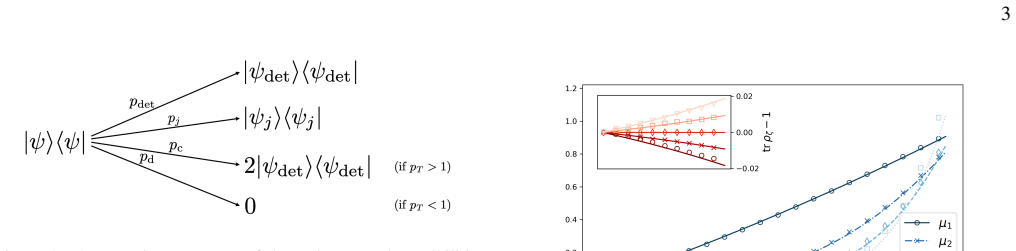
no copy and deterministic:|ψ⟩ 7→ |ψ det⟩with probability pdet n =p np′ det =1−p J − ⟨ΓL −Γ⟩ ψ dt+O(dt 2)
-
[2]
no copy and jump:|ψ⟩ 7→ |ψ j⟩with probabilityp j n = pnp j =p j +O(dt 2); 3 Figure 1. At any given moment of time, there are 4 possibilities for the evolution of the realization, as given in Eqs. (15)-(17). It can either evolve deterministically, jump, create a copy of itself or vanish
-
[3]
In [60], we show that such unraveling scheme matches on av- erage the TNP ME (1)
copy and deterministic: the original copy evolves deter- ministically and a new copy is created in the ensemble |ψ⟩ ⟨ψ| 7→2|ψ det⟩ ⟨ψdet|(14) with probabilityp det c =p cp′ det =⟨Γ L −Γ⟩ ψ dt+O(dt 2). In [60], we show that such unraveling scheme matches on av- erage the TNP ME (1). It is possible to merge the two casesp T <1 andp T >1 as pdet =1−p J − ⟨ΓL...
-
[4]
Quantum Reservoir Computing (QuReCo)
Notice that the final time is chosen to be comparable to the typical timescale 1/γof the dynamics. The proof that the unravelings agree with the ME on average is presented in [60]. Examples.As a first example of our method, we consider a special case of tilted Lindbladian, in which the TNP ME reads [56] d dt ρζ =L[ρ ζ]+ζJ[ρ ζ],(20) whereLis a TP Lindbladi...
work page 2022
-
[5]
R. Dum, A. S. Parkins, P. Zoller, and C. W. Gardiner, Physical Review A46, 4382 (1992)
work page 1992
-
[6]
J. Dalibard, Y . Castin, and K. Mølmer, Physical Review Letters 68, 580 (1992)
work page 1992
- [7]
-
[8]
M. B. Plenio and P. L. Knight, Reviews of Modern Physics70, 101 (1998)
work page 1998
-
[9]
H. P. Breuer, B. Kappler, and F. Petruccione, Journal of Super- conductivity12, 695 (1998), arXiv:9806026 [quant-ph]
work page 1998
-
[10]
H. P. Breuer, B. Kappler, and F. Petruccione, Physical Review A - Atomic, Molecular, and Optical Physics59, 1633 (1999), arXiv:9906024 [quant-ph]
work page 1999
-
[11]
H. P. Breuer, Physical Review A - Atomic, Molecular, and Op- tical Physics70, 1 (2004), arXiv:0403117 [quant-ph]
work page 2004
-
[12]
J. Piilo, S. Maniscalco, K. H ¨ark¨onen, and K. A. Suominen, Physical Review Letters100, 180402 (2008), arXiv:0706.4438
work page internal anchor Pith review Pith/arXiv arXiv 2008
- [13]
- [14]
-
[15]
D. Chru ´sci´nski, K. Luoma, J. Piilo, and A. Smirne, Quantum6, 835 (2022), arXiv:2009.11312
-
[16]
B. Donvil and P. Muratore-Ginanneschi, Nature communica- tions13, 4140 (2022)
work page 2022
-
[17]
F. Settimo, K. Luoma, D. Chru ´sci´nski, B. Vacchini, A. Smirne, and J. Piilo, Physical Review A109, 062201 (2024), arXiv:2402.12445
-
[18]
F. Settimo, A Stochastic Schr ¨odinger Equation for the General- ized Rate Operator Unravelings (2025), arXiv:2507.01107
-
[19]
N. Gisin and I. C. Percival, Journal of Physics A: General Physics25, 5677 (1992)
work page 1992
-
[20]
L. Di ´osi, N. Gisin, and W. T. Strunz, Physical Review A - Atomic, Molecular, and Optical Physics58, 1699 (1998), arXiv:9803062 [quant-ph]
work page 1998
-
[21]
Percival,Quantum State Diffusion(Cambridge University Press, 1998) p
I. Percival,Quantum State Diffusion(Cambridge University Press, 1998) p. 198
work page 1998
-
[22]
A. A. Budini, Physical Review A - Atomic, Molecular, and Op- tical Physics92, 1 (2015), arXiv:1509.00889
work page internal anchor Pith review Pith/arXiv arXiv 2015
-
[23]
Stochastic unraveling of positive quantum dynamics
M. Caiaffa, A. Smirne, and A. Bassi, Physical Review A95, 062101 (2017), arXiv:1612.04546
work page internal anchor Pith review Pith/arXiv arXiv 2017
-
[24]
H.-P. Breuer and F. Petruccione,The Theory of Open Quantum Systems(Oxford University PressOxford, 2007)
work page 2007
-
[25]
Vacchini,Open Quantum Systems, Graduate Texts in Physics (Springer Nature Switzerland, Cham, 2024)
B. Vacchini,Open Quantum Systems, Graduate Texts in Physics (Springer Nature Switzerland, Cham, 2024)
work page 2024
-
[26]
R. Alicki and K. Lendi,Quantum Dynamical Semigroups and Applications, Lecture Notes in Physics, V ol. 717 (Springer Berlin Heidelberg, Berlin, Heidelberg, 2007)
work page 2007
-
[27]
F. Settimo, A. Smirne, K. Luoma, B. Vacchini, J. Piilo, and D. Chru ´sci´nski, Divisibility of dynamical maps: Schr ¨odinger vs. Heisenberg picture (2025), arXiv:2506.08103
-
[28]
F. Minganti, A. Miranowicz, A. Miranowicz, R. W. Chhajlany, I. I. Arkhipov, F. Nori, and R. W. Chhajlany, Physical Review A101, 1 (2020), arXiv:2002.11620
- [29]
-
[30]
D. A. Bagrets and Y . V . Nazarov, Physical Review B - Condensed Matter and Materials Physics67, 1 (2003), arXiv:0207624 [cond-mat]
work page 2003
- [31]
-
[32]
J. P. Garrahan and I. Lesanovsky, Physical Review Letters104, 1 (2010), arXiv:0911.0556
work page internal anchor Pith review Pith/arXiv arXiv 2010
-
[33]
J. P. Garrahan, A. D. Armour, and I. Lesanovsky, Physical Re- view E - Statistical, Nonlinear, and Soft Matter Physics84, 1 (2011), arXiv:1103.0919
work page internal anchor Pith review Pith/arXiv arXiv 2011
- [34]
-
[35]
Lindblad, Communications in Mathematical Physics48, 119 (1976)
G. Lindblad, Communications in Mathematical Physics48, 119 (1976)
work page 1976
-
[36]
H. P. Breuer, E. M. Laine, and J. Piilo, Physical Review Letters 103, 1 (2009), arXiv:0908.0238
work page internal anchor Pith review Pith/arXiv arXiv 2009
-
[37]
Measure for the Non-Markovianity of Quantum Processes
E.-M. Laine, J. Piilo, and H.-P. Breuer, Physical Review A81, 062115 (2010), arXiv:1002.2583
work page internal anchor Pith review Pith/arXiv arXiv 2010
-
[38]
Entanglement and non-Markovianity of quantum evolutions
´A. Rivas, S. F. Huelga, and M. B. Plenio, Physical Review Let- ters105, 050403 (2010), arXiv:0911.4270
work page internal anchor Pith review Pith/arXiv arXiv 2010
-
[39]
H.-P. Breuer, E.-M. Laine, J. Piilo, and B. Vacchini, Reviews of Modern Physics88, 021002 (2016)
work page 2016
-
[40]
F. Minganti, A. Miranowicz, R. W. Chhajlany, and F. Nori, Physical Review A100, 10.1103/PhysRevA.100.062131 (2019), arXiv:1909.11619
- [41]
- [42]
-
[43]
W. D. Heiss, Journal of Physics A: Mathematical and Theoretical45, 10.1088/1751-8113/45/44/444016 (2012), arXiv:1210.7536
work page internal anchor Pith review Pith/arXiv arXiv doi:10.1088/1751-8113/45/44/444016 2012
-
[44]
R. El-Ganainy, K. G. Makris, M. Khajavikhan, Z. H. Mussli- mani, S. Rotter, and D. N. Christodoulides, Nature Physics14, 11 (2018)
work page 2018
-
[45]
M. A. Miri and A. Al `u, Science363, 10.1126/science.aar7709 (2019)
-
[46]
W. D. Heiss, Journal of Physics A: Mathematical and General 37, 2455 (2004), arXiv:0304152 [quant-ph]
work page 2004
-
[47]
C. M. Bender, Reports on Progress in Physics70, 947 (2007), arXiv:0703096 [hep-th]
work page 2007
-
[48]
K. ¨Ozdemir, S. Rotter, F. Nori, and L. Yang, Nature Materials 18, 783 (2019)
work page 2019
- [49]
-
[50]
H.-l. Zhang, P.-r. Han, F. Wu, W. Ning, Z.-b. Yang, and S.-b. Zheng, Experimental observation of non-Markovian quantum exceptional points (2025), arXiv:arXiv:2503.06977v1
- [51]
-
[52]
R. D. J. Le ´on-Montiel, I. Kassal, and J. P. Torres, Journal of Physical Chemistry B118, 10588 (2014)
work page 2014
-
[53]
Distribution of entanglement in light-harvesting complexes and their quantum efficiency
F. Fassioli and A. Olaya-Castro, New Journal of Physics12, 10.1088/1367-2630/12/8/085006 (2010), arXiv:1003.3610. 6
work page internal anchor Pith review Pith/arXiv arXiv doi:10.1088/1367-2630/12/8/085006 2010
-
[54]
Environment-Assisted Quantum Transport
P. Rebentrost, M. Mohseni, I. Kassal, S. Lloyd, and A. Aspuru-Guzik, New Journal of Physics11, 10.1088/1367- 2630/11/3/033003 (2009), arXiv:0807.0929
work page internal anchor Pith review Pith/arXiv arXiv doi:10.1088/1367- 2009
-
[55]
A. Kurt, M. A. Rossi, and J. Piilo, New Journal of Physics22, 10.1088/1367-2630/ab60f2 (2020), arXiv:1909.00167
-
[56]
G. Karpat and B. C ¸ akmak, Physical Review A110, 012446 (2024), arXiv:2402.05517
-
[57]
A. G. Maity and S. Bhattacharya, Journal of Physics A: Mathe- matical and Theoretical57, 215302 (2024)
work page 2024
-
[58]
G. Perfetto, F. Carollo, and I. Lesanovsky, SciPost Physics13, 079 (2022)
work page 2022
-
[59]
Photon counting statistics of a microwave cavity
F. Brange, P. Menczel, and C. Flindt, Physical Review B99, 1 (2019), arXiv:1808.02716
work page internal anchor Pith review Pith/arXiv arXiv 2019
-
[60]
P. Portugal, F. Brange, K. S. Kansanen, P. Samuelsson, and C. Flindt, Physical Review Research5, 33091 (2023), arXiv:2305.01986
-
[61]
P. Menczel, C. Flindt, F. Brange, F. Nori, and C. Gneiting, Full counting statistics and first-passage times in quantum Marko- vian processes: Ensemble relations, metastability, and fluctua- tion theorems (2025), arXiv:2508.18614
-
[62]
W. Li, W. Zhang, C. Li, and H. Song, Communications in The- oretical Physics77, 75102 (2025)
work page 2025
-
[63]
H. P. Breuer, B. Kappler, and F. Petruccione, European Physical Journal D1, 9 (1998), arXiv:9807080 [quant-ph]
work page 1998
-
[64]
See Supplemental Material
- [65]
-
[66]
C. Gerry and P. Knight,Introductory Quantum Optics(Cam- bridge University Press, 2004)
work page 2004
-
[67]
The code used for the simulations is available athttps:// github.com/federicoSettimo/TNP_unravelings.git
-
[68]
F. Settimo, K. Luoma, D. Chru ´sci´nski, A. Smirne, B. Vac- chini, and J. Piilo, Physical Review A112, 042204 (2025), arXiv:2502.12818
- [69]
-
[70]
Orthogonal jumps of wavefunction in white-noise potentials
L. Di ´osi, Physics Letters A112, 288 (1985), arXiv:1501.00274. 7 SUPPLEMENTAL MA TERIAL Appendix A: Proof of TNP unravelings For the casep T <1, the proof that the unravelings agree on average with the TNP ME (1) follows in a straightforward way. Given a realization in the stateψ, it average evolution is given by |ψ⟩ ⟨ψ| 7→ X j p j L j|ψ⟩ ⟨ψ|L† j L j |ψ⟩...
work page internal anchor Pith review Pith/arXiv arXiv 1985
discussion (0)
Sign in with ORCID, Apple, or X to comment. Anyone can read and Pith papers without signing in.