REVIEW 3 major objections 4 minor 41 references
TetraSDF: Analytic Isosurface Extraction with Multi-resolution Tetrahedral Grid
T0 review · 3 major / 4 minor · reviewed 2026-08-03 · deepseek-v4-flash
Pith's one-line read A tetrahedral grid keeps ReLU neural SDFs piecewise-affine, so their zero-level surfaces can be extracted exactly as triangle meshes.
desk verdict Genuinely new analytic meshing for grid-encoded SDFs, with strong self-consistency evidence, though the exactness claim needs a formal proof of the edge-validity criterion. read the letter →
The pith
A machine-rendered reading of the paper's core claim, the machinery that carries it, and where it could break.
The reading
What carries the argument
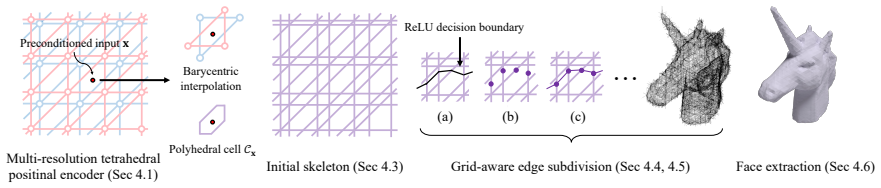
The load-bearing object is the multi-resolution tetrahedral positional encoder: at each resolution level, space is subdivided into tetrahedra and the query point's feature vector is the barycentric interpolation of learnable vertex features. Since barycentric coordinates are affine functions of the input inside a tetrahedron, the encoder is affine on each cell, and concatenating levels preserves this. Combined with the ReLU MLP, the network is piecewise affine; the paper's extractor then walks the encoder-induced polyhedral complex plus the MLP's folded hyperplanes using sign-vector perturbation and grid neighbor lookup, and a fixed global preconditioner A* whitens the encoder's average loca
What would settle it
Run the edge-subdivision extraction on a small ReLU network whose true zero-level set can be computed by brute-force enumeration of the polyhedral arrangement; if the extracted mesh's vertex or edge set differs from the true arrangement's intersections—or if the mesh is non-manifold or has T-junctions—the validity criterion fails. Concretely, build a two-layer ReLU network with folded hyperplanes that create a cell where two zero-level edges intersect at a point not captured by the sign-vector condition, and check whether the extractor produces that intersection vertex.
Extended reading notes
Core claim
The central claim is that composing a ReLU MLP with a multi-resolution tetrahedral positional encoder—where features are interpolated barycentrically within tetrahedra at several resolutions—keeps the entire mapping continuous piecewise affine (CPWA). The encoder's cell structure partitions space into a polyhedral complex, and the ReLU layers fold hyperplanes within those cells. TetraSDF extends an edge-subdivision algorithm to this setting by augmenting sign vectors with region indicators and barycentric masks, so the extractor tracks which polyhedral cell and which ReLU linear region a point lies in. The result is a triangle mesh that, up to floating-point round-off, exactly matches the ne
Load-bearing premise
The extractor's 'exactness' rests on an unproved criterion in Sec. 3.2: that matching nonzero sign-vector entries and connecting vertex pairs that share at least two zero entries reconstructs the complete folded-hyperplane arrangement within the encoder-induced polyhedral complex; if that criterion ever misses or adds an edge, the output mesh will deviate from the network's true zero-level set.
Editorial extensions
If this is right
- Meshes extracted from trained SDFs will match the network's zero-level set to near machine precision, independent of any sampling resolution, so self-consistency metrics like SSDF and VSDF drop to about 1e-8.
- The approach brings the benefits of multi-resolution grid encoders—the ability to learn high-frequency geometry with small MLPs—into the regime of exact analytic meshing, which previously applied only to plain ReLU MLPs.
- TetraSDF can serve as a drop-in extraction backend for neural SDFs, producing meshes with 10x–20x fewer vertices than marching-cubes baselines while avoiding staircase artifacts.
- The polyhedral-complex machinery, including region indicators and neighbor lookup tables, provides a template for exact extraction from other simplex-based encoders such as permutohedral lattices.
- The closed-form preconditioner derived from the encoder's metric offers a concrete way to correct geometric anisotropy for barycentric grid encoders, improving training stability and final SDF accuracy.
Reading between the lines
- If the edge-subdivision validity criterion is formally proven (or patched), the same extraction strategy could generalize to adaptive or higher-dimensional simplex grids, where the lookup-table approach already hints at a scalable path.
- The extractor could be used as an oracle during training: exact surface vertices and normals from the mesh could supervise the SDF loss, potentially improving accuracy beyond the current L1 plus eikonal objective.
- The preconditioner's closed form depends on the specific six-tetrahedron subdivision; analogous preconditioners for other tilings could be derived and tested, with the reported condition-number reduction (16.39 to 5.05) serving as a reference point.
- Because the mesh exactly matches the network, the method could enable auditing or compression of neural SDFs—extract the exact surface and compare it against the network's predictions to measure true representation error.
Editorial analysis
A structured set of objections, weighed in public.
Referee Report
Summary. The paper introduces TetraSDF, a neural SDF representation and analytic mesh-extraction pipeline. A multi-resolution tetrahedral positional encoder using barycentric interpolation is composed with a ReLU MLP. Since barycentric interpolation is affine within each tetrahedron, the encoder is piecewise affine, and the full network f = ν ∘ τ is claimed to be globally continuous piecewise affine (CPWA). The extraction pipeline builds an initial skeleton of the encoder-induced polyhedral complex C, performs edge subdivision guided by sign vectors augmented with region indicators and barycentric masks, and finally selects zero-level vertices and edges to form a triangle mesh. A fixed closed-form input preconditioner A* is derived from the encoder's average metric to reduce directional bias. Experiments on Thingi10K, ABC, and Stanford report Chamfer Distance against ground truth and self-consistency metrics (SSDF, VSDF, AD) against the learned network, with near-machine-precision self-consistency.
Significance. If the exactness claim holds, this is a meaningful step: it extends analytic, discretization-free isosurface extraction from plain ReLU MLPs to a grid-based encoder that can represent high-frequency SDFs, addressing a known limitation of prior analytic methods. The manuscript has clear strengths: the affine property of barycentric interpolation is proved in Appendix A.1, the preconditioner derivation is explicit and reproducible, the reported self-consistency values (SSDF/VSDF ≈ 1e-8 and AD = 0.00) are impressive, and the runtime tables show practical efficiency. The main risk is that the central 'exact zero-level set' guarantee rests on an unproved combinatorial edge-subdivision criterion rather than a formal correctness theorem; the empirical self-consistency metrics, while strong, are evaluated on the extracted mesh itself and cannot detect missing or spurious zero-level components.
major comments (3)
- [Sec. 3.2 and Sec. 4.5] The central claim that the extracted mesh exactly equals the zero-level set of f = ν ∘ τ rests on the edge-subdivision validity criterion, but no correctness theorem is provided. The two conditions in Sec. 3.2 — sign vectors matching on all nonzero entries, and connecting vertex pairs that share at least two zero entries — are asserted, not proved, to reconstruct the complete arrangement of folded hyperplanes. They are not obviously sufficient: zero entries act as wildcards, folded hyperplanes can have multiple sheets, and the straight segment between two intersection points may leave the zero set or cross another region boundary. The extension to encoder cells in Sec. 4.5 augments sign vectors with region indicators and barycentric masks, and the claim that comparing A(x_a) and A(x_b) 'provides a test for region equivalence' is likewise unproved. Because the SSDF/VSDF metrics in Table 4
- [Sec. 3.1 Eq. (3); Sec. 4.4 Eq. (10); Sec. 4.6] The extraction pipeline depends on three user-set thresholds: epsilon_s in the sign-vector definition, epsilon_b in the barycentric mask, and epsilon_f in the zero-level vertex selection. The paper states only that they are 'small positive' and gives no analysis showing that the discretized masks preserve the topology and connectivity of the zero-level 1-skeleton for the chosen values. Since epsilon_f > 0, V* may include vertices with |f(x)| close to epsilon_f, so the output is not exactly the zero set in finite precision. The excellent self-consistency numbers in Table 4 are numerical evidence, but they are not an exactness guarantee. Please state the threshold values, justify their topological safety, and formulate the exact-arithmetic/limit statement under which exactness is claimed.
- [Sec. 5.1, Tables 1-3] The accuracy comparisons are presented as single aggregate CD values without error bars, repeated runs, or significance tests. The margins are small: in Table 1, Ours is 1722 vs HashGrid 1763 on Thingi10K and 1758 vs 1854 on ABC, but on Stanford HashGrid is better (1659 vs 1718); in Table 3, the Large-row difference between Ours and Tropical is 1718 vs 1737. Without variance estimates, the claim that TetraSDF 'matches or surpasses existing grid-based encoders' is not firmly supported. Additionally, the statement in Sec. 5.1 that capacity is 'identical to HashGrid' is not verifiable from the settings paragraph, since the hash table size used for HashGrid is not reported. Please clarify the capacity matching and ideally provide multiple runs with confidence intervals or significance tests.
minor comments (4)
- [Author affiliations and acknowledgements] There are spacing typos in 'NA VER AI Lab' and 'NA VER Smart Machine Learning'.
- [Table 3] The table header/formatting is garbled: the row labels 'RMethod' and 'S/M/L' are unclear, and the Tropical row contains '718736716208 5367', which appears to be a typographical error. Please reformat.
- [Sec. 3.1, Eq. (5)] The symbol gamma is used both for the geometric progression ratio and for the sign-vector entries gamma_i^{(j)}. This is not incorrect but may confuse readers; consider renaming one of them.
- [Appendix A.4] The claim that the tetrahedral subdivision involves 'only six fixed plane normals' would be easier to verify if Fig. 2 explicitly labeled the normals of the diagonal planes and the axis-aligned planes.
Circularity Check
No significant circularity: derivation is self-contained; the only flagged gap is an unproved geometric criterion, which is a correctness risk, not a circular argument.
full rationale
The paper's central derivation does not reduce to its own inputs. The claim that the multi-resolution tetrahedral encoder preserves a global CPWA structure is proved in the supplementary material (Theorem 1 and Lemma 1) directly from the affine nature of barycentric interpolation and concatenation, rather than being assumed or imported from a self-citation. The sign-vector and region-indicator machinery is an algorithmic bookkeeping device for tracking ReLU linear regions and encoder cells; it is not fitted to the outputs it is used to predict. The edge-validity criterion in Sec. 3.2 is asserted and only empirically verified rather than proved to reconstruct the complete zero-level 1-skeleton of the composed CPWA function. That is a genuine correctness risk, but it is not circularity: the criterion is not defined in terms of the extracted mesh or of the self-consistency metrics. The preconditioner A* is derived in closed form from the symmetrized encoder-induced metric (Sec. A.2) by solving A*^T M_sym A* = cI, so it is not a fitted constant masquerading as a prediction. Accuracy is measured against external ground-truth meshes via Chamfer distance, a benchmark outside the paper's fitted values. The self-consistency metrics (SSDF/VSDF/AD) are by construction measurements of agreement between the extracted mesh and the trained network, and the paper does not use them to claim external SDF accuracy; they serve as a sanity check of the extractor's internal consistency. The only self-citation to [17] (TropicalNeRF) is used for a baseline comparison and for a minor face-connectivity implementation detail, not as the load-bearing justification for the exactness claim. No equation in the paper is shown to equal another by construction, and no fitted parameter is renamed as a prediction. Therefore the appropriate circularity score is 0.
Assumptions & free parameters
free parameters (4)
- epsilon_s (sign-vector threshold) =
not specified (small positive)
- epsilon_b (barycentric mask threshold) =
not specified (small positive)
- epsilon_f (zero-level extraction threshold) =
not specified (small)
- eikonal regularizer weight lambda_eik =
5e-3
assumptions (3)
- ad hoc to paper The edge-subdivision validity criterion from [1] — sign vectors matching on nonzero entries and sharing of >=2 zero entries — is sufficient to reconstruct the full arrangement inside encoder-induced polyhedral cells.
- domain assumption The polyhedral cells C_x = intersection of containing tetrahedra across levels form a polyhedral complex whose vertices/edges are exactly the intersections of the six fixed plane families.
- ad hoc to paper For sufficiently small epsilon thresholds, the discretized sign/barycentric masks do not change the topology or connectivity of the recovered zero-level set.
Cite this review
Pith. "Pith review of TetraSDF: Analytic Isosurface Extraction with Multi-resolution Tetrahedral Grid." pith.science (2026). https://pith.science/paper/T2X2J7JJ
@misc{pith2026251116273,
  author       = {Pith},
  title        = {Pith review of: TetraSDF: Analytic Isosurface Extraction with Multi-resolution Tetrahedral Grid},
  year         = {2026},
  howpublished = {\url{https://pith.science/paper/T2X2J7JJ}},
  note         = {Machine review of arXiv:2511.16273}
}
read the original abstract
Extracting an explicit surface that exactly matches the zero-level set of a neural signed distance function (SDF) remains challenging. Sampling-based isosurfacing methods such as Marching Cubes introduce discretization error. In contrast, continuous piecewise affine (CPWA) analytic approaches typically require plain ReLU MLPs, which limits the ability to learn high-frequency SDFs in practice. We present TetraSDF, an analytic isosurface extraction framework for SDFs that retains the expressiveness of grid-based encoders while enabling exact zero-level set extraction, by representing the SDF with a ReLU MLP composed with a multi-resolution tetrahedral positional encoder. Our positional encoder's barycentric interpolation preserves a global CPWA structure, allowing us to track ReLU linear regions within an encoder-induced polyhedral complex. We further introduce a fixed analytic input preconditioner derived from the encoder's metric to reduce directional bias, thereby stabilizing training. Across multiple benchmarks, TetraSDF matches or surpasses existing grid-based encoders in SDF reconstruction accuracy, while faithfully recovering the network's zero-level set as a triangle mesh.
Figures


Figures from the paper (2 more)


Reference graph
Works this paper leans on
-
[1]
Polyhedral complex extraction from relu net- works using edge subdivision
Arturs Berzins. Polyhedral complex extraction from relu net- works using edge subdivision. InInternational Conference on Machine Learning, pages 2234–2244. PMLR, 2023. 1, 2, 3
2023
-
[2]
Cambridge University Press, Cambridge, UK, 2004
Stephen Boyd and Lieven Vandenberghe.Convex Optimiza- tion. Cambridge University Press, Cambridge, UK, 2004. 14
2004
-
[3]
A tetrahedral space- filling curve for nonconforming adaptive meshes.SIAM Journal on Scientific Computing, 38(5):C471–C503, 2016
Carsten Burstedde and Johannes Holke. A tetrahedral space- filling curve for nonconforming adaptive meshes.SIAM Journal on Scientific Computing, 38(5):C471–C503, 2016. 4
2016
-
[4]
TensoRF: Tensorial radiance fields
Anpei Chen, Zexiang Xu, Andreas Geiger, Jingyi Yu, and Hao Su. TensoRF: Tensorial radiance fields. InEuropean conference on computer vision, pages 333–350. Springer,
-
[5]
Neural marching cubes.ACM Transactions on Graphics (SIGGRAPH Asia), 40(6), 2021
Zhiqin Chen and Hao Zhang. Neural marching cubes.ACM Transactions on Graphics (SIGGRAPH Asia), 40(6), 2021. 2
2021
-
[6]
Neural dual contouring.ACM Transactions on Graphics, 41(4), 2022
Zhiqin Chen, Andrea Tagliasacchi, Thomas Funkhouser, and Hao Zhang. Neural dual contouring.ACM Transactions on Graphics, 41(4), 2022. 2
2022
-
[7]
Preconditioners for the stochastic training of neural fields
Shin-Fang Chng, Hemanth Saratchandran, and Simon Lucey. Preconditioners for the stochastic training of neural fields. arXiv preprint arXiv:2402.08784, 2024. 2
arXiv 2024
-
[8]
A volumetric method for building complex models from range images
Brian Curless and Marc Levoy. A volumetric method for building complex models from range images. InProceedings of the 23rd Annual Conference on Computer Graphics and Interactive Techniques (SIGGRAPH), pages 303–312, 1996. 6
1996
Show all 41 references
-
[9]
K- Planes: Explicit radiance fields in space, time, and appear- ance
Sara Fridovich-Keil, Giacomo Meanti, Frederik Rahbæk Warburg, Benjamin Recht, and Angjoo Kanazawa. K- Planes: Explicit radiance fields in space, time, and appear- ance. InProceedings of the IEEE/CVF Conference on Com- puter Vision and Pattern Recognition, pages 12479–12488,
-
[10]
Learning deformable tetrahedral meshes for 3d reconstruc- tion
Jun Gao, Wenzheng Chen, Tommy Xiang, Clement Fuji Tsang, Alec Jacobson, Morgan McGuire, and Sanja Fidler. Learning deformable tetrahedral meshes for 3d reconstruc- tion. InAdvances in Neural Information Processing Systems (NeurIPS), 2020. 2
2020
-
[11]
SIAM, 1997
Anne Greenbaum.Iterative Methods for Solving Linear Sys- tems. SIAM, 1997. 2
1997
-
[12]
On transversality of bent hyperplane arrangements and the topological expres- siveness of relu neural networks.SIAM Journal on Applied Algebra and Geometry, 6(2):216–242, 2022
J Elisenda Grigsby and Kathryn Lindsey. On transversality of bent hyperplane arrangements and the topological expres- siveness of relu neural networks.SIAM Journal on Applied Algebra and Geometry, 6(2):216–242, 2022. 3
2022
-
[13]
Shampoo: Preconditioned stochastic tensor optimization
Vineet Gupta, Tomer Koren, and Yoram Singer. Shampoo: Preconditioned stochastic tensor optimization. InInterna- tional Conference on Machine Learning (ICML), 2018. 2
2018
-
[14]
Complexity of linear re- gions in deep networks
Boris Hanin and David Rolnick. Complexity of linear re- gions in deep networks. InProceedings of the 36th Interna- tional Conference on Machine Learning (ICML), 2019. 1
2019
-
[15]
Dual contouring of hermite data
Tao Ju, Frank Losasso, Scott Schaefer, and Joe Warren. Dual contouring of hermite data. InProceedings of SIGGRAPH,
-
[16]
NSML: Meet the MLAAS platform with a real- world case study.arXiv preprint arXiv:1810.09957, 2018
Hanjoo Kim, Minkyu Kim, Dongjoo Seo, Jinwoong Kim, Heungseok Park, Soeun Park, Hyunwoo Jo, KyungHyun Kim, Youngil Yang, Youngkwan Kim, Nako Sung, and Jung- Woo Ha. NSML: Meet the MLAAS platform with a real- world case study.arXiv preprint arXiv:1810.09957, 2018. 9
2018 arXiv
-
[17]
Polyhedral complex derivation from piece- wise trilinear networks
Jin-Hwa Kim. Polyhedral complex derivation from piece- wise trilinear networks. InAdvances in Neural Information Processing Systems 37, 2024. 1, 2, 6
2024
-
[18]
Kingma and Jimmy Ba
Diederik P. Kingma and Jimmy Ba. Adam: A method for stochastic optimization.ICLR, 2015. 2
2015
-
[19]
Abc: A big cad model dataset for geometric deep learning
Sebastian Koch, Zhongshi Jiang, Daniele Panozzo, Marc Alexa, Alexey Artemov, Evgeny Burnaev, Albert Matveev, Francis Williams, and Denis Zorin. Abc: A big cad model dataset for geometric deep learning. InThe IEEE Conference on Computer Vision and Pattern Recognition (CVPR), 2019. 6
2019
-
[20]
Tetra-NeRF: Represent- ing neural radiance fields using tetrahedra
Jonas Kulhanek and Torsten Sattler. Tetra-NeRF: Represent- ing neural radiance fields using tetrahedra. InProceedings of the IEEE/CVF international conference on computer vision, pages 18458–18469, 2023. 2
2023
-
[21]
Analytic marching: An analytic meshing solution from deep implicit surface networks
Jiabao Lei and Kui Jia. Analytic marching: An analytic meshing solution from deep implicit surface networks. arXiv preprint arXiv:2002.06597, 2020. 1, 2, 6
2002 arXiv
-
[22]
Neural sparse voxel fields.Advances in Neural Information Processing Systems, 33:15651–15663,
Lingjie Liu, Jiatao Gu, Kyaw Zaw Lin, Tat-Seng Chua, and Christian Theobalt. Neural sparse voxel fields.Advances in Neural Information Processing Systems, 33:15651–15663,
-
[23]
Lorensen and Harvey E
William E. Lorensen and Harvey E. Cline. Marching cubes: A high resolution 3d surface construction algorithm.ACM SIGGRAPH Computer Graphics, 21(4):163–169, 1987. 1, 2
1987
-
[24]
Occupancy networks: Learning 3d reconstruction in function space
Lars Mescheder, Michael Oechsle, Michael Niemeyer, Se- bastian Nowozin, and Andreas Geiger. Occupancy networks: Learning 3d reconstruction in function space. InProceedings of the IEEE/CVF conference on computer vision and pattern recognition, pages 4460–4470, 2019. 2
2019
-
[25]
Mont ´ufar, Razvan Pascanu, Kyunghyun Cho, and Yoshua Bengio
Guido F. Mont ´ufar, Razvan Pascanu, Kyunghyun Cho, and Yoshua Bengio. On the number of linear regions of deep neural networks. InAdvances in Neural Information Pro- cessing Systems (NeurIPS), 2014. 1
2014
-
[26]
Instant neural graphics primitives with a multiresolution hash encoding.ACM Transactions on Graphics (TOG), 41(4), 2022
Thomas M ¨uller, Alex Evans, Christoph Schied, and Alexan- der Habermann. Instant neural graphics primitives with a multiresolution hash encoding.ACM Transactions on Graphics (TOG), 41(4), 2022. 1, 2, 4, 6 9
2022
-
[27]
Deepsdf: Learning con- tinuous signed distance functions for shape representation
Jeong Joon Park, Peter Florence, Julian Straub, Richard Newcombe, and Steven Lovegrove. Deepsdf: Learning con- tinuous signed distance functions for shape representation. In Proceedings of the IEEE/CVF Conference on Computer Vi- sion and Pattern Recognition (CVPR), pages 165–1...
2019
-
[28]
Barron, and Ricardo Martin-Brualla
Keunhong Park, Philipp Henzler, Ben Mildenhall, Jonathan T. Barron, and Ricardo Martin-Brualla. Camp: Camera preconditioning for neural radiance fields. InSIGGRAPH Asia, 2023. Project page: https://camp-nerf.github.io/. 2
2023
-
[29]
On the expressive power of deep neural networks
Maithra Raghu, Ben Poole, Jon Kleinberg, Surya Ganguli, and Jascha Sohl-Dickstein. On the expressive power of deep neural networks. InProceedings of the 34th International Conference on Machine Learning (ICML), 2017. 1
2017
-
[30]
On the spectral bias of neural networks
Nasim Rahaman, Aristide Baratin, Devansh Arpit, Felix Draxler, Min Lin, Fred Hamprecht, Yoshua Bengio, and Aaron Courville. On the spectral bias of neural networks. InInternational Conference on Machine Learning, pages 5301–5310. PMLR, 2019. 1, 2
2019
-
[31]
Permutosdf: Fast multi-view reconstruction with implicit surfaces using per- mutohedral lattices
Radu Alexandru Rosu and Sven Behnke. Permutosdf: Fast multi-view reconstruction with implicit surfaces using per- mutohedral lattices. InIEEE/CVF Conference on Computer Vision and Pattern Recognition (CVPR), 2023. 2, 6
2023
-
[32]
SIAM, 2003
Yousef Saad.Iterative Methods for Sparse Linear Systems. SIAM, 2003. 2
2003
-
[33]
Bounding and counting linear regions of deep neural networks
Thiago Serra, Christian Tjandraatmadja, and Srikumar Ra- malingam. Bounding and counting linear regions of deep neural networks. InProceedings of the 35th International Conference on Machine Learning (ICML), 2018. 1
2018
-
[34]
Deep marching tetrahedra: a hybrid represen- tation for high-resolution 3d shape synthesis
Tianchang Shen, Jun Gao, Kangxue Yin, Ming-Yu Liu, and Sanja Fidler. Deep marching tetrahedra: a hybrid represen- tation for high-resolution 3d shape synthesis. InAdvances in Neural Information Processing Systems (NeurIPS), 2021. 2
2021
-
[35]
Implicit neural representa- tions with periodic activation functions.Advances in neural information processing systems, 33:7462–7473, 2020
Vincent Sitzmann, Julien Martel, Alexander Bergman, David Lindell, and Gordon Wetzstein. Implicit neural representa- tions with periodic activation functions.Advances in neural information processing systems, 33:7462–7473, 2020. 2
2020
-
[36]
Srinivasan, Ben Mildenhall, Sara Fridovich-Keil, Nithin Raghavan, Utkarsh Singhal, Ravi Ra- mamoorthi, Jonathan T
Matthew Tancik, Pratul P. Srinivasan, Ben Mildenhall, Sara Fridovich-Keil, Nithin Raghavan, Utkarsh Singhal, Ravi Ra- mamoorthi, Jonathan T. Barron, and Ren Ng. Fourier fea- tures let networks learn high frequency functions in low di- mensional domains. InAdvances in Neural In...
2020
-
[37]
Optimized spa- tial hashing for collision detection of deformable objects
Matthias Teschner, Bruno Heidelberger, Matthias M ¨uller, Danat Pomerantes, and Markus H Gross. Optimized spa- tial hashing for collision detection of deformable objects. In Vmv, pages 47–54, 2003. 4
2003
-
[38]
Lecture 6.5 - rm- sprop: Divide the gradient by a running average of its recent magnitude, 2012
Tijmen Tieleman and Geoffrey Hinton. Lecture 6.5 - rm- sprop: Divide the gradient by a running average of its recent magnitude, 2012. 2
2012
-
[39]
G. M. Treece, R. W. Prager, and A. H. Gee. Regularised marching tetrahedra: Improved iso-surface extraction.Com- puters & Graphics, 23(4):583–598, 1999. 1, 2
1999
-
[40]
Zeiler and Rob Fergus
Matthew D. Zeiler and Rob Fergus. Visualizing and under- standing convolutional networks. InEuropean Conference on Computer Vision (ECCV), 2014. Includes discussion of ZCA whitening for input normalization. 2
2014
-
[41]
Thingi10k: A dataset of 10,000 3d-printing models.arXiv preprint arXiv:1605.04797, 2016
Qingnan Zhou and Alec Jacobson. Thingi10k: A dataset of 10,000 3d-printing models.arXiv preprint arXiv:1605.04797, 2016. 6 10 TetraSDF: Precise Mesh Extraction with Multi-resolution Tetrahedral Grid Supplementary Material A.1. Theoretical proofs In this section, we prove that ...
2016 arXiv
Reviewed August 3, 2026 · model on record in the stance chip above.
Discussion (0). Continue with ORCID to comment.