REVIEW 4 major objections 4 minor 41 references
The Lawson surface ξ2,1 is the only closed embedded minimal surface of genus 2 in the 3-sphere whose isometry group contains the bidihedral group D4h.
Reviewed by Pith at T0; open to challenge. T0 means a machine referee read the full paper against a public rubric. the ladder, T0–T4 →
The Lawson surface ξ2,1 is the unique closed embedded minimal surface of genus 2 in S^3 whose isometry group contains the bidihedral group D4h.
T0 review reviewed 2026-08-03 challenge →
load-bearing objection A significant symmetry-reduction theorem, undermined by a real derivative gap in Proposition 7.9; referee it, but don't accept as is. the 4 major comments →
Genus two embedded minimal surfaces in $\mathbb{S}^3$ with dihedral symmetry
The pith
A machine-rendered reading of the paper's core claim, the machinery that carries it, and where it could break.
The reading
Core claim
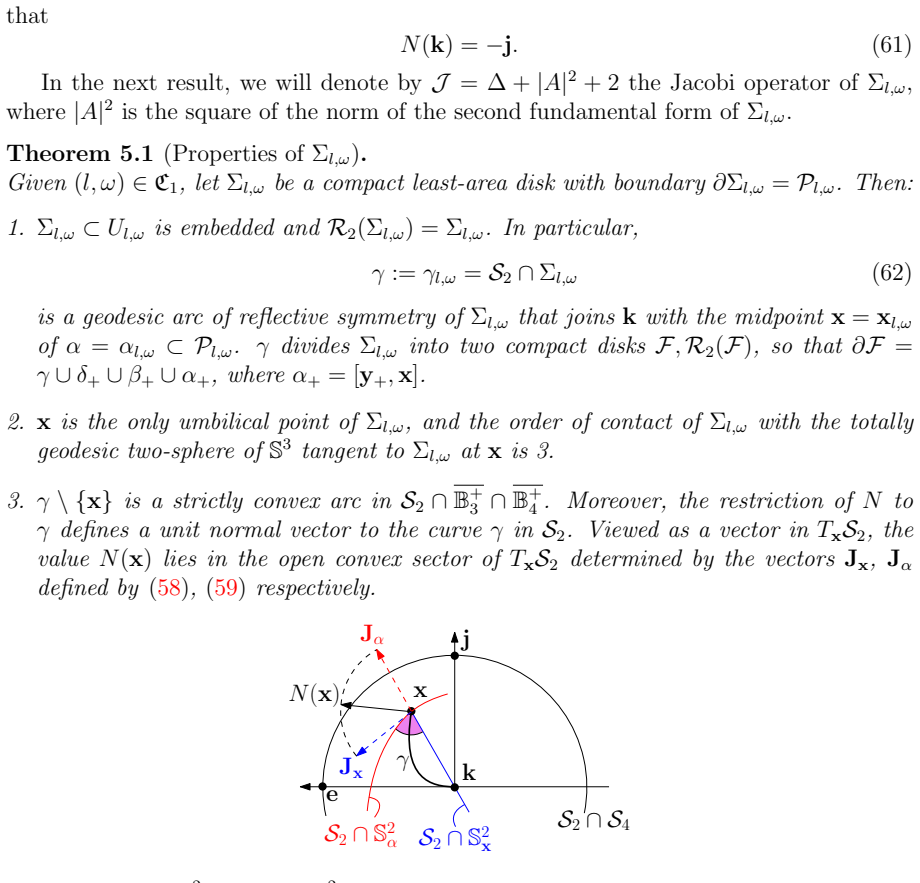
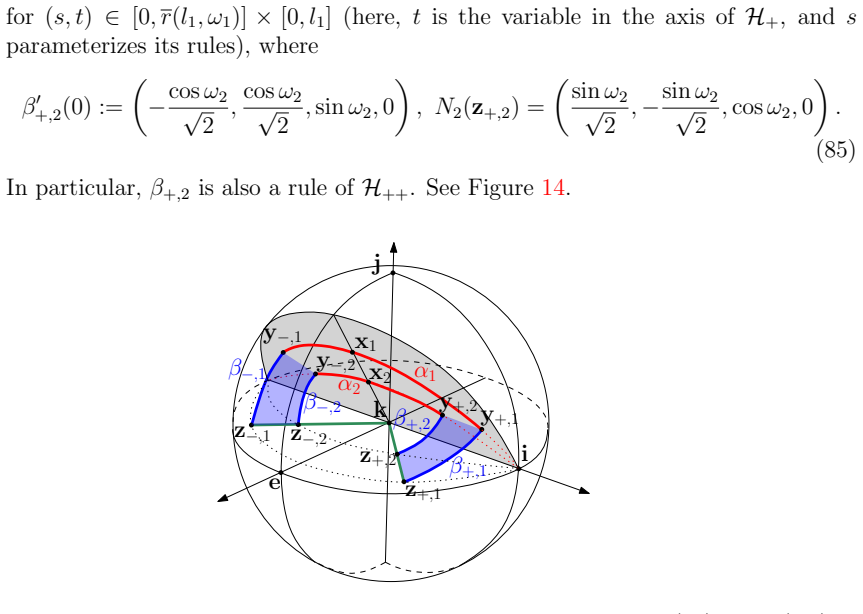
The central claim is Theorem 2.5: ξ2,1 is the unique closed embedded minimal surface in S^3 with genus 2 and D4h-symmetric. Equivalently, every embedded genus-two minimal surface in the sphere whose isometry group contains the bidihedral group (Z2 × D4, with D4 the square dihedral group) is congruent to Lawson's surface. The authors reduce the problem to a two-parameter family of right-angled geodesic pentagons P_{l,ω} in S^3; each pentagon bounds a unique stable minimal disk whose conjugate surface has boundary arcs of reflective symmetry. Solving the closing problem requires the length L of a reflective geodesic to equal π/2 and an angle Θ between two totally geodesic spheres to vanish. Pr
What carries the argument
The bidihedral group D4h = Z2 × D4, realized as the symmetries generated by reflections across two orthogonal totally geodesic two-spheres and a half-turn about a great circle, cuts any invariant surface into sixteen congruent fundamental pieces. The decisive technical objects are the two-parameter family of right-angled geodesic pentagons P_{l,ω} (with parameter domain (0,π)×(−π/2,π/2) minus one point, plus a limiting one-parameter family P_σ), the Plateau solution disks Σ_{l,ω} bounded by them, and the conjugation operation that swaps great-circle boundary arcs with arcs of reflective symmetry. The proof tracks two scalar functions on the parameter space: L(l,ω), the length of the reflecti
Load-bearing premise
The proof assumes that every surface with bidihedral symmetry can be placed, by an ambient isometry, into the standard coordinate model generated by the two reflections R1, R4 and the half-turn R*_+; the paper states but does not prove this conjugacy uniqueness.
What would settle it
Find a closed embedded minimal surface of genus 2 in S^3 whose isometry group contains a group isomorphic to D4h but that is not congruent to Lawson's surface; or, along the analytically defined curve Ξ(τ) of parameter values with L=π/2, compute the angle Θ(τ) and locate a second zero besides the unique Lawson value — a numerical evaluation of Θ(τ) with rigorous interval arithmetic would settle the uniqueness of the zero.
If this is right
- Every closed embedded minimal surface of genus 2 in S^3 with D4h symmetry is congruent to the Lawson surface ξ2,1.
- The earlier uniqueness result for Lawson surfaces under their full symmetry group now holds under the strictly smaller, index-three bidihedral subgroup.
- The open Conjecture 1.1 is settled affirmatively in genus 2 once the Klein subgroup is enlarged to D4h: the extra hypothesis about boundary curves meeting a great circle becomes unnecessary.
- The level-set analysis of the length function L(l,ω)=π/2 gives an analytic one-parameter curve of candidate pentagons, and along that curve the angle condition Θ=0 has exactly one zero.
- The technique is announced to adapt to genus g≥3 for surfaces invariant under the analogous symmetry group generated by reflections across S1, S4 and a half-turn about Γ_{k,v_g}.
Where Pith is reading between the lines
- If the uniqueness is robust, it may provide a rigidity tool: any D4h-symmetric genus-two minimal surface sufficiently close to ξ2,1 in a strong topology would have to be congruent to it, with quantitative estimates on the closing data.
- The two-parameter pentagon family and the monotonicity of L along level sets of τ suggest a possible parameterization of a local moduli space of genus-two minimal surfaces with symmetry, which could make the open classification problem amenable to numeric search.
- A testable extension is to replace the half-turn generator by a rotation of angle 2π/k; the same cut-and-conjugate method may produce explicit closing equations whose number of roots could predict how many symmetric genus-two or higher-genus surfaces exist for larger symmetry groups.
Editorial analysis
A structured set of objections, weighed in public.
Referee Report
Summary. The paper proves Theorem 2.5: among closed embedded minimal surfaces of genus two in the three-sphere, the Lawson surface ξ_{2,1} is the unique one whose isometry group contains the bidihedral group D_{4h}=Z_2×D_4. The proof decomposes any such surface into sixteen congruent fundamental pieces, passes to the conjugate minimal disk bounded by a right-angled geodesic pentagon P_{l,ω}, solves the Plateau problem for these pentagons, and reduces the closing problem after Schwarz reflection to two conditions: L(l,ω)=π/2 and Θ(τ)=0. The final uniqueness step is Proposition 7.9, which asserts that there is a unique parameter τ satisfying both conditions, and the last section identifies the Lawson surface with that parameter.
Significance. If the proof is completed, this is a substantial contribution: it replaces the full symmetry assumption in the Kapouleas–Wiygul characterization by a smaller, index-three subgroup and gives a concrete two-parameter reduction of the closing problem. The manuscript contains explicit parameterizations and computations, a real-analytic length function, and a generally careful monotonicity analysis. The external Kapouleas–Wiygul theorem is used only to identify the Lawson branch, not to force the conclusion. However, the uniqueness of the closing parameter is not established as written, and two supporting results are asserted rather than proved.
major comments (4)
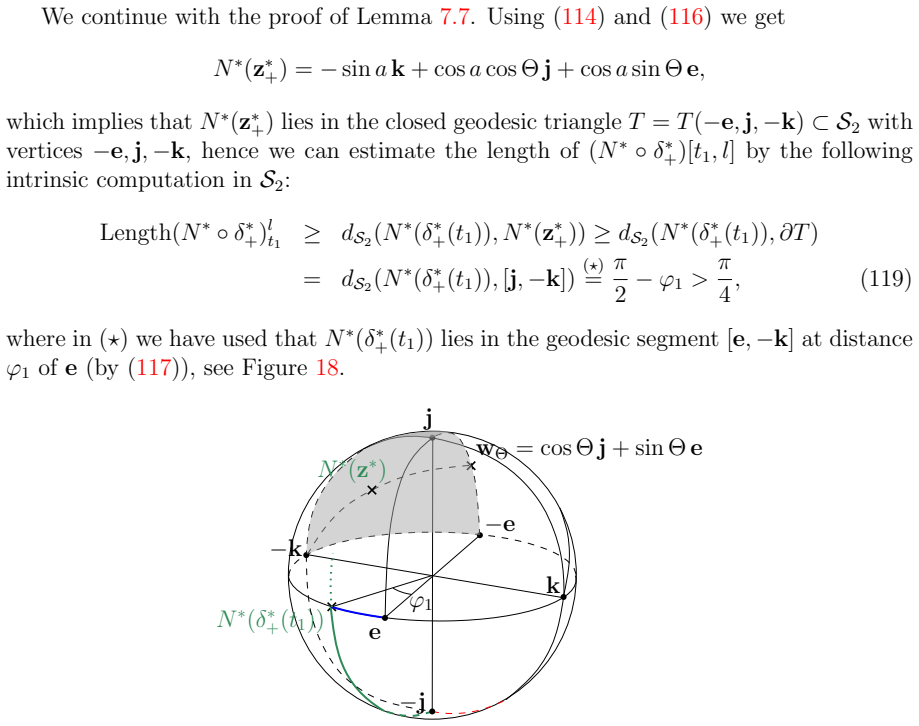
- [Proposition 7.9, Section 7] The step after Eq. (125) is not justified. The identity ρ_{δ+,τ}(lτ)=π−ωτ is the endpoint statement of Theorem 5.1(4) and holds identically for all (l,ω)∈C1. Differentiating an identity gives no information: as a function of (l,ω) the endpoint angle is π−ω, so its partial derivative with respect to ω is −1, and the derivative along the curve is the tautology (ρ_l)\dot l + (ρ_ω+1)\dot ω = 0, i.e. 0=0 after substituting ρ_ω=−1. The conclusion \dot ω=0, and hence the contradiction \dot J_x=0, requires a first-variation computation for the endpoint normal angle (or for Length(N*∘δ*+)) under the normal deformation of Σ*_τ. No such computation is supplied. Without it, Proposition 7.9, and therefore the uniqueness in Theorem 2.5, is unproved.
- [Theorem 5.7, Section 5.2] This theorem is stated with its proof left to the reader. It is not a cosmetic omission: items 3 and 4 (Length(N∘γ)>π/2, uniqueness and stability of Σσ) are used in Lemma 6.6 to discard the P_σ family and in Lemma 7.5 to locate the unique σ with L(σ)=π/2. Since the whole argument for Theorem 2.5 excludes the family P_σ only through this result, the paper should include the full proof, or at least a detailed adaptation of Theorem 5.1 and Lemma 5.6, including the convergence statement (96).
- [Sections 2.5 and 3] The normalization to the generators R1, R4, R∗+ is a premise of the entire octant decomposition. The text asserts that D4h is 'uniquely up to conjugacy' an index-three subgroup of S3×D4, and Section 3 begins by using this as an isometric normalization. No proof or reference is given for this conjugacy uniqueness. If there were a D4h action not conjugate to (F1)–(F3), the fundamental-piece description of Proposition 3.2 and all subsequent parameter reductions would not apply. Please provide the group-theoretic verification.
- [Section 7.1.7] The parameterization of L^{-1}_+({π/2}) by an analytic curve Ξ(τ) needs more support. The proof uses strict monotonicity of L along each τ-level plus analyticity of L. Strict monotonicity of an analytic function does not prevent ∂L/∂ω from vanishing at isolated points; the implicit function theorem requires a nondegeneracy condition. Since Proposition 7.9 later differentiates Θ(τ) and other quantities along Ξ, the analyticity (or at least differentiability) of Ξ is load-bearing. The paper should either prove ∂L/∂ω≠0 on the level set or give an alternative argument.
minor comments (4)
- [Section 2.1] The sentence 'Observe that the totally geodesic two-sphere of S^3 defined by (4) with the choices p=k and v=j, is S^3' appears to be a typo: with v=j the set is the coordinate two-sphere S^3∩{x_2=0}, not the whole S^3. Please correct.
- [Lemma 7.5] The bound σ>π/3 is asserted with only 'can be deduced from the same comparison arguments used in Lemma 7.4'. Since this bound is not used later in an essential way, a brief justification or a clear reference to the comparison would suffice.
- [Lemma 4.10] The proof of Lemma 4.10 is also left to the reader. This is less serious than Theorem 5.7, but a sentence explaining the limiting argument from Lemma 4.9 would improve readability.
- [Concluding remarks] The concluding remarks claim that the techniques can be adapted to prove uniqueness for ξ_{g,1}, g≥3, and that an extension to D_4 is in preparation. These are not proven in the manuscript and should be phrased as conjectures or work in progress.
Circularity Check
No significant circularity; the uniqueness argument is a geometric reduction, and the cited Kapouleas–Wiygul classification is external and used only to identify the Lawson branch.
full rationale
The paper does not fit parameters to data and then call the result a prediction. Its main chain is: any D4h-symmetric genus-2 embedded minimal surface is decomposed into a fundamental piece (Proposition 3.2), conjugated to a Plateau disk over a geodesic pentagon (Sections 3–4), parameterized by (l,ω) or σ with existence/uniqueness from Meeks–Yau and a Radó-type argument (Theorem 5.1), then closing is reduced to two geometric conditions L=π/2 and Θ=0 (Section 7), and Proposition 7.9 asserts one solution. The only classification input, Kapouleas–Wiygul [17], is an external theorem and is used only on the special cos l + cos ω = 1 branch to identify ξ2,1, not to define the target. There are no self-citations of the authors, no ansatz smuggled in via citation, and no renaming of a known result as a new derivation. The reviewer-flagged issue in Proposition 7.9—that differentiating ρ(l,ω)=π−ω with ∂l=0 yields (ρ_ω+1)ω̇=0, which is a tautology because ρ_ω≡−1—is a proof-gap/correctness concern, not a circularity; it does not turn an input into an output. Therefore the circularity burden is essentially zero.
Axiom & Free-Parameter Ledger
axioms (6)
- domain assumption D4h = Z2×D4 is unique up to conjugacy in O(4) as an index-three subgroup of S3×D4, so every D4h-symmetric surface can be conjugated to the normal form (F1)–(F3).
- standard math Meeks–Yau theorem: for a Meeks-Yau type domain U and Jordan curve P⊂∂U there is an embedded least-area minimal disk with boundary P, interior disjoint from ∂U.
- standard math Lawson conjugation correspondence (Prop 2.3): under conjugation, great-circle arcs become geodesics of reflective symmetry and vice versa, preserving angles and lengths.
- standard math Kapouleas–Wiygul theorem: ξ_{m,k} is the unique closed embedded minimal surface in S^3 of genus mk with the symmetry group of ξ_{m,k}.
- standard math Ros two-piece property: a compact minimal surface in S^3 is cut by a totally geodesic sphere into connected pieces.
- standard math White's analytic structure for the space of minimal disks and the properness of the boundary map.
Cite this review
Pith. "Pith review of Genus two embedded minimal surfaces in $\mathbb{S}^3$ with dihedral symmetry." pith.science (2026). https://pith.science/paper/ZKD6TMUE
@misc{pith2026251116295,
  author       = {Pith},
  title        = {Pith review of: Genus two embedded minimal surfaces in $\mathbbS^3$ with dihedral symmetry},
  year         = {2026},
  howpublished = {\url{https://pith.science/paper/ZKD6TMUE}},
  note         = {Machine review of arXiv:2511.16295}
}
abstract
We prove that the Lawson surface $\xi_{2,1}$ is the unique closed embedded minimal surface of genus $2$ in $\mathbb{S}^3$ whose isometry group contains the dihedral group $D_4$ generated by two reflections across orthogonal totally geodesic two-spheres and a half-turn about a great circle. This weakens the full-symmetry hypotheses in previous characterizations of Lawson surfaces and leads to a substantially different geometric problem.
Figures







Reference graph
Works this paper leans on
-
[1]
F. J. Almgren. Some interior regularity theorems for minimal surfaces and an exten- sion of Bernstein’s theorem.Ann. of Math. (2), 84:277–292, 1966. MR200816, Zbl 0146.11905
arXiv 1966
-
[2]
V. B¨ ogelein, F. Duzaar, and N. Fusco. A quantitative isoperimetric inequality on the sphere.Adv. Calc. Var., 10(3):223–265, 2017. MR3667048, Zbl 1370.49039
arXiv 2017
-
[3]
S. Brendle. Embedded minimal tori inS 3 and the Lawson conjecture.Acta Math., 211(2):177–190, 2013. MR3143888, Zbl 1305.53061. 80
arXiv 2013
-
[4]
M. Carozza, F. Giannetti, F. Leonetti, and A. Passarelli di Napoli. A sharp quan- titative estimate for the perimeters of convex sets in the plane.J. Convex Anal., 22(3):853–858, 2015. MR3400158, Zbl 1328.52002
arXiv 2015
-
[5]
J. Choe. Sufficient conditions for constant mean curvature surfaces to be round. Math. Ann., 323(1):143–156, 2002. MR1906912, Zbl 1016.53007
arXiv 2002
-
[6]
J. Choe and M. Soret. First eigenvalue of symmetric minimal surfaces inS 3.Indiana Univ. Math. J., 58(1):269–281, 2009. MR2504411, Zbl 1160.49045
arXiv 2009
-
[7]
J. Choe and M. Soret. New minimal surfaces inS 3 desingularizing the clifford tori. Math. Ann., 364(3-4):763–776, 2016. MR3466850, Zbl 1341.49052
arXiv 2016
- [8]
-
[9]
S. Heller. A spectral curve approach to lawson symmetric CMC surfaces of genus 2. 360(3-4):607–652, 2014. MR3273639, Zbl 1321.53012
arXiv 2014
-
[10]
S. Heller and N. Schmitt. Deformations of symmetric CMC surfaces in the 3-sphere. Exp. Math., 24(1):65–75, 2015. MR3305040, Zbl 1317.53012
arXiv 2015
-
[11]
Hopf.Differential Geometry in the Large, volume 1000 ofLecture Notes in Math
H. Hopf.Differential Geometry in the Large, volume 1000 ofLecture Notes in Math. Springer-Verlag, 1989. MR1013786, Zbl 0669.53001
arXiv 1989
-
[12]
L. Hsu, R. Kusner, and J. M. Sullivan. Minimizing the squared mean curvature inte- gral for surfaces in space forms.Experimental Math., 1(3):191–207, 1992. MR1203874, Zbl 0778.53001
arXiv 1992
-
[13]
D. Jakobson, M. Levitin, N. Nadirashvili, N. Nigam, and I. Polterovich. How large can the first eigenvalue be on a surface of genus two?Int. Math. Res. Not., 63:3967– 3985, 2005. MR2202582, Zbl 1114.58026
arXiv 2005
-
[14]
D. Jakobson, N. Nadirashvili, and I. Polterovich. Extremal metric for the first eigen- value on a Klein bottle.Canadian Journal of Mathematics, 58(2):381–400, 2006. MR2209284, Zbl 1104.58008
arXiv 2006
-
[15]
N. Kapouleas and P. McGrath. Generalizing the Linearized Doubling approach, I: General theory and new minimal surfaces and self-shrinkers.Camb. J. Math., 11(2):299–439, 2023. MR4600544, Zbl 1516.53009
arXiv 2023
-
[16]
N. Kapouleas and D. Wiygul. The index and nullity of the Lawson surfacesξ g,1. Camb. J. Math., 8(2):363–405, 2020. MR4091028, Zbl 1437.53049. 81
arXiv 2020
-
[17]
N. Kapouleas and D. Wiygul. The Lawson surfaces are determined by their sym- metries and topology.J. Reine Angew. Math., 786:155–173, 2022. MR4434746, Zbl 1496.53075
arXiv 2022
-
[18]
N. Kapouleas and D. Wiygul. Minimal surfaces in the round three-sphere by desingu- larizing intersecting Clifford tori.Math. Ann., 383(1-2):119–170, 2022. MR4444117, Zbl 1522.53005
arXiv 2022
-
[19]
N. Kapouleas and S-D. Yang. Minimal surfaces in the three-sphere by doubling the Clifford torus.Amer. J. Math., 132(2):257–295, 2010. MR2654775, Zbl 1198.53060
arXiv 2010
-
[20]
H. Karcher, U. Pinkall, and I. Sterling. New minimal surfaces inS 3.J. Differential Geom., 28(2):169–185, 1988. MR0961512, Zbl 0653.53004
arXiv 1988
-
[21]
M. Karpukhin, R. Kusner, P. McGrath, and D. Stern. Embedded minimal sur- faces inS 3 andB 3 via equivariant eigenvalue optimization. 2024 preprint at https://arxiv.org/abs/2402.13121
Pith/arXiv arXiv 2024
-
[22]
M. Karpukhin, R. Petrides, and D. Stern. Existence of metrics maximizing the first laplace eigenvalue on closed surfaces.Annals of Mathematics, 2025. To appear, arXiv:2505.05293
Pith/arXiv arXiv 2025
-
[23]
D. Ketover. Equivariant min–max theory. 2016 preprint at arXiv:1612.08692
Pith/arXiv arXiv 2016
-
[24]
D. A. Klain. Bonnesen-type inequalities for surfaces of constant curvature.Adv. in Appl. Math., 39(2):143–154, 2007. MR2333645, Zbl 1157.53039
arXiv 2007
-
[25]
R. Kusner. Comparison surfaces for the Willmore problem.Pacific J. Math., 138(2):317–345, 1989. MR996204, Zbl 0643.53044
arXiv 1989
- [26]
-
[27]
H. B. Lawson. Complete minimal surfaces inS 3.Ann. of Math., 92:335–374, 1970. MR0270280, Zbl 0205.52001
arXiv 1970
-
[28]
F. C. Marques and A. Neves. Min-max theory and the Willmore conjecture.Ann. of Math., 179(2):683–782, 2014. MR3152944, Zbl 1297.49079
arXiv 2014
-
[29]
W. H. Meeks III and B. White. Minimal surfaces bounded by convex curves in parallel planes.Comment. Math. Helv., 66(2):263–278, 1991. MR1107841, Zbl 0731.53004
arXiv 1991
-
[30]
W. H. Meeks III and S. T. Yau. The existence of embedded minimal surfaces and the problem of uniqueness.Math. Z., 179(2):151–168, 1982. MR0645492, Zbl 0479.49026. 82
arXiv 1982
-
[31]
F. Mercuri and I. I. Onnis. On the Bj¨ orling problem in a three-dimensional Lie group. Illinois J. Math., 53(2):431–440, 2009. MR2594637, Zbl 1484.53101
arXiv 2009
-
[32]
S. Montiel and A. Ros. Minimal immersions of surfaces by the first eigenfunctions and conformal area.Invent. Math., 83(1):153–166, 1986. MR813585, Zbl 0584.53026
arXiv 1986
-
[33]
N. Nadirashvili. Berger’s isoperimetric problem and minimal immersions of surfaces. Geom. Funct. Anal., 6(5):877–897, 1996. MR1415764, Zbl 0868.58079
arXiv 1996
- [34]
-
[35]
A. Ros. A two-piece property for compact minimal surfaces in a three-sphere.Indiana Univ. Math. J., 44(3):841–849, 1995. MR1375352, Zbl 0861.53009
arXiv 1995
- [36]
-
[37]
C. Wang S. Bai and S. Wang. Minimal surfaces in the three-dimensional sphere with high symmetry.J. Topol. Anal., 13(2):289–317, 2021. MR4284611, Zbl 1481.53075
arXiv 2021
-
[38]
A. El Soufi and S. Ilias. Immersions minimales, premi` ere valeur propre du laplacien et volume conforme.Math. Ann., 275(2):257–267, 1986. MR854009, Zbl 0675.53045
arXiv 1986
- [39]
-
[40]
B. White. New applications of mapping degrees to minimal surface theory.J. Dif- ferential Geom., 29(1):143–162, 1989. MR0978083, Zbl 0638.58005
arXiv 1989
-
[41]
D. Wiygul. Minimal surfaces in the 3 minimal surfaces in the 3-sphere by stack- ing Clifford tori.J. Differential Geom., 114(3):467–549, 2020. MR4072204, Zbl 1434.53066. 83
arXiv 2020
This paper was first reviewed by deepseek-v4-flash on August 3, 2026.
discussion (0)
Sign in with ORCID, Apple, or X to comment. Anyone can read and Pith papers without signing in.