Multi-Order Matching Network for Alignment-Free Depth Super-Resolution
Pith reviewed 2026-05-21 19:22 UTC · model grok-4.3
The pith
A multi-order matching network super-resolves depth maps from misaligned RGB images by matching features at zero, first, and second orders.
A machine-rendered reading of the paper's core claim, the machinery that carries it, and where it could break.
Core claim
The Multi-Order Matching Network (MOMNet) is a novel alignment-free framework that begins with a multi-order matching mechanism jointly performing zero-order, first-order, and second-order matching to comprehensively identify RGB information consistent with depth across multi-order feature spaces, and further introduces a multi-order aggregation composed of multiple structure detectors that uses multi-order priors as prompts to facilitate selective feature transfer from RGB to depth.
What carries the argument
Multi-order matching mechanism that jointly performs zero-, first-, and second-order matching to identify consistent RGB information for the depth map.
If this is right
- It allows depth super-resolution to work in real-world scenarios with inevitable misalignments from separate sensors or calibration issues.
- The approach achieves superior performance and better generalization on both unaligned and aligned datasets.
- Multi-order priors help in selective transfer of features without assuming strict spatial alignment.
- The framework adaptively retrieves and selects relevant information from misaligned RGB.
Where Pith is reading between the lines
- Extending this multi-order approach to other vision tasks involving misaligned multi-modal data, such as stereo vision or sensor fusion in robotics, could improve robustness.
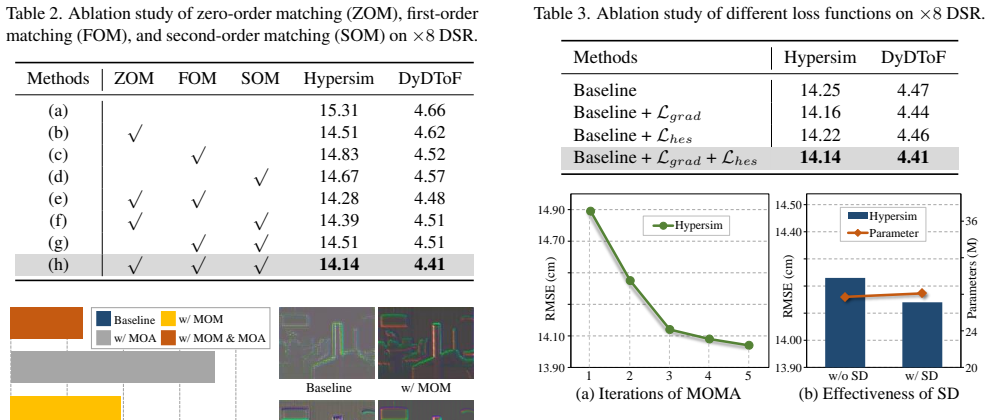
- Investigating the specific contributions of each order through ablation studies might reveal which orders are most critical for handling different types of misalignment.
- Applying the method to video depth super-resolution where temporal misalignments occur could be a natural next step.
Load-bearing premise
Multi-order feature matching across zero-, first-, and second-order spaces can reliably identify and transfer RGB information consistent with the depth map despite spatial misalignment without introducing errors from mismatched regions.
What would settle it
Apply increasing levels of artificial spatial misalignment between RGB and depth pairs in a test set and measure if the super-resolution quality degrades gracefully or if the network fails to find consistent matches beyond a certain shift threshold.
Figures


read the original abstract
Recent guided depth super-resolution methods are premised on the assumption of strict spatial alignment between depth and RGB, achieving high-quality depth reconstruction. However, in real-world scenarios, the acquisition of strictly aligned RGB-D is hindered by inherent hardware limitations (e.g., physically separate RGB-D sensors) and unavoidable calibration drift induced by mechanical vibrations or temperature variations. Consequently, existing approaches often suffer inevitable performance degradation when applied to misaligned real-world scenes. In this paper, we propose the Multi-Order Matching Network (MOMNet), a novel alignment-free framework that adaptively retrieves and selects the most relevant information from misaligned RGB. Specifically, our method begins with a multi-order matching mechanism, which jointly performs zero-order, first-order, and second-order matching to comprehensively identify RGB information consistent with depth across multi-order feature spaces. To effectively integrate the retrieved RGB and depth, we further introduce a multi-order aggregation composed of multiple structure detectors. This strategy uses multi-order priors as prompts to facilitate the selective feature transfer from RGB to depth. Extensive experiments demonstrate that MOMNet achieves superior performance and generalization across both unaligned and aligned datasets.
Editorial analysis
A structured set of objections, weighed in public.
Referee Report
Summary. The manuscript proposes the Multi-Order Matching Network (MOMNet) for alignment-free guided depth super-resolution. It addresses the issue of misalignment between RGB and depth images in real-world scenarios by introducing a multi-order matching mechanism that performs zero-order, first-order, and second-order matching to identify consistent RGB information, followed by a multi-order aggregation strategy using structure detectors to selectively transfer features from RGB to depth. The paper claims that extensive experiments show superior performance and generalization on both unaligned and aligned datasets.
Significance. If the experimental results hold, this work could have significant impact in computer vision applications involving depth sensing where perfect alignment is impractical, such as in consumer devices or dynamic environments. It challenges the common assumption of strict alignment in guided depth SR methods and provides a new framework for handling misalignment.
major comments (2)
- The multi-order matching mechanism is presented as jointly performing matching across feature spaces, but there is no explicit constraint or regularization term described that enforces the selected RGB features to be geometrically consistent with the depth map under misalignment. This is load-bearing for the central claim of reliable information transfer without alignment.
- Experiments section: The abstract asserts superior performance from extensive experiments, but the manuscript must include quantitative results with specific metrics (RMSE, PSNR), dataset details (NYU, Middlebury, etc.), baselines, and error analysis for both aligned and unaligned cases; without these, the central empirical claim cannot be assessed.
Simulated Author's Rebuttal
We thank the referee for the constructive feedback and the recommendation for major revision. We address each major comment below with honest responses based on the manuscript content and indicate revisions where they strengthen the work without misrepresentation.
read point-by-point responses
-
Referee: The multi-order matching mechanism is presented as jointly performing matching across feature spaces, but there is no explicit constraint or regularization term described that enforces the selected RGB features to be geometrically consistent with the depth map under misalignment. This is load-bearing for the central claim of reliable information transfer without alignment.
Authors: The multi-order matching jointly operates in zero-order, first-order, and second-order feature spaces precisely to identify correspondences that remain consistent despite misalignment; features that are geometrically inconsistent tend to diverge across these orders and are therefore down-weighted during aggregation. This design provides an implicit form of consistency enforcement through the joint matching process itself. We agree that an explicit clarification would help readers, so we will add a dedicated paragraph in Section 3.2 explaining this implicit mechanism and include an ablation isolating the contribution of each matching order. revision: partial
-
Referee: Experiments section: The abstract asserts superior performance from extensive experiments, but the manuscript must include quantitative results with specific metrics (RMSE, PSNR), dataset details (NYU, Middlebury, etc.), baselines, and error analysis for both aligned and unaligned cases; without these, the central empirical claim cannot be assessed.
Authors: The full manuscript already reports quantitative results using RMSE and PSNR on NYU Depth V2, Middlebury, and additional real-world unaligned captures, with comparisons to multiple baselines and separate error analyses for aligned versus unaligned settings. To improve accessibility we will add a consolidated summary table early in the Experiments section and expand the discussion of failure cases under severe misalignment. revision: yes
Circularity Check
No significant circularity; new architecture with experimental validation
full rationale
The paper introduces MOMNet as a novel alignment-free framework relying on a multi-order matching mechanism (zero-, first-, and second-order) and multi-order aggregation with structure detectors. These are presented as design choices and architectural innovations rather than derivations that reduce to prior inputs by construction. Claims of superior performance and generalization rest on extensive experiments across unaligned and aligned datasets, not on self-referential fitting, self-citation chains, or renaming of known results. No load-bearing steps equate predictions to fitted parameters or smuggle ansatzes via self-citation. The derivation chain is self-contained as an independent empirical contribution.
Axiom & Free-Parameter Ledger
Reference graph
Works this paper leans on
-
[1]
Intrinsic phase-preserving networks for depth super res- olution
Xuanhong Chen, Hang Wang, Jialiang Chen, Kairui Feng, Jinfan Liu, Xiaohang Wang, Weimin Zhang, and Bingbing Ni. Intrinsic phase-preserving networks for depth super res- olution. InAAAI, pages 1210–1218, 2024. 2
work page 2024
-
[2]
Jaehoon Cho, Dongbo Min, Youngjung Kim, and Kwanghoon Sohn. Deep monocular depth estimation leveraging a large-scale outdoor stereo dataset.Expert Systems with Applications, 178:114877, 2021. 6
work page 2021
-
[3]
Jaehoon Cho, Dongbo Min, Youngjung Kim, and Kwanghoon Sohn. Diml/cvl rgb-d dataset: 2m rgb-d images of natural indoor and outdoor scenes.arXiv preprint arXiv:2110.11590, 2021. 6
-
[4]
V olumefusion: Deep depth fusion for 3d scene reconstruction
Jaesung Choe, Sunghoon Im, Francois Rameau, Minjun Kang, and In So Kweon. V olumefusion: Deep depth fusion for 3d scene reconstruction. InICCV, pages 16086–16095,
-
[5]
Learn- ing graph regularisation for guided super-resolution
Riccardo De Lutio, Alexander Becker, Stefano D’Aronco, Stefania Russo, Jan D Wegner, and Konrad Schindler. Learn- ing graph regularisation for guided super-resolution. In CVPR, pages 1979–1988, 2022. 1
work page 1979
-
[6]
Xin Deng and Pier Luigi Dragotti. Deep convolutional neural network for multi-modal image restoration and fusion.IEEE Transactions on Pattern Analysis and Machine Intelligence, 43(10):3333–3348, 2020. 2, 6
work page 2020
-
[7]
Roma: Robust dense feature matching
Johan Edstedt, Qiyu Sun, Georg B ¨okman, M ˚arten Wadenb¨ack, and Michael Felsberg. Roma: Robust dense feature matching. InCVPR, pages 19790–19800, 2024. 2
work page 2024
-
[8]
Multiscale vessel enhancement filtering
Alejandro F Frangi, Wiro J Niessen, Koen L Vincken, and Max A Viergever. Multiscale vessel enhancement filtering. InMICCAI, pages 130–137. Springer, 1998. 5
work page 1998
-
[9]
Xiao Gu, Yao Guo, Fani Deligianni, and Guang-Zhong Yang. Coupled real-synthetic domain adaptation for real- world deep depth enhancement.IEEE Transactions on Im- age Processing, 29:6343–6356, 2020. 1
work page 2020
-
[10]
Chunle Guo, Chongyi Li, Jichang Guo, Runmin Cong, Huazhu Fu, and Ping Han. Hierarchical features driven resid- ual learning for depth map super-resolution.IEEE Transac- tions on Image Processing, 28(5):2545–2557, 2018. 1
work page 2018
-
[11]
Chengmei Han, Lei Liu, Kunpeng Wang, Fei Xie, and Bing Wei. Hierarchical semantics guided multi-scale correla- tion network for alignment-free red-green-blue and thermal salient object detection.Engineering Applications of Artifi- cial Intelligence, 162:112394, 2025. 3
work page 2025
-
[12]
Towards fast and accurate real-world depth super- resolution: Benchmark dataset and baseline
Lingzhi He, Hongguang Zhu, Feng Li, Huihui Bai, Runmin Cong, Chunjie Zhang, Chunyu Lin, Meiqin Liu, and Yao Zhao. Towards fast and accurate real-world depth super- resolution: Benchmark dataset and baseline. InCVPR, pages 9229–9238, 2021. 2, 6
work page 2021
-
[13]
Depth map super-resolution by deep multi-scale guidance
Tak-Wai Hui, Chen Change Loy, and Xiaoou Tang. Depth map super-resolution by deep multi-scale guidance. In ECCV, pages 353–369, 2016. 1
work page 2016
-
[14]
Omniglue: Generalizable feature match- ing with foundation model guidance
Hanwen Jiang, Arjun Karpur, Bingyi Cao, Qixing Huang, and Andr´e Araujo. Omniglue: Generalizable feature match- ing with foundation model guidance. InCVPR, pages 19865–19875, 2024. 2, 3
work page 2024
-
[15]
C2pd: Continuity-constrained pixelwise deformation for guided depth super-resolution
Jiahui Kang, Qing Cai, Runqing Tan, Yimei Liu, and Zhi Liu. C2pd: Continuity-constrained pixelwise deformation for guided depth super-resolution. InAAAI, pages 4212– 4220, 2025. 6, 7
work page 2025
-
[16]
Beomjun Kim, Jean Ponce, and Bumsub Ham. Deformable kernel networks for joint image filtering.International Jour- nal of Computer Vision, 129(2):579–600, 2021. 2, 6, 7
work page 2021
-
[17]
Deep stereo confidence prediction for depth estimation
Sunok Kim, Dongbo Min, Bumsub Ham, Seungryong Kim, and Kwanghoon Sohn. Deep stereo confidence prediction for depth estimation. InICIP, pages 992–996, 2017. 6
work page 2017
-
[18]
Youngjung Kim, Bumsub Ham, Changjae Oh, and Kwanghoon Sohn. Structure selective depth superresolution for rgb-d cameras.IEEE Transactions on Image Processing, 25(11):5227–5238, 2016
work page 2016
-
[19]
Youngjung Kim, Hyungjoo Jung, Dongbo Min, and Kwanghoon Sohn. Deep monocular depth estimation via in- tegration of global and local predictions.IEEE Transactions on Image Processing, 27(8):4131–4144, 2018. 6
work page 2018
-
[20]
Huafeng Li, Junyu Liu, Yafei Zhang, and Yu Liu. A deep learning framework for infrared and visible image fusion without strict registration.International Journal of Com- puter Vision, 132(5):1625–1644, 2024. 3
work page 2024
-
[21]
Ling Li, Xiaojian Li, Shanlin Yang, Shuai Ding, Alireza Jol- faei, and Xi Zheng. Unsupervised-learning-based continu- ous depth and motion estimation with monocular endoscopy for virtual reality minimally invasive surgery.IEEE Trans- actions on Industrial Informatics, 17(6):3920–3928, 2020. 1
work page 2020
-
[22]
Yijun Li, Jia-Bin Huang, Narendra Ahuja, and Ming-Hsuan Yang. Deep joint image filtering. InECCV, pages 154–169,
-
[23]
Yijun Li, Jia-Bin Huang, Narendra Ahuja, and Ming-Hsuan Yang. Joint image filtering with deep convolutional net- works.IEEE Transactions on Pattern Analysis and Machine Intelligence, 41(8):1909–1923, 2019. 2, 6
work page 1909
-
[24]
Zan Li, Yue Wen, Song Xiao, Jiahui Qu, Nan Li, and Wenqian Dong. A progressive registration-fusion co- optimization a-mamba network: Towards deep unregistered hyperspectral and multispectral fusion.IEEE Transactions on Geoscience and Remote Sensing, 2025. 3
work page 2025
-
[25]
Lightglue: Local feature matching at light speed
Philipp Lindenberger, Paul-Edouard Sarlin, and Marc Polle- feys. Lightglue: Local feature matching at light speed. In ICCV, pages 17627–17638, 2023. 2
work page 2023
-
[26]
Xianming Liu, Deming Zhai, Rong Chen, Xiangyang Ji, De- bin Zhao, and Wen Gao. Depth restoration from rgb-d data via joint adaptive regularization and thresholding on mani- folds.IEEE Transactions on Image Processing, 28(3):1068– 1079, 2018. 1
work page 2018
-
[27]
Guided depth super-resolution by deep anisotropic diffusion
Nando Metzger, Rodrigo Caye Daudt, and Konrad Schindler. Guided depth super-resolution by deep anisotropic diffusion. InCVPR, pages 18237–18246, 2023. 6
work page 2023
-
[28]
Jiahui Qu, Xiaoyang Wu, Wenqian Dong, Jizhou Cui, and Yunsong Li. Ir&arf: Towards deep interpretable arbitrary resolution fusion of unregistered hyperspectral and multi- spectral images.IEEE Transactions on Image Processing,
-
[29]
Hypersim: A photorealistic syn- thetic dataset for holistic indoor scene understanding
Mike Roberts, Jason Ramapuram, Anurag Ranjan, Atulit Kumar, Miguel Angel Bautista, Nathan Paczan, Russ Webb, 9 and Joshua M Susskind. Hypersim: A photorealistic syn- thetic dataset for holistic indoor scene understanding. In ICCV, pages 10912–10922, 2021. 6
work page 2021
-
[30]
Superglue: Learning feature matching with graph neural networks
Paul-Edouard Sarlin, Daniel DeTone, Tomasz Malisiewicz, and Andrew Rabinovich. Superglue: Learning feature matching with graph neural networks. InCVPR, pages 4938– 4947, 2020. 2
work page 2020
-
[31]
Symmetric uncertainty- aware feature transmission for depth super-resolution
Wuxuan Shi, Mang Ye, and Bo Du. Symmetric uncertainty- aware feature transmission for depth super-resolution. In ACMMM, pages 3867–3876, 2022. 6
work page 2022
-
[32]
Channel attention based iterative residual learning for depth map super-resolution
Xibin Song, Yuchao Dai, Dingfu Zhou, Liu Liu, Wei Li, Hongdong Li, and Ruigang Yang. Channel attention based iterative residual learning for depth map super-resolution. In CVPR, pages 5631–5640, 2020. 2
work page 2020
-
[33]
Pixel-adaptive convolutional neural networks
Hang Su, Varun Jampani, Deqing Sun, Orazio Gallo, Erik Learned-Miller, and Jan Kautz. Pixel-adaptive convolutional neural networks. InCVPR, pages 11166–11175, 2019. 1
work page 2019
-
[34]
Baoli Sun, Xinchen Ye, Baopu Li, Haojie Li, Zhihui Wang, and Rui Xu. Learning scene structure guidance via cross- task knowledge transfer for single depth super-resolution. In CVPR, pages 7792–7801, 2021. 2
work page 2021
-
[35]
Consistent direct time-of-flight video depth super-resolution
Zhanghao Sun, Wei Ye, Jinhui Xiong, Gyeongmin Choe, Jialiang Wang, Shuochen Su, and Rakesh Ranjan. Consistent direct time-of-flight video depth super-resolution. InCVPR, pages 5075–5085, 2023. 6
work page 2023
-
[36]
Joint im- plicit image function for guided depth super-resolution
Jiaxiang Tang, Xiaokang Chen, and Gang Zeng. Joint im- plicit image function for guided depth super-resolution. In ACMMM, pages 4390–4399, 2021. 1
work page 2021
-
[37]
Bridgenet: A joint learn- ing network of depth map super-resolution and monocular depth estimation
Qi Tang, Runmin Cong, Ronghui Sheng, Lingzhi He, Dan Zhang, Yao Zhao, and Sam Kwong. Bridgenet: A joint learn- ing network of depth map super-resolution and monocular depth estimation. InACMMM, pages 2148–2157, 2021. 2
work page 2021
-
[38]
Zhengzheng Tu, Zhun Li, Chenglong Li, and Jin Tang. Weakly alignment-free rgbt salient object detection with deep correlation network.IEEE Transactions on Image Pro- cessing, 31:3752–3764, 2022. 3
work page 2022
-
[39]
Jun Wang, Peilin Liu, and Fei Wen. Self-supervised learning for rgb-guided depth enhancement by exploiting the depen- dency between rgb and depth.IEEE Transactions on Image Processing, 32:159–174, 2022. 1
work page 2022
-
[40]
Kunpeng Wang, Danying Lin, Chenglong Li, Zhengzheng Tu, and Bin Luo. Alignment-free rgbt salient object detec- tion: Semantics-guided asymmetric correlation network and a unified benchmark.IEEE Transactions on Multimedia, 26: 10692–10707, 2024. 3
work page 2024
-
[41]
Learning continuous depth repre- sentation via geometric spatial aggregator
Xiaohang Wang, Xuanhong Chen, Bingbing Ni, Zhengyan Tong, and Hang Wang. Learning continuous depth repre- sentation via geometric spatial aggregator. InAAAI, pages 2698–2706, 2023. 2
work page 2023
-
[42]
Sgnet: Struc- ture guided network via gradient-frequency awareness for depth map super-resolution
Zhengxue Wang, Zhiqiang Yan, and Jian Yang. Sgnet: Struc- ture guided network via gradient-frequency awareness for depth map super-resolution. InAAAI, pages 5823–5831,
-
[43]
Scene prior filtering for depth map super-resolution.arXiv preprint arXiv:2402.13876, 2024
Zhengxue Wang, Zhiqiang Yan, Ming-Hsuan Yang, Jinshan Pan, Jian Yang, Ying Tai, and Guangwei Gao. Scene prior filtering for depth map super-resolution.arXiv preprint arXiv:2402.13876, 2024. 2
-
[44]
Zhengxue Wang, Yuan Wu, Xiang Li, Zhiqiang Yan, and Jian Yang. Spatiotemporal difference network for video depth super-resolution.arXiv preprint arXiv:2508.01259, 2025. 2
-
[45]
Dornet: A degradation oriented and regularized network for blind depth super-resolution
Zhengxue Wang, Zhiqiang Yan, Jinshan Pan, Guangwei Gao, Kai Zhang, and Jian Yang. Dornet: A degradation oriented and regularized network for blind depth super-resolution. In CVPR, pages 15813–15822, 2025. 2, 6, 7
work page 2025
-
[46]
Zhiqiang Yan, Kun Wang, Xiang Li, Guangwei Gao, Jun Li, and Jian Yang. Tri-perspective view decomposition for ge- ometry aware depth completion and super-resolution.IEEE Transactions on Pattern Analysis and Machine Intelligence,
-
[47]
Yuxiang Yang, Qi Cao, Jing Zhang, and Dacheng Tao. Codon: On orchestrating cross-domain attentions for depth super-resolution.International Journal of Computer Vision, 130(2):267–284, 2022. 2
work page 2022
-
[48]
Depth super-resolution via deep controllable slicing network
Xinchen Ye, Baoli Sun, Zhihui Wang, Jingyu Yang, Rui Xu, Haojie Li, and Baopu Li. Depth super-resolution via deep controllable slicing network. InACMMM, pages 1809–1818,
-
[49]
Xinchen Ye, Baoli Sun, Zhihui Wang, Jingyu Yang, Rui Xu, Haojie Li, and Baopu Li. Pmbanet: Progressive multi-branch aggregation network for scene depth super-resolution.IEEE Transactions on Image Processing, 29:7427–7442, 2020. 2
work page 2020
-
[50]
Semantics-driven contrastive learning for real-world depth super resolution
Xinchen Ye, Aokai Zhang, and Rui Xu. Semantics-driven contrastive learning for real-world depth super resolution. In ACMMM, pages 3085–3093, 2025. 1
work page 2025
-
[51]
Structure flow-guided network for real depth super-resolution
Jiayi Yuan, Haobo Jiang, Xiang Li, Jianjun Qian, Jun Li, and Jian Yang. Structure flow-guided network for real depth super-resolution. InAAAI, pages 3340–3348, 2023. 2
work page 2023
-
[52]
Jialong Zhang, Lijun Zhao, Jinjing Zhang, Anhong Wang, and Huihui Bai. Joint deep-unfolding optimization learning for depth map arbitrary-scale super-resolution.IEEE Trans- actions on Multimedia, 2025. 1
work page 2025
-
[53]
Mesa: Matching everything by segmenting anything
Yesheng Zhang and Xu Zhao. Mesa: Matching everything by segmenting anything. InCVPR, pages 20217–20226, 2024. 3
work page 2024
-
[54]
Discrete cosine transform network for guided depth map super-resolution
Zixiang Zhao, Jiangshe Zhang, Shuang Xu, Zudi Lin, and Hanspeter Pfister. Discrete cosine transform network for guided depth map super-resolution. InCVPR, pages 5697– 5707, 2022. 2, 6, 7
work page 2022
-
[55]
Spherical space feature decomposition for guided depth map super-resolution
Zixiang Zhao, Jiangshe Zhang, Xiang Gu, Chengli Tan, Shuang Xu, Yulun Zhang, Radu Timofte, and Luc Van Gool. Spherical space feature decomposition for guided depth map super-resolution. InICCV, pages 12547–12558, 2023. 2
work page 2023
-
[56]
Decou- pling fine detail and global geometry for compressed depth map super-resolution
Huan Zheng, Wencheng Han, and Jianbing Shen. Decou- pling fine detail and global geometry for compressed depth map super-resolution. InCVPR, pages 951–960, 2025. 2
work page 2025
-
[57]
Zhiwei Zhong, Xianming Liu, Junjun Jiang, Debin Zhao, Zhiwen Chen, and Xiangyang Ji. High-resolution depth maps imaging via attention-based hierarchical multi-modal fusion.IEEE Transactions on Image Processing, 31:648– 663, 2021. 2
work page 2021
-
[58]
Man Zhou, Keyu Yan, Jinshan Pan, Wenqi Ren, Qi Xie, and Xiangyong Cao. Memory-augmented deep unfolding net- work for guided image super-resolution.International Jour- nal of Computer Vision, 131(1):215–242, 2023. 1 10
work page 2023
discussion (0)
Sign in with ORCID, Apple, or X to comment. Anyone can read and Pith papers without signing in.