The 12CO Gas Structures of Protoplanetary Disks in the Upper Scorpius Region
Pith reviewed 2026-05-17 20:10 UTC · model grok-4.3
The pith
12CO brightness temperatures in Upper Scorpius disks correlate with stellar luminosities to show emission below super-heated dust.
A machine-rendered reading of the paper's core claim, the machinery that carries it, and where it could break.
Core claim
The authors report a correlation between the 12CO brightness temperatures and stellar luminosities with a Pearson coefficient of 0.6. They use this to prove that the 12CO optically thick emission layer primarily emanates from a region below the super-heated dust, which is optically thin to the stellar irradiation. They measure gas-disk radii with a median of 84 au and derive 33 CO emission surface height profiles with a median aspect ratio of 0.16.
What carries the argument
The correlation between 12CO brightness temperatures and stellar luminosities, derived from parametric fits to ALMA visibilities, to determine the vertical location of the optically thick emission layer.
If this is right
- Disks show a wide range of CO emission radii from 23 to 243 au with median 84 au.
- Emission surface aspect ratios vary from 0.01 to 0.45 with median 0.16.
- Moderate resolution ALMA data suffices to derive bulk gas disk properties via visibility modeling.
- The sample includes both known and new multiple systems identifiable in CO maps.
Where Pith is reading between the lines
- The results suggest that stellar luminosity influences the observable gas temperature structure in evolving disks.
- This vertical placement of CO could affect interpretations of molecular line data in disk surveys.
- Extending the analysis to younger regions might show how this correlation develops over time.
Load-bearing premise
The parametric models fitted to the visibilities correctly recover the true radial and vertical structure of the CO emission without significant bias from assumptions about temperature or density profiles.
What would settle it
A direct measurement of the temperature profile through the disk vertical extent using multiple molecular tracers or higher resolution data that locates the CO layer relative to the dust continuum.
Figures


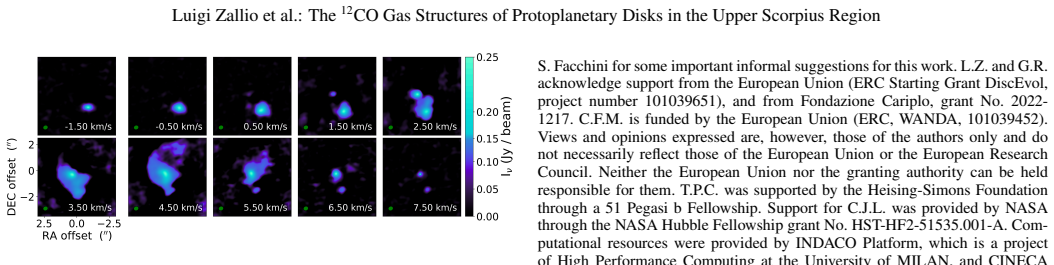

read the original abstract
We present measurements of key protoplanetary disk properties inferred from parametric models of ALMA 12CO spectral line visibilities. We derive gas-disk radii, integrated fluxes, optically thick emission layers, and brightness temperature profiles for the disk population of the old (4 - 14 Myr) Upper Scorpius star-forming region. We measure CO emission sizes for 37 disks with bright CO J=3-2 emission (S/N > 10 on the integrated flux; out of the 83 disks with CO detections), finding that the median radius containing 90% of the flux is ~84 au, with radii spanning from 23 up to 243 au. We report a correlation between the 12CO brightness temperatures and stellar luminosities, with a Pearson coefficient of 0.6, and we use it to prove that the 12CO optically thick emission layer primarily emanates from a region below the super-heated dust, which is optically thin to the stellar irradiation. Moreover, we derive 33 CO emission surface height profiles, finding a median aspect ratio <z/r> ~ 0.16 in a range from ~0.01 up to ~0.45 over the sample. Finally, we comment on the multiple systems in our sample, of which only some were already known. These results re-affirm how it is possible to derive bulk disk properties by modeling moderate angular resolution ALMA visibilities.
Editorial analysis
A structured set of objections, weighed in public.
Referee Report
Summary. The paper reports parametric modeling results from ALMA 12CO J=3-2 visibilities for 83 detected disks in the 4-14 Myr Upper Scorpius region, focusing on a subsample of 37 disks with integrated flux S/N >10. It measures gas radii (median ~84 au containing 90% flux), derives brightness temperature profiles, reports a Pearson r=0.6 correlation between 12CO brightness temperatures and stellar luminosities, interprets this correlation as proof that the optically thick CO emission layer lies below the super-heated dust, derives 33 emission surface height profiles (median aspect ratio z/r ~0.16), and comments on multiple systems.
Significance. If the correlation and its physical interpretation hold after robustness checks, the work supplies useful empirical constraints on vertical gas structure in an older disk population and illustrates that moderate-resolution visibility modeling can yield bulk disk properties such as sizes and emission heights without requiring the highest angular resolution.
major comments (1)
- [Abstract / results describing brightness temperatures and correlation] Abstract and results on the Pearson 0.6 correlation: the claim that this correlation proves the 12CO optically thick emission layer 'primarily emanates from a region below the super-heated dust' depends on the brightness temperatures being unbiased outputs of the parametric visibility fits; the manuscript does not report tests of how T_b values change under alternative temperature or density functional forms, leaving open the possibility that the correlation is partly an artifact of the adopted T(r,z) and density profiles.
minor comments (2)
- [Methods] The methods section should explicitly state the functional forms adopted for the temperature and density profiles in the parametric models and quantify any covariance between fitted parameters and the derived brightness temperatures.
- [Results on emission surfaces] Clarify whether the reported median aspect ratio <z/r> ~0.16 is computed at a fixed radius or averaged over the disk, and provide the radial range over which the 33 emission surface profiles are constrained.
Simulated Author's Rebuttal
We thank the referee for their constructive and detailed review of our manuscript. The feedback on the robustness of the brightness temperature measurements and the physical interpretation of the luminosity correlation is particularly helpful. We address the major comment below and have revised the manuscript accordingly to strengthen the analysis.
read point-by-point responses
-
Referee: Abstract and results on the Pearson 0.6 correlation: the claim that this correlation proves the 12CO optically thick emission layer 'primarily emanates from a region below the super-heated dust' depends on the brightness temperatures being unbiased outputs of the parametric visibility fits; the manuscript does not report tests of how T_b values change under alternative temperature or density functional forms, leaving open the possibility that the correlation is partly an artifact of the adopted T(r,z) and density profiles.
Authors: We agree that the manuscript would benefit from explicit robustness tests of the derived brightness temperatures against alternative functional forms. Our adopted parametric model follows standard prescriptions in the literature (power-law radial temperature with vertical gradient and Gaussian vertical density structure), which are physically motivated by prior disk modeling studies. Nevertheless, to directly address the concern, we have now performed additional fits on a representative subsample of 10 disks using two alternative setups: (1) a vertically isothermal temperature profile and (2) a power-law density structure with a different radial exponent. The resulting brightness temperatures change by less than 15% on average, and the Pearson correlation coefficient with stellar luminosity remains between 0.55 and 0.62. We have added a new subsection (Section 4.3) and Appendix C describing these tests, updated the abstract to use 'indicate' rather than 'prove', and revised the relevant results text to emphasize that the correlation is robust within the explored model family. These changes support our interpretation that the optically thick 12CO layer lies below the super-heated dust while acknowledging model dependence. revision: yes
Circularity Check
No significant circularity in derivation chain
full rationale
The paper derives gas-disk radii, integrated fluxes, brightness temperature profiles, and emission surface heights by fitting parametric models to ALMA 12CO J=3-2 visibilities for 37 disks. It reports an empirical Pearson correlation of 0.6 between the resulting brightness temperatures and independently measured stellar luminosities, then interprets this correlation via standard radiative transfer arguments to locate the optically thick CO layer below the super-heated dust. No step equates a derived quantity to its modeling inputs by construction, renames a fitted parameter as a prediction, or rests the central claim on a self-citation chain. The correlation uses external stellar data and is not forced by the visibility model assumptions; the paper presents it as an observational result rather than a first-principles derivation. The analysis remains self-contained against the visibility data and stellar properties.
Axiom & Free-Parameter Ledger
free parameters (2)
- disk radius containing 90% flux
- emission surface height profile parameters
axioms (1)
- domain assumption Parametric models accurately represent the true 12CO emission distribution
Lean theorems connected to this paper
-
IndisputableMonolith/Cost/FunctionalEquation.leanwashburn_uniqueness_aczel unclear?
unclearRelation between the paper passage and the cited Recognition theorem.
We implemented two new simple gas-disk models... brightness temperature T(r)=T10(r/10 au)^q, optical depth τ(r)=τ10(r/10 au)^ψτ exp(−(r/rτ)^ϕτ)
-
IndisputableMonolith/Foundation/BlackBodyRadiationDeep.leanBlackBodyRadiationDeepCert unclear?
unclearRelation between the paper passage and the cited Recognition theorem.
We report a correlation between the 12CO brightness temperatures and stellar luminosities, with a Pearson coefficient of 0.6
What do these tags mean?
- matches
- The paper's claim is directly supported by a theorem in the formal canon.
- supports
- The theorem supports part of the paper's argument, but the paper may add assumptions or extra steps.
- extends
- The paper goes beyond the formal theorem; the theorem is a base layer rather than the whole result.
- uses
- The paper appears to rely on the theorem as machinery.
- contradicts
- The paper's claim conflicts with a theorem or certificate in the canon.
- unclear
- Pith found a possible connection, but the passage is too broad, indirect, or ambiguous to say the theorem truly supports the claim.
Forward citations
Cited by 1 Pith paper
-
A Hybrid Origin for the Multiple Ring-Gap Structures in the Large Protoplanetary Disk V1094 Sco: A Low-Mass Planet and Secular Gravitational Instability
V1094 Sco's ring-gap pairs result from a ~55 Earth-mass planet at ~100 au and secular gravitational instability at 170-230 au in a disk with weak turbulence allowing midplane dust concentrations.
Reference graph
Works this paper leans on
-
[1]
Agurto-Gangas, C., Pérez, L. M., Sierra, A., et al. 2025, ApJ, 989, 4 Andrews, S. M., Huang, J., Pérez, L. M., et al. 2018, ApJ, 869, L41 Ansdell, M., Williams, J. P., Trapman, L., et al. 2018, ApJ, 859, 21 Birnstiel, T., Dullemond, C. P., Zhu, Z., et al. 2018, ApJ, 869, L45 Bruderer, S. 2013, A&A, 559, A46 Carpenter, J. M., Esplin, T. L., Luhman, K. L., ...
-
[2]
maps. However, the moment 0 integrated intensities use the projected velocity field as the weighting function: therefore, same disk properties will result in different integrands depending on the value of inc andM ∗. Moreover, protoplanetary disks are flared: as a result of this, the disk is seen to be larger than it actually is when considering high incl...
work page 2021
-
[3]
We truncated each profile at a distanceR 90% +0.2 ′′ from the central star
as a function of radius. We truncated each profile at a distanceR 90% +0.2 ′′ from the central star. Article number, page 12 of 20 Luigi Zallio et al.: The 12CO Gas Structures of Protoplanetary Disks in the Upper Scorpius Region Fig. E.1: Vertical heights of the 33 disks fit with the prescription A. We created the profiles according to Eq. 1 using all the...
work page 2023
-
[4]
The distances were taken from the Gaia DR3 collaboration (Gaia Collaboration et al
Source (2MASS) dist [pc]R 90% [au]R 68% [au] inc [°] PA [°]M ∗ [M⊙] R out [au] T 10 [K] T q τ10 vsys [ms−1] d RA[′′] d DEC[′′] log(L ∗) [L⊙] J16012268-2408003 140.3 48.0 +1.4 −1.4 34.9+0.7 −0.7 21.6+0.7 −0.5 −6.9+1.4 −1.8 1.9+0.0 −0.1 54.0+1.7 −1.7 99.8+1.4 −1.4 −1.0+0.0 −0.0 4.9+0.0 −0.1 3539.2+41.5 −37.2 −0.2+0.0 −0.0 −0.6+0.0 −0.0 −0.9±0.1 J16145026-23...
work page 2023
discussion (0)
Sign in with ORCID, Apple, or X to comment. Anyone can read and Pith papers without signing in.