REVIEW 4 major objections 7 minor 37 references
DeltaDeno: Zero-Shot Anomaly Generation via Delta-Denoising Attribution
T0 review · 4 major / 7 minor · reviewed 2026-08-03 · deepseek-v4-flash
Pith's one-line read Contrasting normal and anomaly prompts yields defect masks and realistic edits with no anomalous examples.
desk verdict A credible zero-shot anomaly generation pipeline whose central mask-fidelity and 'consistent gains' claims are over-stated — worth refereeing, but needs mask IoU and an honest per-category read. read the letter →
The pith
A machine-rendered reading of the paper's core claim, the machinery that carries it, and where it could break.
The reading
What carries the argument
Delta-denoising attribution: an accumulator that integrates the squared latent differences between the normal and anomaly denoising branches at each reverse step. The accumulated map is smoothed, normalized, and thresholded to produce a binary mask that both localizes the defect and acts as the inpainting mask for the rest of the reverse trajectory. The framework also uses a partially noised normal reference to start both branches, token-level prompt refinement to keep non-anomaly tokens stable, and spatial attention biasing for the anomaly token.
What would settle it
Measure the overlap (IoU) between DeltaDeno's predicted masks and ground-truth anomaly masks on MVTec AD. If the masks do not align with the real defect regions better than the foreground prior or a random region, the delta-attribution premise collapses and the downstream gains would have to be explained by something else.
Extended reading notes
Core claim
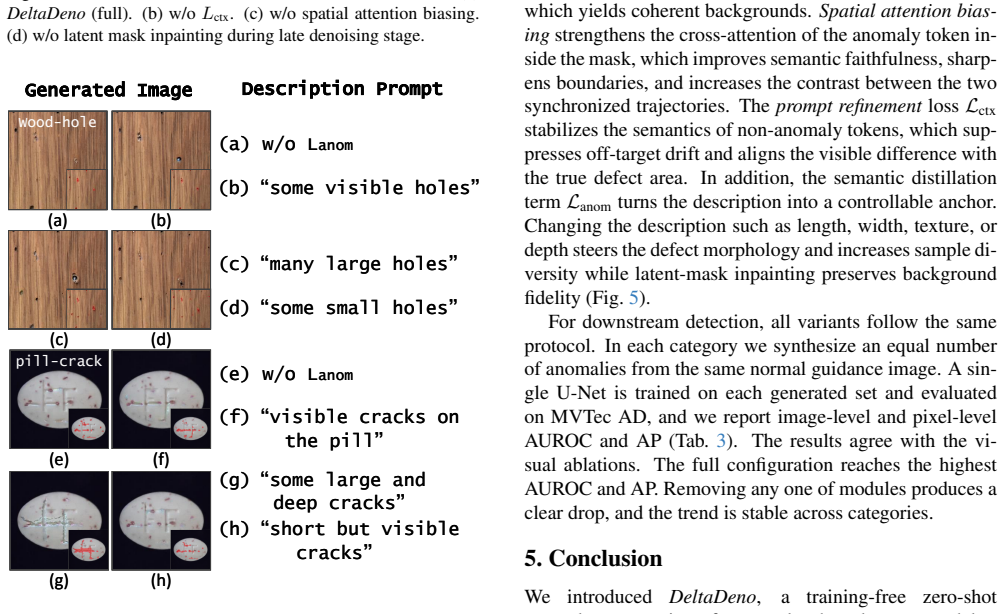
The paper's core claim is that the accumulated latent delta between a normal-prompt branch and an anomaly-prompt branch, taken over the early denoising steps of a shared schedule, localizes the defect with enough precision to drive mask-guided inpainting. A second accumulation over late steps yields a final mask, and two lightweight interventions — token-level prompt refinement that isolates the anomaly token, and a spatial attention bias that concentrates that token's attention inside the mask — stabilize the localization. The result is a training-free pipeline that edits a single normal image into a defective one while keeping the background consistent.
Load-bearing premise
The accumulated difference between the two branches' latents marks the true defect region rather than global semantic drift, sampling noise, or differences unrelated to the anomaly.
Editorial extensions
If this is right
- Anomaly generation no longer requires anomalous samples or masks, so datasets can be bootstrapped from a single normal example per category.
- Downstream detectors trained on DeltaDeno's synthetic defects outperform those trained on a prior zero-shot generator on MVTec AD (mean image AUROC 84.7 vs 77.6; pixel AUROC 84.9 vs 83.3).
- Changing the descriptive anchor for the anomaly token steers defect type and severity, giving a degree of controllability without retraining.
- The method transfers across categories and to unseen domains because it never fine-tunes to category priors.
Reading between the lines
- The localization principle is not specific to industrial defects; the same prompt-contrast delta could be adapted to other localized edits (e.g., object removal, style changes), where the mask is discovered rather than specified.
- If the delta map is a faithful attribution, it could serve as a pseudo-label for weakly supervised anomaly segmentation, reducing the need for pixel annotations.
- The hand-set thresholds (0.6 and 0.35) hint that a calibration-free or learned threshold could be explored; the paper does not test sensitivity to these values.
- A direct validation of the delta map against ground-truth masks (IoU per category) would turn the pipeline into a credible localization method on its own, not just a generation aid.
Editorial analysis
A structured set of objections, weighed in public.
Referee Report
Summary. DeltaDeno addresses zero-shot anomaly generation (ZSAG) with no anomalous training samples. From a normal image, it builds a normal/anomaly prompt pair, runs two synchronized Stable Diffusion reverse processes from the same partially-noised latent, and accumulates per-step latent-space discrepancies into an attribution map S. The map is thresholded into a coarse mask M_mid that guides latent inpainting in the late stage; a second accumulation yields the final mask M. Token-level prompt refinement and spatial attention biasing are used to sharpen the anomaly token. Experiments on MVTec AD report IS/IC-LPIPS generation quality and downstream U-Net detection (Table 2), claiming consistent gains over AnomalyAny and competitive results with few-shot methods.
Significance. The intended contribution is valuable: a training-free generation method that uses the model's own denoising dynamics to localize and synthesize defects could be useful for AD bootstrapping, and the pseudo-code plus promised code release make the approach unusually reproducible. The delta-attribution idea is simple and interesting. However, the evidence currently does not establish the two central pillars: mask fidelity is never measured against ground truth, and the 'consistent gains' wording is contradicted by per-category numbers. The limitations paragraph (§5) concedes evaluation protocols are limited, which undermines the strength of the conclusions. If the missing evaluations are added and claims calibrated, this could become a solid contribution.
major comments (4)
- [§3.2/Eq. (11), §4.3] The method returns M as a localization output (Algorithm 1), and the contribution list claims 'strong localization fidelity', but no IoU/Dice/PRO is reported against MVTec AD ground-truth masks or against the actual edited region. This is load-bearing: the downstream gains are attributed to localization precision. Eq. (11) also makes the late-stage accumulator self-confounding: after M_mid is extracted, the anomaly latent outside the mask is reset to the DDIM-noised normal reference z_src, so the final S compares the free-running normal branch to z_src, not to a prompt-induced edit; any DDIM reconstruction error outside M_mid accumulates as spurious signal. The §5 limitation that 'existing evaluation protocols for ZSAG are limited' strengthens, not weakens, the need for direct mask evaluation.
- [Table 2, §4.3 and Abstract] The words 'consistent gains' over AnomalyAny are not supported by the table. On image AUROC, DeltaDeno is lower on capsule (54.9 vs 59.4), grid (81.3 vs 85.7), toothbrush (89.2 vs 89.6), transistor (78.8 vs 78.9), and wood (99.0 vs 99.4), and barely different on hazelnut (99.1 vs 98.8). The mean +7.1 gain is driven by a few large wins (cable, metal_nut, pill, zipper). Please report per-category deviations/confidence intervals and discuss the failure cases, or revise the claim.
- [§4.1, §4.3] The downstream protocol is under-specified. It is not stated which normal image(s) are used for 'the same single normal image per category', how many random seeds, whether the same source images are used for all baselines, and—critically—whether the generated masks are provided to the U-Net as supervision (and whether Table 2's pixel metrics require that). Without this, the comparison in Table 2 is not fully controlled and the pixel-level results cannot be interpreted. Please specify the U-Net architecture, training schedule, and data construction for every baseline.
- [§4.1, Algorithm 1] The localization/generation pipeline depends on hand-set thresholds τ_mid=0.6 and τ_final=0.35 and on the undefined operations 'clean(normalize(S))'. No sensitivity analysis is reported, so it is unclear how robust the method is to threshold choice—particularly since M is a returned output. Please include a threshold sweep with mask-level metrics and an ablation of γ, α_t, η, and refinement iterations.
minor comments (7)
- [Fig. 3] The column header 'DreamAnoGen' is not defined in the text or references; likely should be 'AnoGen'.
- [§3.3, Eq. (12)] Eq. (12) uses α_t as a step size, but the text says the refinement runs for a few iterations with a fixed step size; clarify the notation.
- [Algorithm 1, line 8] The operation 'clean(normalize(S))' is undefined; specify the smoothing and normalization applied to S.
- [§3.3] The SAM foreground mask M_fg is not described in detail: which image/prompt is used, how the SAM mask is projected to the latent grid, and how empty or multi-object masks are handled.
- [Table 1] IS and IC-LPIPS are reported without error bars or repeated-run variance; given the small sample size, please include deviations or re-run statistics.
- [§5] The limitations paragraph admits that 'controllability offered by semantic distillation remains limited' and that ZSAG evaluation protocols are limited; this is in tension with the abstract's 'great generation, realism and consistent gains' wording. Please calibrate the claims.
- [General] The arXiv header 'arXiv:2511.16920v1 [cs.CV] 21 Nov 2025' should be removed for a journal submission.
Circularity Check
Mask output is self-referential: the final mask is re-thresholded from late-stage deltas that were themselves shaped by the inpainting/attention mask, so the claimed localization fidelity is not independently established.
-
self definitional
[Sec. 3.2 (Eqs. 9-11), Sec. 3.3 (Eq. 13), Sec. 3.4 / Algorithm 1]
"During the late denoising stage, the image-specific mask Mmid serves as a latent inpainting mask that confines subsequent edits to the coarse anomaly region discovered earlier. The update is zt−1 ← Mmid ⊙ ˜zt−1 + (1−Mmid)⊙zsrc t−1 ... At the final step, re-threshold S to get the final mask M ... The bias term β M o⊤a injects spatial awareness into the anomaly token’s attention map."
The final mask M is not an independent localization prediction. S is reset at tmid and then accumulated from a late-stage process whose inputs include Mmid itself: Eq. 11 overwrites the anomaly branch outside Mmid with the normal reference, and Eq. 13 biases the anomaly token’s cross-attention with Mmid. Thus the late-stage deltas — and the final thresholded mask — are partly caused by the same mask the method claims to localize. Outside Mmid, the delta measures normal-branch drift against the reference rather than prompt-induced anomaly, so the returned mask cannot be read as a validated attribution. The paper never reports IoU/Dice against ground truth or against the actual edited region, so the asserted 'localization fidelity' reduces to a self-referential byproduct of the inpainting/at
full rationale
DeltaDeno's downstream detection evaluation is external: a U-Net is trained on generated images and tested on real MVTec AD images, so that part is not circular. However, the paper's central localization claim has a concrete feedback loop. Mmid, obtained by thresholding the early accumulated S, is fed back into Eq. 11 (latent inpainting) and Eq. 13 (attention bias), and the final returned mask M is re-thresholded from S accumulated after this feedback. The final mask's agreement with the generated defect is therefore partly by construction, and no independent mask metric (IoU/Dice against MVTec ground truth or against the actual edit region) is reported. The late-stage delta outside Mmid compares the free-running normal branch to the noised reference, so DDIM reconstruction drift can be counted as spurious anomaly signal. This is a technical confound in the derivation chain rather than a fitted-input-called-prediction or a self-citation chain. The self-citations ([7], [8], [28], [31], [34]) are not load-bearing: [34] is merely the ZSAG baseline, and the others are related work. The claimed 'consistent gains' in Table 2 are not actually consistent across categories, but that is a correctness/statistical concern, not a circularity. Overall, one moderate self-referential step in the mask pipeline warrants score 3.
Assumptions & free parameters
free parameters (5)
- partial-noise ratio gamma =
0.3
- mid-threshold tau_mid =
0.6
- final threshold tau_final =
0.35
- prompt-refinement step size alpha_t and iterations =
not specified
- context alignment weight eta =
not specified
assumptions (3)
- domain assumption Stable Diffusion v1.5 is a sufficiently capable generative prior for industrial defect synthesis
- domain assumption The normal prompt differs from the anomaly prompt only by an anomaly token, and this difference maps to localized visual changes
- domain assumption Latent-space L2 distance between branches corresponds to image-space semantic anomaly region
invented entities (1)
-
Delta-denoising attribution map S
Cite this review
Pith. "Pith review of DeltaDeno: Zero-Shot Anomaly Generation via Delta-Denoising Attribution." pith.science (2026). https://pith.science/paper/QFSW2TZI
@misc{pith2026251116920,
  author       = {Pith},
  title        = {Pith review of: DeltaDeno: Zero-Shot Anomaly Generation via Delta-Denoising Attribution},
  year         = {2026},
  howpublished = {\url{https://pith.science/paper/QFSW2TZI}},
  note         = {Machine review of arXiv:2511.16920}
}
read the original abstract
Anomaly generation is often framed as few-shot fine-tuning with anomalous samples, which contradicts the scarcity that motivates generation and tends to overfit category priors. We tackle the setting where no real anomaly samples or training are available. We propose Delta-Denoising (\textbf{DeltaDeno}), a training-free zero-shot anomaly generation method that localizes and edits defects by contrasting two diffusion branches driven by a minimal prompt pair under a shared schedule. By accumulating per-step denoising deltas into an image-specific localization map, we obtain a mask to guide the latent inpainting during later diffusion steps and preserve the surrounding context while generating realistic local defects. To improve stability and control, DeltaDeno performs token-level prompt refinement that aligns shared content and strengthens anomaly tokens, and applies a spatial attention bias restricted to anomaly tokens in the predicted region. Experiments on public datasets show that DeltaDeno achieves great generation, realism and consistent gains in downstream detection performance. Code will be made publicly available at https://github.com/CROVO1026/DeltaDeno.
Figures


Figures from the paper (2 more)

Reference graph
Works this paper leans on
-
[1]
Blended latent diffusion.ACM transactions on graphics (TOG), 42 (4):1–11, 2023
Omri Avrahami, Ohad Fried, and Dani Lischinski. Blended latent diffusion.ACM transactions on graphics (TOG), 42 (4):1–11, 2023. 2
2023
-
[2]
Mvtec ad–a comprehensive real-world dataset for unsupervised anomaly detection
Paul Bergmann, Michael Fauser, David Sattlegger, and Carsten Steger. Mvtec ad–a comprehensive real-world dataset for unsupervised anomaly detection. InProceedings of the IEEE/CVF conference on computer vision and pattern recognition, pages 9592–9600, 2019. 1, 6
2019
-
[3]
Uninformed students: Student-teacher anomaly detection with discriminative latent embeddings
Paul Bergmann, Michael Fauser, David Sattlegger, and Carsten Steger. Uninformed students: Student-teacher anomaly detection with discriminative latent embeddings. In Proceedings of the IEEE/CVF conference on computer vi- sion and pattern recognition, pages 4183–4192, 2020. 1
2020
-
[4]
In- structpix2pix: Learning to follow image editing instructions
Tim Brooks, Aleksander Holynski, and Alexei A Efros. In- structpix2pix: Learning to follow image editing instructions. InProceedings of the IEEE/CVF conference on computer vi- sion and pattern recognition, pages 18392–18402, 2023. 2
2023
-
[5]
Masactrl: Tuning-free mu- tual self-attention control for consistent image synthesis and editing
Mingdeng Cao, Xintao Wang, Zhongang Qi, Ying Shan, Xi- aohu Qie, and Yinqiang Zheng. Masactrl: Tuning-free mu- tual self-attention control for consistent image synthesis and editing. InProceedings of the IEEE/CVF international con- ference on computer vision, pages 22560–22570, 2023. 2
2023
-
[6]
Attend-and-excite: Attention-based se- mantic guidance for text-to-image diffusion models.ACM transactions on Graphics (TOG), 42(4):1–10, 2023
Hila Chefer, Yuval Alaluf, Yael Vinker, Lior Wolf, and Daniel Cohen-Or. Attend-and-excite: Attention-based se- mantic guidance for text-to-image diffusion models.ACM transactions on Graphics (TOG), 42(4):1–10, 2023. 2
2023
-
[7]
A unified anomaly synthesis strategy with gradi- ent ascent for industrial anomaly detection and localization
Qiyu Chen, Huiyuan Luo, Chengkan Lv, and Zhengtao Zhang. A unified anomaly synthesis strategy with gradi- ent ascent for industrial anomaly detection and localization. InEuropean Conference on Computer Vision, pages 37–54. Springer, 2024. 1
2024
-
[8]
Center-aware residual anomaly synthesis for multiclass industrial anomaly detec- tion.IEEE Transactions on Industrial Informatics, 21(9): 7276–7286, 2025
Qiyu Chen, Huiyuan Luo, Haiming Yao, Wei Luo, Zhen Qu, Chengkan Lv, and Zhengtao Zhang. Center-aware residual anomaly synthesis for multiclass industrial anomaly detec- tion.IEEE Transactions on Industrial Informatics, 21(9): 7276–7286, 2025. 1
2025
Show all 37 references
-
[9]
Diffedit: Diffusion-based seman- tic image editing with mask guidance.arXiv preprint arXiv:2210.11427, 2022
Guillaume Couairon, Jakob Verbeek, Holger Schwenk, and Matthieu Cord. Diffedit: Diffusion-based seman- tic image editing with mask guidance.arXiv preprint arXiv:2210.11427, 2022. 2
2022 arXiv
-
[10]
Seas: few-shot industrial anomaly image gen- eration with separation and sharing fine-tuning
Zhewei Dai, Shilei Zeng, Haotian Liu, Xurui Li, Feng Xue, and Yu Zhou. Seas: few-shot industrial anomaly image gen- eration with separation and sharing fine-tuning. InProceed- ings of the IEEE/CVF International Conference on Com- puter Vision, pages 23135–23144, 2025. 1, 3, 6
2025
-
[11]
Diffusion models beat gans on image synthesis.Advances in neural informa- tion processing systems, 34:8780–8794, 2021
Prafulla Dhariwal and Alexander Nichol. Diffusion models beat gans on image synthesis.Advances in neural informa- tion processing systems, 34:8780–8794, 2021. 1
2021
-
[12]
Few- shot defect image generation via defect-aware feature manip- ulation
Yuxuan Duan, Yan Hong, Li Niu, and Liqing Zhang. Few- shot defect image generation via defect-aware feature manip- ulation. InProceedings of the AAAI conference on artificial intelligence, pages 571–578, 2023. 1, 3, 6
2023
-
[13]
Boosting fine-grained visual anomaly detection with coarse-knowledge-aware adversarial learning
Qingqing Fang, Qinliang Su, Wenxi Lv, Wenchao Xu, and Jianxing Yu. Boosting fine-grained visual anomaly detection with coarse-knowledge-aware adversarial learning. InPro- ceedings of the AAAI Conference on Artificial Intelligence, pages 16532–16540, 2025. 1
2025
-
[14]
Few-shot anomaly-driven generation for anomaly classification and segmentation
Guan Gui, Bin-Bin Gao, Jun Liu, Chengjie Wang, and Yun- sheng Wu. Few-shot anomaly-driven generation for anomaly classification and segmentation. InEuropean Conference on Computer Vision, pages 210–226. Springer, 2024. 6
2024
-
[15]
Prompt-to-prompt im- age editing with cross attention control.arXiv preprint arXiv:2208.01626, 2022
Amir Hertz, Ron Mokady, Jay Tenenbaum, Kfir Aberman, Yael Pritch, and Daniel Cohen-Or. Prompt-to-prompt im- age editing with cross attention control.arXiv preprint arXiv:2208.01626, 2022. 2
2022 arXiv
-
[16]
Classifier-free diffusion guidance.arXiv preprint arXiv:2207.12598, 2022
Jonathan Ho and Tim Salimans. Classifier-free diffusion guidance.arXiv preprint arXiv:2207.12598, 2022. 1
2022 arXiv
-
[17]
Denoising dif- fusion probabilistic models.Advances in neural information processing systems, 33:6840–6851, 2020
Jonathan Ho, Ajay Jain, and Pieter Abbeel. Denoising dif- fusion probabilistic models.Advances in neural information processing systems, 33:6840–6851, 2020. 1
2020
-
[18]
Anomalyd- iffusion: Few-shot anomaly image generation with diffusion model
Teng Hu, Jiangning Zhang, Ran Yi, Yuzhen Du, Xu Chen, Liang Liu, Yabiao Wang, and Chengjie Wang. Anomalyd- iffusion: Few-shot anomaly image generation with diffusion model. InProceedings of the AAAI conference on artificial intelligence, pages 8526–8534, 2024. 1, 3, 6
2024
-
[19]
Dual-interrelated diffusion model for few-shot anomaly image generation
Ying Jin, Jinlong Peng, Qingdong He, Teng Hu, Jiafu Wu, Hao Chen, Haoxuan Wang, Wenbing Zhu, Mingmin Chi, Jun Liu, et al. Dual-interrelated diffusion model for few-shot anomaly image generation. InProceedings of the Computer Vision and Pattern Recognition Conference, pages 304...
2025
-
[20]
Imagic: Text-based real image editing with diffusion models
Bahjat Kawar, Shiran Zada, Oran Lang, Omer Tov, Huiwen Chang, Tali Dekel, Inbar Mosseri, and Michal Irani. Imagic: Text-based real image editing with diffusion models. InPro- ceedings of the IEEE/CVF conference on computer vision and pattern recognition, pages 6007–6017, 2023. 2
2023
-
[21]
Auto-encoding varia- tional bayes.arXiv preprint arXiv:1312.6114, 2013
Diederik P Kingma and Max Welling. Auto-encoding varia- tional bayes.arXiv preprint arXiv:1312.6114, 2013. 3
2013 arXiv
-
[22]
Segment any- thing
Alexander Kirillov, Eric Mintun, Nikhila Ravi, Hanzi Mao, Chloe Rolland, Laura Gustafson, Tete Xiao, Spencer White- head, Alexander C Berg, Wan-Yen Lo, et al. Segment any- thing. InProceedings of the IEEE/CVF international confer- ence on computer vision, pages 4015–4026, 2023. 5
2023
-
[23]
Cutpaste: Self-supervised learning for anomaly de- tection and localization
Chun-Liang Li, Kihyuk Sohn, Jinsung Yoon, and Tomas Pfister. Cutpaste: Self-supervised learning for anomaly de- tection and localization. InProceedings of the IEEE/CVF conference on computer vision and pattern recognition, pages 9664–9674, 2021. 1
2021
-
[24]
Few-shot defect segmentation leveraging abundant defect- 9 free training samples through normal background regulariza- tion and crop-and-paste operation
Dongyun Lin, Yanpeng Cao, Wenbin Zhu, and Yiqun Li. Few-shot defect segmentation leveraging abundant defect- 9 free training samples through normal background regulariza- tion and crop-and-paste operation. In2021 IEEE Interna- tional Conference on Multimedia and Expo (ICME), p...
2021
-
[25]
Sdedit: Guided image synthesis and editing with stochastic differential equa- tions.arXiv preprint arXiv:2108.01073, 2021
Chenlin Meng, Yutong He, Yang Song, Jiaming Song, Jia- jun Wu, Jun-Yan Zhu, and Stefano Ermon. Sdedit: Guided image synthesis and editing with stochastic differential equa- tions.arXiv preprint arXiv:2108.01073, 2021. 2
2021 arXiv
-
[26]
Null-text inversion for editing real im- ages using guided diffusion models
Ron Mokady, Amir Hertz, Kfir Aberman, Yael Pritch, and Daniel Cohen-Or. Null-text inversion for editing real im- ages using guided diffusion models. InProceedings of the IEEE/CVF conference on computer vision and pattern recognition, pages 6038–6047, 2023. 2
2023
-
[27]
Improved denoising diffusion probabilistic models
Alexander Quinn Nichol and Prafulla Dhariwal. Improved denoising diffusion probabilistic models. InInternational conference on machine learning, pages 8162–8171. PMLR,
-
[28]
Investigating shift equivalence of convolutional neural net- works in industrial defect segmentation.IEEE Transactions on Instrumentation and Measurement, 72:1–17, 2023
Zhen Qu, Xian Tao, Fei Shen, Zhengtao Zhang, and Tao Li. Investigating shift equivalence of convolutional neural net- works in industrial defect segmentation.IEEE Transactions on Instrumentation and Measurement, 72:1–17, 2023. 1
2023
-
[29]
High-resolution image synthesis with latent diffusion models
Robin Rombach, Andreas Blattmann, Dominik Lorenz, Patrick Esser, and Bj ¨orn Ommer. High-resolution image synthesis with latent diffusion models. InProceedings of the IEEE/CVF conference on computer vision and pattern recognition, pages 10684–10695, 2022. 1, 2
2022
-
[30]
U- net: Convolutional networks for biomedical image segmen- tation
Olaf Ronneberger, Philipp Fischer, and Thomas Brox. U- net: Convolutional networks for biomedical image segmen- tation. InInternational Conference on Medical image com- puting and computer-assisted intervention, pages 234–241. Springer, 2015. 3
2015
-
[31]
Few-shot defect image generation based on consistency modeling
Qingfeng Shi, Jing Wei, Fei Shen, and Zhengtao Zhang. Few-shot defect image generation based on consistency modeling. InEuropean Conference on Computer Vision, pages 360–376. Springer, 2024. 1
2024
-
[32]
Denoising diffusion implicit models.arXiv preprint arXiv:2010.02502, 2020
Jiaming Song, Chenlin Meng, and Stefano Ermon. Denoising diffusion implicit models.arXiv preprint arXiv:2010.02502, 2020. 4
2010 arXiv
-
[33]
Defectfill: Realistic defect generation with inpainting diffusion model for visual inspection
Jaewoo Song, Daemin Park, Kanghyun Baek, Sangyub Lee, Jooyoung Choi, Eunji Kim, and Sungroh Yoon. Defectfill: Realistic defect generation with inpainting diffusion model for visual inspection. InProceedings of the Computer Vision and Pattern Recognition Conference, pages 18718–18727,
-
[34]
Unseen visual anomaly generation
Han Sun, Yunkang Cao, Hao Dong, and Olga Fink. Unseen visual anomaly generation. InProceedings of the Computer Vision and Pattern Recognition Conference, pages 25508– 25517, 2025. 1, 3, 6
2025
-
[35]
Draem- a discriminatively trained reconstruction embedding for sur- face anomaly detection
Vitjan Zavrtanik, Matej Kristan, and Danijel Skoˇcaj. Draem- a discriminatively trained reconstruction embedding for sur- face anomaly detection. InProceedings of the IEEE/CVF international conference on computer vision, pages 8330– 8339, 2021. 1, 3, 6
2021
-
[36]
Defect-gan: High-fidelity defect synthesis for automated defect inspection
Gongjie Zhang, Kaiwen Cui, Tzu-Yi Hung, and Shijian Lu. Defect-gan: High-fidelity defect synthesis for automated defect inspection. InProceedings of the IEEE/CVF Win- ter Conference on Applications of Computer Vision, pages 2524–2534, 2021. 1, 3
2021
-
[37]
Anomalyclip: Object-agnostic prompt learning for zero-shot anomaly detection
Qihang Zhou, Guansong Pang, Yu Tian, Shibo He, and Jim- ing Chen. Anomalyclip: Object-agnostic prompt learning for zero-shot anomaly detection. InInternational Conference on Learning Representations, 2024. 1 10
2024
Reviewed August 3, 2026 · model on record in the stance chip above.
Discussion (0). Sign in to comment.