Spectroscopy on a single nonlinear mode recognizes quantum states
Pith reviewed 2026-05-17 21:17 UTC · model grok-4.3
The pith
A single nonlinear driven-dissipative quantum mode can recognize parameters of incident squeezed states from its emission spectrum using linear regression.
A machine-rendered reading of the paper's core claim, the machinery that carries it, and where it could break.
Core claim
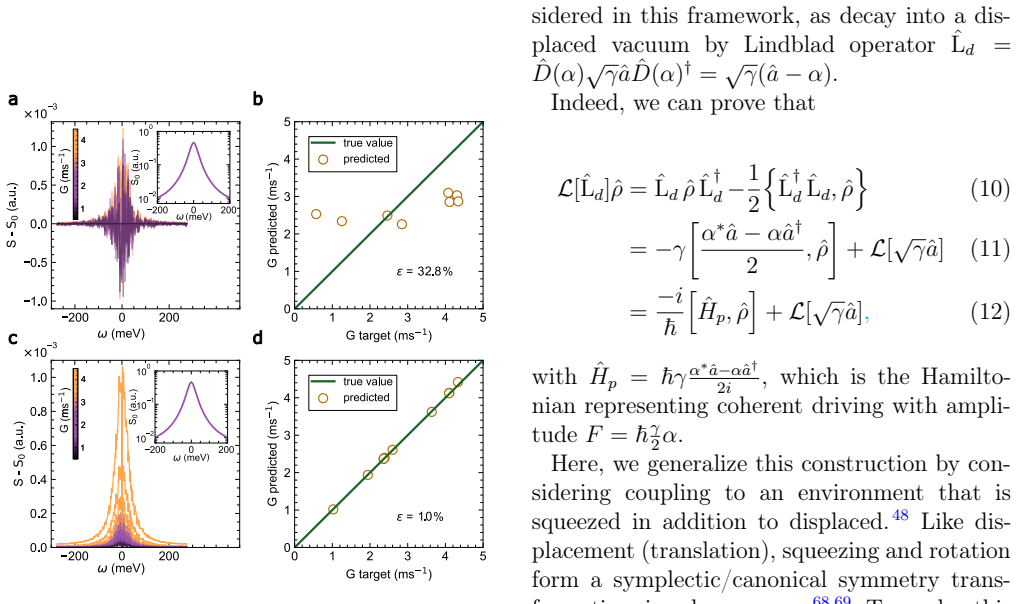
A quantum nonlinear driven-dissipative mode is sufficient to act as a quantum reservoir. By analyzing the occupations at different frequencies in the emission spectrum, a linear regression suffices in many cases to recognize the relevant parameters of incident squeezed states. The demonstration covers general continuous driving and a concrete example with a degenerate optical parametric oscillator coupled to a nonlinear polariton microcavity.
What carries the argument
Frequency-resolved occupations in the emission spectrum of the nonlinear mode, used as input features for linear regression to extract squeezed-state parameters.
If this is right
- Linear regression on spectral occupations recovers squeezed-state parameters without requiring full tomography.
- The method operates effectively under continuous driving of the nonlinear mode.
- The approach succeeds for a source consisting of a degenerate optical parametric oscillator coupled to the nonlinear polariton microcavity.
- This establishes a quantum reservoir based on a single driven-dissipative mode for state recognition tasks.
Where Pith is reading between the lines
- The same spectral-occupation features might support recognition of other nonclassical states if the linear regressor is retrained accordingly.
- Integration into compact photonic chips could lower the resource cost of routine quantum state checks compared with standard tomography setups.
- Varying the nonlinearity strength or driving regime in follow-up experiments would map the boundary where linear regression ceases to suffice.
- The reservoir idea connects naturally to tasks such as real-time feedback control of squeezed-light sources in quantum networks.
Load-bearing premise
The frequency-resolved occupations in the emission spectrum contain enough independent information about the incident squeezed state parameters for linear regression to recover them accurately.
What would settle it
Perform linear regression on measured frequency occupations from the emission spectrum of the driven nonlinear polariton microcavity with a degenerate OPO input; systematic failure to recover the squeezing parameters to within experimental error would falsify the claim.
Figures




read the original abstract
Characterising optical quantum states is essential for the development of quantum technologies. While traditional approaches to perform full quantum state tomography are often experimentally demanding, neuromorphic architectures may provide an effective alternative. In this work, we demonstrate how a quantum nonlinear driven-dissipative mode is sufficient to act as a quantum reservoir. By analyzing the occupations at different frequencies in the emission spectrum, a linear regression suffices in many cases to recognize the relevant parameters of incident squeezed states. Beyond highlighting the general potential of this approach under continuous driving, we illustrate its effectiveness in an explicit nontrivial example where the source is a degenerate optical parametric oscillator (OPO), coupled to a nonlinear polariton microcavity.
Editorial analysis
A structured set of objections, weighed in public.
Referee Report
Summary. The manuscript claims that a single quantum nonlinear driven-dissipative mode is sufficient to function as a quantum reservoir for characterizing incident squeezed states. Under continuous driving, the frequency-resolved occupations in the steady-state emission spectrum provide a feature vector from which a linear regression can recover the amplitude and phase parameters of the squeezed state in many cases. The approach is illustrated with a concrete example of a degenerate optical parametric oscillator (OPO) coupled to a nonlinear polariton microcavity.
Significance. If the central claim is substantiated, the work offers a hardware-efficient alternative to full quantum state tomography that relies on a minimal physical system (one nonlinear mode) and standard spectral measurements rather than complex interferometric setups. It demonstrates the potential of reservoir-computing ideas in driven-dissipative quantum optics and provides an explicit, nontrivial example that could guide experiments with polariton or circuit-QED platforms. The continuous-driving regime is a practical strength.
major comments (2)
- [OPO-polariton example and linear-regression analysis] The central claim that linear regression on frequency occupations suffices rests on the assumption that these occupations furnish a feature vector whose linear span is rich enough to invert for the squeezed-state parameters. The skeptic note correctly identifies that, for perturbative nonlinearity or narrow-band drive, many frequency bins can become linearly dependent or insensitive to higher-order input correlations, rendering the design matrix ill-conditioned. The OPO-polariton example should therefore report the condition number (or singular-value spectrum) of the regression matrix for the chosen detuning and Kerr strength to demonstrate that the sidebands remain distinguishable; without this, it is unclear whether success is generic or an artifact of the specific parameters.
- [Results and discussion of regression performance] The abstract states that linear regression 'suffices in many cases' but provides no quantitative error analysis, success-rate statistics, or robustness checks against experimental noise or parameter variation. A load-bearing claim of this type requires explicit metrics (e.g., mean-squared error on recovered amplitude/phase or failure rate over a parameter sweep) in the results section to allow the reader to judge the regime of validity.
minor comments (2)
- Clarify the precise definition of 'occupations at different frequencies' (e.g., whether these are steady-state photon numbers in frequency bins of the output spectrum or integrated intensities) and how they are extracted from the emission spectrum.
- Add a brief comparison, even qualitative, to existing reservoir-computing or machine-learning approaches for quantum-state discrimination to better situate the novelty of using a single nonlinear mode.
Simulated Author's Rebuttal
We thank the referee for the constructive comments and positive overall assessment of our work. We address each major comment below and have revised the manuscript to strengthen the presentation of the linear-regression analysis.
read point-by-point responses
-
Referee: [OPO-polariton example and linear-regression analysis] The central claim that linear regression on frequency occupations suffices rests on the assumption that these occupations furnish a feature vector whose linear span is rich enough to invert for the squeezed-state parameters. The skeptic note correctly identifies that, for perturbative nonlinearity or narrow-band drive, many frequency bins can become linearly dependent or insensitive to higher-order input correlations, rendering the design matrix ill-conditioned. The OPO-polariton example should therefore report the condition number (or singular-value spectrum) of the regression matrix for the chosen detuning and Kerr strength to demonstrate that the sidebands remain distinguishable; without this, it is unclear whether success is generic or an artifact of the specific parameters.
Authors: We agree that explicitly reporting the conditioning of the regression matrix strengthens the claim. In the revised manuscript we have added the singular-value spectrum (and the resulting condition number) of the design matrix constructed from the frequency-resolved occupations for the OPO-polariton parameters used in the example. The spectrum confirms that the relevant sidebands remain linearly independent and that the matrix is sufficiently well-conditioned for stable inversion, indicating that the reported success is not an artifact of the chosen detuning and Kerr strength. revision: yes
-
Referee: [Results and discussion of regression performance] The abstract states that linear regression 'suffices in many cases' but provides no quantitative error analysis, success-rate statistics, or robustness checks against experimental noise or parameter variation. A load-bearing claim of this type requires explicit metrics (e.g., mean-squared error on recovered amplitude/phase or failure rate over a parameter sweep) in the results section to allow the reader to judge the regime of validity.
Authors: We acknowledge that the original manuscript would benefit from quantitative performance metrics. The revised results section now includes mean-squared errors on the recovered amplitude and phase, success rates (fraction of trials with relative error below a stated threshold) over a parameter sweep of squeezed-state amplitudes and phases, and robustness tests in which controlled Gaussian noise is added to the occupation features. These additions make the regime of validity explicit while preserving the central observation that linear regression works in many cases. revision: yes
Circularity Check
No significant circularity; derivation is self-contained via physical model and numerical demonstration
full rationale
The paper's central claim rests on modeling a driven-dissipative nonlinear mode, computing its steady-state emission spectrum for varied input squeezed-state parameters, and then applying linear regression to recover those parameters from frequency-resolved occupations. This workflow is a standard forward simulation followed by supervised regression on generated data; the regression coefficients are fitted to the model's outputs rather than presupposing the target recognition result. No self-definitional loops, fitted inputs relabeled as predictions, or load-bearing self-citations appear in the provided abstract or description. The approach remains falsifiable against external benchmarks or different nonlinearities, satisfying the criteria for an independent derivation chain.
Axiom & Free-Parameter Ledger
axioms (1)
- domain assumption The system is described by standard quantum optical master equations for a driven nonlinear mode coupled to a reservoir.
Lean theorems connected to this paper
-
IndisputableMonolith/Foundation/RealityFromDistinction.leanreality_from_one_distinction unclear?
unclearRelation between the paper passage and the cited Recognition theorem.
the nonlinear response of the optical cavity remaps the squeezing of an input state to signatures in the frequency domain
What do these tags mean?
- matches
- The paper's claim is directly supported by a theorem in the formal canon.
- supports
- The theorem supports part of the paper's argument, but the paper may add assumptions or extra steps.
- extends
- The paper goes beyond the formal theorem; the theorem is a base layer rather than the whole result.
- uses
- The paper appears to rely on the theorem as machinery.
- contradicts
- The paper's claim conflicts with a theorem or certificate in the canon.
- unclear
- Pith found a possible connection, but the passage is too broad, indirect, or ambiguous to say the theorem truly supports the claim.
Reference graph
Works this paper leans on
-
[1]
(2) Schuman, C. D.; Kulkarni, S. R.; Parsa, M.; Mitchell, J. P.; Date, P.; Kay, B. Opportunities for neuromorphic computing algorithms and applications. Nature Computational Science2022,2, 10–19. (3) Momeni,A.etal.Trainingofphysicalneu- ral networks.Nature2025,645, 53–61. (4) Shastri, B. J.; Tait, A. N.; Fer- reira de Lima, T.; Pernice, W. H. P.; Bhaskara...
work page 2025
-
[2]
Role of all-optical neural networks.Phys
(10) Matuszewski, M.; Prystupiuk, A.; Opala, A. Role of all-optical neural networks.Phys. Rev. Appl.2024,21, 014028. (11) McMahon, P. L. The physics of optical computing.Nature Reviews Physics2023, 5, 717–734. (12) Stroev, N.; Berloff, N. G. Analog Pho- tonics Computing for Information Pro- cessing, Inference, and Optimization.Ad- vanced Quantum Technolog...
work page 2024
-
[3]
(16) Schreiber, F. J.; Eisert, J.; Meyer, J. J. Tomography of Parametrized Quantum States.PRX Quantum2025,6, 020346. (17) Lvovsky, A. I.; Raymer, M. G. Continuous-variable optical quantum- state tomography.Rev. Mod. Phys.2009, 81, 299–332. (18) Ghosh, S.; Opala, A.; Matuszewski, M.; Paterek, T.; Liew, T. C. Quantum reser- voir processing.npj Quantum Infor...
work page 2009
-
[4]
(19) Liu, Z.-H.; Brunel, R.; Østergaard, E. E. B.; Cordero, O.; Chen, S.; Wong, Y.; Nielsen, J. A. H.; Bregnsbo, A. B.; 15 Zhou, S.; Huang, H.-Y.; Oh, C.; Jiang, L.; Preskill, J.; Neergaard-Nielsen, J. S.; An- dersen, U. L. Quantum learning advantage on a scalable photonic platform.Science 2025,389, 1332–1335. (20) Pehle, C.; Wetterich, C. Neuromorphic qu...
work page 2025
-
[5]
(32) Angelatos, G.; Khan, S. A.; Türeci, H. E. Reservoir Computing Approach to Quan- tum State Measurement.Phys. Rev. X 2021,11, 041062. (33) der Sande, G. V.; Brunner, D.; Sori- ano, M. C. Advances in photonic reservoir computing.Nanophotonics2017,6, 561–
work page 2021
-
[6]
(34) Xu, H.; Ghosh, S.; Matuszewski, M.; Liew, T. C. Universal Self-Correcting Computing with Disordered Exciton- Polariton Neural Networks.Phys. Rev. Appl.2020,13, 064074. (35) Xu, H.; Krisnanda, T.; Verstraelen, W.; Liew, T. C. H.; Ghosh, S. Superpolyno- mial quantum enhancement in polaritonic neuromorphic computing.Phys. Rev. B 2021,103, 195302. (36) D...
work page 2020
-
[7]
(38) Blais, A.; Grimsmo, A. L.; Girvin, S. M.; Wallraff, A. Circuit quantum electro- dynamics.Rev. Mod. Phys.2021,93, 025005. (39) Sheremet, A. S.; Petrov, M. I.; Iorsh, I. V.; Poshakinskiy, A. V.; Poddubny, A. N. 16 Waveguide quantum electrodynamics: Collective radiance and photon-photon correlations.Rev. Mod. Phys.2023,95, 015002. (40) Kavokin, A.; Liew...
work page 2021
-
[8]
(43) Liew, T. C. H. The future of quantum in polariton systems: opinion.Opt. Mater. Express2023,13, 1938–1946. (44) Kalt, H.; Klingshirn, C. F.Semiconduc- tor optics 1: Linear Optical Properties of semiconductors; Springer International Publishing,
work page 1938
-
[9]
(55) Carusotto, I.; Ciuti, C. Quantum fluids of light.Rev. Mod. Phys.2013,85, 299–366. (56) Kasprzak, J.; André, R.; Dang, L. S.; She- lykh, I. A.; Kavokin, A. V.; Rubo, Y. G.; Kavokin, K. V.; Malpuech, G. Build up and pinning of linear polarization in the Bose condensates of exciton polaritons. Phys. Rev. B2007,75, 045326. (57) Liew, T. C. H.; Savona, V....
work page 2013
-
[10]
Optical neural networks: progress and challenges.Light: Science & Applications 2024,13,
(59) Fu, T.; Zhang, J.; Sun, R.; Huang, Y.; Xu, W.; Yang, S.; Zhu, Z.; Chen, H. Optical neural networks: progress and challenges.Light: Science & Applications 2024,13,
work page 2024
-
[11]
(60) Govia, L. C. G.; Ribeill, G. J.; Row- lands, G. E.; Krovi, H. K.; Ohki, T. A. Quantum reservoir computing with a sin- gle nonlinear oscillator.Phys. Rev. Res. 2021,3, 013077. (61) Neill, O. D.; Nerenberg, S.; Marcucci, G.; Faccio, D. Quantum reservoir computing with linear photonic networks. Quantum Computing, Communication, and Simula- tion V. 2025;...
work page 2021
-
[12]
(64) Carreño, J. C. L.; Laussy, F. P. Excita- tion with quantum light. I. Exciting a har- monic oscillator.Phys. Rev. A2016,94, 063825. (65) Gardiner, C. W. Driving a quantum sys- tem with the output field from another driven quantum system.Phys. Rev. Lett. 1993,70, 2269–2272. (66) Carmichael, H. J. Quantum trajectory theory for cascaded open systems.Phys...
work page 1993
-
[13]
(69) Glauber, R. J.; Lewenstein, M. Quantum optics of dielectric media.Phys. Rev. A 1991,43, 467–491. (70) Świerczewski, S.; Verstraelen, W.; Deuar, P.; Piętka, B.; Liew, T. C. H.; Matuszewski, M.; Opala, A. Phase-Space Framework for Noisy Intermediate-Scale Quantum Optical Neural Networks
work page 1991
-
[14]
A.; Salem, R.; Okawachi, Y.; Turner-Foster, A
(74) Foster, M. A.; Salem, R.; Okawachi, Y.; Turner-Foster, A. C.; Lipson, M.; Gaeta, A. L. Ultrafast waveform com- pression using a time-domain telescope. Nature Photonics2009,3, 581–585. (75) Joshi, C.; Sparkes, B. M.; Farsi, A.; Gerrits, T.; Verma, V.; Ramelow, S.; Nam, S. W.; Gaeta, A. L. Picosecond- resolution single-photon time lens for tem- poral m...
work page 2022
discussion (0)
Sign in with ORCID, Apple, or X to comment. Anyone can read and Pith papers without signing in.