From Cantilevers to Membranes: Advanced Scanning Protocols for Magnetic Resonance Force Microscopy
Pith reviewed 2026-05-17 20:29 UTC · model grok-4.3
The pith
Simulations show strained SiN resonators and multislice compressed-sensing protocols can cut MRFM scan times by up to 100 times while preserving image fidelity.
A machine-rendered reading of the paper's core claim, the machinery that carries it, and where it could break.
Core claim
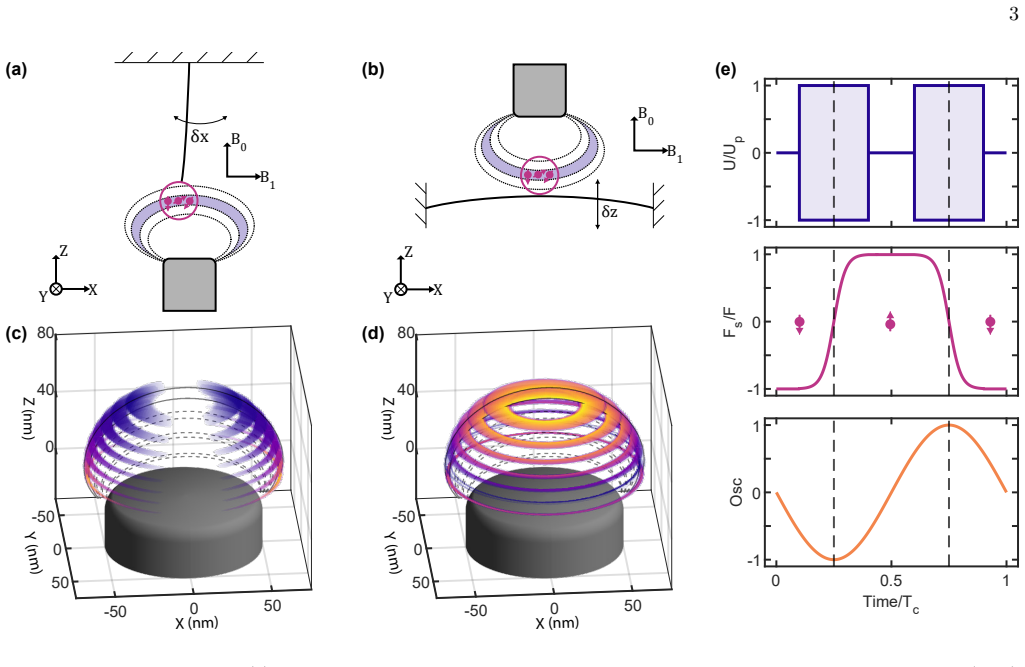
Strained SiN resonators operated in out-of-plane oscillation improve the quality of the reconstructed sample. A multislice, compressed-sensing scan protocol maximizes the information obtained for a given measurement time. Simulations predict that these scanning protocols and optimized algorithms can shorten the total acquisition time by up to two orders of magnitude while maintaining the reconstruction fidelity, demonstrating a promising path toward high-resolution MRFM for volumetric imaging of biological nanostructures.
What carries the argument
Multislice compressed-sensing scan protocol paired with strained SiN resonators in out-of-plane mode, which selects measurement points to maximize information content per unit time and improves reconstruction quality.
If this is right
- Out-of-plane oscillation direction of the resonators improves the quality of the reconstructed sample.
- The protocol maximizes the information obtained for a given measurement time.
- Total acquisition time can be shortened by up to two orders of magnitude.
- Reconstruction fidelity is maintained for nanoscale spin-density imaging.
- The approach enables high-resolution volumetric MRFM of biological nanostructures.
Where Pith is reading between the lines
- If the simulated speedups hold in the lab, MRFM could become practical for routine three-dimensional mapping of spin densities inside individual proteins or viruses.
- The same compressed-sensing trajectory design might be adapted to other scanning-probe methods that currently suffer from long acquisition times.
- Real-world mechanical and thermal noise may reduce the predicted gains, suggesting that adaptive or noise-aware variants of the protocol should be tested next.
- The resonator and protocol changes could be combined with existing cryogenic MRFM hardware to reach sub-nanometer resolution on biological samples.
Load-bearing premise
The numerical simulations of resonator performance and compressed-sensing reconstruction accurately reflect real experimental conditions and noise sources in MRFM setups.
What would settle it
Implement the multislice compressed-sensing protocol on a real MRFM instrument using strained SiN resonators and measure whether the observed acquisition-time reduction and image fidelity match the simulation predictions within experimental noise.
Figures


read the original abstract
Magnetic Resonance Force Microscopy (MRFM) enables three-dimensional imaging of nuclear spin densities in nanoscale objects. Based on numerical simulations, we evaluate the performance of strained SiN resonators as force sensors and show that their out-of-plane oscillation direction improves the quality of the reconstructed sample. We further introduce a multislice, compressed-sensing scan protocol that maximizes the information obtained for a given measurement time. Our simulations predict that these new scanning protocols and optimized algorithms can shorten the total acquisition time by up to two orders of magnitude while maintaining the reconstruction fidelity. Our results demonstrate that combining advanced scanning protocols with state-of-the-art resonators is a promising path toward high-resolution MRFM for volumetric imaging of biological nanostructures.
Editorial analysis
A structured set of objections, weighed in public.
Referee Report
Summary. The manuscript evaluates strained SiN resonators for MRFM via numerical simulations, showing that out-of-plane oscillation modes improve reconstructed sample quality. It further proposes a multislice compressed-sensing scan protocol that maximizes information per unit time. The central prediction is that these protocols and algorithms can reduce total acquisition time by up to two orders of magnitude while preserving reconstruction fidelity for 3D nuclear spin density imaging, with explicit modeling of strained SiN modes, noise sources, and sparsity priors.
Significance. If the simulation results hold under realistic conditions, the work offers a concrete path to overcoming the acquisition-time bottleneck in MRFM, enabling practical high-resolution volumetric imaging of biological nanostructures. The forward-simulation approach with no free parameters and explicit assumptions provides falsifiable predictions that can directly inform experimental design.
major comments (2)
- [Numerical simulations] Numerical simulations section: The two-order-of-magnitude acquisition-time reduction is load-bearing for the central claim, yet the manuscript provides no quantitative sensitivity analysis of how deviations in the assumed noise models or sparsity levels affect the reported fidelity metrics and time savings.
- [Resonator performance] Resonator performance evaluation: The claimed improvement from out-of-plane modes over conventional cantilevers is shown only in forward simulations; without direct comparison of force sensitivity or SNR under identical sample and detection conditions, the magnitude of the gain remains difficult to translate to experimental setups.
minor comments (2)
- [Figures] Figure captions should explicitly state the noise model parameters and sparsity level used in each reconstruction example.
- [Abstract and Results] The abstract states 'up to two orders of magnitude' but the main text should clarify whether this factor is achieved only for specific sample sparsities or holds across a range of realistic biological samples.
Simulated Author's Rebuttal
We thank the referee for the constructive comments and positive overall assessment of our simulation-based study. We address each major comment below and describe the revisions we will implement.
read point-by-point responses
-
Referee: [Numerical simulations] Numerical simulations section: The two-order-of-magnitude acquisition-time reduction is load-bearing for the central claim, yet the manuscript provides no quantitative sensitivity analysis of how deviations in the assumed noise models or sparsity levels affect the reported fidelity metrics and time savings.
Authors: We agree that a quantitative sensitivity analysis is important for establishing the robustness of the reported time savings. In the revised manuscript we will add a new subsection to the Numerical simulations section that varies the noise model parameters (thermal and detection noise amplitudes) and sparsity levels (1–20 % nonzero voxels) while tracking changes in PSNR, SSIM, and effective acquisition-time reduction. This will delineate the parameter regimes in which the two-order-of-magnitude improvement remains valid. revision: yes
-
Referee: [Resonator performance] Resonator performance evaluation: The claimed improvement from out-of-plane modes over conventional cantilevers is shown only in forward simulations; without direct comparison of force sensitivity or SNR under identical sample and detection conditions, the magnitude of the gain remains difficult to translate to experimental setups.
Authors: All forward simulations were performed with identical sample geometries, nuclear-spin densities, and detection-noise statistics for both the strained-SiN out-of-plane mode and the conventional cantilever, enabling a direct comparison by construction. To improve experimental translatability we will insert a new table in the Resonator performance evaluation section that explicitly lists the computed force sensitivity (aN/√Hz) and SNR for each resonator type under the same conditions. Full experimental validation lies outside the scope of this simulation paper. revision: partial
Circularity Check
No significant circularity detected
full rationale
The paper's strongest claim is a forward prediction of up to 100x shorter acquisition time obtained by running numerical simulations of strained SiN resonator dynamics and a multislice compressed-sensing reconstruction algorithm. These simulations start from explicit physical models (out-of-plane modes, stated noise sources, sparsity priors) and compare performance metrics between conventional and proposed protocols; the reported speed-up is an output of that comparison rather than a fitted parameter or a quantity defined in terms of itself. No self-definitional equations, fitted-inputs-renamed-as-predictions, or load-bearing self-citations appear in the derivation chain. The modeling assumptions are stated openly in the methods, making the result falsifiable against external benchmarks and therefore non-circular.
Axiom & Free-Parameter Ledger
Lean theorems connected to this paper
-
IndisputableMonolith/Foundation/RealityFromDistinctionreality_from_one_distinction unclear?
unclearRelation between the paper passage and the cited Recognition theorem.
Our simulations predict that these new scanning protocols and optimized algorithms can shorten the total acquisition time by up to two orders of magnitude while maintaining the reconstruction fidelity.
What do these tags mean?
- matches
- The paper's claim is directly supported by a theorem in the formal canon.
- supports
- The theorem supports part of the paper's argument, but the paper may add assumptions or extra steps.
- extends
- The paper goes beyond the formal theorem; the theorem is a base layer rather than the whole result.
- uses
- The paper appears to rely on the theorem as machinery.
- contradicts
- The paper's claim conflicts with a theorem or certificate in the canon.
- unclear
- Pith found a possible connection, but the passage is too broad, indirect, or ambiguous to say the theorem truly supports the claim.
Reference graph
Works this paper leans on
-
[1]
R. Budakian, A. Finkler, A. Eichler, M. Poggio, C. L. De- gen, S. Tabatabaei, I. Lee, P. C. Hammel, S. P. Eugene, T. H. Taminiau, R. L. Walsworth, P. London, A. Bleszyn- ski Jayich, A. Ajoy, A. Pillai, J. Wrachtrup, F. Jelezko, Y. Bae, A. J. Heinrich, C. R. Ast, P. Bertet, P. Cappel- laro, C. Bonato, Y. Altmann, and E. Gauger, Roadmap on nanoscale magneti...
work page 2024
-
[2]
J. A. Sidles, Noninductive detection of single-proton magnetic resonance, Applied Physics Letters58, 2854 (1991)
work page 1991
-
[3]
J. A. Sidles, Folded Stern-Gerlach experiment as a means for detecting nuclear magnetic resonance in individual nuclei, Physical Review Letters68, 1124 (1992), pub- lisher: American Physical Society
work page 1992
- [4]
-
[5]
C. L. Degen, M. Poggio, H. J. Mamin, C. T. Rettner, and D. Rugar, Nanoscale magnetic resonance imaging, Proceedings of the National Academy of Sciences106, 1313 (2009)
work page 2009
-
[6]
J. M. Nichol, T. R. Naibert, E. R. Hemesath, L. J. Lauhon, and R. Budakian, Nanoscale Fourier-Transform Magnetic Resonance Imaging, Physical Review X3, 031016 (2013), publisher: American Physical Society
work page 2013
-
[7]
U. Grob, M. D. Krass, M. H´ eritier, R. Pachlatko, J. Rhensius, J. Koˇ sata, B. A. Moores, H. Takahashi, A. Eichler, and C. L. Degen, Magnetic Resonance Force Microscopy with a One-Dimensional Resolution of 0.9 Nanometers, Nano Letters19, 7935 (2019), publisher: American Chemical Society
work page 2019
-
[8]
W. Rose, H. Haas, A. Q. Chen, N. Jeon, L. J. Lauhon, D. G. Cory, and R. Budakian, High-Resolution Nanoscale Solid-State Nuclear Magnetic Resonance Spectroscopy, Physical Review X8, 011030 (2018)
work page 2018
-
[9]
S. Tabatabaei, P. Priyadarsi, N. Singh, P. Sahafi, D. Tay, A. Jordan, and R. Budakian, Large-enhancement nanoscale dynamic nuclear polarization near a silicon nanowire surface, Science Advances10, eado9059 (2024), publisher: American Association for the Advancement of Science
work page 2024
-
[10]
H. Haas, S. Tabatabaei, W. Rose, P. Sahafi, M. Piscitelli, A. Jordan, P. Priyadarsi, N. Singh, B. Yager, P. J. Poole, D. Dalacu, and R. Budakian, Nuclear magnetic resonance diffraction with subangstrom precision, Proceedings of the National Academy of Sciences119, e2209213119 (2022), publisher: Proceedings of the National Academy of Sciences
work page 2022
-
[11]
J. G. Longenecker, H. J. Mamin, A. W. Senko, L. Chen, C. T. Rettner, D. Rugar, and J. A. Marohn, High- Gradient Nanomagnets on Cantilevers for Sensitive De- tection of Nuclear Magnetic Resonance, ACS Nano6, 9637 (2012), publisher: American Chemical Society
work page 2012
-
[12]
R. Pachlatko, N. Prumbaum, M.-D. Krass, U. Grob, C. L. Degen, and A. Eichler, Nanoscale Magnets Embedded in a Microstrip, Nano Letters24, 2081 (2024), publisher: American Chemical Society
work page 2081
-
[13]
J. Mamin and D. Rugar, Silicon Nanowires Feel the Force of Magnetic Resonance, Physics5, 20 (2012), publisher: American Physical Society
work page 2012
- [14]
-
[15]
N. J. Engelsen, A. Beccari, and T. J. Kippenberg, Ultrahigh-quality-factor micro- and nanomechanical res- onators using dissipation dilution, Nature Nanotechnol- ogy19, 725 (2024), publisher: Nature Publishing Group
work page 2024
-
[16]
C. Reinhardt, T. M¨ uller, A. Bourassa, and J. C. Sankey, Ultralow-Noise SiN Trampoline Resonators for Sensing and Optomechanics, Physical Review X6, 021001 (2016), publisher: American Physical Society
work page 2016
- [17]
-
[18]
Y. Tsaturyan, A. Barg, E. S. Polzik, and A. Schliesser, Ultracoherent nanomechanical resonators via soft clamp- ing and dissipation dilution, Nature Nanotechnology12, 776 (2017), publisher: Nature Publishing Group
work page 2017
- [19]
- [20]
-
[21]
A. H. Ghadimi, S. A. Fedorov, N. J. Engelsen, M. J. Bereyhi, R. Schilling, D. J. Wilson, and T. J. Kippen- berg, Elastic strain engineering for ultralow mechanical dissipation, Science360, 764 (2018), publisher: Ameri- can Association for the Advancement of Science
work page 2018
-
[22]
A. Beccari, D. A. Visani, S. A. Fedorov, M. J. Bereyhi, V. Boureau, N. J. Engelsen, and T. J. Kip- penberg, Strained crystalline nanomechanical resonators with quality factors above 10 billion, Nature Physics18, 10 436 (2022), publisher: Nature Publishing Group
work page 2022
- [23]
-
[24]
M. J. Bereyhi, A. Arabmoheghi, A. Beccari, S. A. Fe- dorov, G. Huang, T. J. Kippenberg, and N. J. Engelsen, Perimeter Modes of Nanomechanical Resonators Exhibit Quality Factors Exceeding$10ˆ9$at Room Tempera- ture, Physical Review X12, 021036 (2022), publisher: American Physical Society
work page 2022
-
[25]
S. Fedorov, A. Beccari, N. Engelsen, and T. Kippen- berg, Fractal-like Mechanical Resonators with a Soft- Clamped Fundamental Mode, Physical Review Letters 124, 025502 (2020), publisher: American Physical Soci- ety
work page 2020
-
[26]
M. J. Bereyhi, A. Beccari, R. Groth, S. A. Fedorov, A. Arabmoheghi, T. J. Kippenberg, and N. J. Engelsen, Hierarchical tensile structures with ultralow mechani- cal dissipation, Nature Communications13, 3097 (2022), publisher: Nature Publishing Group
work page 2022
-
[27]
D. Shin, A. Cupertino, M. H. J. de Jong, P. G. Steeneken, M. A. Bessa, and R. A. Norte, Spiderweb Nanomechanical Resonators via Bayesian Optimization: Inspired by Nature and Guided by Machine Learn- ing, Advanced Materials34, 2106248 (2022), eprint: https://onlinelibrary.wiley.com/doi/pdf/10.1002/adma.202106248
-
[28]
A. Eichler, Ultra-high-Q nanomechanical resonators for force sensing, Materials for Quantum Technology2, 043001 (2022), publisher: IOP Publishing
work page 2022
-
[29]
M. H´ eritier, R. Pachlatko, Y. Tao, J. M. Abendroth, C. L. Degen, and A. Eichler, Spatial Correlation between Fluctuating and Static Fields over Metal and Dielectric Substrates, Physical Review Letters127, 216101 (2021), publisher: American Physical Society
work page 2021
-
[30]
M.-D. Krass, N. Prumbaum, R. Pachlatko, U. Grob, H. Takahashi, Y. Yamauchi, C. L. Degen, and A. Eichler, Force-Detected Magnetic Resonance Imaging of Influenza Viruses in the Overcoupled Sensor Regime, Physical Re- view Applied18, 034052 (2022), publisher: American Physical Society
work page 2022
-
[31]
D. H¨ alg, T. Gisler, Y. Tsaturyan, L. Catalini, U. Grob, M.-D. Krass, M. H´ eritier, H. Mattiat, A.-K. Thamm, R. Schirhagl, E. C. Langman, A. Schliesser, C. L. Degen, and A. Eichler, Membrane-Based Scanning Force Mi- croscopy, Physical Review Applied15, L021001 (2021), publisher: American Physical Society
work page 2021
-
[32]
T. Gisler, D. H¨ alg, V. Dumont, S. Misra, L. Catal- ini, E. C. Langman, A. Schliesser, C. L. Degen, and A. Eichler, Enhancing membrane-based scanning force microscopy through an optical cavity, Physical Review Applied22, 044001 (2024), publisher: American Physi- cal Society
work page 2024
-
[33]
N. Scozzaro, W. Ruchotzke, A. Belding, J. Cardellino, E. C. Blomberg, B. A. McCullian, V. P. Bhallamudi, D. V. Pelekhov, and P. C. Hammel, Magnetic resonance force detection using a membrane resonator, Journal of Magnetic Resonance271, 15 (2016)
work page 2016
-
[34]
R. Fischer, D. P. McNally, C. Reetz, G. G. T. Assump¸ c˜ ao, T. Knief, Y. Lin, and C. A. Regal, Spin detection with a micromechanical trampoline: towards magnetic reso- nance microscopy harnessing cavity optomechanics, New Journal of Physics21, 043049 (2019), publisher: IOP Publishing
work page 2019
- [35]
-
[36]
J. M. Nichol, E. R. Hemesath, L. J. Lauhon, and R. Bu- dakian, Nanomechanical detection of nuclear magnetic resonance using a silicon nanowire oscillator, Physical Re- view B85, 054414 (2012), publisher: American Physical Society
work page 2012
-
[37]
J. Koˇ sata, O. Zilberberg, C. L. Degen, R. Chitra, and A. Eichler, Spin Detection via Parametric Frequency Conversion in a Membrane Resonator, Physical Review Applied14, 014042 (2020), publisher: American Physical Society
work page 2020
-
[38]
D. A. Visani, L. Catalini, C. L. Degen, A. Eich- ler, and J. d. Pino, Near-resonant nuclear spin de- tection with megahertz mechanical resonators (2025), arXiv:2508.14754 [cond-mat]
work page internal anchor Pith review Pith/arXiv arXiv 2025
- [39]
-
[40]
A. Vinante, G. Wijts, O. Usenko, L. Schinkelshoek, and T. H. Oosterkamp, Magnetic resonance force microscopy of paramagnetic electron spins at millikelvin tempera- tures, Nature Communications2, 572 (2011), publisher: Nature Publishing Group
work page 2011
-
[41]
C. E. Issac, C. M. Gleave, P. T. Nasr, H. L. Nguyen, E. A. Curley, J. L. Yoder, E. W. Moore, L. Chen, and J. A. Marohn, Dynamic nuclear polarization in a magnetic res- onance force microscope experiment, Physical Chemistry Chemical Physics18, 8806 (2016), publisher: The Royal Society of Chemistry
work page 2016
-
[42]
C. L. Degen, M. Poggio, H. J. Mamin, and D. Rugar, Role of Spin Noise in the Detection of Nanoscale Ensem- bles of Nuclear Spins, Physical Review Letters99, 250601 (2007), publisher: American Physical Society
work page 2007
-
[43]
B. E. Herzog, D. Cadeddu, F. Xue, P. Peddibhotla, and M. Poggio, Boundary between the thermal and statistical polarization regimes in a nuclear spin ensemble, Applied Physics Letters105, 043112 (2014)
work page 2014
-
[44]
D. C. Meeker, Finite Element Method Magnetics (2023)
work page 2023
-
[45]
C. Slichter,Principles of Magnetic Resonance, Springer Series in Solid-State Sciences (Springer Berlin Heidel- berg, 1996)
work page 1996
-
[46]
O. Z¨ uger, S. T. Hoen, C. S. Yannoni, and D. Rugar, Three-dimensional imaging with a nuclear magnetic res- onance force microscope, Journal of Applied Physics79, 1881 (1996)
work page 1996
-
[47]
K. Wago, D. Botkin, C. S. Yannoni, and D. Rugar, Para- magnetic and ferromagnetic resonance imaging with a tip-on-cantilever magnetic resonance force microscope, Applied Physics Letters72, 2757 (1998)
work page 1998
- [48]
-
[49]
Donoho, Compressed sensing, IEEE Transactions on Information Theory52, 1289 (2006)
D. Donoho, Compressed sensing, IEEE Transactions on Information Theory52, 1289 (2006)
work page 2006
- [50]
-
[51]
S. B. Andersson and L. Y. Pao, Non-raster sampling in atomic force microscopy: A compressed sensing ap- proach, in2012 American Control Conference (ACC) (2012) pp. 2485–2490, iSSN: 2378-5861
work page 2012
-
[52]
J. Oppliger and F. D. Natterer, Sparse sampling for fast quasiparticle-interference mapping, Physical Review Re- search2, 023117 (2020), publisher: American Physical Society
work page 2020
-
[53]
J. C. Ye, Compressed sensing MRI: a review from signal processing perspective, BMC Biomedical Engineering1, 8 (2019)
work page 2019
-
[54]
B. K. Natarajan, Sparse Approximate Solutions to Linear Systems, SIAM Journal on Computing24, 227 (1995), publisher: Society for Industrial and Applied Mathemat- ics
work page 1995
-
[55]
E. v. d. Berg and M. P. Friedlander, SPGL1: A solver for large-scale sparse reconstruction (2019)
work page 2019
-
[56]
E. van den Berg and M. P. Friedlander, Probing the Pareto Frontier for Basis Pursuit Solutions, SIAM Jour- nal on Scientific Computing31, 890 (2009), publisher: Society for Industrial and Applied Mathematics
work page 2009
-
[57]
L. Landweber, An Iteration Formula for Fredholm Inte- gral Equations of the First Kind, American Journal of Mathematics73, 615 (1951), publisher: The Johns Hop- kins University Press
work page 1951
-
[58]
O. Z¨ uger and D. Rugar, First images from a magnetic resonance force microscope, Applied Physics Letters63, 2496 (1993)
work page 1993
-
[59]
S. Boyd, Distributed Optimization and Statistical Learn- ing via the Alternating Direction Method of Multipli- ers, Foundations and Trends®in Machine Learning3, 1 (2010)
work page 2010
-
[60]
J. Eckstein and D. P. Bertsekas, On the Dou- glas—Rachford splitting method and the proximal point algorithm for maximal monotone operators, Mathemati- cal Programming55, 293 (1992)
work page 1992
-
[61]
C. Chen, B. He, Y. Ye, and X. Yuan, The direct exten- sion of ADMM for multi-block convex minimization prob- lems is not necessarily convergent, Mathematical Pro- gramming155, 57 (2016)
work page 2016
-
[62]
B. A. Moores, A. Eichler, Y. Tao, H. Takahashi, P. Navaretti, and C. L. Degen, Accelerated nanoscale magnetic resonance imaging through phase multiplexing, Applied Physics Letters106, 213101 (2015)
work page 2015
- [63]
-
[64]
J. Nocedal and S. J. Wright,Numerical Optimization, Springer Series in Operations Research and Financial En- gineering (Springer New York, 2006)
work page 2006
- [65]
-
[66]
J. Yang, W. Yin, Y. Zhang, and Y. Wang, A Fast Algo- rithm for Edge-Preserving Variational Multichannel Im- age Restoration, SIAM Journal on Imaging Sciences2, 569 (2009), publisher: Society for Industrial and Applied Mathematics
work page 2009
-
[67]
N. Parikh and S. Boyd, Proximal Algorithms, Founda- tions and Trends®in Optimization1, 127 (2014), pub- lisher: Now Publishers, Inc
work page 2014
-
[68]
H. J. Mamin, T. H. Oosterkamp, M. Poggio, C. L. Degen, C. T. Rettner, and D. Rugar, Isotope-Selective Detection and Imaging of Organic Nanolayers, Nano Letters9, 3020 (2009), publisher: American Chemical Society
work page 2009
-
[69]
J. Barzilai and J. M. Borwein, Two-Point Step Size Gra- dient Methods, IMA Journal of Numerical Analysis8, 141 (1988). 12 Supplementary information Appendix A: Combined Noise Estimates To determine the number of spins undergoing inversion due to an applied rf-inversion pulse, we record both quadra- tures of the resonator motion using a lock-in amplifier. ...
work page 1988
-
[70]
Problem Definition As described in Section IV, MRFM scansIare related to the underlying three-dimensional spin distributionOvia a linear model determined by the measurement protocols (see Eqs. 6-7). To recover the spin distributionOfrom the measurement requires thereby a reconstruction process. In principle, one could invert these linear operators to reco...
-
[71]
Vectorization To simplify the derivation of reconstruction algorithms, it is convenient to transform the three dimensional arrays into tall vectors. Therefore, for bothIandOthe vectorized versionsiandoare defined by stacking all entries in lexicographic order (fastest inz, thenyandx). In particular, for an arbitrary three dimensional arrayXof size (nx, ny...
-
[72]
Solving the whole problem in a single step is infeasible
Reconstruction The optimization problem B4 consists of three distinct terms: a least-squares data-fidelity term, a non-negativity constraint, and an isotropic total-variation penalty. Solving the whole problem in a single step is infeasible. Instead, the alternating direction method of multipliers (ADMM) [59, 60] is applied. ADMM splits the problem into s...
-
[73]
The ADMM algorithm solves this problem in an iterative manner
= arg mino,oTV,o+ arg maxλ1,λ2 Lν(o,o +,o TV,λ 1,λ 2) [59]. The ADMM algorithm solves this problem in an iterative manner. In each iteration (k) we successively minimize Lν with respect too,o + ando TV, before performing a standard gradient ascent step on the dual variablesλ 1,λ 2. This procedure is summarized in Algorithm 1. As this algorithm requires th...
discussion (0)
Sign in with ORCID, Apple, or X to comment. Anyone can read and Pith papers without signing in.