REVIEW 3 major objections 6 minor 50 references
QueryOcc: Query-based Self-Supervision for 3D Semantic Occupancy
T0 review · 3 major / 6 minor · reviewed 2026-08-03 · deepseek-v4-flash
Pith's one-line read Direct 4D query supervision lifts self-supervised 3D occupancy by 26% over prior methods.
desk verdict Solid, well-ablated integration of query-based self-supervision into camera-only 3D occupancy, with a clean in-framework comparison against rendering supervision; the SOTA claim is plausible but needs code, variance, and a discussion of dynamic-object label noise. read the letter →
The pith
A machine-rendered reading of the paper's core claim, the machinery that carries it, and where it could break.
The reading
What carries the argument
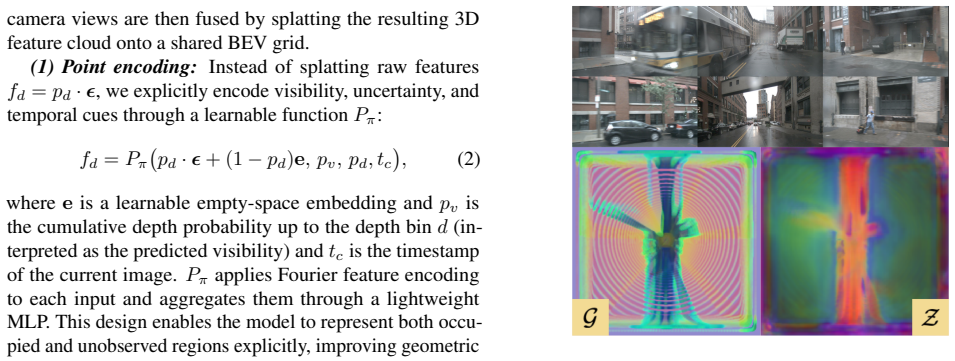
The load-bearing object is the 4D query q=(x,y,z,t): a point in space-time at which the model predicts occupancy and semantics. Supervision is generated by sampling, along rays from a sensor origin to observed points in pseudo or real point clouds, negative queries (free) between origin and point and positive queries (occupied) in a short buffer behind the point, balanced across frames; this yields sparse, continuous, discretization-free labels. To make long-range supervision affordable, QueryOcc uses a contractive BEV: an axis-aligned contraction maps coordinates beyond ±40 m into a fixed grid while preserving near-field resolution, and the 'lift-contract-splat' module lifts image features
What would settle it
Compare pseudo point clouds against lidar in the same frames and measure the fraction of occupied/free query labels that flip; if the label error concentrates on the small or thin classes that drive the 26% gain, part of the claimed advantage is an artifact of label noise. Alternatively, retrain the identical model with lidar as the only supervision source: if RayIoU drops below the pseudo-cloud number, the gain comes from dense pseudo-depth rather than from query supervision per se.
Extended reading notes
Core claim
On its own terms, QueryOcc's central discovery is that direct supervision of 4D spatio-temporal queries — asking the model whether a point at a given time is occupied and what it is — is a stronger and more scalable self-supervised training signal for 3D semantic occupancy than either NeRF/Gaussian-style rendering losses or voxelized lidar aggregation. The method samples positive queries just behind observed points and negative queries along the ray from the sensor to each point, across several adjacent frames, so occupancy and semantics are learned as explicit targets in continuous space rather than as by-products of image reconstruction. A contractive BEV representation (the 'lift-contract
Load-bearing premise
The camera-only headline numbers rest on the accuracy of the off-the-shelf monocular depth model used to build pseudo point clouds: if that metric depth is systematically biased relative to the evaluation geometry, the occupied/free query labels are wrong and the reported gain over rendering-based methods may not transfer to new scenes or sensors.
Editorial extensions
If this is right
- If the central claim holds, self-supervised occupancy training no longer needs 3D annotations or rendering losses at all: camera images plus an off-the-shelf depth model and semantic pseudo-labels suffice.
- Because query supervision directly labels geometry, adding 2D rendering losses on top yields no further gain (23.3 vs 23.6 mRayIoU), so future pipelines can be simpler and faster.
- The contractive representation lets a fixed BEV grid supervise unbounded scenes, so memory stays constant as range grows; this makes long-range occupancy prediction practical at real-time frame rates.
- Performance improves monotonically with input resolution and with additional unlabeled datasets (about +2 RayIoU per added dataset), suggesting the method converts data quantity into accuracy without architectural changes.
- The same framework handles camera-only, lidar-only, or combined supervision with one loss formulation, so a single model can train on heterogeneous sensor configurations.
Reading between the lines
- The paper's own Supp. Sec. 11 notes that continuous predictions are scored against 0.4 m voxelized ground truth that inflates geometry; if evaluation used a finer or continuous metric, QueryOcc's sharper thin-structure predictions might appear stronger than the table shows.
- The camera-only result inherits the biases of the off-the-shelf monocular depth model; a natural test is to swap in different depth estimators or add temporal depth fusion and see whether the 26% gap widens or shrinks.
- Because the paper attributes the gain to the supervision signal rather than the decoder, the query-based scheme could be transplanted into existing Gaussian-splatting or NeRF architectures to isolate whether direct query labels, not the contractive BEV, drive the improvement.
- The positive-query buffer length and negative-ray sampling density are free parameters that the paper does not ablate; their optimal settings, especially under depth noise, remain an open engineering question.
Editorial analysis
A structured set of objections, weighed in public.
Referee Report
Summary. The paper proposes QueryOcc, a self-supervised framework for continuous 3D semantic occupancy prediction from multi-view images. Instead of rendering-based 2D losses or voxelized lidar aggregation, it supervises a query-based decoder with 4D spatio-temporal queries sampled from pseudo point clouds (camera-only) or lidar. A contractive BEV representation and a lift-contract-splat module provide unbounded range at constant memory. On Occ3D-nuScenes, QueryOcc reports 23.6 semantic RayIoU (26% relative over GaussianFlowOcc's 18.7) at 11.6 FPS. Ablations compare query-based vs rendering supervision within the same framework and analyze temporal window, model components, resolution, sampling, and additional datasets.
Significance. If the results hold, the paper makes a strong contribution: it provides a head-to-head demonstration that direct query-based 3D supervision outperforms rendering-based supervision in a matched framework, and it introduces a contractive BEV representation that extends LSS-style lifting to unbounded scenes. The lidar-supervised variant shows the framework is not dependent on pseudo-depth. The paper is unusually thorough on ablations (temporal window, resolution, sampling, supervision sources) and includes a candid discussion of continuous-vs-voxelized evaluation. These strengths make the central mechanism credible. However, load-bearing uncertainties remain around pseudo-depth robustness, temporal label noise, and lack of variance analysis.
major comments (3)
- [Sec. 3.2 / Table 1 / Fig. 6] The camera-only claim rests entirely on pseudo point clouds generated by Metric3D metric depth, with no confidence filtering or depth-error model for the camera-only variant. Since GaussianFlowOcc also uses Metric3D, the reported +26% semantic RayIoU could in part reflect how tightly QueryOcc fits Metric3D's specific error distribution rather than a genuinely better geometric representation. The lidar-only result (22.9 mRayIoU) substantially mitigates this concern and should be emphasized, but it does not validate the camera-only transfer to other scenes/sensors. Please add a pseudo-depth robustness study (e.g., perturbing Metric3D depth by realistic noise, or training with an alternative depth estimator) or explicitly qualify the camera-only SOTA as dependent on the current pseudo-depth model. This is load-bearing for the abstract's headline claim.
- [Sec. 3.2 '4D query generation' / Fig. 5] The temporal supervision transforms point clouds from adjacent frames using ego poses only; no object-motion compensation is described. For dynamic objects (cars, pedestrians, etc.), the transformed point positions in the reference frame are incorrect, so positive/negative queries can receive contradictory labels. The Limitations section does not acknowledge this source of label noise. The temporal-window ablation (Fig. 5) shows that longer windows improve performance, but it does not isolate or quantify this dynamic-object noise. Please specify how dynamic points are treated, add motion-compensation or filtering, or provide an ablation that separates static vs dynamic contribution. As temporal query supervision is a core contribution, this needs to be addressed.
- [Tables 1, 4, 5 / Figs. 5–8] All reported numbers are single training runs; no error bars, seed variance, or statistical significance is given. The 26% SOTA claim and some ablations (e.g., Table 4's marginal gains) could be affected by training variance. Please report mean±std over at least 3 seeds (or equivalent) for the main results and key ablations, and make the evaluation code/checkpoints available to support reproducibility.
minor comments (6)
- [Sec. 11] The discussion of continuous predictions vs voxelized GT is valuable. Since the improvement over baselines is also large on IoU (e.g., 55.0 vs 46.9 Occ. IoU), the abstract and conclusion should cite both metrics rather than only RayIoU, to avoid giving the impression that the headline metric was selected post hoc.
- [Eq. (4)] The contraction function is defined with \bar\kappa and the domain/coordinate normalization could be clearer; state explicitly that \bar\kappa = \kappa/K_hr for \kappa in {x,y}, and that K_hr and beta are hyperparameters.
- [Eq. (3)] Clarify whether the 'infinity bin' at 180 m is included in the set of depth bins used for the log-linear formula or handled separately.
- [Abstract / Sec. 2] The paper repeatedly calls the method 'self-supervised'; since Metric3D, Grounded-SAM, and DINOv3 are external pre-trained models, a short remark on the term's usage (e.g., 'foundation-model-supervised') would improve precision.
- [Table 1 caption] 'Colors indicate First, Second, Third in ranking among more similar methods' is vague; specify the grouping to make the ranking transparent.
- [Sec. 7 / Code availability] The text says 'open source code (upon publication)'; add a placeholder or anonymous link in the manuscript for review reproducibility.
Circularity Check
No significant circularity: supervision inputs are external and evaluation is benchmark-based; author self-citations are non-load-bearing.
full rationale
The central derivation—4D query supervision from pseudo-point clouds (or lidar) produces continuous 3D semantic occupancy—does not reduce to its inputs by construction. Geometry labels are obtained by lifting pixels with the external Metric3D depth model and pairing them with external Grounded-SAM semantic pseudo-labels (Sec. 3.2–3.3); these are disclosed off-the-shelf inputs, not quantities fitted by QueryOcc or renamed as predictions. Eq. (5)–(6) generate negative/positive query labels directly from the point cloud along rays and behind points; this is label construction, not a derived result that is definitionally equal to the supervision. Evaluation is performed against the lidar-derived Occ3D-nuScenes voxel ground truth using RayIoU/IoU, so the reported gains are not a re-statement of the training targets. The only author-overlapping citations (GASP [23], NeuRAD [33]) are used for design details such as decoder offsets, min-depth filtering, and contraction inspiration; they are not invoked as uniqueness theorems and do not carry the empirical claim. The strongest baseline shares Metric3D as a supervision source, which raises a correctness/transfer risk about pseudo-label accuracy, but that is not circularity; the lidar-only variant reaching 22.9 mRayIoU (Fig. 6) shows the framework is not merely fitting the pseudo-depth model. No load-bearing circular step was found.
Assumptions & free parameters
free parameters (6)
- Depth-bin schedule alpha =
0.3
- Depth bin range d_near, d_far, infinity bin =
40 m, 100 m, 180 m
- BEV contraction K_hr and beta =
40, 0.8
- Loss weights lambda_occ, lambda_sem, lambda_vfm, lambda_depth =
1.0, 0.5, 0.5, 0.5
- Positive-query buffer delta =
not specified in main text
- Supervision window and point sampling =
3 frames forward/backward; 30k points/frame
assumptions (9)
- domain assumption Pseudo point clouds from Metric3D depth provide sufficiently accurate geometric supervision for occupancy.
- domain assumption Grounded-SAM semantic pseudo-labels are accurate enough to supervise semantic occupancy.
- domain assumption DINOv3 features can be distilled into the decoder and improve occupancy learning.
- domain assumption Negative queries along the ray from sensor origin up to an observed point are unoccupied.
- domain assumption Positive queries just behind an observed point are occupied.
- domain assumption RayIoU is a reliable and fair metric for semantic occupancy.
- domain assumption Occ3D-nuScenes lidar-derived ground truth is a valid evaluation reference despite voxelization artifacts.
- domain assumption Known camera intrinsics/extrinsics and ego poses are available for lifting and 4D query generation.
- domain assumption The contractive BEV representation preserves enough far-field spatial structure for supervision and reasoning.
Cite this review
Pith. "Pith review of QueryOcc: Query-based Self-Supervision for 3D Semantic Occupancy." pith.science (2026). https://pith.science/paper/KODD6HTK
@misc{pith2026251117221,
  author       = {Pith},
  title        = {Pith review of: QueryOcc: Query-based Self-Supervision for 3D Semantic Occupancy},
  year         = {2026},
  howpublished = {\url{https://pith.science/paper/KODD6HTK}},
  note         = {Machine review of arXiv:2511.17221}
}
read the original abstract
Learning 3D scene geometry and semantics from images is a core challenge in computer vision and a key capability for autonomous driving. Since large-scale 3D annotation is prohibitively expensive, recent work explores self-supervised learning directly from sensor data without manual labels. Existing approaches either rely on 2D rendering consistency, where 3D structure emerges only implicitly, or on discretized voxel grids from accumulated lidar point clouds, limiting spatial precision and scalability. We introduce QueryOcc, a query-based self-supervised framework that learns continuous 3D semantic occupancy directly through independent 4D spatio-temporal queries sampled across adjacent frames. The framework supports supervision from either pseudo-point clouds derived from vision foundation models or raw lidar data. To enable long-range supervision and reasoning under constant memory, we introduce a contractive scene representation that preserves near-field detail while smoothly compressing distant regions. QueryOcc surpasses previous camera-based methods by 26% in semantic RayIoU on the self-supervised Occ3D-nuScenes benchmark while running at 11.6 FPS, demonstrating that direct 4D query supervision enables strong self-supervised occupancy learning. https://research.zenseact.com/publications/queryocc/
Figures


Figures from the paper (9 more)


Reference graph
Works this paper leans on
-
[1]
Implicit occupancy flow fields for perception and prediction in self-driving
Ben Agro, Quinlan Sykora, Sergio Casas, and Raquel Urtasun. Implicit occupancy flow fields for perception and prediction in self-driving. InProceedings of the IEEE/CVF conference on computer vision and pattern recognition, pages 1379–1388,
-
[2]
Uno: Unsupervised occupancy fields for perception and forecasting
Ben Agro, Quinlan Sykora, Sergio Casas, Thomas Gilles, and Raquel Urtasun. Uno: Unsupervised occupancy fields for perception and forecasting. InProceedings of the IEEE/CVF Conference on Computer Vision and Pattern Recognition, pages 14487–14496, 2024. 3, 4
2024
-
[3]
Mip-nerf 360: Unbounded anti-aliased neural radiance fields
Jonathan T Barron, Ben Mildenhall, Dor Verbin, Pratul P Srinivasan, and Peter Hedman. Mip-nerf 360: Unbounded anti-aliased neural radiance fields. InProceedings of the IEEE/CVF conference on computer vision and pattern recog- nition, pages 5470–5479, 2022. 4
2022
-
[4]
Gaus- sianflowocc: Sparse and weakly supervised occupancy estima- tion using gaussian splatting and temporal flow
Simon Boeder, Fabian Gigengack, and Benjamin Risse. Gaus- sianflowocc: Sparse and weakly supervised occupancy estima- tion using gaussian splatting and temporal flow. InProceed- ings of the IEEE/CVF International Conference on Computer Vision (ICCV), pages 24943–24954, 2025. 1, 2, 3, 5, 6, 7
2025
-
[5]
Lan- gocc: Open vocabulary occupancy estimation via volume rendering
Simon Boeder, Fabian Gigengack, and Benjamin Risse. Lan- gocc: Open vocabulary occupancy estimation via volume rendering. In2025 International Conference on 3D Vision (3DV), pages 200–210. IEEE, 2025. 2, 6, 7, 3
2025
-
[6]
Also: Automotive lidar self- supervision by occupancy estimation
Alexandre Boulch, Corentin Sautier, Bj¨orn Michele, Gilles Puy, and Renaud Marlet. Also: Automotive lidar self- supervision by occupancy estimation. InProceedings of the IEEE/CVF Conference on Computer Vision and Pattern Recognition, pages 13455–13465, 2023. 3
2023
-
[7]
nuscenes: A multi- modal dataset for autonomous driving
Holger Caesar, Varun Bankiti, Alex H Lang, Sourabh V ora, Venice Erin Liong, Qiang Xu, Anush Krishnan, Yu Pan, Gi- ancarlo Baldan, and Oscar Beijbom. nuscenes: A multi- modal dataset for autonomous driving. InProceedings of the IEEE/CVF conference on computer vision and pattern recognition, pages 11621–11631, 2020. 1, 6, 8
2020
-
[8]
Nuplan: A closed-loop ml- based planning benchmark for autonomous vehicles
Holger Caesar, Juraj Kabzan, Kok Seang Tan, Whye Kit Fong, Eric M Wolff, Alex H Lang, Luke Fletcher, Oscar Beijbom, and Sammy Omari. Nuplan: A closed-loop ml- based planning benchmark for autonomous vehicles. InCVPR ADP3 workshop, 2021. 8
2021
Show all 50 references
-
[9]
Monoscene: Monocu- lar 3d semantic scene completion
Anh-Quan Cao and Raoul De Charette. Monoscene: Monocu- lar 3d semantic scene completion. InProceedings of the IEEE/CVF Conference on Computer Vision and Pattern Recognition, pages 3991–4001, 2022. 2
2022
-
[10]
Navsim: Data-driven non-reactive autonomous vehicle simulation and benchmark- ing.Advances in Neural Information Processing Systems, 37: 28706–28719, 2024
Daniel Dauner, Marcel Hallgarten, Tianyu Li, Xinshuo Weng, Zhiyu Huang, Zetong Yang, Hongyang Li, Igor Gilitschenski, Boris Ivanovic, Marco Pavone, et al. Navsim: Data-driven non-reactive autonomous vehicle simulation and benchmark- ing.Advances in Neural Information Processin...
2024
-
[11]
Sdgocc: Semantic and depth-guided bird’s-eye view transformation for 3d multimodal occupancy prediction
ZaiPeng Duan, ChenXu Dang, Xuzhong Hu, Pei An, Jun- feng Ding, Jie Zhan, YunBiao Xu, and Jie Ma. Sdgocc: Semantic and depth-guided bird’s-eye view transformation for 3d multimodal occupancy prediction. InProceedings of the IEEE/CVF Conference on Computer Vision and Pattern Rec...
2025
-
[12]
Panoptic nuscenes: A large-scale benchmark for lidar panop- tic segmentation and tracking.IEEE Robotics and Automation Letters, 7(2):3795–3802, 2022
Whye Kit Fong, Rohit Mohan, Juana Valeria Hurtado, Lubing Zhou, Holger Caesar, Oscar Beijbom, and Abhinav Valada. Panoptic nuscenes: A large-scale benchmark for lidar panop- tic segmentation and tracking.IEEE Robotics and Automation Letters, 7(2):3795–3802, 2022. 1
2022
-
[13]
Gaussianocc: Fully self-supervised and efficient 3d occupancy estimation with gaussian splatting
Wanshui Gan, Fang Liu, Hongbin Xu, Ningkai Mo, and Naoto Yokoya. Gaussianocc: Fully self-supervised and efficient 3d occupancy estimation with gaussian splatting. InProceed- ings of the IEEE/CVF International Conference on Computer Vision, pages 28980–28990, 2025. 2, 6, 7
2025
-
[14]
Deep residual learning for image recognition
Kaiming He, Xiangyu Zhang, Shaoqing Ren, and Jian Sun. Deep residual learning for image recognition. InProceed- ings of the IEEE conference on computer vision and pattern recognition, pages 770–778, 2016. 3, 6
2016
-
[15]
Tri-perspective view for vision-based 3d semantic occupancy prediction
Yuanhui Huang, Wenzhao Zheng, Yunpeng Zhang, Jie Zhou, and Jiwen Lu. Tri-perspective view for vision-based 3d semantic occupancy prediction. InProceedings of the IEEE/CVF conference on computer vision and pattern recog- nition, pages 9223–9232, 2023. 2
2023
-
[16]
Selfocc: Self-supervised vision-based 3d occupancy prediction
Yuanhui Huang, Wenzhao Zheng, Borui Zhang, Jie Zhou, and Jiwen Lu. Selfocc: Self-supervised vision-based 3d occupancy prediction. InProceedings of the IEEE/CVF con- ference on computer vision and pattern recognition, pages 19946–19956, 2024. 1, 2, 6, 7, 3 9
2024
-
[17]
Gaussianformer: Scene as gaussians for vision- based 3d semantic occupancy prediction
Yuanhui Huang, Wenzhao Zheng, Yunpeng Zhang, Jie Zhou, and Jiwen Lu. Gaussianformer: Scene as gaussians for vision- based 3d semantic occupancy prediction. InEuropean Con- ference on Computer Vision, pages 376–393. Springer, 2024. 2
2024
-
[18]
Gaussianformer-2: Probabilistic gaussian superposition for efficient 3d occupancy prediction
Yuanhui Huang, Amonnut Thammatadatrakoon, Wenzhao Zheng, Yunpeng Zhang, Dalong Du, and Jiwen Lu. Gaussianformer-2: Probabilistic gaussian superposition for efficient 3d occupancy prediction. InProceedings of the Computer Vision and Pattern Recognition Conference, pages 27477–2...
2025
-
[19]
Gausstr: Foundation model-aligned gaussian transformer for self-supervised 3d spatial understanding
Haoyi Jiang, Liu Liu, Tianheng Cheng, Xinjie Wang, Tian- wei Lin, Zhizhong Su, Wenyu Liu, and Xinggang Wang. Gausstr: Foundation model-aligned gaussian transformer for self-supervised 3d spatial understanding. InProceedings of the Computer Vision and Pattern Recognition Confer...
2025
-
[20]
Bevformer: learning bird’s-eye-view representation from lidar-camera via spatiotemporal transformers.IEEE Transactions on Pattern Analysis and Machine Intelligence, 2024
Zhiqi Li, Wenhai Wang, Hongyang Li, Enze Xie, Chong- hao Sima, Tong Lu, Qiao Yu, and Jifeng Dai. Bevformer: learning bird’s-eye-view representation from lidar-camera via spatiotemporal transformers.IEEE Transactions on Pattern Analysis and Machine Intelligence, 2024. 2
2024
-
[21]
Fully sparse 3d occupancy prediction
Haisong Liu, Yang Chen, Haiguang Wang, Zetong Yang, Tianyu Li, Jia Zeng, Li Chen, Hongyang Li, and Limin Wang. Fully sparse 3d occupancy prediction. InEuropean Con- ference on Computer Vision, pages 54–71. Springer, 2024. 6
2024
-
[22]
A convnet for the 2020s
Zhuang Liu, Hanzi Mao, Chao-Yuan Wu, Christoph Feicht- enhofer, Trevor Darrell, and Saining Xie. A convnet for the 2020s. InProceedings of the IEEE/CVF Conference on Computer Vision and Pattern Recognition (CVPR), pages 11976–11986, 2022. 3, 6, 1
2022
-
[23]
Gasp: Unifying geometric and semantic self-supervised pre-training for autonomous driving.arXiv preprint arXiv:2503.15672,
William Ljungbergh, Adam Lilja, Adam Tonderski Ling, Carl Lindstr¨om, Willem Verbeke, Junsheng Fu, Christoffer Pe- tersson, Lars Hammarstrand, Michael Felsberg, et al. Gasp: Unifying geometric and semantic self-supervised pre-training for autonomous driving.arXiv preprint arXi...
-
[24]
Occdepth: A depth-aware method for 3d semantic scene completion
Ruihang Miao, Weizhou Liu, Mingrui Chen, Zheng Gong, Weixin Xu, Chen Hu, and Shuchang Zhou. Occdepth: A depth-aware method for 3d semantic scene completion. arXiv:2302.13540, 2023. 2
2023 arXiv
-
[25]
Nerf: Representing scenes as neural radiance fields for view syn- thesis.Communications of the ACM, 65(1):99–106, 2021
Ben Mildenhall, Pratul P Srinivasan, Matthew Tancik, Jonathan T Barron, Ravi Ramamoorthi, and Ren Ng. Nerf: Representing scenes as neural radiance fields for view syn- thesis.Communications of the ACM, 65(1):99–106, 2021. 2
2021
-
[26]
Lift, splat, shoot: Encoding images from arbitrary camera rigs by implicitly unprojecting to 3d
Jonah Philion and Sanja Fidler. Lift, splat, shoot: Encoding images from arbitrary camera rigs by implicitly unprojecting to 3d. InEuropean conference on computer vision, pages 194–210. Springer, 2020. 2, 3
2020
-
[27]
Grounded sam: Assembling open-world models for diverse visual tasks.arXiv preprint arXiv:2401.14159,
Tianhe Ren, Shilong Liu, Ailing Zeng, Jing Lin, Kunchang Li, He Cao, Jiayu Chen, Xinyu Huang, Yukang Chen, Feng Yan, et al. Grounded sam: Assembling open-world models for diverse visual tasks.arXiv preprint arXiv:2401.14159,
-
[28]
Imagenet large scale visual recognition challenge.International journal of computer vision, 115(3):211–252, 2015
Olga Russakovsky, Jia Deng, Hao Su, Jonathan Krause, San- jeev Satheesh, Sean Ma, Zhiheng Huang, Andrej Karpathy, Aditya Khosla, Michael Bernstein, et al. Imagenet large scale visual recognition challenge.International journal of computer vision, 115(3):211–252, 2015. 1
2015
-
[29]
Grid-centric traffic scenario perception for autonomous driving: A comprehen- sive review.IEEE Transactions on Neural Networks and Learning Systems, 2024
Yining Shi, Kun Jiang, Jiusi Li, Zelin Qian, Junze Wen, Meng- meng Yang, Ke Wang, and Diange Yang. Grid-centric traffic scenario perception for autonomous driving: A comprehen- sive review.IEEE Transactions on Neural Networks and Learning Systems, 2024. 1
2024
-
[30]
Di- nov3.arXiv preprint arXiv:2508.10104, 2025
Oriane Sim ´eoni, Huy V V o, Maximilian Seitzer, Federico Baldassarre, Maxime Oquab, Cijo Jose, Vasil Khalidov, Marc Szafraniec, Seungeun Yi, Micha¨el Ramamonjisoa, et al. Di- nov3.arXiv preprint arXiv:2508.10104, 2025. 6, 1
2025 arXiv
-
[31]
Minkocc: Towards real-time label-efficient semantic occupancy predic- tion.arXiv preprint arXiv:2504.02270, 2025
Samuel Sze, Daniele De Martini, and Lars Kunze. Minkocc: Towards real-time label-efficient semantic occupancy predic- tion.arXiv preprint arXiv:2504.02270, 2025. 2, 6
2025 arXiv
-
[32]
Occ3d: A large-scale 3d occupancy prediction benchmark for au- tonomous driving.Advances in Neural Information Process- ing Systems, 36:64318–64330, 2023
Xiaoyu Tian, Tao Jiang, Longfei Yun, Yucheng Mao, Huitong Yang, Yue Wang, Yilun Wang, and Hang Zhao. Occ3d: A large-scale 3d occupancy prediction benchmark for au- tonomous driving.Advances in Neural Information Process- ing Systems, 36:64318–64330, 2023. 2, 6
2023
-
[33]
Neurad: Neural rendering for autonomous driving
Adam Tonderski, Carl Lindstr ¨om, Georg Hess, William Ljungbergh, Lennart Svensson, and Christoffer Petersson. Neurad: Neural rendering for autonomous driving. InPro- ceedings of the IEEE/CVF Conference on Computer Vision and Pattern Recognition, pages 14895–14904, 2024. 4
2024
-
[34]
Pop-3d: Open-vocabulary 3d occupancy prediction from im- ages.Advances in Neural Information Processing Systems, 36:50545–50557, 2023
Antonin V obecky, Oriane Sim´eoni, David Hurych, Spyri- don Gidaris, Andrei Bursuc, Patrick P ´erez, and Josef Sivic. Pop-3d: Open-vocabulary 3d occupancy prediction from im- ages.Advances in Neural Information Processing Systems, 36:50545–50557, 2023. 2
2023
-
[35]
Letian Wang, Seung Wook Kim, Jiawei Yang, Cunjun Yu, Boris Ivanovic, Steven Waslander, Yue Wang, Sanja Fidler, Marco Pavone, and Peter Karkus. Distillnerf: Perceiving 3d scenes from single-glance images by distilling neural fields and foundation model features.Advances in Neur...
2024
-
[36]
Openoccupancy: A large scale benchmark for sur- rounding semantic occupancy perception
Xiaofeng Wang, Zheng Zhu, Wenbo Xu, Yunpeng Zhang, Yi Wei, Xu Chi, Yun Ye, Dalong Du, Jiwen Lu, and Xingang Wang. Openoccupancy: A large scale benchmark for sur- rounding semantic occupancy perception. InProceedings of the IEEE/CVF International Conference on Computer Vision (...
2023
-
[37]
Surroundocc: Multi-camera 3d occupancy prediction for autonomous driving
Yi Wei, Linqing Zhao, Wenzhao Zheng, Zheng Zhu, Jie Zhou, and Jiwen Lu. Surroundocc: Multi-camera 3d occupancy prediction for autonomous driving. InProceedings of the IEEE/CVF International Conference on Computer Vision, pages 21729–21740, 2023. 2
2023
-
[38]
Argoverse 2: Next generation datasets for self-driving perception and forecasting
Benjamin Wilson, William Qi, Tanmay Agarwal, John Lam- bert, Jagjeet Singh, Siddhesh Khandelwal, Bowen Pan, Rat- nesh Kumar, Andrew Hartnett, Jhony Kaesemodel Pontes, Deva Ramanan, Peter Carr, and James Hays. Argoverse 2: Next generation datasets for self-driving perception an...
2021
-
[39]
Sdformer: Vision-based 3d se- 10 mantic scene completion via sam-assisted dual-channel voxel transformer
Yujie Xue, Huilong Pi, Jiapeng Zhang, Yunchuan Qin, Zhuo Tang, Kenli Li, and Ruihui Li. Sdformer: Vision-based 3d se- 10 mantic scene completion via sam-assisted dual-channel voxel transformer. InProceedings of the IEEE/CVF International Conference on Computer Vision, pages 26...
2025
-
[40]
Metric3d: Towards zero-shot metric 3d prediction from a single image
Wei Yin, Chi Zhang, Hao Chen, Zhipeng Cai, Gang Yu, Kaix- uan Wang, Xiaozhi Chen, and Chunhua Shen. Metric3d: Towards zero-shot metric 3d prediction from a single image. InProceedings of the IEEE/CVF international conference on computer vision, pages 9043–9053, 2023. 5
2023
-
[41]
Occnerf: Self- supervised multi-camera occupancy prediction with neural radiance fields.CoRR, 2023
Chubin Zhang, Juncheng Yan, Yi Wei, Jiaxin Li, Li Liu, Yansong Tang, Yueqi Duan, and Jiwen Lu. Occnerf: Self- supervised multi-camera occupancy prediction with neural radiance fields.CoRR, 2023. 2, 6, 7
2023
-
[42]
A simple framework for open- vocabulary segmentation and detection
Hao Zhang, Feng Li, Xueyan Zou, Shilong Liu, Chunyuan Li, Jianwei Yang, and Lei Zhang. A simple framework for open- vocabulary segmentation and detection. InProceedings of the IEEE/CVF International Conference on Computer Vision, pages 1020–1031, 2023. 2
2023
-
[43]
Extract free dense labels from clip
Chong Zhou, Chen Change Loy, and Bo Dai. Extract free dense labels from clip. InEuropean conference on computer vision, pages 696–712. Springer, 2022. 2
2022
-
[44]
Deformable {detr}: Deformable transformers for end-to-end object detection
Xizhou Zhu, Weijie Su, Lewei Lu, Bin Li, Xiaogang Wang, and Jifeng Dai. Deformable {detr}: Deformable transformers for end-to-end object detection. InInternational Conference on Learning Representations, 2021. 4 11 QueryOcc: Query-based Self-Supervision for 3D Semantic Occupan...
2021
-
[45]
These classes are grouped intostaticanddynamiccategories ac- cording to their motion characteristics, as summarized in Tab
Dataset details We follow prior work [ 4, 19] and focus on 15 semantic classes from the Panoptic nuScenes dataset [ 12]. These classes are grouped intostaticanddynamiccategories ac- cording to their motion characteristics, as summarized in Tab. 7. As Tab. 9 shows, the dataset ...
-
[46]
Experiment Details Image encoder:For the image encoder, we adopt ConvNeXt-Base [22] pretrained with DINOv3 [ 30]. As Tab. 8 shows, QueryOcc achieves strong performance across a broad range of backbones, including lightweight ResNets, pretrained on ImageNet [28], to larger Conv...
-
[47]
The goal is to test 2D supervision pipeline within the same archi- tecture and using identical supervision sources
Rendering Supervision Details To compare image-space 2D supervision and 4D query- based supervision in the same framework, we implement a rendering-based baseline following neural rendering for- mulations adapted to occupancy prediction [ 16, 35]. The goal is to test 2D superv...
-
[48]
Additional Results This section describes additional experiments and results. 9.1. Class-wise metrics We observe similar trends as for RayIoU in the IoU metrics shown in Tab. 10. Drivable surface, sidewalk, and terrain achieve particularly high scores, suggesting that the mode...
-
[49]
10 to 12 and separate videos
Qualitative examples We present qualitative examples from QueryOcc in Figs. 10 to 12 and separate videos. Overall, these examples show that QueryOcc produces sharp geometry, maintains fine-grained detail, and infers plausible structures behind occlusions. Scene A (Fig. 10):Veh...
-
[50]
Voxelized Ground Truth The qualitative examples reveal a systematic discrepancy between our predictions and the voxelized ground truth used in Occ3D
Continuous Predictions vs. Voxelized Ground Truth The qualitative examples reveal a systematic discrepancy between our predictions and the voxelized ground truth used in Occ3D. The Occ3D ground truth is constructed by fusing multiple lidar sweeps into a fixed 0.4,m grid, which...
Reviewed August 3, 2026 · model on record in the stance chip above.
Discussion (0). Sign in to comment.