Search for new physics in the final state with a single photon and large missing transverse momentum in proton-proton collisions at sqrt{s} = 13 TeV
Pith reviewed 2026-05-17 20:14 UTC · model grok-4.3
The pith
No deviations from standard model expectations appear in single-photon plus missing transverse momentum events at 13 TeV.
A machine-rendered reading of the paper's core claim, the machinery that carries it, and where it could break.
Core claim
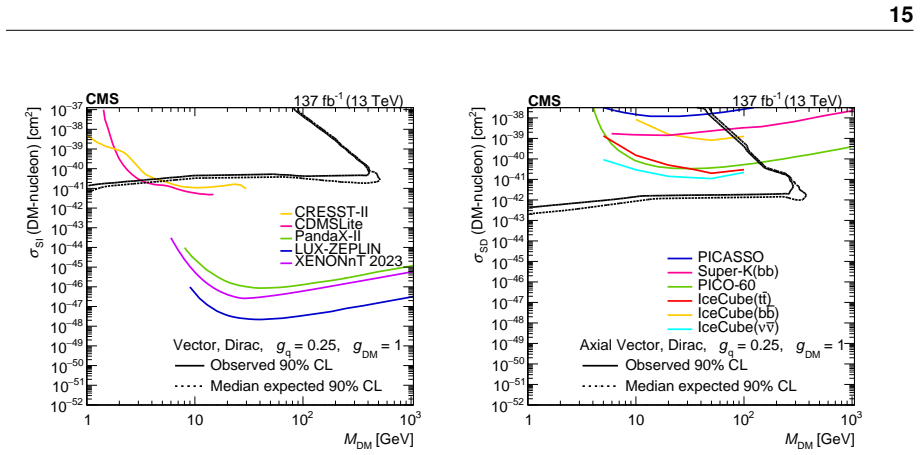
The analysis of the complete 137 fb^{-1} dataset collected at 13 TeV shows that the number of events containing a single photon and large missing transverse momentum is consistent with standard model expectations. Limits at 95% confidence level are placed on the parameters of dark matter mediator models, effective field theory suppression scales, and the fundamental Planck scale in large extra dimension models, with the full dataset providing up to 14% stronger exclusions than the 2016 data alone.
What carries the argument
The single-photon plus missing transverse momentum final state interpreted through simplified dark matter production models and the ADD large extra dimensions framework.
If this is right
- Stronger upper limits on dark matter mediator masses in simplified models.
- Tighter bounds on the effective field theory suppression scale for contact interactions.
- Improved constraints on the fundamental Planck scale in large extra dimensions models.
Where Pith is reading between the lines
- The updated limits narrow the viable parameter space for dark matter candidates that couple to quarks via mediators.
- Similar searches in other final states could be combined to test consistency across different production mechanisms.
Load-bearing premise
The standard model accurately describes all background processes in this final state and the simplified models used for interpretation correctly represent the new physics signatures.
What would settle it
A statistically significant excess of events in the single-photon plus missing transverse momentum signal region above the predicted standard model background would indicate new physics and contradict the no-deviation result.
Figures




read the original abstract
A search for new physics in events featuring a single photon and missing transverse momentum is presented, using proton-proton $\sqrt{s}$ = 13 TeV collision data corresponding to an integrated luminosity of 101 fb$^{-1}$ collected by the CMS experiment at the CERN LHC between 2017 and 2018. This analysis, combined with a previous study of 36 fb$^{-1}$ of 2016 data (totaling 137 fb$^{-1}$), reveals no significant deviations from standard model expectations. The results are then used to establish 95% confidence level limits on parameters in theoretical models involving dark matter and large extra dimensions. Compared to the 2016-only analysis, this search achieves up to a 14% improvement in exclusion reach for mediator masses in simplified dark matter models, along with 11% and 10% enhancements in the limits on the effective field theory suppression scale and the fundamental Planck scale, respectively. These results are the most stringent constraints on these parameters to date.
Editorial analysis
A structured set of objections, weighed in public.
Referee Report
Summary. The manuscript presents a search for new physics in the single-photon plus large missing transverse momentum final state using 101 fb^{-1} of 13 TeV proton-proton collision data collected by CMS in 2017-2018. Combined with a prior analysis of 36 fb^{-1} from 2016 (total 137 fb^{-1}), no significant deviations from standard model expectations are observed. The results are interpreted to set 95% CL limits on simplified dark matter models (improving mediator mass exclusion reach by up to 14%) and large extra dimensions (improvements of 11% on the EFT suppression scale and 10% on the fundamental Planck scale), claiming these as the most stringent constraints to date.
Significance. If the background estimation, systematic uncertainties, and statistical methods are validated as described, the work provides meaningful incremental improvements to existing limits on dark matter and LED parameters using the full Run 2 dataset. The absence of deviations reinforces SM consistency in this channel, and the combined luminosity yields a modest but quantifiable gain in sensitivity. This is a standard, solid contribution to LHC BSM searches with clear falsifiable predictions via the reported limits.
major comments (1)
- [§5] §5 (Background Estimation and Validation): The extrapolation of background predictions from control regions (e.g., Z→ℓℓγ enriched or low-MET samples) to the high-MET signal region for the 2017-2018 dataset must explicitly demonstrate consistency with 2016 data regarding pile-up modeling and photon identification efficiencies; any unaccounted period-dependent differences would directly impact the no-deviation claim and the derived 95% CL limits on DM mediator masses.
minor comments (2)
- [Table 1] Table 1: The breakdown of systematic uncertainties should include a column for the combined 137 fb^{-1} dataset to allow direct assessment of the improvement over the 2016-only result.
- [Figure 4] Figure 4 (limit plots): Adding the 2016-only exclusion curves as dashed lines would facilitate immediate visual comparison of the 14% reach improvement claimed in the abstract.
Simulated Author's Rebuttal
We thank the referee for the positive assessment and recommendation for minor revision. We address the single major comment on background estimation and validation below, agreeing to enhance explicit comparisons as suggested while maintaining the robustness of our analysis.
read point-by-point responses
-
Referee: [§5] §5 (Background Estimation and Validation): The extrapolation of background predictions from control regions (e.g., Z→ℓℓγ enriched or low-MET samples) to the high-MET signal region for the 2017-2018 dataset must explicitly demonstrate consistency with 2016 data regarding pile-up modeling and photon identification efficiencies; any unaccounted period-dependent differences would directly impact the no-deviation claim and the derived 95% CL limits on DM mediator masses.
Authors: We thank the referee for highlighting this point. Our analysis already includes validations of the background extrapolation using control regions for the 2017-2018 dataset, with systematic uncertainties assigned to account for potential differences in pile-up modeling and photon identification efficiencies relative to 2016. These uncertainties are propagated to the final limits. To make the consistency more explicit, we will revise Section 5 in the updated manuscript to include a dedicated comparison of pile-up distributions and photon ID efficiency measurements across the 2016 and 2017-2018 periods, demonstrating agreement within uncertainties. This addition will not change the central results or limits but will strengthen the presentation. revision: yes
Circularity Check
No circularity: results from direct data-to-SM comparison and external model limits
full rationale
The paper's derivation consists of collecting 101 fb^{-1} of 2017-2018 data, estimating SM backgrounds via Monte Carlo normalized in control regions, comparing observed yields to predictions in the single-photon + MET signal region, finding no significant excess, and setting 95% CL limits on external simplified dark matter and large extra dimensions models. The combination with the prior 36 fb^{-1} 2016 dataset is a straightforward luminosity sum for improved sensitivity and does not reduce any central claim to a self-citation or fitted input by construction. All load-bearing steps rely on experimental data, standard simulation tools, and independently defined theoretical models rather than re-deriving inputs from outputs.
Axiom & Free-Parameter Ledger
axioms (2)
- domain assumption Standard Model processes accurately model the expected background in single photon plus missing transverse momentum events.
- domain assumption The simplified theoretical models for dark matter and large extra dimensions are appropriate for setting exclusion limits at 95% CL.
Lean theorems connected to this paper
-
IndisputableMonolith/Foundation/AlexanderDuality.leanalexander_duality_circle_linking unclear?
unclearRelation between the paper passage and the cited Recognition theorem.
The estimated per-bin SR yields of the Z(→νν)+γ and W(→ℓν)+γ backgrounds are scaled by transfer factors from the observed yields in the dilepton and single lepton CRs, respectively. The transfer factors are computed from simulation.
What do these tags mean?
- matches
- The paper's claim is directly supported by a theorem in the formal canon.
- supports
- The theorem supports part of the paper's argument, but the paper may add assumptions or extra steps.
- extends
- The paper goes beyond the formal theorem; the theorem is a base layer rather than the whole result.
- uses
- The paper appears to rely on the theorem as machinery.
- contradicts
- The paper's claim conflicts with a theorem or certificate in the canon.
- unclear
- Pith found a possible connection, but the passage is too broad, indirect, or ambiguous to say the theorem truly supports the claim.
Reference graph
Works this paper leans on
-
[1]
The hierarchy problem and new dimensions at a millimeter
N. Arkani-Hamed, S. Dimopoulos, and G. Dvali, “The hierarchy problem and new dimensions at a millimeter”,Phys. Lett. B429(1998) 263, doi:10.1016/S0370-2693(98)00466-3
-
[2]
N. Arkani-Hamed, S. Dimopoulos, and G. Dvali, “Phenomenology, astrophysics, and cosmology of theories with submillimeter dimensions and TeV scale quantum gravity”, Phys. Rev. D59(1999) 086004,doi:10.1103/PhysRevD.59.086004
-
[3]
Infinitely large new dimensions
N. Arkani-Hamed, S. Dimopoulos, G. R. Dvali, and N. Kaloper, “Infinitely large new dimensions”,Phys. Rev. Lett.84(2000) 586,doi:10.1103/PhysRevLett.84.586
-
[4]
Maverick dark matter at colliders
M. Beltran et al., “Maverick dark matter at colliders”,J. High Energy Phys.2010(2010), no. 09, 037,doi:10.1007/JHEP09(2010)037
-
[5]
Constraints on dark matter from colliders
J. Goodman et al., “Constraints on dark matter from colliders”,Phys. Rev. D82(2010) 116010,doi:10.1103/PhysRevD.82.116010
-
[6]
Missing energy signatures of dark matter at the LHC
P . J. Fox, R. Harnik, J. Kopp, and Y. Tsai, “Missing energy signatures of dark matter at the LHC”,Phys. Rev. D85(2012) 056011,doi:10.1103/PhysRevD.85.056011
-
[7]
Dark matter benchmark models for early LHC Run-2 searches: Report of the ATLAS/CMS dark matter forum
D. Abercrombie, “Dark matter benchmark models for early LHC run-2 searches: Report of the ATLAS/CMS dark matter forum”,Phys. Dark Univ.27(2020) 100371, doi:10.1016/j.dark.2019.100371
-
[8]
A. Boveia et al., “Recommendations on presenting LHC searches for missing transverse energy signals using simplifieds-channel models of dark matter”,Phys. Dark Univ.27 (2020) 100365,doi:10.1016/j.dark.2019.100365
-
[9]
A. Nelson et al., “Confronting the Fermi line with LHC data: An effective theory of dark matter interaction with photons”,Phys. Rev. D89(2014) 056011, doi:10.1103/PhysRevD.89.056011
-
[10]
CMS Collaboration, “Search for new physics in final states with a single photon and missing transverse momentum in proton-proton collisions at √s=13 TeV”,J. High Energy Phys.2019(2019), no. 02, 074,doi:10.1007/JHEP02(2019)074
-
[11]
ATLAS Collaboration, “Search for dark matter in association with an energetic photon in ppcollisions at √s=13 TeV with the ATLAS detector”,J. High Energy Phys.2021(2021), no. 02, 226,doi:10.1007/JHEP02(2021)226. References 19
-
[12]
HEPData record for this analysis
“HEPData record for this analysis”, 2025.doi:10.17182/hepdata.166403
-
[13]
The CMS experiment at the CERN LHC
CMS Collaboration, “The CMS experiment at the CERN LHC”,J. Instrum.3(2008) S08004,doi:10.1088/1748-0221/3/08/S08004
-
[14]
Development of the CMS detector for the CERN LHC Run 3
CMS Collaboration, “Development of the CMS detector for the CERN LHC Run 3”,J. Instrum.19(2024) P05064,doi:10.1088/1748-0221/19/05/P05064
-
[15]
Electron and photon reconstruction and identification with the CMS experiment at the CERN LHC
CMS Collaboration, “Electron and photon reconstruction and identification with the CMS experiment at the CERN LHC”,J. Instrum.16(2021) P05014, doi:10.1088/1748-0221/16/05/P05014
-
[16]
CMS Collaboration, “Performance of the CMS muon detector and muon reconstruction with proton-proton collisions at √s=13 TeV”,J. Instrum.13(2018) P06015, doi:10.1088/1748-0221/13/06/P06015
work page internal anchor Pith review doi:10.1088/1748-0221/13/06/p06015 2018
-
[17]
Description and performance of track and primary-vertex reconstruction with the CMS tracker
CMS Collaboration, “Description and performance of track and primary-vertex reconstruction with the CMS tracker”,J. Instrum.9(2014) P10009, doi:10.1088/1748-0221/9/10/P10009
-
[18]
Performance of the CMS Level-1 trigger in proton-proton collisions at √s = 13 TeV
CMS Collaboration, “Performance of the CMS level-1 trigger in proton-proton collisions at √s=13 TeV”,J. Instrum.15(2020) P10017, doi:10.1088/1748-0221/15/10/P10017
-
[19]
CMS Collaboration, “The CMS trigger system”,J. Instrum.12(2017) P01020, doi:10.1088/1748-0221/12/01/P01020
-
[20]
Performance of the CMS high-level trigger during LHC Run 2
CMS Collaboration, “Performance of the CMS high-level trigger during LHC run 2”,J. Instrum.19(2024) P11021,doi:10.1088/1748-0221/19/11/P11021
-
[21]
Technical proposal for the Phase-II upgrade of the Compact Muon Solenoid
CMS Collaboration, “Technical proposal for the phase-ii upgrade of the CMS detector”, technical report, CERN, 2015.doi:10.17181/CERN.VU8I.D59J
-
[22]
Particle-flow reconstruction and global event description with the CMS detector
CMS Collaboration, “Particle-flow reconstruction and global event description with the CMS detector”,J. Instrum.12(2017) P10003, doi:10.1088/1748-0221/12/10/P10003
work page internal anchor Pith review doi:10.1088/1748-0221/12/10/p10003 2017
-
[23]
The anti-kT jet clustering algorithm
M. Cacciari, G. P . Salam, and G. Soyez, “The anti-kT jet clustering algorithm”,J. High Energy Phys.2008(2008), no. 04, 063,doi:10.1088/1126-6708/2008/04/063
-
[24]
M. Cacciari, G. P . Salam, and G. Soyez, “Fastjet user manual”,Eur. Phys. J. C72(2012) 1896,doi:10.1140/epjc/s10052-012-1896-2
-
[25]
Jet energy scale and resolution in the CMS experiment in pp collisions at 8 TeV
CMS Collaboration, “Jet energy scale and resolution in the CMS experiment in pp collisions at 8 TeV”,J. Instrum.12(2017) P02014, doi:10.1088/1748-0221/12/02/P02014
-
[26]
CMS Collaboration, “Performance of missing transverse momentum reconstruction in proton-proton collisions at √s=13 TeV using the CMS detector”,J. Instrum.14(2019) P07004,doi:10.1088/1748-0221/14/07/P07004
-
[27]
Jet algorithms performance in 13 TeV data
CMS Collaboration, “Jet algorithms performance in 13 TeV data”, CMS Physics Analysis Summary CMS-PAS-JME-16-003, CERN, 2017. 20
work page 2017
-
[28]
CMS Collaboration, “Performance of photon reconstruction and identification with the CMS detector in proton-proton collisions at √s=8 TeV”,J. Instrum.10(2015) P08010, doi:10.1088/1748-0221/10/08/P08010
-
[29]
CMS Collaboration, “Performance of the reconstruction and identification of high-momentum muons in proton-proton collisions at √s=13 TeV”,J. Instrum.15 (2020) P02027,doi:10.1088/1748-0221/15/02/P02027
-
[30]
Parton distributions from high-precision collider data
NNPDF Collaboration, “Parton distributions from high-precision collider data”,Eur. Phys. J. C77(2017) 663,doi:10.1140/epjc/s10052-017-5199-5
work page internal anchor Pith review doi:10.1140/epjc/s10052-017-5199-5 2017
-
[31]
J. Alwall et al., “The automated computation of tree-level and next-to-leading order differential cross sections, and their matching to parton shower simulations”,J. High Energy Phys.2014(2014), no. 07, 079,doi:10.1007/JHEP07(2014)079
-
[32]
T. Sj ¨ostrand et al., “An introduction to PYTHIA 8.2”,Comput. Phys. Commun.191(2015) 159,doi:10.1016/j.cpc.2015.01.024
-
[33]
Event generator tunes obtained from underlying event and multiparton scattering measurements
CMS Collaboration, “Event generator tunes obtained from underlying event and multiparton scattering measurements”,Eur. Phys. J. C76(2016) 155, doi:10.1140/epjc/s10052-016-3988-x
-
[34]
GEANT4 Collaboration, “GEANT4—a simulation toolkit”,Nucl. Instrum. Meth. A506 (2003) 250,doi:10.1016/S0168-9002(03)01368-8
-
[35]
GEANT4 developments and applications
J. Allison, “GEANT4 developments and applications”,IEEE T rans. Nucl. Sci53(2006) 270,doi:10.1109/TNS.2006.869826
-
[36]
A novel beam halo monitor for the CMS experiment at the LHC
S. Orfanelli et al., “A novel beam halo monitor for the CMS experiment at the LHC”,J. Instrum.10(2015) P11011,doi:10.1088/1748-0221/10/11/P11011
-
[37]
Vector boson production at hadron colliders: transverse-momentum resummation and leptonic decay
S. Catani, D. de Florian, G. Ferrera, and M. Grazzini, “Vector boson production at hadron colliders: transverse-momentum resummation and leptonic decay”,J. High Energy Phys. 2015(2015), no. 12, 047,doi:10.1007/JHEP12(2015)047
-
[38]
NLO QCD and electroweak corrections toW+γproduction with leptonicW-boson decays
A. Denner, S. Dittmaier, M. Hecht, and C. Pasold, “NLO QCD and electroweak corrections toW+γproduction with leptonicW-boson decays”,J. High Energy Phys. 2015(2015), no. 04, 018,doi:10.1007/JHEP04(2015)018
-
[39]
NLO QCD and electroweak corrections toZ+γproduction with leptonicZ-boson decays
A. Denner, S. Dittmaier, M. Hecht, and C. Pasold, “NLO QCD and electroweak corrections toZ+γproduction with leptonicZ-boson decays”,J. High Energy Phys.2016 (2016), no. 02, 057,doi:10.1007/JHEP02(2016)057
-
[40]
The photon content of the proton
A. V . Manohar, P . Nason, G. P . Salam, and G. Zanderighi, “The photon content of the proton”,J. High Energy Phys.2017(2017), no. 12, 046, doi:10.1007/JHEP12(2017)046
-
[41]
CMS Collaboration, “Measurement of the inclusiveWandZproduction cross sections in pp collisions at √s=7 TeV with the CMS experiment”,J. High Energy Phys.2011(2011), no. 10, 132,doi:10.1007/JHEP10(2011)132
-
[42]
Precise predictions for V+jets dark matter backgrounds
J. M. Lindert et al., “Precise predictions for V+jets dark matter backgrounds”,Eur. Phys. J. C77(2017) 829,doi:10.1140/epjc/s10052-017-5389-1. References 21
-
[43]
Precision luminosity measurement in proton-proton collisions at√s = 13 TeV in 2015 and 2016 at CMS
CMS Collaboration, “Precision luminosity measurement in proton-proton collisions at√s=13 TeV in 2015 and 2016 at CMS”,Eur. Phys. J. C81(2021) 800, doi:10.1140/epjc/s10052-021-09538-2
-
[44]
CMS luminosity measurement for the 2017 data-taking period at√s=13 TeV
CMS Collaboration, “CMS luminosity measurement for the 2017 data-taking period at√s=13 TeV”, CMS Physics Analysis Summary CMS-PAS-LUM-17-004, CERN, 2018
work page 2017
-
[45]
CMS luminosity measurement for the 2018 data-taking period at√s=13 TeV
CMS Collaboration, “CMS luminosity measurement for the 2018 data-taking period at√s=13 TeV”, CMS Physics Analysis Summary CMS-PAS-LUM-18-002, CERN, 2019
work page 2018
-
[46]
The CMS statistical analysis and combination tool: Combine
CMS Collaboration, “The CMS statistical analysis and combination tool: Combine”, Comput. Softw. Big Sci.8(2024) 19,doi:10.1007/s41781-024-00121-4
-
[47]
Confidence Level Computation for Combining Searches with Small Statistics
T. Junk, “Confidence level computation for combining searches with small statistics”, Nucl. Instrum. Meth. A434(1999) 435,doi:10.1016/S0168-9002(99)00498-2
work page internal anchor Pith review doi:10.1016/s0168-9002(99)00498-2 1999
-
[48]
Presentation of search results: the CL s technique
A. L. Read, “Presentation of search results: Thecl s technique”,J. Phys. G28(2002) 2693, doi:10.1088/0954-3899/28/10/313
-
[49]
Asymptotic formulae for likelihood-based tests of new physics
G. Cowan, K. Cranmer, E. Gross, and O. Vitells, “Asymptotic formulae for likelihood-based tests of new physics”,Eur. Phys. J. C71(2011) 1554, doi:10.1140/epjc/s10052-011-1554-0. [Erratum: doi:10.1140/epjc/s10052-013-2501-z]
work page internal anchor Pith review doi:10.1140/epjc/s10052-011-1554-0 2011
-
[50]
Planck 2015 results. XIII. Cosmological parameters
Planck Collaboration, “Planck 2015 results. XIII. Cosmological parameters”,Astron. Astrophys.594(2016) A13,doi:10.1051/0004-6361/201525830
-
[51]
MadDM v.1.0: Computation of dark matter relic abundance using MadGraph5
M. Backovic, K. Kong, and M. McCaskey, “MadDM v.1.0: Computation of dark matter relic abundance using MadGraph5”,Physics of the Dark Universe5-6(2014) 18, doi:10.1016/j.dark.2014.04.001
-
[52]
SuperCDMS Collaboration, “New results from the search for low-mass weakly interacting massive particles with the CDMS low ionization threshold experiment”, Phys. Rev. Lett.116(2016) 071301,doi:10.1103/PhysRevLett.116.071301
-
[53]
Dark matter search results from 4.2 tonne-years of exposure of the LUX-ZEPLIN (LZ) experiment
LZ Collaboration, “Dark matter search results from 4.2 tonne-years of exposure of the LUX-ZEPLIN (LZ) experiment”,Phys. Rev. Lett.135(2025) 011802, doi:10.1103/4dyc-z8zf
-
[54]
Dark matter results from 54-ton-day exposure of the PandaX-II experiment
PandaX-II Collaboration, “Dark matter results from 54-ton-day exposure of the PandaX-II experiment”,Phys. Rev. Lett.119(2017) 181302, doi:10.1103/PhysRevLett.119.181302
-
[55]
First dark matter search with nuclear recoils from the XENONnT experiment
XENON Collaboration, “First dark matter search with nuclear recoils from the XENONnT experiment”,Phys. Rev. Lett.131(2023) 041003, doi:10.1103/PhysRevLett.131.041003
-
[56]
Results on light dark matter particles with a low-threshold CRESST-II detector
CRESST Collaboration, “Results on light dark matter particles with a low-threshold CRESST-II detector”,Eur. Phys. J. C76(2016) 25, doi:10.1140/epjc/s10052-016-3877-3
-
[57]
Dark matter search results from the PICO-60 c 3f8 bubble chamber
PICO Collaboration, “Dark matter search results from the PICO-60 c 3f8 bubble chamber”, Phys. Rev. Lett.118(2017) 251301,doi:10.1103/PhysRevLett.118.251301. 22
-
[58]
Search for gev-scale dark matter annihilation in the Sun with IceCube DeepCore
IceCube Collaboration, “Search for gev-scale dark matter annihilation in the Sun with IceCube DeepCore”,Phys. Rev. D105(2022) 062004, doi:10.1103/PhysRevD.105.062004
-
[59]
Final results of the PICASSO dark matter search experiment
E. Behnke et al., “Final results of the PICASSO dark matter search experiment”, Astropart. Phys.90(2017) 85,doi:10.1016/j.astropartphys.2017.02.005
-
[60]
Super-Kamiokande Collaboration, “Search for neutrinos from annihilation of captured low-mass dark matter particles in the Sun by Super-Kamiokande”,Phys. Rev. Lett.114 (2015) 141301,doi:10.1103/PhysRevLett.114.141301. 23 A The CMS Collaboration Yerevan Physics Institute, Yerevan, Armenia A. Hayrapetyan, V . Makarenko , A. Tumasyan1 Institut f ¨ ur Hochener...
discussion (0)
Sign in with ORCID, Apple, or X to comment. Anyone can read and Pith papers without signing in.