Optimal Thermalization under Indefinite Causal Order with Identical and Asymmetric Baths
Pith reviewed 2026-05-25 07:10 UTC · model grok-4.3
The pith
Indefinite causal order lets a qubit reach effective temperatures outside the range set by two baths under any definite causal order.
A machine-rendered reading of the paper's core claim, the machinery that carries it, and where it could break.
Core claim
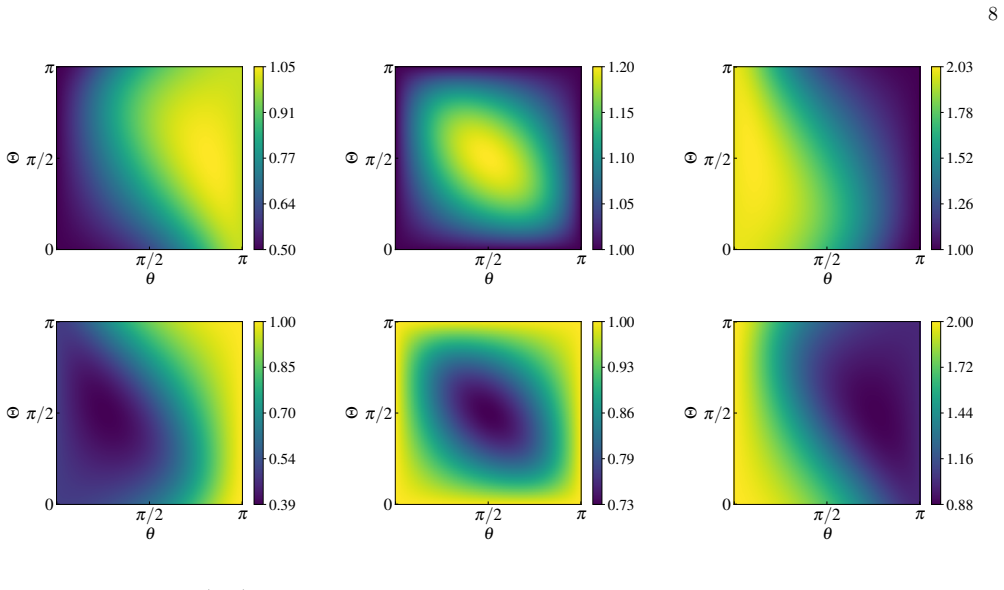
The diagonal and coherent components of the control-qubit state contribute separately to the temperature shift, and their interplay enables departures from the thermal response attainable under protocols with a definite causal order within the thermodynamic setting considered here.
What carries the argument
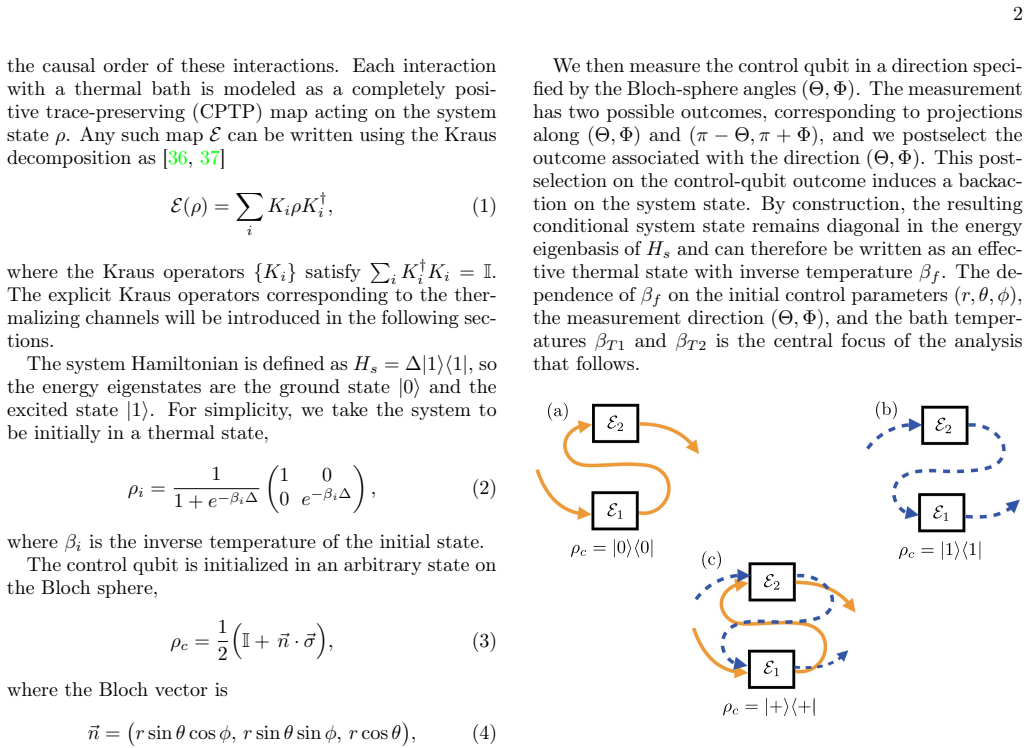
The quantum SWITCH, which applies two thermalizing channels in a coherent superposition of orders controlled by an ancillary qubit, followed by postselection on the control state.
If this is right
- For identical baths the control parameters that maximize heating or cooling are identified explicitly.
- Asymmetric bath temperatures increase the magnitude of the temperature shift beyond definite-order bounds.
- Lower purity of the control qubit monotonically suppresses the extra thermalization effect.
- The closed-form expressions for the final inverse temperature allow direct optimization over control parameters.
Where Pith is reading between the lines
- The separation of population and coherence effects suggests that coherence in the control could act as an independent thermodynamic resource in other indefinite-order processes.
- The framework could be extended to continuous-time or multi-bath settings to test whether similar departures persist.
- Experimental tests would require verifying that the observed temperature shift scales with control coherence exactly as the derived expressions predict.
Load-bearing premise
The thermalizing channels are applied exactly via the quantum SWITCH with perfect postselection on the control qubit state and no additional decoherence or implementation costs.
What would settle it
Prepare the control qubit in a state with known population and coherence, apply the SWITCH protocol to a system qubit, postselect on the control outcome, and measure whether the system's effective temperature lies strictly outside the interval bounded by the two bath temperatures.
Figures


read the original abstract
Indefinite causal order (ICO), in which the order of quantum operations is placed in a coherent superposition, has been demonstrated to enhance various information-processing tasks. Here, we investigate its impact on the thermodynamic processes generated by thermalizing quantum channels. We consider a two-level system interacting with two thermal baths under a quantum SWITCH, with the channel order controlled coherently by an ancillary qubit. We derive closed-form expressions for the effective inverse temperature $\beta_f$ of the postselected system state for both identical and distinct bath temperatures, and identify the control-qubit parameters that maximize heating or cooling. Our analysis reveals how the diagonal and coherent components of the control-qubit state contribute separately to the temperature shift, and how their interplay enables departures from the thermal response attainable under protocols with a definite causal order within the thermodynamic setting considered here. Bath asymmetry enhances these effects, while reduced purity of the control qubit state suppresses them. These results provide a systematic framework for assessing SWITCH-based thermalization in the setting of indefinite causal order, and identify control-qubit coherence as a tunable resource.
Editorial analysis
A structured set of objections, weighed in public.
Referee Report
Summary. The paper investigates thermalization of a two-level system via two thermal baths (identical or asymmetric temperatures) under the quantum SWITCH with an ancillary control qubit in indefinite causal order. It derives closed-form expressions for the postselected system's effective inverse temperature β_f, identifies control-qubit parameters maximizing heating/cooling, and shows that the diagonal and coherent components of the control state contribute separately to the temperature shift, enabling departures from definite causal order thermal responses; bath asymmetry enhances the effects while reduced control purity suppresses them.
Significance. If the derivations hold, the work supplies an analytical framework for ICO in quantum thermodynamics, explicitly crediting the closed-form expressions for β_f and the separation of diagonal/coherent contributions as strengths. This identifies control coherence as a tunable resource for enhanced thermalization beyond definite-order protocols, with potential implications for quantum heat engines and information-thermodynamic tasks.
major comments (1)
- [Abstract/setup] Abstract and setup description: The separation of diagonal and coherent control-qubit contributions to β_f (and the resulting ICO-specific departure from definite-order maps) is derived under the assumption of exact quantum SWITCH application followed by ideal projective postselection with no decoherence or implementation costs. The manuscript does not analyze robustness to control-qubit decoherence, which would suppress off-diagonal terms and mix the contributions, undermining the claimed independent effects and enhanced heating/cooling.
Simulated Author's Rebuttal
We thank the referee for their positive evaluation of the work's significance and for the constructive comment. We address the major point below.
read point-by-point responses
-
Referee: The separation of diagonal and coherent control-qubit contributions to β_f (and the resulting ICO-specific departure from definite-order maps) is derived under the assumption of exact quantum SWITCH application followed by ideal projective postselection with no decoherence or implementation costs. The manuscript does not analyze robustness to control-qubit decoherence, which would suppress off-diagonal terms and mix the contributions, undermining the claimed independent effects and enhanced heating/cooling.
Authors: We agree that the derivations assume an ideal quantum SWITCH and perfect postselection in the absence of decoherence. This ideal setting is required to obtain the exact closed-form expressions for β_f and to isolate the distinct contributions of the control state's diagonal and coherent components. The referee is correct that decoherence would suppress off-diagonal terms and could mix these contributions. The manuscript's scope is the analytical characterization of the ideal case, which provides a benchmark for ICO effects in thermalization. We will add a short paragraph in the conclusions acknowledging the ideal assumptions and identifying robustness to control decoherence as an important direction for future work. This revision clarifies the present scope without changing the main results. revision: partial
Circularity Check
No significant circularity; derivation self-contained from standard formalism
full rationale
The abstract and setup describe deriving closed-form expressions for β_f directly from the quantum SWITCH applied to thermalizing channels on a two-level system, with explicit separation of diagonal and coherent control-qubit contributions. No quoted equations or steps reduce by construction to fitted parameters, self-definitions, or load-bearing self-citations; the results follow from standard quantum channel composition under indefinite causal order without tautological inputs. The reader's assessment of score 2.0 aligns with this, as assumptions like perfect postselection are modeling choices rather than circular reductions.
Axiom & Free-Parameter Ledger
axioms (2)
- domain assumption Quantum SWITCH implements coherent superposition of thermalizing channel orders controlled by ancillary qubit
- domain assumption Postselection on control qubit yields the effective system state whose temperature is analyzed
Reference graph
Works this paper leans on
-
[1]
Evaluating Eq. (16) at the angles that extremizeβf gives, for a pure control state(r= 1), p(±) opt = 1 2 sin2 θ 1±γ ,(18) where the plus and minus signs correspond to the max- imum and minimum values ofβf, respectively. Because 0< γ <1, at least one of the two extremal branches necessarily has a reduced success probability. In the low- temperature limitβi...
-
[2]
G. Chiribella, G. M. D’Ariano, P. Perinotti, and B. Val- iron, Phys. Rev. A88, 022318 (2013)
work page 2013
- [3]
-
[4]
T. Colnaghi, G. M. D’Ariano, S. Facchini, and P. Perinotti, Physics Letters A376, 2940 (2012)
work page 2012
- [5]
- [6]
-
[7]
M. M. Taddei, J. Cariñe, D. Martínez, T. García, N. Guerrero, A. A. Abbott, M. Araújo, C. Branciard, E. S. Gómez, S. P. Walborn, L. Aolita, and G. Lima, PRX Quantum2, 010320 (2021)
work page 2021
- [8]
- [9]
-
[10]
S. Kechrimparis, J. Moran, A. Karsa, C. Lee, and H. Kwon, New Journal of Physics26, 123030 (2024)
work page 2024
- [11]
-
[12]
G. Chiribella, M. Banik, S. S. Bhattacharya, T. Guha, M. Alimuddin, A. Roy, S. Saha, S. Agrawal, and G. Kar, New Journal of Physics23, 033039 (2021)
work page 2021
-
[13]
L. M. Procopio, F. Delgado, M. Enríquez, N. Belabas, and J. A. Levenson, Entropy21, 10.3390/e21101012 (2019)
-
[14]
A. Feix, M. Araújo, and i. c. v. Brukner, Phys. Rev. A 92, 052326 (2015)
work page 2015
-
[15]
P. A. Guérin, A. Feix, M. Araújo, and i. c. v. Brukner, Phys. Rev. Lett.117, 100502 (2016)
work page 2016
- [16]
- [17]
- [18]
-
[19]
A. Z. Goldberg and K. Heshami, Journal of Physics Com- munications7, 015003 (2023)
work page 2023
-
[20]
T. Guha, M. Alimuddin, and P. Parashar, Phys. Rev. A 102, 032215 (2020)
work page 2020
-
[21]
K. Simonov, S. Roy, T. Guha, Z. Zimborás, and G. Chiri- bella, New Journal of Physics27, 074502 (2025)
work page 2025
-
[22]
K. Simonov, G. Francica, G. Guarnieri, and M. Pater- nostro, Phys. Rev. A105, 032217 (2022)
work page 2022
-
[23]
Frey, Quantum Information Processing18(2019)
M. Frey, Quantum Information Processing18(2019)
work page 2019
-
[24]
X. Zhao, Y. Yang, and G. Chiribella, Phys. Rev. Lett. 124, 190503 (2020)
work page 2020
-
[25]
F. m. c. Chapeau-Blondeau, Phys. Rev. A103, 032615 (2021)
work page 2021
-
[26]
Q. Liu, Z. Hu, H. Yuan, and Y. Yang, Phys. Rev. Lett. 130, 070803 (2023)
work page 2023
-
[27]
A. Z. Goldberg, K. Heshami, and L. L. Sánchez-Soto, Phys. Rev. Res.5, 033198 (2023)
work page 2023
-
[28]
L. M. Procopio, A. Moqanaki, M. Araújo, F. Costa, I. Alonso Calafell, E. G. Dowd, D. R. Hamel, L. A. 8 π/2 π θ 0 π/2 π Θ 0.50 0.64 0.77 0.91 1.05 π/2 π θ 0 π/2 π Θ 1.00 1.05 1.10 1.15 1.20 π/2 π θ 0 π/2 π Θ 1.00 1.26 1.52 1.78 2.03 π/2 π θ 0 π/2 π Θ 0.39 0.54 0.70 0.85 1.00 π/2 π θ 0 π/2 π Θ 0.73 0.79 0.86 0.93 1.00 π/2 π θ 0 π/2 π Θ 0.88 1.16 1.44 1.72 2...
work page 2015
-
[29]
K. Goswami, C. Giarmatzi, M. Kewming, F. Costa, C. Branciard, J. Romero, and A. G. White, Phys. Rev. Lett.121, 090503 (2018)
work page 2018
-
[30]
K. Wei, N. Tischler, S.-R. Zhao, Y.-H. Li, J. M. Arrazola, Y. Liu, W. Zhang, H. Li, L. You, Z. Wang, Y.-A. Chen, B. C. Sanders, Q. Zhang, G. J. Pryde, F. Xu, and J.-W. Pan, Phys. Rev. Lett.122, 120504 (2019)
work page 2019
-
[31]
K. Goswami, Y. Cao, G. A. Paz-Silva, J. Romero, and A. G. White, Phys. Rev. Res.2, 033292 (2020)
work page 2020
- [32]
-
[33]
X. Nie, X. Zhu, K. Huang, K. Tang, X. Long, Z. Lin, Y. Tian, C. Qiu, C. Xi, X. Yang, J. Li, Y. Dong, T. Xin, and D. Lu, Phys. Rev. Lett.129, 100603 (2022)
work page 2022
-
[34]
T. Strömberg, P. Schiansky, R. W. Peterson, M. T. Quintino, and P. Walther, Phys. Rev. Lett.131, 060803 (2023)
work page 2023
-
[35]
L. A. Rozema, T. Strömberg, H. Cao, Y. Guo, B.-H. Liu, and P. Walther, Nature Reviews Physics6, 483 (2024)
work page 2024
- [36]
-
[37]
M. A. Nielsen and I. L. Chuang,Quantum computation and quantum information(Cambridge university press, 2010)
work page 2010
-
[38]
Jacobs,Quantum measurement theory and its appli- cations(Cambridge University Press, 2014)
K. Jacobs,Quantum measurement theory and its appli- cations(Cambridge University Press, 2014)
work page 2014
discussion (0)
Sign in with ORCID, Apple, or X to comment. Anyone can read and Pith papers without signing in.