HiFiNet: Hierarchical Fault Identification in Wireless Sensor Networks via Edge-Based Classification and Graph Aggregation
Pith reviewed 2026-05-18 00:03 UTC · model grok-4.3
The pith
A two-stage model first classifies faults locally with LSTM autoencoders then refines them using graph attention over neighboring nodes to improve accuracy in wireless sensor networks.
A machine-rendered reading of the paper's core claim, the machinery that carries it, and where it could break.
Core claim
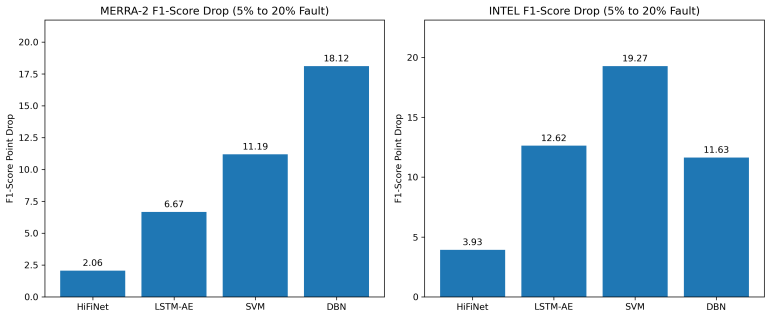
HiFiNet identifies faults through a two-stage process in which edge-based LSTM stacked autoencoders extract temporal features and output initial class predictions for individual nodes, after which a Graph Attention Network aggregates results from neighboring nodes to incorporate topology context and produce refined classifications that outperform prior methods on accuracy, F1-score, and precision when tested on synthetic datasets built from the Intel Lab Dataset and MERRA-2 reanalysis data.
What carries the argument
The two-stage hierarchical architecture in which LSTM stacked autoencoders perform local temporal feature extraction and initial classification before a Graph Attention Network integrates spatial dependencies from the sensor network topology.
If this is right
- The framework captures both local temporal patterns at individual nodes and network-wide spatial dependencies to reach higher classification accuracy.
- Operators can adjust the balance between diagnostic performance and energy consumption to match different deployment needs.
- Diverse fault types become identifiable with better precision than earlier single-stage or non-graph methods achieve.
- The design produces measurable gains in standard metrics on datasets that combine real sensor traces with controlled fault injection.
Where Pith is reading between the lines
- The same local-to-global structure could transfer to other distributed sensing setups such as urban air-quality grids where both timing and location matter.
- Explicit modeling of communication cost at the aggregation step might reveal further energy savings without losing the accuracy benefit.
- Replacing the fixed graph with a learned dynamic topology could extend the method to sensor networks whose connections change over time.
Load-bearing premise
The synthetic faults added to the Intel Lab and MERRA-2 datasets stand in for the complex real-world spatio-temporal fault patterns that appear in unfavourable deployment conditions.
What would settle it
Deploying the framework on sensor data collected from an actual field site with naturally occurring faults and comparing its accuracy and F1-score against existing methods would show whether the reported gains persist outside the synthetic setting.
Figures




read the original abstract
Wireless Sensor Networks (WSN) are the backbone of essential monitoring applications, but their deployment in unfavourable conditions increases the risk to data integrity and system reliability. Traditional fault detection methods often struggle to effectively balance accuracy and energy consumption, and they may not fully leverage the complex spatio-temporal correlations inherent in WSN data. In this paper, we introduce HiFiNet, a novel hierarchical fault identification framework that addresses these challenges through a two-stage process. Firstly, edge classifiers with a Long Short-Term Memory (LSTM) stacked autoencoder perform temporal feature extraction and output initial fault class prediction for individual sensor nodes. Using these results, a Graph Attention Network (GAT) then aggregates information from neighboring nodes to refine the classification by integrating the topology context. Our method is able to produce more accurate predictions by capturing both local temporal patterns and network-wide spatial dependencies. To validate this approach, we constructed synthetic WSN datasets by introducing specific, predefined faults into the Intel Lab Dataset and NASA's MERRA-2 reanalysis data. Experimental results demonstrate that HiFiNet significantly outperforms existing methods in accuracy, F1-score, and precision, showcasing its robustness and effectiveness in identifying diverse fault types. Furthermore, the framework's design allows for a tunable trade-off between diagnostic performance and energy efficiency, making it adaptable to different operational requirements.
Editorial analysis
A structured set of objections, weighed in public.
Referee Report
Summary. The manuscript introduces HiFiNet, a hierarchical fault identification framework for wireless sensor networks consisting of two stages: edge-based LSTM stacked autoencoders that extract temporal features and produce initial per-node fault class predictions, followed by a Graph Attention Network that aggregates neighbor information to refine classifications using network topology. The approach is evaluated on synthetic WSN datasets constructed by injecting predefined faults (such as stuck-at, noise, and offset) into the Intel Lab Dataset and NASA's MERRA-2 reanalysis data. The central claims are that HiFiNet significantly outperforms existing methods in accuracy, F1-score, and precision while enabling a tunable trade-off between diagnostic performance and energy efficiency.
Significance. If the performance claims can be substantiated with transparent experimental controls and more representative validation, the hierarchical design that jointly models local temporal patterns and network-wide spatial dependencies would represent a useful advance for reliable monitoring in energy-constrained WSN deployments. The explicit consideration of an accuracy-energy trade-off is a practical strength not always present in related work.
major comments (2)
- [Abstract and Experimental Results] Abstract and Experimental Results section: the headline claim that HiFiNet 'significantly outperforms existing methods in accuracy, F1-score, and precision' is presented without any description of the baselines, statistical significance tests, error bars, number of runs, or exact fault-injection parameters and distributions. Because the superiority result is the primary evidence offered for the framework's effectiveness, the absence of these controls is load-bearing and prevents assessment of whether the gains are robust or artifactual.
- [Dataset Construction and Evaluation] Dataset Construction and Evaluation section: the central assumption that injecting a small set of predefined synthetic faults (stuck-at, noise, offset) into the Intel Lab and MERRA-2 traces produces representative spatio-temporal statistics is not supported by any ablation on fault-parameter ranges, temporal correlation lengths, spatial clustering, or non-stationary behavior, nor by comparison against any real labeled fault traces from unfavourable deployments. This directly affects the generalizability of the reported robustness.
minor comments (2)
- [Abstract] The abstract would be clearer if it named the specific fault types injected and the number of classes considered.
- [Methods] Notation and architectural diagrams for the LSTM stacked autoencoder and GAT aggregation layers should be provided with explicit input/output dimensions and hyper-parameter settings to aid reproducibility.
Simulated Author's Rebuttal
We appreciate the referee's detailed and constructive feedback on our manuscript. We address each of the major comments below and outline the revisions we plan to make to strengthen the paper.
read point-by-point responses
-
Referee: [Abstract and Experimental Results] Abstract and Experimental Results section: the headline claim that HiFiNet 'significantly outperforms existing methods in accuracy, F1-score, and precision' is presented without any description of the baselines, statistical significance tests, error bars, number of runs, or exact fault-injection parameters and distributions. Because the superiority result is the primary evidence offered for the framework's effectiveness, the absence of these controls is load-bearing and prevents assessment of whether the gains are robust or artifactual.
Authors: We agree with the referee that additional details on the experimental methodology are necessary to substantiate the performance claims. In the revised manuscript, we will provide a comprehensive description of the baseline methods, including their key parameters and implementations. We will report results from multiple independent runs (specifically, 10 runs with varied random seeds), include error bars to represent variability, conduct and report statistical significance tests (such as paired t-tests), and specify the exact fault injection parameters and distributions used for each fault type in the synthetic datasets derived from Intel Lab and MERRA-2. These enhancements will improve the transparency and allow for better assessment of the results' robustness. revision: yes
-
Referee: [Dataset Construction and Evaluation] Dataset Construction and Evaluation section: the central assumption that injecting a small set of predefined synthetic faults (stuck-at, noise, offset) into the Intel Lab and MERRA-2 traces produces representative spatio-temporal statistics is not supported by any ablation on fault-parameter ranges, temporal correlation lengths, spatial clustering, or non-stationary behavior, nor by comparison against any real labeled fault traces from unfavourable deployments. This directly affects the generalizability of the reported robustness.
Authors: We acknowledge the referee's concern regarding the representativeness of our synthetic fault injection approach. To address this, we will add ablation studies in the revised version that vary the ranges of fault parameters, temporal correlation lengths, spatial clustering of faults, and assess performance under non-stationary conditions. These ablations will provide more evidence for the robustness of HiFiNet. However, we note that publicly available real-world labeled fault datasets from WSN deployments in unfavorable conditions are extremely limited. We will include an explicit discussion of this limitation and the rationale behind using synthetic data based on established fault models from the literature. revision: partial
- Direct empirical comparison to real labeled fault traces from unfavorable WSN deployments, as no suitable public datasets exist for such validation.
Circularity Check
No circularity: empirical validation on synthetic data is independent of model construction
full rationale
The paper presents HiFiNet as a two-stage architecture (LSTM stacked autoencoder for per-node temporal classification followed by GAT for spatial aggregation) and validates it via accuracy/F1/precision on faults synthetically injected into Intel Lab and MERRA-2 traces. No equations, parameter-fitting steps, or derivations are described that would reduce any claimed result to the inputs by construction. No self-citations, uniqueness theorems, or ansatzes are invoked as load-bearing. The performance claims rest on external experimental comparison rather than tautological renaming or fitted-input prediction, rendering the derivation chain self-contained.
Axiom & Free-Parameter Ledger
axioms (2)
- domain assumption Synthetic faults added to Intel Lab and MERRA-2 data are representative of real-world WSN faults
- domain assumption LSTM stacked autoencoder extracts sufficient temporal features for initial fault prediction
Lean theorems connected to this paper
-
IndisputableMonolith/Foundation/RealityFromDistinction.leanreality_from_one_distinction unclear?
unclearRelation between the paper passage and the cited Recognition theorem.
HiFiNet first employs a Long Short-Term Memory-based stacked autoencoder (LSTM-SAE) at the edge for temporal feature extraction and initial fault screening, followed by IGN for aggregating neighborhood information and refining fault diagnosis.
What do these tags mean?
- matches
- The paper's claim is directly supported by a theorem in the formal canon.
- supports
- The theorem supports part of the paper's argument, but the paper may add assumptions or extra steps.
- extends
- The paper goes beyond the formal theorem; the theorem is a base layer rather than the whole result.
- uses
- The paper appears to rely on the theorem as machinery.
- contradicts
- The paper's claim conflicts with a theorem or certificate in the canon.
- unclear
- Pith found a possible connection, but the passage is too broad, indirect, or ambiguous to say the theorem truly supports the claim.
Reference graph
Works this paper leans on
-
[1]
J. Yick, B. Mukherjee, D. Ghosal, Wireless sensor network survey, Com- puter Networks 52 (12) (2008) 2292–2330.doi:10.1016/j.comnet.2008. 04.002
-
[2]
S. Chai, Z. Wang, B. Zhang, L. Cui, R. Chai, Wireless Sensor Networks, 1st Edition, Wireless Networks, Springer Singapore, 2020.doi:10.1007/ 978-981-15-5757-6
work page 2020
-
[3]
S. L. Ullo, G. R. Sinha, Advances in smart environment monitoring systems using iot and sensors, Sensors 20 (11).doi:10.3390/s20113113
-
[4]
V. Gungor, G. Hancke, Industrial wireless sensor networks: Challenges, design principles, and technical approaches, Industrial Electronics, IEEE Transactions on 56 (2009) 4258–4265.doi:10.1109/TIE.2009.2015754
-
[5]
R. Prasad, R. K. Baghel, Self-detection based fault diagnosis for wireless sensor networks, Ad Hoc Networks 149 (2023) 103245.doi:10.1016/j. adhoc.2023.103245
work page doi:10.1016/j 2023
- [6]
-
[7]
G. H. Adday, S. K. Subramaniam, Z. A. Zukarnain, N. Samian, Fault tolerance structures in wireless sensor networks (wsns): Survey, classifi- cation, and future directions, Sensors 22 (16).doi:10.3390/s22166041
-
[8]
K.-X. Shi, S.-M. Li, G.-W. Sun, Z.-C. Feng, W. He, A fault diagnosis method for wireless sensor network nodes based on a belief rule base with adaptive attribute weights, Scientific Reports 14 (1) (2024) 4038. doi:10.1038/s41598-024-54589-6
-
[9]
U. Saeed, S. U. Jan, Y.-D. Lee, I. Koo, Fault diagnosis based on extremely randomized trees in wireless sensor networks, Reliability Engineering & System Safety 205 (2021) 107284.doi:10.1016/j.ress.2020.107284
-
[10]
K. Ni, N. Ramanathan, M. N. H. Chehade, L. Balzano, S. Nair, S. Zahedi, E. Kohler, G. Pottie, M. Hansen, M. Srivastava, Sensor network data fault types, ACM Trans. Sen. Netw. 5 (3).doi:10.1145/1525856.1525863. 27
-
[11]
M.N.Hasan, S.U.Jan, I.Koo, Sensorfaultdetectionandclassificationus- ing multi-step-ahead prediction with an long short-term memoery (lstm) autoencoder, Applied Sciences 14 (17).doi:10.3390/app14177717
-
[12]
R. R. Panda, B. S. Gouda, T. Panigrahi, Efficient fault node detection algorithm for wireless sensor networks, in: 2014 International Conference on High Performance Computing and Applications (ICHPCA), 2014, pp. 1–5.doi:10.1109/ICHPCA.2014.7045308
-
[13]
R. Ahmad, E. H. Alkhammash, Online adaptive kalman filtering for real-time anomaly detection in wireless sensor networks, Sensors 24 (15). doi:10.3390/s24155046
-
[14]
G.-W. Sun, G. Xiang, W. He, K. Tang, Z.-Y. Wang, H.-L. Zhu, A wsn node fault diagnosis model based on brb with self-adaptive quality factor, Computers, Materials & Continua 75 (2023) 1157–1177.doi: 10.32604/cmc.2023.035667
-
[15]
Madden, Intel lab data, https://db.csail.mit.edu/labdata/ labdata.html, accessed: 2025-05-09 (2004)
S. Madden, Intel lab data, https://db.csail.mit.edu/labdata/ labdata.html, accessed: 2025-05-09 (2004)
work page 2025
-
[16]
G. Modeling, A. O. (GMAO), Merra-2 inst1_2d_asm_nx: 2d,1- hourly,instantaneous,single-level,assimilation,single-level diagnostics v5.12.4, Goddard Earth Sciences Data and Information Services Center (GES DISC), Greenbelt, MD, USA, accessed: 2025-05-24 (2015). doi:10.5067/3Z173KIE2TPD
-
[17]
T. Muhammed, R. A. Shaikh, An analysis of fault detection strategies in wireless sensor networks, Journal of Network and Computer Applications 78 (2017) 267–287.doi:https://doi.org/10.1016/j.jnca.2016.10. 019
-
[18]
Z. Zhang, A. Mehmood, L. Shu, Z. Huo, Y. Zhang, M. Mukherjee, A survey on fault diagnosis in wireless sensor networks, IEEE Access 6 (2018) 11349–11364.doi:10.1109/ACCESS.2018.2794519
-
[19]
G. Tolle, D. Culler, Design of an application-cooperative management system for wireless sensor networks, in: Proceeedings of the Second European Workshop on Wireless Sensor Networks, 2005., 2005, pp. 121– 132.doi:10.1109/EWSN.2005.1462004. 28
-
[20]
N. Ramanathan, E. Kohler, L. Girod, D. Estrin, Sympathy: a debugging system for sensor networks [wireless networks], in: 29th Annual IEEE International Conference on Local Computer Networks, 2004, pp. 554– 555.doi:10.1109/LCN.2004.121
-
[21]
J. Staddon, D. Balfanz, G. Durfee, Efficient tracing of failed nodes in sensor networks, in: Proceedings of the 1st ACM International Workshop on Wireless Sensor Networks and Applications, WSNA ’02, Association for Computing Machinery, New York, NY, USA, 2002, p. 122–130.doi: 10.1145/570738.570756
-
[22]
J. Chen, S. Kher, A. Somani, Distributed fault detection of wireless sensor networks, in: Proceedings of the 2006 Workshop on Dependability Issues in Wireless Ad Hoc Networks and Sensor Networks, DIWANS ’06, Association for Computing Machinery, New York, NY, USA, 2006, p. 65–72.doi:10.1145/1160972.1160985. URLhttps://doi.org/10.1145/1160972.1160985
-
[23]
A. Munir, J. Antoon, A. Gordon-Ross, Modeling and analysis of fault detection and fault tolerance in wireless sensor networks, ACM Trans. Embed. Comput. Syst. 14 (1).doi:10.1145/2680538
-
[24]
R. Khan, U. Saeed, I. Koo, Fedlstm: A federated learning framework for sensor fault detection in wireless sensor networks, Electronics 13 (24). doi:10.3390/electronics13244907. 29 Appendix A. Edge Classifier Training The design of the Edge Classifier involves a two-phase training process: un- supervised pre-training of a feature extractor using a LSTM-SAE...
discussion (0)
Sign in with ORCID, Apple, or X to comment. Anyone can read and Pith papers without signing in.