Synchronisation of a tidal binary by inward orbital migration. The case of Pluto and Charon
Pith reviewed 2026-05-17 19:49 UTC · model grok-4.3
The pith
Tidal binaries can synchronize through inward orbital migration if the Roche limit is avoided.
A machine-rendered reading of the paper's core claim, the machinery that carries it, and where it could break.
Core claim
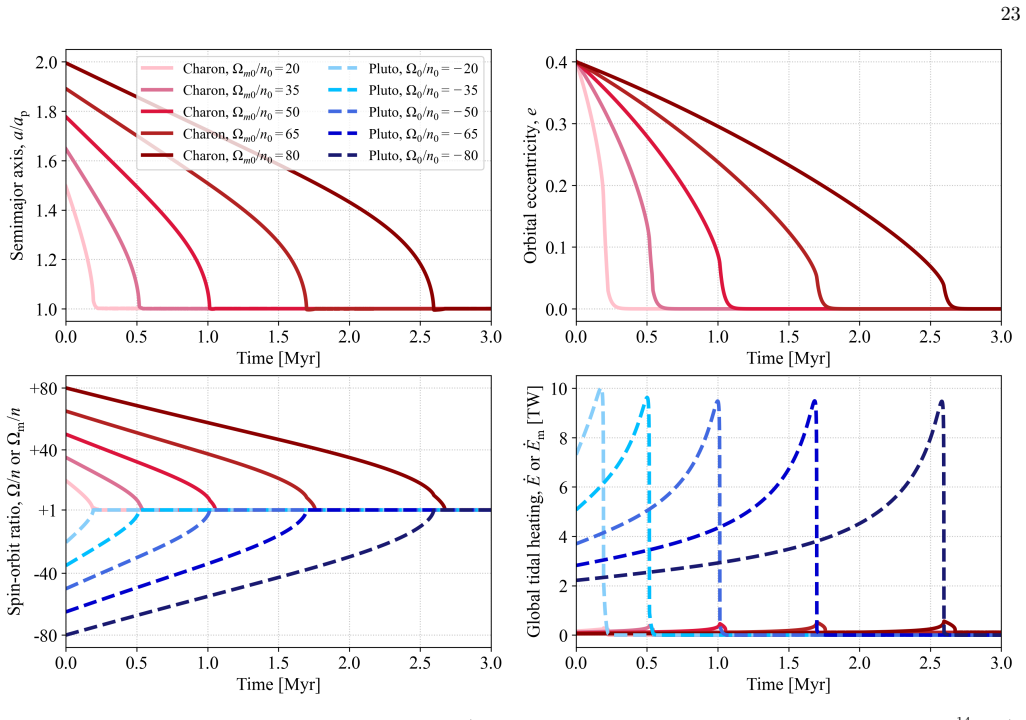
Synchronisation can be achieved also via tidal approach, provided the Roche limit is not crossed. For each of the two scenarios, we derive the condition under which the evolving synchronicity radius catches up with the tidally evolving orbit. We consider the two scenarios for the Pluto-Charon system and examine the impact-origin hypothesis of Charon's formation against capture. Based on geophysical evidence, we propose that capture appears more likely. Motivated by this conclusion, we investigate the capture scenario, wherein the orbital evolution of Charon starts at a larger distance than present and undergoes tidal descent. Depending on the initial conditions, we observe temporary locking
What carries the argument
The synchronicity radius, the orbital distance at which tidal locking makes spin and orbital periods match, and the derived catch-up condition that lets it overtake the tidally evolving orbit.
Load-bearing premise
Geophysical evidence favors capture over impact as Charon's origin, though the specific constraints are not detailed.
What would settle it
A direct measurement or simulation showing that the synchronicity radius fails to catch the orbit before the Roche limit is reached in an inward-migration run would falsify synchronization by approach for that initial separation.
Figures



read the original abstract
It is usually taken for granted that mutual synchronisation of a tidal two-body system is attained through tidal recession, assuming the reduced Hill sphere is not reached. However, synchronisation can be achieved also via tidal approach, provided the Roche limit is not crossed. For each of the two scenarios, we derive the condition under which the evolving synchronicity radius catches up with the tidally evolving orbit. We consider the two scenarios for the Pluto-Charon system and examine the impact-origin hypothesis of Charon's formation against capture. Based on geophysical evidence, we propose that capture appears more likely. Motivated by this conclusion, we investigate the capture scenario, wherein the orbital evolution of Charon starts at a larger distance than present and undergoes tidal descent, both analytically and numerically. We also consider the possibility that Pluto's initial prograde spin underwent a reversal by a tidally approaching retrograde Charon. Depending on the initial conditions, we observe temporary locking of Charon into higher spin-orbit resonances (3:2 to 7:2) during the first 0.5 Myr of the system's evolution. Owing to a greater initial separation between the partners, the power dissipated in each of them turns out to be much lower than in the case of tidal recession of bodies of the same internal structure. The greater initial separation also results in lower tidal stress, which may explain the absence of tidally generated fracture patterns.
Editorial analysis
A structured set of objections, weighed in public.
Referee Report
Summary. The manuscript claims that mutual synchronisation of a tidal two-body system can be achieved via inward orbital migration (tidal approach) as well as the conventional outward recession, provided the Roche limit is not crossed. For each scenario the authors derive the condition under which the evolving synchronicity radius catches up with the tidally evolving orbit. Applied to Pluto-Charon, they examine the impact-origin hypothesis against capture, propose on the basis of geophysical evidence that capture is more likely, and then investigate the capture scenario analytically and numerically. The analysis shows temporary locking into higher-order spin-orbit resonances (3:2 to 7:2) during the first 0.5 Myr, lower dissipated power, and lower tidal stress than in the recession case, which may explain the absence of tidally generated fractures; a possible reversal of Pluto's initial prograde spin by a retrograde Charon is also considered.
Significance. If the catch-up conditions and numerical results hold, the work supplies a previously under-explored evolutionary channel for close tidal binaries that avoids the high dissipation and stress associated with recession from a near-Roche orbit. This could alter interpretations of satellite formation and thermal histories in the outer solar system and provide a mechanism consistent with the observed lack of tidal fractures on Charon.
major comments (2)
- [origin hypothesis discussion (abstract and §4)] The central motivation for focusing the detailed analytic and numeric investigation on the capture scenario rests on the claim (abstract and origin-discussion section) that 'capture appears more likely' than impact origin 'based on geophysical evidence'. No specific geophysical constraints, data sets, or explicit contradictions of the impact hypothesis are supplied. Because this preference directly determines which evolutionary path is examined in depth, the absence of supporting detail is load-bearing for the manuscript's application to Pluto-Charon history.
- [§2] §2 (analytic derivation of the catch-up condition): the manuscript states that analytic results were obtained, yet the full step-by-step derivation, the precise tidal model (constant-Q, constant-time-lag, or frequency-dependent), and any error budget or sensitivity to initial spin states are not presented with sufficient explicitness to allow independent verification of the 'first-principles' character of the result.
minor comments (2)
- [numerical results] The numerical section should tabulate or clearly state the exact initial orbital distances, spin periods, and dissipation parameters used in the integrations that produce the reported 0.5 Myr resonance-locking episodes.
- [figures] Figure captions and axis labels should explicitly define the synchronicity radius and the evolving semi-major axis so that the catch-up condition can be read directly from the plots.
Simulated Author's Rebuttal
We thank the referee for their detailed and constructive report. We address each major comment below and have revised the manuscript to improve clarity and completeness where appropriate.
read point-by-point responses
-
Referee: [origin hypothesis discussion (abstract and §4)] The central motivation for focusing the detailed analytic and numeric investigation on the capture scenario rests on the claim (abstract and origin-discussion section) that 'capture appears more likely' than impact origin 'based on geophysical evidence'. No specific geophysical constraints, data sets, or explicit contradictions of the impact hypothesis are supplied. Because this preference directly determines which evolutionary path is examined in depth, the absence of supporting detail is load-bearing for the manuscript's application to Pluto-Charon history.
Authors: We agree that the discussion of the origin hypothesis would benefit from greater explicitness. In the revised manuscript we have expanded Section 4 to cite specific geophysical constraints (Pluto-Charon bulk densities, surface composition contrasts, and absence of expected impact-generated features) drawn from the existing literature, and we have updated the abstract to reflect this expanded justification. The core proposal that capture appears more likely remains unchanged, but the supporting detail is now supplied. revision: yes
-
Referee: [§2] §2 (analytic derivation of the catch-up condition): the manuscript states that analytic results were obtained, yet the full step-by-step derivation, the precise tidal model (constant-Q, constant-time-lag, or frequency-dependent), and any error budget or sensitivity to initial spin states are not presented with sufficient explicitness to allow independent verification of the 'first-principles' character of the result.
Authors: We accept that the analytic derivation in Section 2 requires more explicit presentation. The revised manuscript includes a new appendix that supplies the complete step-by-step derivation of the catch-up condition, identifies the tidal model as the constant-time-lag formulation, and provides a brief sensitivity analysis with respect to initial spin states together with an assessment of the principal assumptions. revision: yes
Circularity Check
Derivation of synchronicity catch-up condition is self-contained with no reduction to inputs by construction
full rationale
The paper states that it derives the condition under which the evolving synchronicity radius catches up with the tidally evolving orbit for both recession and approach scenarios. This is presented as an analytical derivation, with subsequent numerical investigation of the capture scenario for Pluto-Charon. No self-definitional loops, fitted parameters called predictions, or load-bearing self-citations that make the central result equivalent to its own inputs appear in the text. The proposal that capture is more likely than impact is a separate motivational claim based on geophysical evidence and does not alter or reduce the derived mathematical condition. The overall derivation chain remains independent of the authors' prior outputs by construction.
Axiom & Free-Parameter Ledger
axioms (2)
- domain assumption Tidal torques drive both orbital migration and spin evolution in a two-body system.
- standard math The Roche limit and reduced Hill sphere set hard boundaries that the orbit must respect.
Reference graph
Works this paper leans on
-
[1]
Agnor, C. B., & Hamilton, D. P. 2006, Nature, 441, 192, doi: 10.1038/nature04792 Allan, R. R. 1965, Proceedings of the Royal Society A, 288, 60, doi: 10.1098/rspa.1965.0201 Andrade, E. N. 1962, Philosophical Magazine, 7, 2003, doi: 10.1080/14786436208214469 Arakawa, S., Hyodo, R., & Genda, H. 2019, Nature Astronomy, 3, 802, doi: 10.1038/s41550-019-0797-9 ...
-
[2]
https://www. hou.usra.edu/meetings/plutosystem2025/pdf/7045.pdf Nesvorn´ y, D., & Vokrouhlick´ y, D. 2019, Icarus, 331, 49, doi: 10.1016/j.icarus.2019.04.030 26 Nimmo, F., & McKinnon, W. B. 2021, in The Pluto System After New Horizons, ed. S. A. Stern, J. M. Moore, W. M. Grundy, L. A. Young, & R. P. Binzel, 89–103, doi: 10.2458/azu uapress 9780816540945-c...
-
[3]
https://dx.doi.org/10.3847/PSJ/abc0f3 Rhoden, A. R., Rudolph, M. L., & Manga, M. 2023, Icarus, 392, 115391, doi: 10.1016/j.icarus.2022.115391 Rhoden, A. R., Skjetne, H. L., Henning, W. G., et al. 2020, Journal of Geophysical Research (Planets), 125, e06449, doi: 10.1029/2020JE006449 Robinson, J. E., Fraser, W. C., Fitzsimmons, A., & Lacerda, P. 2020, Astr...
discussion (0)
Sign in with ORCID, Apple, or X to comment. Anyone can read and Pith papers without signing in.