REVIEW 4 major objections 3 minor 78 references
Hybrid Event Frame Sensors: Modeling, Calibration, and Simulation
T0 review · 4 major / 3 minor · reviewed 2026-08-03 · deepseek-v4-flash
Pith's one-line read The paper claims that a single statistical noise model can describe both the RAW frames and the event stream of a hybrid event-frame sensor, and that a simulator calibrated from that model yields synthetic data that improves real-sensor vid
desk verdict Solid APS side, shaky EVS core: the unified-noise idea is right, but Eq. 12 trades away the stated physics and the transfer claims lack a control. read the letter →
The pith
A machine-rendered reading of the paper's core claim, the machinery that carries it, and where it could break.
The reading
What carries the argument
The mechanism that carries the argument is the Q-function identity σ_n^2 = (θ / Q^{-1}(P))^2, which turns the discrete ON/OFF output of an event pixel into a measurable noise variance. Around this identity the model uses a shared ideal signal I_c, a second-order polynomial Var(N_a) = β0 + β1 I_c + β2 Δt + β3 I_c^2 + β4 I_c Δt + β5 Δt^2 for APS noise variance, and an affine voltage mapping V̂ + V_PD ≈ β1 I_c + β2 to connect the APS intensity domain to the EVS logarithmic voltage domain. Together these allow a calibration pipeline to convert observed event probabilities and frame variances into a parameter set that drives the simulator's noise injection and threshold comparison.
What would settle it
Record a static grayscale ramp at several exposure times and temperatures, count per-pixel event probabilities, and fit Q^{-1}(P) against the affine-plus-square-root form of Eq. 12. A systematic nonlinearity in I_c, or a change in event rate with temperature at fixed brightness, would falsify the constant-dark-current and fixed-correlation assumptions.
Extended reading notes
Core claim
The core claim is that both pixel types in a hybrid sensor—the integrating APS pixel and the differential, thresholding EVS pixel—obey the same noise-generating physics, so both can be written as Gaussian noise terms added to a shared ideal signal. The key relationship is P+ = P− = Q(θ/σ_n) for a static scene, which means the probability of a noise-triggered event directly reveals the event noise variance. Calibrating static multi-brightness frames therefore yields the shot-noise, dark-current, and fixed-pattern parameters for both modalities, and the simulator injects those same statistics when generating frames and events. The authors validate this on two hybrid sensors by matching measure
Load-bearing premise
The calibration assumes that in static scenes the event signal S is zero and the mean event noise μ_n is zero, and that the mapping from APS intensity to EVS voltage is affine; if these fail under motion, low light, or temperature change, the calibrated event statistics and the simulator's events will no longer match the real sensor.
Editorial extensions
If this is right
- Calibrated noise parameters from a real hybrid sensor can be reused to synthesize RAW frames and events for that sensor without hand-tuned thresholds or heuristic event rules.
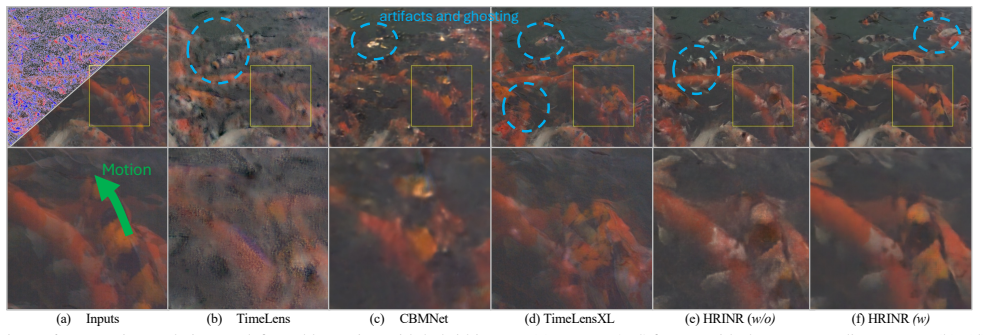
- Fine-tuning video frame interpolation and deblurring networks on H-ESIM synthetic data improves their perceptual quality on real hybrid-sensor sequences.
- The unified model separates illumination-dependent, exposure-dependent, and fixed noise, so it predicts how sensor noise changes with brightness and exposure time.
- The calibration has to be performed per sensor and per layout; the two sensors studied show different row noise and color-filter-dependent variance, so transfer across sensor models is not automatic.
Reading between the lines
- Because the calibrated model ties event rates to absolute brightness, the same pipeline could be inverted to estimate scene irradiance from event counts alone, which the paper does not claim to do.
- The per-position Quad-Bayer coefficients expose spatially structured noise at the color-filter level, suggesting a demosaicing or denoising network could be designed to consume those calibrated positions as side information.
- The Gaussian model for event noise will likely need a Poisson or Gamma replacement at very low photon counts; testing H-ESIM in that regime would directly probe the model's range of validity.
Editorial analysis
A structured set of objections, weighed in public.
Referee Report
Summary. The paper proposes the first unified statistical noise model for hybrid event-frame sensors, jointly describing APS and EVS noise (shot, dark-current, fixed-pattern, quantization). It introduces a calibration pipeline that estimates noise parameters from real hybrid sensors (AlpsenTek GEN2 and Eiger), and presents H-ESIM, a simulator that generates synthetic RAW frames and events with calibrated noise statistics. The simulator is evaluated by fine-tuning video frame interpolation and deblurring networks on synthetic data and testing on real hybrid-sensor data, reporting improvements in no-reference quality metrics. The central claim is that calibrated, jointly modeled noise statistics enable realistic simulation that transfers to downstream tasks.
Significance. If the claims hold, the paper would provide a principled, reproducible simulation tool for the emerging hybrid event-frame sensor domain, potentially reducing the need for costly real-data collection for training. The release of an open NumPy/PyTorch simulator and the use of a 3200 fps input video dataset to avoid interpolation artifacts are concrete, useful contributions. However, the validation currently has important gaps: the EVS noise model is fit and tested on the same data, the transfer experiments lack a control simulator, and a stated physical scaling in Section 3 is contradicted by the calibration equation in Section 4. These issues bear directly on the 'statistically grounded' claim, so the significance is contingent on resolving them.
major comments (4)
- [§3 vs. §4, Eq. (12)] The shot-noise model is internally inconsistent. Section 3 states σ_shot² ∝ V̂_t (Poisson scaling), which implies σ_shot ∝ sqrt(β1 I_c + β2). Equation (12), however, sets σ_shot = β3 I_c, a linear dependence on intensity. This is not a minor notational slip: it changes the predicted brightness dependence of event probability. With the physical sqrt scaling and the static-scene Q-function, P = Q(θ/σ_n) should decrease as brightness increases (since σ_n ∝ 1/sqrt(V)), yet Figure 5(d) shows P increasing with brightness. The calibration thus substitutes a flexible regression form for the stated physics. The paper should either revise Section 3 to present the model actually used (empirical intensity-dependent shot noise) or extend the physical derivation to explain the observed increase. The current presentation undermines the 'statistically grounded' claim.
- [§4, Event Noise Calibration; §6.1, Fig. 5] The EVS noise 'validation' is in-sample. The parameters β_e are estimated by fitting Eq. (12) to observed event probabilities P(I_c) from static scenes, and Fig. 5 then compares model-generated probabilities to those same observed probabilities. This is a check of the fit, not an independent prediction. The same holds for APS in Fig. 4(d)–(g), where the fitted variance polynomial is evaluated on the calibration data. To support generalization, the authors should hold out brightness levels, scenes, or sensors and report prediction error, or validate the calibrated event statistics on dynamic scenes where the signal part S is nonzero.
- [§6.2, Tables 1–2] The downstream transfer experiments do not isolate the contribution of the calibrated noise statistics. Fine-tuning with H-ESIM is compared only against not fine-tuning; there is no control fine-tuned with an existing simulator (e.g., ESIM or v2e) or with an uncorrupted/ideal event stream. Consequently, the observed improvements could stem from the 3200 fps input, the specific event-generation pipeline, or joint RAW+event simulation, rather than from the calibrated noise parameters. Additionally, Table 1 reports BRISQUE for Eiger HR-INR(w) as 45.43 vs. 31.45 for (w/o), yet the text claims 'lower distortion' — a direct contradiction that must be addressed.
- [§4, Eq. (12), parameter identifiability] The parameter set β_e = {β0,...,β5} in Eq. (12) is not identifiable from P(I) alone. The right-hand side is invariant under rescaling transformations (e.g., multiplying β0 and β1 by reciprocal constants, or scaling β3 and β4 together and adjusting β0). The paper does not discuss this gauge freedom or impose constraints. This matters because the calibrated β's are presented as interpretable physical noise parameters (shot coefficient, dark-current coefficient, correlation). At minimum, the authors should state which parameters are identifiable and how the remaining degrees of freedom are fixed, or drop the interpretability claim for those parameters.
minor comments (3)
- [§5, EVS Simulator, step (3)] Parameter names are inconsistent: the text says 'σ_shot ≈ β4 I_c, σ_DCSN ≈ β5, and correlation ρ≈β6', but Section 4 defines σ_shot = β3 I_c, σ_DCSN = β4, ρ = −β5. Please correct to avoid confusion.
- [§4, Eq. (11)–(12)] The mapping from I_c to V̂ is affine (V̂+V_PD ≈ β1 I_c + β2). Since σ_shot in Eq. (12) is linear in I_c, the denominator in Eq. (12) can be re-expressed directly in terms of V̂. Clarify whether β3 is a voltage-domain or intensity-domain coefficient, and ensure all references (including Sec. 5) use the same convention.
- [§6.2, Table 2] The improvement for MAER is marginal (CLIP-IQA 0.3297→0.3370, MUSIQ 18.88→19.05, NRQM 5.038→5.064). Reporting statistical significance or confidence intervals would help assess whether the fine-tuning benefit is real for that model.
Circularity Check
EVS noise 'prediction' in Fig. 5(d) is a roundtrip of the Eq. 12 fit; the simulator's event statistics are calibrated, not independently predicted.
-
fitted input called prediction
[Sec. 4 (Event Noise Calibration, Eq. 12) and Sec. 6.1 (EVS Noise Analysis, Fig. 5(d))]
"For random noise, we adopt an intensity-dependent model consistent with the APS: σ_shot = β3Ic, σ_DCSN = β4, and ρ = −β5, which yields the regression form in Eq. 12. ... Since Eq. 12 is nonlinear, we apply gradient descent to fit the relationship between pixel intensity Ic and the observed event probability P. ... Fig. 5 (d) further shows that, as brightness increases, the entire distribution shifts upward, aligning with the prediction of Eq. 12."
Eq. 12 is a parameterized regression whose parameters β_e are fitted by gradient descent to the observed event probability P(I_c) in the same static calibration scenes. The simulator then samples events from the same fitted probabilities (Eq. 11/12), so Fig. 5(d)'s 'prediction of Eq. 12' is a restatement of the fit. Matching the calibration data is guaranteed by construction and provides no independent evidence that the EVS noise model generalizes. Moreover, the claimed physics (σ_shot^2 ∝ V̂t in Sec. 3) is replaced by the flexible linear form σ_shot = β3I_c, chosen to reproduce the observed brightness trend, making the validation self-consistent rather than predictive.
full rationale
The paper's central downstream claim is partially independent: networks fine-tuned on H-ESIM generalize to real hybrid-sensor VFI/deblurring data, and these experiments compare with and without H-ESIM fine-tuning. That transfer is external evidence and is not circular. However, the EVS noise validation is circular: Eq. 12 is fitted to observed event probabilities, then Fig. 5(d) is presented as 'aligning with the prediction of Eq. 12.' This is a fit check, not an independent prediction. The simulator's event output inherits the same fitted statistics by construction, so the claim that H-ESIM is 'statistically grounded' is supported by calibration, not by a test of the noise model's predictive power. The paper also honestly limits itself by excluding low light, extreme temperatures, and bandwidth bottlenecks. There is no load-bearing self-citation here; references to prior event-camera noise work are standard. The score reflects one central 'prediction' that reduces by construction to the fitted regression, while the downstream transfer experiments keep the overall contribution from being entirely circular.
Assumptions & free parameters
free parameters (8)
- APS noise-variance polynomial β_a (β0..β5) per Quad-Bayer position =
six coefficients × 16 positions
- APS fixed components N_DP, N_row, N_BLC =
row vector / per-pixel map from dark-frame linear fits
- EVS threshold scale β0 =
unit-conversion factor
- EVS voltage mapping β1, β2 =
affine coefficients
- EVS shot-noise coefficient β3 =
σ_shot = β3 I_c
- EVS dark-current coefficient β4 =
σ_DCSN = β4
- EVS shot–dark correlation β5 =
ρ = −β5
- Per-pixel defective offset μ_n and bad-pixel mask =
mask and offsets from dark events
assumptions (8)
- domain assumption The ideal electrical signal I_c is shared by APS and EVS through the same optical path (Eq. 1).
- domain assumption All APS noise sources in Eq. 2 are approximately additive and Gaussian/uniform; shot noise approximated as Gaussian.
- domain assumption Event noise between t0 and t1 is independent (Brownian-motion assumption, after Lin et al. [35]), yielding Gaussian N_e with variance in Eq. 6.
- domain assumption Calibration scenes are static (S=0) with zero-mean bias μ_n=0, so P+=P-=Q(θ/σ_n).
- ad hoc to paper APS intensity maps to EVS voltage affinely: V̂+V_PD ≈ β1 I_c + β2.
- ad hoc to paper Noise variance as a function of (I_c, Δt) is well described by the second-order polynomial Eq. 10 with per-position coefficients.
- ad hoc to paper Shot and dark-current noise in the same event pixel have a constant correlation ρ fitted as −β5.
- standard math Event decisions are conditionally independent Bernoulli trials with probabilities P+ and P-.
Cite this review
Pith. "Pith review of Hybrid Event Frame Sensors: Modeling, Calibration, and Simulation." pith.science (2026). https://pith.science/paper/7JURPLM5
@misc{pith2026251118037,
  author       = {Pith},
  title        = {Pith review of: Hybrid Event Frame Sensors: Modeling, Calibration, and Simulation},
  year         = {2026},
  howpublished = {\url{https://pith.science/paper/7JURPLM5}},
  note         = {Machine review of arXiv:2511.18037}
}
read the original abstract
Hybrid event-frame sensors integrate an Event Vision Sensor (EVS) and an Active Pixel Sensor (APS) within a single chip, combining the high dynamic range and low latency of the EVS with the rich spatial intensity information from the APS. While this tight integration offers compact and temporally precise imaging, the complex circuit architecture introduces nontrivial noise patterns that remain poorly understood and unmodeled. In this work, we present the first unified statistics-based imaging noise model that jointly describes the noise behavior of APS and EVS pixels. Our formulation explicitly incorporates photon shot noise, dark current noise, fixed-pattern noise, and quantization noise, and links EVS noise to illumination level and dark current. Based on this formulation, we further develop a calibration pipeline to estimate noise parameters from real data and provide a detailed analysis of both APS and EVS noise behaviors. Finally, we propose H-ESIM, a statistically grounded simulator that generates RAW frames and events under realistic jointly calibrated noise statistics. Experiments on two hybrid sensors validate our model across multiple imaging tasks, including video frame interpolation and deblurring, demonstrating strong transfer from simulation to real data.
Figures


Figures from the paper (3 more)


Reference graph
Works this paper leans on
-
[1]
Vista 2.0: An open, data-driven simulator for multimodal sensing and policy learning for autonomous vehicles
Alexander Amini, Tsun-Hsuan Wang, Igor Gilitschenski, Wilko Schwarting, Zhijian Liu, Song Han, Sertac Karaman, and Daniela Rus. Vista 2.0: An open, data-driven simulator for multimodal sensing and policy learning for autonomous vehicles. InInternational Conference on Robotics and Au- tomation, pages 2419–2426. IEEE, 2022. 3
2022
-
[2]
A 240x180 120db 10mw 12us- latency sparse output vision sensor for mobile applications
Raphael Berner, Christian Brandli, Minhao Yang, Shih-Chii Liu, and Tobi Delbruck. A 240x180 120db 10mw 12us- latency sparse output vision sensor for mobile applications. InProceedings of the International Image Sensors Work- shop, number CONF, pages 41–44, 2013. 2
2013
-
[3]
Black-level offset: Characterization and correction.Journal of the Society for Information Display, 14(10):895–903, 2006
Jacobus Besuijen. Black-level offset: Characterization and correction.Journal of the Society for Information Display, 14(10):895–903, 2006. 6
2006
-
[4]
A 240×180 130 db 3µs latency global shutter spatiotemporal vision sensor.IEEE Journal of Solid-State Circuits, 49(10):2333–2341, 2014
Christian Brandli, Raphael Berner, Minhao Yang, Shih-Chii Liu, and Tobi Delbruck. A 240×180 130 db 3µs latency global shutter spatiotemporal vision sensor.IEEE Journal of Solid-State Circuits, 49(10):2333–2341, 2014. 1, 2
2014
-
[5]
Noise2image: noise-enabled static scene re- covery for event cameras.Optica, 12(1):46–55, 2025
Ruiming Cao, Dekel Galor, Amit Kohli, Jacob L Yates, and Laura Waller. Noise2image: noise-enabled static scene re- covery for event cameras.Optica, 12(1):46–55, 2025. 2, 3
2025
-
[6]
Physics-guided iso-dependent sensor noise modeling for extreme low-light photography
Yue Cao, Ming Liu, Shuai Liu, Xiaotao Wang, Lei Lei, and Wangmeng Zuo. Physics-guided iso-dependent sensor noise modeling for extreme low-light photography. InProceed- ings of the IEEE/CVF Conference on Computer Vision and Pattern Recognition, pages 5744–5753, 2023. 2, 3
2023
-
[7]
Learn- ing camera-aware noise models
Ke-Chi Chang, Ren Wang, Hung-Jin Lin, Yu-Lun Liu, Chia- Ping Chen, Yu-Lin Chang, and Hwann-Tzong Chen. Learn- ing camera-aware noise models. InEuropean Conference on Computer Vision, pages 343–358. Springer, 2020. 2, 3
2020
-
[8]
New exponential bounds and approximations for the computation of error probability in fading channels.IEEE Transactions on Wireless Communications, 2(4):840–845, 2003
Marco Chiani, Davide Dardari, and Marvin K Simon. New exponential bounds and approximations for the computation of error probability in fading channels.IEEE Transactions on Wireless Communications, 2(4):840–845, 2003. 2, 4
2003
Show all 78 references
-
[9]
Thomas Finateu, Atsumi Niwa, Daniel Matolin, Koya Tsuchimoto, Andrea Mascheroni, Etienne Reynaud, Poo- ria Mostafalu, Frederick Brady, Ludovic Chotard, Florian LeGoff, et al. 5.10 a 1280×720 back-illuminated stacked temporal contrast event-based vision sensor with 4.86µm pixel...
2020
-
[10]
Event-based vision: A survey.IEEE Transactions on Pattern Analysis and Machine Intelligence, 44(1):154–180, 2020
Guillermo Gallego, Tobi Delbr ¨uck, Garrick Orchard, Chiara Bartolozzi, Brian Taba, Andrea Censi, Stefan Leutenegger, Andrew J Davison, J ¨org Conradt, Kostas Daniilidis, et al. Event-based vision: A survey.IEEE Transactions on Pattern Analysis and Machine Intelligence, 44(1):...
2020
-
[11]
Low-latency auto- motive vision with event cameras.Nature, 629(8014):1034– 1040, 2024
Daniel Gehrig and Davide Scaramuzza. Low-latency auto- motive vision with event cameras.Nature, 629(8014):1034– 1040, 2024. 1
2024
-
[12]
Deep joint demosaicking and denoising.ACM Transactions on Graphics, 35(6):1–12, 2016
Micha ¨el Gharbi, Gaurav Chaurasia, Sylvain Paris, and Fr´edo Durand. Deep joint demosaicking and denoising.ACM Transactions on Graphics, 35(6):1–12, 2016. 7
2016
-
[13]
Unraveling the paradox of intensity-dependent dvs pixel noise.arXiv preprint arXiv:2109.08640, 2021
Rui Graca and Tobi Delbruck. Unraveling the paradox of intensity-dependent dvs pixel noise.arXiv preprint arXiv:2109.08640, 2021. 2, 3
2021 arXiv
-
[14]
Optimal biasing and physical limits of dvs event noise.arXiv preprint arXiv:2304.04019, 2023
Rui Graca, Brian McReynolds, and Tobi Delbruck. Optimal biasing and physical limits of dvs event noise.arXiv preprint arXiv:2304.04019, 2023. 2, 3
2023 arXiv
-
[15]
Live demonstration: A 768×640 pixels 200meps dynamic vision sensor
Menghan Guo, Jing Huang, and Shoushun Chen. Live demonstration: A 768×640 pixels 200meps dynamic vision sensor. In2017 IEEE International Symposium on Circuits and Systems (ISCAS), pages 1–1. IEEE, 2017. 2
2017
-
[16]
A 3-wafer- stacked hybrid 15mpixel cis+ 1 mpixel evs with 4.6 gevent/s readout, in-pixel tdc and on-chip isp and esp function
Menghan Guo, Shoushun Chen, Zhe Gao, Wenlei Yang, Peter Bartkovjak, Qing Qin, Xiaoqin Hu, Dahei Zhou, Masayuki Uchiyama, Yoshiharu Kudo, et al. A 3-wafer- stacked hybrid 15mpixel cis+ 1 mpixel evs with 4.6 gevent/s readout, in-pixel tdc and on-chip isp and esp function. In 202...
2023
-
[17]
Physical-based event camera simulator
Haiqian Han, Jiacheng Lyu, Jianing Li, Henglu Wei, Cheng Li, Yajing Wei, Shu Chen, and Xiangyang Ji. Physical-based event camera simulator. InEuropean Conference on Com- puter Vision, pages 19–35. Springer, 2024. 3
2024
-
[18]
Array programming with numpy.Nature, 585(7825): 357–362, 2020
Charles R Harris, K Jarrod Millman, St ´efan J Van Der Walt, Ralf Gommers, Pauli Virtanen, David Cournapeau, Eric Wieser, Julian Taylor, Sebastian Berg, Nathaniel J Smith, et al. Array programming with numpy.Nature, 585(7825): 357–362, 2020. 2, 6, 7
2020
-
[19]
v2e: From video frames to realistic dvs events
Yuhuang Hu, Shih-Chii Liu, and Tobi Delbruck. v2e: From video frames to realistic dvs events. InProceedings of the IEEE/CVF Conference 730 on Computer Vision and Pattern Recognition, pages 1312–1321, 2021. 2, 3, 6
2021
-
[20]
DA VIS 346 AER product specification and datasheet
Inivation AG. DA VIS 346 AER product specification and datasheet. Product Datasheet, 2023. 4
2023
-
[21]
An analytically tractable approximation for the gaussian q-function.IEEE Communications Letters, 12(9):669–671, 2008
Yogananda Isukapalli and Bhaskar D Rao. An analytically tractable approximation for the gaussian q-function.IEEE Communications Letters, 12(9):669–671, 2008. 2
2008
-
[22]
Adv2e: Bridging the gap between analogue circuit and discrete frames in the video-to-events simulator.arXiv preprint arXiv:2411.12250,
Xiao Jiang, Fei Zhou, and Jiongzhi Lin. Adv2e: Bridging the gap between analogue circuit and discrete frames in the video-to-events simulator.arXiv preprint arXiv:2411.12250,
-
[23]
Understanding noise and noise reduction in cmos imaging sensors
Jess Johnson. Understanding noise and noise reduction in cmos imaging sensors. 2024. 2, 4
2024
-
[24]
Some properties of the range in samples from tukey’s symmetric lambda distri- butions.Journal of the American Statistical Association, 66 (334):394–399, 1971
Brian L Joiner and Joan R Rosenblatt. Some properties of the range in samples from tukey’s symmetric lambda distri- butions.Journal of the American Statistical Association, 66 (334):394–399, 1971. 3
1971
-
[25]
An improved approximation for the gaussian q-function.IEEE Communications Letters, 11(8):644–646, 2007
George K Karagiannidis and Athanasios S Lioumpas. An improved approximation for the gaussian q-function.IEEE Communications Letters, 11(8):644–646, 2007. 2
2007
-
[26]
Musiq: Multi-scale image quality transformer
Junjie Ke, Qifei Wang, Yilin Wang, Peyman Milanfar, and Feng Yang. Musiq: Multi-scale image quality transformer. InProceedings of the IEEE/CVF International Conference on Computer Vision, pages 5148–5157, 2021. 8
2021
-
[27]
Event-based video frame interpolation with cross- modal asymmetric bidirectional motion fields
Taewoo Kim, Yujeong Chae, Hyun-Kurl Jang, and Kuk-Jin Yoon. Event-based video frame interpolation with cross- modal asymmetric bidirectional motion fields. InProceed- ings of the IEEE/CVF Conference 730 on Computer Vision and Pattern Recognition, pages 18032–18042, 2023. 8 9
2023
-
[28]
1.22µm 35.6 mpixel rgb hybrid event-based vision sensor with 4.88µm-pitch event pixels and up to 10k event frame rate by adaptive control on event sparsity
Kazutoshi Kodama, Yusuke Sato, Yuhi Yorikado, Raphael Berner, Kyoji Mizoguchi, Takahiro Miyazaki, Masahiro Tsukamoto, Yoshihisa Matoba, Hirotaka Shinozaki, Atsumi Niwa, et al. 1.22µm 35.6 mpixel rgb hybrid event-based vision sensor with 4.88µm-pitch event pixels and up to 10k ...
2023
-
[29]
Modeling srgb camera noise with normal- izing flows
Shayan Kousha, Ali Maleky, Michael S Brown, and Mar- cus A Brubaker. Modeling srgb camera noise with normal- izing flows. InProceedings of the IEEE/CVF Conference on Computer Vision and Pattern Recognition, pages 17463– 17471, 2022. 2
2022
-
[30]
Local tone mapping using the k-means algorithm and automatic gamma setting.IEEE Transactions on Consumer Electron- ics, 57(1):209–217, 2011
Ji Won Lee, Rae-Hong Park, and Soonkeun Chang. Local tone mapping using the k-means algorithm and automatic gamma setting.IEEE Transactions on Consumer Electron- ics, 57(1):209–217, 2011. 6
2011
-
[31]
Noise model- ing in one hour: Minimizing preparation efforts for self- supervised low-light raw image denoising
Feiran Li, Haiyang Jiang, and Daisuke Iso. Noise model- ing in one hour: Minimizing preparation efforts for self- supervised low-light raw image denoising. InProceedings of the Computer Vision and Pattern Recognition Conference, pages 5699–5708, 2025. 2
2025
-
[32]
Image demosaic- ing: A systematic survey
Xin Li, Bahadir Gunturk, and Lei Zhang. Image demosaic- ing: A systematic survey. InVisual Communications and Image Processing 2008, pages 489–503. SPIE, 2008. 6
2008
-
[33]
A 128x128 120db 15 mu s latency asynchronous temporal con- trast vision sensor.IEEE Journal of Solid-state Circuits, 43 (2):566–576, 2008
Patrick Lichtsteiner, Christoph Posch, and Tobi Delbruck. A 128x128 120db 15 mu s latency asynchronous temporal con- trast vision sensor.IEEE Journal of Solid-state Circuits, 43 (2):566–576, 2008. 2, 3
2008
-
[34]
Event-guided frame interpolation and dy- namic range expansion of single rolling shutter image
Guixu Lin, Jin Han, Mingdeng Cao, Zhihang Zhong, and Yinqiang Zheng. Event-guided frame interpolation and dy- namic range expansion of single rolling shutter image. In Proceedings of the 31st ACM International Conference on Multimedia, pages 3078–3088, 2023. 1
2023
-
[35]
Dvs- voltmeter: Stochastic process-based event simulator for dy- namic vision sensors
Songnan Lin, Ye Ma, Zhenhua Guo, and Bihan Wen. Dvs- voltmeter: Stochastic process-based event simulator for dy- namic vision sensors. InEuropean Conference on Computer Vision, pages 578–593. Springer, 2022. 2, 3, 4
2022
-
[36]
Hr-inr: Continuous space-time video super-resolution via event camera.arXiv:2405.13389, 2024
Yunfan Lu, Zipeng Wang, Yusheng Wang, and Hui Xiong. Hr-inr: Continuous space-time video super-resolution via event camera.arXiv:2405.13389, 2024. 8
2024
-
[37]
Event camera demosaicing via swin transformer and pixel-focus loss
Yunfan Lu, Yijie Xu, Wenzong Ma, Weiyu Guo, and Hui Xiong. Event camera demosaicing via swin transformer and pixel-focus loss. InProceedings of the IEEE/CVF Confer- ence on Computer Vision and Pattern Recognition, pages 1095–1105, 2024. 1
2024
-
[38]
Image de- noising in mixed poisson–gaussian noise.IEEE Transactions on Image Processing, 20(3):696–708, 2010
Florian Luisier, Thierry Blu, and Michael Unser. Image de- noising in mixed poisson–gaussian noise.IEEE Transactions on Image Processing, 20(3):696–708, 2010. 3
2010
-
[39]
Learning a no-reference quality metric for single-image super-resolution.Computer Vision and Image Understanding, 158:1–16, 2017
Chao Ma, Chih-Yuan Yang, Xiaokang Yang, and Ming- Hsuan Yang. Learning a no-reference quality metric for single-image super-resolution.Computer Vision and Image Understanding, 158:1–16, 2017. 8
2017
-
[40]
Timelens-xl: Real-time event-based video frame interpolation with large motion
Yongrui Ma, Shi Guo, Yutian Chen, Tianfan Xue, and Jin- wei Gu. Timelens-xl: Real-time event-based video frame interpolation with large motion. InEuropean Conference on Computer Vision, pages 178–194. Springer, 2025. 6, 8
2025
-
[41]
Noise2noiseflow: Realistic camera noise modeling without clean images
Ali Maleky, Shayan Kousha, Michael S Brown, and Mar- cus A Brubaker. Noise2noiseflow: Realistic camera noise modeling without clean images. InProceedings of the IEEE/CVF Conference on Computer Vision and Pattern recognition, pages 17632–17641, 2022. 2
2022
-
[42]
A silicon model of early visual processing.Neural Networks, 1(1):91–97, 1988
Carver A Mead and Misha A Mahowald. A silicon model of early visual processing.Neural Networks, 1(1):91–97, 1988. 2
1988
-
[43]
Mobile intelligent photography and imag- ing workshop 2024.https: //mipi - challenge
MIPI Challenge. Mobile intelligent photography and imag- ing workshop 2024.https: //mipi - challenge. org/MIPI2024/, 2024. 1, 2
2024
-
[44]
Mobile intelligent photography and imag- ing workshop 2025
MIPI Challenge. Mobile intelligent photography and imag- ing workshop 2025. InProceedings of the IEEE/CVF Inter- national Conference on Computer Vision Workshops, Hon- olulu, HI, USA, 2025. IEEE/CVF. 1, 2
2025
-
[45]
No-reference image quality assessment in the spa- tial domain.IEEE Transactions on Image Processing, 21 (12):4695–4708, 2012
Anish Mittal, Anush Krishna Moorthy, and Alan Conrad Bovik. No-reference image quality assessment in the spa- tial domain.IEEE Transactions on Image Processing, 21 (12):4695–4708, 2012. 8
2012
-
[46]
Non-parametric sensor noise modeling and synthesis
Ali Mosleh, Luxi Zhao, Atin Singh, Jaeduk Han, Abhi- jith Punnappurath, Marcus A Brubaker, Jihwan Choe, and Michael S Brown. Non-parametric sensor noise modeling and synthesis. InEuropean Conference on Computer Vision, pages 73–89. Springer, 2024. 2
2024
-
[47]
Temperature and parasitic photocurrent effects in dynamic vision sensors.IEEE Trans- actions on Electron Devices, 64(8):3239–3245, 2017
Yuji Nozaki and Tobi Delbruck. Temperature and parasitic photocurrent effects in dynamic vision sensors.IEEE Trans- actions on Electron Devices, 64(8):3239–3245, 2017. 3
2017
-
[48]
Event-based sensor noise modeling for space-based space domain awareness.The Journal of the Astronautical Sci- ences, 72(5):46, 2025
Rachel Oliver, Brian McReynolds, and Dmitry Savransky. Event-based sensor noise modeling for space-based space domain awareness.The Journal of the Astronautical Sci- ences, 72(5):46, 2025. 3
2025
-
[49]
Event camera simula- tor design for modeling attention-based inference architec- tures.Journal of Real-Time Image Processing, 19(2):363– 374, 2022
Md Jubaer Hossain Pantho, Joel Mandebi Mbongue, Pankaj Bhowmik, and Christophe Bobda. Event camera simula- tor design for modeling attention-based inference architec- tures.Journal of Real-Time Image Processing, 19(2):363– 374, 2022. 3
2022
-
[50]
Pytorch: An im- perative style, high-performance deep learning library.Ad- vances in Neural Information Processing Systems, 32, 2019
Adam Paszke, Sam Gross, Francisco Massa, Adam Lerer, James Bradbury, Gregory Chanan, Trevor Killeen, Zeming Lin, Natalia Gimelshein, Luca Antiga, et al. Pytorch: An im- perative style, high-performance deep learning library.Ad- vances in Neural Information Processing Systems, ...
2019
-
[51]
A qvga 143 db dynamic range frame-free pwm image sensor with lossless pixel-level video compression and time-domain cds.IEEE Journal of Solid-State Circuits, 46(1):259–275,
Christoph Posch, Daniel Matolin, and Rainer Wohlgenannt. A qvga 143 db dynamic range frame-free pwm image sensor with lossless pixel-level video compression and time-domain cds.IEEE Journal of Solid-State Circuits, 46(1):259–275,
-
[52]
Esim: an open event camera simulator
Henri Rebecq, Daniel Gehrig, and Davide Scaramuzza. Esim: an open event camera simulator. InConference on Robot Learning, pages 969–982. PMLR, 2018. 2, 3, 6
2018
-
[53]
Simultaneous motion and noise estimation with event cam- eras.arXiv preprint arXiv:2504.04029, 2025
Shintaro Shiba, Yoshimitsu Aoki, and Guillermo Gallego. Simultaneous motion and noise estimation with event cam- eras.arXiv preprint arXiv:2504.04029, 2025. 3
2025 arXiv
-
[54]
John Wiley & Sons, 2011
Chris Solomon and Toby Breckon.Fundamentals of Digital Image Processing: A practical approach with examples in Matlab. John Wiley & Sons, 2011. 6
2011
-
[55]
Fixed pattern noise removal based on a semi-calibration method.IEEE Transactions on 10 Pattern Analysis and Machine Intelligence, 45(10):11842– 11855, 2023
Lingfei Song and Hua Huang. Fixed pattern noise removal based on a semi-calibration method.IEEE Transactions on 10 Pattern Analysis and Machine Intelligence, 45(10):11842– 11855, 2023. 2, 5
2023
-
[56]
Event-based fusion for motion deblurring with cross- modal attention
Lei Sun, Christos Sakaridis, Jingyun Liang, Qi Jiang, Kailun Yang, Peng Sun, Yaozu Ye, Kaiwei Wang, and Luc Van Gool. Event-based fusion for motion deblurring with cross- modal attention. InEuropean Conference on Computer Vi- sion, pages 412–428. Springer, 2022. 6, 8
2022
-
[57]
Event-based frame interpolation with ad-hoc de- blurring
Lei Sun, Christos Sakaridis, Jingyun Liang, Peng Sun, Jiezhang Cao, Kai Zhang, Qi Jiang, Kaiwei Wang, and Luc Van Gool. Event-based frame interpolation with ad-hoc de- blurring. InProceedings of the IEEE/CVF Conference 730 on Computer Vision and Pattern Recognition, pages 1804...
2023
-
[58]
Low-light image enhancement using event-based illumination estimation.arXiv preprint arXiv:2504.09379,
Lei Sun, Yuhan Bao, Jiajun Zhai, Jingyun Liang, Yu- lun Zhang, Kaiwei Wang, Danda Pani Paudel, and Luc Van Gool. Low-light image enhancement using event-based illumination estimation.arXiv preprint arXiv:2504.09379,
-
[59]
Motion aware event representation-driven image deblurring
Zhijing Sun, Xueyang Fu, Longzhuo Huang, Aiping Liu, and Zheng-Jun Zha. Motion aware event representation-driven image deblurring. InEuropean Conference on Computer Vi- sion, pages 418–435. Springer, 2024. 8
2024
-
[60]
Global minimax approximations and bounds for the gaussian q-function by sums of exponentials.IEEE Transactions on Communica- tions, 68(10):6514–6524, 2020
Islam M Tanash and Taneli Riihonen. Global minimax approximations and bounds for the gaussian q-function by sums of exponentials.IEEE Transactions on Communica- tions, 68(10):6514–6524, 2020. 2, 4
2020
-
[61]
Improved coefficients for the karagiannidis–lioumpas approximations and bounds to the gaussian q-function.IEEE Communications Letters, 25(5):1468–1471, 2021
Islam M Tanash and Taneli Riihonen. Improved coefficients for the karagiannidis–lioumpas approximations and bounds to the gaussian q-function.IEEE Communications Letters, 25(5):1468–1471, 2021. 2, 4
2021
-
[62]
Event-based camera simulation using monte carlo path tracing with adaptive denoising
Yuta Tsuji, Tatsuya Yatagawa, Hiroyuki Kubo, and Shigeo Morishima. Event-based camera simulation using monte carlo path tracing with adaptive denoising. InIEEE Inter- national Conference on Image Processing, pages 301–305. IEEE, 2023. 3
2023
-
[63]
Time lens: Event-based video frame interpola- tion
Stepan Tulyakov, Daniel Gehrig, Stamatios Georgoulis, Julius Erbach, Mathias Gehrig, Yuanyou Li, and Davide Scaramuzza. Time lens: Event-based video frame interpola- tion. InProceedings of the IEEE/CVF Conference on Com- puter Vision and Pattern Recognition, pages 16155–16164,
-
[64]
Time lens: Event-based video frame interpo- lation
Stepan Tulyakov, Daniel Gehrig, Stamatios Georgoulis, Julius Erbach, Mathias Gehrig, Yuanyou Li, and Davide Scaramuzza. Time lens: Event-based video frame interpo- lation. InProceedings of the IEEE/CVF Conference 730 on Computer Vision and Pattern Recognition, pages 16155– 161...
2021
-
[65]
Time lens++: Event-based frame interpolation with paramet- ric non-linear flow and multi-scale fusion
Stepan Tulyakov, Alfredo Bochicchio, Daniel Gehrig, Sta- matios Georgoulis, Yuanyou Li, and Davide Scaramuzza. Time lens++: Event-based frame interpolation with paramet- ric non-linear flow and multi-scale fusion. InProceedings of the IEEE/CVF Conference on Computer Vision and...
2022
-
[66]
Ex- ploring clip for assessing the look and feel of images
Jianyi Wang, Kelvin CK Chan, and Chen Change Loy. Ex- ploring clip for assessing the look and feel of images. InPro- ceedings of the AAAI Conference on Artificial Intelligence, pages 2555–2563, 2023. 8
2023
-
[67]
A physics-based noise formation model for extreme low-light raw denoising
Kaixuan Wei, Ying Fu, Jiaolong Yang, and Hua Huang. A physics-based noise formation model for extreme low-light raw denoising. InProceedings of the IEEE/CVF Conference on Computer Vision and Pattern Recognition, pages 2758– 2767, 2020. 2, 3, 5
2020
-
[68]
Mipi 2024 challenge on demosaic for hybridevs camera: Methods and results
Yaqi Wu, Zhihao Fan, Xiaofeng Chu, Jimmy S Ren, Xi- aoming Li, Zongsheng Yue, Chongyi Li, Shangcheng Zhou, Ruicheng Feng, Yuekun Dai, et al. Mipi 2024 challenge on demosaic for hybridevs camera: Methods and results. InPro- ceedings of the IEEE/CVF Conference on Computer Vision...
2024
-
[69]
Mipi 2025 challenge on deblurring for hybrid evs camera: Methods and results
Yaqi Wu, Zhihao Fan, Hirotaka Shinozaki, Frank Zhang, Xander Li, Alexis Baudron, Wenbin Feng, Shuang Zhao, Jin Han, Cheng Li, et al. Mipi 2025 challenge on deblurring for hybrid evs camera: Methods and results. InProceedings of the IEEE/CVF International Conference on Computer...
2025
-
[70]
Vector sparse representation of color image using quaternion matrix analysis.IEEE Transactions on Image Processing, 24(4):1315–1329, 2015
Yi Xu, Licheng Yu, Hongteng Xu, Hao Zhang, and Truong Nguyen. Vector sparse representation of color image using quaternion matrix analysis.IEEE Transactions on Image Processing, 24(4):1315–1329, 2015. 6
2015
-
[71]
A vision chip with complementary pathways for open-world sensing.Nature, 629(8014):1027– 1033, 2024
Zheyu Yang, Taoyi Wang, Yihan Lin, Yuguo Chen, Hui Zeng, Jing Pei, Jiazheng Wang, Xue Liu, Yichun Zhou, Jianqiang Zhang, et al. A vision chip with complementary pathways for open-world sensing.Nature, 629(8014):1027– 1033, 2024. 1, 2
2024
-
[72]
Robotic tissue scanning with biophotonic probe
Lauren Yates, Laura Connolly, Amoon Jamzad, Mark As- selin, Rachel Rubino, Scott Yam, Tamas Ungi, Andras Lasso, Christopher Nicol, Parvin Mousavi, et al. Robotic tissue scanning with biophotonic probe. InMedical Imaging 2020: Image-Guided Procedures, Robotic Interventions, and...
2020
-
[73]
Learning to super- resolve blurry images with events.IEEE Transactions on Pattern Analysis and Machine Intelligence, 45(08):10027– 10043, 2023
Lei Yu, Bishan Wang, Xiang Zhang, Haijian Zhang, Wen Yang, Jianzhuang Liu, and Gui-Song Xia. Learning to super- resolve blurry images with events.IEEE Transactions on Pattern Analysis and Machine Intelligence, 45(08):10027– 10043, 2023. 8
2023
-
[74]
Rgb-event isp: The dataset and benchmark
LU Yunfan, Yanlin Qian, Ziyang Rao, Junren Xiao, Lim- ing Chen, and Hui Xiong. Rgb-event isp: The dataset and benchmark. InThe Thirteenth International Conference on Learning Representations, 2024. 6, 7
2024
-
[75]
Rethinking noise synthesis and modeling in raw denois- ing
Yi Zhang, Hongwei Qin, Xiaogang Wang, and Hongsheng Li. Rethinking noise synthesis and modeling in raw denois- ing. InProceedings of the IEEE/CVF International Confer- ence on Computer Vision, pages 4593–4601, 2021. 2
2021
-
[76]
V2ce: Video to continuous events simulator
Zhongyang Zhang, Shuyang Cui, Kaidong Chai, Haowen Yu, Subhasis Dasgupta, Upal Mahbub, and Tauhidur Rah- man. V2ce: Video to continuous events simulator. InIn- ternational Conference on Robotics and Automation, pages 12455–12461. IEEE, 2024. 3
2024
-
[77]
Eventgan: Leveraging large scale image datasets for event cameras
Alex Zihao Zhu, Ziyun Wang, Kaung Khant, and Kostas Daniilidis. Eventgan: Leveraging large scale image datasets for event cameras. InIEEE International Conference on Computational Photography, pages 1–11. IEEE, 2021. 3
2021
-
[78]
Eventhdr: From event to high-speed hdr videos and beyond.IEEE Transactions on Pattern Analysis and Ma- chine Intelligence, 2024
Yunhao Zou, Ying Fu, Tsuyoshi Takatani, and Yinqiang Zheng. Eventhdr: From event to high-speed hdr videos and beyond.IEEE Transactions on Pattern Analysis and Ma- chine Intelligence, 2024. 1 11
2024
Reviewed August 3, 2026 · model on record in the stance chip above.
Discussion (0). Sign in to comment.