REVIEW 5 major objections 5 minor 64 references
Active motility and wetting cooperatively regulate liquid-liquid phase separation
T0 review · 5 major / 5 minor · reviewed 2026-08-03 · deepseek-v4-flash
Pith's one-line read This paper claims that bacterial motility and interfacial wetting act together as a single control mechanism for liquid–liquid phase separation in a dextran–polyethylene glycol mixture, giving activity a dual kinetic role that suppresses or
desk verdict Solid experimental morphology sequence with a plausible but under-calibrated simulation mechanism; deserves peer review with required revisions. read the letter →
The pith
A machine-rendered reading of the paper's core claim, the machinery that carries it, and where it could break.
The reading
What carries the argument
The central object is a coarse-grained pusher-type swimmer: each bacterium is a head–tail rod with a force dipole of magnitude f_act, embedded in a binary fluid described by a Ginzburg–Landau free energy with order parameter ψ (DEX-rich vs PEG-rich). Wetting enters through affinity coefficients γ1 and γ2 on the head and tail, set to γ1 = −4 and γ2 = 2 to match P. aeruginosa's amphiphilicity with slight DEX preference. The fluid dynamics couples the order parameter to the Navier–Stokes equation via the fluid particle dynamics method. This machinery converts bacterial propulsion into interfacial stresses: in the droplet regime it produces coherent internal rotation; at low DEX fraction it prod
What would settle it
In an active suspension with dextran as the majority phase, track the center-to-center distance between two nearby self-spinning droplets: the mechanism predicts a systematic, monotonic separation without coalescence at Reynolds number around 10^-3, while a non-motile control should coalesce; failure to observe such separation would refute the hydrodynamic-repulsion explanation.
Extended reading notes
Core claim
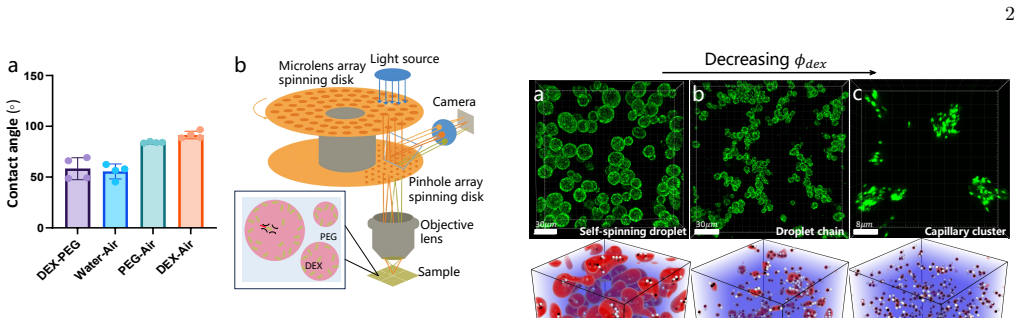
The paper claims that the interplay between bacterial activity and interfacial wetting—not either alone—regulates liquid–liquid phase separation in a dextran–polyethylene glycol mixture. As the dextran fraction is lowered, experiments and simulations show a reproducible sequence: self-spinning droplets, elongated droplet chains, branched capillary-like clusters, and fingerlike deformed droplets. Activity suppresses coarsening in the droplet regime because bacteria inside droplets drive coherent rotation, and two rotating droplets undergo a low-Reynolds-number hydrodynamic repulsion that blocks coalescence. When dextran is the minority phase, activity accelerates coarsening: wetting affinity
Load-bearing premise
The entire mechanism rests on simulations where the wetting affinities (γ1 = −4, γ2 = 2) and the activity force were chosen to reproduce the observed morphology rather than independently measured; if that tuned interfacial stress balance is not quantitatively faithful to real P. aeruginosa, the proposed rotation-repulsion and capillary-attraction mechanisms could be artifacts.
Editorial extensions
If this is right
- Motile bacteria can act as an active stabilizer: the same strain both delays macroscopic stratification in the droplet regime and accelerates domain growth in the capillary-cluster regime, so a single control parameter—the phase-volume ratio—selects the direction of coarsening.
- The morphology of an all-aqueous emulsion can be programmed by adjusting the ratio of minority-phase volume to bacterial volume, yielding droplets, chains, or branched clusters without changing chemistry.
- Wetting-mediated capillary attraction offers a physical route to bacterial aggregation from dilute suspension, potentially relevant to early biofilm formation.
- The rotation-induced hydrodynamic repulsion at low Reynolds number extends the known colloidal wetting-and-coarsening picture to active swimmers, implying that hydrodynamic interactions cannot be neglected in active ATPS models.
Reading between the lines
- This suggests a design rule for switchable emulsions: if bacterial swimming can be toggled by oxygen or nutrient availability, the same chemical system could be driven between slow and fast coarsening regimes.
- The tuned wetting parameters imply a falsifiable prediction: altering bacterial surface chemistry should shift the morphology sequence and the sign of activity's effect on coarsening in a predictable way.
- The two-bacteria simulations suggest a generic mechanism: any preferentially wetting small particle—not just a swimmer—could accelerate aggregation in a minority-phase-scarce regime, with activity amplifying the effect.
Signed reviews
Editorial analysis
A structured set of objections, weighed in public.
Referee Report
Summary. The paper combines confocal experiments on Pseudomonas aeruginosa in a dextran–polyethylene glycol aqueous two-phase system with fluid-particle-dynamics (FPD) simulations. It reports a morphology sequence (self-spinning droplets, elongated droplet chains, branched capillary-like clusters, and strongly deformed droplets) controlled by the DEX volume fraction and bacterial volume fraction. The central mechanistic proposal is that bacterial activity and interfacial wetting act together: activity suppresses coarsening in the droplet regime via rotation-induced hydrodynamic repulsion, and accelerates coarsening in the low-DEX regime via wetting-mediated capillary attraction. The paper also reports a dual kinetic role for activity and proposes a general active-wetting coupling framework.
Significance. If the proposed mechanism is correct, the paper establishes a genuinely new control principle for liquid–liquid phase separation in active binary fluids: motility and wetting, not either effect alone, set the morphology and coarsening kinetics. The direct experimental observation of the morphology sequence and of the opposite effect of activity on coarsening in the two regimes is valuable and will likely stimulate follow-up work. However, the mechanistic conclusions are carried by FPD simulations whose wetting coefficients and activity force are set ad hoc, and a key biological claim (the "wetting glue" protein) is confined to a placeholder Supplemental Material. Quantitative kinetic curves are shown without error bars or replicate information. The work is therefore a promising but not yet fully supported contribution.
major comments (5)
- [Hybrid particle–field simulations; Fig. 2] The two central mechanisms are established with the wetting coefficients γ1=−4, γ2=2 and activity f_act that are chosen "motivated by the experimentally observed amphiphilicity" with no mapping to the measured contact angle θ≈50° and no calibration of f_act to the swimming speed of P. aeruginosa. Since the morphology sequence is then reproduced with these same values, the agreement in Fig. 2 does not by itself validate the mechanism. Please provide a derivation of γ1, γ2 from the measured contact angle, or at minimum a sensitivity analysis over γ1, γ2, f_act; otherwise the rotation-repulsion and capillary-attraction mechanisms remain post-hoc.
- [Fig. 3(a), Fig. 4(a), Fig. A2] The experimental evidence for the dual kinetic role is presented as single curves without error bars, replicate number, or measurement definitions for R and A. More importantly, the "non-motile" control is not described; if inactivation is achieved by heat or chemical treatment, the cell surface (and hence wetting affinity) may change, confounding activity with altered interfacial properties. The method of producing non-motile bacteria and the statistics must be reported, and ideally a flagellar/chemotaxis mutant should be used.
- [Abstract and Ref. [54]] The abstract and summary claim that a biofilm-associated protein acts as a "wetting glue" promoting bacterial clustering even in dilute suspensions. This result is not presented in the main text or End Matter; it is relegated to the placeholder Supplemental Material [54]. As submitted, this is an unverifiable core claim and should either be brought into the main text or removed from the abstract.
- [Self-spinning droplets and hydrodynamic repulsion; Fig. 3(d)] The effective low-Reynolds-number repulsion between two rotating droplets is demonstrated only by a simulation described as "two 3D rollers" with details in the missing SM. Because Stokes-flow interactions between rotating bodies are sensitive to boundary conditions and to the presence of a deformable interface, it is crucial to report the domain size, boundary conditions, and droplet deformation in this test. The experimental time-lapse (Fig. 3e) shows separation, but alternative explanations (Marangoni flow, droplet deformation, or confinement) are not ruled out.
- [Fig. 2, Fig. 4] The comparison between experiment and simulation is exclusively visual/qualitative. No quantitative morphology metrics (e.g., droplet size distribution, chain length, cluster fractal dimension) or a phase diagram in (ϕdex, ϕbac) are provided. The claim that the mechanism is "robust" would be better supported by a quantitative mapping between experimental ϕdex/ϕbac and simulation ψ̄, and by showing that the sequence persists for a range of f_act and γ values.
minor comments (5)
- [Introduction] Typo: "passive ATTS" should presumably read "passive ATPS."
- [Fig. 3(a)] The axis label "τt/ s" and the caption's "τt/ e" are inconsistent; it should likely be t/τ_e.
- [Fig. 4(c)] The condition "γ1, γ2 = 0" should be written "γ1 = γ2 = 0" for clarity.
- [Ref. [54]] The Supplemental Material URL contains "xxx" and is a placeholder; it must be completed before final submission.
- [End Matter, Fig. A2] The caption says the DEX volume fraction "increases from left to right" but the panel labels may be ambiguous; clarify.
Circularity Check
No significant circularity: simulations are retrospectively validated against experiments, and the proposed mechanisms are demonstrated in controlled model configurations rather than derived from fitted predictions.
full rationale
The paper's derivation chain is not circular in the sense defined here. The morphology sequence (self-spinning droplets, chains, branched clusters) is an experimental fact, and the simulations with hand-set wetting coefficients (γ1 = −4, γ2 = 2) are described as qualitatively reproducing that sequence, not as predicting it from independently fitted parameters. The mechanistic claims—low-Reynolds hydrodynamic repulsion between spinning droplets and wetting-mediated capillary attraction between bacteria—are demonstrated in dedicated two-body simulations (Figs. 3d, 4c,d) and are corroborated by experiment (Fig. 3e, Fig. 4a). The paper does not define the wetting or activity parameters in terms of the targeted outcomes, and it explicitly acknowledges simulation–experiment discrepancies (early-time plateau, rapid non-motile growth), showing the model is not identical to the experimental result. Self-citations to the FPD method and to prior wetting-attraction work are to established, externally validated results and are not load-bearing reductions. The missing Supplemental Material, including the 'wetting glue' experiment, is a completeness/evidence problem, not a circularity. No specific equation or fitted quantity is renamed as a prediction, so no circular step can be exhibited under the required standard.
Assumptions & free parameters
free parameters (3)
- γ1 (head wetting affinity) =
-4
- γ2 (tail wetting affinity) =
2
- f_act (dimensionless activity force) =
1 (and 5 in escape simulations)
assumptions (5)
- standard math Ginzburg–Landau free-energy functional with order parameter ψ for the binary DEX–PEG mixture.
- standard math Incompressible Navier–Stokes equations solved with the fluid particle dynamics method.
- domain assumption Each P. aeruginosa bacterium is modeled as a pusher-type force dipole on a rod-like head–tail–virtual-particle geometry.
- ad hoc to paper Wetting interactions enter through surface-coupling terms with coefficients γ1=−4, γ2=2.
- domain assumption Randomly oriented interfacial bacteria produce a coherent torque that rotates the droplet.
Cite this review
Pith. "Pith review of Active motility and wetting cooperatively regulate liquid-liquid phase separation." pith.science (2026). https://pith.science/paper/DVVYRI4A
@misc{pith2026251118077,
  author       = {Pith},
  title        = {Pith review of: Active motility and wetting cooperatively regulate liquid-liquid phase separation},
  year         = {2026},
  howpublished = {\url{https://pith.science/paper/DVVYRI4A}},
  note         = {Machine review of arXiv:2511.18077}
}
read the original abstract
Liquid--liquid phase separation in aqueous two-phase systems is fundamental across physical and biological sciences. While well understood for passive mixtures, how it is regulated by active agents such as motile bacteria remains largely unexplored. By combining experiments on Pseudomonas aeruginosa in a dextran--polyethylene glycol mixture with hydrodynamic simulations, we show that the coupling between bacterial activity and interfacial wetting converts self-propulsion into mechanically effective interfacial stresses, giving rise to a robust sequence of morphologies, including self-spinning droplets, elongated droplet chains, and branched capillary-like clusters. More importantly, it gives activity a dual kinetic role: activity suppresses coarsening in the droplet regime through rotation-induced hydrodynamic repulsion, but accelerates coarsening when dextran is the minority phase, where wetting-mediated attraction drives aggregation. To probe the biological relevance of this mechanism, we further show that a biofilm-associated protein can act as an interfacial ``wetting glue,'' promoting bacterial clustering even in dilute suspensions. Our findings establish activity--wetting coupling, rather than activity or wetting alone, as a mechanism by which active motility regulates pattern morphology and coarsening dynamics, and reveal a physical route to enhancing bacterial aggregation from dilute suspensions.
Figures


Reference graph
Works this paper leans on
-
[54]
See Supplemental Material at http://link.aps.org/supplemental/xxx on the details of experiments and simulations
-
[1]
Masao Doi,Soft matter physics(Oxford University Press, 2013)
2013
-
[2]
Unusual phase separation in a poly- mer solution caused by asymmetric molecular dynamics,
Hajime Tanaka, “Unusual phase separation in a poly- mer solution caused by asymmetric molecular dynamics,” Phys. Rev. Lett.71, 3158–3161 (1993)
1993
-
[3]
Spin- odal decomposition in a model colloid-polymer mixture in microgravity,
A. E. Bailey, W. C. K. Poon, R. J. Christianson, A. B. Schofield, U. Gasser, V. Prasad, S. Manley, P. N. Segre, L. Cipelletti, W. V. Meyer, M. P. Doherty, S. Sankaran, A. L. Jankovsky, W. L. Shiley, J. P. Bowen, J. C. Eggers, C. Kurta, T. Lorik, P. N. Pusey, and D. A. Weitz, “Spin- odal decomposition in a model colloid-polymer mixture in microgravity,” Ph...
2007
-
[4]
Viscoelastic phase separation in soft matter and foods,
Hajime Tanaka, “Viscoelastic phase separation in soft matter and foods,” Faraday Discuss.158, 371–406 (2012)
2012
-
[5]
Power-law coars- ening in network-forming phase separation governed by mechanical relaxation,
Michio Tateno and Hajime Tanaka, “Power-law coars- ening in network-forming phase separation governed by mechanical relaxation,” Nat. Commun.12, 912 (2021)
2021
-
[6]
Me- 7 chanical slowing down of network-forming phase separa- tion of polymer solutions,
Jiaxing Yuan, Michio Tateno, and Hajime Tanaka, “Me- 7 chanical slowing down of network-forming phase separa- tion of polymer solutions,” ACS Nano17, 18025–18036 (2023)
2023
-
[7]
Charge asym- metry suppresses coarsening dynamics in polyelectrolyte complex coacervation,
Shensheng Chen and Zhen-Gang Wang, “Charge asym- metry suppresses coarsening dynamics in polyelectrolyte complex coacervation,” Phys. Rev. Lett.131, 218201 (2023)
2023
Show all 64 references
-
[8]
Germline P granules are liquid droplets that localize by controlled dissolution/condensation,
Clifford P. Brangwynne, Christian R. Eckmann, David S. Courson, Agata Rybarska, Carsten Hoege, J¨ obin Gharakhani, Frank J¨ ulicher, and Anthony A. Hyman, “Germline P granules are liquid droplets that localize by controlled dissolution/condensation,” Science324, 1729– 1732 (2009)
2009
-
[9]
Phase transitions in the assembly of multivalent sig- nalling proteins,
Pilong Li, Sudeep Banjade, Hui-Chun Cheng, Soyeon Kim, Baoyu Chen, Liang Guo, Marc Llaguno, Javoris V Hollingsworth, David S King, Salman F Banani,et al., “Phase transitions in the assembly of multivalent sig- nalling proteins,” Nature483, 336–340 (2012)
2012
-
[10]
Considerations and challenges in studying liquid-liquid phase separation and biomolecular condensates,
Simon Alberti, Amy Gladfelter, and Tanja Mittag, “Considerations and challenges in studying liquid-liquid phase separation and biomolecular condensates,” Cell 176, 419–434 (2019)
2019
-
[11]
Phase separation: Bridging polymer physics and biology,
Sarah L. Perry, “Phase separation: Bridging polymer physics and biology,” Curr. Opin. Colloid Interface Sci. 39, 86–97 (2019)
2019
-
[12]
Viscoelastic phase separation in biolog- ical cells,
Hajime Tanaka, “Viscoelastic phase separation in biolog- ical cells,” Commun. Phys.5, 167 (2022)
2022
-
[13]
Formation of network and cellular structures by viscoelastic phase separation,
Hajime Tanaka, “Formation of network and cellular structures by viscoelastic phase separation,” Adv. Mater. 21, 1872–1880 (2009)
2009
-
[14]
Rheology of food, cosmet- ics and pharmaceuticals,
C. Gallegos and J.M. Franco, “Rheology of food, cosmet- ics and pharmaceuticals,” Curr. Opin. Colloid Interface Sci.4, 288–293 (1999)
1999
-
[15]
Progress report on phase separation in polymer solutions,
Fei Wang, Patrick Altschuh, Lorenz Ratke, Haodong Zhang, Michael Selzer, and Britta Nestler, “Progress report on phase separation in polymer solutions,” Adv. Mater.31, 1806733 (2019)
2019
-
[16]
Aqueous two-phase system (ATPS): from basic science to applications,
Xunan Zhang, Mingxue Han, Shuang Han, and Wei Zong, “Aqueous two-phase system (ATPS): from basic science to applications,” RSC advances15, 9041–9054 (2025)
2025
-
[17]
Liquid-liquid phase separation in biology,
Anthony A Hyman, Christoph A Weber, and Frank J¨ ulicher, “Liquid-liquid phase separation in biology,” Annu. Rev. Cell Dev. Biol.30, 39–58 (2014)
2014
-
[18]
Emerging biotechnology applications of aqueous two-phase systems,
Alyne G Teixeira, Rishima Agarwal, Kristin Robin Ko, Jessica Grant-Burt, Brendan M Leung, and John P Frampton, “Emerging biotechnology applications of aqueous two-phase systems,” Adv. Healthc. Mater.7, 1701036 (2018)
2018
-
[19]
Cell-inspired all-aqueous microfluidics: from intracellu- lar liquid–liquid phase separation toward advanced bio- materials,
Qingming Ma, Yang Song, Wentao Sun, Jie Cao, Hao Yuan, Xinyu Wang, Yong Sun, and Ho Cheung Shum, “Cell-inspired all-aqueous microfluidics: from intracellu- lar liquid–liquid phase separation toward advanced bio- materials,” Adv. Sci.7, 1903359 (2020)
2020
-
[20]
Akira Onuki,Phase transition dynamics(Cambridge University Press, 2002)
2002
-
[21]
Activity-induced phase separation and self-assembly in mixtures of ac- tive and passive particles,
Joakim Stenhammar, Raphael Wittkowski, Davide Marenduzzo, and Michael E. Cates, “Activity-induced phase separation and self-assembly in mixtures of ac- tive and passive particles,” Phys. Rev. Lett.114, 018301 (2015)
2015
-
[22]
Small activity differences drive phase separation in active-passive polymer mix- tures,
Jan Smrek and Kurt Kremer, “Small activity differences drive phase separation in active-passive polymer mix- tures,” Phys. Rev. Lett.118, 098002 (2017)
2017
-
[23]
Active phase separation by turning to- wards regions of higher density,
Jie Zhang, Ricard Alert, Jing Yan, Ned S Wingreen, and Steve Granick, “Active phase separation by turning to- wards regions of higher density,” Nat. Phys.17, 961–967 (2021)
2021
-
[24]
Active surface flows accelerate the coarsening of lipid membrane domains,
Daniel P. Arnold, Aakanksha Gubbala, and Sho C. Taka- tori, “Active surface flows accelerate the coarsening of lipid membrane domains,” Phys. Rev. Lett.131, 128402 (2023)
2023
-
[25]
Phase separation driven by active flows,
Saraswat Bhattacharyya and Julia M. Yeomans, “Phase separation driven by active flows,” Phys. Rev. Lett.130, 238201 (2023)
2023
-
[26]
Colloid phase sepa- ration dynamics driven by chiral turbulent flows,
Jiaxing Yuan and Hajime Tanaka, “Colloid phase sepa- ration dynamics driven by chiral turbulent flows,” Phys. Rev. Res.6, 023186 (2024)
2024
-
[27]
Phase-separated droplets swim to their dissolution,
Etienne Jambon-Puillet, Andrea Testa, Charlotta Lorenz, Robert W Style, Aleksander A Rebane, and Eric R Dufresne, “Phase-separated droplets swim to their dissolution,” Nat. Commun.15, 3919 (2024)
2024
-
[28]
Engineering motile coacervate droplets via nanomotor stabilization,
Siwen Sun, Jianhong Wang, Yudong Li, Alexander B Cook, Bingbing Sun, Sebastian Novosedlik, Lars JMM Paffen, Sander GAM Huisman, Lou MV Raeven, Alexan- der D Fusi,et al., “Engineering motile coacervate droplets via nanomotor stabilization,” J. Am. Chem. Soc. 147, 31871–31881 (2025)
2025
-
[29]
Uncon- ventional colloidal aggregation in chiral bacterial baths,
Daniel Grober, Ivan Palaia, Mehmet Can U¸ car, Edouard Hannezo, Andela ˇSari´ c, and J´ er´ emie Palacci, “Uncon- ventional colloidal aggregation in chiral bacterial baths,” Nat. Phys.19, 1680–1688 (2023)
2023
-
[30]
Hydrodynamics-induced long-range at- traction between plates in bacterial suspensions,
Luhui Ning, Xin Lou, Qili Ma, Yaochen Yang, Nan Luo, Ke Chen, Fanlong Meng, Xin Zhou, Mingcheng Yang, and Yi Peng, “Hydrodynamics-induced long-range at- traction between plates in bacterial suspensions,” Phys. Rev. Lett.131, 158301 (2023)
2023
-
[31]
Motility modulates the partitioning of bacteria in aque- ous two-phase systems,
Jiyong Cheon, Kyu Hwan Choi, Kevin J. Modica, Robert J. Mitchell, Sho C. Takatori, and Joonwoo Jeong, “Motility modulates the partitioning of bacteria in aque- ous two-phase systems,” Phys. Rev. Lett.135, 128401 (2025)
2025
-
[32]
Capillary inter- actions drive the self-organization of bacterial colonies,
Matthew E Black, Chenyi Fei, Ricard Alert, Ned S Wingreen, and Joshua W Shaevitz, “Capillary inter- actions drive the self-organization of bacterial colonies,” Nat. Phys. , 1–7 (2025)
2025
-
[33]
Fluid dynamics and noise in bacterial cell–cell and cell–surface scatter- ing,
Knut Drescher, J¨ orn Dunkel, Luis H Cisneros, Sujoy Ganguly, and Raymond E Goldstein, “Fluid dynamics and noise in bacterial cell–cell and cell–surface scatter- ing,” Proc. Natl. Acad. Sci. U.S.A.108, 10940–10945 (2011)
2011
-
[34]
An introduction to the hydrodynamics of swimming mi- croorganisms,
Julia M Yeomans, Dmitri O Pushkin, and Henry Shum, “An introduction to the hydrodynamics of swimming mi- croorganisms,” Eur. Phys. J. Special Topics223, 1771– 1785 (2014)
2014
-
[35]
Modelling the mechanics and hy- drodynamics of swimming E. coli,
Jinglei Hu, Mingcheng Yang, Gerhard Gompper, and Roland G Winkler, “Modelling the mechanics and hy- drodynamics of swimming E. coli,” Soft matter11, 7867– 7876 (2015)
2015
-
[36]
Computational models for active matter,
M Reza Shaebani, Adam Wysocki, Roland G Winkler, Gerhard Gompper, and Heiko Rieger, “Computational models for active matter,” Nat. Rev. Phys.2, 181–199 (2020)
2020
-
[37]
Transition from turbulent to coherent flows in confined three-dimensional active fluids,
Kun-Ta Wu, Jean Bernard Hishamunda, Daniel TN Chen, Stephen J DeCamp, Ya-Wen Chang, Alberto Fern´ andez-Nieves, Seth Fraden, and Zvonimir Dogic, “Transition from turbulent to coherent flows in confined three-dimensional active fluids,” Science355, eaal1979 8 (2017)
2017
-
[38]
Self-organization of swimmers drives long-range fluid transport in bacterial colonies,
Haoran Xu, Justas Dauparas, Debasish Das, Eric Lauga, and Yilin Wu, “Self-organization of swimmers drives long-range fluid transport in bacterial colonies,” Nat. Commun.10, 1792 (2019)
2019
-
[39]
Robust edge flows in swarming bacterial colonies,
He Li, Hugues Chat´ e, Masaki Sano, Xia-qing Shi, and HP Zhang, “Robust edge flows in swarming bacterial colonies,” Phys. Rev. X14, 041006 (2024)
2024
-
[40]
Activity-induced clustering in model dumbbell swimmers: The role of hydrodynamic interactions,
Akira Furukawa, Davide Marenduzzo, and Michael E Cates, “Activity-induced clustering in model dumbbell swimmers: The role of hydrodynamic interactions,” Phys. Rev. E90, 022303 (2014)
2014
-
[41]
Dynamic clustering in suspension of motile bacteria,
Xiao Chen, Xiang Yang, Mingcheng Yang, and HP Zhang, “Dynamic clustering in suspension of motile bacteria,” Europhys. Lett.111, 54002 (2015)
2015
-
[42]
Clustering of microswim- mers: interplay of shape and hydrodynamics,
Mario Theers, Elmar Westphal, Kai Qi, Roland G Win- kler, and Gerhard Gompper, “Clustering of microswim- mers: interplay of shape and hydrodynamics,” Soft Mat- ter14, 8590–8603 (2018)
2018
-
[43]
Viscoelastic model of phase separa- tion,
Hajime Tanaka, “Viscoelastic model of phase separa- tion,” Phys. Rev. E56, 4451 (1997)
1997
-
[44]
Phase separation in soft matter: The concept of dynamic asymmetry,
Hajime Tanaka, “Phase separation in soft matter: The concept of dynamic asymmetry,” Soft Interfaces: Lecture Notes of the Les Houches Summer School98, 465–526 (2017)
2017
-
[45]
Capillary condensation and prewetting between spheres,
HT Dobbs and JM Yeomans, “Capillary condensation and prewetting between spheres,” J. Phys.: Condens. Matter4, 10133 (1992)
1992
-
[46]
Wetting and spreading,
Daniel Bonn, Jens Eggers, Joseph Indekeu, Jacques Meu- nier, and Etienne Rolley, “Wetting and spreading,” Rev. Mod. Phys.81, 739–805 (2009)
2009
-
[47]
Demixing, remixing and cellular networks in binary liquids containing col- loidal particles,
Job HJ Thijssen and Paul S Clegg, “Demixing, remixing and cellular networks in binary liquids containing col- loidal particles,” Soft Matter6, 1182–1190 (2010)
2010
-
[48]
Wetting effect induced depletion and adsorption layers: Diffuse interface perspective,
Haodong Zhang, Hongmin Zhang, Fei Wang, and Britta Nestler, “Wetting effect induced depletion and adsorption layers: Diffuse interface perspective,” ChemPhysChem25, e202400086 (2024)
2024
-
[49]
Interplay between wetting and phase separation in binary fluid mixtures: roles of hydrody- namics,
Hajime Tanaka, “Interplay between wetting and phase separation in binary fluid mixtures: roles of hydrody- namics,” J. Phys.: Condens. Matter13, 4637 (2001)
2001
-
[50]
Dynamic deple- tion attraction between colloids suspended in a phase- separating binary liquid mixture,
Takeaki Araki and Hajime Tanaka, “Dynamic deple- tion attraction between colloids suspended in a phase- separating binary liquid mixture,” J. Condens. Matter Phys.20, 072101 (2008)
2008
-
[51]
Wetting-induced depletion interaction between particles in a phase- separating liquid mixture,
Takeaki Araki and Hajime Tanaka, “Wetting-induced depletion interaction between particles in a phase- separating liquid mixture,” Phys. Rev. E73, 061506 (2006)
2006
-
[52]
Simulation method of colloidal suspensions with hydrodynamic interactions: Fluid particle dynamics,
Hajime Tanaka and Takeaki Araki, “Simulation method of colloidal suspensions with hydrodynamic interactions: Fluid particle dynamics,” Phys. Rev. Lett.85, 1338–1341 (2000)
2000
-
[53]
Physical foundation of the fluid particle dynamics method for colloid dynamics simulation,
Akira Furukawa, Michio Tateno, and Hajime Tanaka, “Physical foundation of the fluid particle dynamics method for colloid dynamics simulation,” Soft Matter14, 3738–3747 (2018)
2018
-
[55]
Numerical cal- culation of time-dependent viscous incompressible flow of fluid with free surface,
Francis H. Harlow and J. Eddie Welch, “Numerical cal- culation of time-dependent viscous incompressible flow of fluid with free surface,” Phys. Fluids8, 2182–2189 (1965)
1965
-
[56]
Bacteria driving droplets,
Gabriel Ramos, Mar ´ ıa Luisa Cordero, and Rodrigo Soto, “Bacteria driving droplets,” Soft Matter16, 1359–1365 (2020)
2020
-
[57]
Directional self-locomotion of ac- tive droplets enabled by nematic environment,
Mojtaba Rajabi, Hend Baza, Taras Turiv, and Oleg D Lavrentovich, “Directional self-locomotion of ac- tive droplets enabled by nematic environment,” Nat. Phys.17, 260–266 (2021)
2021
-
[58]
Purely hydrodynamic ordering of rotating disks at a finite reynolds number,
Yusuke Goto and Hajime Tanaka, “Purely hydrodynamic ordering of rotating disks at a finite reynolds number,” Nat. Commun.6, 5994 (2015)
2015
-
[59]
Shaping the growth behaviour of biofilms initi- ated from bacterial aggregates,
Gavin Melaugh, Jaime Hutchison, Kasper Nørskov Kragh, Yasuhiko Irie, Aled Roberts, Thomas Bjarnsholt, Stephen P Diggle, Vernita D Gordon, and Rosalind J Allen, “Shaping the growth behaviour of biofilms initi- ated from bacterial aggregates,” PloS one11, e0149683 (2016)
2016
-
[60]
New insight into the early stages of biofilm formation,
Catherine R Armbruster and Matthew R Parsek, “New insight into the early stages of biofilm formation,” Proc. Natl. Acad. Sci. U.S.A.115, 4317–4319 (2018)
2018
-
[61]
Morphology of active deformable 3D droplets,
Liam J Ruske and Julia M Yeomans, “Morphology of active deformable 3D droplets,” Phys. Rev. X11, 021001 (2021)
2021
-
[62]
Migration and deformation of a droplet enclosing an active particle,
Sho Kawakami and Petia M Vlahovska, “Migration and deformation of a droplet enclosing an active particle,” J. Fluid Mech.1007, A41 (2025)
2025
-
[63]
Active colloids with collective mobility status and research opportunities,
Jie Zhang, Erik Luijten, Bartosz A Grzybowski, and Steve Granick, “Active colloids with collective mobility status and research opportunities,” Chem. Soc. Rev.46, 5551–5569 (2017)
2017
-
[64]
The surprising physics of interfaces in active matter,
Solon Alexandre and Zhao Yongfeng, “The surprising physics of interfaces in active matter,” Chin. Phys. Lett. 42, 100901–100901 (2025)
2025
Reviewed August 3, 2026 · model on record in the stance chip above.
Discussion (0). Continue with ORCID to comment.