REVIEW 6 major objections 4 minor 58 references
EcoDefender: Energy-Efficient Hybrid Anomaly Detection for IoT Edge Gateways
T0 review · 6 major / 4 minor · reviewed 2026-08-03 · deepseek-v4-flash
Pith's one-line read EcoDefender, a hybrid autoencoder–isolation forest detector, achieves up to 94% accuracy on IoT traffic with 30% lower energy use than AE-only baselines.
desk verdict Not publishable as submitted: the sustainability numbers are internally inconsistent and the theory has load-bearing derivation errors, though the testbed and evaluation design show real effort. read the letter →
The pith
A machine-rendered reading of the paper's core claim, the machinery that carries it, and where it could break.
The reading
What carries the argument
The load-bearing mechanism is the hybrid fusion function F(x) = αe(x) + (1−α)s(x), where e(x) is the autoencoder's mean-squared reconstruction error, s(x) is the isolation forest score, and α is chosen by a closed-form likelihood-ratio formula with variance regularization (Eqs. 20–21). Around this core sit three supporting ideas: a trace-based symmetry constraint (Eq. 12) that forces the decoder weights toward the encoder's transpose, making the AE converge to a principal subspace and amplifying reconstruction error for anomalies; the energy–complexity coupling E ≈ κ(NdL + mn log n) (Eq. 39), which ties computational workload directly to energy draw; and a dynamic threshold update (Eq. 22) t
What would settle it
Retrain EcoDefender on Bot-IoT using only unlabeled feature selection (e.g., variance or PCA) and a label-free threshold (e.g., a fixed percentile of the fused score), then measure accuracy on the same held-out attack families; if accuracy falls materially below the reported 94%, the claim of a fully unsupervised high-accuracy detector collapses.
Extended reading notes
Core claim
The paper introduces EcoDefender, an edge-oriented hybrid AE–IF framework that performs anomaly scoring in a compressed latent space. Three design elements carry the argument: an anomaly-aware latent manifold regularizer that aligns encoder and decoder subspaces via a trace-based symmetry term; a learnable fusion weight that adaptively balances reconstruction error and isolation score under distributional drift; and a dynamic threshold adjustment rule that recalibrates the decision boundary over time. The authors report up to 94% detection accuracy (F1 0.92, ROC-AUC 0.963) on the Bot-IoT dataset deployed across ten Raspberry Pi gateways, with average CPU usage of 22%, end-to-end inference la
Load-bearing premise
The claim that EcoDefender is fully unsupervised while achieving 94% accuracy rests on the assumption that the label-driven feature selection (Eq. 45) and threshold calibration (Eq. 22) do not leak label information into the reported results.
Editorial extensions
If this is right
- Edge gateways can run effective anomaly detection at 22% average CPU and 27 ms latency, leaving headroom for other workloads and bursty traffic.
- Per-inference energy drops roughly 30% versus AE-only detectors, translating to lower operational cost and a measurable carbon footprint (0.28 g CO2 per inference on the Quebec grid).
- The theoretical convergence and Lipschitz-stability guarantees imply the method stays stable under small input perturbations and bounded gradient noise, supporting deployment in noisy IoT environments.
- The leave-family-out evaluation suggests the latent-space hybrid generalizes to unseen attack families, with the strongest separation on UDP traffic (98.6% AUC).
Reading between the lines
- The label-informed feature selection (mutual information and tree importance, Eq. 45) and label-dependent threshold calibration (Eq. 22) mean the 'fully unsupervised' framing should be read narrowly: the reported 94% likely depends on those label-based choices, so a strictly unsupervised variant would be a natural, harder test.
- The near-linear energy–complexity coupling implies that halving either the autoencoder depth or the isolation forest's tree count should cut energy proportionally; deployment designers could use this as a tunable knob rather than treating the reported figures as fixed.
- Since carbon is computed as a linear rescaling of energy (γ = 1.0e-4 g CO2/J in the testbed), reporting carbon adds little information beyond energy itself; future comparisons should focus on energy per detection and grid intensity.
Editorial analysis
A structured set of objections, weighed in public.
Referee Report
Summary. The paper proposes EcoDefender, a hybrid autoencoder (AE) and Isolation Forest (IF) anomaly detector intended for IoT edge gateways. It combines composite input normalization, AE latent-space regularization, a modified IF score, an adaptive fusion of reconstruction error and isolation score, dynamic threshold tuning, and a series of theoretical claims about convergence, robustness, and energy-complexity coupling. The experimental evaluation uses the Bot-IoT dataset and a ten-node Raspberry Pi 4 testbed, reporting roughly 94% detection accuracy, 22% CPU usage, 27 ms latency, 0.45 J per inference (0.28 g CO2), and a 30% energy reduction relative to AE-only baselines. It also reports statistical analyses across nodes and a comparison to several literature baselines.
Significance. If the results held, the paper would make a useful contribution to green edge security: it combines detection quality with system-level metrics and attempts to provide theoretical justifications for lightweight operation. The distributed testbed and the leave-family-out evaluation protocol are worthwhile design choices. However, the main sustainability claim—central to the paper's title and novelty—is internally inconsistent, and the carbon-energy 'validation' is circular because carbon is defined as a linear function of energy. Several derived formulas are also incorrect or unverifiable. The paper therefore cannot be accepted in its current form, and the issues are not merely cosmetic.
major comments (6)
- [§IV-D, Eq. (20)–(21)] Eq. (21) is not the minimizer of Eq. (20). The objective in Eq. (20) is affine in α; differentiating with respect to α gives e(x)−s(x)=0, not the stated quotient. The μ and ρ terms do not depend on α, so the claimed closed-form α* is invalid. This undermines the proposed adaptive fusion mechanism, a central contribution.
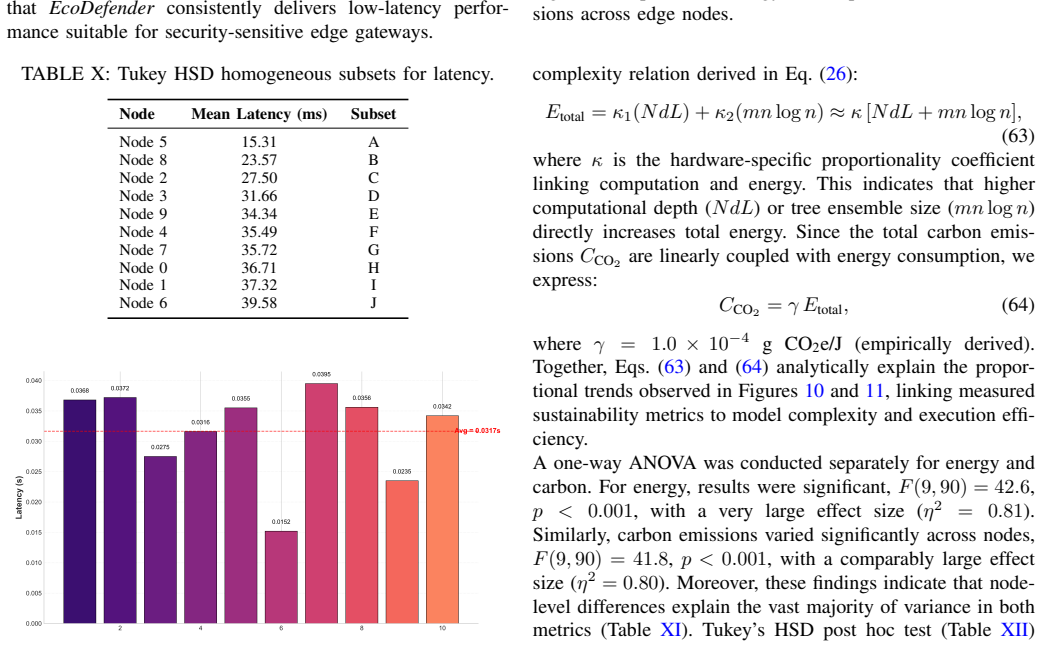
- [Abstract and §VI-F/Table XII] The flagship energy/carbon figures are mutually inconsistent. The abstract states 0.45 J/inference and 0.28 g CO2; with Eq. (64)'s γ=1.0e-4 g/J this gives 4.5e-5 g, and with §III-G's γ=1.7 g/kWh it gives about 2.1e-7 g. Table XII pairs 4.9 J with 0.30 g and 12.0 J with 0.90 g, i.e. about 0.06–0.075 g/J, matching neither conversion. Additionally, 0.45 J × 5,000 samples/s = 2,250 W, far above a Raspberry Pi 4's power budget. No independent AE-only energy measurement is reported to substantiate the 30% reduction.
- [§VI-F, Eq. (64), Fig. 11] The Pearson r=1.00 and R²=1.00 for energy versus carbon are forced by the definition C=γE in Eq. (64); they cannot be presented as an empirical validation of the proportionality. The regression is therefore circular, not a measured finding. The same issue affects the claim that optimizing complexity directly minimizes carbon emissions.
- [§V-C and §IV-E] The 'fully unsupervised' and 'zero-day' claims are contradicted by the experimental pipeline. Feature selection in §V-C uses mutual information and tree-based importance against class labels (Eq. (45)), and the threshold optimization in Eq. (22) uses precision/recall, which require labels. The reported 94% accuracy is therefore not the result of a fully unsupervised pipeline, and the comparison with unsupervised baselines is not apples-to-apples.
- [§IV-C, Eq. (17)] The modified IF score in Eq. (17) is introduced without derivation. The notation E_{πt}, n_l(πt), and the exponential normalization are not defined, and no connection to the standard IF score in Eq. (1) is established. Since the paper claims a formal theoretical foundation, this missing derivation is load-bearing for the method as presented.
- [§VI-D vs §IV-H5, Eq. (37)] The score-separation statistics (KS=0.93, Cohen's d=4.32) are used to 'confirm' the exponential error bound in Eq. (37)/(93). However, Eq. (37) is a generic sub-Gaussian tail bound; a large empirical separation does not test or validate that bound. No comparison of measured classification error to the bound's prediction is provided, so the claimed confirmation is unsupported.
minor comments (4)
- [§VI-E4, Eq. (62)] The product T_i·τ_i ≈ 1 cannot hold dimensionally with throughput in samples/s and latency in ms. For example, Node 5: 12,780 samples/s × 15.31 ms ≈ 195.7, not 1; Eq. (62) appears to be a numerical coincidence or a dimensional error.
- [General] There are several broken or vague cross-references, e.g., 'Eqs. (34)–(93)' in §VI-C and 'Eq. (93)' in §VI-D; these make the theoretical claims hard to trace.
- [Typos] The paper contains typos such as 'pervious works' in Section II and inconsistent spacing in 'ANOV A' throughout the tables and text.
- [Table XIII] The baseline comparison reports no error bars or significance tests for the detection metrics, despite the paper's extensive use of ANOVA and t-tests elsewhere. It is also unclear whether the cited baseline numbers were obtained under the same train/test protocol.
Circularity Check
The flagship energy–carbon 'validation' is a tautology: Eq. (64) defines C=γE, so the r=1.00/R²=1.00 regression is forced by construction; the 'fully unsupervised' claim also depends on label-driven feature selection and threshold tuning.
-
self definitional
[Section VI-F, Eq. (64) and Figure 11 (also Section III-G, Eq. (7))]
"CCO2 = γ Etotal, (64) where γ = 1.0 × 10⁻⁴ g CO2e/J (empirically derived). ... Pearson’s correlation revealed an almost perfect relationship (r = 1.00, p < 0.001), while regression analysis confirmed complete linearity with R2 = 1.00. This empirically validates Eq. (64) and demonstrates that carbon emissions scale strictly linearly with energy cost."
Carbon emissions were defined in Eq. (7) as C = E × γ, and Eq. (64) restates this definition with a fitted γ. Therefore a scatter plot of C against E is a plot of γE against E: the correlation is exactly 1 and R² is exactly 1 by construction, not because of any empirical discovery. The claimed 'validation' of the energy–carbon coupling is the definition itself. Additionally, the abstract’s 0.45 J → 0.28 g CO2 conversion is inconsistent with both stated γ values (1.7 gCO2/kWh in Section III-G and 1.0e-4 gCO2/J in Eq. (64)), so the reported numbers are not even a consistent application of the formula.
-
fitted input called prediction
[Abstract; Section V-C, Eq. (45); Section IV-E, Eq. (22)]
"Abstract: '...EcoDefender enables lightweight and fully unsupervised anomaly detection suitable for edge deployment.' Section V-C: 'mutual information was computed as: I(X;Y) = Σ p(x,y) log p(x,y)/p(x)p(y), where higher values indicate stronger dependence between feature X and class label Y.' Section IV-E: 'τ∗ = arg minτ { − 2P(τ)R(τ)/(P(τ)+R(τ)) + λ max{0, FP(τ)−ϵ}² + ρ ∫_τ^∞ p(F)dF }.'"
The system is advertised as 'fully unsupervised,' but the pipeline is label-informed at two load-bearing stages: Eq. (45) selects features using class labels Y, and Eq. (22) optimizes the decision threshold using precision/recall, both of which require ground-truth labels. The reported 94% accuracy is therefore obtained after label-driven feature reduction and threshold calibration, so the 'unsupervised' and zero-day interpretation reduces to a fitted result, not an autonomous property of unlabeled learning.
1 more flagged steps
-
self definitional
[Section VI-E.4, Eqs. (55) and (62)]
"Eq. (55): 'Ti = 1/τi = 1/(τAE,i + τIF,i)'. Eq. (62): 'Since throughput Ti and latency τi are inversely related as in Eq. (55), the product Ti · τi ≈ 1 provides an empirical validation of real-time stability: Ti · τi ≈ 1, ∀i.'"
Throughput was defined as the reciprocal of latency in Eq. (55). Therefore Eq. (62)'s 'Ti · τi ≈ 1' is an algebraic identity following from the definitions, not an empirical validation of stability. Presenting this tautology as confirming real-time behavior is circular, though it is a secondary point relative to the energy/carbon tautology.
full rationale
The paper's detection-accuracy comparisons are not circular: Bot-IoT evaluation and leave-family-out testing provide external data, and the baseline numbers in Table XIII are independent comparisons. Likewise, the convergence and Lipschitz arguments are standard mathematical statements, though several are proof sketches. The central circularity is in the sustainability claim: Section VI-F defines carbon as γ times energy and then treats the resulting perfect correlation as empirical validation, so the 'green' result is true by construction. The 'fully unsupervised' framing is also undermined by explicit label use in feature selection (Eq. 45) and threshold tuning (Eq. 22). A minor tautology appears in the throughput–latency 'validation.' Overall, the load-bearing novelty claims—sustainability and unsupervised operation—reduce to definitions or fitted inputs, giving a circularity score of 7. The inconsistencies between stated γ values and the abstract's CO2 figures are correctness failures that reinforce the same conclusion but are not themselves the circular step.
Assumptions & free parameters
free parameters (3)
- Carbon intensity conversion γ =
1.7 g CO2/kWh (Section III-G); later 1.0e-4 g CO2e/J (Eq. 64); abstract implies ~0.62 g/J
- AE/IF hyperparameters (latent dim, depth, epochs, λ1–λ4, β, γ, δ, η, tree count m, subsample size n, threshold τ, fusion =
not reported
- Hardware energy coefficient κ / C_cpu =
asserted, not measured
assumptions (5)
- domain assumption Standard AE and Isolation Forest formulations from [31],[32] are valid and apply to the compressed latent space.
- standard math Convergence assumptions (A1) fθ,gθ Lipschitz; (A2) η_t in (0,2/L); (A3) bounded gradient variance.
- domain assumption Benign and malicious fused scores are sub-Gaussian with fixed means/variances.
- domain assumption Power model P(f)=C_cpu f^3 + C_mem ρ_acc and optimal frequency f* ∝ (N/C_cpu)^(1/3).
- domain assumption E[E(x)] = Tr((I-W_dec W_enc)^T Σ_x (I-W_dec W_enc)) (Eq. 13) assumes zero-mean inputs and exact expectations; Theorem 1's PCA equivalence uses tied weights W_dec=W_enc^T, which the actual trained AE does not enforce.
Cite this review
Pith. "Pith review of EcoDefender: Energy-Efficient Hybrid Anomaly Detection for IoT Edge Gateways." pith.science (2026). https://pith.science/paper/KMJPRRYX
@misc{pith2026251118235,
  author       = {Pith},
  title        = {Pith review of: EcoDefender: Energy-Efficient Hybrid Anomaly Detection for IoT Edge Gateways},
  year         = {2026},
  howpublished = {\url{https://pith.science/paper/KMJPRRYX}},
  note         = {Machine review of arXiv:2511.18235}
}
read the original abstract
The rapid growth of the Internet of Things (IoT) has created large-scale, heterogeneous ecosystems that are increasingly vulnerable to sophisticated, distributed cyber threats. However, many existing anomaly detection systems prioritize detection accuracy while overlooking system-level constraints, such as latency, computational overhead, and energy consumption, thereby limiting their practicality for resource-constrained edge gateways. This paper presents EcoDefender, an edge-oriented hybrid anomaly detection framework that combines Autoencoder (AE)-based latent representation learning with Isolation Forest (IF) anomaly scoring for IoT traffic analysis. The proposed architecture introduces several enhancements over conventional AE-IF pipelines, including anomaly-aware latent manifold regularization, variance-weighted isolation splits in the latent space, and a learnable fusion mechanism that adaptively combines reconstruction error and isolation-based anomaly scores in the presence of potential distributional drift. By compressing high-dimensional traffic features into compact latent representations and performing anomaly scoring in this reduced space, EcoDefender enables lightweight and fully unsupervised anomaly detection suitable for edge deployment. An experimental evaluation of realistic IoT traffic and a distributed Raspberry Pi edge testbed demonstrates that EcoDefender achieves up to 94% detection accuracy while maintaining low computational overhead, with an average CPU usage of 22% and an end-to-end inference latency of 27 ms. Furthermore, energy-aware measurements obtained through device-level power monitoring show an average energy consumption of 0.45 J per inference (0.28 g CO2 emissions), representing a 30% reduction in energy consumption compared with AE-only baselines while sustaining inference throughput of up to 5,000 samples per second.
Figures


Figures from the paper (10 more)




Reference graph
Works this paper leans on
-
[1]
Quantum computing and the future of healthcare internet of things security: Challenges and opportunities,
M. Adil, A. Ali, T. T. Tin, A. Farouk, S. Al-Kuwari, H. Song, Z. Jin et al., “Quantum computing and the future of healthcare internet of things security: Challenges and opportunities,”IEEE Internet of Things Journal, 2025
2025
-
[2]
A survey on intelligent internet of things: Applications, security, privacy, and future directions,
O. Aouedi, T.-H. Vu, A. Sacco, D. C. Nguyen, K. Piamrat, G. Marchetto, and Q.-V . Pham, “A survey on intelligent internet of things: Applications, security, privacy, and future directions,”IEEE communications surveys & tutorials, 2024
2024
-
[3]
The role of internet of things (iot) technology in industry 4.0 economy,
K. C. Rath, A. Khang, and D. Roy, “The role of internet of things (iot) technology in industry 4.0 economy,” inAdvanced IoT technologies and applications in the industry 4.0 digital economy. CRC Press, 2024, pp. 1–28
2024
-
[4]
An optimized isolation forest based intrusion detection system for heterogeneous and streaming data in the industrial internet of things (iiot) networks,
S. A. Elsaid and A. Binbusayyis, “An optimized isolation forest based intrusion detection system for heterogeneous and streaming data in the industrial internet of things (iiot) networks,”Discover Applied Sciences, vol. 6, no. 9, p. 483, 2024
2024
-
[5]
Healthcare internet of things: Security threats, challenges, and future research directions,
M. Adil, M. K. Khan, N. Kumar, M. Attique, A. Farouk, M. Guizani, and Z. Jin, “Healthcare internet of things: Security threats, challenges, and future research directions,”IEEE Internet of Things Journal, vol. 11, no. 11, pp. 19 046–19 069, 2024
2024
-
[6]
Automated network intrusion detection for internet of things: Security enhancements,
L. A. Maghrabi, “Automated network intrusion detection for internet of things: Security enhancements,”IEEE Access, vol. 12, pp. 30 839– 30 851, 2024
2024
-
[7]
Challenges and opportunities in securing the industrial internet of things,
M. Serror, S. Hack, M. Henze, M. Schuba, and K. Wehrle, “Challenges and opportunities in securing the industrial internet of things,”IEEE Transactions on Industrial Informatics, vol. 17, no. 5, pp. 2985–2996, 2020. 20
2020
-
[8]
Security and privacy in the industrial internet of things: Current standards and future challenges,
T. Gebremichael, L. P. Ledwaba, M. H. Eldefrawy, G. P. Hancke, N. Pereira, M. Gidlund, and J. Akerberg, “Security and privacy in the industrial internet of things: Current standards and future challenges,” IEEE Access, vol. 8, pp. 152 351–152 366, 2020
2020
Show all 58 references
-
[9]
On deep rein- forcement learning security for industrial internet of things,
X. Liu, W. Yu, F. Liang, D. Griffith, and N. Golmie, “On deep rein- forcement learning security for industrial internet of things,”Computer Communications, vol. 168, pp. 20–32, 2021
2021
-
[10]
Intrusion detection systems for industrial internet of things: A survey,
D. Hamouda, M. A. Ferrag, N. Benhamida, and H. Seridi, “Intrusion detection systems for industrial internet of things: A survey,” in2021 International Conference on Theoretical and Applicative Aspects of Computer Science (ICTAACS). IEEE, 2021, pp. 1–8
2021
-
[11]
Machine learning-based network vulnerability analysis of industrial internet of things,
M. Zolanvari, M. A. Teixeira, L. Gupta, K. M. Khan, and R. Jain, “Machine learning-based network vulnerability analysis of industrial internet of things,”IEEE internet of things journal, vol. 6, no. 4, pp. 6822–6834, 2019
2019
-
[12]
Anomaly detection in iot sensor data using machine learning techniques for predictive maintenance in smart grids,
E. Omol, L. Mburu, and D. Onyango, “Anomaly detection in iot sensor data using machine learning techniques for predictive maintenance in smart grids,”International Journal of Science, Technology & Manage- ment, vol. 5, no. 1, pp. 201–210, 2024
2024
-
[13]
Unsupervised anomaly detection in flight data using convolutional variational auto-encoder,
M. Memarzadeh, B. Matthews, and I. Avrekh, “Unsupervised anomaly detection in flight data using convolutional variational auto-encoder,” Aerospace, vol. 7, no. 8, p. 115, 2020
2020
-
[14]
Evaluating the isolation forest method for anomaly detection in software-defined networking security
M. Lakshmi, G. Rajavikram, V . Dattatreya, B. S. Jyothi, S. Patil, and M. Bhavsingh, “Evaluating the isolation forest method for anomaly detection in software-defined networking security.”journal of electrical systems, vol. 19, no. 4, 2023
2023
-
[15]
An anomaly intrusion detection systems in iot based on autoencoder: A review,
M. A. Alsoufi, M. M. Siraj, F. A. Ghaleb, A. H. Abdulqader, E. Ali, and M. Omar, “An anomaly intrusion detection systems in iot based on autoencoder: A review,” inInternational Conference of Reliable Information and Communication Technology. Springer, 2023, pp. 224– 239
2023
-
[16]
Canada 2022: Energy policy review,
I. E. A. (IEA), “Canada 2022: Energy policy review,” 2022, accessed: 2025-09-28. [Online]. Available: https://www.iea.org/reports/ canada-2022
2022
-
[17]
Energy use and greenhouse gas emissions in canada, 2022,
S. Canada, “Energy use and greenhouse gas emissions in canada, 2022,” 2022, accessed: 2025-09-28. [Online]. Available: https:// www150.statcan.gc.ca/n1/daily-quotidien/230627/dq230627c-eng.htm
2022
-
[18]
The 17 sustainable development goals,
United Nations, “The 17 sustainable development goals,” https://sdgs. un.org/goals, 2025
2025
-
[19]
A convo- lutional autoencoder architecture for robust network intrusion detection in embedded systems,
N. Borgioli, F. Aromolo, L. T. X. Phan, and G. Buttazzo, “A convo- lutional autoencoder architecture for robust network intrusion detection in embedded systems,”Journal of Systems Architecture, vol. 156, p. 103283, 2024
2024
-
[20]
Network intrusion detection system using autoencoders,
M. I. Beg and M. Y . Ansari, “Network intrusion detection system using autoencoders,” in2024 International Conference on Communication, Control, and Intelligent Systems (CCIS). IEEE, 2024, pp. 1–5
2024
-
[21]
Modified overcomplete autoencoder for anomaly detection based on tinyml,
Y . S. Yap and M. R. Ahmad, “Modified overcomplete autoencoder for anomaly detection based on tinyml,”IEEE Sensors Letters, vol. 8, no. 10, pp. 1–4, 2024
2024
-
[22]
Federated isolation forest for efficient anomaly detection on edge iot systems,
P. Vasiljevic, M. Matic, and M. Popovic, “Federated isolation forest for efficient anomaly detection on edge iot systems,”arXiv preprint arXiv:2506.05138, 2025
2025 arXiv
-
[23]
Federated anomaly detection with isolation forest for iot network traffics,
J. Li, X. Zhang, H. Xiang, and A. Beheshti, “Federated anomaly detection with isolation forest for iot network traffics,” in2023 IEEE 29th International Conference on Parallel and Distributed Systems (ICPADS). IEEE, 2023, pp. 2622–2629
2023
-
[24]
Anomaly detection in power grid iot system based on isolated forest,
N. Li, X. Liu, Z. Liu, L. Mao, L. Zhao, and X. Wang, “Anomaly detection in power grid iot system based on isolated forest,” in IEEE/WIC/ACM International Conference on Web Intelligence and Intelligent Agent Technology, 2021, pp. 9–12
2021
-
[25]
Anomaly detection method of new energy vehicle battery based on isolated forest algorithm,
W. Chen, “Anomaly detection method of new energy vehicle battery based on isolated forest algorithm,” in2024 5th International Conference for Emerging Technology (INCET). IEEE, 2024, pp. 1–5
2024
-
[26]
Anomaly detection based on improved isolated forest,
X. Cheng, Z. Liu, M. Tang, Y . Du, and C. Xu, “Anomaly detection based on improved isolated forest,” in2023 IEEE 3rd International Conference on Information Technology, Big Data and Artificial Intelligence (ICIBA), vol. 3. IEEE, 2023, pp. 971–975
2023
-
[27]
A high-dimensional anomaly detection algorithm based on iforest with autoencoder,
J. Yang, X. Yang, and Z. Zhang, “A high-dimensional anomaly detection algorithm based on iforest with autoencoder,” in2022 4th International Conference on Data-driven Optimization of Complex Systems (DOCS). IEEE, 2022, pp. 1–5
2022
-
[28]
Anomaly identification and prediction method for network timing data based on improved isolated forest approach,
X. Hu, Z. Zhang, R. Wang, and C. Hu, “Anomaly identification and prediction method for network timing data based on improved isolated forest approach,” in2025 IEEE 6th International Seminar on Artificial Intelligence, Networking and Information Technology (AINIT). IEEE, 2025, pp. 1–5
2025
-
[29]
Research and improvement of intrusion detection based on isolated forest and fp-growth,
Y . Zhou, J. Cui, and Q. Liu, “Research and improvement of intrusion detection based on isolated forest and fp-growth,” in2020 IEEE 8th International Conference on Computer Science and Network Technology (ICCSNT). IEEE, 2020, pp. 160–164
2020
-
[30]
Quantized autoencoder (qae) intrusion detection system for anomaly detection in resource-constrained iot devices using rt-iot2022 dataset,
B. Sharmila and R. Nagapadma, “Quantized autoencoder (qae) intrusion detection system for anomaly detection in resource-constrained iot devices using rt-iot2022 dataset,”Cybersecurity, vol. 6, no. 1, p. 41, 2023
2023
-
[31]
Isolation forest,
F. T. Liu, K. M. Ting, and Z.-H. Zhou, “Isolation forest,” in2008 eighth ieee international conference on data mining. IEEE, 2008, pp. 413–422
2008
-
[32]
Autoencoder-based feature learning for cyber security applications,
M. Yousefi-Azar, V . Varadharajan, L. Hamey, and U. Tupakula, “Autoencoder-based feature learning for cyber security applications,” in 2017 International joint conference on neural networks (IJCNN). IEEE, 2017, pp. 3854–3861
2017
-
[33]
Reducing internet latency: A survey of techniques and their merits,
B. Briscoe, A. Brunstrom, A. Petlund, D. Hayes, D. Ros, J. Tsang, S. Gjessing, G. Fairhurst, C. Griwodz, and M. Welzl, “Reducing internet latency: A survey of techniques and their merits,”IEEE Communications Surveys & Tutorials, vol. 18, no. 3, pp. 2149–2196, 2014
2014
-
[34]
Predictability of process resource usage: A measurement-based study on unix,
M. V . Devarakonda and R. K. Iyer, “Predictability of process resource usage: A measurement-based study on unix,”IEEE transactions on Software Engineering, vol. 15, no. 12, pp. 1579–1586, 2002
2002
-
[35]
Attack-detection architectural framework based on anomalous patterns of system per- formance and resource utilization—part ii,
A. Aloseel, S. Al-Rubaye, A. Zolotas, and C. Shaw, “Attack-detection architectural framework based on anomalous patterns of system per- formance and resource utilization—part ii,”IEEE Access, vol. 9, pp. 87 611–87 629, 2021
2021
-
[36]
Energy use and environmental impacts: A general review,
A. M. Omer, “Energy use and environmental impacts: A general review,” Journal of renewable and Sustainable Energy, vol. 1, no. 5, p. 053101, 2009
2009
-
[37]
Carbon footprint vs energy optimization in iot network deployments,
F.-J. Alvarado-Alcon, R. Asorey-Cacheda, A.-J. Garcia-Sanchez, and J. Garcia-Haro, “Carbon footprint vs energy optimization in iot network deployments,”IEEE Access, vol. 10, pp. 111 297–111 309, 2022
2022
-
[38]
(2024, May) Emission factors and reference values, version 2.0
Environment and Climate Change Canada. (2024, May) Emission factors and reference values, version 2.0. [Online]. Available: https://www.canada.ca/en/environment-climate-change/ services/climate-change/pricing-pollution-how-it-will-work/ output-based-pricing-system/federal-gree...
2024
-
[39]
Analysis of variance (anova),
L. St, S. Woldet al., “Analysis of variance (anova),”Chemometrics and intelligent laboratory systems, vol. 6, no. 4, pp. 259–272, 1989
1989
-
[40]
On the use of post-hoc tests in environmental and biological sciences: A critical review,
C. E. Agbangba, E. S. Aide, H. Honfo, and R. G. Kakai, “On the use of post-hoc tests in environmental and biological sciences: A critical review,”Heliyon, vol. 10, no. 3, 2024
2024
-
[41]
Sensitivity analysis of welch’st-test,
N. A. Ahad and S. S. S. Yahaya, “Sensitivity analysis of welch’st-test,” inAIP Conference proceedings, vol. 1605, no. 1. American Institute of Physics, 2014, pp. 888–893
2014
-
[42]
A generalization of the eckart-young-mirsky matrix approximation theorem,
G. H. Golub, A. Hoffman, and G. W. Stewart, “A generalization of the eckart-young-mirsky matrix approximation theorem,”Linear Algebra and its applications, vol. 88, pp. 317–327, 1987
1987
-
[43]
R ´enyi divergence and kullback-leibler divergence,
T. Van Erven and P. Harremos, “R ´enyi divergence and kullback-leibler divergence,”IEEE Transactions on Information Theory, vol. 60, no. 7, pp. 3797–3820, 2014
2014
-
[44]
Local disentanglement in variational auto- encoders using jacobianl 1regularization,
T. Rhodes and D. Lee, “Local disentanglement in variational auto- encoders using jacobianl 1regularization,”Advances in Neural Infor- mation Processing Systems, vol. 34, pp. 22 708–22 719, 2021
2021
-
[45]
Bot iot dataset,
V . Venkateswaran, “Bot iot dataset,” https://www.kaggle.com/datasets/ vigneshvenkateswaran/bot-iot, 2020
2020
-
[46]
Ddos detection using active and idle features of revised cicflowmeter and statistical approaches,
B. H. Ali, N. Sulaiman, S. Al-Haddad, R. Atan, and S. L. M. Hassan, “Ddos detection using active and idle features of revised cicflowmeter and statistical approaches,” in2022 4th International Conference on Advanced Science and Engineering (ICOASE). IEEE, 2022, pp. 148– 153
2022
-
[47]
On the effectiveness of feature selection techniques in the context of ml-based regression test prioritization,
M. A. Khan, A. Azim, R. Liscano, K. Smith, Y .-K. Chang, G. Seferi, and Q. Tauseef, “On the effectiveness of feature selection techniques in the context of ml-based regression test prioritization,”IEEE Access, 2024
2024
-
[48]
Investigating the impact of feature selection on adversarial transferability in intrusion detection system,
J. M. Adeke, G. Liu, L. Amoah, and O. J. Nwali, “Investigating the impact of feature selection on adversarial transferability in intrusion detection system,”Computers & Security, vol. 151, p. 104327, 2025
2025
-
[49]
A study on packet capture mechanisms in real time network traffic,
S. B. Alias, S. Manickam, and M. M. Kadhum, “A study on packet capture mechanisms in real time network traffic,” in2013 International Conference on Advanced Computer Science Applications and Technolo- gies. IEEE, 2013, pp. 456–460
2013
-
[50]
The development of an internet of things (iot) network traffic dataset with simulated attack data,
D. Stiawan, D. Wahyudi, T. W. Septian, M. Y . Idris, and R. Budiarto, “The development of an internet of things (iot) network traffic dataset with simulated attack data,”Journal of Internet Technology, vol. 24, no. 2, pp. 345–356, 2023. 21
2023
-
[51]
Descriptor: Deakin iot traffic (d-iot),
A. Pasquini, R. Vasa, I. Logothetis, H. H. Gharakheili, A. Chambers, and M. Tran, “Descriptor: Deakin iot traffic (d-iot),”IEEE Data De- scriptions, 2025
2025
-
[52]
Iot anomaly detection methods and applications: A survey,
A. Chatterjee and B. S. Ahmed, “Iot anomaly detection methods and applications: A survey,”Internet of Things, vol. 19, p. 100568, 2022
2022
-
[53]
Edge ai: a survey,
R. Singh and S. S. Gill, “Edge ai: a survey,”Internet of Things and Cyber-Physical Systems, vol. 3, pp. 71–92, 2023
2023
-
[54]
Tiny machine learning and on-device inference: A survey of applications, challenges, and future directions,
S. Heydari and Q. H. Mahmoud, “Tiny machine learning and on-device inference: A survey of applications, challenges, and future directions,” Sensors, vol. 25, no. 10, p. 3191, 2025
2025
-
[55]
Lightesd: Fully-automated and lightweight anomaly detection framework for edge computing,
R. Das and T. Luo, “Lightesd: Fully-automated and lightweight anomaly detection framework for edge computing,” in2023 IEEE International Conference on Edge Computing and Communications (EDGE). IEEE, 2023, pp. 150–158
2023
-
[56]
Shared rate process for mobile users in poisson networks and applications,
P. Madadi, F. Baccelli, and G. de Veciana, “Shared rate process for mobile users in poisson networks and applications,”IEEE Transactions on Information Theory, vol. 64, no. 3, pp. 2121–2141, 2017
2017
-
[57]
Wohlin, P
C. Wohlin, P. Runeson, M. H ¨ost, M. C. Ohlsson, B. Regnell, and A. Wessl´en,Experimentation in software engineering. Springer Science & Business Media, 2012. 22 XI. EXTENDEDMATHEMATICALDERIVATIONS FOR EC ODE F E N D E R This appendix provides extended mathematical formulation...
2012
-
[58]
(94) 23 J
lnπ1σ0 π0σ1 σ2 1 −σ 2 0 . (94) 23 J. Spectral Analysis of Weight Matrices Spectral norms control stability and prevent weight explo- sion: λmax(Wenc)≤ ∥Wenc∥2 ≤ q Tr(W⊤encWenc),(95) cond(Wenc) = λmax(Wenc) λmin(Wenc) ,(96) Rspec = X i λi(Wenc) ¯λ 2 + X j λj(Wdec) ¯λ 2 . (97) K...
Reviewed August 3, 2026 · model on record in the stance chip above.
Discussion (0). Sign in to comment.