REVIEW 3 major objections 4 minor 41 references
DHAuDS: A Dynamic and Heterogeneous Audio Benchmark for Test-Time Adaptation
T0 review · 3 major / 4 minor · reviewed 2026-08-03 · deepseek-v4-flash
Pith's one-line read Audio TTA evaluation gets a benchmark that varies noise per sample
desk verdict Useful, reproducible benchmark artifacts, but the headline claim of heterogeneous noise mixtures is contradicted by the implementation—samples get one noise type each, not mixtures. read the letter →
The pith
A machine-rendered reading of the paper's core claim, the machinery that carries it, and where it could break.
The reading
What carries the argument
The central mechanism is the corruption pipeline: per sample, a severity is drawn from a table (e.g., SNR in [5,7] dB for L2 white noise) and a noise type from a subset of 27 environmental, white, pitch-shift, or time-stretch corruptions. The TTA objective used for evaluation is the AMAuT-style loss combining entropy management (nuclear-norm maximization, entropy minimization, modified generalized entropy) with a consistency loss between two temporally shifted views, plus the binary learning rate strategy that decouples feature-extractor and classifier learning rates.
What would settle it
Inspect the released DHAuDS code and public corrupted sets: if every audio file in the -C sets can be shown to contain exactly one noise type (no superposition of two or more noise sources per sample), then the claim that 'several types of noise may affect each sample simultaneously' is disproven, and the benchmark's heterogeneity is between samples only. A second check: rerun the experiments with a constant severity (e.g., SNR fixed at 5 dB) for all samples; if model rankings and TTA gains are unchanged, the dynamic-severity component is not the source of the exposed limitations.
Extended reading notes
Core claim
DHAuDS is offered as a standardized, publicly released evaluation suite in which audio corruption is dynamic—each sample gets a severity randomly drawn from a defined range—and heterogeneous, with a noise type randomly selected from a level-dependent subset. The suite covers four datasets (UrbanSound8K-C, SpeechCommandsV2-C, VocalSound-C, ReefSet-C), 27 noise types, and two adaptation levels L1 and L2, defined by broader severity ranges and more noise types. The authors report that under this protocol, test-time adaptation always improves performance across the three evaluated models (HuBERT, AMAuT, CoNMix++), that low optimizer momentum (≤0.75) and a binary learning rate (feature extractor
Load-bearing premise
The benchmark's corruption ranges and noise-type subsets are calibrated by the authors' own repeated testing of model efficiency and difficulty, and the 'heterogeneous' claim rests on a code path that assigns each sample one noise type from a subset; if either the ranges are arbitrary or the within-sample mixture is absent, DHAuDS's claim to simulate realistic dynamic heterogeneity fails.
Editorial extensions
If this is right
- TTA audio research gets a common, released benchmark with a defined protocol (two seeds, released corrupted sets), so results become comparable across papers.
- Robustness estimates from fixed-noise evaluations may be optimistic; dynamic severity can reveal larger or different gaps.
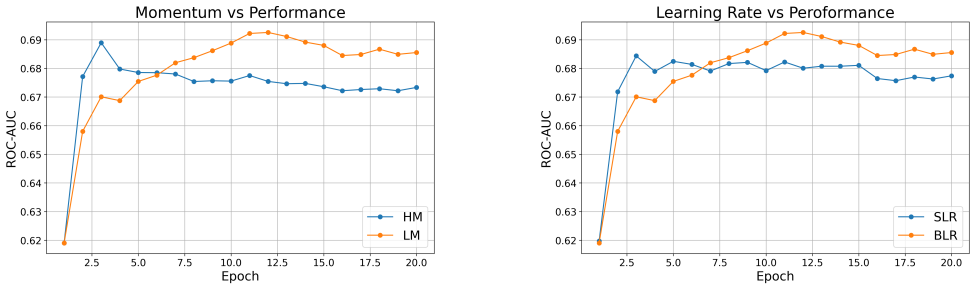
- The two hyperparameter suggestions (low momentum ≤0.75, binary learning rate) give immediate practical guidance for stabilizing TTA in audio.
- Pseudo-labeling in audio TTA can be dropped with minimal or positive effect under hardware constraints.
- The suite's span of sample rates (16–44.1 kHz) and lengths (1–12 s) lets the community test whether adaptation methods transfer across acoustic domains.
Reading between the lines
- The severity ranges and noise-type subsets were calibrated by 'repeatedly testing model efficiency and adaptation difficulty' rather than by measurements of real acoustic environments; generalizing the benchmark's 'realistic' status to untested conditions is an extrapolation, not a claim of the paper.
- The paper describes heterogeneity as multiple noise types possibly affecting each sample, but the implementation randomly selects one noise type per sample from a subset; the benchmark is therefore heterogeneous across samples, and a true within-sample mixture of simultaneous noise sources would be a testable extension.
- If the released code reproduces the 124 experiments, the suite could serve as a consistency check for future TTA algorithms; a natural extension not explored by the paper is using DHAuDS for continual or fully online adaptation rather than one-pass inference.
- The low non-corrupted accuracy on UrbanSound8K (F1≈0.80) is identified by the paper as the likely cause of weak TTA gains; this suggests that DHAuDS on US8-C may be measuring baseline representation quality more than adaptation capability—an interpretation the authors themselves raise.
Editorial analysis
A structured set of objections, weighed in public.
Referee Report
Summary. The paper introduces DHAuDS, a benchmark suite for evaluating test-time adaptation (TTA) of audio classifiers. It constructs four corrupted versions of existing datasets (UrbanSound8K, SpeechCommandsV2, VocalSound, ReefSet), applying four corruption categories (white noise, environmental noise, time stretch, pitch shift) with per-sample randomly sampled severity levels (L1/L2) and randomly selected noise types. The evaluation adapts HuBERT and AMAuT using AMAuT's TTA objective and compares against CoNMix++, reports metric gains, and recommends low momentum and binary learning rates. The datasets and code are publicly released.
Significance. If the 'dynamic and heterogeneous' design were fully realized, DHAuDS would be a useful standardized infrastructure: it spans four audio domains, releases reproducible corruption sets with fixed seeds, and offers a broad set of experimental configurations (50 conditions, 124 runs). The ablations around pseudo-labeling, momentum, and binary learning rates are informative, and the GPU-cost analysis is practical. However, as written the manuscript does not implement within-sample noise mixtures, so the headline 'heterogeneous noise mixtures' contribution is not established; the current mechanism reduces to dynamic severity with random single-noise selection. The calibration circularity further weakens the 'realistic' claim. With corrections, the released benchmark could still be a valuable community resource.
major comments (3)
- [Abstract; §3.1; §3.4; Table 3] The central 'heterogeneous mixtures' claim is not supported by the implementation described. The Abstract advertises 'heterogeneous noise mixtures'; §3.1 says DHAuDS 'mixes multiple noise sources'; and §3.4 first says 'several types of noise may affect each sample simultaneously.' However, the next sentence defines the actual mechanism as 'one of several noise types randomly selected from a defined subset.' Table 3 lists only candidate types per difficulty level, and no mixing/summation operation is described. As written, the benchmark is dynamic single-source corruption, not different in kind from the 'Heterogeneous, but not Dynamic' setting of TTAAPSD in Table 1 except for severity sampling. Please describe and release an actual mixing procedure (e.g., SNR-weighted summation of multiple noise excerpts), or revise the abstract/title/§3.1/§5.3 to claim 'heterogeneous noise types across s
- [§4.4; Table 5; §7] The paper repeatedly states that TTA 'consistently enhanced performance' and that 'all benchmarks exhibit positive gains after TTA.' Table 5 contradicts this: HuBERT on SC2-C under END2-L2 drops from 0.9687 to 0.9639. Please correct the overclaim to 'most experiments' and discuss the negative cases, ideally with standard deviations across seeds.
- [§3.3; Tables 2–3] The L1/L2 severity ranges and noise-type subsets were calibrated by 'repeatedly testing model efficiency and adaptation difficulty' using the same model families (HuBERT, AMAuT) later evaluated in the paper. This makes the claim that L2 is 'more challenging' and the benchmark is 'realistic' partially circular. No external validation is provided (independent held-out model families, perceptual criteria, or physical sound-level measurements). Please add an independent validation or explicitly present L1/L2 as model-relative ordinal levels, and document the calibration protocol in the repository.
minor comments (4)
- [§3.1; §3.4; Table 3] The paper says DHAuDS incorporates '27 noise types,' but counting the unique entries in Table 3 (WHN: 2, ENQ: 5, END1: 6, END2: 6, ENSC: 6) gives 25. Please reconcile the count or clarify what the 27 includes.
- [§3.4; Table 3] The statement that 'L2 configurations always include more noise types and greater variability than L1' is false for WHN: WHN-L1 and WHN-L2 both contain exactly Gaussian and Random. Revise to say that L2 always provides broader ranges, and for environmental noise additionally more types.
- [Appendix B.2; Figure 7] The caption of Figure 7 is identical to that of Figure 6 ('HuBERT ENQ-L1 on RS-C'), while the surrounding text says the figure shows CoNMix++. Correct the caption.
- [§3.6; Eq. (2)] Eq. (2) refers to 'predicted possibility'; this should be 'predicted probability.' Also, the value of λ in Eq. (1) is never reported; please state the consistency-loss weight used in all experiments.
Circularity Check
Partial circularity: L2 severity tuned on the evaluated models and AMAuT's own TTA objective is used to validate AMAuT; benchmark artifacts themselves remain independently reusable.
-
fitted input called prediction
[Section 3.3, Table 2 (Dynamic Severity)]
"Given the absence of established reference ranges, the noise intensity of L2 was set to exceed that of L1 by repeatedly testing model efficiency and adaptation difficulty."
The L2 corruption ranges were calibrated by testing the same model families (AMAuT, HuBERT, CoNMix++) that later fill Table 5. Thus the observed ordering that L2 is harder than L1, and any model-specific difficulty comparisons, are partly selected to occur by construction rather than discovered from an external standard of acoustic realism. The released benchmark artifacts remain valid for reuse, but the claim that DHAuDS 'exposes robustness limitations' is partially an artifact of this tuning.
-
self citation load bearing
[Section 3.6 (TTA Strategy); Section 7 (Conclusion)]
"For the TTA evaluations in DHAuDS, we adopt the test-time domain adaptation from AMAuT [29] ... TTA consistently enhanced performance, validating the overall effectiveness of our proposed adaptation procedure."
The adaptation objective used to produce all 'after adaptation' results is taken from the authors' own AMAuT paper [29], and the conclusion then reads the consistently positive results as validating 'our proposed adaptation procedure.' The procedure being validated is the same procedure used to generate the numbers, so this particular validation loop is not independent. The presence of HuBERT and CoNMix++ as external comparison models prevents this from being total circularity, but it is a genuine self-citation-backed evaluation.
full rationale
DHAuDS is primarily a benchmark/artifact paper rather than a fitted prediction. The four corrupted datasets are constructed from existing corpora with stated ranges, seeds, and released code, so the central deliverable—a reproducible testbed—does not reduce to a fitted parameter. However, two load-bearing steps are partially self-referential. First, Section 3.3 fixes L2 ranges by 'repeatedly testing model efficiency and adaptation difficulty' on the same model families later used as the evaluation; consequently L1-vs-L2 and model-difficulty findings are partly a product of that calibration rather than an external measurement. Second, the TTA objective is taken from the authors' own AMAuT [29], and Section 7 treats positive results as validating that same proposed procedure, forming a self-citation-backed validation loop. These issues do not make the benchmark useless: the released artifacts can be independently rerun and HuBERT/CoNMix++ provide partial external anchors. I also flag, as a non-circular but material weakness, Section 3.4's 'several types of noise may affect each sample simultaneously' being immediately operationalized as 'one of several noise types randomly selected from a defined subset' (Table 3), with no mixing mechanism described; this is a correctness/consistency risk rather than an additional circular step. Overall score 4: some self-citation and calibration are present, but the core benchmark claim retains independent content.
Assumptions & free parameters
free parameters (7)
- WHN/EN SNR ranges =
L1: [6,7]/[5,6] dB; L2: [5,7]/[5,7] dB
- TST tempo-stretch ranges =
L1: [-6%,-4%] ∪ [4%,6%]; L2: [-12%,-8%] ∪ [8%,12%]
- PSH pitch-shift ranges =
L1: [-5,-4] ∪ [4,5] semitones; L2: [-7,-5] ∪ [5,7]
- L1 environmental-noise subsets =
ENQ-L1: HOME/REVERB/STREET; END1-L1: NFIELD/PRESTO/TCAR/OOFFICE; END2-L1: DLIVING/OHALLWAY/SPSQUARE/TMETRO; ENSC-L1: exe
- Momentum threshold =
≤0.75
- Binary learning-rate ratios =
AMAuT lr_fe/lr_c ∈ [0.45,0.55]; HuBERT ∈ [0.25,0.55]; CoNMix++ = 0.1
- Consistency-loss weight λ (Eq. 1) =
not reported
assumptions (5)
- domain assumption Random per-sample SNR drawn from a uniform range models real-world dynamic severity.
- domain assumption QUT-NOISE, DEMAND, and SpeechCommands V2 noise subsets adequately represent heterogeneous real-world acoustic degradation.
- domain assumption Adaptation performance under DHAuDS corruptions predicts robustness under real-world test-time shift.
- domain assumption AMAuT's entropy + consistency TTA objective is a valid canonical method for evaluating all DHAuDS benchmarks.
- ad hoc to paper Broader corruption ranges (L2) are sufficient to define increasing adaptation difficulty.
Cite this review
Pith. "Pith review of DHAuDS: A Dynamic and Heterogeneous Audio Benchmark for Test-Time Adaptation." pith.science (2026). https://pith.science/paper/RFE6P7Z4
@misc{pith2026251118421,
  author       = {Pith},
  title        = {Pith review of: DHAuDS: A Dynamic and Heterogeneous Audio Benchmark for Test-Time Adaptation},
  year         = {2026},
  howpublished = {\url{https://pith.science/paper/RFE6P7Z4}},
  note         = {Machine review of arXiv:2511.18421}
}
read the original abstract
Existing Test-time Adaptation (TTA) studies rely heavily on static and homogeneous corruption protocols, such as ImageNet-C and CIFAR-10-C/100-C, leading to inconsistent evaluation settings and potentially inflated robustness estimates that are compared with real-world situations. TTA lacks a standardized evaluation infrastructure capable of modeling realistic heterogeneous acoustic degradation. We introduce DHAuDS, a standardized benchmark suite for evaluating audio classification TTA robustness under dynamic corruption severity and heterogeneous noise mixtures. Rather than proposing a new TTA algorithm, DHAuDS focuses on exposing robustness limitations that remain hidden under conventional fixed-noise evaluation protocols.
Figures


Figures from the paper (2 more)

Reference graph
Works this paper leans on
-
[1]
G.-T. Lin, S.-W. Li, and H.-y. Lee, “Listen, adapt, bet- ter wer: Source-free single-utterance test-time adapta- tion for automatic speech recognition,”arXiv preprint arXiv:2203.14222, 2022
arXiv 2022
-
[2]
The third ‘chime’speech separation and recognition challenge: Analysis and outcomes,
J. Barker, R. Marxer, E. Vincent, and S. Watanabe, “The third ‘chime’speech separation and recognition challenge: Analysis and outcomes,”Computer Speech & Language, vol. 46, pp. 605–626, 2017
2017
-
[3]
Librispeech: an asr corpus based on public domain audio books,
V. Panayotov, G. Chen, D. Povey, and S. Khudanpur, “Librispeech: an asr corpus based on public domain audio books,” in2015 IEEE international conference on acous- tics, speech and signal processing (ICASSP), pp. 5206–5210, IEEE, 2015
2015
-
[4]
C. Kim, J. Park, H. Shim, and E. Yang, “Sgem: Test-time adaptation for automatic speech recognition via sequential- level generalized entropy minimization,”arXiv preprint arXiv:2306.01981, 2023
arXiv 2023
-
[5]
A scalable noisy speech dataset and online subjective test framework,
C. K. Reddy, E. Beyrami, J. Pool, R. Cutler, S. Srini- vasan, and J. Gehrke, “A scalable noisy speech dataset and online subjective test framework,”arXiv preprint arXiv:1909.08050, 2019
arXiv 1909
-
[6]
Continual test- time adaptation for end-to-end speech recognition on noisy speech,
G.-T. Lin, W. P. Huang, and H.-y. Lee, “Continual test- time adaptation for end-to-end speech recognition on noisy speech,” inProceedings of the 2024 Conference on Empirical Methods in Natural Language Processing, pp. 20003–20015, 2024
2024
-
[7]
Test-time adaptation for auto- matic pathological speech detection in noisy environments,
M. Amiri and I. Kodrasi, “Test-time adaptation for auto- matic pathological speech detection in noisy environments,” in2024 32nd European Signal Processing Conference (EU- SIPCO), pp. 86–90, 2024
2024
-
[8]
The qut- noise-timit corpus for evaluation of voice activity detec- tion algorithms,
D. Dean, S. Sridharan, R. Vogt, and M. Mason, “The qut- noise-timit corpus for evaluation of voice activity detec- tion algorithms,” inProceedings of the 11th annual confer- ence of the international speech communication association, pp. 3110–3113, International Speech Communication Asso- ciation, 2010
2010
Show all 41 references
-
[9]
The qut-noise-sre protocol for the evaluation of noisy speaker recognition,
D. Dean, A. Kanagasundaram, H. Ghaemmaghami, M. H. Rahman, and S. Sridharan, “The qut-noise-sre protocol for the evaluation of noisy speaker recognition,” inProceedings of the 16th Annual Conference of the International Speech Communication Association, Interspeech 2015, pp. 3...
2015
-
[10]
Demand: a collec- tion of multi-channel recordings of acoustic noise in diverse environments,
J. Thiemann, N. Ito, and E. Vincent, “Demand: a collec- tion of multi-channel recordings of acoustic noise in diverse environments,”(No Title), 2013
2013
-
[11]
An investigation of test-time adaptation for audio classification under background noise,
W. Shao, I. Y. Liao, T. H. B. Maul, and T. Chandesa, “An investigation of test-time adaptation for audio classification under background noise,”arXiv preprint arXiv:2507.15523, 2025
2025 arXiv
-
[12]
Tent: Fully test-time adaptation by entropy minimiza- tion,
D. Wang, E. Shelhamer, S. Liu, B. Olshausen, and T. Dar- rell, “Tent: Fully test-time adaptation by entropy minimiza- tion,” inInternational Conference on Learning Representa- tions, 2021
2021
-
[13]
Benchmarking neural net- work robustness to common corruptions and perturbations,
D. Hendrycks and T. Dietterich, “Benchmarking neural net- work robustness to common corruptions and perturbations,” arXiv preprint arXiv:1903.12261, 2019
1903 arXiv
-
[14]
Test-time training with self-supervision for generalization under distribution shifts,
Y. Sun, X. Wang, Z. Liu, J. Miller, A. Efros, and M. Hardt, “Test-time training with self-supervision for generalization under distribution shifts,” inInternational conference on machine learning, pp. 9229–9248, PMLR, 2020
2020
-
[15]
The norm must go on: Dynamic unsupervised domain adapta- tion by normalization,
M. J. Mirza, J. Micorek, H. Possegger, and H. Bischof, “The norm must go on: Dynamic unsupervised domain adapta- tion by normalization,” inProceedings of the IEEE/CVF Conference on Computer Vision and Pattern Recognition (CVPR), pp. 14765–14775, June 2022
2022
-
[16]
L-tta: Lightweight test-time adapta- tion using a versatile stem layer,
J. Shin and H. Kim, “L-tta: Lightweight test-time adapta- tion using a versatile stem layer,”Advances in Neural Infor- mation Processing Systems, vol. 37, pp. 39325–39349, 2024
2024
-
[17]
Improved self-training for test-time adaptation,
J. Ma, “Improved self-training for test-time adaptation,” inProceedings of the IEEE/CVF Conference on Computer Vision and Pattern Recognition, pp. 23701–23710, 2024
2024
-
[18]
A comprehensive survey on test-time adaptation under distribution shifts,
J. Liang, R. He, and T. Tan, “A comprehensive survey on test-time adaptation under distribution shifts,”Inter- national Journal of Computer Vision, pp. 1–34, 2024
2024
-
[19]
Ro- bustbench: a standardized adversarial robustness bench- mark,
F. Croce, M. Andriushchenko, V. Sehwag, E. Debenedetti, N. Flammarion, M. Chiang, P. Mittal, and M. Hein, “Ro- bustbench: a standardized adversarial robustness bench- mark,” inThirty-fifth Conference on Neural Information Processing Systems Datasets and Benchmarks Track, 2021
2021
-
[20]
Speech commands: A dataset for limited-vocabulary speech recognition,
P. Warden, “Speech commands: A dataset for limited-vocabulary speech recognition,”arXiv preprint arXiv:1804.03209, 2018
2018 arXiv
-
[21]
Specaugment: A simple data aug- mentation method for automatic speech recognition,
D. S. Park, W. Chan, Y. Zhang, C.-C. Chiu, B. Zoph, E. D. Cubuk, and Q. V. Le, “Specaugment: A simple data aug- mentation method for automatic speech recognition,”arXiv preprint arXiv:1904.08779, 2019
1904 arXiv
-
[22]
Lpcnet: Improving neu- ral speech synthesis through linear prediction,
J.-M. Valin and J. Skoglund, “Lpcnet: Improving neu- ral speech synthesis through linear prediction,” inICASSP 2019-2019 IEEE International Conference on Acoustics, Speech and Signal Processing (ICASSP), pp. 5891–5895, IEEE, 2019
2019
-
[23]
Neural pitch-shifting and time-stretching with controllable lpcnet,
M. Morrison, Z. Jin, N. J. Bryan, J.-P. Caceres, and B. Pardo, “Neural pitch-shifting and time-stretching with controllable lpcnet,”arXiv preprint arXiv:2110.02360, 2021
2021 arXiv
-
[24]
Quasi-periodic parallel wavegan: A non-autoregressive raw waveform generative model with pitch-dependent dilated convolution neural network,
Y.-C. Wu, T. Hayashi, T. Okamoto, H. Kawai, and T. Toda, “Quasi-periodic parallel wavegan: A non-autoregressive raw waveform generative model with pitch-dependent dilated convolution neural network,”IEEE/ACM Transactions on Audio, Speech, and Language Processing, vol. 29, pp. ...
2021
-
[25]
Ast: Audio spectro- gram transformer,
Y. Gong, Y.-A. Chung, and J. Glass, “Ast: Audio spectro- gram transformer,”arXiv preprint arXiv:2104.01778, 2021
2021 arXiv
-
[26]
Ssast: Self- supervised audio spectrogram transformer,
Y. Gong, C.-I. Lai, Y.-A. Chung, and J. Glass, “Ssast: Self- supervised audio spectrogram transformer,” inProceedings of the AAAI Conference on Artificial Intelligence, vol. 36, pp. 10699–10709, 2022
2022
-
[27]
Masked autoencoders that listen,
P.-Y. Huang, H. Xu, J. Li, A. Baevski, M. Auli, W. Galuba, F. Metze, and C. Feichtenhofer, “Masked autoencoders that listen,”Advances in Neural Information Processing Systems, vol. 35, pp. 28708–28720, 2022
2022
-
[28]
Hubert: Self- supervised speech representation learning by masked pre- diction of hidden units,
W.-N. Hsu, B. Bolte, Y.-H. H. Tsai, K. Lakhotia, R. Salakhutdinov, and A. Mohamed, “Hubert: Self- supervised speech representation learning by masked pre- diction of hidden units,”IEEE/ACM transactions on au- dio, speech, and language processing, vol. 29, pp. 3451–3460, 2021
2021
-
[29]
Amaut: A flexible and efficient multiview audio trans- former framework trained from scratch,
W. Shao, I. Y. Liao, T. H. B. Maul, and T. Chandesa, “Amaut: A flexible and efficient multiview audio trans- former framework trained from scratch,”arXiv preprint arXiv:2510.19368, 2025
2025
-
[30]
wav2vec 2.0: A framework for self-supervised learning of speech rep- resentations,
A. Baevski, Y. Zhou, A. Mohamed, and M. Auli, “wav2vec 2.0: A framework for self-supervised learning of speech rep- resentations,”Advances in neural information processing systems, vol. 33, pp. 12449–12460, 2020
2020
-
[31]
Mel spectrogram-based audio forgery detection using cnn,
A. Ustubioglu, B. Ustubioglu, and G. Ulutas, “Mel spectrogram-based audio forgery detection using cnn,”Sig- nal, Image and Video Processing, vol. 17, no. 5, pp. 2211– 2219, 2023
2023
-
[32]
Mel-spectrogram augmentation for sequence to se- quence voice conversion,
Y. Hwang, H. Cho, H. Yang, D.-O. Won, I. Oh, and S.- W. Lee, “Mel-spectrogram augmentation for sequence to se- quence voice conversion,”arXiv preprint arXiv:2001.01401, 2020
2001 arXiv
-
[33]
Conmix for source-free single and multi-target domain adaptation,
V. Kumar, R. Lal, H. Patil, and A. Chakraborty, “Conmix for source-free single and multi-target domain adaptation,” inProceedings of the IEEE/CVF Winter Conference on Ap- plications of Computer Vision, pp. 4178–4188, 2023
2023
-
[34]
A dataset and tax- onomy for urban sound research,
J. Salamon, C. Jacoby, and J. P. Bello, “A dataset and tax- onomy for urban sound research,” inProceedings of the 22nd ACM international conference on Multimedia, pp. 1041– 1044, 2014
2014
-
[35]
Vocalsound: A dataset for improving human vocal sounds recognition,
Y. Gong, J. Yu, and J. Glass, “Vocalsound: A dataset for improving human vocal sounds recognition,” inICASSP 2022 - 2022 IEEE International Conference on Acoustics, Speech and Signal Processing (ICASSP), pp. 151–155, 2022
2022
-
[36]
Using tropical reef, bird and un- related sounds for superior transfer learning in marine bioa- coustics,
B. Williams, B. van Merri¨ enboer, V. Dumoulin, J. Hamer, A. B. Fleishman, M. McKown, J. Munger, A. N. Rice, A. Lillis, C. White,et al., “Using tropical reef, bird and un- related sounds for superior transfer learning in marine bioa- coustics,”Philosophical Transactions B, vol...
1928
-
[37]
An introduction to roc analysis,
T. Fawcett, “An introduction to roc analysis,”Pattern recognition letters, vol. 27, no. 8, pp. 861–874, 2006
2006
-
[38]
A simple generalisation of the area under the roc curve for multiple class classification problems,
D. J. Hand and R. J. Till, “A simple generalisation of the area under the roc curve for multiple class classification problems,”Machine learning, vol. 45, no. 2, pp. 171–186, 2001
2001
-
[39]
Cochlscene: Acquisition of acoustic scene data using crowdsourcing,
I.-Y. Jeong and J. Park, “Cochlscene: Acquisition of acoustic scene data using crowdsourcing,” in2022 Asia- Pacific Signal and Information Processing Association An- nual Summit and Conference (APSIPA ASC), pp. 17–21, IEEE, 2022
2022
-
[40]
Audiomnist: Exploring explain- able artificial intelligence for audio analysis on a simple benchmark,
S. Becker, J. Vielhaben, M. Ackermann, K.-R. M¨ uller, S. La- puschkin, and W. Samek, “Audiomnist: Exploring explain- able artificial intelligence for audio analysis on a simple benchmark,”Journal of the Franklin Institute, 2023
2023
-
[41]
Kaufman and P
L. Kaufman and P. J. Rousseeuw,Finding groups in data: an introduction to cluster analysis. John Wiley & Sons, 2009. A Algorithm Details A.1 Evaluation Metrics ROC-AUC TPRc = TPc TPc + FNc ; FPRc = FPc FPc + TNc (3) ROC-AUCc ≈ N−1X i=1 (FPRc,i+1 −FPR c,i)· TPRc,i+1 + TPRc,i 2 ...
2009
Reviewed August 3, 2026 · model on record in the stance chip above.
Discussion (0). Sign in to comment.