Topological surface-state destruction via trivializing proximity effect: Lattice localization despite continuum criticality
Pith reviewed 2026-05-17 04:48 UTC · model grok-4.3
The pith
Hybridization with a trivial 2D band localizes surface states of class-CI topological lattice models under weak disorder.
A machine-rendered reading of the paper's core claim, the machinery that carries it, and where it could break.
Core claim
Surface states of a bulk class-CI topological lattice model can be Anderson localized by the combination of weak quenched randomness and hybridization with an additional trivial 2D band via the trivializing proximity effect. Without the additional band the surface states remain extended and exhibit robust spectrum-wide quantum criticality. Continuum models show the opposite trend, with localization near gap edges at weak disorder but restored criticality at stronger disorder that fills spectral gaps.
What carries the argument
The trivializing proximity effect, defined as hybridization between topological surface states and an added trivial 2D band, which enables Anderson localization when combined with quenched disorder.
If this is right
- Stronger disorder becomes more effective at localizing surface states once the trivializing proximity effect is present.
- Pure class-CI lattice models without extra bands support extended surface states with spectrum-wide quantum criticality.
- Effective continuum Dirac theories miss the localization induced by the trivializing proximity effect that appears in lattice models.
Where Pith is reading between the lines
- Real materials with inevitable proximity to trivial bands may exhibit localized rather than conducting surface states under weak disorder.
- Lattice-specific effects appear necessary to explain fragility that continuum approximations overlook.
- Similar trivializing effects could be tested numerically in other localizable topological classes to check for general fragility of surface states.
Load-bearing premise
The chosen numerical lattice model and disorder implementation capture the essential symmetries and physics of real class-CI materials without missing longer-range effects that could change the localization outcome.
What would settle it
A calculation or measurement showing that surface states of the class-CI lattice model remain extended and critical even after adding the trivial 2D band and applying weak disorder.
Figures




read the original abstract
In a significant conceptual revision to the tenfold classification scheme for topological insulators and superconductors, it was recently demonstrated that most three-dimensional (3D) classes are simultaneously "localizable" in two distinct, but intricately connected ways: (1) There is no obstruction to Wannier localization of all bulk eigenstates, and (2) Almost all surface states can be Anderson localized by arbitrarily weak symmetry-preserving quenched disorder. Here we consider the localizable class CI in 3D, and numerically investigate the stability of surface states. We demonstrate that surface states of a bulk class-CI topological lattice model are fragile in that they can be Anderson localized by the combination of weak quenched randomness and hybridization with an additional trivial 2D band (a trivializing proximity effect, TPE). With the TPE, stronger disorder is more destructive to the surface states of the bulk lattice model. By contrast, without additional bands the surface states remain extended, exhibiting robust spectrum-wide quantum criticality. We also investigate the fragility of surface states in effective 2D class-CI continuum Dirac theories, including the chiral limit of the Bistritzer-MacDonald model for twisted bilayer graphene. Although the continuum models exhibit signs of Anderson localization near gap edges for weak disorder, stronger disorder instead appears to heal the surface, restoring criticality whilst filling in spectral energy gaps. Our results provide further evidence that effective continuum field theories fail to capture key aspects of surface-state physics in localizable topological phases.
Editorial analysis
A structured set of objections, weighed in public.
Referee Report
Summary. The manuscript examines the stability of surface states in three-dimensional class-CI topological insulators using lattice models. It demonstrates that these surface states can be Anderson localized through the combination of weak symmetry-preserving quenched disorder and hybridization with an additional trivial 2D band, referred to as the trivializing proximity effect (TPE). In the absence of this hybridization, the surface states remain extended and exhibit robust spectrum-wide quantum criticality. The study contrasts this with effective 2D continuum Dirac models, including the chiral limit of the Bistritzer-MacDonald model, where stronger disorder appears to restore criticality. The results suggest that continuum field theories inadequately capture surface-state physics in localizable topological phases.
Significance. If substantiated, this work offers valuable numerical support for the fragility of surface states in localizable topological classes like CI, highlighting the role of lattice-specific effects and proximity to trivial bands. It strengthens the case for rethinking aspects of the tenfold classification regarding localizability and provides a contrast between lattice and continuum descriptions that could guide future theoretical and experimental studies in topological materials.
major comments (2)
- [Numerical Simulations] The description of the numerical results lacks essential details such as the system sizes used, the number of disorder realizations for averaging, error bars on the localization measures, and the precise diagnostics employed to identify Anderson localization versus criticality (e.g., inverse participation ratio or conductance). This information is necessary to assess whether the observation that stronger disorder is more destructive is robust, particularly given the central claim about TPE.
- [Lattice Model and Hybridization] The explicit form of the trivial 2D band and the hybridization term with the bulk class-CI model is not detailed, nor is there verification that this hybridization commutes with the time-reversal, particle-hole, and spin-rotation symmetries defining class CI. Since the central claim attributes localization specifically to the TPE rather than symmetry reduction, this verification is load-bearing and should be provided, for example through commutation checks or explicit matrix forms in the model section.
minor comments (2)
- [Abstract] The abstract mentions 'numerically investigate' but could briefly note the key observables or system parameters for better context.
- [References] Ensure all relevant prior works on class-CI models and Anderson localization in topological systems are cited, particularly recent revisions to the tenfold scheme.
Simulated Author's Rebuttal
We thank the referee for the careful reading of our manuscript and the constructive comments. We address the major comments point by point below and will revise the manuscript accordingly to improve clarity and completeness.
read point-by-point responses
-
Referee: [Numerical Simulations] The description of the numerical results lacks essential details such as the system sizes used, the number of disorder realizations for averaging, error bars on the localization measures, and the precise diagnostics employed to identify Anderson localization versus criticality (e.g., inverse participation ratio or conductance). This information is necessary to assess whether the observation that stronger disorder is more destructive is robust, particularly given the central claim about TPE.
Authors: We agree that these methodological details are essential for assessing the robustness of the results. In the revised manuscript we will add a dedicated subsection in the methods or numerical details section specifying the lattice sizes used (e.g., linear dimensions and total sites), the number of independent disorder realizations for ensemble averaging, the presence of error bars on all plotted localization measures, and the precise diagnostics employed, including the inverse participation ratio to quantify localization and conductance or level-spacing statistics to identify criticality. These additions will directly support the claim that stronger disorder is more destructive in the presence of the TPE. revision: yes
-
Referee: [Lattice Model and Hybridization] The explicit form of the trivial 2D band and the hybridization term with the bulk class-CI model is not detailed, nor is there verification that this hybridization commutes with the time-reversal, particle-hole, and spin-rotation symmetries defining class CI. Since the central claim attributes localization specifically to the TPE rather than symmetry reduction, this verification is load-bearing and should be provided, for example through commutation checks or explicit matrix forms in the model section.
Authors: We agree that explicit model details and symmetry verification are necessary to substantiate that localization is due to the TPE and not to any unintended symmetry breaking. In the revised manuscript we will include the explicit Hamiltonian for the additional trivial 2D band and the hybridization term coupling it to the bulk class-CI lattice model. We will also add a verification subsection showing that the hybridization commutes with the time-reversal, particle-hole, and spin-rotation symmetry operators of class CI, either via explicit commutation relations or by presenting the matrix representations in the appropriate basis. This will confirm that the symmetry class remains CI. revision: yes
Circularity Check
Numerical simulations establish independent results on surface-state fragility
full rationale
The paper's central results come from direct numerical diagonalization and localization diagnostics on explicit lattice Hamiltonians and continuum Dirac models. No derivation chain reduces a claimed prediction or first-principles outcome to a fitted parameter, self-defined quantity, or self-citation by construction. The contrast between lattice localization under TPE and continuum criticality is obtained by explicit computation of eigenstates and participation ratios rather than by renaming or tautological re-expression of inputs. Self-citations, if present for the prior tenfold-classification revision, are not load-bearing for the new numerical claims here.
Axiom & Free-Parameter Ledger
free parameters (1)
- disorder strength
axioms (1)
- domain assumption The bulk lattice model realizes the 3D class-CI topological phase with no Wannier obstruction.
Lean theorems connected to this paper
-
IndisputableMonolith/Foundation/AlexanderDuality.leanalexander_duality_circle_linking unclear?
unclearRelation between the paper passage and the cited Recognition theorem.
We consider the localizable class CI in 3D, and numerically investigate the stability of surface states... trivializing proximity effect (TPE)
What do these tags mean?
- matches
- The paper's claim is directly supported by a theorem in the formal canon.
- supports
- The theorem supports part of the paper's argument, but the paper may add assumptions or extra steps.
- extends
- The paper goes beyond the formal theorem; the theorem is a base layer rather than the whole result.
- uses
- The paper appears to rely on the theorem as machinery.
- contradicts
- The paper's claim conflicts with a theorem or certificate in the canon.
- unclear
- Pith found a possible connection, but the passage is too broad, indirect, or ambiguous to say the theorem truly supports the claim.
Reference graph
Works this paper leans on
-
[1]
Surface states Topological superconductors with|ν|= 2 typically possess two surface Dirac cones (with the Dirac points appearing atexactlyzero energy, defined relative to the Fermi energy in the paired bulk). For the lattice model in Eq. (2), this is the case for anx-cut surface (paral- lel to theyzplane). By contrast, for thez-cut surface the model exhib...
-
[2]
Surface states with flat-band coupling We will demonstrate that the surface states exhibited in Fig. 2(a) become fragile (vulnerable to Anderson local- ization withweakdisorder) when these are coupled to an additional 2D flat-band lattice model. Taking the topo- logical bulk to havez≥1, we can couple it to a flat-band layer atz= 0 by adding the Hamiltonia...
-
[3]
Disorder Disorder is incorporated into the continuum model us- ing the random-phase parameterization in momentum space [22, 62], Ai x,y(q) = √λa L exp i Θi x,y(q)− q2ξ2 4 ,(12a) Ac(q) = √λc L exp i Θc(q)− q2ξ2 4 ,(12b) 7 γ1,2(q) = p λg L exp i Θ1,2(q)− q2ξ2 4 ,(12c) whereqdenotes a 2D momentum vector and where each phase angle satisfies Θ(q) =−Θ(−q), but ...
-
[4]
What is the physical picture behind the trivializa- tion of surface states in class-CI bulk topological lattice models? For class AIII, a Berry curvature mechanism was uncovered in Ref. [6], reviewed in Sec. I C. This cannot apply to class CI due to the T 2 = +1 time-reversal symmetry in the latter. One possibility is quantum geometry [66–69], although fo...
-
[5]
A second key result of this work is the divergence between lattice and continuum surface models re- garding the fragility of class-CI surface states. This points to a fundamental incompleteness of the 2D continuum Dirac equation for describing topologi- cal surface states. In particular, the TPE (intro- duced in Ref. [6] but explored for the first time nu...
-
[6]
the spectrum-wide quantum crit- icality scenario
Finally, another persistent mystery is thedelocal- ization mechanismfor class-CI surface states at fi- nite energy, i.e. the spectrum-wide quantum crit- icality scenario. For class AIII, the observation of critical, integer-quantum-Hall-plateau states at all nonzero surface-state energies is understood as the result of a statistical symmetry, tuning betwe...
-
[7]
Parame- ters:N y = 72,N z = 10,µ=−2, ∆ 1 = 1, ∆ 2 = 1, mc = 1
CI lattice model.W 1 = 0.4,0.7,0.85,1. Parame- ters:N y = 72,N z = 10,µ=−2, ∆ 1 = 1, ∆ 2 = 1, mc = 1. Energy window (0.1,∞)
-
[8]
Parame- ters:ε c = 0.4,γ= 0.5,N y = 72,N z = 10,µ=−2, ∆1 = 1, ∆2 = 1,m c = 1
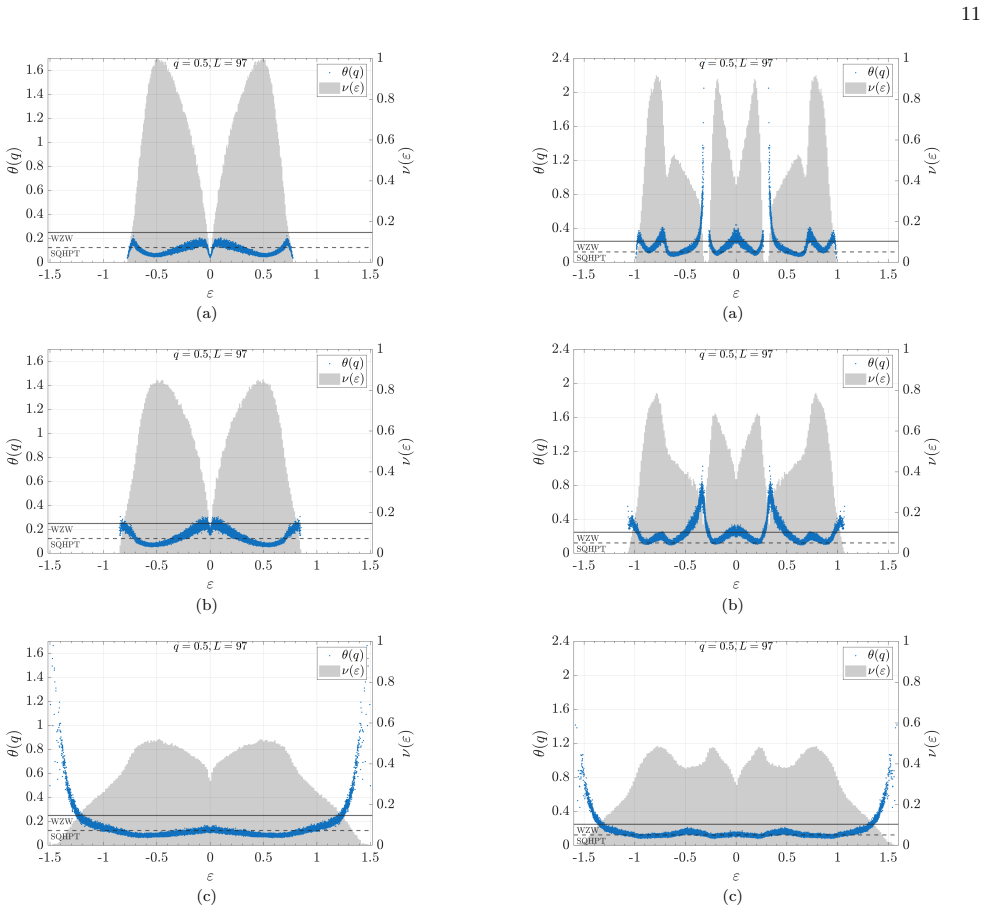
CI lattice flat band.W 1 = 0.4,0.7,1,1.2. Parame- ters:ε c = 0.4,γ= 0.5,N y = 72,N z = 10,µ=−2, ∆1 = 1, ∆2 = 1,m c = 1. Energy window (0.1,∞). 14
-
[9]
Parame- ters:L= 97,ξ=π,b= (4,6,8)
CI continuum model.W= 0.5,1, π,2π. Parame- ters:L= 97,ξ=π,b= (4,6,8). Energy window (0.1,0.4)
-
[10]
Parameters:ε c = 0.4,λ c = 0.2, γ0 = 0.35,λ g = 0.2,L= 97,ξ=π,b= (4,6,8)
CI continuum model with flat band.W= 0.2,1, π,2π. Parameters:ε c = 0.4,λ c = 0.2, γ0 = 0.35,λ g = 0.2,L= 97,ξ=π,b= (4,6,8). Energy window (0.1,0.6)
-
[11]
Parameters:M 1 = 5,M 2 = 7,L= 105
BM model.W= 0.5, π,2π,7. Parameters:M 1 = 5,M 2 = 7,L= 105. Energy window (0.1,1.5)
-
[12]
B. A. Bernevig and T. L. Hughes,Topological Insulators and Topological Superconductors(Princeton University Press, 2013)
work page 2013
-
[13]
M. Z. Hasan and C. L. Kane, Colloquium: Topological Insulators, Rev. Mod. Phys.82, 3045 (2010)
work page 2010
-
[14]
X.-L. Qi and S.-C. Zhang, Topological insulators and su- perconductors, Rev. Mod. Phys.83, 1057 (2011)
work page 2011
-
[15]
Y. Ando and L. Fu, Topological crystalline insulators and topological superconductors: From concepts to materials, Ann. Rev. Condens. Matter Phys.6, 361 (2015)
work page 2015
-
[16]
For a review, see e.g. A. Altland and B. D. Simons,Con- densed Matter Field Theory, 3rd edition (Cambridge Uni- versity Press, Cambridge, England, 2023)
work page 2023
-
[17]
A. Altland, P. W. Brouwer, J. Dieplinger, M. S. Foster, M. Moreno-Gonzalez, and L. Trifunovic, Fragility of Sur- face States in Non-Wigner-Dyson Topological Insulators, Phys. Rev. X14, 011057 (2024)
work page 2024
-
[18]
A. P. Schnyder, S. Ryu, A. Furusaki, and A. W. W. Lud- wig, Classification of topological insulators and super- conductors in three spatial dimensions, Phys. Rev. B78, 195125 (2008)
work page 2008
-
[19]
Kitaev, Periodic table for topological insulators and superconductors, AIP Conf
A. Kitaev, Periodic table for topological insulators and superconductors, AIP Conf. Proc.1134, 22 (2009)
work page 2009
-
[20]
S. Ryu, A. P. Schnyder, A. Furusaki, and A. W. W. Lud- wig, Topological insulators and superconductors: tenfold way and dimensional hierarchy, New J. Phys.12, 065010 (2010)
work page 2010
-
[21]
A. M. Essin and V. Gurarie, Delocalization of boundary states in disordered topological insulators, J. Phys. A 48, 11FT01 (2015)
work page 2015
-
[22]
H. Schulz-Baldes and T. Stoiber,Harmonic Analysis in Operator Algebras and its Applications to Index Theory and Topological Solid State Systems(Springer, Cham, Switzerland, 2022)
work page 2022
-
[23]
R. B. Laughlin, Quantized Hall conductivity in two di- mensions, Phys. Rev. B23, 5632 (1981)
work page 1981
-
[24]
B. I. Halperin, Quantized Hall conductance, current- carrying edge states, and the existence of extended states in a two-dimensional disordered potential, Phys. Rev. B 25, 2185 (1982)
work page 1982
-
[25]
In addition to localizable classes CI, CII, and AIII, class DIII, which includes 3He-B[7], is non-localizable (localiz- able) for odd (even) winding numbers in three dimensions [6]
-
[26]
B. Lapierre, L. Trifunovic, T. Neupert, and P. W. Brouwer, Topology of ultra-localized insulators and su- perconductors, arXiv:2407.07957
-
[27]
D. Nakamura, K. Shiozaki, K. Shimomura, M. Sato, and K. Kawabata, Non-Hermitian Origin of Detachable Boundary States in Topological Insulators, Phys. Rev. Lett.135, 096601 (2025)
work page 2025
-
[28]
K. Shiozaki, D. Nakamura, K. Shimomura, M. Sato, and K. Kawabata,K-theory classification of Wannier localiz- ability and detachable topological boundary states, Phys. Rev. B112, 075152 (2025)
work page 2025
-
[29]
A. P. Schnyder, P. M. R. Brydon, D. Manske, and C. Timm, Andreev Spectroscopy and Surface Density of States for a Three-Dimensional Time-Reversal-Invariant Topological Superconductor, Phys. Rev. B82, 184508 (2010)
work page 2010
- [30]
-
[31]
H. Guan and W. Zhang, Dual Applications of Chebyshev Polynomials Method: Efficiently Finding Thousands of Central Eigenvalues for Many-Spin Systems, SciPost11, 103 (2021)
work page 2021
- [32]
-
[33]
S. A. A. Ghorashi, Y. Liao, and M. S. Foster, Critical Per- colation without Fine-Tuning on the Surface of a Topo- logical Superconductor, Phys. Rev. Lett.121, 016802 (2018)
work page 2018
-
[34]
B. Sbierski, J. F. Karcher, and M. S. Foster, Spectrum- Wide Quantum Criticality at the Surface of Class AIII Topological Phases: An “Energy Stack” of Integer Quan- tum Hall Plateau Transitions, Phys. Rev. X10, 021025 (2020)
work page 2020
-
[35]
S. A. A. Ghorashi, J. F. Karcher, S. M. Davis, and M. S. Foster, Criticality across the Energy Spectrum from Random Artificial Gravitational Lensing in Two- Dimensional Dirac Superconductors, Phys. Rev. B101, 214521 (2020)
work page 2020
-
[36]
J. F. Karcher and M. S. Foster, How spectrum-wide quantum criticality protects surface states of topological superconductors from Anderson localization: Quantum Hall plateau transitions (almost) all the way down, Ann. Phys.435, 168439 (2021)
work page 2021
-
[37]
A. H. Castro Neto, F. Guinea, N. M. R. Peres, K. S. Novoselov, and A. K. Geim, The electronic properties of graphene, Rev. Mod. Phys.81, 109 (2009)
work page 2009
-
[38]
N. M. R. Peres, Colloquium: The transport properties of graphene: An introduction, Rev. Mod. Phys.82, 2673 (2010)
work page 2010
-
[39]
S. Das Sarma, S. Adam, E. H. Hwang, and E. Rossi, Electronic transport in two-dimensional graphene, Rev. Mod. Phys.83, 407 (2011)
work page 2011
-
[40]
A. Altland, B. Simons, and M. Zirnbauer, Theories of low-energy quasi-particle states in disorderedd-wave su- perconductors, Phys. Rep.359, 283 (2002)
work page 2002
-
[41]
J. M. B. Lopes dos Santos, N. M. R. Peres, and A. H. Castro Neto, Graphene Bilayer with a Twist: Electronic Structure, Phys. Rev. Lett.99, 256802 (2007). 15
work page 2007
-
[42]
R. Bistritzer and A. H. MacDonald, Moir´ e bands in twisted double-layer graphene, Proc. Natl. Acad. Sci. (USA)108, 12233 (2011)
work page 2011
-
[43]
R. de Gail, M. O. Goerbig, F. Guinea, G. Montam- baux, and A. H. Castro Neto, Topologically protected zero modes in twisted bilayer graphene, Phys. Rev. B 84, 045436 (2011)
work page 2011
-
[44]
For a review, see e.g. A. H. MacDonald, Bilayer Graphene’s Wicked, Twisted Road, Physics12, 12 (2019)
work page 2019
-
[45]
G. Tarnopolosky, A. J. Kruchov, and A. Vishwanath, Origin of Magic Angles in Twisted Bilayer Graphene, Phys. Rev. Lett.122, 106405 (2019)
work page 2019
-
[46]
A. N. Redlich, Gauge Noninvariance and Parity Non- conservation of Three-Dimensional Fermions, Phys. Rev. Lett.52, 18 (1984)
work page 1984
-
[47]
G. W. Semenoff, Condensed-Matter Simulation of a Three-Dimensional Anomaly, Phys. Rev. Lett.53, 2449 (1984)
work page 1984
-
[48]
F. D. M. Haldane, Model for a Quantum Hall Effect with- out Landau Levels: Condensed-Matter Realization of the “Parity Anomaly,” Phys. Rev. Lett.61, 2015 (1988)
work page 2015
-
[49]
In the case of twisted bilayer, the chiral limit is equivalent to a class-CI surface theory. IncorporatingAAinterlayer hopping but preserving approximate particle-hole sym- metry (the model with “stable topology” [39, 40]) can be viewed as class-CI surface states with time-reversal sym- metry breaking (class C) that does not open a gap. Break- ing both ch...
-
[50]
Z. Song, Z. Wang, W. Shi, G. Li, C. Fang, and B. A. Bernevig, All Magic Angles in Twisted Bilayer Graphene are Topological, Phys. Rev. Lett.123, 036401 (2019)
work page 2019
-
[51]
Z. Song, B. Lian, N. Regnault, and B. A. Bernevig, Twisted bilayer graphene. II. Stable symmetry anomaly, Phys. Rev. B103, 205412 (2021)
work page 2021
-
[52]
H. C. Po, L. Zou, A. Vishwanath, and T. Senthil, Ori- gin of Mott Insulating Behavior and Superconductivity in Twisted Bilayer Graphene, Phys. Rev. X8, 031089 (2018)
work page 2018
-
[53]
H. C. Po, L. Zou, T. Senthil, and A. Vishwanath, Faithful tight-binding models and fragile topology of magic-angle bilayer graphene, Phys. Rev. B99, 195455 (2019)
work page 2019
-
[54]
J. Ahn, S. Park, and B.-J. Yang, Failure of Nielsen- Ninomiya Theorem and Fragile Topology in Two- Dimensional Systems with Space-Time Inversion Symme- try: Application to Twisted Bilayer Graphene at Magic Angle, Phys. Rev. X9, 021013 (2019)
work page 2019
-
[55]
Ordinary electric potential disorder enters into the 2D surface theory of a 3D topological superconductorin an anomalous way, i.e. as a type of chiral-symmetric vector potential perturbation [7]. This is due to the “fraction- alized” version of chiral symmetry that is realized at the boundary of the topological bulk
-
[56]
J. H. Wilson, Y. Fu, S. Das Sarma, and J. H. Pixley, Disorder in Twisted Bilayer Graphene, Phys. Rev. Res. 2, 023325 (2020)
work page 2020
- [57]
- [58]
-
[59]
N. Nakatsuji and M. Koshino, Moire Disorder Effect in Twisted Bilayer Graphene, Phys. Rev. B105, 245408 (2022)
work page 2022
-
[60]
P. A. Guerrero, V.-H. Nguyen, J. M. Romeral, A. W. Cummings, J.-H. Garcia, J.-C. Charlier, and S. Roche, Disorder-Induced Delocalization in Magic-Angle Twisted Bilayer Graphene, Phys. Rev. Lett.134, 126301 (2025)
work page 2025
-
[61]
A. Sanjuan Ciepielewski, J. Tworzyd lo, T. Hyart, and A. Lau, Transport Effects of Twist-Angle Disorder in Meso- scopic Twisted Bilayer Graphene, Nanotechnology36, 065401 (2025)
work page 2025
-
[62]
V. Cr´ epel, P. Ding, N. Verma, N. Regnault, and R. Queiroz, Topologically Protected Flatness in Chiral Moir´ e Heterostructures, Phys. Rev. X15, 021056 (2025)
work page 2025
-
[63]
A. Uri, S. Grover, Y. Cao, J. A. Crosse, K. Bagani, D. Rodan-Legrain, Y. Myasoedov, K. Watanabe, T. Taniguchi, P. Moon, M. Koshino, P. Jarillo-Herrero, and E. Zeldov, Mapping the Twist-Angle Disorder and Lan- dau Levels in Magic-Angle Graphene, Nature581, 47–52 (2020)
work page 2020
-
[64]
M. Kapfer, B. S. Jessen, M. E. Eisele, M. Fu, D. R. Danielsen, T. P. Darlington, S. L. Moore, N. R. Finney, A. Marchese, V. Hsieh, P. Majchrzak, Z. Jiang, D. Biswas, P. Dudin, J. Avila, K. Watanabe, T. Taniguchi, S. Ulstrup, P. Bøggild, P. J. Schuck, D. N. Basov, J. Hone, and C. R. Dean, Programming Twist Angle and Strain Profiles in 2D Materials, Science...
work page 2023
-
[65]
For a review, see e.g. F. Evers and A. D. Mirlin, Anderson transitions, Rev. Mod. Phys.80, 1355 (2008)
work page 2008
-
[66]
D. Bernard and A. LeClair, A classification of 2D random Dirac fermions, J. Phys. A35, 2555 (2002)
work page 2002
-
[67]
A.A. Nersesyan, A.M. Tsvelik, F. Wenger, Disorder ef- fects in two-dimensional d-wave superconductors, Phys. Rev. Lett.72, 2628 (1994)
work page 1994
-
[68]
A.W.W. Ludwig, M.P.A. Fisher, R. Shankar, G. Grin- stein, Integer quantum Hall transition: An alternative approach and exact results, Phys. Rev. B50, 7526 (1994)
work page 1994
-
[69]
Tsvelik, Exactly solvable model of fermions with disorder, Phys
A.M. Tsvelik, Exactly solvable model of fermions with disorder, Phys. Rev. B51, 9449 (1995)
work page 1995
- [70]
- [71]
-
[72]
M.J. Bhaseen, J.-S. Caux, I.I. Kogan, A.M. Tsvelik, Dis- ordered Dirac fermions: the marriage of three different approaches, Nucl. Phys. B618, 465 (1996)
work page 1996
-
[73]
Y. Z. Chou and M. S. Foster, Chalker scaling, level re- pulsion, and conformal invariance in critically delocal- ized quantum matter: Disordered topological supercon- ductors and artificial graphene, Phys. Rev. B89, 165136 (2014)
work page 2014
-
[74]
Z. Wang, M. P. A. Fisher, S.M. Girvin, and J. T. Chalker, Short-range interactions and scaling near integer quan- tum Hall transitions, Phys. Rev. B61, 8326 (2000)
work page 2000
- [75]
-
[76]
F.Wegner, Inverse participation ration in 2 +ϵdimen- 16 sions, Z. Phys. B36, 209 (1980)
work page 1980
-
[77]
J. P. Provost and G. Vallee, Riemannian Structure on Manifolds of Quantum States, Comm. Math. Phys.76, 289-301 (1980)
work page 1980
-
[78]
T¨ orm¨ a, Essay: Where Can Quantum Geometry Lead Us?, Phys
P. T¨ orm¨ a, Essay: Where Can Quantum Geometry Lead Us?, Phys. Rev. Lett.131, 240001 (2023)
work page 2023
- [79]
- [80]
discussion (0)
Sign in with ORCID, Apple, or X to comment. Anyone can read and Pith papers without signing in.