Planar Josephson junctions for sensors and electronics:Different geometry, new functionality
Pith reviewed 2026-05-17 04:44 UTC · model grok-4.3
The pith
Planar Josephson junctions provide enhanced magnetic field sensitivity and enable flexible miniaturization in superconducting electronics.
A machine-rendered reading of the paper's core claim, the machinery that carries it, and where it could break.
Core claim
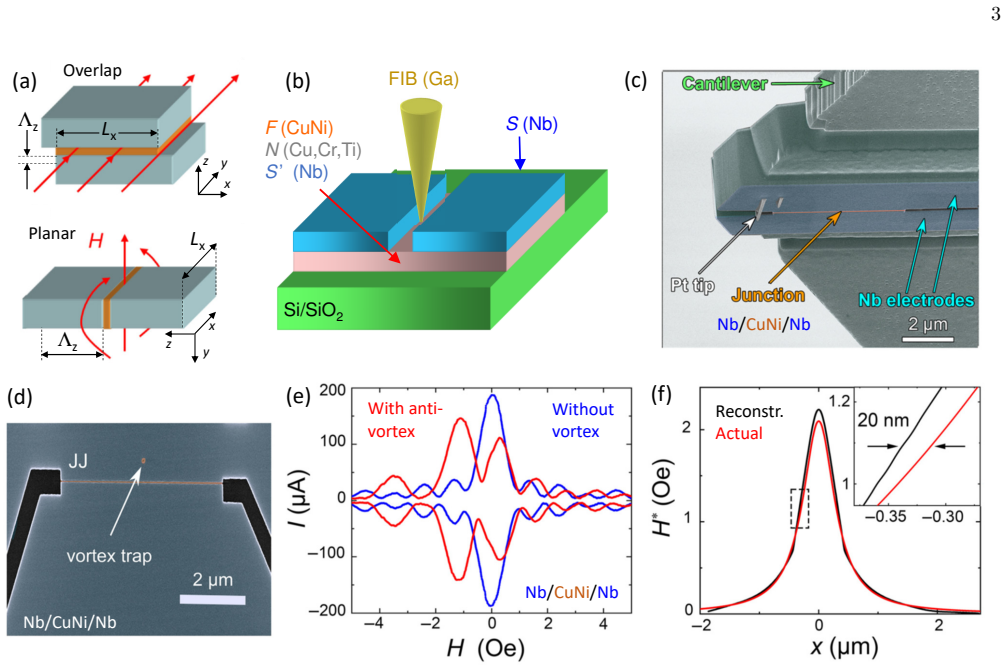
The central claim is that the planar geometry of Josephson junctions, formed at the edge of two superconducting films in the same plane instead of vertical overlap, greatly enhances sensitivity to magnetic fields and improves impedance matching for terahertz devices. The two-dimensional structure permits simple and flexible design of electronic components, leading to drastic miniaturization. Recent advances include junction-on-cantilever sensors for super-resolution magnetic imaging, vortex-based memory cells, and programmable superconducting diodes.
What carries the argument
The planar geometry of Josephson junctions, where the weak link is formed laterally between two superconducting films without vertical stacking, which alters the response to magnetic fields and current flow compared to sandwich-type overlap junctions.
If this is right
- Enhanced magnetic field sensitivity enables junction-on-cantilever sensors for super-resolution magnetic imaging.
- Improved design flexibility supports vortex-based memory cells in superconducting electronics.
- Better impedance matching facilitates use in terahertz devices.
- Two-dimensional structure allows programmable superconducting diodes with new functionalities.
- Overall, the geometry change enables drastic miniaturization of superconducting components.
Where Pith is reading between the lines
- Integrating planar junctions with existing nanofabrication techniques could accelerate development of hybrid quantum-classical circuits.
- Testing these junctions in high-frequency circuits might reveal additional benefits for signal processing beyond those described.
- The emphasis on planar layouts suggests potential compatibility with two-dimensional materials for further performance gains.
- Future devices might combine sensing and memory functions on the same planar chip more easily than with overlap junctions.
Load-bearing premise
The geometric change from overlap to planar layout produces the claimed enhancements in sensitivity and functionality without being limited by fabrication defects, material interfaces, or other practical constraints.
What would settle it
Fabricating both planar and overlap Josephson junctions from the same materials and measuring no significant difference in their magnetic field sensitivity or impedance matching at terahertz frequencies would challenge the central claims.
Figures


read the original abstract
Josephson junctions are key elements in superconducting electronics. The most common type is the overlap (sandwich-type) junction, formed by vertically stacking two superconducting layers. In contrast, planar junctions are fabricated without overlap, at the edge of two superconducting films within a single plane. This geometric distinction has a significant impact on their physical properties. The planar geometry greatly enhances sensitivity to magnetic fields and improves impedance matching for terahertz (THz) devices. Its two-dimensional structure allows for simple and flexible electronic component design, enabling drastic miniaturization. Here I highlight recent advances in the application of planar junctions for novel technologies, including junction-on-cantilever sensors for super-resolution magnetic imaging, vortex-based memory cells, and programmable superconducting diodes. I will also discuss the general requirements, future perspectives, and key challenges in the evolving field of superconducting electronics.
Editorial analysis
A structured set of objections, weighed in public.
Referee Report
Summary. The manuscript is a perspective article arguing that planar Josephson junctions—fabricated in a single plane at the edge of two superconducting films—offer distinct advantages over conventional overlap (sandwich-type) junctions. It claims that the planar geometry greatly enhances sensitivity to magnetic fields, improves impedance matching for terahertz devices, and enables simple, flexible designs that support drastic miniaturization. The paper reviews recent applications including junction-on-cantilever sensors for super-resolution magnetic imaging, vortex-based memory cells, and programmable superconducting diodes, while outlining general requirements, future perspectives, and key challenges in superconducting electronics.
Significance. If the geometric advantages are borne out by quantitative device performance, the perspective could help steer research toward more compact and sensitive superconducting sensors and electronics, particularly in quantum sensing and THz applications. The synthesis of recent advances in cantilever sensors, vortex memory, and diodes provides a useful overview for the field, though the manuscript itself introduces no new data, derivations, or parameter-free predictions.
major comments (2)
- [Abstract / Introduction] Abstract and opening discussion of geometry: the central claim that planar geometry 'greatly enhances sensitivity to magnetic fields' and 'improves impedance matching' is presented without any quantitative comparison (e.g., effective area scaling, critical-current density, or noise spectral density) between planar and overlap devices fabricated from comparable materials. This quantitative gap is load-bearing for the asserted functionality gains.
- [Key challenges / Future perspectives] Section on key challenges and future perspectives: fabrication defects, edge roughness, and interface transparency are flagged as challenges, yet no bounds or citations are given on how these factors limit the claimed sensitivity or miniaturization advantages relative to ideal geometry. Without such assessment the extrapolation from geometry to device performance remains untested.
minor comments (2)
- [Abstract] The abstract would benefit from one or two concrete citations to the 'recent advances' being highlighted so readers can immediately locate the supporting experimental literature.
- [Figures] Figure captions (if present) should explicitly state whether any plotted data are new measurements or reproduced from cited works.
Simulated Author's Rebuttal
We thank the referee for the thoughtful and constructive report on our perspective article. The comments correctly identify areas where additional quantitative context and literature grounding would strengthen the presentation. We address each major comment below and indicate the planned revisions.
read point-by-point responses
-
Referee: [Abstract / Introduction] Abstract and opening discussion of geometry: the central claim that planar geometry 'greatly enhances sensitivity to magnetic fields' and 'improves impedance matching' is presented without any quantitative comparison (e.g., effective area scaling, critical-current density, or noise spectral density) between planar and overlap devices fabricated from comparable materials. This quantitative gap is load-bearing for the asserted functionality gains.
Authors: We agree that the perspective would benefit from explicit quantitative benchmarks drawn from the literature. While the manuscript synthesizes published experimental results rather than presenting new data, we will revise the introduction and abstract to include a concise comparison of key metrics. This will reference effective area scaling and magnetic sensitivity enhancements reported for planar junction-on-cantilever devices (e.g., from recent super-resolution imaging studies) versus typical overlap junctions, along with impedance-matching advantages in THz contexts supported by cited experimental works. These additions will be framed as summaries of existing measurements rather than new derivations. revision: yes
-
Referee: [Key challenges / Future perspectives] Section on key challenges and future perspectives: fabrication defects, edge roughness, and interface transparency are flagged as challenges, yet no bounds or citations are given on how these factors limit the claimed sensitivity or miniaturization advantages relative to ideal geometry. Without such assessment the extrapolation from geometry to device performance remains untested.
Authors: We accept this observation. In the revised manuscript we will expand the challenges section to incorporate additional citations and, where available, quantitative estimates from the literature on how edge roughness and interface transparency affect critical current density and magnetic field sensitivity in planar junctions. We will also note the current scarcity of direct comparative bounds versus ideal geometries as an open issue requiring further experimental work, thereby clarifying the limits of current extrapolations. revision: yes
Circularity Check
No circularity: descriptive perspective without derivations or fitted predictions
full rationale
The manuscript is a review-style perspective on planar Josephson junctions that describes geometric differences, application examples, and challenges without any equations, derivations, or quantitative predictions. No load-bearing steps reduce to self-definitions, fitted inputs renamed as predictions, or self-citation chains; claims rest on cited experimental advances and geometric arguments that remain externally verifiable. The text is self-contained as an overview rather than a closed derivation loop.
Axiom & Free-Parameter Ledger
Lean theorems connected to this paper
-
IndisputableMonolith/Foundation/AlexanderDuality.leanalexander_duality_circle_linking unclear?
unclearRelation between the paper passage and the cited Recognition theorem.
The planar geometry greatly enhances sensitivity to magnetic fields... non-local electrodynamics... large demagnetization factor... Abrikosov vortices... flexibility of geometrical design... Terahertz applications: impedance matching
-
IndisputableMonolith/Cost/FunctionalEquation.leanwashburn_uniqueness_aczel unclear?
unclearRelation between the paper passage and the cited Recognition theorem.
Planar JJs have a geometry that is orthogonal to that of overlap JJs... This geometric distinction has a significant impact on their physical properties.
What do these tags mean?
- matches
- The paper's claim is directly supported by a theorem in the formal canon.
- supports
- The theorem supports part of the paper's argument, but the paper may add assumptions or extra steps.
- extends
- The paper goes beyond the formal theorem; the theorem is a base layer rather than the whole result.
- uses
- The paper appears to rely on the theorem as machinery.
- contradicts
- The paper's claim conflicts with a theorem or certificate in the canon.
- unclear
- Pith found a possible connection, but the passage is too broad, indirect, or ambiguous to say the theorem truly supports the claim.
Reference graph
Works this paper leans on
-
[1]
https://www.iea.org/reports/electricity-2024/executive- summary
work page 2024
-
[2]
Weisheng, L. et al. Approaching the quantum limit in two-dimensional semiconductor contacts.Nature613, 274-279 (2023)
work page 2023
-
[3]
Cardoso, J. M. P., Coutinho, J. G. F., Diniz, P. C., Em- bedded Computing for High Performance: Efficient Map- ping of Computations Using Customization, Code Trans- formations and Compilation (Morgan Kaufmann Pub- lishers, 2017 Elsevier Inc.)
work page 2017
-
[4]
Holmes, D. S., Ripple, A. L., & Manheimer, M. A. Energy-efficient superconducting computing—Power budgets and requirements.IEEE Trans. Appl. Supercond. 23, 1701610 (2013)
work page 2013
-
[5]
Ortlepp, T., and Van Duzer, T., Access time and power dissipation of a model 256-bit single flux quantum RAM. IEEE Trans. Appl. Supercond.24, 1300307 (2014)
work page 2014
-
[6]
M., Single Abrikosov vortices as quantized information bits,Nat
Golod, T., Iovan, A., and Krasnov, V. M., Single Abrikosov vortices as quantized information bits,Nat. Commun.6, 8628 (2015)
work page 2015
- [7]
-
[8]
Tolpygo, S. K., Superconductor digital electronics: Scal- ability and energy efficiency issues.Low Temperature Physics,42(5), 361-379 (2016)
work page 2016
-
[9]
Energy efficiency of adiabatic superconductor logic,Supercond
Takeuchi, N., Yamanashi, Y., and Yoshikawa, N. Energy efficiency of adiabatic superconductor logic,Supercond. Sci. Technol.28, 015003 (2015)
work page 2015
-
[10]
Kirichenko, A. F., Vernik, I. V., Kamkar, M. Y., Walter, J. Miller, M., Albu, L. R., and Mukhanov, O. A., ERSFQ 8-Bit Parallel Arithmetic Logic Unit.IEEE Trans. Appl. Supercond.,29, 1302407 (2019)
work page 2019
-
[11]
V. K. Semenov, Y. A. Polyakov, and S. K. Tolpygo, AC-Biased Shift Registers as Fabrication Process Bench- mark Circuits and Flux Trapping Diagnostic Tool,IEEE Trans. Appl. Supercond.271301409, (2017)
work page 2017
-
[12]
S. K. Tolpygo, V. Bolkhovsky, R. Rastogi, S. Zarr, A. L. Day, E. Golden, T. J. Weir, A. Wynn, and L. M. John- son, Advanced Fabrication Processes for Superconduc- tor Electronics: Current Status and New Developments, IEEE Trans. Appl. Supercond.291102513, (2019)
work page 2019
-
[13]
Soloviev, I. I., et al., Beyond Moore’s technologies: oper- ation principles of a superconductor alternative.Beilstein J. Nanotechnol.8, 2689 (2017)
work page 2017
-
[14]
M., Word and bit line operation of a 1×1µm 2 supercon- ducting vortex-based memory.Nat
Golod, T., Morlet-Decarnin, L., and Krasnov, V. M., Word and bit line operation of a 1×1µm 2 supercon- ducting vortex-based memory.Nat. Commun.14, 4926 (2023)
work page 2023
-
[15]
Alam, S., Hossain, M. S., Srinivasa, S. R., and Aziz, A., Cryogenic memory technologies.Nat. Electr.6, 185–198 (2023)
work page 2023
-
[16]
Dresselhaus, P. D., Elsbury, M. M., Olaya, D., Bur- roughs, C. J., and Benz, S. P., 10 Volt Programmable Josephson Voltage Standard Circuits Using NbSi-Barrier Junctions,IEEE Trans. Appl. Supercond.21, 693-696 (2011)
work page 2011
-
[17]
The term “planar” may sound confusing for people famil- iar with semiconducting electronics since there “planar” junctions are formed along the substrate (as in overlap JJs), while non-planar junctions are expanding in the third (vertical) dimension, as in 3D FinFET. Using simi- lar logics, the term “planar junction” has been sometimes applied to overlap ...
-
[18]
K., Superconducting weak links,Rev
Likharev, K. K., Superconducting weak links,Rev. Mod. Phys.51101-159 (1979)
work page 1979
-
[19]
Kirtley, J. R., Tsuei, C. C., Rupp, M., Sun, J. Z., Yu- Jahnes, L. S., Gupta, A., Ketchen, M. B., Moler, K. A., and Bhushan, M., Direct Imaging of Integer and Half- Integer Josephson Vortices in High-Tc Grain Boundaries, Phys. Rev. Lett.76, 1336 (1996)
work page 1996
-
[20]
A., Rydh, A., Golod, T., Motzkau, H., Klushin, A
Boris, A. A., Rydh, A., Golod, T., Motzkau, H., Klushin, A. M., and Krasnov, V. M., Evidence for Nonlocal Elec- trodynamics in Planar Josephson Junctions.Phys. Rev. Lett.111, 117002 (2013)
work page 2013
-
[21]
Krasnov, V. M., Bauch, T., Intiso, S., H¨ urfeld, E., Akazaki, T., Takayanagi, H., and Delsing, P., Collapse of Thermal Activation in Moderately Damped Joseph- son Junctions.Phys. Rev. Lett.95, 157002 (2005)
work page 2005
-
[22]
Baumgartner, C., Fuchs, L., Costa, A., Reinhardt, S., Gronin, S., Gardner, G.C., Lindemann, T., Manfra, M.J., Faria Junior, P.E., Kochan, D. Fabian, J. Paradiso N. & Strunk C. Supercurrent rectification and magnetochi- ral effects in symmetric Josephson junctions.Nat. Nan- otechn.17, 39 (2022)
work page 2022
-
[23]
D., Jung, W., Lee, G.-H., Efetov, D
Walsh, E. D., Jung, W., Lee, G.-H., Efetov, D. K., Wu, B.-I., Huang, K.-F., Ohki, T. A., Taniguchi, T., Watanabe, K., Kim, P., Englund, D., and Fong, K. C., Josephson junction infrared single-photon detector.Sci- ence372, 409–412 (2021)
work page 2021
-
[24]
Rodan-Legrain, D., Cao, Y., Park, J. M., de la Barrera, S. C., Randeria, M. T., Watanabe, K., Taniguchi, T., and 10 Jarillo-Herrero, P., Highly tunable junctions and non- local Josephson effect in magic-angle graphene tunnelling devices,Nat. Nanotechn.16, 769 (2021)
work page 2021
-
[25]
& Peng, X., Non- reciprocal superconducting NbSe2 antenna.Nat
Zhang, E., Xu, X., Zou, Y.C., Ai, L., Dong, X., Huang, C., Leng, P., Liu, S., Zhang, Y., Jia, Z. & Peng, X., Non- reciprocal superconducting NbSe2 antenna.Nat. Comm., 11, 5634 (2020)
work page 2020
-
[26]
Kudriashov, A., t al., Non-Majorana origin of anoma- lous current-phase relation and Josephson diode effect in Bi 2Se3/NbSe2 Josephson junctions,Sc. Adv.,11, eadw6925 (2025)
work page 2025
-
[27]
Moseley, R. W., Booij, W. E., Tarte, E. J., and Blamire, M. G., Direct writing of low superconductor- normal metal-superconductor junctions using a focused ion beam,Appl. Phys. Lett.75, 262 (1999)
work page 1999
-
[28]
M., Ericsson, O., Intiso, S., Delsing, P., Oboznov, V
Krasnov, V. M., Ericsson, O., Intiso, S., Delsing, P., Oboznov, V. A., Prokofiev, A. S., and Ryazanov, V. V., Planar S–F–S Josephson junctions made by focused ion beam etching.Physica C418, 16-22 (2005)
work page 2005
-
[29]
M., Detection of the phase shift from a single Abrikosov vortex.Phys
Golod, T., Rydh, A., and Krasnov, V. M., Detection of the phase shift from a single Abrikosov vortex.Phys. Rev. Lett.104, 227003 (2010)
work page 2010
-
[30]
Cox, D. C., Gallop, J. C., Hao, L., Focused Ion Beam Processing of Superconducting Junctions and SQUID Based Devices,Nanofabrication1, 53–64 (2014)
work page 2014
-
[31]
Reconfigurable Josephson phase shifter
Golod, T., et al. Reconfigurable Josephson phase shifter. Nano Lett.21, 5240–5246 (2021)
work page 2021
-
[32]
Fermin, R., de Wit, B., and Aarts, J., Beyond the effec- tive length: How to analyze magnetic interference pat- terns of thin-film planar Josephson junctions with finite lateral dimensions,Phys. Rev. B107, 064502 (2023)
work page 2023
-
[33]
Lahabi, K., Amundsen, M., Ouassou, J. A., Beukers, E., Pleijster, M., Linder, J., Alkemade, P., and Aarts, J., Controlling supercurrents and their spatial distribution in ferromagnets,Nat. Commun.8, 2056 (2017)
work page 2056
-
[34]
M., Two mechanisms of Josephson phase shift generation by an Abrikosov vortex.Phys
Golod, T., Pagliero, A., and Krasnov, V. M., Two mechanisms of Josephson phase shift generation by an Abrikosov vortex.Phys. Rev. B100, 174511 (2019)
work page 2019
-
[35]
Golod, T., Kapran, O. M., and Krasnov, V. M., Pla- nar superconductor-ferromagnet-superconductor Joseph- son junctions as scanning-probe sensors,Phys. Rev. Appl. 11, 014062 (2019)
work page 2019
-
[36]
Golod, T. and Krasnov, V.M. Demonstration of a super- conducting diode-with-memory, operational at zero mag- netic field with switchable nonreciprocity.Nat. Commun. 13, 3658 (2022)
work page 2022
-
[37]
Y., Cattaneo, R., Golod, T., and Kras- nov, V
Grebenchuk, S. Y., Cattaneo, R., Golod, T., and Kras- nov, V. M., Nonlocal long-range synchronization of pla- nar Josephson-junction arrays,Phys. Rev. Appl.17, 064032 (2022)
work page 2022
-
[38]
C., Cho, E., Li, H., Cai, H., and Cybart, S
LeFebvre, J. C., Cho, E., Li, H., Cai, H., and Cybart, S. A., Flux focused series arrays of long Josephson junctions for high-dynamic range magnetic field sensing,J. Appl. Phys.131, 163902 (2022)
work page 2022
-
[39]
Schmid, C., Jozani, A., Kleiner, R., Koelle, D., and Goldobin, E., YBa2Cu3O7 Josephson diode fabricated by focused-helium-ion-beam irradiation,Phys. Rev. Applied 24, 014041 (2025)
work page 2025
-
[40]
Direct observation of Josephson vor- tex cores.Nat
Roditchev, D., et al. Direct observation of Josephson vor- tex cores.Nat. Phys.11, 332 (2015)
work page 2015
-
[41]
Y., et al., Observation of interacting Josephson vortex chains by magnetic force microscopy, Phys
Grebenchuk, S. Y., et al., Observation of interacting Josephson vortex chains by magnetic force microscopy, Phys. Rev. Res.2, 023105 (2020)
work page 2020
-
[42]
Chen, S., Park, S., Vool, U., Maksimovic, N., Broadway, D. A., Flaks, M., Zhou, T. X., Maletinsky, P., Stern, A., Halperin, B. I., and Yacoby, A., Current induced hidden states in Josephson junctions,Nature Commun.15, 8059 (2024)
work page 2024
-
[43]
Barone A., and Paterno, G., Physics and Applications of the Josephson Effect (John Wiley & Sons, New York 1982)
work page 1982
-
[44]
Kogan, V. G., Dobrovitski, V. V., Clem, J. R., Mawatari, Y., and Mints, R. G., Josephson junction in a thin film, Phys. Rev. B63, 144501 (2001)
work page 2001
-
[45]
R., Josephson junctions in thin and narrow rect- angular superconducting strips.Phys
Clem, J. R., Josephson junctions in thin and narrow rect- angular superconducting strips.Phys. Rev. B81, 144515 (2010)
work page 2010
-
[46]
A., Demagnetizing Factors of the General El- lipsoid,Phys
Osborn, J. A., Demagnetizing Factors of the General El- lipsoid,Phys. Rev.67, 351-357 (1945)
work page 1945
-
[47]
Hovhannisyan, R., Golod, T., and Krasnov, V. M., Su- perresolution magnetic imaging by a Josephson junc- tion via holographic reconstruction ofI c(H) modulation, Phys. Rev. Appl.20, 064012 (2023)
work page 2023
-
[48]
Gubankov, V. N., Lisitskii, M. P., Serpuchenko, I. L., Sklokin, F. N. and Fistul’, M. V., Influence of trapped Abrikosov vortices on the critical current of the Joseph- son tunnel junction,Supercond. Sci. Technol.5, 168 (1992)
work page 1992
-
[49]
K., Thermal depinning of a single superconducting vortex in Nb,Phys
Sok, J., and Finnemore, D. K., Thermal depinning of a single superconducting vortex in Nb,Phys. Rev. B50, 12770 (1994)
work page 1994
-
[50]
Weides, M., Kohlstedt, H., Waser, R., Kemmler, M., Pfeiffer, J., Koelle, D., Kleiner, R., and Goldobin, E., Ferromagnetic 0–πJosephson junctions,Appl. Phys. A 89, 613 (2007)
work page 2007
-
[51]
Skog, A., Hovhannisyan, R., and Krasnov, V. M., Numer- ical Modeling of Vortex-Based Superconducting Memory Cells: Dynamics and Geometrical Optimization.Nan- otechnology14, 1634 (2024)
work page 2024
-
[52]
Cattaneo, R., Efimov, A. E., Shiianov, K. I., Kieler, O., and Krasnov, V. M., Cascade switching current detectors based on arrays of Josephson junctions,Nat. Commun. 16, 7927 (2025)
work page 2025
-
[53]
Borodianskyi E. A., and Krasnov, V. M., Josephson emission with frequency span 1-11 THz from small Bi2Sr2CaCu2O8+δ mesa structures,Nat. Commun.8, 1742 (2017)
work page 2017
-
[54]
Miyamoto, M., Kobayashi, R., Kuwano, G., Tsujimoto, M., and Kakeya, I., Wide-band frequency modulation of a terahertz intrinsic Josephson junction emitter of a cuprate superconductor.Nat. Photon.18, 267-275 (2024)
work page 2024
-
[55]
Kulik I. O., and Omel’yanchuk, A. N., Properties of su- perconducting microbridges in the pure limit,Sov. J. Low Temp. Phys.3, 459 (1977). [Zh. Eksp. Teor. Fiz. 73, 1434 (1977)]
work page 1977
-
[56]
M., A distributed active patch antenna model of a Josephson oscillator.Beilstein J
Krasnov, V. M., A distributed active patch antenna model of a Josephson oscillator.Beilstein J. Nanotech- nol.14, 151 (2023)
work page 2023
-
[57]
Miller, D., Rice, F., Stern, J
Karpov, A. Miller, D., Rice, F., Stern, J. A., Bumble, B., Le Duc, H. D., and Zmuidzinas, J., Low Noise 1 THz–1.4 THz Mixers Using Nb/Al-AlN/NbTiN SIS Junctions. IEEE Trans. Appl. Supercond.17, 343 (2007)
work page 2007
-
[58]
Ando, Y., Sato, R., Tanaka, M., Takagi, K., Takagi N., and Fujimaki, A., Design and Demonstration of an 8- bit Bit-Serial RSFQ Microprocessor: CORE e4,IEEE Trans. Appl. Supercond.26, 1301205, (2016). 11
work page 2016
-
[59]
Electron.E93-C, 440-444 (2010)
Yamanashi, Y., Kainuma, T., Yoshikawa, N., Kataeva, I., Akaike, H., Fujimaki, A., Tanaka, M., Takagi, N., Naga- sawa, S., and Hidaka, M., 100GHz demonstrations based on the single-flux-quantum cell library for the 10kA/cm2 Nb multi-layer process,IEICE Trans. Electron.E93-C, 440-444 (2010)
work page 2010
-
[60]
J., et al., ColdFlux Superconducting EDA and TCAD Tools Project: Overview and Progress,IEEE Trans
Fourie, C. J., et al., ColdFlux Superconducting EDA and TCAD Tools Project: Overview and Progress,IEEE Trans. Appl. Supercond.29, 1300407 (2019)
work page 2019
discussion (0)
Sign in with ORCID, Apple, or X to comment. Anyone can read and Pith papers without signing in.