REVIEW 3 major objections 5 minor 83 references
This paper claims that constrained analytic continuation of quantum Monte Carlo single-hole Green's functions resolves sharp spectral features in one-dimensional spin chains, revealing a gap between two holon bands where the spin-charge sep
Reviewed by Pith at T0; open to challenge. T0 means a machine referee read the full paper against a public rubric. the ladder, T0–T4 →
T0 review · deepseek-v4-flash
2026-08-03 20:15 UTC pith:QGWNLJLR
load-bearing objection The method work is real and the dimerized-chain spin-polaron results are convincing, but the holon-band gap claim is read off constraints that presuppose the sharp features being measured, and the paper itself concedes it has not cross-validated them. the 3 major comments →
Single-hole spectral functions in one-dimensional quantum magnets with different ground states
The pith
A machine-rendered reading of the paper's core claim, the machinery that carries it, and where it could break.
Core claim
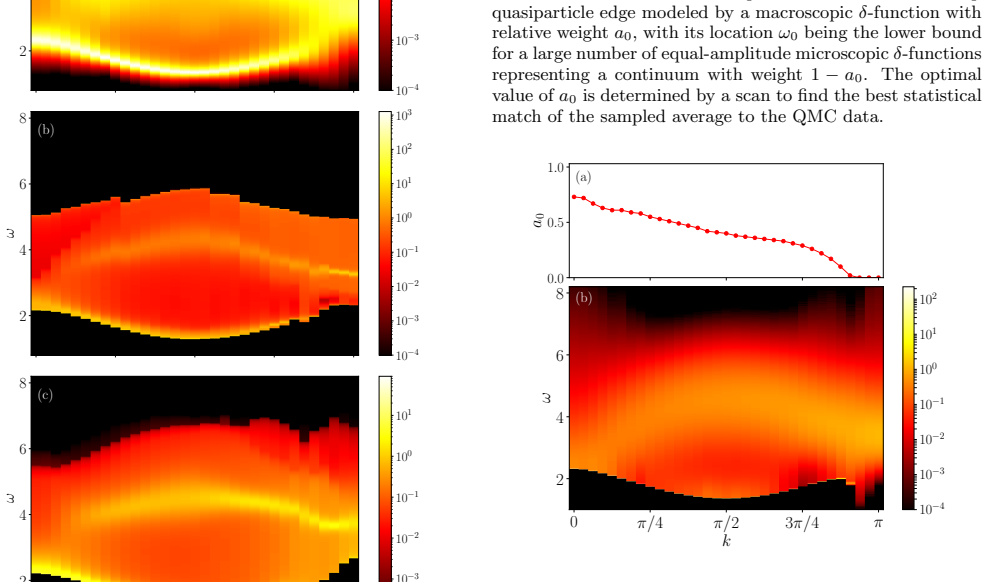
On the paper's own terms, the central discovery is that the conventional spin-charge separation ansatz is quantitatively incomplete even where it works qualitatively. When combined with lower-edge and double-edge constrained SAC parametrizations, the QMC-derived spectral function of the t-J chain at the supersymmetric point (t=1, J=2) and of the t-J-Q chain at the dimerization critical point show that the upper and lower holon branches do not merge at k=0 and k=π as the ansatz predicts; instead a finite gap persists, weakly dependent on system size for L≥32. In the spontaneously dimerized t-J-Q phase (t=1, J=0, Q=1), the methods show a sharp low-energy quasiparticle—interpreted as the even-p
What carries the argument
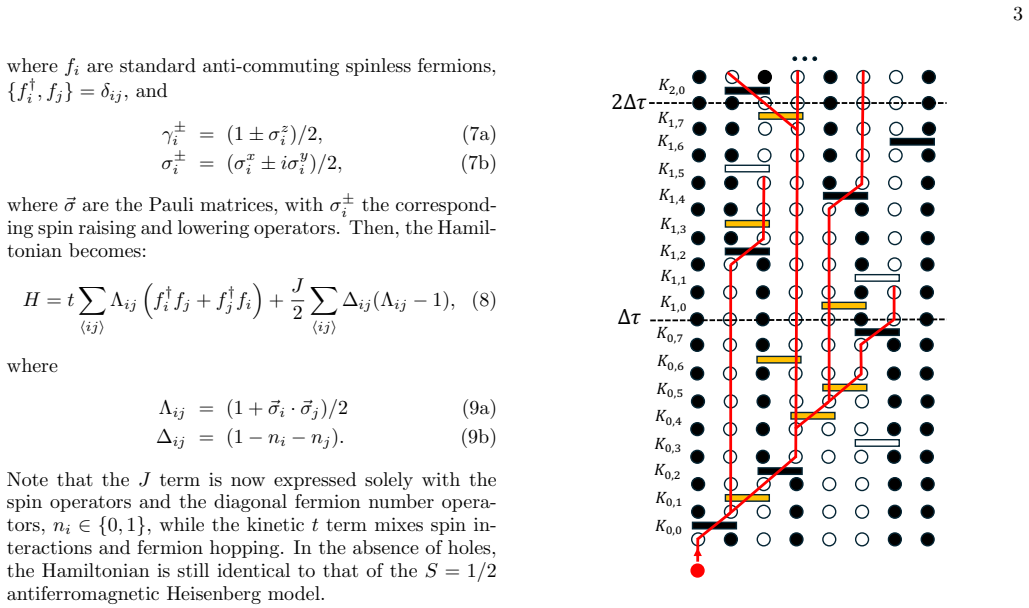
The central machinery is constrained stochastic analytic continuation (SAC) applied to the single-hole imaginary-time Green's function G(k,τ), computed with SSE QMC using Angelucci's canonical transformation so the hole appears only in the measurement, not in the sign-free host sampling. The spectral function A(k,ω) is represented by many δ-functions, and constraints are imposed on their arrangement: an edge is enforced by requiring monotonically increasing spacing of equal-weight δ-functions (giving a power-law divergent edge), a quasiparticle is enforced by a single macroscopic δ-function at the lower bound, and an optional second gap excludes continuum weight below a further edge. These c
Load-bearing premise
The extracted spectral features—the gap between the two holon bands, the isolated spin-polaron peak in the VBS phase, and the even-odd polaron bands—are what the constrained parametrizations impose rather than what the imaginary-time data alone demand, because each constraint (double edge, δ-function edge, second gap) presupposes the very structure being reported and the paper validates the outcome only by visual comparison across parametrizations.
What would settle it
Re-analyze the same QMC Green's functions G(k,τ) with an independent continuation method that does not presuppose edges or quasiparticle peaks—for example, time-dependent DMRG on comparable chain lengths, or unconstrained SAC with statistical cross-validation—and check whether the finite gap between the two holon bands at k=0 and k=π and the isolated low-energy quasiparticle in the VBS phase persist. If either feature disappears or moves outside statistical uncertainty, the central new physics claims are artifacts of the constraints.
If this is right
- If the holon-band gap at k=0 and k=π is real, the mean-field spin-charge separation ansatz is not exact; the actual low-energy spectrum has interaction-induced avoided crossings, and quantitative theories must go beyond non-interacting spinon-holon pictures.
- In the spontaneously dimerized VBS phase, the lowest single-hole excitation is a spin polaron (a bound spinon-holon pair), implying spin-charge confinement in that phase, with an even-parity ground state and an odd-parity excited band separated roughly by 2t.
- The equally spaced even-odd spin-polaron bands in the statically dimerized chain imply a linear string potential between spinon and holon, analogous to quark confinement, and resolvable with the constrained method.
- Constrained SAC on SSE QMC data can resolve sharp fermionic spectral features in 1D with frequency resolution exceeding unconstrained continuation and DMRG-based approaches, making QMC a competitive tool for single-particle dynamics in sign-problem-free host systems.
Where Pith is reading between the lines
- If the holon gap persists in the thermodynamic limit, a testable extension is to look for a corresponding suppression of spectral weight near k=0 and k=π in ARPES data on quasi-1D materials such as SrCuO2, where holon branches are commonly fit with cosine dispersions that touch at those momenta.
- The parity selection rule found for the dimerized chain—even polaron weight vanishing at k=π and odd at k=0—could be used as a diagnostic in other numerical or experimental settings to identify internal symmetry of bound parton states.
- The same constrained-SAC pipeline transfers directly to the 2D t-J model, where the fate of the spin polaron versus deconfined spinons is central to cuprate physics; the systematic comparison of constraints demonstrated here offers a template for those studies.
- A statistical cross-validation of the three parametrizations, which the paper notes is possible, would sharpen confidence in each reported feature and could be run on the same data.
Editorial analysis
A structured set of objections, weighed in public.
Referee Report
Summary. The paper develops and applies constrained stochastic analytic continuation (SAC) to the single-hole spectral function A(k,ω) of 1D S=1/2 t-J and t-J-Q chains. The imaginary-time Green's function G(k,τ) is obtained by SSE QMC using Angelucci's canonical transformation, and A(k,ω) is extracted with several SAC parametrizations that impose edge, quasiparticle, and gap constraints. The authors benchmark G(k,τ) against exact diagonalization for N=8 chains and benchmark constrained SAC output against ED for a bond-alternating dimerized chain. They report spin-charge separation in the uniform critical phase, a finite gap between holon bands at k=0 and k=π (claimed to disagree with the conventional spin-charge separation ansatz), evidence for spinon-holon binding (spin polaron) deep in the spontaneously dimerized VBS phase, and equally spaced spin-polaron bands in a statically dimerized chain. The paper presents the method in detail and explicitly discusses the presence and dangers of constraints in Sec. V.
Significance. If the central findings hold, the paper would show that the mean-field spin-charge separation ansatz is incomplete for the uniform t-J/t-J-Q chain, that a spin polaron is the lowest single-hole excitation in the spontaneously dimerized phase, and that constrained SAC can resolve sharp fermionic spectral features beyond conventional analytic continuation. The methodological core is strong: the SSE implementation of Angelucci's transformation, the N=8 ED validation of G(k,τ) (Fig. 2), and the L=12 ED cross-check of the dimerized band ladder (Fig. 14a vs 14c) are concrete, reproducible anchors. However, the new physics claims are read off constrained SAC outputs that share a sharp-feature prior, and the paper itself states that only visual comparisons were made. The significance is therefore high but conditional on an independent test of the constraint-induced bias.
major comments (3)
- [Sec. III A; Figs. 7–8; Sec. V] The central new claim—a finite gap between the two holon bands at k=0 and k=π—is extracted from edge positions produced by constrained SAC. The double-edge parametrization (Fig. 6) and the single-edge/δ-edge variants explicitly assume sharp edges, and the dispersion parameters t_h, J_s, μ in Eqs. (32) are fitted to those same edge positions. Consistency among three parametrizations is therefore not an independent test, because all three share the sharp-edge prior. The paper admits in Sec. V that only visual comparisons were made and that statistical cross-validation is possible but was not performed. No finite-size extrapolation or statistical uncertainty of the gap is given; the statement that the flattening is 'only very weakly dependent on system size for L≥32' does not quantify an extrapolated gap. If the true A(k,ω) has a rounded or weakly divergent onset, the constrained priors wil
- [Sec. III B; Figs. 11–13] The VBS spin-polaron evidence also rests on a prior: the δ-edge parametrization (Fig. 11) presupposes an isolated quasiparticle with weight a_0, and the second-gap scan (Fig. 13) presupposes a gap. The optimized a_0(k) can therefore be nonzero even if the true spectrum has no δ-like peak. The text is appropriately hedged, but the abstract states 'evidence for spinon-holon binding at large Q/J' as a result. I ask for at least one independent check not using the δ-edge prior—for example, a small-system ED comparison in the t-J-Q VBS phase, or the statistical cross-validation of Refs. [52,54] to choose between the δ-edge and edge-only parametrizations—or, if no such check is available, for the claim to be explicitly presented as a conjecture rather than as evidence.
- [II B; Figs. 2 and 14] The method-validation core validates quantities different from the critical-phase edge/gap claim. Figure 2 benchmarks the imaginary-time Green's function, not the analytic-continuation output A(k,ω). Figure 14 validates constrained SAC for isolated spin-polaron bands in a strongly dimerized chain, where the spectral structure is qualitatively different from the power-law edges of the critical phase. Thus the ability of constrained SAC to locate true edges in a power-law continuum—the load-bearing input for the holon-gap claim—is not independently benchmarked. The paper should either provide such a benchmark (e.g., against the known L=28 ED spectrum of Ref. [25], or against a model with known edge singularities) or clearly mark the gap as a method-dependent observation pending further validation.
minor comments (5)
- [Sec. III A, near Fig. 7] 'In Figs. 7(b) and 7(a), we have fitted G(0,τ) to a single δ-function' appears to contain a typo; the intended references are probably 7(b) and 7(c). Please check all cross-references.
- [Sec. V] The caveat 'Here we have only provided visual comparisons' is important and should appear earlier, in Sec. III A, so that readers do not mistake the three-parametrization comparison for a quantitative validation.
- [Fig. 13] The inset labels and axes are small; consider enlarging and adding error bars from independent SAC runs to the ⟨χ²⟩/N_τ curves.
- [Fig. 14] The color scale in panel (a) is inverted relative to panels (b) and (c), making visual comparison unnecessarily difficult; using the same convention would improve clarity.
- [General] A data/code availability statement would strengthen reproducibility, especially given the detailed algorithmic description.
Circularity Check
Headline holon gap and VBS spin-polaron evidence are read off constrained SAC fits whose priors include the features claimed; ED anchors keep the paper from being fully circular.
specific steps
-
fitted input called prediction
[Sec. III, text before Eqs. (32)-(33); Fig. 7 caption]
"The parameterst h andJ s are equal to 2t andJ in the mean-field Hamiltonian according to Ref. [71], but instead of the bare values they can also be taken as phenomenological parameters. In the case of thet-J-Qchain, we have not derived the mean-field expressions for ts and J s but simply take them as fitting parameters. In all cases, we also have to add a constant to the holon dispersion, corresponding to a chemical potential,ϵ h →ϵ h +µ, where we also treatµas a fitting parameter."
The 'predictions' of the spin-charge-separation ansatz with which the SAC edges are compared are not parameter-free: t_h, J_s, and μ are fitted to the same spectral edges. Fig. 7 states that J_s = 1.35 was 'chosen to match the holon dispersion close to k=π and the putative spinon branch close to k=0.' Thus the claimed agreement with the ansatz is partly reinstalled by the fit, and the residual non-closure at k=0,π is a fit residual of a constrained continuation rather than an independent measurement.
-
other
[Sec. III A, Fig. 6 and text; Sec. V]
"Here we further extend this approach to also involve an upper edge, combining three different sets of mutually constrained δ-functions, as illustrated in Fig. 6. ... One may argue that the constraints introduce bias and the approach either just confirms previously known facts or produces misleading results. ... Here we have only provided visual comparisons, but in principle statistical cross-validation methods can also be used to single out the most likely spectrum out of a group [54]."
The double-edge parametrization presupposes compact support between two singular edges at every k. The headline holon gap at k=0,π is the separation of these two imposed edges, and the paper's own Sec. V concedes that only visual comparisons were made and that constraints may 'produce misleading results.' Without a constraint-free estimate, finite-size scaling, or cross-validation, the non-degeneracy of the two holon bands is not established independently of the edge prior.
-
fitted input called prediction
[Sec. III B, Fig. 13 and surrounding text]
"To explore the possibility of a very small gap separating an isolated sharp quasiparticle from the continuum, we impose a further constraint; a lower bound ω 1 > ω 0 for the contributions above the macroscopic δ-function at ω 0. ... The fact that the gap is small ... gives further support to the existence of a spin polaron—a single isolated bound state followed by a continuum of excitations."
The VBS spin-polaron evidence is produced by a parametrization that already contains a macroscopic δ-function quasiparticle edge (Fig. 11) and then imposes a second gap ω_1 > ω_0. The existence of the bound state and of a gap are inputs of the constrained model; the optimized small ω_1 is then cited as support for the spin polaron. The conclusion is therefore partly a restatement of the assumed parametrization, not an independent detection.
full rationale
The QMC Green's function computation itself is validated against exact diagonalization in Fig. 2, and the bond-alternating chain results are cross-checked against ED for L=12 in Fig. 14; those anchors are independent and keep the paper from being globally circular. The repeated citations to the authors' own SAC developments are not treated as load-bearing circularity because the method has external benchmarks elsewhere and the QMC-to-Green's-function pipeline is tested against ED here. However, the paper's genuinely new physics claims are read off constrained SAC outputs whose priors overlap with the claimed findings. The ansatz parameters t_h, J_s, μ are fitted to the same edges they are used to explain; the double-edge parametrization forces two singular edges into every spectrum; and the δ-edge plus second-gap parametrization forces a quasiparticle and a gap before measuring them. The paper itself flags this in Sec. V ('constraints introduce bias... misleading results') and admits only visual comparisons were made. Therefore the holon gap and the VBS spin-polaron identification are partially circular: the inputs of the constrained models carry part of the output. This is not a full reduction—edge locations and weights are sampled and compared across parametrizations, and some independent ED checks exist—so a moderate score of 4 is appropriate.
Axiom & Free-Parameter Ledger
free parameters (5)
- t_h (holon hopping amplitude) =
2t (bare) for t-J; 1.8 for t-J-Q at Q_c
- J_s (spinon exchange amplitude) =
J (bare, J/t=0.4); 1.35 (supersymmetric point); 1.05 (t-J-Q at Q_c)
- μ (holon chemical-potential shift) =
not quoted (adjusted per case)
- a_0(k) (quasiparticle weight at δ-edge) =
0 to ~1 across k (Figs. 12a, 17)
- ω_1 (second-gap position) =
1.82 at k=π/4 (VBS case, Fig. 13)
axioms (6)
- domain assumption Spin-charge separation ansatz dispersions ε_s = -J_s cos q_s, ε_h = -t_h cos q_h, F_k = (J_s² + t_h² - 2 t_h J_s cos k)^½ (Eqs. 32-33)
- domain assumption Constrained SAC parametrizations (monotone-spacing edge, double-edge, macroscopic δ-edge, second-gap bound) represent true spectral features
- standard math Lehmann representation G(k,τ) = (1/π)∫dω A(k,ω) e^{-τω} (Eq. 26) with A from Eq. (24)
- domain assumption The host t-J-Q dimerization transition at (Q/J)_c ≈ 0.1645 is in the J1-J2 universality class driven by a marginal operator
- domain assumption The SSE matrix-element-ratio estimator (Eqs. 20-23) gives unbiased G(i,j,τ) at L=64, β=2N
- domain assumption L=64 is effectively thermodynamic; the holon-gap size does not shrink with L for L≥32
Cite this review
Pith. "Pith review of Single-hole spectral functions in one-dimensional quantum magnets with different ground states." pith.science (2026). https://pith.science/paper/QGWNLJLR
@misc{pith2026251120447,
  author       = {Pith},
  title        = {Pith review of: Single-hole spectral functions in one-dimensional quantum magnets with different ground states},
  year         = {2026},
  howpublished = {\url{https://pith.science/paper/QGWNLJLR}},
  note         = {Machine review of arXiv:2511.20447}
}
read the original abstract
Recent advances in numerical analytic continuation with physics-motivated constraints allow sharp spectral features to be extracted from imaginary-time quantum Monte Carlo (QMC) data. We apply these methods to one-dimensional $S=1/2$ spin systems with a single ejected fermion, computing the momentum- and energy-dependent single-hole spectral function $A(k,\omega)$. The real-space Green's function $G(r,\tau)$ is evaluated using Angelucci's canonical transformation [Phys. Rev. B 51, 11580 (1995)] implemented within stochastic series expansion QMC, and $A(k,\omega)$ is obtained by constrained stochastic analytic continuation. We contrast systems exhibiting spin-charge separation with those forming a spin polaron through effective spin-charge attraction. For the conventional $t$-$J$ chain, we recover the established signatures of spin-charge separation. Adding a multispin interaction $Q$ drives the system into a spontaneously dimerized valence-bond-solid (VBS) state; spin-charge-separation features persist up to the transition. Although the spectra generally agree with the conventional analytical ansatz, we find a gap between two holon bands that the ansatz predicts to be degenerate at $k=0$ and $k=\pi$. Deep in the VBS phase, the spectra provide evidence for spinon-holon binding at large $Q/J$. In a statically dimerized $t$-$J$ chain, we observe equally spaced spin-polaron bands associated with increasingly large bound states and two internal modes, even and odd under parton permutation. These results demonstrate the power of constrained analytic continuation combined with large-scale QMC for resolving sharp spectral features and distinguishing fractionalized from bound excitations.
Figures




Reference graph
Works this paper leans on
-
[1]
Hasegawa and D
Y. Hasegawa and D. Poilblanc, Hole dynamics in the t-J model: An exact diagonalization study, Phys. Rev. B40, 9035 (1989)
1989
-
[2]
Dagotto, R
E. Dagotto, R. Joynt, A. Moreo, S. Bacci, and E. Gagliano, Strongly correlated electronic systems with one hole: Dynamical properties, Phys. Rev. B41, 9049 (1990)
1990
-
[3]
Dagotto, A
E. Dagotto, A. Moreo, F. Ortolani, D. Poilblanc, and J. Riera, Static and dynamical properties of doped Hub- bard clusters, Phys. Rev. B45, 10741 (1992)
1992
-
[4]
Poilblanc, T
D. Poilblanc, T. Ziman, H. J. Schulz, and E. Dagotto, Dynamical properties of a single hole in an antiferromag- net, Phys. Rev. B47, 14267 (1993)
1993
-
[5]
Poilblanc, H
D. Poilblanc, H. J. Schulz, and T. Ziman, Single-hole spectral density in an antiferromagnetic background, Phys. Rev. B47, 3268 (1993)
1993
-
[6]
Preuss, A
R. Preuss, A. Muramatsu, W. von der Linden, P. Di- eterich, F. F. Assaad, and W. Hanke, Spectral Proper- ties of the One-Dimensional Hubbard Model, Phys. Rev. Lett.73, 732 (1994)
1994
-
[7]
B´ eran, D
P. B´ eran, D. Poilblanc, and R. Laughlin, Evidence for composite nature of quasiparticles in the 2D t-J model, 18 Nuclear Physics B473, 707 (1996)
1996
-
[8]
Sorella, Sharp photoemission spectra in the quantum antiferromagnet, Phys
S. Sorella, Sharp photoemission spectra in the quantum antiferromagnet, Phys. Rev. B53, 15119 (1996)
1996
-
[9]
Sorella and A
S. Sorella and A. Parola, Spectral Properties of One Di- mensional Insulators and Superconductors, Phys. Rev. Lett.76, 4604 (1996)
1996
-
[10]
Suzuura and N
H. Suzuura and N. Nagaosa, Spin-charge separation in angle-resolved photoemission spectra, Phys. Rev. B56, 3548 (1997)
1997
-
[11]
K. Penc, K. Hallberg, F. Mila, and H. Shiba, Spectral functions of the one-dimensional Hubbard model in the U→+∞limit:How to use the factorized wave function, Phys. Rev. B55, 15475 (1997)
1997
-
[12]
Sorella and A
S. Sorella and A. Parola, Theory of hole propagation in one-dimensional insulators and superconductors, Phys. Rev. B57, 6444 (1998)
1998
-
[13]
G. B. Martins, C. Gazza, J. C. Xavier, A. Feiguin, and E. Dagotto, Doped Stripes in Models for the Cuprates Emerging from the One-Hole Properties of the Insulator, Phys. Rev. Lett.84, 5844 (2000)
2000
-
[14]
Capponi and F
S. Capponi and F. F. Assaad, Spin and charge dy- namics of the ferromagnetic and antiferromagnetic two- dimensional half-filled Kondo lattice model, Phys. Rev. B63, 155114 (2001)
2001
-
[15]
K. A. Al-Hassanieh, F. A. Reboredo, A. E. Feiguin, I. Gonz´ alez, and E. Dagotto, Excitons in the One- Dimensional Hubbard Model: A Real-Time Study, Phys. Rev. Lett.100, 166403 (2008)
2008
-
[16]
T. A. Maier, D. Poilblanc, and D. J. Scalapino, Dynamics of the Pairing Interaction in the Hubbard andt−JMod- els of High-Temperature Superconductors, Phys. Rev. Lett.100, 237001 (2008)
2008
-
[17]
E. H. Lieb and F. Y. Wu, Absence of Mott Transition in an Exact Solution of the Short-Range, One-Band Model in One Dimension, Phys. Rev. Lett.20, 1445 (1968)
1968
-
[18]
Voit, One-dimensional Fermi liquids, Reports on Progress in Physics58, 977 (1995)
J. Voit, One-dimensional Fermi liquids, Reports on Progress in Physics58, 977 (1995)
1995
-
[19]
Arikawa, Y
M. Arikawa, Y. Saiga, and Y. Kuramoto, Electron Addi- tion Spectrum in the Supersymmetrict−JModel with Inverse-Square Interaction, Phys. Rev. Lett.86, 3096 (2001)
2001
-
[20]
Arikawa, T
M. Arikawa, T. Yamamoto, Y. Saiga, and Y. Kuramoto, Exact electron addition spectrum in 1D supersymmetric t–J model with 1/r 2 interaction, Nuclear Physics B702, 380 (2004)
2004
-
[21]
Kollath, U
C. Kollath, U. Schollw¨ ock, and W. Zwerger, Spin-Charge Separation in Cold Fermi Gases: A Real Time Analysis, Phys. Rev. Lett.95, 176401 (2005)
2005
-
[22]
Kollath and U
C. Kollath and U. Schollw¨ ock, Cold Fermi gases: a new perspective on spin-charge separation, New Journal of Physics8, 220 (2006)
2006
-
[23]
Poilblanc, A
D. Poilblanc, A. L¨ auchli, M. Mambrini, and F. Mila, Spinon deconfinement in doped frustrated quantum an- tiferromagnets, Phys. Rev. B73, 100403 (2006)
2006
-
[24]
ˇSmakov, A
J. ˇSmakov, A. L. Chernyshev, and S. R. White, Spinon- holon interactions in an anisotropict−Jchain: A com- prehensive study, Phys. Rev. B76, 115106 (2007)
2007
-
[25]
Wrzosek, A
P. Wrzosek, A. K losi´ nski, Y. Wang, M. Berciu, C. E. Agrapidis, and K. Wohlfeld, The fate of the spin polaron in the 1D antiferromagnets, SciPost Phys.17, 018 (2024)
2024
-
[26]
C. Kim, A. Y. Matsuura, Z.-X. Shen, N. Motoyama, H. Eisaki, S. Uchida, T. Tohyama, and S. Maekawa, Ob- servation of Spin-Charge Separation in One-Dimensional SrCuO2, Phys. Rev. Lett.77, 4054 (1996)
1996
-
[27]
Kim, Z.-X
C. Kim, Z.-X. Shen, N. Motoyama, H. Eisaki, S. Uchida, T. Tohyama, and S. Maekawa, Separation of spin and charge excitations in one-dimensional SrCuO 2, Phys. Rev. B56, 15589 (1997)
1997
-
[28]
Fujisawa, T
H. Fujisawa, T. Yokoya, T. Takahashi, S. Miyasaka, M. Kibune, and H. Takagi, Angle-resolved photoemission study of Sr 2CuO3, Phys. Rev. B59, 7358 (1999)
1999
-
[29]
Recati, P
A. Recati, P. O. Fedichev, W. Zwerger, and P. Zoller, Spin-Charge Separation in Ultracold Quantum Gases, Phys. Rev. Lett.90, 020401 (2003)
2003
-
[30]
Koitzsch, S
A. Koitzsch, S. V. Borisenko, J. Geck, V. B. Zabolot- nyy, M. Knupfer, J. Fink, P. Ribeiro, B. B¨ uchner, and R. Follath, Current spinon-holon description of the one- dimensional charge-transfer insulator SrCuO 2: Angle- resolved photoemission measurements, Phys. Rev. B73, 201101 (2006)
2006
-
[31]
B. J. Kim, H. Koh, E. Rotenberg, S. J. Oh, H. Eisaki, N. Motoyama, S. Uchida, T. Tohyama, S. Maekawa, Z. X. Shen, and C. Kim, Distinct spinon and holon dispersions in photoemission spectral functions from one-dimensional SrCuO2, Nature Physics2, 397 (2006)
2006
-
[32]
Vijayan, P
J. Vijayan, P. Sompet, G. Salomon, J. Koepsell, S. Hirthe, A. Bohrdt, F. Grusdt, I. Bloch, and C. Gross, Time-resolved observation of spin-charge deconfinement in fermionic Hubbard chains, Science367, 186 (2020)
2020
-
[33]
J. G. Bednorz and K. A. M¨ uller, Possible highT c su- perconductivity in the Ba-La-Cu-O system, Z. Phys. B: Condens. Matter64, 189 (1986)
1986
-
[34]
S. A. Trugman, Interaction of holes in a Hubbard antifer- romagnet and high-temperature superconductivity, Phys. Rev. B37, 1597 (1988)
1988
-
[35]
C. L. Kane, P. A. Lee, and N. Read, Motion of a single hole in a quantum antiferromagnet, Phys. Rev. B39, 6880 (1989)
1989
-
[36]
Martinez and P
G. Martinez and P. Horsch, Spin polarons in the t-J model, Phys. Rev. B44, 317 (1991)
1991
-
[37]
S. R. White, Density matrix formulation for quantum renormalization groups, Phys. Rev. Lett.69, 2863 (1992)
1992
-
[38]
S. R. White, Density-matrix algorithms for quantum renormalization groups, Phys. Rev. B48, 10345 (1993)
1993
-
[39]
¨Ostlund and S
S. ¨Ostlund and S. Rommer, Thermodynamic Limit of Density Matrix Renormalization, Phys. Rev. Lett.75, 3537 (1995)
1995
-
[40]
Schollw¨ ock, The density-matrix renormalization group, Rev
U. Schollw¨ ock, The density-matrix renormalization group, Rev. Mod. Phys.77, 259 (2005)
2005
-
[41]
Schollw¨ ock, The density-matrix renormalization group in the age of matrix product states, Annals of Physics 326, 96 (2011), january 2011 Special Issue
U. Schollw¨ ock, The density-matrix renormalization group in the age of matrix product states, Annals of Physics 326, 96 (2011), january 2011 Special Issue
2011
-
[42]
Yang and A
L. Yang and A. E. Feiguin, From deconfined spinons to coherent magnons in an antiferromagnetic Heisenberg chain with long range interactions, SciPost Phys.10, 110 (2021)
2021
-
[43]
L. Yang, I. Hamad, L. O. Manuel, and A. E. Feiguin, Fate of pairing and spin-charge separation in the presence of long-range antiferromagnetism, Phys. Rev. B105, 195104 (2022)
2022
-
[44]
S.-H. Lin, M. P. Zaletel, and F. Pollmann, Efficient simu- lation of dynamics in two-dimensional quantum spin sys- tems with isometric tensor networks, Phys. Rev. B106, 245102 (2022)
2022
-
[45]
Drescher, L
M. Drescher, L. Vanderstraeten, R. Moessner, and F. Pollmann, Dynamical signatures of symmetry-broken and liquid phases in anS= 1 2 Heisenberg antiferromag- 19 net on the triangular lattice, Phys. Rev. B108, L220401 (2023)
2023
-
[46]
Jarrell and J
M. Jarrell and J. Gubernatis, Bayesian inference and the analytic continuation of imaginary-time quantum Monte Carlo data, Physics Reports269, 133 (1996)
1996
-
[47]
A. W. Sandvik, Stochastic method for analytic continu- ation of quantum Monte Carlo data, Phys. Rev. B57, 10287 (1998)
1998
-
[48]
K. S. D. Beach, Identifying the maximum entropy method as a special limit of stochastic analytic continu- ation (2004), arXiv:cond-mat/0403055
Pith/arXiv arXiv 2004
-
[49]
A. W. Sandvik, Constrained sampling method for ana- lytic continuation, Phys. Rev. E94, 063308 (2016)
2016
-
[50]
H. Shao, Y. Q. Qin, S. Capponi, S. Chesi, Z. Y. Meng, and A. W. Sandvik, Nearly Deconfined Spinon Excita- tions in the Square-Lattice Spin-1/2 Heisenberg Antifer- romagnet, Phys. Rev. X7, 041072 (2017)
2017
-
[51]
Shao and A
H. Shao and A. W. Sandvik, Progress on stochastic ana- lytic continuation of quantum Monte Carlo data, Physics Reports1003, 1 (2023)
2023
-
[52]
Schumm, S
G. Schumm, S. Yang, and A. W. Sandvik, Cross vali- dation in stochastic analytic continuation, Phys. Rev. E 110, 055307 (2024)
2024
-
[53]
S. Yang, G. Schumm, and A. W. Sandvik, Dynamic struc- ture factor of a spin-1/2 Heisenberg chain with long-range interactions, Phys. Rev. B111, 224404 (2025)
2025
-
[54]
Schumm, S
G. Schumm, S. Zhang, and A. W. Sandvik, Single- particle dispersion and density of states of the half-filled two-dimensional Hubbard model, Phys. Rev. B112, 085109 (2025)
2025
-
[55]
S. R. White and A. E. Feiguin, Real-Time Evolution Us- ing the Density Matrix Renormalization Group, Phys. Rev. Lett.93, 076401 (2004)
2004
-
[56]
Jeckelmann, Dynamical density-matrix renormalization-group method, Phys
E. Jeckelmann, Dynamical density-matrix renormalization-group method, Phys. Rev. B66, 045114 (2002)
2002
-
[57]
Yang and A
S. Yang and A. W. Sandvik (2025), in preparation
2025
-
[58]
S. Yang and A. W. Sandvik, Spinons and Spin-Charge Separation at the Deconfined Quantum Critical Point (2025), arXiv:2512.02962 [cond-mat.str-el]
arXiv 2025
-
[59]
Tang and A
Y. Tang and A. W. Sandvik, Method to Characterize Spinons as Emergent Elementary Particles, Phys. Rev. Lett.107, 157201 (2011)
2011
-
[60]
Tang and A
Y. Tang and A. W. Sandvik, Confinement and Decon- finement of Spinons in Two Dimensions, Phys. Rev. Lett. 110, 217213 (2013)
2013
-
[61]
C. K. Majumdar and D. K. Ghosh, On Next-Nearest- Neighbor Interaction in Linear Chain. II, Journal of Mathematical Physics10, 1399 (1969)
1969
-
[62]
C. K. Majumdar, Antiferromagnetic model with known ground state, Journal of Physics C: Solid State Physics 3, 911 (1970)
1970
-
[63]
Okamoto and K
K. Okamoto and K. Nomura, Fluid-dimer critical point in S = 1/2 antiferromagnetic Heisenberg chain with next nearest neighbor interactions, Physics Letters A169, 433 (1992)
1992
-
[64]
Nomura and K
K. Nomura and K. Okamoto, Critical properties of S= 1/2 antiferromagnetic XXZ chain with next-nearest- neighbour interactions, Journal of Physics A: Mathemat- ical and General27, 5773 (1994)
1994
-
[65]
Wess and B
J. Wess and B. Zumino, Consequences of anomalous ward identities, Physics Letters B37, 95 (1971)
1971
-
[66]
Witten, Global aspects of current algebra, Nuclear Physics B223, 422 (1983)
E. Witten, Global aspects of current algebra, Nuclear Physics B223, 422 (1983)
1983
-
[67]
Witten, Non-abelian bosonization in two dimen- sions, Communications in Mathematical Physics92, 455 (1984)
E. Witten, Non-abelian bosonization in two dimen- sions, Communications in Mathematical Physics92, 455 (1984)
1984
-
[68]
A. W. Sandvik, Stochastic series expansion method with operator-loop update, Phys. Rev. B59, R14157 (1999)
1999
-
[69]
A. W. Sandvik, Computational Studies of Quantum Spin Systems, AIP Conference Proceedings1297, 135 (2010)
2010
-
[70]
Angelucci, Effective lattice actions for correlated elec- trons, Phys
A. Angelucci, Effective lattice actions for correlated elec- trons, Phys. Rev. B51, 11580 (1995)
1995
-
[71]
Brunner, F
M. Brunner, F. F. Assaad, and A. Muramatsu, Single hole dynamics in the one-dimensional t-J model, The European Physical Journal B - Condensed Matter and Complex Systems16, 209 (2000)
2000
-
[72]
Brunner, F
M. Brunner, F. F. Assaad, and A. Muramatsu, Single- hole dynamics in thet−Jmodel on a square lattice, Phys. Rev. B62, 15480 (2000)
2000
-
[73]
E. Y. Loh, J. E. Gubernatis, R. T. Scalettar, S. R. White, D. J. Scalapino, and R. L. Sugar, Sign problem in the nu- merical simulation of many-electron systems, Phys. Rev. B41, 9301 (1990)
1990
-
[74]
slave bosons
and the other where the amplitudes are also sampled along with the frequenciesω i [48]. The configurational entropies of these parametrizations are different [51, 75], leading to slightly different outcomes for the mean spec- tral density accumulated in a histogram. It is also possi- ble to define the frequenciesω i on a fixed grid and only sample the amp...
-
[75]
Y. Q. Qin, B. Normand, A. W. Sandvik, and Z. Y. Meng, Amplitude Mode in Three-Dimensional Dimerized Anti- ferromagnets, Phys. Rev. Lett.118, 147207 (2017)
2017
-
[76]
Ghanem and E
K. Ghanem and E. Koch, Generalized maximum entropy methods as limits of the average spectrum method, Phys. Rev. B108, L201107 (2023)
2023
-
[77]
Affleck, T
I. Affleck, T. Kennedy, E. H. Lieb, and H. Tasaki, Rig- orous results on valence-bond ground states in antiferro- magnets, Phys. Rev. Lett.59, 799 (1987)
1987
-
[78]
Affleck, T
I. Affleck, T. Kennedy, E. H. Lieb, and H. Tasaki, Valence bond ground states in isotropic quantum antiferromag- nets, Communications in Mathematical Physics115, 477 (1988)
1988
-
[79]
S. Yang, D.-X. Yao, and A. W. Sandvik, Deconfined quantum criticality in spin-1/2 chains with long-range interactions (2020), arXiv:2001.02821 [physics.comp-ph]
Pith/arXiv arXiv 2020
-
[80]
R. O. Kuzian, R. Hayn, and J. Richter, Recursion method and one-hole spectral function of the Majumdar-Ghosh model, The European Physical Journal B - Condensed Matter and Complex Systems35, 21 (2003)
2003
discussion (0)
Sign in with ORCID, Apple, or X to comment. Anyone can read and Pith papers without signing in.