Charge carrier relaxation dynamics in the one-dimensional Kondo lattice model
Pith reviewed 2026-05-17 04:40 UTC · model grok-4.3
The pith
Charge carriers in the one-dimensional Kondo lattice reach a stationary state compatible with thermalization when filling is finite or the background spins form singlets.
A machine-rendered reading of the paper's core claim, the machinery that carries it, and where it could break.
Core claim
While in the well-studied cases of one or two charge carriers in a ferromagnetic background, no thermalization occurs, we demonstrate that the stationary state is compatible with thermalization if either the electronic filling is finite or the magnetic background is in the singlet sector.
What carries the argument
Time-dependent Lanczos evolution of the one-dimensional Kondo lattice Hamiltonian, with observables including conduction-electron spin polarization, localized-conduction spin-spin correlations, and electronic momentum distribution.
If this is right
- At finite electron filling the relaxation channel to magnetic excitations produces a thermal stationary state.
- Singlet magnetic backgrounds allow the same thermal outcome even at low carrier density.
- The electronic momentum distribution in the stationary state matches the thermal distribution.
- Level statistics via the gap ratio confirm the approach to a thermal ensemble.
Where Pith is reading between the lines
- Similar relaxation-to-thermalization behavior may appear in other one-dimensional spin-charge coupled models when carrier density is not dilute.
- The same observables could be tracked in higher-dimensional Kondo lattices to test whether the singlet versus ferromagnetic distinction persists.
- Ultrafast optical experiments on real Kondo materials could check whether the observed momentum distributions match the predicted thermal form outside the dilute ferromagnetic limit.
Load-bearing premise
Finite-size chains and the Lanczos truncation in the simulations represent the thermodynamic-limit long-time stationary state without boundary or truncation effects that would change the apparent thermalization behavior.
What would settle it
A long-time momentum distribution or set of spin correlations that deviates from the corresponding finite-temperature thermal ensemble at the same energy density would show the stationary state is not thermal.
Figures




read the original abstract
A generic question in the field of ultrafast dynamics is concerned with the relaxation dynamics and the subsequent thermalization of optically excited charge carriers. Among several possible relaxation channels available in a solid-state system, we focus on the coupling to magnetic excitations. In this paper, we study the real-time dynamics of a paradigmatic model, the Kondo lattice model in one dimension. We conduct a comprehensive study of the relaxation processes by evaluating the spin polarization of the conduction electron, the local spin-spin correlation between localized and conduction electrons, and the electronic momentum distribution. While in the well-studied cases of one or two charge carriers in a ferromagnetic background, no thermalization occurs, we demonstrate that the stationary state is compatible with thermalization if either the electronic filling is finite or the magnetic background is in the singlet sector. Our real-time simulations using the time-dependent Lanczos method are corroborated by a direct comparison with finite-temperature expectation values and an analysis of the spectrum in terms of the gap ratio.
Editorial analysis
A structured set of objections, weighed in public.
Referee Report
Summary. The manuscript investigates the real-time relaxation dynamics of charge carriers in the one-dimensional Kondo lattice model via time-dependent Lanczos simulations. It claims that, in contrast to the well-studied non-thermalizing cases of one or two carriers in a ferromagnetic background, the long-time stationary state becomes compatible with thermalization when the electronic filling is finite or the localized spins are in the singlet sector. This is supported by direct comparison of observables (spin polarization, local spin-spin correlations, momentum distribution) to finite-temperature thermal averages and by gap-ratio analysis of the many-body spectrum.
Significance. If the central numerical observations prove robust, the work clarifies the conditions under which coupling to magnetic excitations drives thermalization in Kondo systems, extending beyond the known non-thermalizing limits. The use of direct time evolution cross-checked against independent finite-temperature calculations and spectral statistics constitutes a methodological strength that strengthens the evidence for the filling- and sector-dependent claim.
major comments (3)
- [Methods] Methods section (time-dependent Lanczos implementation): the manuscript does not report the chain lengths N employed, the Krylov-subspace dimension, or any convergence tests with respect to subspace size. These omissions are load-bearing because the central claim of compatibility with thermalization rests on the long-time stationary values; without this information it is impossible to assess whether the observed relaxation is free of truncation artifacts or finite-size revivals.
- [Results] Results section (comparison to finite-T averages): the agreement between time-evolved observables and thermal expectation values is stated qualitatively but without quantitative error metrics, relative deviations, or uncertainty estimates on the stationary plateaus. This weakens the ability to judge how close the match actually is, particularly for the finite-filling and singlet-sector cases that underpin the main conclusion.
- [Spectral Analysis] Spectral analysis (gap-ratio discussion): while the gap ratio is used to infer chaotic level statistics, the text does not address whether this guarantees dynamical convergence on the simulated time scales or rules out slow revivals that could appear only at longer times or larger N. This is relevant because the skeptic concern about artifactual thermalization hinges on whether the finite-system dynamics faithfully represent the thermodynamic limit.
minor comments (2)
- [Abstract] Abstract: add a brief statement of typical system sizes and Lanczos subspace dimensions used; this is standard for numerical dynamics papers and would immediately address the reader's noted lack of information.
- [Figures] Figure captions: ensure all panels indicate the time window over which the stationary value is averaged and whether any smoothing or fitting was applied.
Simulated Author's Rebuttal
We thank the referee for the positive assessment of our work and for the constructive comments that will help improve the manuscript. We address each major comment below and will make the corresponding revisions.
read point-by-point responses
-
Referee: [Methods] Methods section (time-dependent Lanczos implementation): the manuscript does not report the chain lengths N employed, the Krylov-subspace dimension, or any convergence tests with respect to subspace size. These omissions are load-bearing because the central claim of compatibility with thermalization rests on the long-time stationary values; without this information it is impossible to assess whether the observed relaxation is free of truncation artifacts or finite-size revivals.
Authors: We agree that these technical details are necessary for assessing the reliability of the results. In the revised manuscript we will explicitly report the chain lengths N employed in the simulations, the Krylov-subspace dimension used in the time-dependent Lanczos procedure, and the results of convergence tests with respect to subspace size. These tests confirm that the long-time stationary plateaus remain stable and are not affected by truncation artifacts on the time scales considered. revision: yes
-
Referee: [Results] Results section (comparison to finite-T averages): the agreement between time-evolved observables and thermal expectation values is stated qualitatively but without quantitative error metrics, relative deviations, or uncertainty estimates on the stationary plateaus. This weakens the ability to judge how close the match actually is, particularly for the finite-filling and singlet-sector cases that underpin the main conclusion.
Authors: We acknowledge that quantitative measures would strengthen the presentation. In the revised manuscript we will include relative deviation metrics and uncertainty estimates for the stationary values of the spin polarization, local spin-spin correlations, and momentum distribution compared with the finite-temperature thermal averages. This will be done for both the finite-filling and singlet-sector cases to allow a more precise judgment of the agreement. revision: yes
-
Referee: [Spectral Analysis] Spectral analysis (gap-ratio discussion): while the gap ratio is used to infer chaotic level statistics, the text does not address whether this guarantees dynamical convergence on the simulated time scales or rules out slow revivals that could appear only at longer times or larger N. This is relevant because the skeptic concern about artifactual thermalization hinges on whether the finite-system dynamics faithfully represent the thermodynamic limit.
Authors: We agree that the gap-ratio analysis alone does not guarantee the absence of slow revivals at longer times or in the thermodynamic limit. In the revised manuscript we will add an explicit discussion of this limitation, clarifying that the gap-ratio result is used only as supporting evidence for chaotic dynamics. We will emphasize that our main conclusions rest on the direct comparison of time-evolved observables with thermal averages together with the lack of revivals within the simulated window, and we will comment on the expected behavior for larger systems. revision: yes
Circularity Check
No circularity: direct numerical comparison to independent thermal benchmarks
full rationale
The paper's central result—that the long-time stationary state after charge-carrier relaxation is compatible with thermalization when electronic filling is finite or the magnetic background is in the singlet sector—is obtained by explicit time-dependent Lanczos evolution on finite chains, followed by direct comparison of observables (spin polarization, local spin-spin correlations, momentum distribution) to separately computed finite-temperature expectation values and by gap-ratio diagnostics of the spectrum. No parameter is fitted to a subset of data and then relabeled as a prediction, no self-citation supplies a load-bearing uniqueness theorem, and no ansatz or definition is smuggled in via prior work by the same authors. The derivation chain therefore remains self-contained against external numerical benchmarks rather than reducing to its own inputs by construction.
Axiom & Free-Parameter Ledger
free parameters (1)
- Kondo coupling J and hopping t
axioms (2)
- standard math The time-dependent Schrödinger equation governs the unitary evolution of the many-body wavefunction.
- standard math Finite-temperature expectation values can be computed by tracing over the canonical ensemble.
Lean theorems connected to this paper
-
IndisputableMonolith/Cost/FunctionalEquation.leanwashburn_uniqueness_aczel unclear?
unclearRelation between the paper passage and the cited Recognition theorem.
We conduct a comprehensive study of the relaxation processes by evaluating the spin polarization of the conduction electron, the local spin-spin correlation... Our real-time simulations using the time-dependent Lanczos method are corroborated by a direct comparison with finite-temperature expectation values and an analysis of the spectrum in terms of the gap ratio.
What do these tags mean?
- matches
- The paper's claim is directly supported by a theorem in the formal canon.
- supports
- The theorem supports part of the paper's argument, but the paper may add assumptions or extra steps.
- extends
- The paper goes beyond the formal theorem; the theorem is a base layer rather than the whole result.
- uses
- The paper appears to rely on the theorem as machinery.
- contradicts
- The paper's claim conflicts with a theorem or certificate in the canon.
- unclear
- Pith found a possible connection, but the passage is too broad, indirect, or ambiguous to say the theorem truly supports the claim.
Reference graph
Works this paper leans on
-
[1]
2, two separate regimes emerge based on the ratioJ/t 0
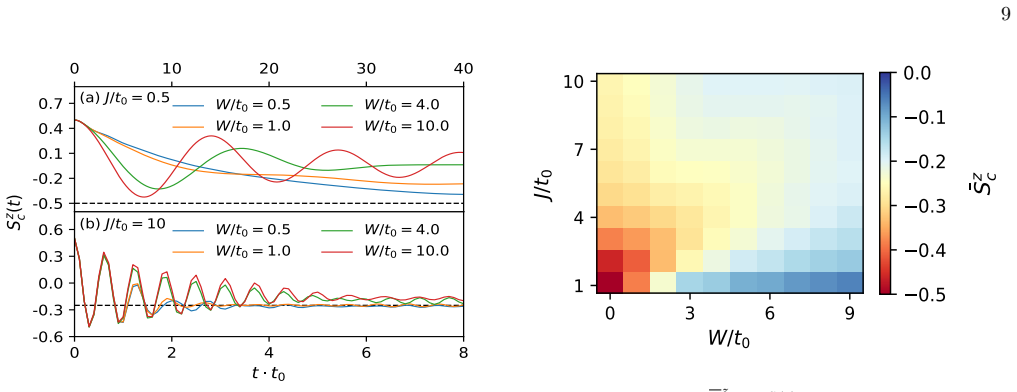
Regime ofJ≪2t 0 As shown in Fig. 2, two separate regimes emerge based on the ratioJ/t 0. We first discuss the regime when the electronic bandwidth exceeds the exchange coupling,i.e., J <2t 0. In this parameter regime, the expectation values of the operators exhibit a smooth time evolution, accom- panied by small oscillations. For the smallest Kondo cou- p...
-
[2]
4, we show a sketch of the relevant processes for smallJ/t 0
Two-level picture forJ/t 0 ≪1 In Fig. 4, we show a sketch of the relevant processes for smallJ/t 0. There, we consider a simple two-level system (TLS) interacting with a bosonic bath. In this analogy, the bosonic bath represents the localized spins, while the spontaneously emitted excitation corresponds to the magnon propagating through the spin chain. Th...
-
[3]
Energy transfer and crossover regimeJ∼2t 0 For smallJ/t 0, a complete magnetization transfer takes place on time scales proportional to 4t 0/J2. At the same time, the kinetic energy of the electron can- not be further reduced after this process since the energy transfer is tied to magnetization transfer. In the small J/t0 regime, the energy transferred ∆E...
-
[4]
Regime ofJ≫2t 0 The time evolution of expectation values in the strong- coupling limit is illustrated in the right part of Fig. 2. As the exchange interaction increases, magnon emission and absorption events intensify, resulting in coherent oscilla- tions seen in all expectation values. Moreover, the steady values ofS z c andS cf are far from a complete s...
-
[5]
Absence of thermalization in theS z total = (L−1)/2sector We return to the case of clean systems withW= 0. In the subspace withS z total = (L−1)/2, the Hilbert-space scales only polynomially with system sizeL. Hence, on general grounds, the density of states will not be- come dense enough to allow for thermalization. Con- sistently, we find that (i) the q...
-
[6]
and with our exact numerical results. Furthermore, we investigated the effect of disorder on the relaxation dynamics, where the behavior at large values of disorder strength is consistent with localization. Most notably in the context of the current study, the expected absence of thermalization is evident in the stationary form of the quasi-momentum distr...
-
[7]
F. Boschini, M. Zonno, and A. Damascelli, Time-resolved ARPES studies of quantum materials, Rev. Mod. Phys. 96, 015003 (2024)
work page 2024
- [8]
-
[9]
C. Giannetti, M. Capone, D. Fausti, M. Fabrizio, F. Parmigiani, and D. Mihailovic, Ultrafast optical spectroscopy of strongly correlated materials and high- temperature superconductors: a non-equilibrium ap- 15 proach, Adv. Phys.65, 58 (2016)
work page 2016
-
[10]
M. Mitrano, A. Cantaluppi, D. Nicoletti, S. Kaiser, A. Perucchi, S. Lupi, P. Di Pietro, D. Pontiroli, M. Ricco, S. R. Clark,et al., Possible light-induced superconduc- tivity inK 3C60 at high temperature, Nature530, 461 (2016)
work page 2016
-
[11]
S. Dal Conte, L. Vidmar, D. Goleˇ z, M. Mierzejewski, G. Soavi, S. Peli, F. Banfi, G. Ferrini, R. Comin, B. M. Ludbrook,et al., Snapshots of the retarded interaction of charge carriers with ultrafast fluctuations in cuprates, Nat. Phys.11, 421 (2015)
work page 2015
-
[12]
Orenstein, Ultrafast spectroscopy of quantum materi- als, Phys
J. Orenstein, Ultrafast spectroscopy of quantum materi- als, Phys. Today65, 44 (2012)
work page 2012
- [13]
-
[14]
R. Yusupov, T. Mertelj, V. V. Kabanov, S. Brazovskii, P. Kusar, J.-H. Chu, I. R. Fisher, and D. Mihailovic, Co- herent dynamics of macroscopic electronic order through a symmetry breaking transition, Nat. Phys.6, 681 (2010)
work page 2010
-
[15]
A. Cavalleri, C. T´ oth, C. W. Siders, J. Squier, F. R´ aksi, P. Forget, and J. Kieffer, Femtosecond structural dynam- ics inV O 2 during an ultrafast solid-solid phase transi- tion, Phys. Rev. Lett.87, 237401 (2001)
work page 2001
- [16]
-
[17]
Dagotto, Complexity in strongly correlated electronic systems, Science309, 257 (2005)
E. Dagotto, Complexity in strongly correlated electronic systems, Science309, 257 (2005)
work page 2005
-
[18]
E. Y. Wilner, H. Wang, M. Thoss, and E. Rabani, Nonequilibrium quantum systems with electron-phonon interactions: Transient dynamics and approach to steady state, Phys. Rev. B89, 205129 (2014)
work page 2014
-
[19]
H. Aoki, N. Tsuji, M. Eckstein, M. Kollar, T. Oka, and P. Werner, Nonequilibrium dynamical mean-field theory and its applications, Rev. Mod. Phys.86, 779 (2014)
work page 2014
-
[20]
V. Moshnyaga, C. Jooss, P. Bl¨ ochl, V. Bruchmann- Bamberg, A. Dehning, L. Allen-Rump, C. Hausmann, M. Kr¨ uger, A. Rathnakaran, S. Rajpurohit,et al., Ele- mentary steps of energy conversion in strongly correlated systems: Beyond single quasiparticles and rigid bands, arXiv:2507.05487 (2025)
work page internal anchor Pith review Pith/arXiv arXiv 2025
-
[21]
Y. Murakami, D. Goleˇ z, M. Eckstein, and P. Werner, Photoinduced nonequilibrium states in Mott insulators, Rev. Mod. Phys.97, 035001 (2025)
work page 2025
-
[22]
P. Werner and M. Eckstein, Relaxation dynamics of the Kondo lattice model, Phys. Rev. B86, 045119 (2012)
work page 2012
-
[23]
W. Zhu, B. Fauseweh, A. Chacon, and J.-X. Zhu, Ultra- fast laser-driven many-body dynamics and Kondo coher- ence collapse, Phys. Rev. B103, 224305 (2021)
work page 2021
-
[24]
J. Chen, E. M. Stoudenmire, Y. Komijani, and P. Cole- man, Matrix product study of spin fractionalization in the one-dimensional Kondo insulator, Phys. Rev. Res.6, 023227 (2024)
work page 2024
- [25]
-
[26]
T. K¨ ohler, S. Rajpurohit, O. Schumann, S. Paeckel, F. R. A. Biebl, M. Sotoudeh, S. C. Kramer, P. E. Bl¨ ochl, S. Kehrein, and S. R. Manmana, Relaxation of photoex- citations in polaron-induced magnetic microstructures, Phys. Rev. B97, 235120 (2018)
work page 2018
-
[27]
F. Dorfner, L. Vidmar, C. Brockt, E. Jeckelmann, and F. Heidrich-Meisner, Real-time decay of a highly excited charge carrier in the one-dimensional Holstein model, Phys. Rev. B91, 104302 (2015)
work page 2015
-
[28]
D. Goleˇ z, J. Bonˇ ca, L. Vidmar, and S. A. Trugman, Re- laxation dynamics of the Holstein polaron, Phys. Rev. Lett.109, 236402 (2012)
work page 2012
-
[29]
Z. Lenarˇ ciˇ c, D. Goleˇ z, J. Bonˇ ca, and P. Prelovˇ sek, Op- tical response of highly excited particles in a strongly correlated system, Phys. Rev. B89, 125123 (2014)
work page 2014
-
[30]
M. Mierzejewski, L. Vidmar, J. Bonˇ ca, and P. Prelovˇ sek, Nonequilibrium quantum dynamics of a charge carrier doped into a Mott insulator, Phys. Rev. Lett.106, 196401 (2011)
work page 2011
-
[31]
A. Polkovnikov, K. Sengupta, A. Silva, and M. Vengalat- tore, Colloquium: Nonequilibrium dynamics of closed in- teracting quantum systems, Rev. Mod. Phys.83, 863 (2011)
work page 2011
-
[32]
B. Fauseweh and J.-X. Zhu, Laser pulse driven control of charge and spin order in the two-dimensional Kondo lattice, Phys. Rev. B102, 165128 (2020)
work page 2020
-
[33]
A. Osterkorn and S. Kehrein, Photoinduced prethermal order parameter dynamics in the two-dimensional large- n Hubbard-Heisenberg model, Phys. Rev. B106, 214318 (2022)
work page 2022
-
[34]
E. Paprotzki, A. Osterkorn, V. Mishra, and S. Kehrein, Quench dynamics in higher-dimensional Holstein models: Insights from truncated Wigner approaches, Phys. Rev. B109, 174303 (2024)
work page 2024
-
[35]
T. Shirakawa, S. Miyakoshi, and S. Yunoki, Photoin- ducedηpairing in the Kondo lattice model, Phys. Rev. B101, 174307 (2020)
work page 2020
-
[36]
S. Paeckel, B. Fauseweh, A. Osterkorn, T. K¨ ohler, D. Manske, and S. R. Manmana, Detecting supercon- ductivity out of equilibrium, Phys. Rev. B101, 180507 (2020)
work page 2020
-
[37]
B. Fauseweh and J.-X. Zhu, Ultrafast optical induction of magnetic order at a quantum critical point, J. Phys.: Condens. Matter37, 075603 (2024)
work page 2024
-
[38]
K. Ueda and M. Sigrist, Single electron in the Kondo lattice, Prog. Theor. Phys. Suppl.106, 167 (1991)
work page 1991
-
[39]
H. Tsunetsugu, M. Sigrist, and K. Ueda, Phase diagram of the one-dimensional Kondo-lattice model, Phys. Rev. B47, 8345 (1993)
work page 1993
-
[40]
H. Tsunetsugu, M. Sigrist, and K. Ueda, The ground- state phase diagram of the one-dimensional Kondo lattice model, Rev. Mod. Phys.69, 809 (1997)
work page 1997
-
[41]
Gulacsi, The Kondo lattice model, Philos
M. Gulacsi, The Kondo lattice model, Philos. Mag.86, 1907 (2006)
work page 1907
- [42]
-
[43]
S. Basylko, P.-H. Lundow, and A. Rosengren, One- dimensional Kondo lattice model studied through numer- ical diagonalization, Phys. Rev. B77, 073103 (2008)
work page 2008
- [44]
-
[45]
Y. Arredondo, E. Vallejo, O. Navarro, and M. Avignon, Formation of spin-polarons in the ferromagnetic Kondo lattice model away from half-filling, J. Phys.: Condens. 16 Matter24, 335601 (2012)
work page 2012
-
[46]
M. A. Sentef, A. Kemper, A. Georges, and C. Kollath, Theory of light-enhanced phonon-mediated superconduc- tivity, Phys. Rev. B93, 144506 (2016)
work page 2016
-
[47]
J. Park, Y. Luo, J.-J. Zhou, and M. Bernardi, Many-body theory of phonon-induced spin relaxation and decoher- ence, Phys. Rev. B106, 174404 (2022)
work page 2022
-
[48]
F. Caruso and D. Novko, Ultrafast dynamics of electrons and phonons: from the two-temperature model to the time-dependent Boltzmann equation, Adv. Phys. X7, 2095925 (2022)
work page 2022
-
[49]
D. Goleˇ z, J. Bonˇ ca, M. Mierzejewski, and L. Vidmar, Mechanism of ultrafast relaxation of a photo-carrier in antiferromagnetic spin background, Phys. Rev. B89, 165118 (2014)
work page 2014
- [50]
- [51]
- [52]
- [53]
-
[54]
C. Sch¨ onle, D. Jansen, F. Heidrich-Meisner, and L. Vid- mar, Eigenstate thermalization hypothesis through the lens of autocorrelation functions, Phys. Rev. B103, 235137 (2021)
work page 2021
-
[55]
B. S. Shastry and D. C. Mattis, Theory of the magnetic polaron, Phys. Rev. B24, 5340 (1981)
work page 1981
-
[56]
M. Sigrist, H. Tsunetsuga, and K. Ueda, Rigorous re- sults for the one-electron Kondo-lattice model, Phys. Rev. Lett.67, 2211 (1991)
work page 1991
- [57]
-
[58]
S. Henning, P. Herrmann, and W. Nolting, Exact results on the Kondo-lattice magnetic polaron, Phys. Rev. B86, 085101 (2012)
work page 2012
-
[59]
M. M¨ oller and M. Berciu, Low-temperature evolution of the spectral weight of a spin-up carrier moving in a ferro- magnetic background, Phys. Rev. B88, 195111 (2013)
work page 2013
-
[60]
M. Frakulla, J. Strockoz, D. S. Antonenko, and J. W. F. Venderbos, Kondo-Heisenberg toy models: Compari- son of exact results and spin wave expansion (2024), arXiv:2408.16752 [cond-mat.str-el]
-
[61]
M. M¨ oller, G. A. Sawatzky, and M. Berciu, Magnon- mediated interactions between fermions depend strongly on the lattice structure, Phys. Rev. Lett.108, 216403 (2012)
work page 2012
-
[62]
M. M¨ oller, G. A. Sawatzky, and M. Berciu, Role of the lattice structure in determining the magnon-mediated interactions between charge carriers doped into a mag- netically ordered background, Phys. Rev. B86, 075128 (2012)
work page 2012
- [63]
-
[64]
S. R. Manmana, R. Noack, and A. Muramatsu, Time evo- lution of one-dimensional quantum many body systems, AIP Conf. Proc.789, 269 (2005)
work page 2005
- [65]
-
[66]
A. W. Sandvik, Computational studies of quantum spin systems, inAIP Conference Proceedings, Vol. 1297 (American Institute of Physics, 2010) pp. 135–338
work page 2010
-
[67]
E. Anderson, Z. Bai, C. Bischof, L. S. Blackford, J. Dem- mel, J. Dongarra, J. Du Croz, A. Greenbaum, S. Ham- marling, A. McKenney,et al.,LAPACK users’ guide (SIAM, 1999)
work page 1999
- [68]
-
[69]
L. D’Alessio, Y. Kafri, A. Polkovnikov, and M. Rigol, From quantum chaos and eigenstate thermalization to statistical mechanics and thermodynamics, Adv. Phys. 65, 239 (2016)
work page 2016
-
[70]
V. S. Varadarajan,Lie groups, Lie algebras, and their representations, Vol. 102 (Springer Science & Business Media, 2013)
work page 2013
-
[71]
J. Seke, Spontaneous emission of a two-level system and the influence of the rotating-wave approximation on the final state. I, J. Stat. Phys.33, 223 (1983)
work page 1983
-
[72]
A. A. Golosov, S. I. Tsonchev, P. Pechukas, and R. A. Friesner, Spin–spin model for two-level system/bath problems: A numerical study, J. Chem. Phys.111, 9918 (1999)
work page 1999
-
[73]
P. R. Berman and G. W. Ford, Spontaneous decay, unitarity, and the Weisskopf-Wigner approximation, in Advances in Atomic, Molecular, and Optical Physics, Vol. 59 (Elsevier, 2010) pp. 175–221
work page 2010
-
[74]
P. Crowley and A. Chandran, Partial thermalisation of a two-state system coupled to a finite quantum bath, Sci- Post Phys.12, 103 (2022)
work page 2022
-
[75]
A. Mitrofanov and S. Urazhdin, Energy and momentum conservation in spin transfer, Phys. Rev. B102, 184402 (2020)
work page 2020
-
[76]
N. Tramsen, A. Mitrofanov, and S. Urazhdin, Effects of the dynamical magnetization state on spin transfer, Phys. Rev. B103, 134415 (2021)
work page 2021
-
[77]
N. Prokof’ev and P. Stamp, Theory of the spin bath, Rep. Prog. Phys.63, 669 (2000)
work page 2000
-
[78]
C. A. B¨ usser, I. de Vega, and F. Heidrich-Meisner, Deco- herence of an entangled state of a strongly correlated dou- ble quantum dot structure through tunneling processes, Phys. Rev. B90, 205118 (2014)
work page 2014
-
[79]
I. de Vega and D. Alonso, Dynamics of non-Markovian open quantum systems, Rev. Mod. Phys.89, 015001 (2017)
work page 2017
- [80]
discussion (0)
Sign in with ORCID, Apple, or X to comment. Anyone can read and Pith papers without signing in.