Elementary Steps of Energy Conversion in Strongly Correlated Systems: Beyond Single Quasiparticles and Rigid Bands
Pith reviewed 2026-05-19 05:10 UTC · model grok-4.3
The pith
Energy conversion in strongly correlated systems requires models where quasiparticle nature and interactions change during the process.
A machine-rendered reading of the paper's core claim, the machinery that carries it, and where it could break.
Core claim
In manganite perovskites the nature and interactions of quasiparticles can change during excitation, transport, and phase transitions, thereby modifying the electronic structure. At sufficiently high stimulation, quasiparticle excitations can induce or actuate phase transitions. This yields a comprehensive understanding of energy conversion steps that extends beyond the single quasiparticle pictures and rigid band approximations familiar from conventional semiconductors.
What carries the argument
Models of interacting and tunable quasiparticles whose nature and interactions evolve during excitation, transport, and phase transitions.
If this is right
- Surface friction arises from correlation-driven low-energy excitations rather than conventional scattering.
- Thermal transport is governed by the interplay of multiple correlation types instead of simple phonon or electron diffusion.
- Optical excitations become time-, energy-, and power-dependent because electronic structure changes with stimulation level.
- Photovoltaic conversion efficiency is modified by correlation-induced phase transitions that respond to incident light intensity.
- High-intensity stimulation can trigger phase transitions through quasiparticle excitations, enabling active control of material state.
Where Pith is reading between the lines
- The same breakdown into low- and high-energy excitations could be used to analyze energy conversion in other perovskite families.
- External fields or stimuli might be tuned to steer phase transitions and thereby improve conversion efficiency in devices.
- Theoretical simulations of tunable quasiparticles could identify new correlated materials with targeted transport or optical properties.
Load-bearing premise
Manganite perovskite oxides capture the essential interplay of correlations that occurs across strongly correlated materials in general.
What would settle it
Measurements on other strongly correlated materials that show all energy conversion steps fully explained by fixed single quasiparticles and unchanging rigid bands would contradict the claimed need for dynamic quasiparticle models.
Figures




read the original abstract
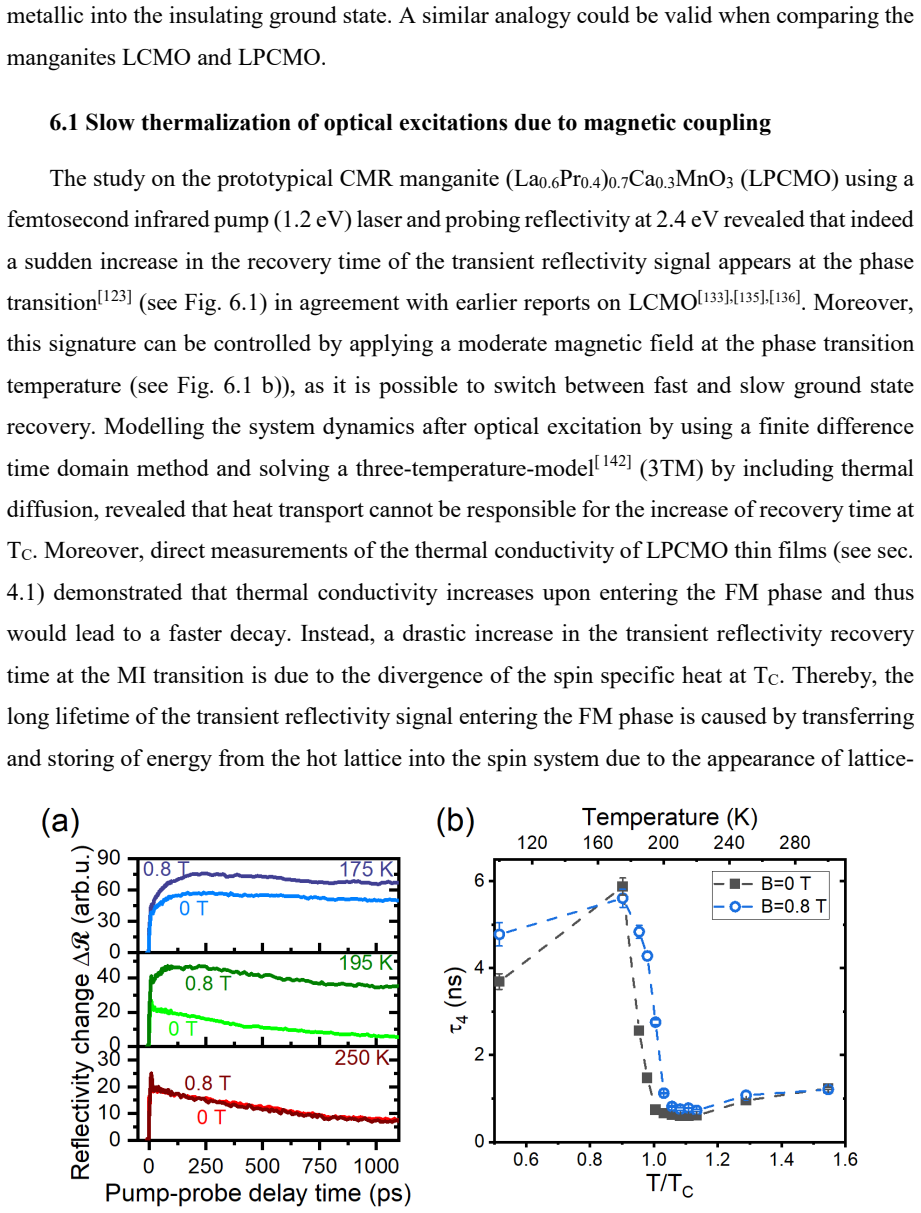
Energy conversion in materials can be considered as a sequence of elementary steps initiated by a primary excitation. While these steps are quite well understood in classical semiconductors in terms of quasiparticle (QP) excitations and interactions, their understanding in strongly correlated materials is still elusive. Here, we review the progress which has been achieved over recent years by studies of manganite perovskite oxides as a model system for materials with strong correlations. They show a subtle interplay of different types of correlations, i.e., electron-phonon, electron-electron and spin-spin, resulting in rich physical phenomena due to competition between different ground states accompanied by temperature- and field-induced phase transitions. They strongly impact various types of energy conversion and transport processes including friction at surfaces, thermal transport, time-, energy- and power-dependent optical excitations as well as photovoltaic energy conversion. The underlying microscopic processes can be broken down to the behavior of the low-energy thermal and high-energy optical excitations, their interactions, transport and conversion which are theoretically analyzed by using models of interacting and tunable QPs: Their nature and interactions can change during excitation, transport and phase transitions, thus modifying electronic structure. At sufficiently high stimulation, QP excitations can even induce or actuate phase transitions. As a result, we obtained a comprehensive understanding of energy conversion steps going far beyond single QP pictures and rigid band approximations well-known for conventional semiconductors.
Editorial analysis
A structured set of objections, weighed in public.
Referee Report
Summary. This review examines energy conversion in strongly correlated materials by analyzing elementary steps initiated by primary excitations, using manganite perovskite oxides as a model system. It emphasizes the interplay of electron-phonon, electron-electron, and spin-spin correlations that produce competing ground states and temperature- or field-induced phase transitions, affecting processes such as surface friction, thermal transport, time- and energy-dependent optical excitations, and photovoltaic conversion. Theoretical analysis relies on models of interacting and tunable quasiparticles whose nature and interactions evolve during excitation, transport, and transitions, thereby modifying the electronic structure; at high stimulation these excitations can induce phase transitions. The manuscript concludes that this framework yields a comprehensive understanding of energy conversion steps that goes far beyond single-quasiparticle pictures and rigid-band approximations characteristic of conventional semiconductors.
Significance. If the synthesis is accurate, the review offers a coherent organizing framework that links multiple experimental probes of manganites to a unified picture of dynamic correlations in energy-conversion pathways. By treating quasiparticle properties as stimulus-dependent rather than fixed, the approach could help identify design principles for correlated materials in energy applications. The review format itself is a strength, as it aggregates disparate transport, optical, and photovoltaic observations under a single conceptual umbrella.
major comments (2)
- [Abstract / concluding section] Abstract and concluding section: The central claim that the analysis yields understanding 'going far beyond single QP pictures and rigid band approximations' is load-bearing for the manuscript's contribution. The text describes the theoretical tools as 'models of interacting and tunable QPs' whose 'nature and interactions can change during excitation, transport and phase transitions'. It remains unclear whether these models introduce excitations or dynamics that cannot be captured by any effective quasiparticle theory (even with stimulus-dependent renormalization), or whether they remain within an extended QP paradigm. An explicit contrast—perhaps in a dedicated subsection—between the tunable-QP description and what can already be achieved by parameter-renormalized single-QP or rigid-band models would be required to substantiate the 'beyond' assertion.
- [Model system introduction] Section introducing the model system: The generalization that manganites constitute a representative platform whose correlation interplay can guide understanding of energy conversion in other strongly correlated materials is stated without detailed justification. While manganites exhibit rich phase competition, the specific balance of electron-phonon, electron-electron, and spin correlations may not map directly onto other families (e.g., cuprates or nickelates). A short paragraph enumerating which features are expected to be universal versus material-specific would strengthen the broader applicability claim.
minor comments (2)
- [Throughout / notation] Notation for quasiparticle parameters is introduced in the abstract but would benefit from a compact table or glossary in the main text that distinguishes fixed versus stimulus-dependent quantities.
- [Optical excitations / photovoltaic sections] Several cited experimental studies on optical excitations and photovoltaics are referenced only by author-year; adding a short summary table of key observables (e.g., excitation density thresholds for phase switching) would improve readability.
Simulated Author's Rebuttal
We are grateful to the referee for the thorough review and valuable feedback on our manuscript. The comments have helped us to clarify and strengthen our presentation of the key ideas. Below, we provide point-by-point responses to the major comments.
read point-by-point responses
-
Referee: [Abstract / concluding section] Abstract and concluding section: The central claim that the analysis yields understanding 'going far beyond single QP pictures and rigid band approximations' is load-bearing for the manuscript's contribution. The text describes the theoretical tools as 'models of interacting and tunable QPs' whose 'nature and interactions can change during excitation, transport and phase transitions'. It remains unclear whether these models introduce excitations or dynamics that cannot be captured by any effective quasiparticle theory (even with stimulus-dependent renormalization), or whether they remain within an extended QP paradigm. An explicit contrast—perhaps in a dedicated subsection—between the tunable-QP description and what can already be achieved by parameter-renormalized single-QP or rigid-band models would be required to substantiate the 'beyond' assertion.
Authors: We thank the referee for this insightful comment on the central claim of our review. We acknowledge that the distinction could be made more explicit to better substantiate the 'beyond' assertion. Accordingly, in the revised manuscript, we have included a dedicated subsection in the concluding section. This subsection contrasts the tunable quasiparticle models, where the nature of the excitations evolves with the stimulus (e.g., transitioning from electron-phonon dressed states to spin-coupled excitations during phase transitions), with conventional approaches that rely on fixed quasiparticles with renormalized parameters or rigid bands. We illustrate how this evolution enables description of phenomena such as stimulus-induced phase transitions that lie outside the scope of static renormalization. revision: yes
-
Referee: [Model system introduction] Section introducing the model system: The generalization that manganites constitute a representative platform whose correlation interplay can guide understanding of energy conversion in other strongly correlated materials is stated without detailed justification. While manganites exhibit rich phase competition, the specific balance of electron-phonon, electron-electron, and spin correlations may not map directly onto other families (e.g., cuprates or nickelates). A short paragraph enumerating which features are expected to be universal versus material-specific would strengthen the broader applicability claim.
Authors: We appreciate the referee's suggestion regarding the broader applicability of manganites as a model system. To address this, we have added a short paragraph in the section introducing the model system. This paragraph specifies that universal aspects include the interplay of multiple correlation types leading to competing ground states and phase transitions that influence energy conversion processes, which may apply to other strongly correlated materials such as cuprates and nickelates. Material-specific features, including the dominant role of Jahn-Teller electron-phonon coupling in manganites, are distinguished from cases where electron-electron or spin correlations play a more primary role in other families. revision: yes
Circularity Check
Review aggregates external literature; minor self-citation risk but central claim independent
full rationale
This is a review paper summarizing progress on manganite perovskites as a model system for correlated energy conversion processes. The central claim of understanding 'going far beyond single QP pictures and rigid band approximations' is framed as the outcome of analyzing experimental and theoretical literature on these materials, not as a new derivation from first principles or fitted parameters within the paper itself. No equations or model constructions are shown that reduce by definition to the inputs. While author overlap with prior manganite studies exists, the review structure draws on a broader body of work, and the 'beyond QP' assertion rests on the described interplay of correlations and phase transitions rather than a self-referential loop. This qualifies as a normal, non-circular review outcome.
Axiom & Free-Parameter Ledger
Forward citations
Cited by 1 Pith paper
-
Charge carrier relaxation dynamics in the one-dimensional Kondo lattice model
In the 1D Kondo lattice model, finite electron filling or a singlet magnetic background produces a stationary state after carrier relaxation that matches thermal expectations, unlike the one- or two-carrier ferromagne...
Reference graph
Works this paper leans on
-
[1]
Fulde, Correlated Electrons in Quantum Matter, World Scientific (2012) https://doi.org/10.1142/
P. Fulde, Correlated Electrons in Quantum Matter, World Scientific (2012) https://doi.org/10.1142/
work page 2012
-
[2]
R. B. Laughlin and David Pines, PNAS 97 (2000) 28-31; https://doi.org/10.1073/pnas.97.1.28
-
[3]
L. D. Landau, The theory of a Fermi liquid, Zh. Eksp. Teor. Fiz. 30, 1058 (1956)
work page 1956
-
[4]
L. D. Landau, Oscillations of a Fermi liquid, Zh. Eksp. Teor. Fiz. 32, 59 (1957)
work page 1957
-
[5]
E. Dagotto, Y. Tokura, Strongly Correlated Electronic Materials: Present and Future. MRS Bulletin 33, 1037–1045 (2008). https://doi.org/10.1557/mrs2008.223
-
[7]
K. T. Munson, E. R. Kennehan, G. S. Doucette, & J. B. Asbury, Dynamic Disorder Dominates Delocalization, Transport, and Recombination in Halide Perovskites. Chem, 4, 2826-2843 (2018)
work page 2018
-
[8]
J. M. Frost, L. D. Whalley, and Aron Walsh, Slow Cooling of Hot Polarons in Halide Perovskite Solar Cells, ACS Energy Lett. 2, 2647 (2017). 43
work page 2017
- [9]
-
[10]
R. Ghosh and F. C. Spano, Excitons and Polarons in Organic Materials, Acc. Chem. Res. 53, 2201– 2211 (2020)
work page 2020
-
[11]
J. G. Bednorz and K. A. Müller, Possible high T c superconductivity in the Ba−La−Cu−O system, Z. Physik B - Condensed Matter 64, 189–193 (1986)
work page 1986
-
[12]
J. B. Torrance, P. Lacorre, A. I. Nazzal, E. J. Ansaldo and C. Niedermayer, Systematic study of insulator-metal transitions in perovskites RNiO3 (R=Pr, Nd, Sm, Eu) due to closing of charge -transfer gap, Phys. Rev. B 45, 8209 (1992)
work page 1992
- [13]
-
[14]
K. Miyano, T. Tanaka, Y. Tomioka, & Y. Tokura, Photoinduced insulator -to-metal transition in a perovskite manganite, Phys. Rev. Lett. 78, 4257–4260 (1997). [15a] P. Schiffer, A. P. Ramirez, W. Bao, and S.- W. Cheong, Low Temperature Magnetoresistance and the Magnetic Phase Diagram of La1-xCaxMnO3, Phys. Rev. Lett. 75, 3336 (1995); [15b] A. J. Millis, Lat...
work page 1997
-
[15]
Lattice Effects on the Magnetoresistance in Doped LaMn03
H. Y. Hwang, S -W. Cheong, P. G. Radaelli, M. Marezio, and B. Batlogg, “Lattice Effects on the Magnetoresistance in Doped LaMn03”, Phys. Rev. Lett. 75, 914 (1995)
work page 1995
-
[16]
H. Y. Hwang, T. T. M. Palstra, S -W. Cheong, and B. Batlogg, Pressu re effects on the magnetoresistance in doped manganese perovskites, Phys. Rev. Lett. 52, 15046 (1995)
work page 1995
-
[17]
V. Kiryukhin, D. Casa, J. Hill et al. An X -ray-induced insulator –metal transition in a magnetoresistive manganite, Nature 386, 813–815 (1997)
work page 1997
- [18]
-
[19]
J. Hemberger, A. Krimmel, T. Kurz, H. -A. Krug von Nidda, V. Yu. Ivanov, A. A. Mukhin, A. M. Balbashov, and A. Loidl, Structural, magnetic, and electrical properties of single -crystalline La 1- xSrxMnO3 (0.4<x<0.85), Phys. Rev. B 66, 094410 (2002)
work page 2002
- [20]
-
[21]
B. Kressdorf, T. Meyer, M. ten Brink, C. Seick, S. Melles, N. Ottinger, T. Titze, H. Meer, A. Weisser, J. Hoffmann, S. Mathias, H. Ulrichs, D. Steil, M. Seibt, P. E. Blöchl, and C. Jooss, Orbital-order phase transition in Pr1-xCaxMnO3 probed by photovoltaics, Phys. Rev. B 103, 235122 (2021)
work page 2021
-
[22]
V. Moshnyaga and K. Samwer , Electron-lattice correlations and phase transitions in CMR manganites, Ann. Phys. (Berlin) 523, 652-663 (2011)
work page 2011
-
[23]
E. Dagotto, J. Burgy, A. Moreo, Nanoscale phase separation in colossal magnetoresistance materials: lessons for the cuprates, Sol. St. Comm. 126, 9-22 (2003)
work page 2003
-
[24]
A. Asamitsu, Y. Tomioka, H. Kuwahara, and Y. Tokura, Current switching of resistive states in magnetoresistive manganites, Nature (London) 388, 50 (1997)
work page 1997
-
[25]
A. J. Millis, P. B. Littlewood and B. I. Shraiman, Double Exchange Alone Does Not Explain the Resistivity of La1−𝑥𝑥Sr𝑥𝑥MnO3, Phys. Rev. Lett. 74, 5144 (1995)
work page 1995
-
[26]
Mary C. M. O’Brien, C. C. Chancey, The Jahn– Teller effect: An introduction and current review, Amer. J. Phys. 61, 688–697 (1993); https://doi.org/10.1119/1.17197 44
-
[27]
J. He and C. Franchini, Screened hybrid functional applied to 3𝑑𝑑0→3𝑑𝑑8 transition-metal perovskites La𝑀𝑀O3 (𝑀𝑀 = Sc–Cu): Influence of the exchange mixing parameter on the structural, electronic, and magnetic properties, Phys. Rev. B 86 235117 (2012); https://doi.org/10.1103/PhysRevB.86.235117
-
[28]
Z. Yang, Z. Huang, L. Ye, and Xi. Xie, Influence of parameters U and J in the LSDA+U method on electronic structure of the perovskites La𝑀𝑀O3(𝑀𝑀 =Cr,Mn,Fe,Co,Ni), Phys. Rev. B 60, 15 674 (1999)
work page 1999
-
[29]
Y. Murakami, J. P. Hill, D. Gibbs, M. Blume, I. Koyama, M. Tanaka, H. Kawata, T. Arima, Y. Tokura, K. Hirota, and Y. Endoh, “Resonant X-Ray Scattering from Orbital Ordering in LaMnO3, Phys. Rev. Lett. 81, 582 (1998)
work page 1998
-
[30]
L. Martın-Carrona and A. de Andres, Melting of the cooperative JT distortion in LaMnO 3 single crystal studied by Raman spectroscopy, Eur. Phys. J. B 22, 11-16 (2001)
work page 2001
-
[31]
C. P. Adams, J. W. Lynn, Y. M. Mukovskii, A. A. Arsenov, and D. A. Shuly atev, Charge Ordering and Polaron Formation in the Magnetoresistive Oxide La0.7Ca0.3MnO3, Phys. Rev. Lett. 85, 3954 (2000)
work page 2000
-
[32]
A. Daoud- Aladine, J. Rodríguez -Carvajal, L. Pinsard -Gaudart, M. T. Fernández -Díaz, and A. Revcolevschi, Phys. Rev. Lett. 89, 097205 (2002)
work page 2002
- [33]
-
[34]
L. Wu, R. Klie Y. Zhu, and Ch. Jooss, Confirmation of Zener polaron ordering in Pr 1-xCaxMnO3 Phys. Rev. B 76 174210 (2007)
work page 2007
-
[35]
Ch. Hartinger, F. Mayr, J. Deisenhofer, and A. Loidl, T. Kopp, Large and small polaron excitations in La2/3(SrCa)1/3MnO3 films, Phys. Rev. B 69, 100403R (2004)
work page 2004
-
[36]
M. Quijada, J. Cerne, J. R. Simpson, H. D. Drew, K. H. Ahn, A. J. Millis, R. Shreekala, R. Ramesh, M. Rajeswari, and T. Venkatesan, Optical conductivity of manganites: Crossover from Jahn -Teller small polaron to coherent transport in the ferromagnetic state, Phys. Rev. B 58, 16093 (1998)
work page 1998
-
[37]
S. Mildner, J. Hoffmann, and C. Jooss, P. E. Bloechl, S. Techert, Temperature and doping dependent optical absorption in the small polaron system Pr1-xCaxMnO3, Phys. Rev B. 92, 035145 (2015)
work page 2015
-
[38]
M. Jungbauer, S. Hühn, R. Egoavil, H. Tan, J. Verbeeck, G. Van Tendeloo, V. Moshnyaga, Atomic Layer Epitaxy of Ruddlesden- Popper SrO(SrTiO 3)n Films by means of Metalorganic Aerosol Deposition, Appl. Phys. Lett. 105, 251603 (2014)
work page 2014
- [39]
-
[40]
S. Hoffmann-Urlaub, U. Ross, J. Hoffmann, A. Belenchuk, O. Shapoval, V. Roddatis, Q. Ma, B. Kressdorf, V. Moshnyaga, and C. Jooss, Tailoring c-axis orientation in epitaxial Ruddlesden- Popper Pr0.5Ca1.5MnO4 films. Adv. Mater. Interfaces 8, 2002049 (2021)
work page 2021
-
[41]
B. Kressdorf, T. Meyer, A. Belenchuk, O. Shapoval, S. Melles, U. Ross, J. Hoffmann, V. Moshnyaga, M. Seibt, C. Jooss, Room-temperature hot-polaron photovoltaics in the charge-ordered state of a layered perovskite oxide heterojunction, Phys. Rev. Appl. 14, 054006 (2020)
work page 2020
- [42]
-
[43]
Zener, Interaction between the d-shells in the transition metals
C. Zener, Interaction between the d-shells in the transition metals. II. Ferromagnetic compounds of manganese with perovskite structure. Phys. Rev. 82 , 403 (1951); P.W. Anderson, H. Hasegawa, Considerations on double exchange. Phys. Rev. 100, 675 (1955); P.- G. de Gennes, Effects of double exchange in magnetic crystals. Phys. Rev. 118, 141 (1960)
work page 1951
-
[44]
V. M. Goldschmidt, Die Gesetze Der Krystallochemie (The Laws of Crystallochemistry). Naturwissenschaften, 14, 477−485 (1926). 45
work page 1926
-
[45]
P. G. Radaelli, G. Iannone, M. Marezio, H. Y. Hwang and S-W. Cheong, J. D. Jorgensen and D. N. Argyriou, Structural effects on the magnetic and transport properties of perovskite A 1-xA’xMnO3 (𝑥𝑥=0.25, 0.30), Phys. Rev. B 56 (13), 8265 (1997)
work page 1997
-
[46]
P.-W. Shao, Y. -H. Chu, Advances in strain engineering on oxide heteroepitaxy, Matter 4, 2117 (2021)
work page 2021
-
[47]
Lu, D. et al. Strain tuning in complex oxide epitaxial films using an ultrathin strontium aluminate buffer layer. Phys. St. Sol. RRL 12, 1700339 (2018)
work page 2018
-
[48]
Deng, Strain engineering of epitaxial oxide heterostructures beyond substrate limitations
X. Deng, Strain engineering of epitaxial oxide heterostructures beyond substrate limitations. Matter 4, 1323 (2021)
work page 2021
-
[49]
P. Henning, R. Gruhl, U. Ross, V. Roddatis, V. Bruchmann -Bamberg, K.P. Stroh, M. Seibt, P. Gegenwart and V. Moshnyaga, Tailoring of Magnetism & Electron Transport of Manganate Thin Films by Controlling the Mn-O-Mn Bond Angles via Strain Engineering, Sci. Rep. 14, 3253 (2024)
work page 2024
- [50]
-
[51]
J. W. Freeland, J.J. Kavich, K.E. Gray, L. Ozyuzer, H. Zheng, J.F. Mitchell, M. P. Warusawithana, P. Ryan, X. Zhai, R.H. Kodama, J.N. Eckstein, Suppressed magnetization at the surfaces and interfaces of ferromagnetic metallic manganites, J. Phys. 19, 315210 (2007)
work page 2007
-
[52]
A. Verna, B.A. Davidson, Y. Szeto, A. Petrov, A. Mirone, A. Giglia, N. Mahne, S. Nannarone, Measuring magnetic profiles at manganite surfaces with monolayer resolution, J. Magn. Magn. Mater. 322, 1212–1216 (2010)
work page 2010
-
[53]
M.J. Calderon, L. Brey, F. Guinea, Surface electronic structure and magnetic properties of doped manganites, Phys. Rev. B 60, 6698–6704 (1999)
work page 1999
- [54]
- [55]
-
[56]
L. Schüler, U. Ross, and V. Moshnyaga, Strain- induced phase transition at the surface of epitaxial La0.65Sr0.35MnO3 films, Surfaces and Interfaces 45, 103906 (2024)
work page 2024
-
[57]
K.-Y. Choi, P. Lemmens, T. Sahaoui, G. Güntherodt, Y.G. Pashkevich, V. P. Gnezdilov, P. Reutler, L. Pinsard -Gaudart, B. Büchner, A. Revcolevschi, Existence of orbital polarons in ferromagnetic insulating La1-xSrxMnO3, (0.11⩽x⩽0.14) revealed by giant phonon softening, Phys. Rev. B 71, 174402 (2005)
work page 2005
-
[58]
M. Keunecke, F. Lyzwa, D. Schwarzbach, V. Roddatis, N. Gauquelin, K. Mueller -Caspary, J. Verbeeck, S. J. Callori, F. Klose, M. Jungbauer and V. Moshnyaga, High-TC Interfacial Ferromagnetism in SrMnO3/LaMnO3 Superlattices, Adv. Funct. Mater. 29, 1808270 (2020)
work page 2020
-
[59]
J. P. Bange, V. Roddatis, L. Schüler, F. Lyzwa, M. Keunecke, S. Lopatin, V. Bruchmann -Bamberg and V. Moshnyaga, Charge Transfer Control of Emergent Mag netism at SrMnO3/LaMnO3 Interfaces, Adv. Mater. Interfaces 9, 2201282 (2022)
work page 2022
-
[60]
Brey, Electronic phase separation in manganite -insulator interfaces
L. Brey, Electronic phase separation in manganite -insulator interfaces. Phys. Rev. B 75, 104423 (2007)
work page 2007
- [61]
- [62]
-
[63]
C.G. Milward, M.J. Calderon, P.B. Littlewood, Electronically soft phases in manganites, Nature 433, 607–610 (2005)
work page 2005
-
[64]
M.S. Rzchowski, R. Joynt, Electronic inhomogeneity at magnetic domain walls in strongly correlated systems, Europhys. Lett. 67, 287–293 (2004)
work page 2004
-
[65]
N. Mathur & P. Littlewood, Mesoscopic texture in manganites, Phys. Today 56, 25–30 (2003)
work page 2003
-
[66]
V. Moshnyaga, A. Belenchuk, S. Hühn, C. Kalkert, M. Jungbauer, O. I. Lebedev, S. Merten, K.-Y. Choi, P. L emmens et al. Intrinsic antiferromagnetic coupling underlies colossal magnetoresistance effect: Role of correlated polarons, Phys. Rev. B 89, 024420 (2014)
work page 2014
-
[67]
R. W. Carpick, M. Salmeron, Scratching the Surface: Fundamental Investigations of Tribology with Atomic Force Microscopy, Chem. Rev. 97.4, 1163 (1997)
work page 1997
-
[68]
F. P. Bowden, D. Tabor, The Friction and Lubrication of Solids , Vol. 1, Oxford university press, New York, 2001
work page 2001
-
[69]
A. J. Millis, R. Mueller, A. Boris, I. Shraiman, Fermi -liquid-to-polaron crossover. II. Double exchange and the physics of colossal magnetoresistance, Phys. Rev. B 54, 5405 (1996)
work page 1996
-
[70]
G. Kotliar and D. Vollhardt, Strongly Correlated Materials: Insights from Dynamical Mean -Field Theory, Physics Today 3, 53 (2004)
work page 2004
- [71]
-
[72]
I. Altfeder and J. Krim, Temperature dependence of nanoscale friction for Fe on YBCO, J. Appl. Phys. 111, 094916 (2012)
work page 2012
-
[73]
W. Wang, D. Dietzel, A. Schirmeisen , Single-asperity sliding friction across the superconducting phase transition, Sci. Adv. 6: eaay0165 (2020)
work page 2020
-
[74]
J. H. Kim, D. Fu, S. Kwon, K. Liu, J. Wu, and J. Y. Park, Crossing Thermal Lubricity and Electronic Effects in Friction: Vanadium Dioxide under the Metal–Insulator Transition, Adv. Mater. Interfaces 3, 1500388 (2016)
work page 2016
- [75]
-
[76]
J. Y. Park, D. F. Ogletree, P. A. Thiel, and M. Salmeron, Electronic Control of Friction in Silicon pn Junctions, Science 313, 186 (2006)
work page 2006
- [77]
-
[78]
V.B. Podobedov, A. Weber, D.B. Romero, J.P. Rice, H.D. Drew, Raman scattering in La1-xSrxMnO₃ single crystals (x = 0, 0.1, 0.2, 0.3), Sol. St. Comm. 105, 589–593 (1998)
work page 1998
-
[79]
O. Ben -David, S. M. Rubinstein, J. Fineberg, Slip- stick and the evolution of frictional strength, Nature, 463, 76 (2010)
work page 2010
-
[80]
J.-O. Krisponeit, B. Damaschke, V. Moshnyaga, K. Samwer, Layer -by-layer resistive switching: multi-state functionality d ue to electric -field-induced healing of “dead” layers, Phys. Rev. Lett . 122, 136801 (2019)
work page 2019
-
[81]
H. Schmidt, J.-O. Krisponeit, N. Weber, K. Samwer, and C. A. Volkert, Switching friction at a manganite surface using electric fields, Phys. Rev. Mater. 4, 113610 (2020)
work page 2020
discussion (0)
Sign in with ORCID, Apple, or X to comment. Anyone can read and Pith papers without signing in.