Lazy Quantum Walks with Native Multiqubit Gates
Pith reviewed 2026-05-17 04:47 UTC · model grok-4.3
The pith
Native multiqubit gates on neutral-atom hardware yield higher final state fidelities than decompositions for small lazy quantum walks under realistic Rydberg error models.
A machine-rendered reading of the paper's core claim, the machinery that carries it, and where it could break.
Core claim
For small one-dimensional quantum walks including lazy variants, the gate sequences built from native multiqubit Rydberg gates produce higher predicted final state fidelities than equivalent sequences that decompose each multiqubit gate into multiple two-qubit gates, when evaluated under the detailed realistic error model for two-photon adiabatic rapid passage.
What carries the argument
The quantum half-adder gate method for quantum walks, which supplies concrete gate sequences that allow direct fidelity comparison between native multiqubit operations and their decompositions on hardware supporting dynamic qubit rearrangement.
If this is right
- Lazy quantum walks become practical benchmarks for testing multiqubit gate performance on neutral-atom devices.
- The identified sweet spot depends on the specific error rates and gate durations of the Rydberg interactions.
- Higher final state fidelities translate directly into more reliable simulation of fluid dynamics on near-term hardware.
- Dynamic qubit rearrangement enables the physical layout changes needed to apply the multiqubit gate sequences.
Where Pith is reading between the lines
- If the error model holds, similar native-multiqubit advantages could appear in other walk-based algorithms once hardware scales.
- Extending the comparison to two-dimensional or larger walks would require quantifying how error accumulation changes with system size.
- Hardware experiments that vary the adiabatic rapid passage parameters could map the exact boundary of the performance advantage.
Load-bearing premise
The detailed realistic error modelling for multiqubit Rydberg gates via two-photon adiabatic rapid passage accurately captures the dominant error sources on current or near-term neutral-atom hardware.
What would settle it
An experiment that implements a small lazy quantum walk on neutral-atom hardware using native multiqubit gates, measures the actual final state fidelity, and checks whether it meets or exceeds the simulated value while outperforming a decomposed two-qubit implementation under the same conditions.
Figures




read the original abstract
Quantum walks, the quantum analogue of the classical random walk, have been shown to underpin quantum algorithms for fluid dynamics. We propose the quantum half-adder gate method for quantum walks as a good benchmark algorithm, specifically to compare native two-qubit gate and native multiqubit gate implementations. Neutral atom hardware is a promising choice of platform for implementing quantum walks due to its ability to implement native multiqubit (>2-qubit) gates and to dynamically re-arrange qubits. Using detailed realistic error modelling for multiqubit Rydberg gates via two-photon adiabatic rapid passage, we present the gate sequences and predicted final state fidelities for some small one dimensional quantum walks, including lazy quantum walks; lazy quantum walks include a rest state, which is needed for quantum walks for fluid simulation. Our simulations pinpoint the sweet spot where native multiqubit gates provide an advantage compared with decomposing the gate into multiple smaller higher fidelity gates.
Editorial analysis
A structured set of objections, weighed in public.
Referee Report
Summary. The paper proposes the quantum half-adder gate method for quantum walks as a benchmark to compare native two-qubit and native multiqubit gate implementations on neutral atom hardware. Using detailed realistic error modelling for multiqubit Rydberg gates via two-photon adiabatic rapid passage, it presents gate sequences and predicted final state fidelities for small one-dimensional quantum walks, including lazy quantum walks with a rest state. The simulations identify a sweet spot where native multiqubit gates provide an advantage over decomposing the gate into multiple smaller higher fidelity gates.
Significance. If the error model holds, this provides a concrete benchmark for when native multiqubit gates benefit quantum walk algorithms relevant to fluid dynamics. The explicit gate sequences and predicted fidelities for small instances are a strength, enabling direct experimental comparison on neutral-atom platforms.
major comments (2)
- The central claim identifying a sweet spot for native multiqubit advantage rests on fidelity predictions from the two-photon adiabatic rapid passage error model. The manuscript should include sensitivity analysis to unmodeled multiqubit errors such as collective dephasing or position-dependent coupling variations, as these could shift or remove the reported crossover.
- For the lazy quantum walk cases, the comparison of native versus decomposed gates assumes the external error model (spontaneous emission, laser fluctuations, interaction shifts) dominates; without a table or section quantifying how the sweet spot changes under parameter variations, the robustness of the advantage is not established.
minor comments (1)
- The abstract refers to 'some small one dimensional quantum walks' without specifying exact qubit numbers or step counts; adding these details would clarify the scope of the simulations.
Simulated Author's Rebuttal
We thank the referee for their constructive comments. We address each major comment below and describe the revisions made to strengthen the robustness of our results.
read point-by-point responses
-
Referee: The central claim identifying a sweet spot for native multiqubit advantage rests on fidelity predictions from the two-photon adiabatic rapid passage error model. The manuscript should include sensitivity analysis to unmodeled multiqubit errors such as collective dephasing or position-dependent coupling variations, as these could shift or remove the reported crossover.
Authors: We agree that sensitivity analysis to additional error sources would strengthen the manuscript. In the revised version we have added a dedicated subsection that varies collective dephasing rates and position-dependent coupling strengths over experimentally motivated ranges. The new analysis shows that the reported sweet spot persists for moderate variations of these parameters, although the precise crossover fidelity shifts by a few percent; we have updated the discussion and added a supplementary figure summarizing the results. revision: yes
-
Referee: For the lazy quantum walk cases, the comparison of native versus decomposed gates assumes the external error model (spontaneous emission, laser fluctuations, interaction shifts) dominates; without a table or section quantifying how the sweet spot changes under parameter variations, the robustness of the advantage is not established.
Authors: We acknowledge that explicit quantification of robustness under parameter variation is needed. We have therefore inserted a new table in the results section for the lazy-walk instances that reports the location and width of the sweet spot as a function of spontaneous-emission rate and laser-intensity fluctuation amplitude. The table demonstrates that the multiqubit advantage remains present across the range of parameters consistent with current neutral-atom hardware, and we have added a short paragraph discussing the limiting cases. revision: yes
Circularity Check
No significant circularity in fidelity predictions or sweet-spot identification
full rationale
The paper's central results are simulation outputs: explicit gate sequences for small 1D quantum walks (including lazy walks) and predicted final-state fidelities computed from an external detailed error model for multiqubit Rydberg gates implemented via two-photon adiabatic rapid passage. These fidelities are compared against decomposed two-qubit implementations to locate a sweet spot, but the error model itself is presented as an independent realistic description of dominant error sources rather than being fitted, redefined, or derived inside the paper. No step reduces a prediction to its own inputs by construction, no load-bearing self-citation chain is invoked to force uniqueness, and the derivation remains self-contained against the stated external modeling assumptions.
Axiom & Free-Parameter Ledger
axioms (1)
- domain assumption Neutral-atom hardware can implement native multiqubit gates via Rydberg interactions with the modeled error rates.
Lean theorems connected to this paper
-
IndisputableMonolith/Cost/FunctionalEquation.leanwashburn_uniqueness_aczel unclear?
unclearRelation between the paper passage and the cited Recognition theorem.
Using detailed realistic error modelling for multiqubit Rydberg gates via two-photon adiabatic rapid passage, we present the gate sequences and predicted final state fidelities...
-
IndisputableMonolith/Foundation/ArithmeticFromLogic.leanLogicNat unclear?
unclearRelation between the paper passage and the cited Recognition theorem.
lazy quantum walks include a rest state, which is needed for quantum walks for fluid simulation
What do these tags mean?
- matches
- The paper's claim is directly supported by a theorem in the formal canon.
- supports
- The theorem supports part of the paper's argument, but the paper may add assumptions or extra steps.
- extends
- The paper goes beyond the formal theorem; the theorem is a base layer rather than the whole result.
- uses
- The paper appears to rely on the theorem as machinery.
- contradicts
- The paper's claim conflicts with a theorem or certificate in the canon.
- unclear
- Pith found a possible connection, but the passage is too broad, indirect, or ambiguous to say the theorem truly supports the claim.
Reference graph
Works this paper leans on
-
[1]
The first coin qubit andθ t controls the probability of changing or maintaining the shift direction with the same dynamics as the single-qubit (1q) coin walk, givingP(c 1(t) =c 1(t−1) andc 2(t) = 1) = 1 4 , P(c1(t)̸=c 1(t−1) andc 2(t) = 1) = 1
-
[2]
Encoded position rings and shift directions, including the rest state, and the physical qubits required to encode them are shown in Figure 1 for a 4-node ring and an 8-node ring. For a two-qubit coin the shift dynamics become S|x,00⟩=|x,00⟩(13) S|x,01⟩=|x−1,01⟩(14) S|x,10⟩=|x,10⟩(15) S|x,11⟩=|x+ 1,11⟩.(16) and therefore the shift operator for a two-qubit ...
-
[3]
Y. Aharonov, L. Davidovich, and N. Zagury, “Quantum random walks,” Phys. Rev. A48, 1687–1690 (1993)
work page 1993
-
[4]
Quantum walks and their algorithmic applications
Andris Ambainis, “Quantum walks and their algorithmic applications,” (2004), arXiv:quant-ph/0403120 [quant-ph]
work page internal anchor Pith review Pith/arXiv arXiv 2004
-
[5]
An example of the difference between quantum and classical random walks,
Andrew M. Childs, Edward Farhi, and Sam Gutmann, “An example of the difference between quantum and classical random walks,” Quantum Information Processing1, 35–43 (2002)
work page 2002
-
[6]
Quantum Random Walks Hit Exponentially Faster
Julia Kempe, “Quantum random walks hit exponentially faster,” (2002), arXiv:quant-ph/0205083 [quant-ph]
work page internal anchor Pith review Pith/arXiv arXiv 2002
-
[7]
Exponential algorithmic speedup by a quantum walk,
Andrew M. Childs, Richard Cleve, Enrico Deotto, Edward Farhi, Sam Gutmann, and Daniel A. Spielman, “Exponential algorithmic speedup by a quantum walk,” inProceedings of the thirty-fifth annual ACM symposium on Theory of computing, STOC03 (ACM, 2003) p. 59–68
work page 2003
-
[8]
Quantum random-walk search algorithm,
Neil Shenvi, Julia Kempe, and K. Birgitta Whaley, “Quantum random-walk search algorithm,” Phys. Rev. A67, 052307 (2003)
work page 2003
-
[9]
Discrete-time quantum walks: Continuous limit and symmetries,
Giuseppe Di Molfetta and Fran¸ cois Debbasch, “Discrete-time quantum walks: Continuous limit and symmetries,” Journal of Mathematical Physics53, 123302 (2012)
work page 2012
-
[10]
Quantum walks in artificial electric and gravitational fields,
Giuseppe Di Molfetta, Marc Brachet, and Fabrice Debbasch, “Quantum walks in artificial electric and gravitational fields,” Physica A: Statistical Mechanics and its Applications397, 157–168 (2014)
work page 2014
-
[11]
The dirac equation as a quantum walk: higher dimensions, observa- tional convergence,
Pablo Arrighi, Vincent Nesme, and Marcelo Forets, “The dirac equation as a quantum walk: higher dimensions, observa- tional convergence,” Journal of Physics A: Mathematical and Theoretical47, 465302 (2014)
work page 2014
-
[12]
Quantum lattice boltzmann is a quantum walk,
Sauro Succi, Fran¸ cois Fillion-Gourdeau, and Silvia Palpacelli, “Quantum lattice boltzmann is a quantum walk,” EPJ Quantum Technology2(2015), 10.1140/epjqt/s40507-015-0025-1
-
[13]
Mohamed Hatifi, Giuseppe Di Molfetta, Fabrice Debbasch, and Marc Brachet, “Quantum walk hydrodynamics,” Scientific Reports9(2019), 10.1038/s41598-019-40059-x
-
[14]
Physics of Fluids37(5) (2025) https://doi.org/10.1063/5.0268240
R. Au-Yeung, V. M. Kendon, and S. J. Lind, “Quantum smoothed particle hydrodynamics algorithm inspired by quantum walks,” Physics of Fluids37(2025), 10.1063/5.0268240. 12
-
[15]
On the relationship between continuous- and discrete-time quantum walk,
Andrew M. Childs, “On the relationship between continuous- and discrete-time quantum walk,” Communications in Math- ematical Physics294, 581–603 (2009)
work page 2009
-
[16]
Cycle discrete-time quantum walks on a noisy quantum computer,
Vivek Wadhia, Nicholas Chancellor, and Viv Kendon, “Cycle discrete-time quantum walks on a noisy quantum computer,” The European Physical Journal D78(2024), 10.1140/epjd/s10053-023-00795-2
-
[17]
Quantum walks and dirac cellular automata on a programmable trapped-ion quantum computer,
C. Huerta Alderete, Shivani Singh, Nhung H. Nguyen, Daiwei Zhu, Radhakrishnan Balu, Christopher Monroe, C. M. Chandrashekar, and Norbert M. Linke, “Quantum walks and dirac cellular automata on a programmable trapped-ion quantum computer,” Nature Communications11(2020), 10.1038/s41467-020-17519-4
-
[18]
C. A. Ryan, M. Laforest, J. C. Boileau, and R. Laflamme, “Experimental implementation of a discrete-time quantum random walk on an nmr quantum-information processor,” Physical Review A72(2005), 10.1103/physreva.72.062317
-
[19]
Benchmarking the algorithmic performance of near-term neutral atom processors,
K. McInroy, N. Pearson, and J. D. Pritchard, “Benchmarking the algorithmic performance of near-term neutral atom processors,” (2024), arXiv:2402.02127 [quant-ph]
-
[20]
High-fidelity multiqubit rydberg gates via two-photon adiabatic rapid passage,
G Pelegr´ ı, A J Daley, and J D Pritchard, “High-fidelity multiqubit rydberg gates via two-photon adiabatic rapid passage,” Quantum Science and Technology7, 045020 (2022)
work page 2022
-
[21]
A quantum processor based on coherent transport of entangled atom arrays,
Dolev Bluvstein, Harry Levine, Giulia Semeghini, Tout T. Wang, Sepehr Ebadi, Marcin Kalinowski, Alexander Keesling, Nishad Maskara, Hannes Pichler, Markus Greiner, Vladan Vuleti´ c, and Mikhail D. Lukin, “A quantum processor based on coherent transport of entangled atom arrays,” Nature604, 451–456 (2022)
work page 2022
-
[22]
Decoherence in the three-state quantum walk,
Lu´ ısa Toledo Tude and Marcos C´ esar de Oliveira, “Decoherence in the three-state quantum walk,” Physica A: Statistical Mechanics and its Applications605, 128012 (2022)
work page 2022
-
[23]
Garreth Kemp, Ilya Sinayskiy, and Francesco Petruccione, “Lazy open quantum walks,” Phys. Rev. A102, 012220 (2020)
work page 2020
-
[24]
Twisted quantum walks, generalised Dirac equation and Fermion doubling,
Nicolas Jolly and Giuseppe Di Molfetta, “Twisted quantum walks, generalised Dirac equation and Fermion doubling,” The European Physical Journal D77(2023), 10.1140/epjd/s10053-023-00659-9
-
[25]
Proposal of multidimensional quantum walks to explore dirac and schr¨ odinger systems,
Manami Yamagishi, Naomichi Hatano, Ken-Ichiro Imura, and Hideaki Obuse, “Proposal of multidimensional quantum walks to explore dirac and schr¨ odinger systems,” Phys. Rev. A107, 042206 (2023)
work page 2023
-
[26]
Michael A Nielsen and Isaac Chuang,Quantum computation and quantum information(American Association of Physics Teachers, 2002)
work page 2002
-
[27]
Neue begr¨ undung der theorie quadratischer formen von unendlichvielen ver¨ anderlichen,
Ernst Hellinger, “Neue begr¨ undung der theorie quadratischer formen von unendlichvielen ver¨ anderlichen,” Journal f¨ ur die reine und angewandte Mathematik136, 210–271 (1909). [26]https://qiskit.org/documentation/stubs/qiskit.quantum_info.hellinger_fidelity.html, Accessed 14 October 2025
work page 1909
-
[28]
A random walk approach to quantum algorithms,
Vivien M Kendon, “A random walk approach to quantum algorithms,” Philosophical Transactions of the Royal Society A: Mathematical, Physical and Engineering Sciences364, 3407–3422 (2006)
work page 2006
-
[29]
Efficient quantum circuit implementation of quantum walks,
B. L. Douglas and J. B. Wang, “Efficient quantum circuit implementation of quantum walks,” Phys. Rev. A79, 052335 (2009)
work page 2009
-
[30]
Wang, Sepehr Ebadi, Hannes Bernien, Markus Greiner, Vladan Vuletić, Hannes Pichler, and Mikhail D
Harry Levine, Alexander Keesling, Giulia Semeghini, Ahmed Omran, Tout T. Wang, Sepehr Ebadi, Hannes Bernien, Markus Greiner, Vladan Vuleti´ c, Hannes Pichler, and Mikhail D. Lukin, “Parallel implementation of high-fidelity mul- tiqubit gates with neutral atoms,” Physical Review Letters123(2019), 10.1103/physrevlett.123.170503
-
[31]
Elementary gates for quantum computation,
Adriano Barenco, Charles H. Bennett, Richard Cleve, David P. DiVincenzo, Norman Margolus, Peter Shor, Tycho Sleator, John A. Smolin, and Harald Weinfurter, “Elementary gates for quantum computation,” Physical Review A52, 3457–3467 (1995)
work page 1995
-
[32]
Randomized benchmarking using nondestructive readout in a two-dimensional atom array,
B. Nikolov, E. Diamond-Hitchcock, J. Bass, N. L. R. Spong, and J. D. Pritchard, “Randomized benchmarking using nondestructive readout in a two-dimensional atom array,” Phys. Rev. Lett.131, 030602 (2023)
work page 2023
-
[33]
High-fidelity parallel entangling gates on a neutral-atom quantum computer,
Simon J. Evered, Dolev Bluvstein, Marcin Kalinowski, Sepehr Ebadi, Tom Manovitz, Hengyun Zhou, Sophie H. Li, Alexandra A. Geim, Tout T. Wang, Nishad Maskara, Harry Levine, Giulia Semeghini, Markus Greiner, Vladan Vuleti´ c, and Mikhail D. Lukin, “High-fidelity parallel entangling gates on a neutral-atom quantum computer,” Nature622, 268–272 (2023)
work page 2023
-
[34]
A tweezer array with 6100 highly coherent atomic qubits
Hannah J. Manetsch, Gyohei Nomura, Elie Bataille, Kon H. Leung, Xudong Lv, and Manuel Endres, “A tweezer array with 6100 highly coherent atomic qubits,” (2025), arXiv:2403.12021 [quant-ph]
work page internal anchor Pith review arXiv 2025
-
[35]
The virtual quantum device (vqd): A tool for detailed emulation of quantum computers,
Cica Gustiani, Tyson Jones, and Simon C. Benjamin, “The virtual quantum device (vqd): A tool for detailed emulation of quantum computers,” Quantum9, 1642 (2025)
work page 2025
-
[36]
Fault-tolerant stabilizer measurements in surface codes with three-qubit gates,
Josias Old, Stephan Tasler, Michael J. Hartmann, and Markus M¨ uller, “Fault-tolerant stabilizer measurements in surface codes with three-qubit gates,” (2025), arXiv:2506.09029 [quant-ph]. 13 A. QW circuits with native gates of maximum rank 3
-
[37]
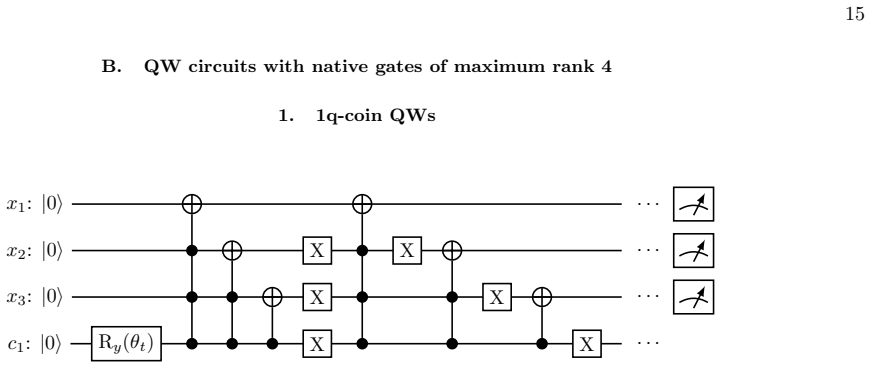
1q-coin QWs x1:|0⟩ · · · x2:|0⟩ X X · · · c1:|0⟩ Ry(θt) X X · · · Figure 11: Gate circuit for quantum walk on a 4-node ring with single qubit coin. x1:|0⟩ · · · x2:|0⟩ X X · · · x3:|0⟩ X X · · · c1:|0⟩ Ry(θt) M M X M M X · · · a1:|0⟩ · · · Figure 12: Max 3-qubit gate decomposition circuit for 1D non-lazy 8-node quantum walk. x1: · · · x2: · · · x3: · · · ...
-
[38]
2q-coin QWs x1:|0⟩ · · · x2:|0⟩ X X · · · c1:|0⟩ Ry(θt) X X · · · c2:|0⟩ Ry(ϕt) M M X M M · · · a1:|0⟩ · · · Figure 14: Max 3-qubit gate decomposition circuit for 1D lazy 4-node quantum walk. x1: · · · x2: · · · x3: · · · c1: · · · c2: M M · · · a1: M M M M · · · a2: · · · Figure 15: Max 3-qubit gate circuit for 1D lazy 8-node quantum walk, INCREMENT ONLY...
-
[39]
1q-coin QWs x1:|0⟩ · · · x2:|0⟩ X X · · · x3:|0⟩ X X · · · c1:|0⟩ Ry(θt) X X · · · Figure 17: Max 4 gate circuit for 1D non-lazy 8-node quantum walk. x1: · · · x2: · · · x3: · · · x4: M M · · · c1: M M · · · a1: · · · Figure 18: Gate circuit for 1D non-lazy 16-node quantum walk, INCREMENT ONLY. 16
-
[40]
2q-coin QWs x1:|0⟩ · · · x2:|0⟩ X X · · · c1:|0⟩ Ry(θt) X X · · · c2:|0⟩ Ry(ϕt) · · · Figure 19: Max 4-qubit gate circuit for 1D lazy 4-node quantum walk. x1: · · · x2: · · · x3: · · · c1: M M · · · c2: M M · · · a1: · · · Figure 20: Max 4-qubit gate circuit for 1D lazy 8-node quantum walk, INCREMENT ONLY. x1: M M · · · x2: · · · x3: · · · x4: · · · c1: M...
discussion (0)
Sign in with ORCID, Apple, or X to comment. Anyone can read and Pith papers without signing in.