Recognition: no theorem link
Toward Data-Driven Surrogates of the Solar Wind with Spherical Fourier Neural Operator
Pith reviewed 2026-05-17 04:24 UTC · model grok-4.3
The pith
A Spherical Fourier Neural Operator delivers a data-driven surrogate for steady-state solar wind modeling that matches or exceeds HUX performance on standard metrics.
A machine-rendered reading of the paper's core claim, the machinery that carries it, and where it could break.
Core claim
The central claim is that a Spherical Fourier Neural Operator, trained on solar wind simulation data, produces steady-state velocity fields whose accuracy on standard metrics is comparable to or better than the HUX numerical surrogate while remaining computationally efficient and improvable with additional training data.
What carries the argument
The Spherical Fourier Neural Operator (SFNO), a neural-network architecture that learns direct mappings from boundary conditions to output velocity fields on the sphere.
If this is right
- SFNO enables rapid evaluation of many boundary-condition scenarios that would be too expensive to run with full MHD codes.
- Trained models support real-time or near-real-time solar wind forecasting once inference speed is achieved.
- Accuracy can continue to rise as larger archives of solar wind observations or simulations become available for training.
- The same architecture can be retrained or fine-tuned for related heliospheric quantities such as magnetic field or density.
Where Pith is reading between the lines
- SFNO-style operators could be extended to transient events such as coronal mass ejections by adding time as an input dimension.
- Ensemble forecasts that combine SFNO speed with occasional full MHD runs become practical for operational space-weather centers.
- Similar spherical neural operators may transfer to other global spherical problems such as atmospheric circulation or ocean modeling.
Load-bearing premise
That the chosen scalar error and correlation metrics are sufficient to judge whether the predicted solar wind fields are physically realistic.
What would settle it
A side-by-side check of velocity-field smoothness, divergence, or conservation properties in SFNO outputs versus HUX and full MHD runs, where large unphysical artifacts appear only in the SFNO fields.
Figures


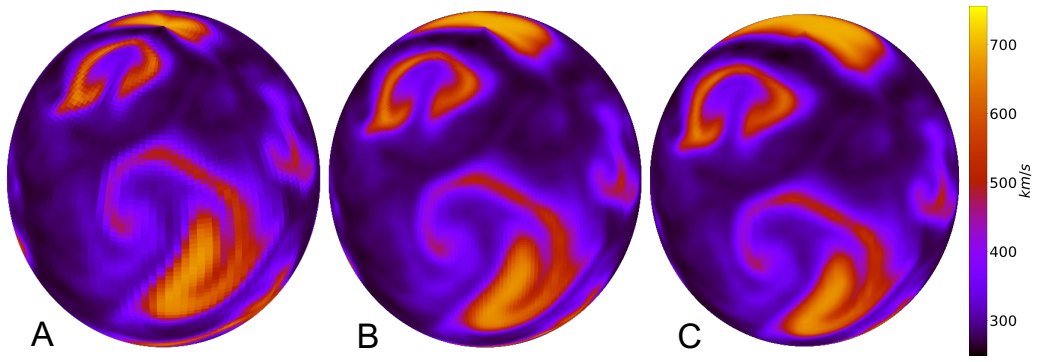

read the original abstract
The solar wind, a continuous stream of charged particles from the Sun's corona, shapes the heliosphere and impacts space systems near Earth. Variations such as high-speed streams and coronal mass ejections can disrupt satellites, power grids, and communications, making accurate modeling essential for space weather forecasting. While 3D magnetohydrodynamic (MHD) models are used to simulate and investigate these variations in the solar wind, they tend to be computationally expensive, limiting their usefulness in investigating the impacts of boundary condition uncertainty. In this work, we develop a surrogate for steady state solar wind modeling, using a Spherical Fourier Neural Operator (SFNO). We compare our model to a previously developed numerical surrogate for this task called HUX, and we show that the SFNO achieves comparable or better performance across several metrics. Though HUX retains advantages in physical smoothness, this underscores the need for improved evaluation criteria rather than a flaw in SFNO. As a flexible and trainable approach, SFNO enables efficient real-time forecasting and can improve with more data. The source code and more visual results are available at https://github.com/rezmansouri/solarwind-sfno-velocity.
Editorial analysis
A structured set of objections, weighed in public.
Referee Report
Summary. The manuscript develops a Spherical Fourier Neural Operator (SFNO) as a data-driven surrogate for steady-state solar wind velocity, trained on external simulation data. It compares SFNO to the HUX numerical baseline and claims that SFNO achieves comparable or better performance across several (scalar) metrics, while noting that HUX retains advantages in physical smoothness and calling for improved evaluation criteria.
Significance. If the evaluation is strengthened with statistical rigor and physical-consistency checks, the work could supply a flexible, trainable surrogate that improves computational efficiency over full MHD models for heliospheric forecasting and uncertainty quantification. The open-source code and emphasis on data-driven improvement are positive features.
major comments (1)
- [Abstract] Abstract: performance numbers are reported without error bars, without any description of training/validation splits or cross-validation procedure, and without held-out tests for physical properties such as smoothness or approximate divergence-free behavior. The abstract itself states that the chosen metrics may not capture physical smoothness; this directly undermines the central claim that SFNO constitutes a valid surrogate for solar-wind modeling.
Simulated Author's Rebuttal
We thank the referee for their detailed review and valuable suggestions. We have addressed the major comment on the abstract and evaluation by revising the manuscript to include more rigorous reporting of results and additional discussion on physical consistency.
read point-by-point responses
-
Referee: [Abstract] Abstract: performance numbers are reported without error bars, without any description of training/validation splits or cross-validation procedure, and without held-out tests for physical properties such as smoothness or approximate divergence-free behavior. The abstract itself states that the chosen metrics may not capture physical smoothness; this directly undermines the central claim that SFNO constitutes a valid surrogate for solar-wind modeling.
Authors: We appreciate the referee pointing out the need for greater statistical rigor in the abstract. The detailed description of the data splits, training procedure, and cross-validation is provided in the Methods section of the manuscript. To address the concern, we have updated the abstract to include error bars on the reported performance metrics and a brief mention of the validation approach. For held-out tests on physical properties: our current evaluation uses standard metrics from the solar wind literature for direct comparison with HUX. We have not conducted explicit tests for approximate divergence-free behavior in this study, as the focus is on velocity field prediction from simulation data. We acknowledge this limitation and have added text in the revised manuscript discussing potential physical consistency checks as future work. The note in the abstract about the metrics not fully capturing physical smoothness is intended to provide balance and does not undermine our claim. The central claim is that the SFNO provides a flexible, data-driven alternative that performs comparably or better on the chosen metrics and can be improved with additional training data. We explicitly recognize HUX's strengths in smoothness to highlight opportunities for better surrogate evaluation criteria. This is consistent with the significance of the work as a trainable surrogate for efficiency in forecasting and uncertainty quantification. revision: yes
Circularity Check
No significant circularity in SFNO solar wind surrogate claims
full rationale
The paper trains a Spherical Fourier Neural Operator on external MHD simulation data to produce steady-state solar wind velocity fields and evaluates it against the independent HUX numerical surrogate using standard scalar metrics. No load-bearing step in the described workflow reduces by construction to a fitted parameter, self-definition, or self-citation chain; the central performance comparison rests on held-out simulation data and an externally developed baseline. The manuscript itself flags HUX's retained advantages in physical smoothness, confirming that evaluation choices are presented as provisional rather than internally forced.
Axiom & Free-Parameter Ledger
free parameters (1)
- SFNO network weights
axioms (1)
- domain assumption Steady-state solar wind can be adequately represented by velocity fields on a spherical grid
Reference graph
Works this paper leans on
-
[1]
NASA, “Space technology 5,” Jan 2025. [Online]. Available: https://www.jpl.nasa.gov/nmp/st5/SCIENCE/solarwind.html
work page 2025
-
[2]
National Academies Press, dec 2008
National Research Council,Severe Space Weather Events– Understanding Societal and Economic Impacts. National Academies Press, dec 2008. [Online]. Available: https://doi.org/10.17226/12507
-
[3]
Description of a singular appearance seen in the sun on September 1, 1859,
R. C. Carrington, “Description of a singular appearance seen in the sun on September 1, 1859,”Mon. Not. R. Astron. Soc., vol. 20, no. 1, pp. 13– 15, nov 1859. [Online]. Available: https://doi.org/10.1093/mnras/20.1.13
-
[4]
Large-scale structure of the interplanetary medium,
J. T. Nolte and E. C. Roelof, “Large-scale structure of the interplanetary medium,”Solar Physics, vol. 33, no. 1, pp. 241–257, Nov 1973. [Online]. Available: https://doi.org/10.1007/BF00152395
-
[5]
Spatial structure of the solar wind and comparisons with solar data and models,
M. Neugebauer, R. J. Forsyth, A. B. Galvin, K. L. Harvey, J. T. Hoeksema, A. J. Lazarus, R. P. Lepping, J. A. Linker, Z. Mikic, J. T. Steinberg, R. von Steiger, Y .-M. Wang, and R. F. Wimmer- Schweingruber, “Spatial structure of the solar wind and comparisons with solar data and models,”Journal of Geophysical Research: Space Physics, vol. 103, no. A7, pp....
-
[6]
Improvement in the prediction of solar wind conditions using real-time solar magnetic field updates,
C. Arge and V . Pizzo, “Improvement in the prediction of solar wind conditions using real-time solar magnetic field updates,”Journal of Geophysical Research, vol. 105, pp. 10 465–10 480, 05 2000
work page 2000
-
[7]
Mapping solar wind streams from the sun to 1 au: A comparison of techniques,
P. Riley and R. Lionello, “Mapping solar wind streams from the sun to 1 au: A comparison of techniques,”Solar Physics, vol. 270, no. 2, pp. 575–592, Jun 2011. [Online]. Available: https://doi.org/10.1007/s11207-011-9766-x
-
[8]
P. Riley and O. Issan, “Using a heliospheric upwinding extrapolation technique to magnetically connect different regions of the heliosphere,” Frontiers in Physics, vol. V olume 9 - 2021, 2021. [Online]. Available: https://www.frontiersin.org/journals/physics/articles/10.3389/ fphy.2021.679497
-
[9]
An empirically-driven global mhd model of the solar corona and inner heliosphere,
P. Riley, J. A. Linker, and Z. Miki ´c, “An empirically-driven global mhd model of the solar corona and inner heliosphere,”Journal of Geophysical Research: Space Physics, vol. 106, no. A8, pp. 15 889–15 901, 2001. [Online]. Available: https://agupubs.onlinelibrary. wiley.com/doi/abs/10.1029/2000JA000121
-
[10]
R. Gramacy,Surrogates: Gaussian Process Modeling, Design, and Optimization for the Applied Sciences, ser. Chapman & Hall/CRC Texts in Statistical Science. CRC Press, 2020. [Online]. Available: https://books.google.com/books?id=1w WDwAAQBAJ
work page 2020
-
[11]
Ensemble Modeling of CMEs Using the WSA–ENLIL+Cone Model,
M. L. Mays, A. Taktakishvili, A. Pulkkinen, P. J. MacNeice, L. Rast ¨atter, D. Odstrcil, L. K. Jian, I. G. Richardson, J. A. LaSota, Y . Zheng, and M. M. Kuznetsova, “Ensemble Modeling of CMEs Using the WSA–ENLIL+Cone Model,”Space Physics, vol. 290, no. 6, pp. 1775–1814, Jun. 2015. [Online]. Available: https://doi.org/10.1007/s11207-015-0692-1
-
[12]
P. Riley, J. A. Linker, R. Lionello, and Z. Mikic, “Corotating interaction regions during the recent solar minimum: The power and limitations of global mhd modeling,”Journal of Atmospheric and Solar-Terrestrial Physics, vol. 83, pp. 1–10, 2012, corotating Interaction Regions from Sun to Earth: Modeling their formation, evolution and geoeffectiveness. [Onl...
-
[13]
Spherical fourier neural operators: Learning stable dynamics on the sphere,
B. Bonev, T. Kurth, C. Hundt, J. Pathak, M. Baust, K. Kashinath, and A. Anandkumar, “Spherical fourier neural operators: Learning stable dynamics on the sphere,” 2023. [Online]. Available: https: //arxiv.org/abs/2306.03838
-
[14]
Solar wind prediction using deep learning,
V . Upendran, M. C. M. Cheung, S. Hanasoge, and G. Krishnamurthi, “Solar wind prediction using deep learning,” Space Weather, vol. 18, no. 9, p. e2020SW002478, 2020, e2020SW002478 10.1029/2020SW002478. [Online]. Available: https: //agupubs.onlinelibrary.wiley.com/doi/abs/10.1029/2020SW002478
-
[15]
Swan: A multihead autoregressive attention model for solar wind speed forecasting,
M. Cobos-Maestre, M. Flores-Soriano, and D. F. Barrero, “Swan: A multihead autoregressive attention model for solar wind speed forecasting,”Expert Systems with Applications, vol. 252, p. 124128, 2024. [Online]. Available: https://www.sciencedirect.com/ science/article/pii/S0957417424009941
work page 2024
-
[16]
Operator learning: Algorithms and analysis,
N. B. Kovachki, S. Lanthaler, and A. M. Stuart, “Operator learning: Algorithms and analysis,” 2024. [Online]. Available: https: //arxiv.org/abs/2402.15715
-
[17]
Fourier Neural Operator for Parametric Partial Differential Equations
Z. Li, N. Kovachki, K. Azizzadenesheli, B. Liu, K. Bhattacharya, A. Stuart, and A. Anandkumar, “Fourier neural operator for parametric partial differential equations,” 2021. [Online]. Available: https://arxiv.org/abs/2010.08895
work page internal anchor Pith review Pith/arXiv arXiv 2021
-
[18]
J. Pathak, S. Subramanian, P. Harrington, S. Raja, A. Chattopadhyay, M. Mardani, T. Kurth, D. Hall, Z. Li, K. Azizzadenesheli, P. Hassanzadeh, K. Kashinath, and A. Anandkumar, “Fourcastnet: A global data-driven high-resolution weather model using adaptive fourier neural operators,” 2022. [Online]. Available: https://arxiv.org/abs/2202. 11214
work page 2022
-
[19]
The tilts of corotating interaction regions at midheliographic latitudes,
P. Riley, J. T. Gosling, L. A. Weiss, and V . J. Pizzo, “The tilts of corotating interaction regions at midheliographic latitudes,”Journal of Geophysical Research: Space Physics, vol. 101, no. A11, pp. 24 349–24 357, 1996. [Online]. Available: https://agupubs.onlinelibrary. wiley.com/doi/abs/10.1029/96JA02447
-
[20]
Multiscale structural similarity for image quality assessment,
Z. Wang, E. Simoncelli, and A. Bovik, “Multiscale structural similarity for image quality assessment,” inThe Thrity-Seventh Asilomar Confer- ence on Signals, Systems & Computers, 2003, vol. 2, 2003, pp. 1398– 1402 V ol.2
work page 2003
-
[21]
A library for learning neural operators,
J. Kossaifi, N. Kovachki, Z. Li, D. Pitt, M. Liu-Schiaffini, R. J. George, B. Bonev, K. Azizzadenesheli, J. Berner, and A. Anandkumar, “A library for learning neural operators,” 2024
work page 2024
-
[22]
Neural operator: Learning maps between function spaces,
N. B. Kovachki, Z. Li, B. Liu, K. Azizzadenesheli, K. Bhattacharya, A. M. Stuart, and A. Anandkumar, “Neural operator: Learning maps between function spaces,”CoRR, vol. abs/2108.08481, 2021
discussion (0)
Sign in with ORCID, Apple, or X to comment. Anyone can read and Pith papers without signing in.