REVIEW 3 major objections 5 minor 198 references
Exchange-Correlation Functionals in 2D Materials: Applications, Challenges, and Limitations
T0 review · 3 major / 5 minor · reviewed 2026-08-03 · deepseek-v4-flash
Pith's one-line read This review establishes that no single exchange-correlation functional predicts all properties of 2D materials, and gives a property-by-property recommendation map.
desk verdict A useful field-guide review whose central band-gap ranking is undermined by comparing Kohn–Sham gaps with optical gaps; fixable, but the numbers should not be quoted as is. read the letter →
The pith
A machine-rendered reading of the paper's core claim, the machinery that carries it, and where it could break.
The reading
What carries the argument
Kohn–Sham DFT's exchange-correlation functional — the approximation that replaces all electron-electron interactions beyond the classical Hartree term. The review organizes functionals by Jacob's ladder (LDA, GGA, meta-GGA such as SCAN/r2SCAN, hybrids such as HSE06, and many-body methods such as GW+BSE) and uses the ladder to explain why each level fails or succeeds for specific 2D properties.
What would settle it
Compute SCAN and G0W0 band gaps and BSE exciton binding energies for a set of 2D semiconductors such as MoS2, WS2, and hBN. If SCAN gap plus BSE binding energy is systematically larger than the experimental optical gap by more than the claimed ~5%, the paper's performance ranking against experiment is an artifact of comparing different physical quantities.
Extended reading notes
Core claim
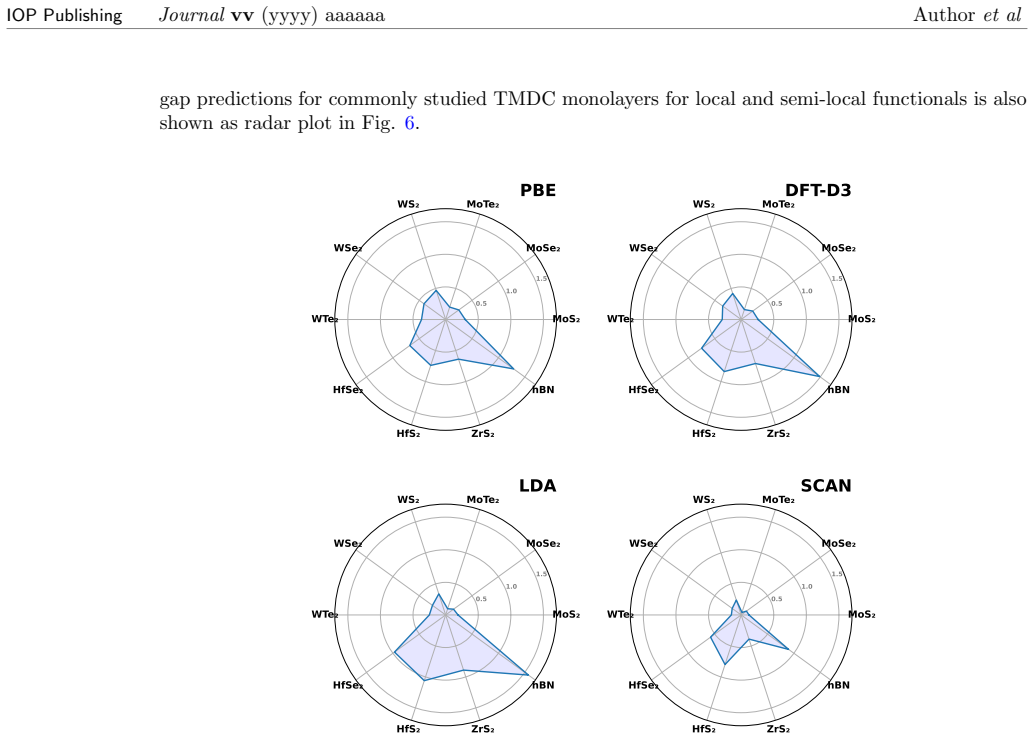
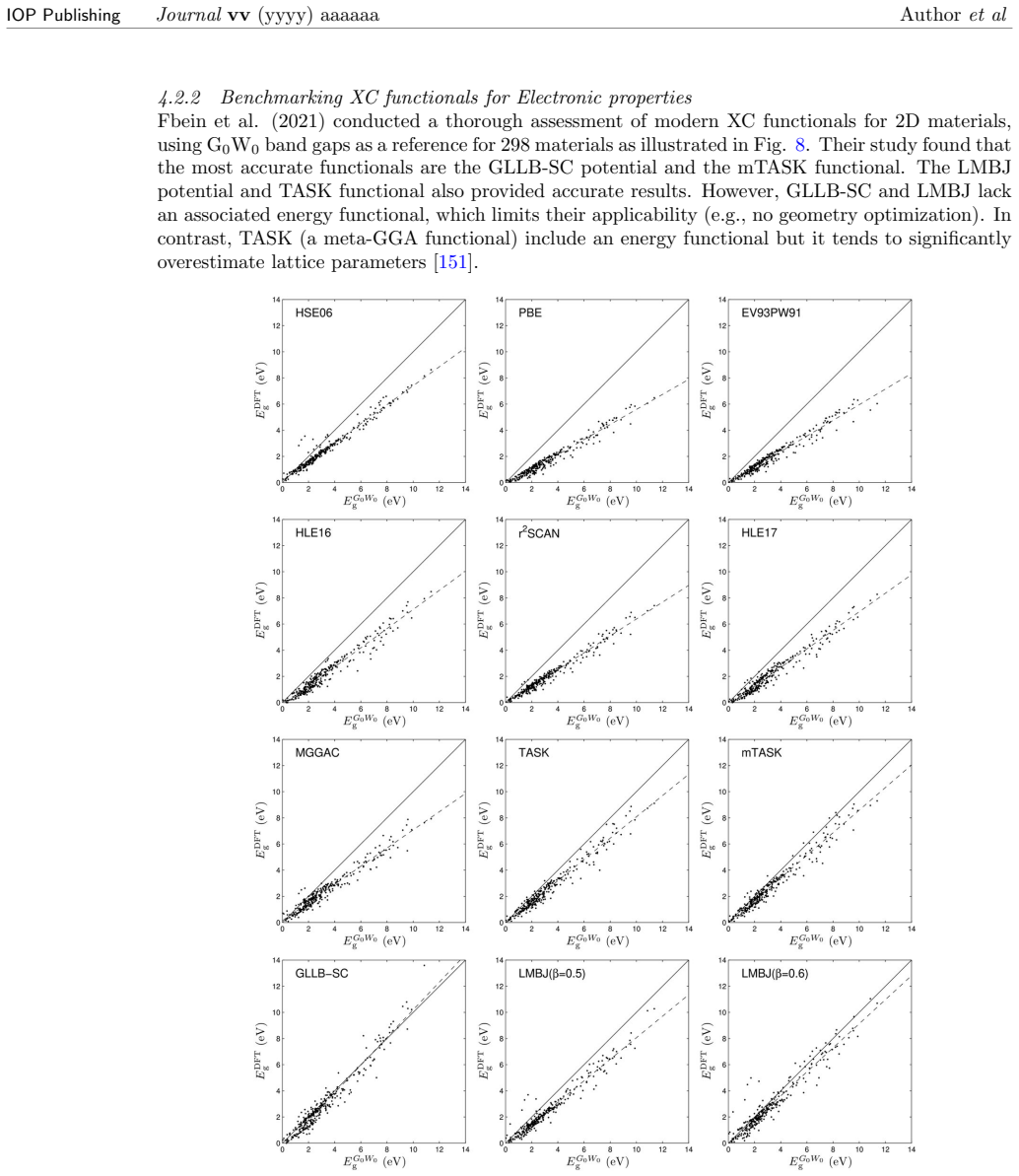
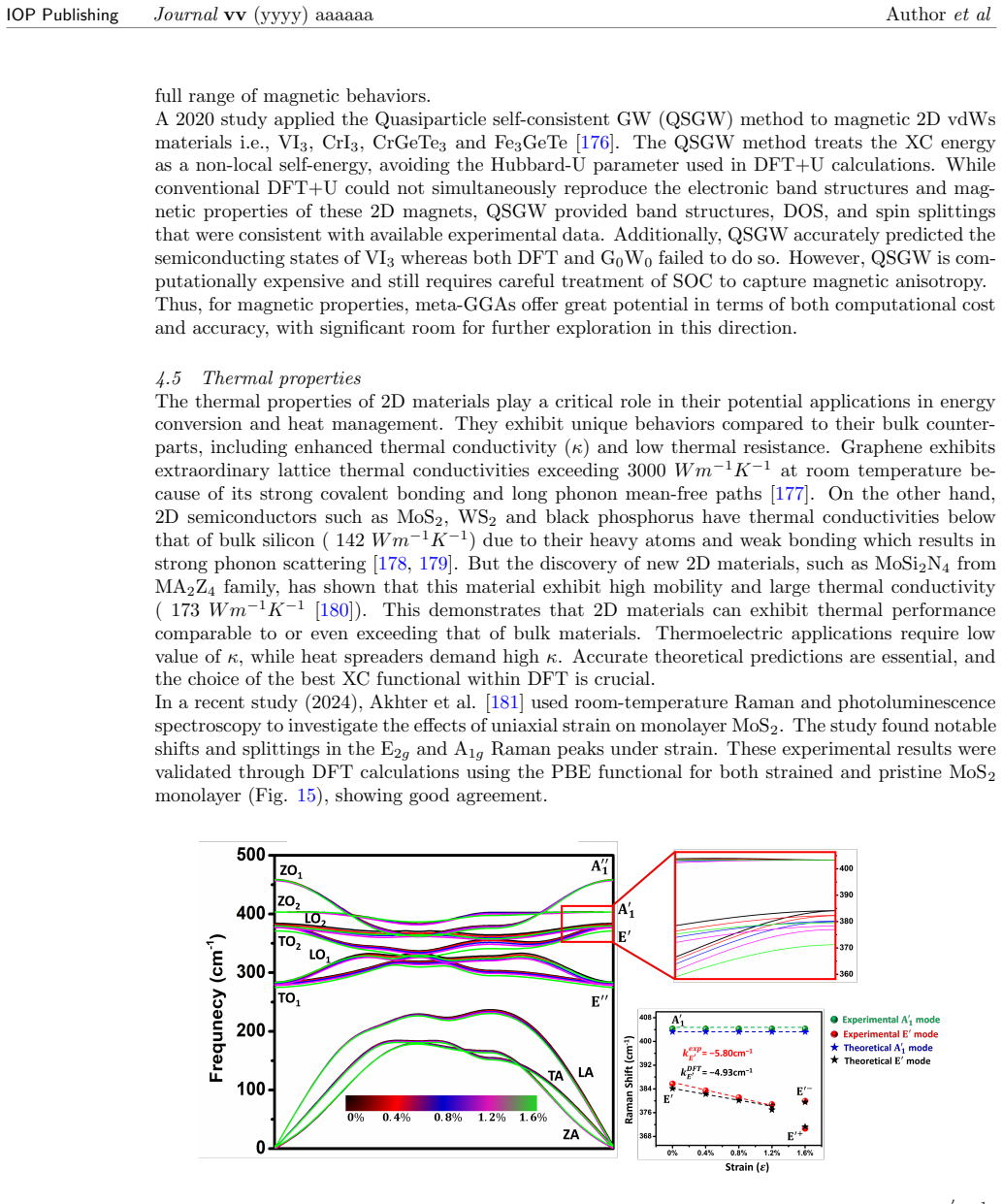
The paper's central claim is that exchange-correlation functional accuracy is property-specific in 2D materials: SCAN and r2SCAN provide the most reliable lattice constants, bond lengths, and magnetic exchange parameters; HSE06 gives the best band gaps and direct-to-indirect crossover strains but artificially opens gaps in graphene and silicene and overestimates gaps in strongly correlated systems; PBE and PBEsol yield the most realistic thermal conductivity predictions; and only GW+BSE captures the large exciton binding energies that dominate optical spectra. The paper also documents non-universality across material families, showing that no functional works for all cases, and identifies ma
Load-bearing premise
The load-bearing premise is that experimental optical gaps can be used as reference values for Kohn–Sham single-particle gaps, on the assumption that excitonic contributions are generally smaller than the typical errors introduced by DFT functionals — an assumption that is questionable for 2D materials where exciton binding energies reach 1–2 eV.
Editorial extensions
If this is right
- For structural predictions in 2D material databases, using SCAN or r2SCAN instead of PBE reduces lattice-constant errors substantially for common transition metal dichalcogenides.
- For electronic band gaps, HSE06 is the preferred variational functional, but its artificial gap opening in gapless Dirac materials means PBE or LDA remains safer for graphene and silicene.
- Accurate magnetic transition temperatures in antiferromagnetic 2D materials can be obtained from SCAN/r2SCAN exchange parameters, rivaling hybrid functionals at much lower computational cost.
- Thermal conductivity estimates should default to PBE or PBEsol; the review notes that no comprehensive meta-GGA benchmarks for thermal properties have been reported yet.
- Optical properties, including exciton binding energies of 1–2 eV, require GW+BSE; no semilocal or hybrid functional captures them.
Reading between the lines
- The paper's Table 3 compares Kohn–Sham single-particle gaps directly with experimental optical gaps, and its justification rests on the claim that excitonic corrections are smaller than functional errors. In 2D materials exciton binding energies are often 0.5–2 eV, so the apparent ~5% SCAN accuracy may shift if quasiparticle and excitonic corrections are included; a fairer benchmark would compare
- The recommendation map is based on a limited set of material families; extending the same benchmarks to MXenes, metal-organic frameworks, and Janus TMDCs could reveal additional functional-specific failures not covered in this review.
- Machine-learning surrogates trained on G0W0/BSE data could sidestep functional choice entirely, but their transferability depends on structurally diverse training sets; the material-family examples in this review suggest such models need careful out-of-sample testing.
- If the SCAN/r2SCAN advantage for magnetic transition temperatures holds beyond the antiferromagnets benchmarked, it would provide a low-cost route to screening 2D magnets for spintronic applications.
Editorial analysis
A structured set of objections, weighed in public.
Referee Report
Summary. The manuscript is a topical review of exchange-correlation (XC) functionals for 2D materials. It provides a theoretical overview of DFT, Jacob's ladder, and the GW+BSE framework, then surveys functional performance for structural, electronic, optical, magnetic, and thermal properties, and discusses machine-learning approaches. The central deliverable is a practical mapping: SCAN/r2SCAN for structures and magnetism, HSE06 for electronic properties, PBE/PBEsol for thermal properties, and GW+BSE for excitonic/optical properties. The review is organized by target property with summary tables (Tables 2, 5, 6, 7) and explicit recommendations in §6.
Significance. The review addresses a timely and important need: a practical guide to choosing XC functionals for 2D materials. Its organization by target property, inclusion of ML/AI methods, and concrete, falsifiable recommendations are useful strengths. The paper would be a valuable reference if the quantitative electronic-property ranking were built on consistent physical references. As presented, however, the central electronic-property recommendation is weakened by (i) mixing Kohn–Sham gaps with optical experimental gaps in Table 3, (ii) an incorrect Dyson equation in §2.2, and (iii) unreferenced 'self-calculated' G0W0 values without computational details. These issues are fixable but require re-analysis of the main comparative tables and a correction of the theory section.
major comments (3)
- [§4.2.1, Eq. (14), Table 3] The band-gap validation compares Kohn–Sham single-particle gaps (LDA/PBE/SCAN/HSE06) and G0W0 quasiparticle gaps directly against experimental optical gaps. The paper itself states that experimental gaps are optical and differ from photoemission gaps by the exciton binding energy, and that G0W0 overestimates the optical gap because it neglects excitonic effects. For 2D materials, exciton binding energies are often 0.5–2 eV (e.g., ~2 eV for hBN, ~0.5–1 eV for TMDCs), comparable to or larger than the functional errors being ranked. The G0W0 column in Table 3 illustrates the magnitude: values are 0.5–1.2 eV above the listed optical gaps. Consequently, Table 3 and the claim that SCAN 'underestimates the experimental values (around 5%)' conflate different physical quantities. Moreover, even on its own terms, the 5% figure is inconsistent with Table 3 (e.g., hBN: 5.05 vs 5.95, ~15% under; HfS2
- [§2.2, Eqs. (12)–(13)] The many-body theory section contains incorrect equations. The Dyson equation is miswritten: Eq. (12) is not the Dyson equation. The correct relation is G^{-1} = G_0^{-1} − Σ (or G = G_0 + G_0 Σ G). Similarly, Eq. (13) writes W = v + v·ε·W, but the standard form is W = v + v χ_0 W (with ε = 1 − v χ_0) or W = ε^{-1} v. As printed, these equations are dimensionally/formally inconsistent and undermine the tutorial value of the review. Please correct both equations and the surrounding text.
- [Table 3 caption and §4.2.1] The caption states that band-gap values without references are 'self calculated results and are in accordance with literature,' but no computational parameters are provided: no code, pseudopotential, plane-wave cutoff, k-mesh, GW scheme (one-shot vs self-consistent), or treatment of the vacuum/slab geometry. These unreferenced G0W0 values are used to draw conclusions about functional rankings and about the gap between G0W0 and experiment. For a review making quantitative claims, all self-calculated data should be either fully documented or replaced by published, citable values.
minor comments (5)
- [Throughout] The notation 'GoWo' appears repeatedly (e.g., Table 3, §4.2.3); it should be 'G0W0' for consistency with standard usage.
- [§4.2.3] The notation 'ΔHSEso > ΔGoWoso > ΔDFTso' is difficult to read; please typeset the subscripts clearly (e.g., Δ_HSE^so, Δ_G0W0^so, Δ_DFT^so).
- [§4.2.5] The FeCl2 example would benefit from specifying whether the experimental gap and the calculated gaps refer to the monolayer or bulk, and from clarifying the measurement type (optical or transport gap).
- [§6.1] Typographical errors: 'materails' should be 'materials'; 'hetero structures' should be 'heterostructures'. In §6.3, 'V ASP' should read 'VASP'.
- [§2.1, Eq. (5)–(7)] The notation 'ϵXxc (X=LDA.GGA,meta-GGA)' contains a period instead of a comma; this is a minor presentation issue.
Circularity Check
No significant circularity: the review synthesizes independent benchmarks; the optical-gap reference concern is a correctness issue, not a circular derivation.
full rationale
This is a topical review rather than a derivation chain. Its central recommendations (SCAN/r2SCAN for structures, HSE06 for electronic properties, PBE/PBEsol for thermal properties, SCAN/r2SCAN for magnetism) are presented as qualitative syntheses of literature benchmarks, not as results deduced from first principles. The paper explicitly uses external databases and prior studies (e.g., C2DB, Tran et al., Edzards et al., Rezaei/Alaei/Oganov, Zhang et al.) alongside the authors' own published benchmarks. The authors' self-citations, such as [58] for lattice constants and band-gap radar plots and [154] for spin-orbit splitting, are parameter-free published calculations that are compared against experimental references, so they function as independent empirical evidence rather than as a self-referential derivation. The one substantive concern—using experimental optical gaps as a proxy for electronic gaps in Table 3 and the stated ~5% SCAN underprediction—is a validity issue: the text itself acknowledges that experimental gaps are optical and differ from fundamental gaps by the exciton binding energy, and the paper's own G0W0 column shows large excitonic corrections in 2D materials. But this is a mistaken comparison or an over-strong assumption about small exciton binding energies, not a case where the claimed prediction is identical to its input by construction. No fitted parameter is renamed as a prediction, no equation reduces to another by definition, and no uniqueness claim is imported from the authors' prior work. Therefore the circularity score is 0.
Assumptions & free parameters
assumptions (3)
- domain assumption Experimental optical band gaps are a valid reference for judging DFT Kohn–Sham gap errors.
- domain assumption The values compiled from cited literature (C2DB, experiments) are accurate and consistently computed.
- ad hoc to paper Self-calculated GoWo band gaps in Table 3 are computed with unknown but adequate parameters.
Cite this review
Pith. "Pith review of Exchange-Correlation Functionals in 2D Materials: Applications, Challenges, and Limitations." pith.science (2026). https://pith.science/paper/O75JZEWD
@misc{pith2026251200921,
  author       = {Pith},
  title        = {Pith review of: Exchange-Correlation Functionals in 2D Materials: Applications, Challenges, and Limitations},
  year         = {2026},
  howpublished = {\url{https://pith.science/paper/O75JZEWD}},
  note         = {Machine review of arXiv:2512.00921}
}
read the original abstract
The rapid development of two-dimensional (2D) materials has reshaped modern nanoscience, offering properties that differ fundamentally from their bulk counterparts. As experimental discovery accelerates, the need for reliable computational techniques has become increasingly important. Within the framework of density functional theory, this review explores the critical role of exchange-correlation functionals in predicting key material properties such as structural, optoelectronic, magnetic, and thermal. We examine the challenges posed by quantum confinement, anisotropic screening, and van der Waals interactions, which conventional functionals often fail to describe. Advanced approaches, including meta-GGA, hybrid functionals, and many-body perturbation theory (e.g., GW and Bethe-Salpeter equation), are assessed for their improved accuracy in capturing electronic structure and excitonic effects. We further discuss the non-universality of functionals across different 2D material families and the emerging role of machine learning to enhance computational efficiency. Finally, the review outlines current limitations and emerging strategies, providing a roadmap for advancing exchange-correlation functionals and beyond, to enable the practical design and application of 2D materials.
Figures


Figures from the paper (14 more)







Reference graph
Works this paper leans on
-
[1]
Singh V, Ranjan V, Kumar V and Aggarwal S 1998Physics of Semiconductor Devices (Springer)
-
[2]
Geim A K and Novoselov K S 2007Nature Materials6183–191
-
[3]
Ares P and Novoselov K S 2022Nano Materials Science43–9
-
[4]
Morozov S, Novoselov K, Katsnelson M, Schedin F, Elias D C, Jaszczak J A and Geim A 2008 Physical Review Letters100016602
2008
-
[5]
Xu X, Liu C, Sun Z, Cao T, Zhang Z, Wang E, Liu Z and Liu K 2018Chemical Society Reviews 473059–3099
-
[6]
Ramzan M S, Wo´ zniak T, Kuc A and Cocchi C 2024physica status solidi (b)261ISSN 1521- 3951
-
[7]
Khan I, Bezzerga D, Marfoua B and Hong J 2025npj 2D Materials and Applications918
-
[8]
Maroof S, Sattar A, Bashir A I, Irfan M, Latif H, Mustafa H, Saeed A, Amjad R J and Alvi F 2025arXiv preprint arXiv:2506.07745
Show all 198 references
-
[9]
Stehle Y, Meyer III H M, Unocic R R, Kidder M, Polizos G, Datskos P G, Jackson R, Smirnov S N and Vlassiouk I V 2015Chemistry of materials278041–8047
-
[10]
Ali S A, Irfan A, Mazumder A, Balendhran S, Ahmed T, Walia S and Ulhaq A 2021Applied Physics Letters119
-
[11]
Ramzan M S, Bacic V, Jing Y and Kuc A 2019The Journal of Physical Chemistry C123 25470–25476
-
[12]
Wo´ zniak T, Faria Junior P E, Ramzan M S and Kuc A B 2023Small192206444
-
[13]
Sajid A, Reimers J R and Ford M J 2018Physical Review B97064101
-
[14]
L¨ upke F, Waters D, de la Barrera S C, Widom M, Mandrus D G, Yan J, Feenstra R M and Hunt B M 2020Nature Physics16526–530
-
[15]
Zhang H, Yu J, Piti´ e S, Gu´ egan F, Wang J and Frapper G 2025Nanoscale176874–6883
-
[16]
Zhu Z, Dong B, Guo H, Yang T and Zhang Z 2020Chinese Physics B29046101
-
[18]
Mustafa H, Irfan M, Sattar A, Amjad R J, Latif H, Usman A, Ahmad M A and Qin S 2023 Materials Science and Engineering: B289116205
2023
-
[19]
Wang Y, Mei L, Li Y, Xia X, Cui N, Long G, Yu W, Chen W, Mu H and Lin S 2024Physics Reports10811–46
-
[20]
thesis Tulane University
Ismael T 2024Two-Dimensional Materials-Based Photovoltaics for High Specific Power Ap- plicationsPh.D. thesis Tulane University
-
[21]
Sohail M T, Yin J, Abdullah M, Younis M, Anjum M N, Sohail M T, Alroobaea R, Ahmad I and Peiguang Y 2024Materials Today Physics49101600
-
[22]
Downes M, Shuck C E, McBride B, Busa J and Gogotsi Y 2024Nature protocols191807–1834
-
[23]
Mustafa H, Rasheed A, Ajmal S, Sarwar N, Falak U, Lee S G and Sattar A 2023Energy & Fuels372410–2419
-
[24]
Liu H, Neal A T, Zhu Z, Luo Z, Xu X, Tom´ anek D and Ye P D 2014ACS nano84033–4041
-
[25]
Li J, Li Y, Du S, Wang Z, Gu B L, Zhang S C, He K, Duan W and Xu Y 2019Science advances 5eaaw5685
-
[26]
Vyazovskaya A Y, Bosnar M, Chulkov E V and Otrokov M M 2025Communications Materials 688
-
[27]
Saito Y, Nojima T and Iwasa Y 2016Nature Reviews Materials21–18 25 IOP PublishingJournalvv(yyyy) aaaaaa Authoret al
-
[28]
Qiu D, Gong C, Wang S, Zhang M, Yang C, Wang X and Xiong J 2021Advanced Materials 332006124
-
[29]
Hashmi A, Nakanishi K, Farooq M U and Ono T 2020npj 2D Materials and Applications4 39
-
[30]
Wei S, Liao X, Wang C, Li J, Zhang H, Zeng Y J, Linghu J, Jin H and Wei Y 20202D Materials 8012005
-
[31]
Dhakshinamoorthy A, Asiri A M and Garcia H 2019Advanced Materials311900617
-
[32]
Yuan H, Li N, Fan W, Cai H and Zhao D 2022Advanced science92104374
-
[33]
Khan U, Nairan A, Gao J and Zhang Q 2023Small Structures42200109
-
[34]
Wang Z F, Su N and Liu F 2013Nano Letters132842–2845 ISSN 1530-6984
-
[35]
Wang Z F, Liu Z and Liu F 2013Phys. Rev. Lett.110(19) 196801
-
[36]
Jiang W, Huang H and Liu F 2019Nature Communications102207 ISSN 2041-1723
-
[37]
Jiang W, Zhang S, Wang Z, Liu F and Low T 2020Nano Letters201959–1966 ISSN 1530-6984
1966
-
[38]
Jiang W, Ni X and Liu F 2021Accounts of Chemical Research54416–426 ISSN 0001-4842
-
[39]
Chaves A, Azadani J G, Alsalman H, Da Costa D, Frisenda R, Chaves A, Song S H, Kim Y D, He D, Zhou Jet al.2020npj 2D Materials and Applications429
-
[40]
Duan X, Wang C, Pan A and Yu R 2015Chemical Society Reviews248859–8876
-
[41]
Bansal S, Chaudhary P, Sharma B B, Saini S and Joshi A 2024Journal of Energy Storage87 111420
-
[42]
Ratcliff L E, Mohr S, Huhs G, Deutsch T, Masella M and Genovese L 2017Wiley Interdisci- plinary Reviews: Computational Molecular Science7e1290
-
[43]
Ziesche P, Kurth S and Perdew J P 1998Computational materials science11122–127
-
[44]
Koch W and Holthausen M C 2015A chemist’s guide to density functional theory(John Wiley & Sons)
-
[45]
Snyder J C, Rupp M, Hansen K, M¨ uller K R and Burke K 2012Physical review letters108 253002
-
[46]
Schleder G R, Padilha A C, Acosta C M, Costa M and Fazzio A 2019Journal of Physics: Materials2032001
-
[47]
Bystrom K, Falletta S and Kozinsky B 2024Journal of Chemical Theory and Computation20 7516–7532
-
[48]
Carvalho A, Trevisanutto P E, Taioli S and Neto A C 2021Reports on Progress in Physics84 106501
-
[49]
Penev E S, Marzari N and Yakobson B I 2021ACS nano155959–5976
-
[50]
Gupta S, Zhang J J, Lei J, Yu H, Liu M, Zou X and Yakobson B I 2025Chemical Reviews 125786–834
-
[51]
Giustino F 2014Materials modelling using density functional theory: properties and predictions (Oxford University Press)
-
[52]
Hohenberg P and Kohn W 1964Physical review136B864
-
[53]
Kohn W and Sham L J 1965Physical review140A1133
-
[54]
Kohn W 1999Reviews of Modern Physics711253
-
[55]
Javed A, Asif M and Ullah R 2024Materials Letters372137066
-
[56]
Perdew J P and Wang Y 1992Physical Review B4513244 26 IOP PublishingJournalvv(yyyy) aaaaaa Authoret al
-
[57]
Shahbaz M and Szalewicz K 2018Phys. Rev. Lett.121113402
-
[58]
Javed A, Ali S A, Asif M and Ullah R 2025Materials Letters380137661
-
[59]
Sun J, Remsing R C, Zhang Y, Sun Z, Ruzsinszky A, Peng H, Yang Z, Paul A, Waghmare U, Wu Xet al.2015arXiv preprint arXiv:1511.01089
-
[60]
Perdew J P 2025APL Computational Physics1
-
[61]
Lee K, Murray ´E D, Kong L, Lundqvist B I and Langreth D C 2010Phys. Rev. B82081101
-
[62]
Chakraborty D, Berland K and Thonhauser T 2020J. Chem. Theory Comput.165893–5911
-
[63]
Vydrov O A and Van Voorhis T 2010J. Chem. Phys.133244103
-
[64]
Peng H, Yang Z H, Sun J and Perdew J P 2015arXiv:1510.05712
-
[65]
Shahbaz M and Szalewicz K 2019Theor. Chem. Acc.1381–17
-
[66]
Bakar A, Shahbaz M and Afaq A 2023Phys. Scr
-
[67]
Today Commun.39108546 ISSN 2352-4928
Azam M, Shahbaz M, ur Rehman H and Khan N 2024Mater. Today Commun.39108546 ISSN 2352-4928
-
[68]
Scr.99115953
Rehman H u, Shahbaz M and Afaq A 2024Phys. Scr.99115953
-
[69]
Bakar A, Shahbaz M and Afaq A 2025Materialia39102329 ISSN 2589-1529
-
[70]
Peng H, Yang Z H, Sun J and Perdew J P 2015arXiv
-
[71]
Modeling and Simulation
Franchini C 2015Many-Body Physics: From Kondo to Hubbard. Modeling and Simulation. Verlag des Forschungszentrum J¨ ulich
-
[72]
Becke A D 1993J. Chem. Phys.985648–5652
-
[73]
Perdew J P, Ernzerhof M and Burke K 1996The Journal of Chemical Physics1059982–9985
-
[74]
Jain M, Chelikowsky J R and Louie S G 2011Physical Review Letters107216806
-
[75]
Shishkin M, Marsman M and Kresse G 2007Physical review letters99246403
-
[76]
Hybertsen M S and Louie S G 1986Physical Review B345390
-
[77]
Shishkin M and Kresse G 2006Phys. Rev. B74(3) 035101
-
[78]
Shishkin M and Kresse G 2007Phys. Rev. B75(23) 235102
-
[79]
Golze D, Dvorak M and Rinke P 2019Frontiers in Chemistry7377
-
[80]
Albrecht S, Reining L, Del Sole R and Onida G 1998Phys. Rev. Lett.80(20) 4510–4513
-
[81]
Rohlfing M and Louie S G 1998Phys. Rev. Lett.81(11) 2312–2315
-
[82]
Louie S G and Rubio A 2005 Quasiparticle and optical properties of solids and nanostructures: The gw-bse approachHandbook of Materials Modeling: Methods(Springer) pp 215–240
2005
-
[83]
Tal A, Liu P, Kresse G and Pasquarello A 2020Phys. Rev. Res.2(3) 032019
-
[84]
Sander T, Maggio E and Kresse G 2015Phys. Rev. B92(4) 045209
-
[85]
Car R 2016Nature chemistry8820–821
-
[86]
Li Q, Wu K, Zhu H, Yang Y, He S and Lian T 2024Chemical reviews1245695–5763
-
[87]
Cipriano L A, Di Liberto G, Tosoni S and Pacchioni G 2020Nanoscale1217494–17501
-
[88]
Lorke M 2025arXiv preprint arXiv:2504.01684
-
[89]
Rudenko A N and Katsnelson M I 20242D Materials11042002
-
[90]
Latini S, Olsen T and Thygesen K S 2015Physical Review B92245123 27 IOP PublishingJournalvv(yyyy) aaaaaa Authoret al
-
[91]
St¨ ohr M, Van Voorhis T and Tkatchenko A 2019Chemical Society Reviews484118–4154
-
[92]
Momeni K, Ji Y, Wang Y, Paul S, Neshani S, Yilmaz D E, Shin Y K, Zhang D, Jiang J W, Park H Set al.2020npj Computational Materials622
-
[93]
Banszerus L, M¨ oller S, Steiner C, Icking E, Trellenkamp S, Lentz F, Watanabe K, Taniguchi T, Volk C and Stampfer C 2021Nature communications125250
-
[94]
Patra A, Jana S, Samal P, Tran F, Kalantari L, Doumont J and Blaha P 2021The Journal of Physical Chemistry C12511206–11215
-
[95]
Borlido P, Schmidt J, Huran A W, Tran F, Marques M A and Botti S 2020npj Computational Materials61–17
-
[96]
Rasmussen F A and Thygesen K S 2015The Journal of Physical Chemistry C11913169– 13183
-
[97]
Ding Y, Wang Y, Ni J, Shi L, Shi S and Tang W 2011Physica B: Condensed Matter406 2254–2260
-
[98]
Ataca C, Sahin H and Ciraci S 2012The Journal of Physical Chemistry C1168983–8999
-
[99]
Yamusa S A, Shaari A, Alsaif N A, Alsalamah I M, Isah I and Rekik N 2022ACS omega7 45719–45731
-
[100]
Buda I G, Lane C, Barbiellini B, Ruzsinszky A, Sun J and Bansil A 2017Scientific reports7 44766
-
[101]
Gjerding M N, Taghizadeh Aet al.20212D Materials8044002
-
[103]
Prasad M K, Taverne M P, Huang C C, Mar J D and Ho Y L D 2024Materials174122
-
[104]
Korsaks V 2015Materials Research Bulletin70976–979
-
[105]
Guti´ errez H R, Perea-L´ opez N, El ´ ıas A L, Berkdemir A, Wang B, Lv R, L´ opez-Ur ´ ıas F, Crespi V H, Terrones H and Terrones MNano Letters133447–3454
-
[106]
Zhao W, Ghorannevis Z, Chu L, Toh M, Kloc C, Tan P H and Eda G 2013ACS Nano7 791–797
-
[107]
Zhong H, Quhe R, Wang Y, Ni Z, Ye M, Song Z, Pan Y, Yang J, Yang L, Lei Met al.2016 Scientific reports621786
2016
-
[108]
Hu X, Zhang Q and Yu S 2019Applied Surface Science478857–865
-
[109]
Miller B, Steinhoff A, Pano B, Klein J, Jahnke F, Holleitner A and Wurstbauer U 2017Nano Letters175229–5237
-
[110]
Yan-Bin Q, Yan-Ling L, Guo-Hua Z, Zhi Z and Xiao-Ying Q 2007Chinese Physics163809
-
[111]
Zhou Y, Wang Z, Yang P, Zu X, Yang L, Sun X and Gao F 2012Acs Nano69727–9736
-
[112]
Xiang H, Xu B, Liu J, Xia Y, Lu H, Yin J and Liu Z 2016AIP Advances6
-
[113]
Manjula M M and Ramesh R 2023Journal of Computational Electronics221433–1442
-
[114]
Huynh T M D, Nguyen D K, Nguyen T D H, Dien V K, Pham H D and Lin M F 2021Frontiers in Materials7569756
-
[115]
Li Y 2024Results in Physics56107156
-
[116]
Edzards J, Santana-Andreo J, Saßnick H D and Cocchi C 2025Journal of Chemical Theory and Computation217062–7074
-
[117]
Li H, Eddaoudi M, O’Keeffe M and Yaghi O M 1999nature402276–279
-
[118]
Carpinelli J M, Weitering H H, Plummer E W and Stumpf R 1996Nature381398–400 28 IOP PublishingJournalvv(yyyy) aaaaaa Authoret al
-
[119]
Xi X, Zhao L, Wang Z, Berger H, Forr´ o L, Shan J and Mak K F 2015Nature nanotechnology 10765–769
-
[120]
Chowdhury S, Rigosi A F, Hill H M, Vora P, Hight Walker A R and Tavazza F 2022Nanoma- terials12504
-
[121]
Wines D, Ibrahim A, Gudibandla N, Adel T, Abel F M, Jois S, Saritas K, Krogel J T, Yin L, Berlijn Tet al.2025ACS nano199925–9935
-
[122]
Yin L, Tang H, Berlijn T and Ruzsinszky A 2024npj Computational Materials10207
-
[123]
Chiu W C, Mardanya S, Markiewicz R, Nieminen J, Singh B, Hakioglu T, Agarwal A, Chang T R, Lin H and Bansil A 2025ACS nano1918108–18116
-
[124]
Zhang D, Schoenherr P, Sharma P and Seidel J 2023Nature Reviews Materials825–40
-
[125]
Poudel S P, Villanova J W and Barraza-Lopez S 2019Physical Review Materials3124004
-
[126]
Bilc D, Orlando R, Shaltaf R, Rignanese G M, ´I˜ niguez J and Ghosez P 2008Physical Review B—Condensed Matter and Materials Physics77165107
-
[127]
Zhang Y, Sun J, Perdew J P and Wu X 2017Physical Review B96035143
-
[128]
Fu L, Hu Y, Tang N, Duan J, Jia X, Yang H, Li Z, Han X, Li G, Lu Jet al.2025Physical Review Letters135046903
-
[129]
Cassabois G, Valvin P and Gil B 2016Nature Photonics10262–266
-
[130]
Jung C S, Shojaei F, Park K, Oh J Y, Im H S, Jang D M, Park J and Kang H S 2015ACS nano99585–9593
-
[131]
Yagmurcukardes M, Senger R T, Peeters F M and Sahin H 2016Physical Review B94245407
-
[132]
Guti´ errez Y, Giangregorio M M, Dicorato S, Palumbo F and Losurdo M 2021Frontiers in Chemistry9781467
-
[133]
Yue C, Huang Z, Wang W L, Gao Z, Lin H, Liu J and Chang K 2024ACS nano1825478– 25488
-
[134]
Liu H, Antwi K A, Chua S and Chi D 2014Nanoscale6624–629
-
[135]
Gaiser C, Zandt T, Krapf A, Serverin R, Janowitz C and Manzke R 2004Physical Review B 69075205
-
[136]
Bafekry A, Faraji M, Hoat D M, Shahrokhi M, Fadlallah M, Shojaei F, Feghhi S, Ghergherehchi M and Gogova D 2021Journal of Physics D: Applied Physics54155303
-
[137]
Liang D, Xu S, Lu P and Cai Y 2022Physical Review B105195302
-
[138]
2020Science369670–674
Hong Y L, Liu Z, Wang L, Zhou T, Ma W, Xu C, Feng S, Chen L, Chen M L, Sun D Met al. 2020Science369670–674
-
[139]
Mak K F, Lee C, Hone Jet al.2010Physical Review Letters105(13) 136805
-
[140]
Vu T V, Lavrentyev A, Thuan D V, Nguyen C V, Khyzhun O, Gabrelian B, Tran K C, Luong H L, Tung P D, Pham K Det al.2019Superlattices and Microstructures125205–213
-
[141]
Coehoorn R, Haas C, Dijkstra J, Flipse C d, De Groot R and Wold A 1987Physical Review B 356195
-
[142]
Sahin H, Tongay S, Horzum S, Fan W, Zhou J, Li J, Wu J and Peeters F 2013Physical Review B—Condensed Matter and Materials Physics87165409
-
[143]
Zhang Y, Chang T R, Zhou B, Cui Y T, Yan H, Liu Z, Schmitt F, Lee J, Moore R, Chen Y et al.2014Nature nanotechnology9111–115
-
[144]
Ruppert C, Aslan B and Heinz T F 2014Nano letters146231–6236
-
[145]
Lezama I G, Arora A, Ubaldini A, Barreteau C, Giannini E, Potemski M and Morpurgo A F 2015Nano letters152336–2342 29 IOP PublishingJournalvv(yyyy) aaaaaa Authoret al
-
[146]
Yue R, Barton A T, Zhu H, Azcatl A, Pena L F, Wang J, Peng X, Lu N, Cheng L, Addou R et al.2015ACS nano9474–480
-
[147]
Islam M R, Mojumder M R H, Moghal B K, Islam A J, Miah M R, Roy S, Kumar A, Shi- havuddin A and Ashique R H 2022Physica Scripta97045806
-
[148]
Ramasubramaniam A 2012Physical Review B86115409
-
[149]
Wang X, Meng W and Yan Y 2017arXiv preprint arXiv:1706.03877
-
[150]
Blase Xet al.1995Physical Review B51(11) 6868–6875
-
[151]
Tran F, Doumont J, Kalantari L, Blaha P, Rauch T, Borlido P, Botti S, Marques M A, Patra A, Jana Set al.2021The Journal of Chemical Physics155
-
[152]
Zollner K, Junior P E F and Fabian J 2019arXiv preprint arXiv:1909.10763
1909 arXiv
-
[153]
Chen J, Wu K, Hu W and Yang J 2021The Journal of Physical Chemistry Letters1212256– 12268
-
[154]
Javed A, Asif M and Ullah R 2025Journal of Inorganic and Organometallic Polymers and Materials35651–660
-
[155]
Pan Y and Caruso F 2024npj 2D Materials and Applications842
-
[156]
Blundo E, Felici M, Yildirim Tet al.2020Physical Review Research2
-
[157]
Das R, Rakshit B, Debnath Set al.2014Physical Review B89(11) 115201
-
[158]
Ahmad S, Mukherjee Set al.2014Graphene352
-
[159]
Pet˝ o J, Dobrik P, Ko´ os A Aet al.2019npj 2D Materials and Applications339
-
[160]
Nguyen C V and Hieu N N 2016Chemical Physics4689–14
-
[161]
Lu D, Liu L, Ma Y, Yang K and Wu H 2022Journal of Materials Chemistry C108009–8014
-
[162]
Xia F, Wang H, Xiao D, Dubey M and Ramasubramaniam A 2014Nature photonics8899–907
-
[163]
Bernardi M, Ataca C, Palummo M and Grossman J C 2017Nanophotonics6479–493
-
[164]
Galvani T, Paleari F, Miranda H P, Molina-S´ anchez A, Wirtz L, Latil S, Amara H and Ducastelle F 2016Physical Review B94125303
-
[165]
Jung E, Park J C, Seo Y S, Kim J H, Hwang J and Lee Y H 2022Scientific Reports124543
-
[166]
Hu B, Qian T X, Zhou J, Ding Y, Cai T and Ju S 2025ACS omega1030924–30934
-
[167]
Sun J, Zhang R, Li X and Yang J 2016Applied Physics Letters109
-
[168]
Tang H, Pangeni N and Ruzsinszky A 2025The Journal of Physical Chemistry C
-
[169]
Mermin N D and Wagner H 1966Physical Review Letters171133
-
[170]
Aldea J G, Esteras D L, Roche S and Garcia J H 2025Nanoscale1724955–24989
-
[171]
Lado J L and Fern´ andez-Rossier J 20172D Materials4035002
-
[172]
Gong C, Li L, Li Z, Ji H, Stern A, Xia Y, Cao T, Bao W, Wang C, Wang Yet al.2017Nature 546265–269
-
[173]
Fei Z, Huang B, Malinowski P, Wang W, Song T, Sanchez J, Yao W, Xiao D, Zhu X, May A F et al.2018Nature materials17778–782
-
[175]
Tellez-Mora A, He X, Bousquet E, Wirtz L and Romero A H 2024npj Computational Materials 1020
-
[176]
Lee Y, Kotani T and Ke L 2020Physical Review B101241409 30 IOP PublishingJournalvv(yyyy) aaaaaa Authoret al
-
[177]
Renteria J D, Nika D L and Balandin A A 2014Applied sciences4525–547
-
[178]
Gu X, Li B and Yang R 2016Journal of Applied Physics119
-
[179]
Farooq R, Javed A, Azam M, Asif M and Shaheen M 2025Materials Letters389138304
-
[180]
He C, Xu C, Chen C, Tong J, Zhou T, Sun S, Liu Z, Cheng H M and Ren W 2024Nature Communications154832
-
[181]
Ali S A, Ahmed B, Javed A, Muzaffar M U, Bano A and Ulhaq A 2024Applied Physics Letters 125
-
[182]
Zhang F, Zheng X, Wang H, Ding L and Qin G 2022Materials Advances35108–5117
-
[183]
Li Z, Xia Y and Wolverton C 2023Physical Review B108184307
-
[184]
Kielar S, Li C, Huang H, Hu R, Slebodnick C, Alatas A and Tian Z 2024Nature Communica- tions156981
-
[185]
Han Z, Yang X, Li W, Feng T and Ruan X 2022Computer Physics Communications270 108179
-
[186]
Zhou H, Zhou S, Hua Z, Bawane K and Feng T 2023Applied Physics Letters123
-
[187]
Lu B, Xia Y, Ren Y, Xie M, Zhou L, Vinai G, Morton S A, Wee A T, van der Wiel W G, Zhang Wet al.2024Advanced Science112305277
-
[188]
Sajid A and Thygesen K S 2022Physical Review B106104108
-
[189]
del Rio B G, Phan B and Ramprasad R 2023npj Computational Materials9158
-
[190]
Zhuang Y, Gu Y, Zhang B, Wu J and Chen G 2025JACS Au54002–4010
-
[191]
Gupta V, Choudhary K, DeCost B, Tavazza F, Campbell C, Liao W k, Choudhary A and Agrawal A 2024npj Computational Materials101
-
[192]
Fiedler L, Shah K, Bussmann M and Cangi A 2022Physical Review Materials6040301
-
[193]
Grunert M, Großmann M and Runge E 2025Nature Communications168142
-
[194]
Javed A and Ali S 2025arXiv preprint arXiv:2501.01092
-
[195]
Rezaei N, Alaei M and Oganov A R 2025Physical Review B111144406
-
[196]
Mazdziarz M 2024Journal of Chemical Theory and Computation209734–9740
-
[197]
Hbab A, Ait Lamine L, Amounas S and Chaib H 2025Solid State Communications397115838
-
[198]
Hafner J 2008Journal of Computational Chemistry292044–2078
-
[199]
Garc ´ ıa A, Papior N, Akhtar A, Artacho E, Blum V, Bosoni E, Brandimarte P, Brandbyge M, Cerd´ a J I, Corsetti Fet al.2020The Journal of chemical physics152
-
[200]
Dau M T, Al Khalfioui M, Michon A, Reserbat-Plantey A, V´ ezian S and Boucaud P 2023 Scientific Reports135426
2023
-
[201]
Nair A S, Foppa L and Scheffler M 2025Scientific Data121518 31
Reviewed August 3, 2026 · model on record in the stance chip above.
Discussion (0). Sign in to comment.