Alternative winding patterns for twisted solenoid coils with improved characteristics for TRASE MRI
Pith reviewed 2026-05-17 02:12 UTC · model grok-4.3
The pith
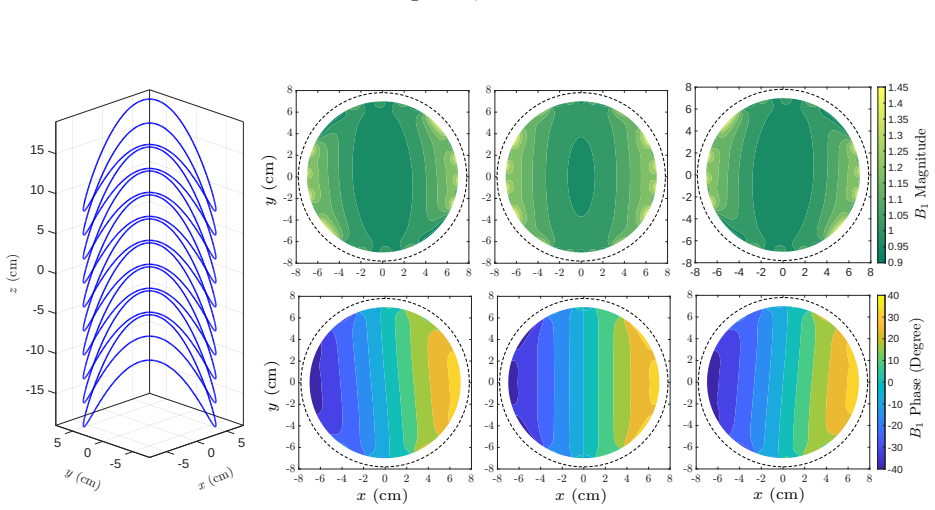
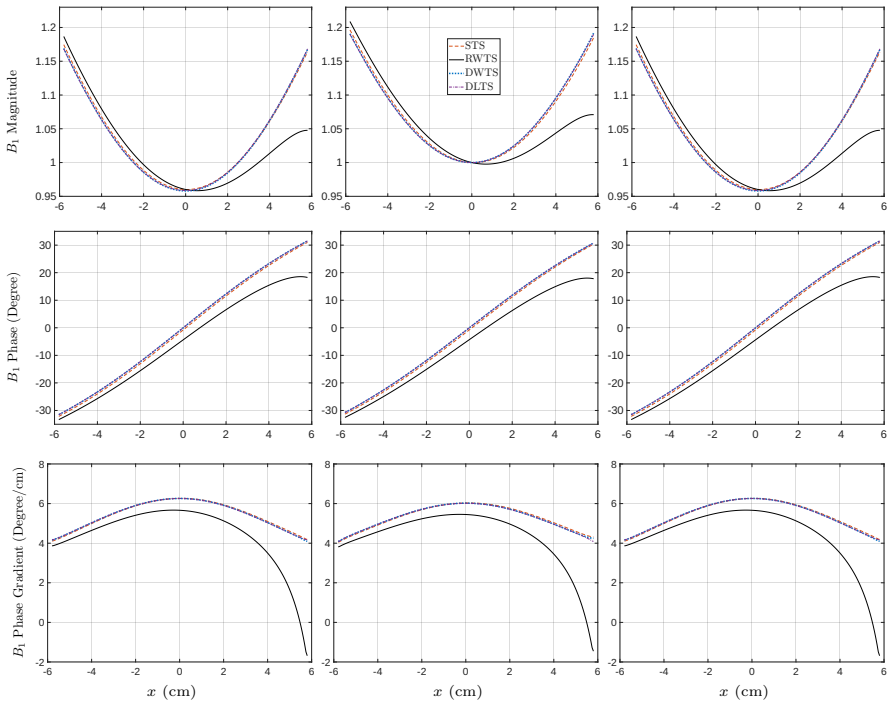
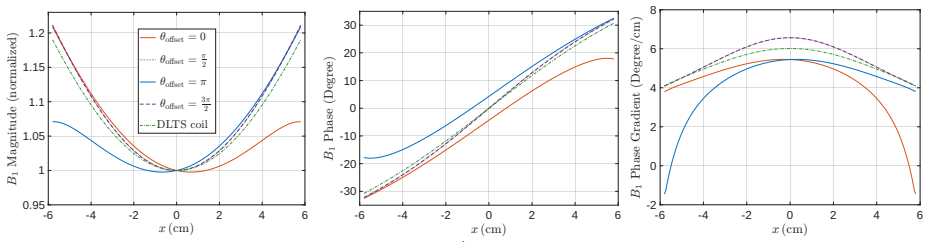
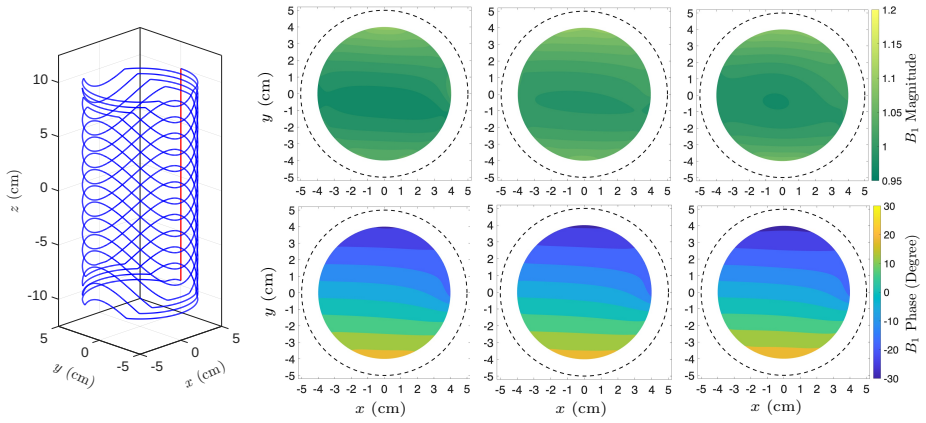
Discrete-loop twisted solenoid designs match double-wound performance but use less wire in TRASE MRI
A machine-rendered reading of the paper's core claim, the machinery that carries it, and where it could break.
Core claim
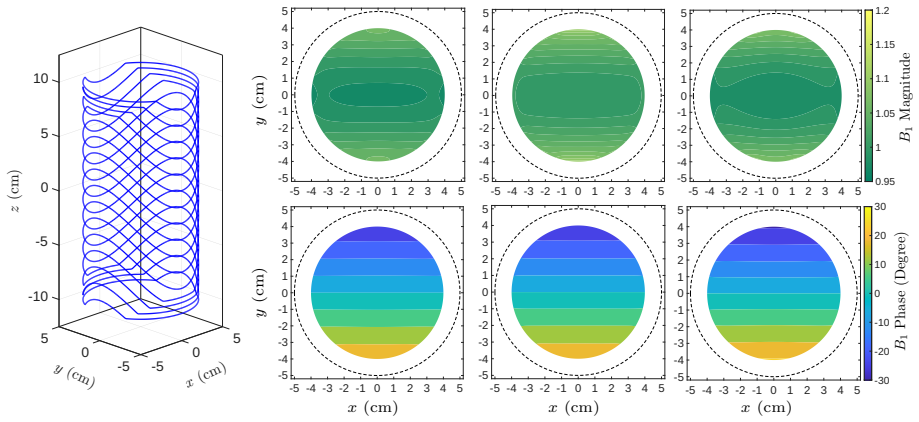
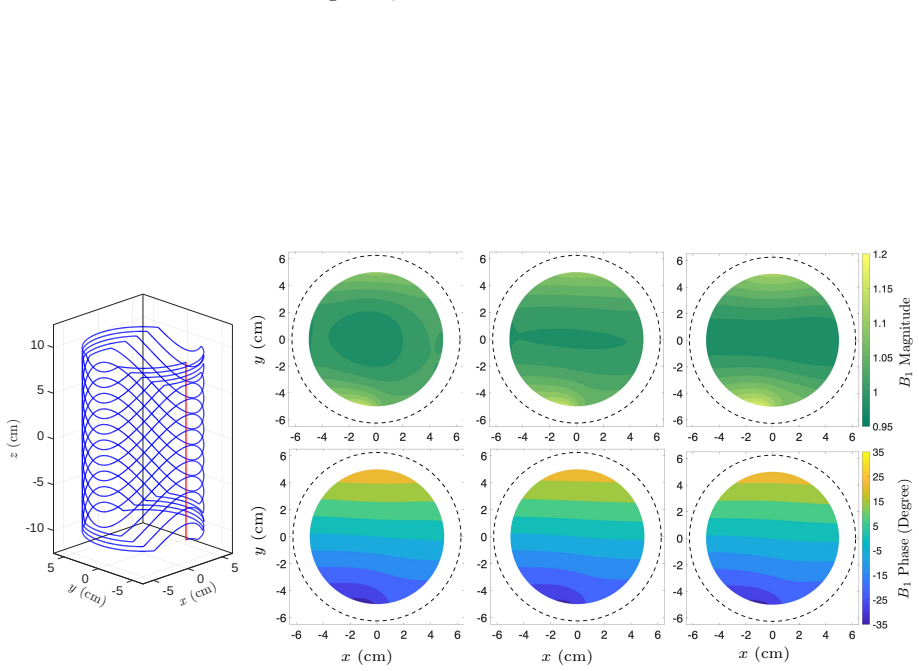
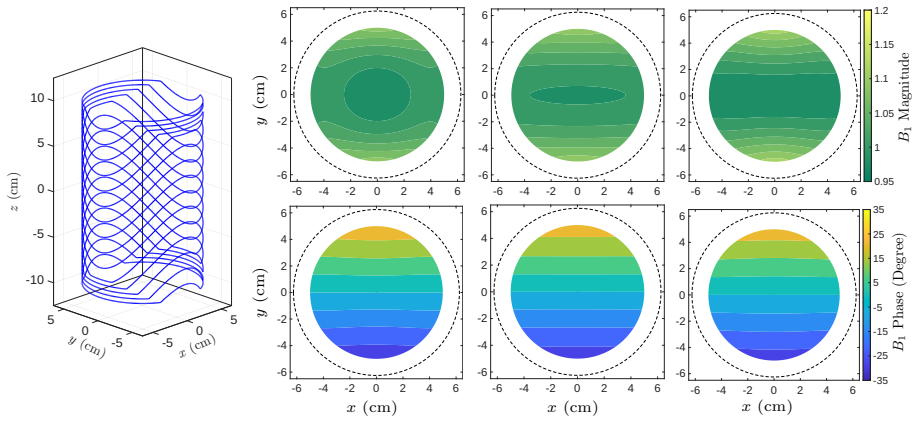
We analyze the magnetic field uniformity and phase linearity of simple twisted solenoid (with and without return wire), double-wound twisted solenoid, and discrete-loop twisted solenoid configurations using Biot-Savart simulations. Our results show that both the double-wound and discrete loop designs offer similar improvements over the simple twisted solenoid with return wire. The discrete loop pattern requires less wire than the double-wound version, making it the preferred option for practical coil construction and operation in a TRASE MRI system.
What carries the argument
The discrete-loop twisted solenoid winding pattern, which uses discrete current loops to generate the B1 phase gradients with reduced wire length compared to double-wound alternatives.
If this is right
- The improved uniformity and linearity enhance the accuracy of spatial encoding in TRASE MRI.
- Less wire in the discrete loop design simplifies coil construction and reduces operational challenges.
- The similar performance of double-wound and discrete loop designs provides flexibility in choosing based on practical needs.
Where Pith is reading between the lines
- These coil designs may help in developing MRI systems that are both quieter and mechanically simpler.
- Experimental validation of the simulations could confirm their utility in real TRASE setups.
- The focus on wire efficiency might apply to optimizing other types of gradient coils in MRI.
Load-bearing premise
The simulations assume ideal current distributions and neglect real-world factors such as wire resistance variations and manufacturing tolerances.
What would settle it
Constructing a discrete-loop twisted solenoid coil and experimentally measuring its B1 field uniformity and phase linearity to compare against the simulation results.
Figures
read the original abstract
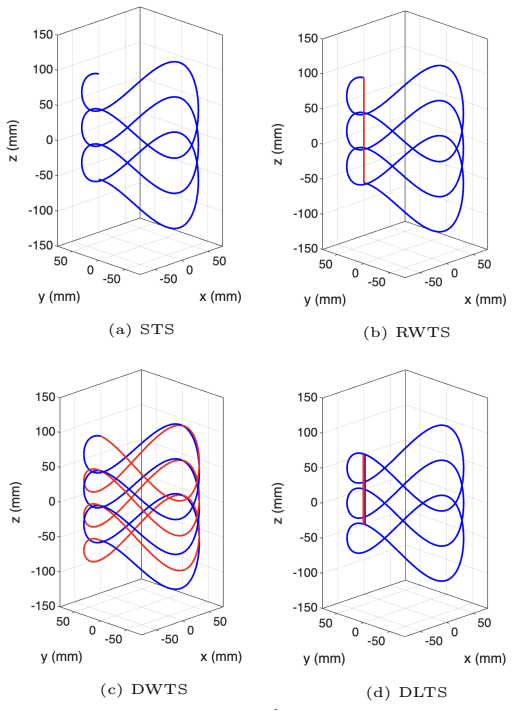
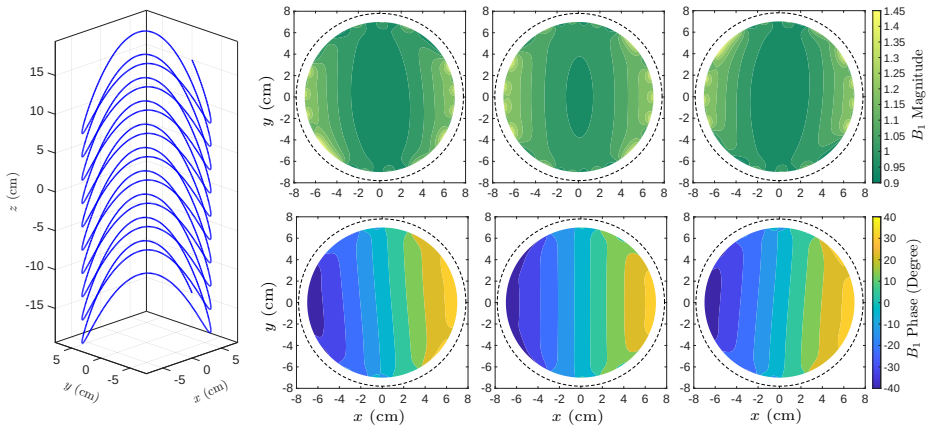
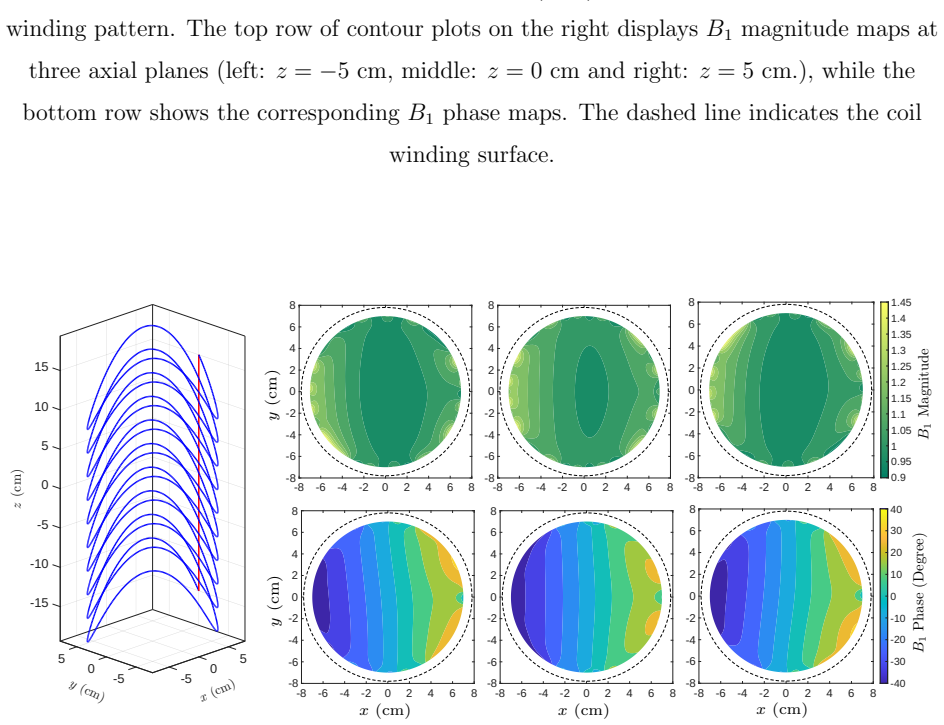
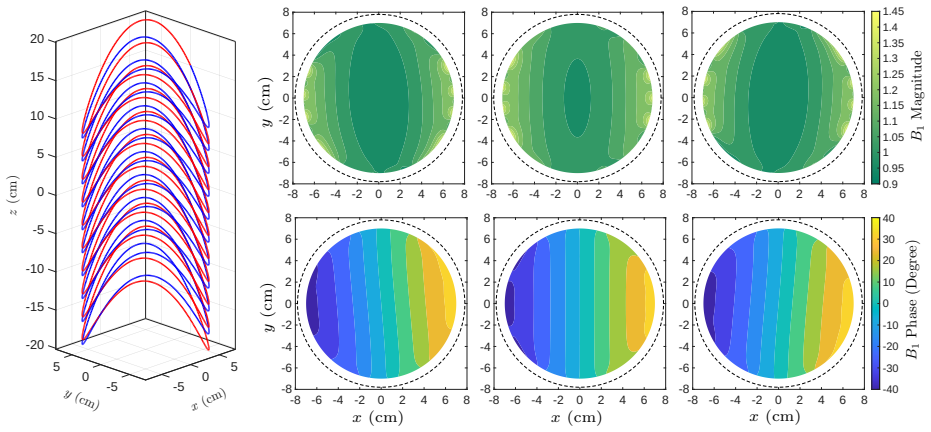
Transmit Array Spatial Encoding (TRASE) is an MRI technique in which spatial encoding is achieved using phase gradients of the B1 field. This approach offers potential advantages such as hardware simplicity and reduced acoustic noise. In this study, we present an assessment of various winding patterns for twisted solenoid phase-gradient coils, including the simple twisted solenoid (with and without return wire), a double-wound twisted solenoid, and a discrete-loop twisted solenoid. We analyze the magnetic field uniformity and phase linearity of these configurations using Biot-Savart simulations. Our results show that both the double-wound and discrete loop designs offer similar improvements over the simple twisted solenoid with return wire. The discrete loop pattern requires less wire than the double-wound version, making it the preferred option for practical coil construction and operation in a TRASE MRI system.
Editorial analysis
A structured set of objections, weighed in public.
Referee Report
Summary. The manuscript evaluates alternative winding patterns for twisted solenoid phase-gradient coils in Transmit Array Spatial Encoding (TRASE) MRI. It compares the simple twisted solenoid (with and without return wire), double-wound twisted solenoid, and discrete-loop twisted solenoid using Biot-Savart simulations to assess B1 field uniformity and phase linearity. The central result is that both the double-wound and discrete-loop designs yield similar improvements over the simple twisted solenoid with return wire, with the discrete-loop version preferred for requiring less wire in practical coil construction.
Significance. If the simulation-based performance claims hold under real conditions, the work could inform more efficient coil designs for TRASE MRI, supporting hardware simplicity and reduced acoustic noise. The application of standard Biot-Savart methods for field calculations provides a reproducible framework in principle, though the absence of experimental validation or consideration of non-ideal effects limits immediate applicability to clinical systems.
major comments (1)
- The preference for the discrete-loop design over the double-wound version, based on reduced wire length while maintaining similar B1 uniformity and phase linearity (abstract and results), rests on simulations that assume ideal uniform current distributions along wire paths. This assumption is load-bearing for the practical recommendation, as manufacturing tolerances, resistance variations, and hardware interactions could perturb the discrete-loop current distribution more than the continuous double-wound pattern, eroding both the reported performance parity and the wire-length advantage.
minor comments (2)
- The methods description should specify mesh resolution, boundary conditions, and quantitative error metrics for the Biot-Savart simulations to support verification of the uniformity and linearity claims.
- Provide explicit quantitative values (e.g., standard deviations or percentage improvements) for the 'similar improvements' in B1 uniformity and phase linearity rather than qualitative statements.
Simulated Author's Rebuttal
We thank the referee for their constructive comments on our manuscript. We address the major comment below and will revise the manuscript to incorporate a discussion of the ideal assumptions in our simulations.
read point-by-point responses
-
Referee: The preference for the discrete-loop design over the double-wound version, based on reduced wire length while maintaining similar B1 uniformity and phase linearity (abstract and results), rests on simulations that assume ideal uniform current distributions along wire paths. This assumption is load-bearing for the practical recommendation, as manufacturing tolerances, resistance variations, and hardware interactions could perturb the discrete-loop current distribution more than the continuous double-wound pattern, eroding both the reported performance parity and the wire-length advantage.
Authors: We appreciate the referee highlighting this important limitation of our simulation-based approach. Our analysis employs standard Biot-Savart calculations under the assumption of ideal uniform current distributions along the wire paths, which is typical for comparative theoretical studies of coil designs. We agree that this assumption underpins the reported performance parity and the preference for the discrete-loop design on the basis of reduced wire length. In real implementations, manufacturing tolerances, resistance variations, and hardware interactions could indeed affect the segmented discrete-loop configuration differently from the continuous double-wound pattern. To address the comment, we will revise the manuscript by adding a dedicated paragraph in the Discussion section on potential non-ideal effects and by qualifying the preference stated in the abstract and conclusions to note that it is derived from ideal simulations. We will also emphasize the value of future experimental validation. revision: yes
- The quantitative impact of manufacturing tolerances, resistance variations, and hardware interactions on the relative performance of the discrete-loop design cannot be assessed from simulations alone and would require physical coil construction and testing.
Circularity Check
Simulation-driven comparison against external Biot-Savart law shows no circularity
full rationale
The paper evaluates winding patterns for twisted solenoid coils via direct Biot-Savart numerical integration over specified current paths. B1 uniformity and phase linearity metrics are computed outputs from the standard electromagnetic forward model applied to each geometry; wire length is a direct geometric integral. No parameters are fitted to the reported performance figures, no self-citation supplies a load-bearing uniqueness theorem, and no ansatz or definition is smuggled in from prior author work. The discrete-loop preference follows from comparing two independent simulation outputs (field quality and total wire length) against the same external reference (simple twisted solenoid with return wire). The derivation chain is therefore self-contained and externally falsifiable.
Axiom & Free-Parameter Ledger
axioms (1)
- standard math Biot-Savart law accurately models static magnetic fields from steady currents in thin wires
Reference graph
Works this paper leans on
-
[1]
Alternative winding patterns for twisted solenoid coils with improved characteristics for TRASE MRI
Alternative winding patterns for twisted solenoid coils with improved characteristics for TRASE MRI Nahid Ghomimolkar Department of Physics & Astronomy, University of Manitoba, Winnipeg, Manitoba, Canada Alexander E. Krosney Department of Physics, University of Winnipeg, Winnipeg, Manitoba, Canada Christopher P. Bidinosti ∗ Department of Physics, Universi...
work page internal anchor Pith review Pith/arXiv arXiv 2025
-
[2]
For the outer coil, they areN= 15,a= 6.25 cm,A= 3.32 cm,φ= 90 ◦,h= 1.7 cm
The winding 14 parameters for the inner coil areN= 16,a= 5.0 cm,A= 2.44 cm,φ= 90 ◦, andh= 1.5 cm. For the outer coil, they areN= 15,a= 6.25 cm,A= 3.32 cm,φ= 90 ◦,h= 1.7 cm. Both were designed asG −y coils, but the outer coil was deployed with a physical rotation of 90 ◦ about thez-axis, effectively turning it into aG +y coil (see Table 2 in Ref.23). The t...
work page 2020
discussion (0)
Sign in with ORCID, Apple, or X to comment. Anyone can read and Pith papers without signing in.