Recognition: 2 theorem links
· Lean TheoremMu2e Straw Tube Tracker Gas Flow Quality Control
Pith reviewed 2026-05-17 01:24 UTC · model grok-4.3
The pith
Time-dependent current measurements detect inadequate gas flow in straw tube trackers
A machine-rendered reading of the paper's core claim, the machinery that carries it, and where it could break.
Core claim
The central discovery is a new method where the onset time of ionization gain, quantified using time-dependent current measurements induced by an 55Fe source during gas exchange, correlates with the gas conductance in the straw. This correlation enables the identification of channels with inadequate flow, providing a screening tool for high-channel-count gaseous detectors.
What carries the argument
The onset time of ionization gain measured via current during gas exchange, which acts as an indicator of gas conductance through the straw.
Load-bearing premise
The onset time of ionization gain is directly correlated to gas conductance without significant effects from source position, electronics noise, or variations in straw geometry.
What would settle it
A test where straws with known different conductances show overlapping or inconsistent onset times, or where changing the 55Fe source position alters the measured onset time substantially.
Figures

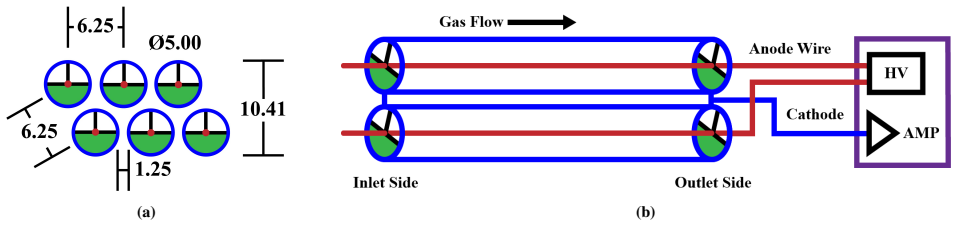


read the original abstract
We present a tracker gas flow quality control method developed for the Mu2e straw tube tracker. Using time-dependent current measurements, we quantify the onset time of ionization gain induced by an 55Fe source during gas exchange, which is correlated to the gas conductance in the straw. This allows for the identification of channels with inadequate flow. This approach is broadly applicable to other gaseous detectors that require high-channel-count screening.
Editorial analysis
A structured set of objections, weighed in public.
Referee Report
Summary. The manuscript presents a quality control method for gas flow in the Mu2e straw tube tracker. Using time-dependent current measurements with an 55Fe source during gas exchange, the onset time of ionization gain is quantified and correlated to the gas conductance in the straw to identify channels with inadequate flow. The approach is proposed as applicable to other high-channel-count gaseous detectors.
Significance. If validated, this empirical screening technique could offer a practical, non-invasive approach to quality assurance for large-scale straw tube trackers, addressing a key operational need in the Mu2e experiment. The broad applicability claim is noted, but the lack of any presented quantitative results, error bars, or cross-checks with independent flow measurements limits the assessed impact.
major comments (2)
- [Abstract] Abstract: The central claim that onset time of ionization gain during gas exchange is correlated to gas conductance (and thus usable for flagging inadequate flow) is stated without any supporting quantitative data, plots, tables, error analysis, or validation against known good/bad channels. This absence prevents assessment of the method's specificity and reproducibility.
- [Method description] Method description: The procedure assumes that the measured onset time is dominated by bulk gas replacement rate. Potential confounding factors such as 55Fe source position tolerance, local mixing effects near the source, radial field variations, or manufacturing scatter in straw diameter/wall thickness are not addressed or quantified, raising the risk that onset-time distributions for good and bad channels may overlap.
minor comments (1)
- [Abstract] Consider specifying the gas mixture composition, nominal flow rates, and typical straw dimensions used in the tests to allow reproducibility.
Simulated Author's Rebuttal
We thank the referee for their careful reading and constructive comments on our manuscript describing the gas flow quality control method for the Mu2e straw tube tracker. We address each major comment below and indicate revisions that will be incorporated in the next version of the manuscript.
read point-by-point responses
-
Referee: [Abstract] Abstract: The central claim that onset time of ionization gain during gas exchange is correlated to gas conductance (and thus usable for flagging inadequate flow) is stated without any supporting quantitative data, plots, tables, error analysis, or validation against known good/bad channels. This absence prevents assessment of the method's specificity and reproducibility.
Authors: We agree that the abstract, as currently written, presents the central claim without quantitative support. The body of the manuscript includes time-dependent current measurements and onset-time results from the 55Fe source during gas exchange for multiple straw channels. To strengthen the abstract and improve assessability, we will revise it to include a concise statement of the observed correlation, such as the typical difference in onset times between channels with adequate and inadequate flow, along with references to the relevant figures showing the data. revision: yes
-
Referee: [Method description] Method description: The procedure assumes that the measured onset time is dominated by bulk gas replacement rate. Potential confounding factors such as 55Fe source position tolerance, local mixing effects near the source, radial field variations, or manufacturing scatter in straw diameter/wall thickness are not addressed or quantified, raising the risk that onset-time distributions for good and bad channels may overlap.
Authors: This is a valid concern regarding the robustness of the method. In the revised manuscript we will add a new subsection that explicitly discusses these potential confounding factors. We will provide estimates of source positioning repeatability from our experimental setup, argue that bulk gas flow dominates local mixing effects at the flow rates employed, and include a brief analysis of how manufacturing variations in straw diameter and wall thickness are expected to influence onset time relative to the much larger effects from blocked or restricted channels. revision: yes
Circularity Check
No circularity: empirical QC procedure without derivations or self-referential claims
full rationale
The paper presents a practical experimental method for identifying inadequate gas flow in straw tubes via time-dependent current measurements during gas exchange with an 55Fe source. The abstract and description state an empirical correlation between measured onset time of ionization gain and gas conductance, without any equations, fitted parameters, derivations, or mathematical modeling. No load-bearing steps reduce to inputs by construction, self-citation chains, or ansatzes. The approach is a self-contained measurement protocol for high-channel-count screening, with the claimed correlation treated as an observed outcome rather than a derived result. This is the standard case of an honest non-finding for an experimental instrumentation paper.
Axiom & Free-Parameter Ledger
axioms (1)
- domain assumption The onset time of ionization gain is correlated to the gas conductance in the straw.
Lean theorems connected to this paper
-
IndisputableMonolith/Cost/FunctionalEquation.leanwashburn_uniqueness_aczel unclear?
unclearRelation between the paper passage and the cited Recognition theorem.
quantify the onset time of ionization gain induced by an 55Fe source during gas exchange, which is correlated to the gas conductance in the straw
-
IndisputableMonolith/Foundation/RealityFromDistinction.leanreality_from_one_distinction unclear?
unclearRelation between the paper passage and the cited Recognition theorem.
rise time ... when the current reaches 90% of the error function maximum
What do these tags mean?
- matches
- The paper's claim is directly supported by a theorem in the formal canon.
- supports
- The theorem supports part of the paper's argument, but the paper may add assumptions or extra steps.
- extends
- The paper goes beyond the formal theorem; the theorem is a base layer rather than the whole result.
- uses
- The paper appears to rely on the theorem as machinery.
- contradicts
- The paper's claim conflicts with a theorem or certificate in the canon.
- unclear
- Pith found a possible connection, but the passage is too broad, indirect, or ambiguous to say the theorem truly supports the claim.
Reference graph
Works this paper leans on
-
[1]
" write newline "" before.all 'output.state := FUNCTION n.dashify 't := "" t empty not t #1 #1 substring "-" = t #1 #2 substring "--" = not "--" * t #2 global.max substring 't := t #1 #1 substring "-" = "-" * t #2 global.max substring 't := while if t #1 #1 substring * t #2 global.max substring 't := if while FUNCTION word.in bbl.in ":" * " " * FUNCTION f...
-
[2]
L.\ Bartoszek, et al., Mu2e Technical Design Report, 2015, https://doi.org/10.48550/arXiv.1501.05241
work page internal anchor Pith review Pith/arXiv arXiv doi:10.48550/arxiv.1501.05241 2015
-
[3]
https://doi.org/10.1140/epjc/s2006-02582-x
W.\ Bertl, R.\ Engfer, E.\ Hermes et al., A search for --e conversion in muonic gold, Eur.\ Phys.\ J.\ C 47 (2006) 337–346. https://doi.org/10.1140/epjc/s2006-02582-x
-
[4]
https://doi.org/10.1016/0168-9002(91)90381-Y
J.\,A.\ Kadyk, Wire chamber aging, Nucl.\ Instrum.\ Methods Phys.\ Res.\ A 300 (1991) 436–479. https://doi.org/10.1016/0168-9002(91)90381-Y
-
[5]
https://doi.org/10.18434/T4859Z
R.\,D.\ Deslattes, et al., X-ray Transition Energies (version 1.2), NIST Standard Reference Database 128 (2005), National Institute of Standards and Technology, Gaithersburg, MD. https://doi.org/10.18434/T4859Z
discussion (0)
Sign in with ORCID, Apple, or X to comment. Anyone can read and Pith papers without signing in.