Plasmonic enhancement of the infrared radiation absorption in an ultrathin InSb layer
Pith reviewed 2026-05-17 00:21 UTC · model grok-4.3
The pith
A plasmonic structure can greatly increase infrared absorption in an ultrathin InSb film.
A machine-rendered reading of the paper's core claim, the machinery that carries it, and where it could break.
Core claim
We propose a plasmonic structure that significantly enhances infrared absorption in an ultrathin InSb film. The resonant characteristics of this plasmonic enhancement effect could serve as a foundation for developing highly sensitive multi-color detectors.
What carries the argument
The plasmonic structure that supports resonant modes to concentrate the electric field within the ultrathin InSb layer and increase interband absorption.
If this is right
- Higher absorption raises the quantum efficiency of InSb-based infrared detectors.
- Resonant peaks in the enhancement allow wavelength-selective response for multi-color detection.
- The approach works with very thin films, which can reduce dark current and improve device speed.
- The same resonant mechanism could be tuned by changing geometry to target specific infrared bands.
Where Pith is reading between the lines
- The enhancement might permit detector operation at higher temperatures by strengthening the signal relative to thermal noise.
- Integration with existing semiconductor processing could lead to arrays of wavelength-specific pixels on a single chip.
- If losses remain low, the design might extend to other narrow-gap materials for broader infrared coverage.
Load-bearing premise
A practical plasmonic structure can be fabricated on ultrathin InSb without introducing excessive losses, defects, or fabrication challenges that would negate the absorption gain.
What would settle it
Fabricate the proposed plasmonic structure on an ultrathin InSb film and measure its infrared absorption spectrum, then compare the result directly to the absorption of an identical bare InSb film of the same thickness.
Figures
read the original abstract
Indium antimonide (InSb) is a fundamental material for infrared radiation detectors based on interband transitions. Its narrow bandgap enables detection of infrared radiation within the $3-5 \mu m$ atmospheric window, while its high quantum efficiency ensures excellent sensitivity in InSb-based detectors. We propose a plasmonic structure that significantly enhances infrared absorption in an ultrathin InSb film. The resonant characteristics of this plasmonic enhancement effect could serve as a foundation for developing highly sensitive multi-color detectors.
Editorial analysis
A structured set of objections, weighed in public.
Referee Report
Summary. The manuscript proposes a plasmonic structure to significantly enhance infrared absorption in an ultrathin InSb film for the 3-5 μm range, with resonant characteristics potentially enabling highly sensitive multi-color detectors based on interband transitions in InSb.
Significance. If the proposed enhancement can be quantitatively demonstrated and survives realistic losses, the work could contribute to improved mid-IR detector sensitivity by addressing low absorption in thin films via plasmonics. The conceptual framing for multi-color detection is a positive aspect, but the current lack of supporting analysis limits the immediate significance.
major comments (2)
- [Abstract] Abstract and main text: The central claim that the plasmonic structure 'significantly enhances' absorption is presented without any calculations, simulations, or quantitative results (e.g., no absorption spectra, enhancement factors, or field distributions). This is load-bearing for the proposal, as the assertion requires evidence that the local-field boost overcomes the intrinsic low absorption of the ultrathin layer.
- [Proposed structure] Proposed structure description: No analysis is provided of mid-IR plasmon damping or realistic Drude-model optical constants for the metal at 3-5 μm, where damping rates are high and Q-factors low; this leaves open whether net absorption gain is possible over ohmic losses, as required for the claimed improvement.
minor comments (1)
- [Abstract] The abstract would benefit from a brief mention of the specific plasmonic geometry (e.g., grating period or nanoparticle type) to clarify the resonant mechanism.
Simulated Author's Rebuttal
We thank the referee for the constructive comments on our manuscript. We agree that quantitative support is needed for the enhancement claims and will revise the manuscript to include the requested simulations and analysis.
read point-by-point responses
-
Referee: [Abstract] Abstract and main text: The central claim that the plasmonic structure 'significantly enhances' absorption is presented without any calculations, simulations, or quantitative results (e.g., no absorption spectra, enhancement factors, or field distributions). This is load-bearing for the proposal, as the assertion requires evidence that the local-field boost overcomes the intrinsic low absorption of the ultrathin layer.
Authors: We agree that the current manuscript lacks quantitative evidence for the enhancement. In the revised version, we will add FDTD or similar simulations providing absorption spectra with and without the plasmonic structure, explicit enhancement factors (e.g., >10x), and field distributions at resonance wavelengths in the 3-5 μm range to demonstrate that the local-field boost overcomes the low intrinsic absorption of the ultrathin InSb layer. revision: yes
-
Referee: [Proposed structure] Proposed structure description: No analysis is provided of mid-IR plasmon damping or realistic Drude-model optical constants for the metal at 3-5 μm, where damping rates are high and Q-factors low; this leaves open whether net absorption gain is possible over ohmic losses, as required for the claimed improvement.
Authors: We acknowledge this valid point regarding realistic losses. The revised manuscript will include a detailed analysis using the Drude model with wavelength-dependent optical constants and damping rates appropriate for metals (such as Au) in the mid-IR. We will compute Q-factors and demonstrate via simulations that the net absorption in the InSb layer exceeds ohmic losses, confirming a positive gain. revision: yes
Circularity Check
No circularity: proposal lacks derivation chain or fitted predictions
full rationale
The manuscript is a device proposal centered on a plasmonic geometry for enhancing absorption in ultrathin InSb. No equations, parameter fits, or self-citations that reduce a claimed prediction to its own inputs appear in the provided abstract or context. The central claim rests on electromagnetic modeling of a proposed structure rather than on any self-referential loop, uniqueness theorem imported from prior work, or renaming of known results. External benchmarks (Drude losses, fabrication feasibility) remain open but do not create circularity within the paper's own logic.
Axiom & Free-Parameter Ledger
Lean theorems connected to this paper
-
IndisputableMonolith/Cost/FunctionalEquation.leanwashburn_uniqueness_aczel unclear?
unclearRelation between the paper passage and the cited Recognition theorem.
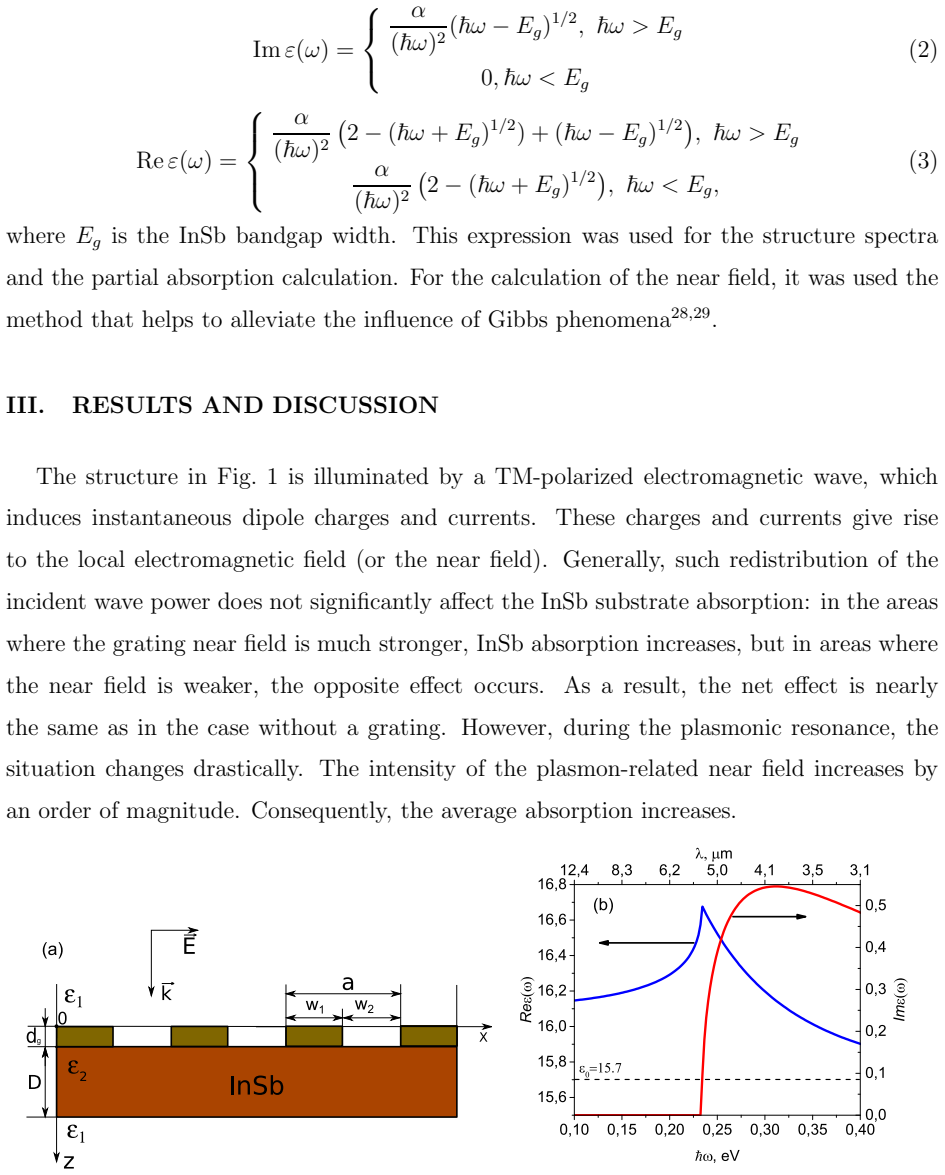
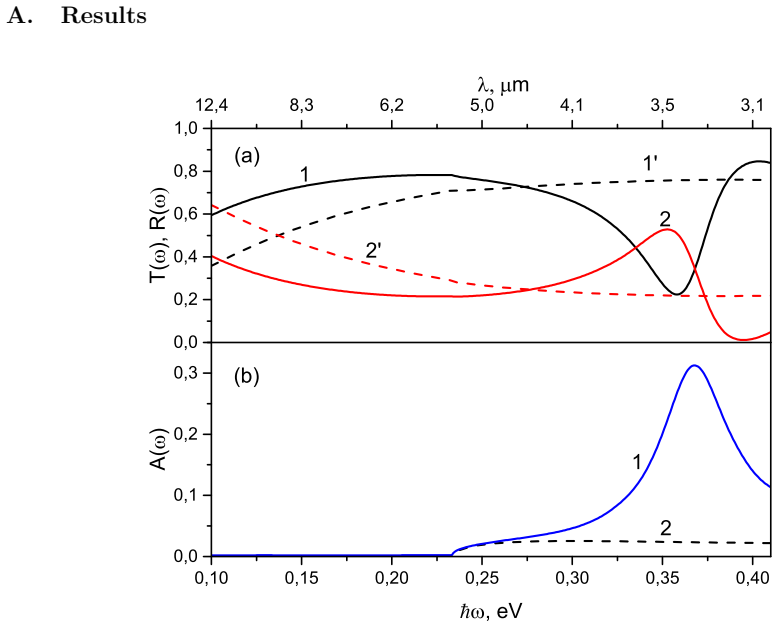
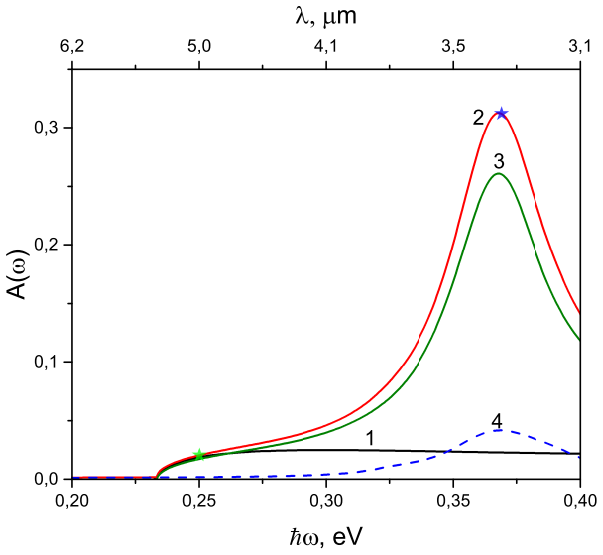
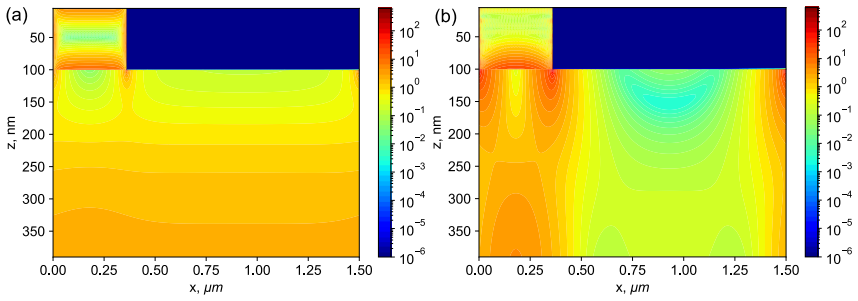
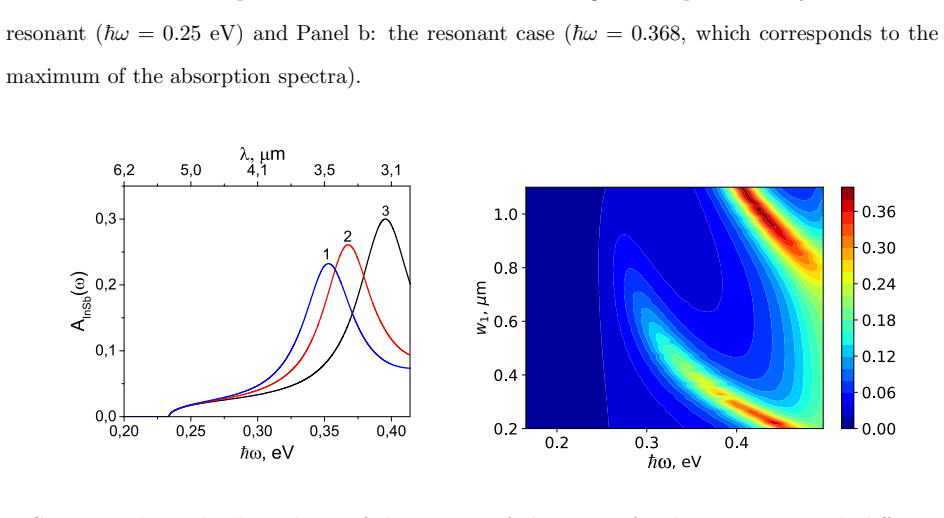
We propose a plasmonic structure... resonant characteristics of this plasmonic enhancement effect... RCWA... integral equation method... frequency-dependent dielectric function of InSb... Im ε(ω) = α/(ℏω)² (ℏω − Eg)½ ... partial absorption A(r,ω) = ω/c Im ε(r,ω) |E(r,ω)|²
-
IndisputableMonolith/Foundation/AlexanderDuality.leanalexander_duality_circle_linking unclear?
unclearRelation between the paper passage and the cited Recognition theorem.
grating period a = 1.5 µm, strip width w1 = 0.36 µm... plasmon resonance dependence on geometric parameters
What do these tags mean?
- matches
- The paper's claim is directly supported by a theorem in the formal canon.
- supports
- The theorem supports part of the paper's argument, but the paper may add assumptions or extra steps.
- extends
- The paper goes beyond the formal theorem; the theorem is a base layer rather than the whole result.
- uses
- The paper appears to rely on the theorem as machinery.
- contradicts
- The paper's claim conflicts with a theorem or certificate in the canon.
- unclear
- Pith found a possible connection, but the passage is too broad, indirect, or ambiguous to say the theorem truly supports the claim.
Reference graph
Works this paper leans on
-
[1]
1M. Henini and M. Razeghi. Handbook of Infrared Detection Technologies. Elsevier Science Publishers, 2002. 2Lily M Ng and Reiko Simmons. Infrared spectroscopy. Analytical chemistry, 71(12):343– 350, 1999. 3Elnaz Neinavaz, Martin Schlerf, Roshanak Darvishzadeh, Max Gerh ards, and Andrew K. Skidmore. Thermal infrared remote sensing of vegetation: Curre nt s...
work page 2002
-
[2]
Recent progress in insb based quantum detectors in israel
Lukomsky, Lior Shkedy, Itay Shtrichman, Noam Snapi, Michael Yas sen, and Eliezer Weiss. Recent progress in insb based quantum detectors in israel. Infrared Physics and Technology, 59:172–181, 2013. Proceedings of the International Conferenc e on Quantum Structure Infrared Photodetector (QSIP) 2012. 11R. D. Gehrz, T. L. Roellig, M. W. Werner, G. G. Fazio, ...
work page 2013
-
[3]
Rieke, B. T. Soifer, D. A. Levine, and E. A. Romana. The nasa spitze r space telescope. Review of Scientific Instruments , 78(1):011302, 2007. 12Koichiro Ueno, Edson Gomes Camargo, Takashi Katsumata, Hiroma sa Goto, Naohiro
work page 2007
-
[4]
Insb mid-infrared p hoton detector for room-temperature operation
Kuze, Yoshihiro Kangawa, and Koichi Kakimoto. Insb mid-infrared p hoton detector for room-temperature operation. Japanese Journal of Applied Physics , 52(9R):092202, aug 2013. 13Ziji Zhou, Hongyu Lin, Xiaohang Pan, Chong Tan, Dongjie Zhou, Zhe ngji Wen, Yan
work page 2013
-
[5]
Surface plasmon enha nced inas-based mid-wavelength infrared photodetector
Sun, Shuhong Hu, Ning Dai, Junhao Chu, et al. Surface plasmon enha nced inas-based mid-wavelength infrared photodetector. Applied Physics Letters , 122(9):091105, 2023. 14Wei Wu, Alireza Bonakdar, and Hooman Mohseni. Plasmonic enhanced quantum well infrared photodetector with high detectivity. Applied Physics Letters, 96(16):161107, 2010. 11 15S. Pillai, ...
work page 2023
-
[6]
Haldane, Jaime Fern´ andez del R ´ ıo, Mark Wiebe, Pearu Peterson,Pierre G´ erard-Marchant, Kevin Sheppard, Tyler Reddy, Warren Weckesser, Hameer Abbasi, Christoph Gohlke, and Travis E. Oliphant. Array programming with NumPy. Nature, 585(7825):357–362, sep 2020. 22Pauli Virtanen, Ralf Gommers, Travis E. Oliphant, Matt Haberland, T yler Reddy, David
work page 2020
-
[7]
SciPy 1.0: Fundamental Algorithms for Scientific Computing in Python
Ribeiro, Fabian Pedregosa, Paul van Mulbregt, and SciPy 1.0 Contrib utors. SciPy 1.0: Fundamental Algorithms for Scientific Computing in Python. Nature Methods, 17:261–272, 2020. 23Olga V. Shapoval, Ronan Sauleau, and Alexander I. Nosich. Modeling o f plasmon reso- nances of multiple flat noble-metal nanostrips with a median-line integ ral equation tech- 12...
work page 2020
discussion (0)
Sign in with ORCID, Apple, or X to comment. Anyone can read and Pith papers without signing in.