A new initialisation to Control Gradients in Sinusoidal Neural network
Pith reviewed 2026-05-17 00:53 UTC · model grok-4.3
The pith
A closed-form initialization for sinusoidal networks, derived from fixed-point analysis of pre-activations and Jacobian variances, controls gradients with depth and improves generalization over the original SIREN scheme.
A machine-rendered reading of the paper's core claim, the machinery that carries it, and where it could break.
Core claim
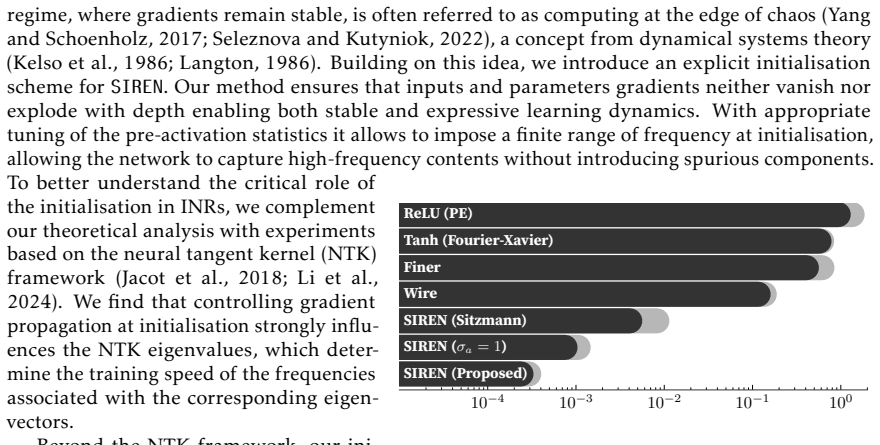
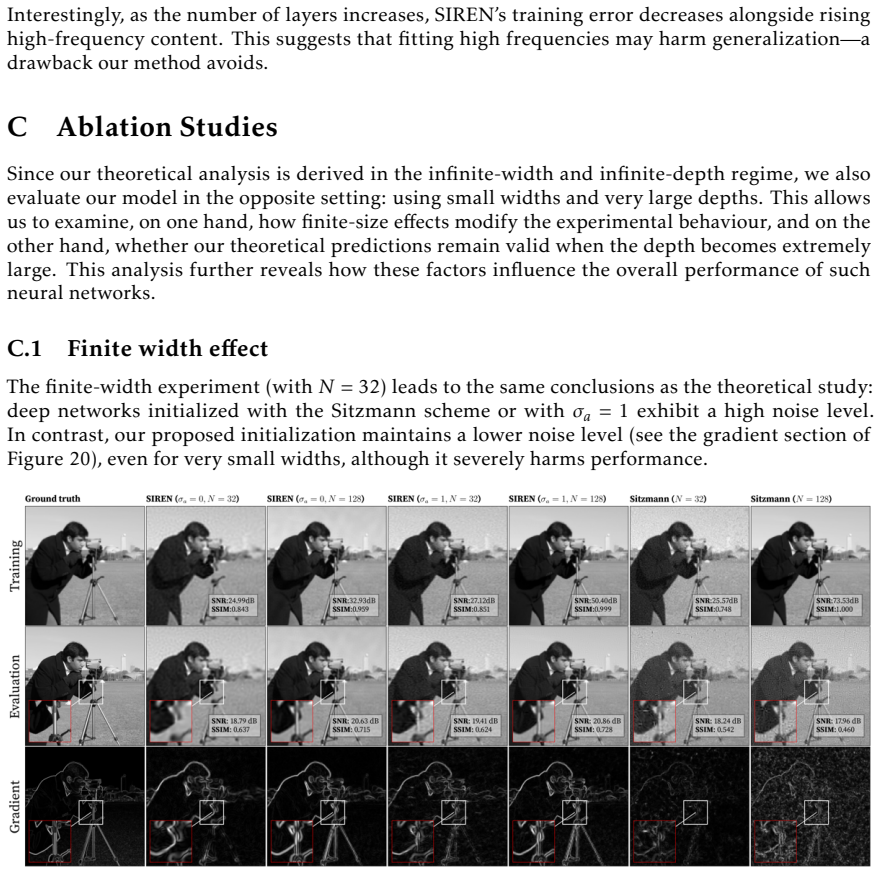
The central claim is that the fixed points of the pre-activation distribution and of the Jacobian variance sequence together determine a unique scaling for the initial weights and biases; when this scaling is used, gradient magnitudes remain controlled across layers, pre-activations concentrate near zero, and the network avoids fitting extraneous frequencies that degrade generalization on function fitting and image reconstruction benchmarks.
What carries the argument
Fixed-point equations for the pre-activation distribution and Jacobian variance sequence that produce the closed-form initialization scaling.
If this is right
- Gradient norms stay bounded as depth grows, allowing deeper sinusoidal networks to be trained reliably.
- Fewer extraneous frequencies appear in the learned representation, raising accuracy on function-fitting and image-reconstruction tasks.
- Physics-informed neural network solutions become more accurate because the initialization already favors physically plausible low-frequency content.
- Training trajectories align more closely with the predictions of the neural tangent kernel, simplifying analysis of convergence speed.
Where Pith is reading between the lines
- The same fixed-point approach might supply initializations for other periodic activations whose frequency content must be controlled.
- Because the scaling is depth-aware, it could be used to decide how many layers are feasible before retraining becomes necessary.
- The initialization might be combined with adaptive frequency regularization to handle signals that genuinely contain both low- and high-frequency content.
Load-bearing premise
The mathematical fixed points for pre-activation and Jacobian statistics translate directly into an initialization that remains stable and beneficial on every practical task without introducing new instabilities or requiring task-specific adjustments.
What would settle it
Training a SIREN with the proposed scaling on standard image-reconstruction benchmarks and finding no consistent improvement in final error or generalization compared with the original SIREN scheme would falsify the claim.
Figures



read the original abstract
Proper initialisation strategy is of primary importance to mitigate gradient explosion or vanishing when training neural networks. Yet, the impact of initialisation parameters still lacks a precise theoretical understanding for several well-established architectures. Here, we propose a new initialisation for networks with sinusoidal activation functions such as \texttt{SIREN}, focusing on gradients control, their scaling with network depth, their impact on training and on generalization. To achieve this, we identify a closed-form expression for the initialisation of the parameters, differing from the original \texttt{SIREN} scheme. This expression is derived from fixed points obtained through the convergence of pre-activation distribution and the variance of Jacobian sequences. Controlling both gradients and targeting vanishing pre-activation helps preventing the emergence of inappropriate frequencies during estimation, thereby improving generalization. We further show that this initialisation strongly influences training dynamics through the Neural Tangent Kernel framework (NTK). Finally, we benchmark \texttt{SIREN} with the proposed initialisation against the original scheme and other baselines on function fitting and image reconstruction. The new initialisation consistently outperforms state-of-the-art methods across a wide range of reconstruction tasks, including those involving physics-informed neural networks.
Editorial analysis
A structured set of objections, weighed in public.
Referee Report
Summary. The manuscript proposes a new initialization for sinusoidal networks such as SIREN. It derives a closed-form expression for the weights from fixed-point convergence of the pre-activation distribution and the variance of Jacobian sequences. The scheme is claimed to control gradient scaling with depth, target vanishing pre-activations, suppress inappropriate frequencies during training, and thereby improve generalization. The work further analyzes the effect on training dynamics via the Neural Tangent Kernel and reports consistent empirical gains over the original SIREN initialization and other baselines on function-fitting and image-reconstruction tasks, including physics-informed settings.
Significance. A rigorously derived, closed-form initialization that demonstrably links initial statistics to frequency control and generalization would be a useful contribution to the literature on implicit neural representations and PINNs. The empirical results, if reproducible, indicate practical value; however, the absence of an explicit propagation argument from initialization to training-time frequency content limits the strength of the central theoretical claim.
major comments (3)
- [§3] §3 (Fixed-point derivation): The manuscript obtains the initialization by matching moments of the pre-activation distribution and Jacobian variance at convergence, yet provides no derivation or auxiliary lemma showing that these initial conditions persist or directly constrain the frequency content of the learned function under subsequent gradient updates. Because pre-activation statistics evolve nonlinearly for sinusoidal activations, the claimed causal link between vanishing pre-activations at initialization and suppression of inappropriate frequencies remains unsubstantiated.
- [§4] §4 (NTK analysis): The statement that the proposed initialization “strongly influences training dynamics through the NTK framework” is not supported by quantitative comparisons (e.g., eigenvalue spectra, condition numbers, or convergence-rate bounds) between the new and original schemes. Without such evidence the NTK discussion does not yet corroborate the generalization improvements reported in the experiments.
- [§5.3] Table 2 / §5.3 (Reconstruction benchmarks): The reported gains are presented without an ablation that isolates the contribution of the fixed-point assumptions versus simple variance rescaling. If the performance advantage disappears under modest perturbations of the activation scaling, the central claim that the fixed-point analysis itself prevents inappropriate frequencies would be weakened.
minor comments (2)
- [Notation] Notation for the fixed-point variances and the scaling factor ω₀ should be introduced once and used consistently; several equations reuse the same symbol for distinct quantities.
- [Figure 3] Figure 3 (NTK heatmaps): Axis labels and color-bar ranges are missing, making it difficult to compare the proposed and baseline kernels directly.
Simulated Author's Rebuttal
We thank the referee for the constructive and detailed comments. Below we respond point-by-point to the major comments, indicating planned revisions where appropriate.
read point-by-point responses
-
Referee: [§3] §3 (Fixed-point derivation): The manuscript obtains the initialization by matching moments of the pre-activation distribution and Jacobian variance at convergence, yet provides no derivation or auxiliary lemma showing that these initial conditions persist or directly constrain the frequency content of the learned function under subsequent gradient updates. Because pre-activation statistics evolve nonlinearly for sinusoidal activations, the claimed causal link between vanishing pre-activations at initialization and suppression of inappropriate frequencies remains unsubstantiated.
Authors: We agree that the manuscript lacks an explicit propagation argument or auxiliary lemma demonstrating persistence of the fixed-point statistics through nonlinear gradient updates. The derivation focuses on setting initial gradient scaling and pre-activation variance to avoid immediate explosion/vanishing and inappropriate high frequencies at the start of training. We will revise §3 to add a clarifying remark on the expected influence during early dynamics (drawing on the NTK perspective already present in the paper) and will include a short discussion of related initialization analyses for sinusoidal networks. A full persistence proof under arbitrary updates is beyond the current scope but the empirical frequency-control benefits are supported by the reported reconstruction results. revision: partial
-
Referee: [§4] §4 (NTK analysis): The statement that the proposed initialization “strongly influences training dynamics through the NTK framework” is not supported by quantitative comparisons (e.g., eigenvalue spectra, condition numbers, or convergence-rate bounds) between the new and original schemes. Without such evidence the NTK discussion does not yet corroborate the generalization improvements reported in the experiments.
Authors: We accept this criticism. The current NTK discussion is largely qualitative. In the revision we will add quantitative evidence: eigenvalue spectra of the empirical NTK, condition-number comparisons, and a brief note on how these metrics relate to observed convergence behavior for both initializations. This will directly support the claim that the new scheme influences training dynamics. revision: yes
-
Referee: [§5.3] Table 2 / §5.3 (Reconstruction benchmarks): The reported gains are presented without an ablation that isolates the contribution of the fixed-point assumptions versus simple variance rescaling. If the performance advantage disappears under modest perturbations of the activation scaling, the central claim that the fixed-point analysis itself prevents inappropriate frequencies would be weakened.
Authors: We will add the requested ablation. The revised experiments will include a controlled comparison between (i) the full fixed-point initialization (pre-activation moments plus Jacobian variance sequence) and (ii) a simpler variance-rescaling baseline that matches only the first-moment target without the Jacobian term. Results on the same reconstruction tasks will be reported to isolate the contribution of the complete analysis. revision: yes
Circularity Check
Fixed-point derivation of initialization is mathematically independent of generalization claims
full rationale
The paper derives a closed-form initialization by analyzing convergence of pre-activation distributions and Jacobian variance sequences to fixed points, then separately shows NTK influence on dynamics. This chain does not reduce to its own outputs by construction, nor does it rely on self-citation of a uniqueness result or rename a fitted quantity as a prediction. The link from initial variance control to frequency suppression during training is presented as a consequence rather than an input assumption. No load-bearing step collapses to a tautology or to performance numbers on the tested tasks. The derivation remains self-contained against external benchmarks such as the original SIREN scheme.
Axiom & Free-Parameter Ledger
axioms (2)
- domain assumption Pre-activation distributions converge to a fixed point whose moments can be matched by a closed-form weight initialization.
- domain assumption Variance of the Jacobian sequence controls gradient scaling with depth.
Lean theorems connected to this paper
-
IndisputableMonolith/Cost/FunctionalEquation.leanwashburn_uniqueness_aczel echoes?
echoesECHOES: this paper passage has the same mathematical shape or conceptual pattern as the Recognition theorem, but is not a direct formal dependency.
Theorem 3.1 ... σ_a² = c_b² + c_w²/6 + ½ W_0(-c_w²/3 exp(-c_w²/3-2c_b²)); sequence converges to fixed point σ_a ... exponentially attractive for c_w ≠ √3
-
IndisputableMonolith/Foundation/AlphaCoordinateFixation.leancostAlphaLog_high_calibrated_iff echoes?
echoesECHOES: this paper passage has the same mathematical shape or conceptual pattern as the Recognition theorem, but is not a direct formal dependency.
Theorem 3.2 ... lim N eσ_ℓ² = σ_g = c_w²/6 (1 + e^{-2σ_a²}); set σ_g=1 to obtain cb(cw) curve
-
IndisputableMonolith/Foundation/BranchSelection.leanbranch_selection refines?
refinesRelation between the paper passage and the cited Recognition theorem.
σ_a=0 (Proposed) ... (c_w, c_b)=(√3,0) ... suppresses emergence of higher frequencies ... depth-independent cutoff around w0
What do these tags mean?
- matches
- The paper's claim is directly supported by a theorem in the formal canon.
- supports
- The theorem supports part of the paper's argument, but the paper may add assumptions or extra steps.
- extends
- The paper goes beyond the formal theorem; the theorem is a base layer rather than the whole result.
- uses
- The paper appears to rely on the theorem as machinery.
- contradicts
- The paper's claim conflicts with a theorem or certificate in the canon.
- unclear
- Pith found a possible connection, but the passage is too broad, indirect, or ambiguous to say the theorem truly supports the claim.
Reference graph
Works this paper leans on
-
[1]
doi: 10.1007/s12346-020-00406-0
ISSN 1575-5460. doi: 10.1007/s12346-020-00406-0. URL https://doi.org/10.1007/ s12346-020-00406-0. Filipe de Avila Belbute-Peres and J Zico Kolter. Simple initialization and parametrization of sinusoidal networks via their kernel bandwidth. InThe Eleventh International Conference on Learning Representations, 2023. URLhttps://openreview.net/forum?id=yVqC6gC...
-
[2]
URLhttps://proceedings.mlr.press/v163/hayou22a.html. Kaiming He, Xiangyu Zhang, Shaoqing Ren, and Jian Sun. Delving deep into rectifiers: Surpassing human-level performance on imagenet classification. In2015 IEEE International Conference on Computer Vision (ICCV), pages 1026–1034, 2015. doi: 10.1109/ICCV.2015.123. Arthur Jacot, Franck Gabriel, and Clément...
-
[3]
Forc w > √ 3, Lemma A.3 gives f ′(σ 2 a ) = 2(−f(σ a) + c2w 6 +c 2 b) =−W 0 − c2w 3 e−c2w/3−2c2 b . Since − 1 e <− c2w 3 e−c2w/3−2c2 b <0, the properties of the principal branch W0 imply |f ′(σ 2a )|< 1. Hence, the fixed point is exponentially attractive for all values of cw , √ 3, and convergence occurs rapidly. For cw = √ 3, the map f can be written f(x...
work page 2020
discussion (0)
Sign in with ORCID, Apple, or X to comment. Anyone can read and Pith papers without signing in.