REVIEW 3 major objections 4 minor 1 cited by
Locally Recoverable Codes with availability from a family of fibered surfaces
T0 review · 3 major / 4 minor · reviewed 2026-08-03 · deepseek-v4-flash
Pith's one-line read Fibered surfaces give locally recoverable codes with availability 2, dimension r(r−1)−1, and a sharp distance bound at r=3.
desk verdict New LRC family with availability 2, but the existence of the evaluation set rests on a Chebotarev step that does not close as written. read the letter →
The pith
A machine-rendered reading of the paper's core claim, the machinery that carries it, and where it could break.
The reading
What carries the argument
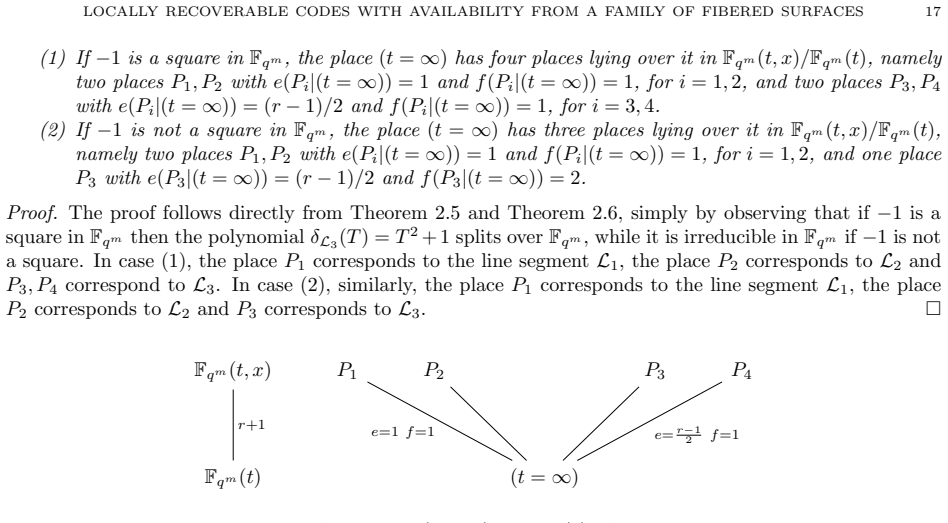
The machinery is the pair of fibrations on E_r: projection to t and projection to x, together with the curve M_r, a multisection of degree r+1 of both. The two fibrations supply the two recovery sets: fixing x gives a horizontal fiber, fixing t gives a vertical fiber. The function space L has degree less than r in each variable, so on each fiber the values of a function are governed by a Vandermonde system, which is what makes recovery by interpolation possible. The minimum-distance estimate is extracted from the Newton arc of the polynomial P_t(T) defining M_r at the place t=∞, which determines the valuations of elements of L at the poles; the place P_1 is a common zero of all functions in
What would settle it
Check whether the set G_m of nice elements is non-empty for a triple (q, r, m) that just satisfies q^m/m ≥ 2(r+1)!, e.g., r=3, q=5, m=4, by direct search in F_{5^4} for a t such that P_t(T) = T^4 + 2T^2 − T^3 + T^2(t^4+1) − T t^4 + 1 splits into four distinct linear factors. If none exists, the construction has no evaluation points.
Extended reading notes
Core claim
Take an odd integer r ≥ 3, a prime power q ≡ 1 (mod r+1), and a finite field F_{q^m}. On the surface E_r: y^2 = x^3 − x^2(t^{r+1}+1) + x t^{r+1}, single out the curve M_r given by y = x^{(r+1)/2}+1. Call a rational point P on M_r 'nice' if its horizontal fiber (fixed x) and vertical fiber (fixed t) each contain r further F_{q^m}-rational points of M_r. Choose b orbits of such nice points and evaluate the space L of polynomials x^i t^j with i=1,…,r−2, j=0,…,r−1 together with x^{r−1}t^h, h=0,…,r−2, on the resulting set S_B of b(r+1)^2 points. The paper proves the image is a code with dimension r(r−1)−1, locality r, availability 2, and minimum distance at least n − (2r^2 − 2r − 3); for r=3 this
Load-bearing premise
The load-bearing premise is that the bound in Lemma 3.4 really guarantees at least one completely splitting place, but its proof drops a Chebotarev error term O(q^{m/2}/m) whose size relative to the main term is not controlled by the stated inequality.
Editorial extensions
If this is right
- For b=1, every code C(B,L) has minimum distance exactly 8, independent of r.
- For r=3 and b≥2, the lower bound n − (2r^2 − 2r − 3) is attained in the explicit examples computed in Section 4.3.
- The construction provides the first example of an error-correcting code built from a doubly elliptic K3 surface.
- Each symbol of a codeword has two disjoint recovery sets of size r, so losing one recovery set does not compromise locality.
Reading between the lines
- A natural next step is to search, for small q and r, for 'nice' elements t of F_{q^m} when q^m/m is only slightly above 2(r+1)!; the Chebotarev bound used in the paper likely overestimates the smallest m, and a computational census could show the true threshold and whether the construction works well beyond the stated guarantee.
- Because the two recovery mechanisms are independent (Vandermonde interpolation on fibers versus elliptic-curve group law on the K3 model), one could vary the space L or the curve M_r while keeping the two fibrations, obtaining availability-2 LRC families with different rate–distance tradeoffs.
- The role of the common zero P_1 of all functions in L in the distance bound suggests a design principle: for a fibered-surface construction, choosing L with a large common zero outside the evaluation set may improve the lower bound; this is implicit in the paper's −2 correction.
Editorial analysis
A structured set of objections, weighed in public.
Referee Report
Summary. The paper constructs algebraic-geometry codes from a family of fibered surfaces. For odd r ≥ 3 and q ≡ 1 mod r+1, the authors define a surface E_r and a curve M_r, choose b(r+1)^2 evaluation points obtained from completely splitting places, and evaluate the bidegree-restricted space L defined in Eq. (18). They claim the resulting codes C(B,L) have length b(r+1)^2, dimension r(r−1)−1, locality r, availability 2, and minimum distance d ≥ n − (2r^2 − 2r − 3). For r = 3 the bound is claimed to be sharp, and for b = 1 the distance is claimed to be exactly 8. Section 5 reinterprets the r = 3 case in terms of two genus-1 fibrations on a K3 surface.
Significance. If the central construction and the distance estimates are correct, the paper gives a new infinite family of LRCs with availability 2 from a geometric source different from previous constructions. The recovery procedure via Vandermonde systems is explicit and clean, the lower distance bound is derived directly from pole divisors rather than fitted to examples, and the r = 3 examples in Table 1 provide independent brute-force support. The interpretation via a doubly elliptic K3 surface is attractive and, if properly substantiated, would be a novel contribution. However, two load-bearing points currently lack rigorous proofs: the existence of evaluation points and the exact d = 8 statement.
major comments (3)
- [3, Lemma 3.4] The existence of a nice t-bar is not proved. The proof writes the number of completely splitting places as q^m/(m|G|) + O(q^{m/2}/m) and then drops the error term. From q^m/m ≥ 2(r+1)! one only obtains q^m/(m|G|) ≥ 2; the O-term can be much larger, e.g. r = 7, q = 9, m = 6 gives q^m/(m(r+1)!) ≈ 2.2 and q^{m/2}/m ≈ 121.5. Moreover, the argument excludes only the pole of t; if the completely splitting place is t^{r+1} = 0, then t-bar = 0 and the set H_P in Eq. (9) has size 1, so the claimed (r+1)^2 evaluation grid cannot be formed. Since Lemma 3.4 is the only nonemptiness statement for S_B, the code C(B,L) may be undefined.
- [4.2, Proposition 4.10] The exact-distance proof for b = 1 is incomplete. After displaying f_min in Eq. (34), the proof asserts that no function in L has more than r^2 + 2r − 7 zeros in S_t-bar, but the supporting 'maximality' argument is informal: it assumes the extremal configuration must consist of r − 1 full vertical fibers together with r − 3 additional horizontal fibers. Partial vanishing patterns are not ruled out. The claim may be true, and Table 1 supports it for r = 3, but the general odd-r case requires a rigorous extremal argument. Since d = 8 is one of the headline parameter claims, this gap is load-bearing.
- [5, Lemma 5.2] The alternative recovery proof rests on several assertions that are not fully justified: the statement that the trace of the image of M in the jacobian fibration is contained in the 2-torsion of the generic fiber; the application of [24, Thm 2.4]; and the conclusion from [26, Specialization thm.] that the sum of the four intersection points lies in the 2-torsion of the fiber. Because this section underpins the abstract's K3-surface claim, these statements need either precise proofs with all definitions or an explicit disclaimer that Section 5 is only a sketch. The code parameters themselves are already established by Lemma 4.2.
minor comments (4)
- [Throughout] Several cross-references are to 'Theorem 2.3', 'Theorem 3.4', 'Theorem 3.7', etc., where the cited items are Definitions or Lemmas. The numbering and labels should be harmonized.
- [Table 1] The notation for q^m is ambiguous: entries like '72' and '112' are hard to read as powers. Also, some listed pairs (q,m) do not satisfy Eq. (11); the authors should clarify whether those rows are direct computational existence checks rather than consequences of Lemma 3.4.
- [Definitions 3.3 and 3.5] The definitions of nice point and nice t-bar should explicitly require t-bar ≠ 0. The subsequent claim that t-bar, ζ t-bar, ..., ζ^r t-bar gives (r+1)^2 distinct points depends on this; as written, the case t-bar = 0 is not excluded.
- [5, proof of Lemma 5.2] The assertions about the singular fibers (2I_8, 4I_2) and the discriminant are stated without derivation. Since these are used to apply the Shioda-Tate formula, a short computation or a precise reference would improve readability.
Circularity Check
No significant circularity: distance bound is derived from pole divisors and evaluation-set geometry, not from the target d; the claimed sharpness is checked by brute-force tables. The only flagged issue (Lemma 3.4's dropped Chebotarev error term) is a nonemptiness/correctness gap, not a circular reduction.
full rationale
The central derivation chain is not circular. The code's dimension is dim L by injectivity of evaluation (Lemma 4.1), which uses distinct x-coordinates per vertical fiber; locality and availability are proved by Vandermonde interpolation in Lemma 4.2, with the space L (Eq. 18) restricting to degree ≤ r−1 polynomials on each fiber—this is the standard design of AG-LRCs and not a fitted prediction. The distance bound Eq. (33) is obtained by computing the Newton arc of P_t at t=∞ (Lemma 4.3), deriving valuations (Lemma 4.6), and bounding max pole degree (2r^2−2r−1) and a common zero of multiplicity 2 (Eqs. 28, 32); it does not use the claimed d as an input. Sharpness for r=3 is supported by explicit exhaustive/branch examples in Table 1, not by tuning constants to match d. Proposition 4.10's exact distance 8 for b=1 is proved by constructing f_min and proving no L-function can have more zeros in S_t; this is an independent extremal argument. The one self-citation [23] (Salgado–Várilly-Alvarado–Voloch) appears in Section 5 and supports an alternative recovery proof; since the same parameters were already proven in Lemma 4.2 and [23] is a published, parameter-free external theorem, it is not load-bearing and does not make the derivation circular. I note a real non-circular correctness gap: Lemma 3.4 invokes Chebotarev with count q^m/(m|G|)+O(q^{m/2}/m), then drops the error term and concludes positivity from q^m/m ≥ 2(r+1)!; as written the error can dominate, so existence of a nice t and hence nonemptiness of S_B is not rigorously established. This is a gap in an input hypothesis, not a case of the paper predicting its own inputs.
Assumptions & free parameters
assumptions (5)
- standard math Chebotarev Density Theorem for function fields (Rosen, Theorem 9.13B) with the error term O(q^{m/2}/m) being negligible under condition q^m/m ≥ 2(r+1)!
- standard math Newton polygon theorem for Kummer extensions (Beelen's unpublished notes, Theorem 2.5/2.6)
- standard math Shioda-Tate formula and [23, Lemmas VI.1, VI.2] for recovery on elliptic curves
- domain assumption E_3 is a K3 surface with singular fibers 2I_8 and 4I_2, and the fibration Π_x has MW group Z/2Z
- ad hoc to paper The family E_r and M_r and the space L are chosen to make the Newton arc have three segments and the Vandermonde recovery work
Cite this review
Pith. "Pith review of Locally Recoverable Codes with availability from a family of fibered surfaces." pith.science (2026). https://pith.science/paper/NDWOVIF2
@misc{pith2026251208100,
  author       = {Pith},
  title        = {Pith review of: Locally Recoverable Codes with availability from a family of fibered surfaces},
  year         = {2026},
  howpublished = {\url{https://pith.science/paper/NDWOVIF2}},
  note         = {Machine review of arXiv:2512.08100}
}
abstract
We construct Locally Recoverable Codes (LRCs) with availability $2$ from a family of fibered surfaces. To obtain the locality and availability properties, and to estimate the minimum distance of the codes, we combine techniques coming from the theory of one-variable function fields and from the theory of fibrations on surfaces. When the locality parameter is $r=3$, we obtain a sharp bound on the minimum distance of the codes. In that case, we give a geometric interpretation of our codes in terms of doubly elliptic surfaces. In particular, this provides the first instance of an error correcting code constructed using a (doubly elliptic) K3 surface.
Figures


Figures from the paper (3 more)


Forward citations
Cited by 1 Pith paper
-
Locally recoverable codes from elliptic surfaces with availability and hierarchical locality
Constructions of locally recoverable codes from elliptic surfaces that provide availability t>2, hierarchical locality, and their combination via torsion groups and fibered geometry.
Reference graph
Works this paper leans on
-
[1]
K. Aguilar, A. ´Alvarez, R. Ardila, P. S. Ocal, C. R. Avila, A. V´ arilly-Alvarado,Locally recoverable algebro-geometric codes from projective bundles, arXiv preprint arXiv:2409.04201 (2024)
arXiv 2024
-
[2]
Ballentine, A
S. Ballentine, A. Barg, S. Vl˘ adut ¸,Codes with hierarchical locality from covering maps of curves, IEEE Transactions on Information Theory65.10(2019), 6056–6071
2019
-
[3]
A. Barg, K. Haymaker, E.W. Howe, G.L. Matthews, A. V´ arilly-Alvarado,Locally recoverable codes from algebraic curves and surfaces, Algebraic Geometry for Coding Theory and Cryptography: IPAM, Los Angeles, CA, February 2016 (2017), 95–127
2016
-
[4]
Beelen,Kummer theory and Newton polygons, unpublished notes, Technical University of Denmark (2023)
P. Beelen,Kummer theory and Newton polygons, unpublished notes, Technical University of Denmark (2023)
2023
-
[5]
Beelen,Algebraic geometry and coding theory, Phd Thesis 1 (Research TU/e / Graduation TU/e), Mathematics and Computer Science, Technische Universiteit Eindhoven (2001)
P. Beelen,Algebraic geometry and coding theory, Phd Thesis 1 (Research TU/e / Graduation TU/e), Mathematics and Computer Science, Technische Universiteit Eindhoven (2001)
2001
-
[6]
J. Berg, B. Malmskog, W. West,Codes with Hierarchical Locality on Artin-Schreier Surfaces, arXiv preprint arXiv:2405.19533 (2024)
arXiv 2024
-
[7]
Beelen, R
P. Beelen, R. Pellikaan,The Newton Polygon of Plane Curves with Many Rational Points, Designs, Codes and Cryptog- raphy21(2000), 41–67
2000
-
[8]
Dimakis, P
A. Dimakis, P. Godfrey, Y. Wu, M. Wainwright, K. Ramchandran,Network Coding for Distributed Storage Systems Transactions on Information Theory, IEEE56(2010), 4539–4551
2010
Show all 32 references
-
[9]
El Fadil,Prime ideal factorization in a number field via Newton polygons, Czechoslovak Mathematical Journal71.2 (2021), 529–543
L. El Fadil,Prime ideal factorization in a number field via Newton polygons, Czechoslovak Mathematical Journal71.2 (2021), 529–543
2021
-
[10]
Gopalan, C
P. Gopalan, C. Huang, H. Simitci, S. YekhaninOn the locality of codeword symbols, IEEE Transactions on Information Theory58.11(2012), 6925-6934
2012
-
[11]
Han, L.A
J. Han, L.A. Lastras-Montano,Reliable memories with subline accesses, 2007 IEEE International Symposium on Informa- tion Theory (2007), 2531–2535
2007
-
[12]
Huang, M
C. Huang, M. Chen, J. Lin,Pyramid codes: Flexible schemes to trade space for access efficiency in reliable data storage systems, ACM Transactions on Storage (TOS)9.1(2013), 1–28
2013
-
[13]
Goss,Basic structures of function field arithmetic, Springer Science & Business Media, Berlin, Heidelberg (2012)
D. Goss,Basic structures of function field arithmetic, Springer Science & Business Media, Berlin, Heidelberg (2012)
2012
-
[14]
26 CEC ´ILIA SALGADO AND LARA VICINO
V.D.Goppa,A new class of linear correcting codes, Problemy Peredachi Informatsii,6, n.3, (1970), 24–30. 26 CEC ´ILIA SALGADO AND LARA VICINO
1970
-
[15]
V.D.Goppa,A rational representation of codes and (L,g)-codes, Problemy Peredachi Informatsii,7, n.3, (1971), 41–49
1971
-
[16]
V.D.Goppa,Codes associated with divisors, Problemy Peredachi Informatsii,13, n.1, (1977), 33–39
1977
-
[17]
V.D.Goppa,Codes on algebraic curves, Doklady Akademii Nauk SSSR,259, n.6, (1981), 1289–1290
1981
-
[18]
Seriya Matematicheskaya,46, n.4, (1982), 762–781
V.D.Goppa,Algebraico-geometric codes, Izvestiya Rossiiskoi Akademii Nauk. Seriya Matematicheskaya,46, n.4, (1982), 762–781
1982
-
[19]
Haymaker, B
K. Haymaker, B. Malmskog, G.L. Matthews,Locally recoverable codes with availabilityt≥2from fiber products of curves, Advances in Mathematics of Communications12, n. 2, (2018), 317–336
2018
-
[20]
Haymaker, B
K. Haymaker, B. Malmskog, G.L. Matthews,Algebraic hierarchical locally recoverable codes with nested affine subspace recovery, Designs, Codes and Cryptography93.1, (2025), 111–132
2025
-
[21]
Høholdt, J.H
T. Høholdt, J.H. van Lint, and R. Pellikaan,Algebraic geometry codes, Handbook of coding theory, Vol. I, II, North- Holland, Amsterdam (1998), 871–961
1998
-
[22]
Rosen,Number theory in function fields, Springer Science & Business Media, Berlin, Heidelberg (2013)
M. Rosen,Number theory in function fields, Springer Science & Business Media, Berlin, Heidelberg (2013)
2013
-
[23]
Salgado, A
C. Salgado, A. V´ arilly-Alvarado, J. F. Voloch,Locally recoverable codes on surfaces, IEEE Transactions on Information Theory67.9(2021), 5765–5777
2021
-
[24]
Shimada,On elliptic K3 surfacesThe Michigan Mathematical Journal47(3), (2005)
I. Shimada,On elliptic K3 surfacesThe Michigan Mathematical Journal47(3), (2005)
2005
-
[25]
Schuett, T
M. Schuett, T. Shioda,Elliptic Surfaces, Adv. Stud. Pure Math., 51–160 (2010)
2010
-
[26]
Silverman,The arithmetic of elliptic curves2nd ed., Graduate Texts in Mathematics, vol.106, Springer, Dordrecht, (2009)
J. Silverman,The arithmetic of elliptic curves2nd ed., Graduate Texts in Mathematics, vol.106, Springer, Dordrecht, (2009)
2009
-
[27]
Stichtenoth,Algebraic function fields and codes, Springer Graduate Texts in Mathematics, Berlin, Heidelberg (2009)
H. Stichtenoth,Algebraic function fields and codes, Springer Graduate Texts in Mathematics, Berlin, Heidelberg (2009)
2009
-
[28]
I. Tamo, A. Barg,A family of optimal locally recoverable codes, IEEE Transactions on Information Theory60.8(2014), 4661–4676
2014
-
[29]
I. Tamo, A. Barg,Bounds on locally recoverable codes with multiple recovering sets, 2014 IEEE International Symposium on Information Theory (2014), 691–695
2014
-
[30]
I. Tamo, A. Barg, S.G. Vl˘ adut ¸,Locally recoverable codes on algebraic curvesIEEE Transactions on Information Theory, 63, Issue 8, (2017) 4928–4939
2017
-
[31]
I. Tamo, A. Barg, A. Frolov,Bounds on the parameters of locally recoverable codes, IEEE Transactions on Information Theory62.6(2016), 3070–3083
2016
-
[32]
Tsfasman, S.G
M.A. Tsfasman, S.G. Vl˘ adut ¸, D. NoginAlgebraic Geometric Codes: Basic Notions, American Mathematical Society, USA (2007)
2007
Reviewed August 3, 2026 · model on record in the stance chip above.
Discussion (0). Sign in to comment.