REVIEW 4 major objections 4 minor 3 references
A Unified Variational Framework for Planar Elastica with General Distributed Loads
T0 review · 4 major / 4 minor · reviewed 2026-08-03 · deepseek-v4-flash
Pith's one-line read Fubini's theorem reduces distributed-load elastica energies to single integrals that yield compact planar rod equations.
desk verdict The Fubini reduction is standard and the heavy-elastica section is fine, but the magnetic-rod equation is wrong: Eq. (11) is not the Euler-Lagrange equation of Eq. (10), so the paper's central unifying claim collapses. read the letter →
The pith
A machine-rendered reading of the paper's core claim, the machinery that carries it, and where it could break.
The reading
What carries the argument
The load-bearing mechanism is Fubini's theorem applied to the triangular domain of a nested arc-length integral: instead of integrating g1 over s1 then g2 over s2 up to s1, it integrates g1 from s to L to form a cumulative tail G(s), leaving a single integral G(s)g2(s). In the rod examples, the cumulative field functions K_x(s), K_y(s) are these tails for the magnetic field components; they carry the distributed-load information into the Euler-Lagrange equation as an effective torque per unit curvature.
What would settle it
For a rod in a gradient field B = b y êy, derive the full Euler-Lagrange equation without treating the cumulative field as known: substitute y(s)=y0+∫₀^s sinθ dσ into the energy E=∫₀ᴸ (EI/2 θ'^2 − (ABr b/μ0) y(s) cosθ) ds, take the first variation, and compare with Eq. (14). A mismatch would show Eq. (14) is not the correct stationarity condition for this load.
Extended reading notes
Core claim
On its own terms, the paper's discovery is that any distributed potential whose energy has the structure ∫₀ᴸ g1(s1) ∫₀^{s1} g2(s2) ds2 ds1 can be re-expressed as ∫₀ᴸ G(s) g2(s) ds with G(s)=∫_s^L g1(ξ)dξ. Applied to hard magnetic rods, this reduces the magnetic torque integral to a term proportional to θ′(s) times [−sinθ K_x(s) + cosθ K_y(s)], where K_x and K_y are tail integrals of the applied field components, and yields the Euler-Lagrange equation EI θ″ − (AB_r/μ0)[−sinθ K_x + cosθ K_y] = 0. For gravitational loading the same reduction gives a weight term ρAg(L−s) cosθ. The paper argues these reductions exactly match established heavy-elastica and planar hard-magnetic-rod results.
Load-bearing premise
The cumulative field functions such as K_x(s) and K_y(s) are assumed to be known functions of arc length; for loads like gravity or a gradient magnetic field that depend on the deformed rod position, these functions themselves depend on θ, so that assumption does not hold.
Editorial extensions
If this is right
- Any distributed potential expressible as a two-layer nested integral yields an Euler-Lagrange equation with no nested integrals remaining.
- The Fubini reduction extends recursively to n-fold nested integrals, so higher-order load couplings can be handled in the same style.
- Load contributions remain separated in the final equation, so adding a new distributed potential only requires adding one term to the energy and one term to the governing equation.
- For gravity, the reduction yields the standard heavy-elastica equation, showing the variational route reproduces classical force-balance results in that setting.
Reading between the lines
- For position-dependent loads such as a gradient magnetic field B ∝ y êy, the cumulative field K(s) is a functional of θ, not a known function; the derivation of Eq. (11) silently omits that dependence, so the specialized Eq. (14) may not be the true stationarity condition for that energy.
- The heavy-elastica recovery imports the internal force resultant F1 from standard force balance rather than deriving it from the energy functional, so the claimed unification is not fully self-contained for constrained rods.
- A corrected variational treatment of position-dependent loads would have to vary the cumulative fields with respect to θ, likely reintroducing nested integrals; computing the first variation directly for a single gradient-field rod would reveal the discrepancy.
Signed reviews
Editorial analysis
A structured set of objections, weighed in public.
Referee Report
Summary. The paper proposes a variational framework for planar elastica under distributed loads. The central idea is to use Fubini's theorem to rewrite nested load integrals, such as those arising from magnetic body torques or gravity, as single integrals involving cumulative field functions K(s). The authors apply this to hard magnetic rods and to the heavy elastica, claiming to recover exactly the governing equations of Wang (1986) and Sano et al. (2022). The mathematical rearrangement leading to Eq. (10) is correct, but the subsequent Euler–Lagrange step, Eq. (11), is not. The paper's benchmark claims therefore do not follow.
Significance. If the proposed reduction were valid, it would provide a compact and modular way to derive planar rod equations for a broad class of distributed loads. The paper is genuinely elementary: it fits no free parameters, compares against external published results, and the Fubini reduction itself is a useful observation. However, the central technical step — the derivation of the Euler–Lagrange equation from the reduced magnetic energy — is incorrect. Since Eq. (11) is the load-bearing equation for the magnetic-rod part and the claimed recovery of Sano et al. depends on it, the central results of the paper are not established. The heavy-elastica part also relies on an ad hoc insertion of an internal force resultant rather than a purely variational derivation.
major comments (4)
- [§3, Eq. (10)–(11)] Equation (11) is not the Euler–Lagrange equation of Eq. (10). Let c=AB_r/μ_0 and F = EIθ'^2/2 − c θ'(−sinθ K_x^a + cosθ K_y^a). Varying F with respect to θ gives EIθ'' + c(sinθ (K_x^a)' − cosθ (K_y^a)') = 0. Since (K_x^a)' = −B_x^a and (K_y^a)' = −B_y^a, the correct equation is EIθ'' = c(sinθ B_x^a − cosθ B_y^a), not Eq. (11), which retains K. A uniform field makes the error concrete: for B=(0,B0), direct variation of Eq. (6) gives EIθ'' = −cB0 cosθ, whereas Eq. (11) gives EIθ'' = cB0(L−s)cosθ. The spurious (L−s) factor arises precisely because the s-derivatives of K are omitted. This is a load-bearing error for the magnetic-rod section.
- [§3.1, Eq. (13)–(14)] The transition from Eq. (13) to Eq. (14) is not a valid Fubini simplification. Expanding ∫_s^L y(s')ds' under the kinematics y' = sinθ gives y(s)(L−s) + ∫_s^L (L−σ) sinθ(σ)dσ, not the right-hand side of Eq. (14). Thus Eq. (14) is a different differential equation, and the claim that Eq. (14) reproduces Sano et al. is unsupported. Since Eq. (14) is the paper's main magnetic-rod result, this is a central technical failure.
- [§5 and §3, Eq. (12)] The conclusion states that the accumulated field functions such as B_x^a are assumed to be known a priori, but this assumption is false for the examples used. For the gradient field B=by e_y, K_y^a(s)=b∫_s^L y(s')ds', and y depends on θ through y'=sinθ (Eq. (15)). The variation of K_y with respect to θ therefore contributes additional terms that are absent from Eq. (11) and Eq. (13). Even if Eq. (11) were corrected to use B rather than K, the derivation would still be incomplete for position-dependent fields. The framework's validity is thus limited to fields that are fixed functions of s, which excludes the magnetic and gravitational applications emphasized in the paper.
- [§4, Eq. (23)] The heavy-elastica equation (23) is not derived solely from the variational functional. The term −F_1 sinθ is an internal force resultant that is inserted after the variation; it does not arise from varying Eq. (22) or from the inextensibility constraint as written. To obtain Wang's Eq. (24), one must separately impose force equilibrium. This weakens the paper's claim to provide a unified variational derivation that avoids force-balance constructions, even though the gravitational potential term (18) itself is standard.
minor comments (4)
- [§2, Eq. (2)] The lower limit in the definition of G(s) appears to be a typo: it should be ∫_s^L g_1(ξ)dξ, not ∫_L^{s_2} g_1(ξ)dξ.
- [§3.1, Eq. (13)–(14)] The phrase 'Applying Fubini's theorem and relabeling dummy variables as needed' hides a nontrivial manipulation that is not reproducible from the text. The detailed algebra should be shown, especially since the result does not follow from Eq. (13).
- [§5] There is a grammatical typo in the conclusion: 'an general integral simplification method' should be 'a general integral simplification method'.
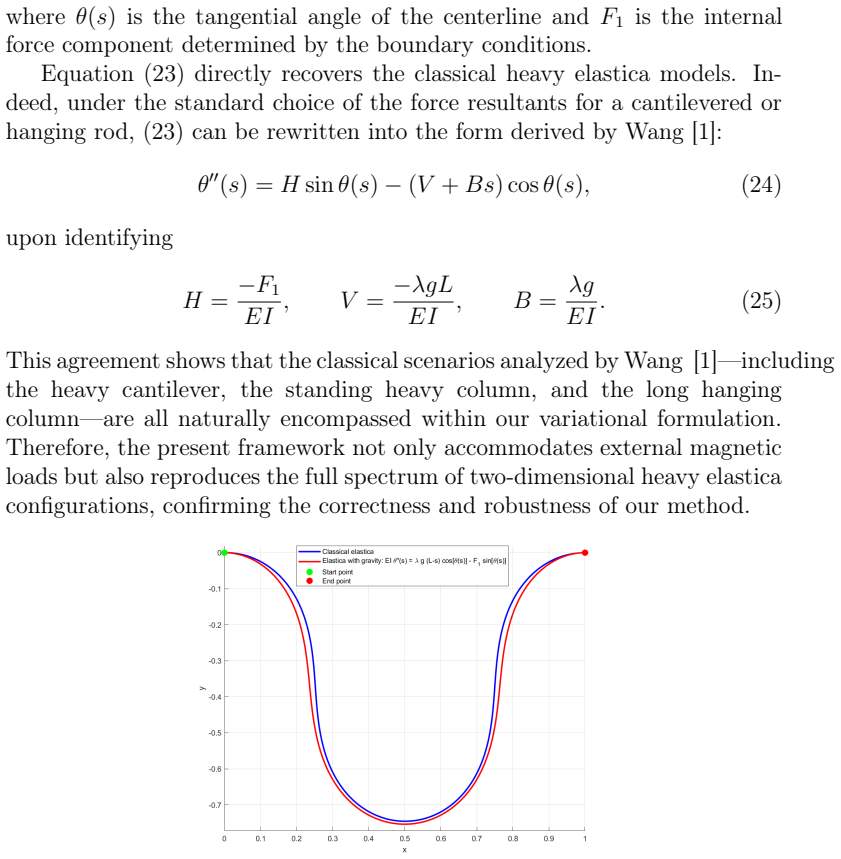
- [Figure 1] The figure caption refers to a 'corrected equation' but the correction is never identified in the text. The figure is also not described in the body of the paper, making its role unclear.
Circularity Check
No significant circularity: the derivation is self-contained and validated against external benchmarks.
full rationale
The paper's derivation chain starts from a physical energy functional and applies Fubini's theorem to rewrite nested load integrals in terms of cumulative field functions. It then forms an Euler-Lagrange equation and compares the result with the external heavy-elastica results of Wang [1] and hard-magnetic-rod results of Sano et al. [3]. No parameters are fitted to those benchmark results, and no self-citations appear: references [1], [2], and [3] are works by other authors. The Fubini reduction is a mathematical identity, not an ansatz defined in terms of the target equations. The conclusion explicitly states a limitation ('the accumulated field functions such as Ba_x are assumed to be known a priori'), which narrows the claim but does not make the argument circular. The apparent mismatch between Eq. (10) and Eq. (11) noted by a skeptical reader is a mathematical correctness concern about the Euler-Lagrange variation, not a circular-reasoning concern; the equation is not shown to be equivalent to its inputs by construction. Therefore, under the circularity rubric, the paper receives no circularity score.
Assumptions & free parameters
assumptions (5)
- standard math Fubini's theorem for triangular integration domains (Section 2, Eq. (1)-(3))
- domain assumption Planar, inextensible rod with arc-length parametrization and tangent angle θ (Section 2)
- domain assumption Euler-Bernoulli bending energy EI/2 ∫ (θ')² ds (Eq. (5))
- domain assumption Magnetic moment aligns with tangent and deformation gradient F=1 (Section 3)
- ad hoc to paper Cumulative field functions K(s) are known a priori, independent of θ (Conclusion)
Cite this review
Pith. "Pith review of A Unified Variational Framework for Planar Elastica with General Distributed Loads." pith.science (2026). https://pith.science/paper/5R4TDOGI
@misc{pith2026251208958,
  author       = {Pith},
  title        = {Pith review of: A Unified Variational Framework for Planar Elastica with General Distributed Loads},
  year         = {2026},
  howpublished = {\url{https://pith.science/paper/5R4TDOGI}},
  note         = {Machine review of arXiv:2512.08958}
}
read the original abstract
We present a simple variational framework for planar elastica that enables distributed energies, such as gravitational loading or magnetic body torques, to be incorporated in a modular and unified manner. The formulation is based on expressing all load induced contributions directly at the level of the energy functional, which avoids the force balance constructions used in classical treatments such as Wang (1986) and makes the inclusion of additional physical effects straightforward. The resulting planar energy functional yields compact governing equations in which the contributions of individual load types remain clearly separated. We demonstrate that the framework reproduces the classical heavy elastica equations exactly and naturally accommodates magnetic energy terms commonly used in hard magnetic rod models. Although mathematically elementary, the formulation provides a clean and extensible structure for describing planar rod deformations under general distributed loads.
Figures
Reference graph
Works this paper leans on
-
[1]
Wang,A critical review of the heavy elastica, International Journal of Mechanical Sciences, vol
C.Y. Wang,A critical review of the heavy elastica, International Journal of Mechanical Sciences, vol. 28, no. 8, pp. 549–559, 1986
1986
-
[2]
Love,A Treatise on the Mathematical Theory of Elasticity, Cam- bridge, 1892
A.E.H. Love,A Treatise on the Mathematical Theory of Elasticity, Cam- bridge, 1892
-
[3]
T.G. Sano, M. Pezzulla, P.M. Reis,A Kirchhoff-like theory for hard magnetic rods under geometrically nonlinear deformation in three di- mensions, Journal of the Mechanics and Physics of Solids, 160, 104739, 2022. 8
2022
Reviewed August 3, 2026 · model on record in the stance chip above.
Discussion (0). Continue with ORCID to comment.