Dark-State-Mediated Efficient Energy Trapping in a Model GFP Chromophore
Pith reviewed 2026-05-16 23:30 UTC · model grok-4.3
The pith
An optically dark charge-transfer state forms in 100 fs and lives 94 ps in the meta-GFP chromophore anion, trapping energy by quenching electron emission.
A machine-rendered reading of the paper's core claim, the machinery that carries it, and where it could break.
Core claim
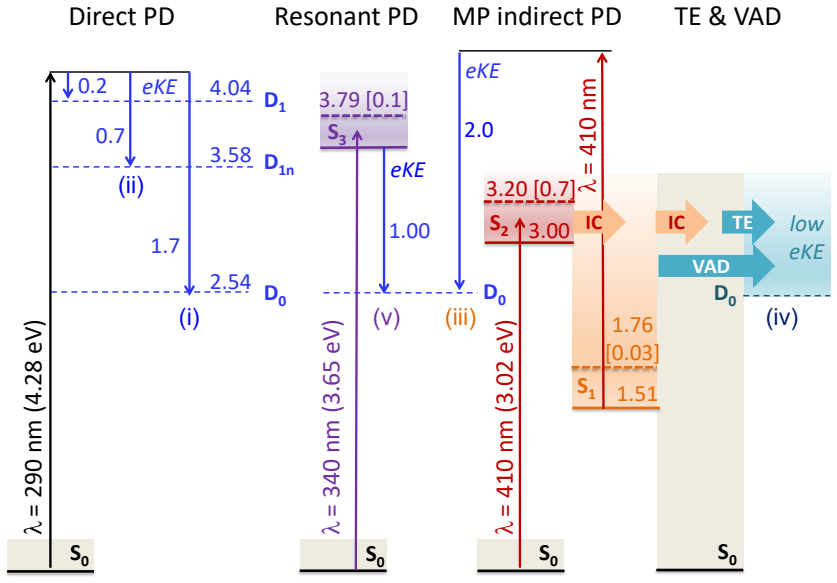
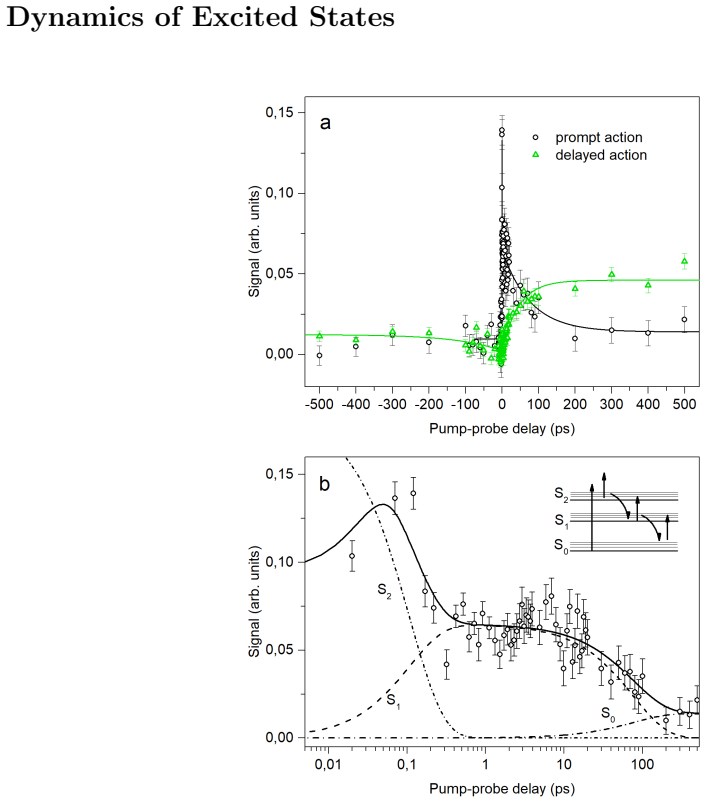
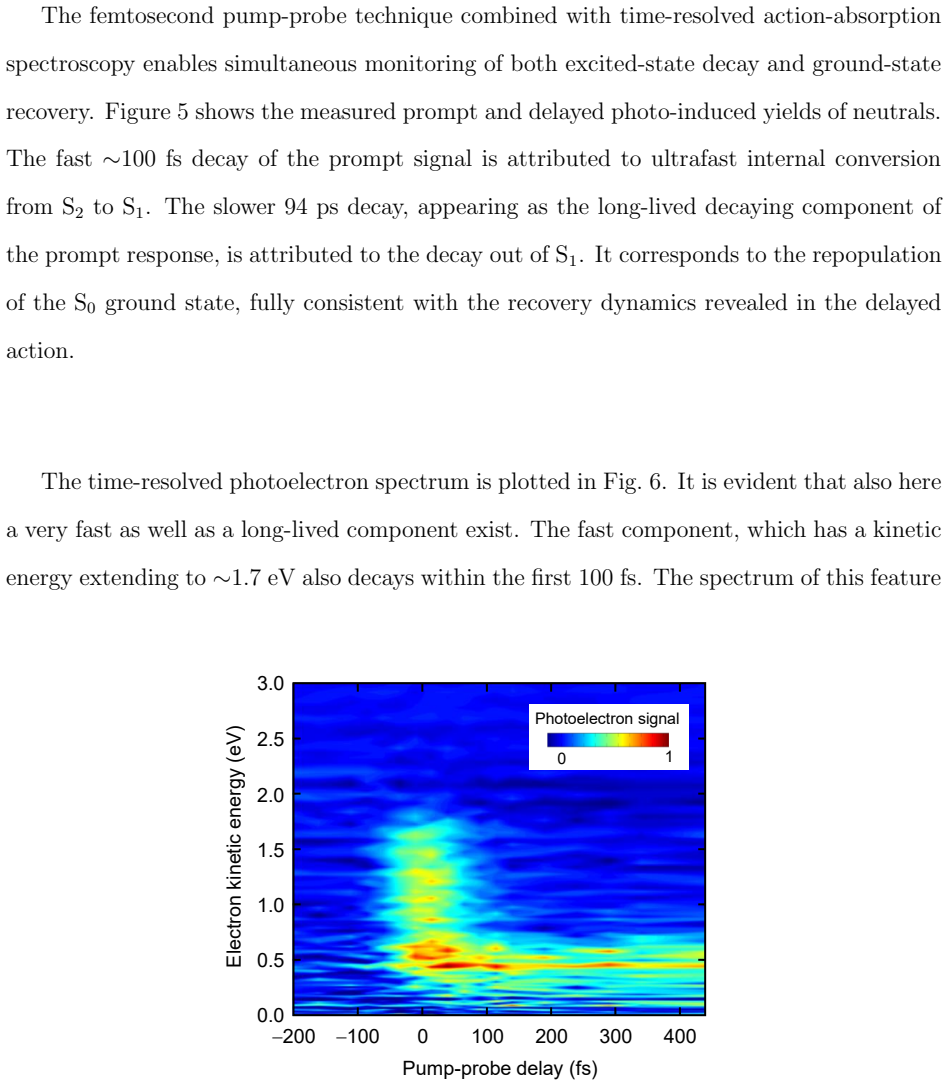
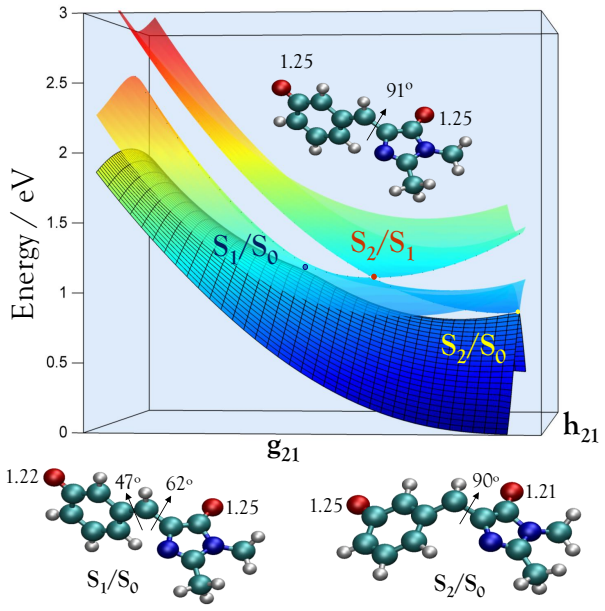
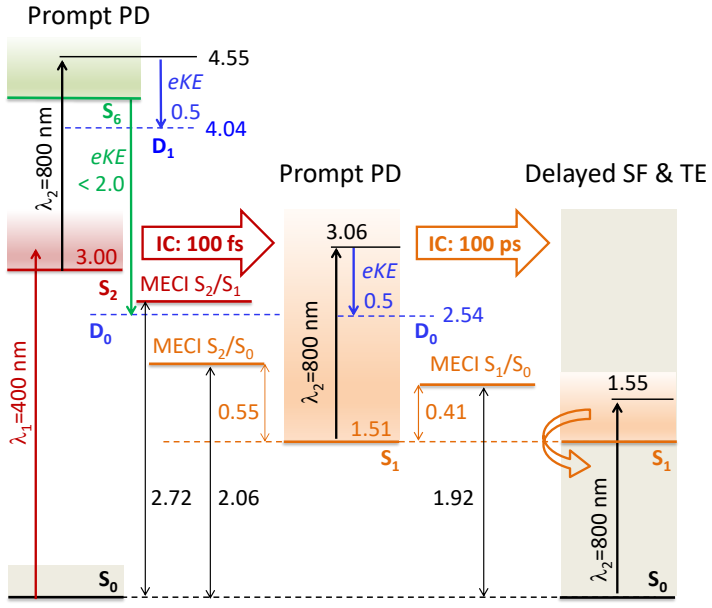
We report the direct observation and full characterization of an optically dark, low-lying singlet excited state in the isolated anion of the meta green fluorescent protein chromophore. Using ultrafast time-resolved action-absorption and photoelectron spectroscopy, we capture the formation of this state in 100 fs and measure its lifetime of 94 ps. High-level ab initio calculations assign the state charge-transfer character and reveal the trapping mechanism: ultrafast internal conversion quenches electron emission, stabilizing long-lived electronic excitation even above the detachment threshold.
What carries the argument
The optically dark, low-lying singlet excited state with charge-transfer character that mediates ultrafast internal conversion to trap excitation energy.
If this is right
- The anion can maintain long-lived electronic excitation without losing an electron.
- Ultrafast internal conversion into the dark state supplies photoprotection in biomolecular anions.
- The interplay between bright and dark states controls the functional properties of photoactive proteins.
- Energy trapping occurs without requiring fluorescence or photon emission.
Where Pith is reading between the lines
- Analogous dark states may operate in the chromophores of other fluorescent proteins and could be tested by the same spectroscopy.
- The 94 ps lifetime suggests the state could serve as a temporary energy reservoir in molecular systems.
- Modifying the charge-transfer character through chemical substitution might tune the trapping efficiency for designed light-harvesting anions.
Load-bearing premise
The high-level ab initio calculations must reproduce the measured spectra and dynamics without significant systematic errors in energies or couplings.
What would settle it
A time-resolved experiment that either fails to detect a long-lived intermediate after 100 fs or measures a lifetime far from 94 ps while the excitation energy remains above the detachment threshold would falsify the trapping claim.
Figures
read the original abstract
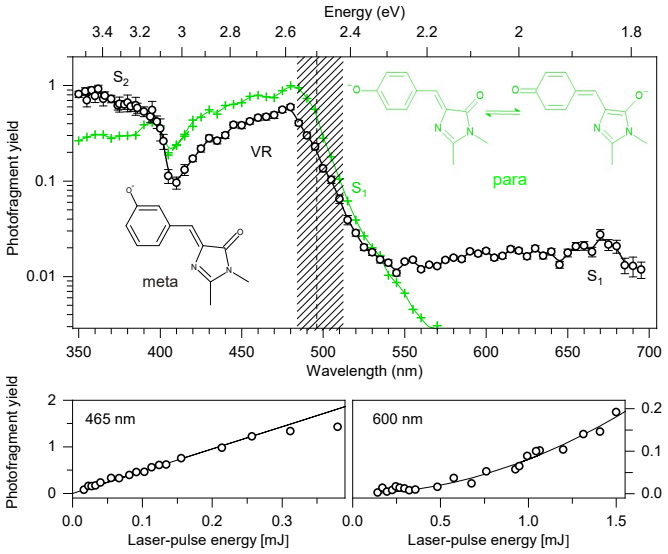
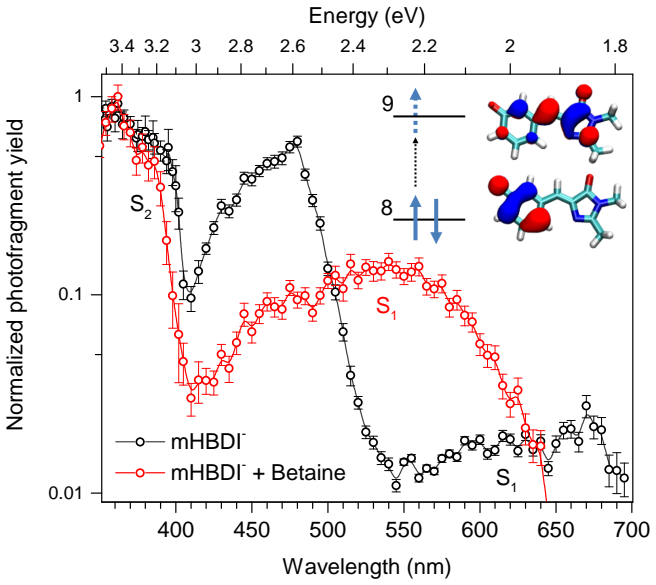
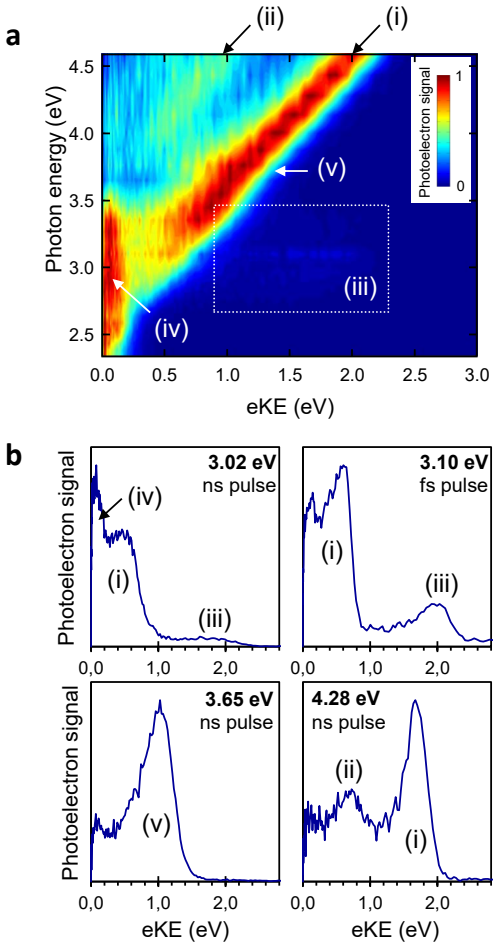
The functional properties of photoactive proteins are governed by the interplay between bright and dark excited states. While the bright states are well-studied, the dark states, which are fundamental to photostability and light harvesting, are notoriously difficult to characterize. Here, we report the direct observation and full characterization of an optically dark, low-lying singlet excited state in the isolated anion of the meta green fluorescent protein (GFP) chromophore. Using a combination of ultrafast time-resolved action-absorption and photoelectron spectroscopy, we have captured the formation of this state in 100 fs and measured its remarkably long lifetime of 94 ps. We unambiguously assign its charge-transfer character and reveal the precise trapping mechanism through high-level ab initio calculations. Our findings uncover a photoprotective mechanism in biomolecular anions where ultrafast internal conversion quenches electron emission, stabilizing long-lived electronic excitation even when the energy exceeds the electron detachment threshold.
Editorial analysis
A structured set of objections, weighed in public.
Referee Report
Summary. The manuscript reports the direct observation via ultrafast time-resolved action-absorption and photoelectron spectroscopy of an optically dark low-lying singlet excited state in the isolated meta-GFP chromophore anion, with formation in 100 fs and a lifetime of 94 ps. High-level ab initio calculations assign charge-transfer character to this state and identify the trapping mechanism as ultrafast internal conversion that quenches electron emission, even above the detachment threshold, thereby revealing a photoprotective pathway in biomolecular anions.
Significance. If the central claim holds, the work provides a concrete experimental characterization of a dark state that enables long-lived electronic excitation in an anionic chromophore, with computational support for the internal-conversion trapping route. This advances understanding of photostability and energy management in GFP-like systems and offers a model for how dark states can suppress photodetachment in anions.
major comments (1)
- [Computational Results] The unambiguous assignment of charge-transfer character and the precise trapping mechanism (internal conversion within 100 fs) rests on the ab initio calculations reproducing the experimental timescales and spectra. The manuscript must include explicit comparison of computed vs. measured photoelectron spectra and the location of the relevant conical intersection on the PES (e.g., in the Computational Results or SI section) to demonstrate that state ordering and barrier heights are not subject to the 0.2–0.5 eV systematic shifts common in anionic excited-state methods near the detachment threshold.
minor comments (1)
- [Introduction] The abstract states the experimental timescales clearly, but the main text should define all acronyms (e.g., ADC, EOM-CCSD) at first use and provide error estimates on the reported 100 fs and 94 ps values.
Simulated Author's Rebuttal
We thank the referee for the positive assessment of our work and for the constructive comment. We address the major point below and have revised the manuscript to incorporate the requested comparisons.
read point-by-point responses
-
Referee: [Computational Results] The unambiguous assignment of charge-transfer character and the precise trapping mechanism (internal conversion within 100 fs) rests on the ab initio calculations reproducing the experimental timescales and spectra. The manuscript must include explicit comparison of computed vs. measured photoelectron spectra and the location of the relevant conical intersection on the PES (e.g., in the Computational Results or SI section) to demonstrate that state ordering and barrier heights are not subject to the 0.2–0.5 eV systematic shifts common in anionic excited-state methods near the detachment threshold.
Authors: We agree that explicit validation against experiment is required to confirm the state ordering and to rule out method-dependent shifts near the detachment threshold. In the revised manuscript we have added a direct overlay of the computed and measured photoelectron spectra in the Computational Results section, together with a quantitative discussion of the agreement in peak positions and intensities. We have also included in the SI the optimized geometry and energy of the relevant conical intersection, the minimum-energy path connecting the bright state to the dark charge-transfer state, and the computed barrier heights (all obtained at the same level of theory used for the spectra). These additions show that the internal-conversion timescale is consistent with the experimental 100 fs formation and that the dark state lies below the detachment threshold, thereby supporting the photoprotective trapping mechanism. revision: yes
Circularity Check
No significant circularity detected
full rationale
The paper's core results consist of direct experimental measurements (100 fs formation time and 94 ps lifetime obtained via time-resolved action-absorption and photoelectron spectroscopy) that are independent of the subsequent ab initio calculations used only for state assignment and mechanism interpretation. No load-bearing step reduces by construction to a fitted parameter, self-citation chain, or ansatz smuggled from prior work; the experimental observables stand on their own and the calculations are presented as a separate interpretive tool rather than a re-derivation of the measured timescales.
Axiom & Free-Parameter Ledger
axioms (1)
- standard math Standard assumptions underlying high-level ab initio calculations for molecular excited states (e.g., basis set completeness, electron correlation treatment)
Lean theorems connected to this paper
-
IndisputableMonolith/Cost/FunctionalEquation.leanwashburn_uniqueness_aczel unclear?
unclearRelation between the paper passage and the cited Recognition theorem.
We unambiguously assign its charge-transfer character and reveal the precise trapping mechanism through high-level ab initio calculations... Three conical intersections (CI) are located that interconnect the S2, S1, and S0 states... The XMCQDPT2/SA(3)-CASSCF(16,14)/(aug)-cc-pVDZ barrier of 0.41 eV
-
IndisputableMonolith/Foundation/AlphaCoordinateFixation.leanalpha_pin_under_high_calibration unclear?
unclearRelation between the paper passage and the cited Recognition theorem.
The calculated vertical excitation energy of the S0 → S1 transition is 1.76 eV (704 nm) with an oscillator strength of 0.03... rotation around the bridge C=C bond serves as the key reaction coordinate
What do these tags mean?
- matches
- The paper's claim is directly supported by a theorem in the formal canon.
- supports
- The theorem supports part of the paper's argument, but the paper may add assumptions or extra steps.
- extends
- The paper goes beyond the formal theorem; the theorem is a base layer rather than the whole result.
- uses
- The paper appears to rely on the theorem as machinery.
- contradicts
- The paper's claim conflicts with a theorem or certificate in the canon.
- unclear
- Pith found a possible connection, but the passage is too broad, indirect, or ambiguous to say the theorem truly supports the claim.
Reference graph
Works this paper leans on
-
[1]
Ultrafast Dynamics of Carotenoid Excited States From Solution to Natural and Artificial Systems
Pol\` i vka, T.; Sundstr \"o m, V. Ultrafast Dynamics of Carotenoid Excited States From Solution to Natural and Artificial Systems. Chem. Rev. 2004, 104, 2021--2072
work page 2004
-
[2]
Scholes, G. D.; Fleming, G. R.; Olaya-Castro, A.; van Grondelle, R. Lessons from nature about solar light harvesting. Nat. Chem. 2011, 3, 763--774
work page 2011
-
[3]
Berera, R.; van Stokkum, I. H. M.; Gwizdala, M.; Wilson, A.; Kirilovsky, D.; van Grondelle, R. The Photophysics of the Orange Carotenoid Protein, a Light-Powered Molecular Switch. J. Phys. Chem. B 2012, 116, 2568--2574
work page 2012
-
[4]
Frank, H. A.; Bautista, J. A.; Josue, J.; Pendon, Z.; Hiller, R. G.; Sharples, F. P.; Gosztola, D.; Wasielewski, M. R. Effect of the Solvent Environment on the Spectroscopic Properties and Dynamics of the Lowest Excited States of Carotenoids. J. Phys. Chem. B 2000, 104, 4569--4577
work page 2000
-
[5]
Wise, K. J.; Gillespie, N. B.; Stuart, J. A.; Krebs, M. P.; Birge, R. R. Optimization of bacteriorhodopsin for bioelectronic devices. Trends Biotechnol. 2002, 20, 387 -- 394
work page 2002
-
[6]
Bhuckory, S.; Kays, J. C.; Dennis, A. M. In Vivo Biosensing Using Resonance Energy Transfer. Biosensors 2019, 9, 76
work page 2019
-
[7]
Photodegradation and photostabilization of polymers, especially polystyrene: review
Yousif, E.; Haddad, R. Photodegradation and photostabilization of polymers, especially polystyrene: review. SpringerPlus 2013, 2, 398
work page 2013
-
[8]
Rocha-Rinza, T.; Christiansen, O.; Rahbek, D. B.; Kl rke, B.; Andersen, L. H.; Lincke, K.; Nielsen, M. B. Spectroscopic Implications of the Electron Donor - Acceptor Effect in the Photoactive Yellow Protein Chromophore. Chem. Eur. J. 2010, 16, 11977--11984
work page 2010
-
[9]
Dong, J.; Solntsev, K. M.; Poizat, O.; Tolbert, L. M. The Meta-Green Fluorescent Protein Chromophore. J. Am. Chem. Soc. 2007, 129, 10084--10085
work page 2007
-
[10]
M.; Poizat, O.; Dong, J.; Rehault, J.; Lou, Y.; Burda, C.; Tolbert, L
Solntsev, K. M.; Poizat, O.; Dong, J.; Rehault, J.; Lou, Y.; Burda, C.; Tolbert, L. M. Meta and Para Effects in the Ultrafast Excited-State Dynamics of the Green Fluorescent Protein Chromophores. J. Phys. Chem. B 2008, 112, 2700–-2711
work page 2008
-
[11]
Bochenkova, A. V.; Kl rke, B.; Rahbek, D. B.; Rajput, J.; Toker, Y.; Andersen, L. H. UV Excited-State Photoresponse of Biochromophore Negative Ions. Angew. Chem. Int. Ed. 2014, 53, 9797--9801
work page 2014
-
[12]
B.; Lapierre, A.; Andersen, J.; Pedersen, U.; Tomita, S.; Andersen, L
Nielsen, S. B.; Lapierre, A.; Andersen, J.; Pedersen, U.; Tomita, S.; Andersen, L. Absorption spectrum of the green fluorescent protein chromophore anion in vacuo. Phys. Rev. Lett. 2001, 87, 228102
work page 2001
-
[13]
Andersen, L.; Bluhme, H.; Boy \'e , S.; J rgensen, T.; Krogh, H.; Nielsen, I.; Nielsen, S. B.; Svendsen, A. Experimental studies of the photophysics of gas-phase fluorescent protein chromophores. Phys. Chem. Chem. Phys. 2004, 6, 2617--2627
work page 2004
-
[14]
Svendsen, A.; Kiefer, H. V.; Pedersen, H. B.; Bochenkova, A. V.; Andersen, L. H. Origin of the intrinsic fluorescence of the green fluorescent protein. J. Am. Chem. Soc. 2017, 139, 8766--8771
work page 2017
-
[15]
V.; Gruber, E.; Langeland, J.; Kusochek, P
Kiefer, H. V.; Gruber, E.; Langeland, J.; Kusochek, P. A.; Bochenkova, A. V.; Andersen, L. H. Intrinsic photoisomerization dynamics of protonated Schiff-base retinal. Nat. Commun. 2019, 10, 1210
work page 2019
-
[16]
West, C. W.; Bull, J. N.; Antonkov, E.; Verlet, J. R. R. Anion Resonances of para-Benzoquinone Probed by Frequency-Resolved Photoelectron Imaging. J. Phys. Chem. A 2014, 118, 11346--11354
work page 2014
-
[17]
Anstöter, C. S.; Bull, J. N.; Verlet, J. R. Ultrafast dynamics of temporary anions probed through the prism of photodetachment. Int. Rev. Phys. Chem. 2016, 35, 509--538
work page 2016
-
[18]
Bochenkova, A. V. Multiconfigurational Methods Including XMCQDPT2 Theory for Excited States of Light-Sensitive Biosystems. In Comprehensive Computational Chemistry (First Edition); Yáñez, M., Boyd, R. J., Eds.; Elsevier: Oxford, 2024; pp 141--157
work page 2024
-
[19]
Bochenkova, A. V.; Andersen, L. H. Ultrafast dual photoresponse of isolated biological chromophores: link to the photoinduced mode-specific non-adiabatic dynamics in proteins. Faraday Discuss. 2013, 163, 297--319
work page 2013
-
[20]
Bochenkova, A. V.; Mooney, C. R. S.; Parkes, M. A.; Woodhouse, J. L.; Zhang, L.; Lewin, R.; Ward, J. M.; Hailes, H. C.; Andersen, L. H.; Fielding, H. H. Mechanism of resonant electron emission from the deprotonated GFP chromophore and its biomimetics. Chem. Sci. 2017, 8, 3154--3163
work page 2017
-
[21]
Tsien, R. Y. The Green Fluorescent Protein. Annu. Rev. Biochem. 1998, 67, 509--544
work page 1998
-
[22]
Andersen, L. H.; Rasmussen, A. P.; Pedersen, H. B.; Beletsan, O. B.; Bochenkova, A. V. High- Resolution Spectroscopy and Selective Photoresponse of Cryogenically Cooled Green Fluorescent Protein Chromophore Anions . J. Phys. Chem. Lett. 2023, 14, 6395--6401
work page 2023
-
[23]
Direct and indirect electron emission from the green fluorescent protein chromophore
Toker, Y.; Rahbek, D.; Kl rke, B.; Bochenkova, A.; Andersen, L. Direct and indirect electron emission from the green fluorescent protein chromophore. Phys. Rev. Lett. 2012, 109, 128101
work page 2012
-
[24]
Kiefer, H. V.; Pedersen, H. B.; Bochenkova, A. V.; Andersen, L. H. Decoupling Electronic versus Nuclear Photoresponse of Isolated Green Fluorescent Protein Chromophores Using Short Laser Pulses. Phys. Rev. Lett. 2016, 117, 243004
work page 2016
-
[25]
S.; Mensa-Bonsu, G.; Nag, P.; Rankovi c \' c , M
Anst\"oter, C. S.; Mensa-Bonsu, G.; Nag, P.; Rankovi c \' c , M. c. v.; Kumar T. P., R.; Boichenko, A. N.; Bochenkova, A. V.; Fedor, J.; Verlet, J. R. R. Mode-Specific Vibrational Autodetachment Following Excitation of Electronic Resonances by Electrons and Photons. Phys. Rev. Lett. 2020, 124, 203401
work page 2020
-
[26]
Andersen, L. H.; Rasmussen, A. P.; Pedersen, H. B.; Klinkby, N. Valence (S1) and nonvalence (dipole-bound) spectroscopy of chromophore models of the photoactive yellow protein probed by cryogenic action spectroscopy. Phys. Rev. A 2025, 112, 022821
work page 2025
-
[27]
H.; Boesen, M.; Houm ller, J.; Nielsen, S
Stockett, M. H.; Boesen, M.; Houm ller, J.; Nielsen, S. B. Accessing the Intrinsic Nature of Electronic Transitions from Gas-Phase Spectroscopy of Molecular Ion/Zwitterion Complexes. Angew. Chem. Int. Ed. 2017, 56, 3490--3495
work page 2017
-
[28]
Dielectric relaxation behavior of glycine betaine in aqueous solution
Shikata, T. Dielectric relaxation behavior of glycine betaine in aqueous solution. J. Phys. Chem. A 2002, 106, 7664--7670
work page 2002
-
[29]
Toker, Y.; Langeland, J.; Gruber, E.; Kj r, C.; Nielsen, S. B.; Andersen, L. H.; Borin, V. A.; Schapiro, I. Counterion-controlled spectral tuning of the protonated S chiff-base retinal. Phys. Rev. A 2018, 98, 043428
work page 2018
-
[30]
Langeland, J.; Kj r, C.; Andersen, L. H.; Nielsen, S. B. The Effect of an Electric Field on the Spectroscopic Properties of the Isolated Green Fluorescent Protein Chromophore Anion. ChemPhysChem 2018, 19, 1686--1690
work page 2018
-
[31]
Mensa-Bonsu, G.; Lietard, A.; Tozer, D. J.; Verlet, J. R. R. Low energy electron impact resonances of anthracene probed by 2D photoelectron imaging of its radical anion. J. Chem. Phys. 2020, 152, 174303
work page 2020
-
[32]
Lietard, A.; Verlet, J. R. R.; Slimak, S.; Jordan, K. D. Temporary Anion Resonances of Pyrene: A 2D Photoelectron Imaging and Computational Study. J. Phys. Chem. A 2021, 125, 7004--7013
work page 2021
-
[33]
Granovsky, A. A. Extended multi-configuration quasi-degenerate perturbation theory: The new approach to multi-state multi-reference perturbation theory. J. Chem. Phys. 2011, 134, 214113
work page 2011
-
[34]
Campbell, E. E. B.; Ulmer, G.; Hertel, I. V. Delayed ionization of C _ 60 and C _ 70 . Phys. Rev. Lett. 1991, 67, 1986--1988
work page 1991
-
[35]
A.; Li, Q.; Blancafort, L.; Verlet, J
Horke, D. A.; Li, Q.; Blancafort, L.; Verlet, J. R. R. Ultrafast above-threshold dynamics of the radical anion of a prototypical quinone electron-acceptor. Nat. Chem. 2013, 5, 711--717
work page 2013
-
[36]
Bull, J. N.; West, C. W.; Verlet, J. R. R. On the formation of anions: frequency- , angle- , and time-resolved photoelectron imaging of the menadione radical anion. Chem. Sci. 2015, 6, 1578--1589
work page 2015
-
[37]
West, C. W.; Bull, J. N.; Hudson, A. S.; Cobb, S. L.; Verlet, J. R. R. Excited State Dynamics of the Isolated Green Fluorescent Protein Chromophore Anion Following UV Excitation. J. Phys. Chem. B 2015, 119, 3982--3987
work page 2015
-
[38]
Pedersen, H. B.; Svendsen, A.; Harbo, L. S.; Kiefer, H. V.; Kjeldsen, H.; Lammich, L.; Toker, Y.; Andersen, L. H. Characterization of a new electrostatic storage ring for photofragmentation experiments. Rev. Sci. Instrum. 2015, 86, 063107
work page 2015
-
[39]
Lecointre, J.; Roberts, G. M.; Horke, D. A.; Verlet, J. R. R. Ultrafast Relaxation Dynamics Observed Through Time-Resolved Photoelectron Angular Distributions. J. Phys. Chem. A 2010, 114, 11216--11224
work page 2010
-
[40]
Granovsky, A. A. Firefly version 8. http://classic.chem.msu.su, Accessed on December 09, 2025 mcitethebibliography document
work page 2025
discussion (0)
Sign in with ORCID, Apple, or X to comment. Anyone can read and Pith papers without signing in.