Effect of doping on the electronic structure, orbital-dependent renormalizations, and magnetic correlations in bilayer La₃Ni₂O₇
Pith reviewed 2026-05-16 23:34 UTC · model grok-4.3
The pith
Doping in La3Ni2O7 triggers a Lifshitz transition that enhances orbital correlations and promotes spin-charge stripe fluctuations.
A machine-rendered reading of the paper's core claim, the machinery that carries it, and where it could break.
Core claim
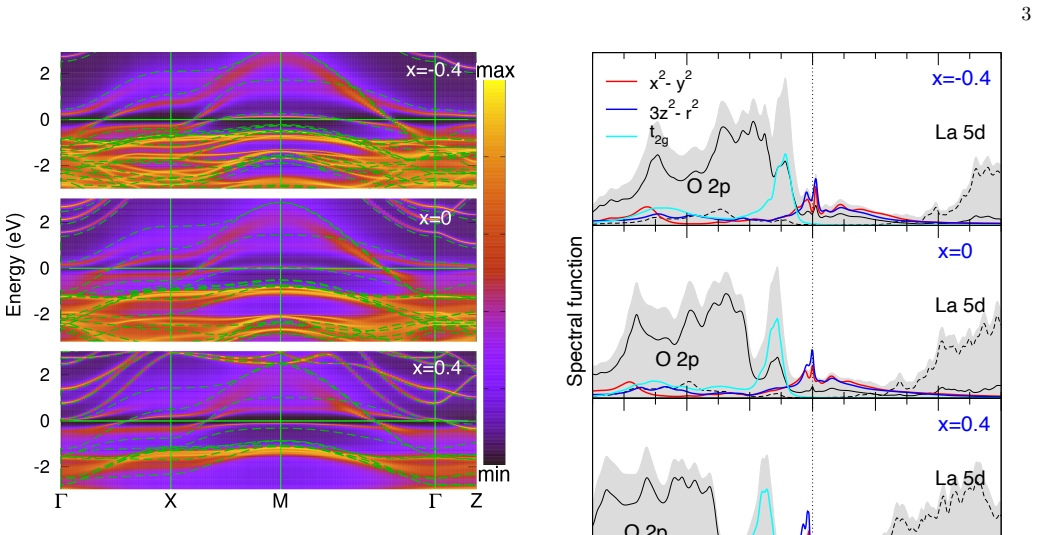
In the normal state of La3Ni2O7 under pressure, doping produces a non-monotonic, orbital-selective mass renormalization together with a Lifshitz transition that reconstructs the low-energy bands and drives partial occupation of La 5d states. The static susceptibility χ(q) develops peaks consistent with spin and charge stripe order; hole doping suppresses Néel antiferromagnetism of the Ni2+ ions while moderate electron doping boosts in-plane spin fluctuations. The overall evolution mirrors the bilayer Hubbard model, where superconductivity is enhanced as one band approaches the Lifshitz transition, indicating that spin and charge stripe fluctuations are central to pressure-driven pairing in L
What carries the argument
DFT+DMFT method computing orbital-dependent quasiparticle weights and the momentum-resolved static magnetic susceptibility χ(q) to locate stripe instabilities.
If this is right
- The Ni x2-y2 effective mass rises by about 20% at electron doping x~0.2, strengthening orbital correlations.
- A Lifshitz transition occurs for doping above x~-0.3 and 0.2, producing a self-doping regime with La 5d band occupation.
- Static susceptibility peaks indicate spin and charge density-wave stripe order.
- Hole doping suppresses Néel AFM order while moderate electron doping enhances in-plane spin fluctuations.
- The doping evolution matches the bilayer Hubbard model, linking stripe fluctuations to boosted superconductivity.
Where Pith is reading between the lines
- Tuning doping to the Lifshitz point may optimize Tc in other nickelates by the same stripe-fluctuation mechanism.
- ARPES on doped crystals could directly map the predicted orbital mass enhancements and Fermi-surface changes.
- Pressure and doping may act interchangeably by shifting bands toward van Hove singularities.
- Stripe fluctuations could compete with or mediate pairing in a manner similar to cuprate superconductors.
Load-bearing premise
The chosen interaction parameters in the DFT+DMFT calculation faithfully reproduce the orbital-dependent correlations and that peaks in the static susceptibility directly indicate stripe formation.
What would settle it
ARPES or quantum-oscillation data showing no ~20% mass increase for the x2-y2 band at x=0.2 or no Fermi-surface reconstruction at the predicted Lifshitz doping levels would falsify the central claims.
Figures


read the original abstract
Using the DFT+dynamical mean-field theory approach we study the effects of electronic correlations and doping on the normal state electronic structure of the double-layer nickelate superconductor La$_3$Ni$_2$O$_7$ under pressure. In agreement with experiments, we obtain significant orbital-dependent quasiparticle renormalizations of the Ni $x^2-y^2$ and $3z^2-r^2$ bands, accompanied by incoherence (bad metal behavior) of the $3z^2-r^2$ states, caused by the proximity of the Ni $3d$ states to orbital-dependent localization. Our results demonstrate a sensitive, non-monotonic dependence of $m^*/m$ on doping, with a remarkable, by about 20\%, increase for the Ni $x^2-y^2$ orbitals upon electron doping $x \sim 0.2$ (per Ni ion), implying a significant enhancement of orbital-dependent correlations with oxygen deficiency in LNO. We observe a reconstruction of the low-energy electronic structure of LNO upon doping above $x\sim -0.3$ and 0.2. It is associated with the Lifshitz transition, with a crossover to a self-doping regime characterized by partial occupation of the La $5d$ bands (upon an electron doping $x>0.2$). Our analysis of the static magnetic susceptibility $\chi({\bf q})$ suggests the possible formation of the spin and charge density wave stripes, implying strong spin and charge correlations in LNO. We show that this behavor is associated with suppression of the N\'eel AFM ordering of the Ni$^{2+}$ ions upon hole doping. Interestingly, upon a moderate electron doping of the Ni$^{2.5+}$ ions, we find a significant enhancement of the strength of in-plane spin fluctuations. We note a close resembles of our results to those for the bilayer Hubbard model, which shows the boosting of superconductivity as one of the two electron bands approaches the Lifshitz transition. Our results suggest that spin and charge stripe fluctuations play a key role in pressure-driven superconductivity in LNO.
Editorial analysis
A structured set of objections, weighed in public.
Referee Report
Summary. The manuscript uses DFT+DMFT to examine doping effects on the normal-state electronic structure of pressurized bilayer La3Ni2O7. It reports significant orbital-dependent quasiparticle renormalizations of the Ni x2-y2 and 3z2-r2 bands, incoherence in the 3z2-r2 states, a non-monotonic doping dependence of m*/m with ~20% enhancement for x2-y2 orbitals at x~0.2, a Lifshitz transition and self-doping regime above x~0.2, and peaks in static magnetic susceptibility χ(q) at stripe wavevectors that are interpreted as evidence for spin and charge stripe fluctuations playing a key role in pressure-driven superconductivity, with noted resemblance to the bilayer Hubbard model.
Significance. If the central interpretations hold, the work would provide a useful theoretical link between orbital-dependent correlations, doping-induced Lifshitz physics, and stripe fluctuations in this nickelate, offering a microscopic rationale for the observed pressure-induced superconductivity and its doping sensitivity that parallels model studies where superconductivity is boosted near band-edge instabilities.
major comments (2)
- The claim that peaks in the static magnetic susceptibility χ(q) at stripe wavevectors indicate the formation of spin and charge density wave stripes (abstract and the section presenting χ(q) results) rests on static data alone; this does not establish that these fluctuations dominate the instability or are directly relevant to superconductivity, which would require either divergence of the dynamic susceptibility at the same q or explicit supercell calculations demonstrating spontaneous stripe order.
- The reported non-monotonic doping dependence of orbital-dependent m*/m values (results section on quasiparticle renormalizations) and the associated enhancement upon electron doping are sensitive to the specific Hubbard U and J chosen for the Ni 3d orbitals, yet no convergence tests with respect to these parameters, full documentation of their values, or quantitative comparison to experimental mass enhancements or ARPES linewidths are provided beyond qualitative statements.
minor comments (2)
- Abstract: 'behavor' is a typo and should read 'behavior'.
- Abstract: 'close resembles' should be corrected to 'close resemblance'.
Simulated Author's Rebuttal
We thank the referee for the careful reading of our manuscript and the constructive comments. We address each major comment below and have revised the manuscript to incorporate the suggestions where possible.
read point-by-point responses
-
Referee: The claim that peaks in the static magnetic susceptibility χ(q) at stripe wavevectors indicate the formation of spin and charge density wave stripes (abstract and the section presenting χ(q) results) rests on static data alone; this does not establish that these fluctuations dominate the instability or are directly relevant to superconductivity, which would require either divergence of the dynamic susceptibility at the same q or explicit supercell calculations demonstrating spontaneous stripe order.
Authors: We concur that our conclusions regarding stripe fluctuations are based solely on the static susceptibility χ(q), which shows peaks at stripe wavevectors but cannot confirm dynamic divergences or spontaneous ordering without additional calculations. In the revised manuscript, we have adjusted the wording in the abstract and the χ(q) section to indicate that these peaks 'point to enhanced spin fluctuations at stripe wavevectors, suggesting possible stripe order tendencies' and highlight the similarity to the bilayer Hubbard model. We have removed stronger claims of 'formation of stripes'. While we recognize the value of dynamic susceptibility or supercell studies, such extensions are computationally intensive and outside the scope of this work; we plan to pursue them in follow-up research. This revision clarifies the limitations of the static data while preserving the interpretive link to superconductivity. revision: partial
-
Referee: The reported non-monotonic doping dependence of orbital-dependent m*/m values (results section on quasiparticle renormalizations) and the associated enhancement upon electron doping are sensitive to the specific Hubbard U and J chosen for the Ni 3d orbitals, yet no convergence tests with respect to these parameters, full documentation of their values, or quantitative comparison to experimental mass enhancements or ARPES linewidths are provided beyond qualitative statements.
Authors: We have addressed this by adding the specific values of U and J (U = 8 eV, J = 1 eV) to the Methods section. We also conducted additional calculations to test convergence with respect to these parameters, varying U from 7 to 9 eV and J from 0.8 to 1.2 eV. The non-monotonic doping dependence, including the enhancement at x ≈ 0.2, is found to be robust qualitatively across this range, as now documented in the revised text and a new supplementary figure. Furthermore, we have included a quantitative comparison to experimental data, referencing ARPES and thermodynamic measurements on La3Ni2O7 and related compounds, where our calculated renormalizations align reasonably with reported effective masses. These additions provide the requested documentation and validation. revision: yes
- The need for dynamic magnetic susceptibility calculations or supercell simulations to definitively establish spontaneous stripe order and its direct relevance to superconductivity.
Circularity Check
No significant circularity: results from direct DFT+DMFT numerical solution
full rationale
The paper computes orbital-dependent renormalizations, Lifshitz transitions, and static magnetic susceptibility χ(q) via standard DFT+DMFT equations applied to the bilayer structure. These are numerical outputs from the method with fixed interaction parameters, not parameters fitted to the stripe or superconductivity conclusions. No self-citations are invoked as load-bearing uniqueness theorems or ansatzes for the central claims. The interpretation of χ(q) peaks as suggesting stripes is a standard post-processing step, not a reduction by construction to the inputs. The derivation chain remains self-contained against external benchmarks.
Axiom & Free-Parameter Ledger
free parameters (1)
- Hubbard U and J for Ni 3d orbitals
axioms (1)
- domain assumption DFT+DMFT reliably describes orbital-dependent correlations near the localization threshold in this nickelate
Lean theorems connected to this paper
-
IndisputableMonolith/Cost/FunctionalEquation.leanwashburn_uniqueness_aczel unclear?
unclearRelation between the paper passage and the cited Recognition theorem.
Our analysis of the static magnetic susceptibility χ(q) ... suggests the possible formation of the spin and charge density wave stripes
-
IndisputableMonolith/Foundation/AlexanderDuality.leanalexander_duality_circle_linking unclear?
unclearRelation between the paper passage and the cited Recognition theorem.
close resembles of our results to those for the bilayer Hubbard model
What do these tags mean?
- matches
- The paper's claim is directly supported by a theorem in the formal canon.
- supports
- The theorem supports part of the paper's argument, but the paper may add assumptions or extra steps.
- extends
- The paper goes beyond the formal theorem; the theorem is a base layer rather than the whole result.
- uses
- The paper appears to rely on the theorem as machinery.
- contradicts
- The paper's claim conflicts with a theorem or certificate in the canon.
- unclear
- Pith found a possible connection, but the passage is too broad, indirect, or ambiguous to say the theorem truly supports the claim.
Reference graph
Works this paper leans on
-
[1]
H. Sun, M. Huo, X. Hu, J. Li, Z. Liu, Y. Han, L. Tang, Z. Mao, P. Yang, B. Wang, J. Cheng, D.-X. Yao, G.-M. Zhang, and M. Wang, Signatures of superconductivity near 80 K in a nickelate under high pressure, Nature 621, 493 (2023)
work page 2023
-
[2]
J. Hou, P. T. Yang, Z. Y. Liu, J. Y. Li, P. F. Shan, L. Ma, G. Wang, N. N. Wang, H. Z. Guo, J. P. Sun, Y. Uwatoko, M. Wang, G.-M. Zhang, B. S. Wang, and J.-G. Cheng, Emergence of high-temperature superconducting phase in the pressurized La _3 Ni _2 O _7 crystals, Chin. Phys. Lett. 40, 117302, (2023)
work page 2023
-
[3]
G. Wang, N. N. Wang, X. L. Shen, J. Hou, L. Ma, L. F. Shi, Z. A. Ren, Y. D. Gu, H. M. Ma, P. T. Yang, Z.Y. Liu, H.Z. Guo, J.P. Sun, G.M. Zhang, S. Calder, J.-Q. Yan, B.S. Wang, Y. Uwatoko, and J.-G. Cheng, Pressure-Induced Superconductivity In Polycrystalline La _3 Ni _2 O _ 7- , Phys. Rev. X 14, 011040 (2024)
work page 2024
- [4]
-
[5]
F. Li, Z. Xing, D. Peng, J. Dou, N. Guo, L. Ma, Y. Zhang, L. Wang, J. Luo, J. Yang et al., Bulk superconductivity up to 96 K in pressurized nickelate single crystals, Nature (2025), https://doi.org/10.1038/s41586-025-09954-4
- [6]
-
[7]
E. K. Ko, Y. Yu, Y. Liu, L. Bhatt, J. Li, V. Thampy, C.-T. Kuo, B. Yang Wang, Y. Lee, K. Lee, J.-S. Lee, B. H. Goodge, D. A. Muller, and H. Y. Hwang, Signatures of ambient pressure superconductivity in thin film La _3 Ni _2 O _7 , Nature 638, 935 (2025)
work page 2025
-
[8]
G. Zhou, W. Lv, H. Wang, Z. Nie, Y. Chen, Y. Li, H. Huang, W.-Q. Chen, Y.-J. Sun, Q.-K. Xue, and Z. Chen, Ambient-pressure superconductivity onset above 40K in (La,Pr) _3 Ni _2 O _7 films, Nature 640, 641 (2025)
work page 2025
-
[9]
Z. Dong, M. Huo, J. Li, J. Li, P. Li, H. Sun, L. Gu, Y. Lu, M. Wang, Y. Wang, and Z. Chen, Visualization of oxygen vacancies and self-doped ligand holes in La _3 Ni _2 O _ 7- , Nature 630, 847 (2024)
work page 2024
-
[10]
J. Yang, H. Sun, X. Hu, Y. Xie, T. Miao, H. Luo, H. Chen, B. Liang, W. Zhu, G. Qu, C.-Q. Chen, M. Huo, Y. Huang, S. Zhang, F. Zhang, F. Yang, Z. Wang, Q. Peng, H. Mao, G. Liu, Z. Xu, T. Qian, D.-X. Yao, M. Wang, L. Zhao, and X. J. Zhou, Orbital-dependent electron correlation in double-layer nickelate La _3 Ni _2 O _7 , Nat. Commun. 15, 4373 (2024)
work page 2024
-
[11]
Z. Liu, M. Huo, J. Li, Q. Li, Y. Liu, Y. Dai, X. Zhou, J. Hao, Y. Lu, M. Wang, and H.-H. Wen, Electronic correlations and partial gap in the bilayer nickelate La _3 Ni _2 O _7 , Nat. Commun. 15, 7570 (2024)
work page 2024
-
[12]
T. Xie, M. Huo, X. Ni, F. Shen, X. Huang, H. Sun, H. C. Walker, D. Adroja, D. Yu, B. Shen, L. He, K. Cao, and M. Wang, Strong interlayer magnetic exchange coupling in La _3 Ni _2 O _ 7- revealed by inelastic neutron scattering, Sci. Bull 69, 3221 (2024)
work page 2024
-
[13]
Z. Liu, J. Li, M. Huo, B. Ji, J. Hao, Y. Dai, M. Ou, Q. Li, H. Sun, B. Xu, Y. Lu, M. Wang, amd H.-H. Wen, Evolution of Electronic Correlations in the Ruddlesden-Popper Nickelates, Phys. Rev. B 111, L220505 (2025)
work page 2025
-
[14]
K. Chen, X. Liu, J. Jiao, M. Zou, C. Jiang, X. Li, Y. Luo, Q. Wu, N. Zhang, Y. Guo, and L. Shu, Evidence of Spin Density Waves in La _3 Ni _2 O _ 7- , Phys. Rev. Lett. 132, 256503 (2024)
work page 2024
-
[15]
M. Kakoi, T. Oi, Y. Ohshita, M. Yashima, K. Kuroki, T. Kato, H. Takahashi, S. Ishiwata, Y. Adachi, N. Hatada, T. Uda, and H. Mukuda Multiband metallic ground state in multi-layered nickelates La _3 Ni _2 O _7 and La _4 Ni _3 O _ 10 revealed by ^ 139 La-NMR at ambient pressure, J. Phys. Soc. Jpn. 93, 053702 (2024)
work page 2024
-
[16]
S. Agrestini, M. Garcia-Fernandez, X. Huang, H. Sun, D. Shen, M. Wang, J. Hu, Y. Lu, K.-J. Zhou, and D. Feng, Electronic and magnetic excitations in La _3 Ni _2 O _7 , Nat. Commun. 15, 9597 (2024)
work page 2024
-
[17]
D. Zhao, Y. Zhou, M. Huo, Y. Wang, L. Nie, M. Wang, T. Wu, and X. Chen, Pressure-enhanced spin-density-wave transition in double-layer nickelate La _3 Ni _2 O _7 , Sci. Bull. 70, 1239 (2025)
work page 2025
-
[18]
Y. Meng, Y. Yang, H. Sun, S. Zhang, J. Luo, L. Chen, X. Ma, M. Wang, F. Hong, X. Wang, and X. Yu, Density-wave-like gap evolution in La _3 Ni _2 O _7 under high pressure revealed by ultrafast optical spectroscopy, Nat. Commun. 15, 10408 (2024)
work page 2024
-
[19]
R. Khasanov, T. J. Hicken, D. J. Gawryluk, L. P. Sorel, S. B\"otzel, F. Lechermann, I. M. Eremin, H. Luetkens, and Z. Guguchia, Pressure-induced split of the density wave transitions in La _3 Ni _2 O _ 7- , Nat. Phys. 21, 430 (2025)
work page 2025
-
[20]
Y. Zhang, L.-F. Lin, A. Moreo, and E. Dagotto, Electronic structure, orbital-selective behavior, and magnetic tendencies in the bilayer nickelate superconductor La _3 Ni _2 O _7 under pressure, Phys. Rev. B 108, L180510 (2023)
work page 2023
-
[21]
D. A. Shilenko and I. V. Leonov, Correlated electronic structure, orbital-selective behavior, and magnetic correlations in double-layer La _3 Ni _2 O _7 under pressure, Phys. Rev. B 108, 125105 (2023)
work page 2023
-
[22]
F. Lechermann, J. Gondolf, S. B\"otzel, and I. M. Eremin, Electronic correlations and superconducting instability in La _3 Ni _2 O _7 under high pressure, Phys. Rev. B 108, L201121 (2023)
work page 2023
-
[23]
V. Christiansson, F. Petocchi, and P. Werner, Correlated electronic structure of La _3 Ni _2 O _7 under pressure, Phys. Rev. Lett 131, 206501 (2023)
work page 2023
-
[24]
Z. Liao, L. Chen, G. Duan, Y. Wang, C. Liu, R. Yu, and Q. Si, Electron correlations and superconductivity in La _3 Ni _2 O _7 under pressure tuning, Phys. Rev. B 108, 214522 (2023)
work page 2023
-
[25]
Y. Shen, M. Qin, and G.-M. Zhang, Effective bi-layer model Hamiltonian and density-matrix renormalization group study for the high- T_c superconductivity in La _3 Ni _2 O _7 under high pressure, Chin. Phys. Lett. 40, 127401 (2023)
work page 2023
-
[26]
S. Ryee, N. Witt, and T. O. Wehling, Critical role of interlayer dimer correlations in the superconductivity of La _3 Ni _2 O _7 , Phys. Rev. Lett. 133, 096002 (2024)
work page 2024
-
[27]
F. Lechermann, S. B\"otzel, and I. M. Eremin, Electronic instability, layer selectivity, and Fermi arcs in La _3 Ni _2 O _7 , Phys. Rev. Materials 8, 074802 (2024)
work page 2024
-
[28]
L. Craco and S. Leoni, Strange metal and coherence-incoherence crossover in pressurized La _3 Ni _2 O _7 , Phys. Rev. B 109, 165116 (2024)
work page 2024
-
[29]
Y. Cao and Y.-F. Yang, Flat bands promoted by Hund's rule coupling in the candidate double-layer high-temperature superconductor La _3 Ni _2 O _7 , Phys. Rev. B 109, L081105 (2024)
work page 2024
-
[30]
W. W\'u, Z. Luo, D.-X. Yao, and M. Wang, Superexchange and charge transfer in the nickelate superconductor La _3 Ni _2 O _7 under pressure, Sci. China-Phys. Mech. Astron. 67, 117402 (2024)
work page 2024
- [31]
-
[32]
H. LaBollita, V. Pardo, M. R. Norman, A. S. Botana, Assessing the formation of spin and charge stripes in La _3 Ni _2 O _7 from first-principles, Phys. Rev. Mater. 8, L111801 2024)
work page 2024
- [33]
-
[34]
X.-S. Ni, Y. Ji, L. He, T. Xie, D.-X. Yao, M. Wang, and K. Cao, First-principles study on spin density wave in La _3 Ni _2 O _ 7- , npj Quantum Matter. 10, 17 (2025)
work page 2025
-
[35]
Y. Tian and Y. Chen, Spin density wave and superconductivity in the bilayer t - J model of La _3 Ni _2 O _7 under renormalized mean-field theory, Phys. Rev. B 112, 014520 (2025)
work page 2025
-
[36]
Y. Zhang, L.-F. Lin, A. Moreo, T. A. Maier, and E. Dagotto, Trends in electronic structures and s_ -wave pairing for the rare-earth series in bilayer nickelate superconductor R _3 Ni _2 O _7 , Phys. Rev. B 108, 165141 (2023)
work page 2023
- [37]
-
[38]
Q.-G. Yang, D. Wang, Q.-H. Wang, Possible s_ -wave superconductivity in La _3 Ni _2 O _7 , Phys. Rev. B 108, L140505 (2023)
work page 2023
- [39]
-
[40]
C. Lu, Z. Pan, F. Yang, and C. Wu, Interlayer-Coupling-Driven High-Temperature Superconductivity in La _3 Ni _2 O _7 under Pressure, Phys. Rev. Lett. 132, 146002 (2024)
work page 2024
- [41]
-
[42]
Possible high T_c superconductivity in La _3 Ni _2 O _7 under high pressure through manifestation of a nearly-half-filled bilayer Hubbard model, H. Sakakibara, N. Kitamine, M. Ochi, and K. Kuroki, Phys. Rev. Lett. 132, 106002 (2024)
work page 2024
-
[43]
Y.-H. Tian, Y. Chen, J.-M. Wang, R.-Q. He, and Z.-Y. Lu, Correlation effects and concomitant two-orbital s_ -wave superconductivity in La _3 Ni _2 O _7 under high pressure, Phys. Rev. B 109, 165154 (2024)
work page 2024
-
[44]
D. Li, K. Lee, B. Y. Wang, M. Osada, S. Crossley, H. R. Lee, Y. Cui, Y. Hikita, and H. Y. Hwang, Superconductivity in an infinite-layer nickelate, Nature 572, 624 (2019)
work page 2019
-
[45]
M. Hepting, D. Li, C. Jia, H. Lu, E. Paris, Y. Tseng, X. Feng, M. Osada, E. Been, Y. Hikita et al., Electronic structure of the parent compound of superconducting infinite-layer nickelates, Nat. Mater. 19, 381 (2020)
work page 2020
- [46]
-
[47]
K. Lee, B. Y. Wang, M. Osada, B. H. Goodge, T. C. Wang, Y. Lee, S. Harvey, W. J. Kim, Y. Yu, C. Murthy, S. Raghu, L. F. Kourkoutis, and H. Y. Hwang, Linear-in-temperature resistivity for optimally superconducting (Nd,Sr)NiO _2 , Nature 619, 288 (2023)
work page 2023
-
[48]
N. N. Wang, M. W. Yang, Z. Yang, K. Y. Chen, H. Zhang, Q. H. Zhang, Z. H. Zhu, Y. Uwatoko, L. Gu, X. L. Dong, K. J. Jin, J. P. Sun, and J.-G. Cheng, Pressure-induced monotonic enhancement of T_c to over 30 K in the superconducting Pr _ 0.82 Sr _ 0.18 NiO _2 thin films, Nat. Commun. 13, 4367 (2022)
work page 2022
-
[49]
X. Ren, J. Li, W.-C. Chen, Q. Gao, J. J. Sanchez, J. Hales, H. Luo, F. Rodolakis, J. L. McChesney, T. Xiang, J. Hu, R. Comin, Y. Wang, X. Zhou, and Z. Zhu, Possible strain-induced enhancement of the superconducting onset transition temperature in infinite-layer nickelates, Commun. Phys. 6, 341 (2023)
work page 2023
-
[50]
Y. Zhu, D. Peng, E. Zhang, B. Pan, X. Chen, L. Chen, H. Ren, F. Liu, Y. Hao, N. Li et al., Superconductivity in pressurized trilayer La _4 Ni _3 O _ 10- single crystals, Nature 631, 531 (2024)
work page 2024
- [51]
- [52]
-
[53]
J.-X. Wang, Z. Ouyang, R.-Q. He, and Z.-Y. Lu, Non-Fermi liquid and Hund correlation in La _4 Ni _3 O _ 10 under high pressure, Phys. Rev. B 109, 165140 (2024)
work page 2024
-
[54]
I. V. Leonov, Electronic structure and magnetic correlations in the trilayer nickelate superconductor La _4 Ni _3 O _ 10 under pressure, Phys. Rev. B 109, 235123 (2024)
work page 2024
-
[55]
H. LaBollita, J. Kapeghian, M. R. Norman, and A. S. Botana, Electronic structure and magnetic tendencies of trilayer La _4 Ni _3 O _ 10 under pressure: Structural transition, molecular orbitals, and layer differentiation, Phys. Rev. B 109 195151 (2024)
work page 2024
-
[56]
J. Huang and T. Zhou, Interlayer pairing-induced partially gapped Fermi surface in trilayer La _4 Ni _3 O _ 10 superconductors, Phys. Rev. B 110, L060506 (2024)
work page 2024
-
[57]
C.-Q. Chen, Z. Luo, M. Wang, W. W\'u, and D.-X. Yao, Trilayer multiorbital models of La _4 Ni _3 O _ 10 , Phys. Rev. B 110, 014503 (2024)
work page 2024
-
[58]
P.-F. Tian, H.-T. Ma, X. Ming, X.-J. Zheng, and H. Li, Effective model and electron correlations in trilayer nickelate superconductor La _4 Ni _3 O _ 10 J. Phys.: Condens. Matter 36, 355602 (2024)
work page 2024
-
[59]
Y. Zhang, L.-F. Lin, A. Moreo, T. A. Maier, and E. Dagotto, Prediction of s_ -Wave Superconductivity Enhanced by Electronic Doping in Trilayer Nickelates La _4 Ni _3 O _ 10 under Pressure, Phys. Rev. Lett. 133, 136001 (2024)
work page 2024
-
[60]
Q.-G. Yang, K.-Y. Jiang, D. Wang, H.-Y. Lu, and Q.-H. Wang, Effective model and s_ -wave superconductivity in trilayer nickelate La _4 Ni _3 O _ 10 , Phys. Rev. B 109, L220506 (2024)
work page 2024
-
[61]
A. Georges, G. Kotliar, W. Krauth, and M. J. Rozenberg, Dynamical mean-field theory of strongly correlated fermion systems and the limit of infinite dimensions, Rev. Mod. Phys. 68, 13 (1996)
work page 1996
-
[62]
G. Kotliar, S. Y. Savrasov, K. Haule, V. S. Oudovenko, O. Parcollet, and C. A. Marianetti, Electronic structure calculations with dynamical mean-field theory, Rev. Mod. Phys. 78, 865 (2006)
work page 2006
-
[63]
S. Biermann, F. Aryasetiawan, and A. Georges, First-Principles Approach to the Electronic Structure of Strongly Correlated Systems: Combining the GW Approximation and Dynamical Mean-Field Theory, Phys. Rev. Lett. 90, 086402 (2003)
work page 2003
-
[64]
J. M. Tomczak, P. Liu, A. Toschi, G. Kresse, and K. Held, Merging GW with DMFT and non-local correlations beyond, Eur. Phys. J. Special Topics 226, 2565 (2017)
work page 2017
- [65]
-
[66]
G. M. Gaifutdinov and I. V. Leonov, Electronic correlations and long-range magnetic ordering in NiO tuned by pressure, Phys. Rev. B 110, 235103 (2024)
work page 2024
-
[67]
S. Karakuzu, S. Johnston, and T. A. Maier, Superconductivity in the bilayer Hubbard model: Are two Fermi surfaces better than one?, Phys. Rev. B 104, 245109 (2021)
work page 2021
-
[68]
P. Giannozzi, S. Baroni, N. Bonini, M. Calandra, R. Car, C. Cavazzoni, D. Ceresoli, G. L. Chiarotti, M. Cococcioni, I. Dabo et al., QUANTUM ESPRESSO: a modular and open-source software project for quantum simulations of materials, J. Phys.: Condens. Matter 21, 395502 (2009)
work page 2009
-
[69]
P. Giannozzi, O. Andreussi, T. Brumme, O. Bunau, M. B. Nardelli, M. Calandra, R. Car, C. Cavazzoni, D. Ceresoli, M. Cococcioni et al., Advanced capabilities for materials modelling with Quantum ESPRESSO, J. Phys.: Condens. Matter 29, 465901 (2017)
work page 2017
-
[70]
Dal Corso, Pseudopotentials periodic table: From H to Pu, Comput
A. Dal Corso, Pseudopotentials periodic table: From H to Pu, Comput. Mater. Sci. 95, 337 (2014)
work page 2014
-
[71]
V. I. Anisimov, D. E. Kondakov, A. V. Kozhevnikov, I. A. Nekrasov, Z. V. Pchelkina, J. W. Allen, S.-K. Mo, H.-D. Kim, P. Metcalf, S. Suga, A. Sekiyama, G. Keller, I. Leonov, X. Ren, and D. Vollhardt, Full orbital calculation scheme for materials with strongly correlated electrons, Phys. Rev. B 71, 125119 (2005)
work page 2005
-
[72]
N. Marzari, A. A. Mostofi, J. R. Yates, I. Souza, and D. Vanderbilt, Maximally localized Wannier functions: Theory and applications, Rev. Mod. Phys. 84, 1419 (2012)
work page 2012
-
[73]
E. Gull, A. J. Millis, A. I. Lichtenstein, A. N. Rubtsov, M. Troyer, and P. Werner, Continuous-time Monte Carlo methods for quantum impurity models, Rev. Mod. Phys. 83, 349 (2011)
work page 2011
- [74]
-
[75]
C. N. Varney, C.-R. Lee, Z. J. Bai, S. Chiesa, M. Jarrell, and R. T. Scalettar, Quantum monte carlo study of the two-dimensional fermion hubbard model, Phys. Rev. B 80, 075116 (2009)
work page 2009
-
[76]
M. Qin, T. Sch\"afer, S. Andergassen, P. Corboz, and E. Gull, The hubbard model: A computational perspective, Annu. Rev. Condens. Matter Phys. 13, 275 (2022)
work page 2022
- [77]
- [78]
-
[79]
M. Kitatani, L. Si, O. Janson, R. Arita, Z. Zhong, and K. Held, npj Quantum Mater. 5, 59 (2020)
work page 2020
-
[80]
A. S. Botana, K.-W. Lee, M. R. Norman, V. Pardo, and W. E. Pickett, Front. Phys. 9, 813532 (2022)
work page 2022
discussion (0)
Sign in with ORCID, Apple, or X to comment. Anyone can read and Pith papers without signing in.