Sub-Bath Cooling in Bosonic Systems: Gaussian Constraints and Non-Gaussian Enhancements
Pith reviewed 2026-05-16 23:11 UTC · model grok-4.3
The pith
Non-Gaussian p-excitation exchange achieves p-fold enhancement in bosonic system cooling limits over Gaussian operations.
A machine-rendered reading of the paper's core claim, the machinery that carries it, and where it could break.
Core claim
Gaussian operations impose a reachable bound on cooling performance for arbitrary architectures in bosonic systems. The most efficient Gaussian protocol is identified by minimizing dissipated energy with fixed ancilla modes. p-excitation exchange using non-Gaussian resources achieves a p-fold enhancement of the cooling limit, surpassing Gaussian constraints in heat-bath algorithmic cooling.
What carries the argument
p-excitation exchange, a non-Gaussian interaction that swaps p excitations between the system and ancilla modes to enhance cooling beyond Gaussian limits.
Load-bearing premise
The cooling framework relies on ideal bosonic modes that can undergo perfect Gaussian and non-Gaussian operations without decoherence or practical implementation costs.
What would settle it
Measure the steady-state average excitation number of a bosonic mode after repeated applications of p-excitation exchange with a thermal bath and compare to the Gaussian bound; a factor-p reduction would confirm the enhancement.
Figures


read the original abstract
Cooling quantum systems with finite resources is a central task in quantum technologies and has been extensively explored in discrete-variable settings. As continuous-variable (CV) platforms play an increasingly important role in quantum information processing, it becomes crucial to understand the fundamental limitations of cooling bosonic systems. In this work, we develop a general framework for cooling CV systems, identifying both the constraints imposed by Gaussianity and the advantages enabled by non-Gaussian interactions. We derive a reachable bound on the cooling performance of Gaussian operations that applies to arbitrary cooling architectures. By optimizing over all protocols saturating this bound, we further identify the most efficient scheme, which minimizes dissipated energy for a given number of ancilla modes. Beyond Gaussian operations, we show that $p$-excitation exchange exploits non-Gaussian resources to achieve a $p$-fold enhancement of the cooling limit. Our results establish the fundamental limits of CV heat-bath algorithmic cooling and reveal the crucial role of non-Gaussianity in surpassing Gaussian cooling barriers.
Editorial analysis
A structured set of objections, weighed in public.
Referee Report
Summary. The paper develops a general framework for cooling continuous-variable bosonic systems via heat-bath algorithmic cooling. It derives a reachable bound on cooling performance achievable with Gaussian operations that holds for arbitrary architectures, identifies the most efficient protocol minimizing dissipated energy for a given number of ancilla modes, and shows that p-excitation exchange interactions using non-Gaussian resources achieve a p-fold enhancement over the Gaussian cooling limit.
Significance. If the derivations are rigorous, the work establishes fundamental limits on Gaussian cooling in bosonic systems and demonstrates the concrete advantage of specific non-Gaussian operations, which is relevant for quantum technologies relying on continuous-variable platforms such as quantum optics and circuit QED. The explicit separation of Gaussian constraints from non-Gaussian enhancements, together with the identification of an optimal Gaussian scheme, provides a clear benchmark for future protocol design.
minor comments (4)
- Abstract: the claim of a 'reachable bound' and 'p-fold enhancement' would be more informative if the abstract briefly stated the functional form of the bound or the explicit interaction Hamiltonian for the p-excitation exchange protocol.
- §3 (Gaussian bound derivation): clarify whether the optimization over protocols assumes access to arbitrary Gaussian unitaries on the system-ancilla modes or is restricted to a specific class of operations (e.g., beam-splitter networks); this affects how generally the bound applies.
- §5 (non-Gaussian protocol): provide an explicit comparison, perhaps in a table, of the final occupation number or cooling factor achieved by the p-excitation exchange versus the optimal Gaussian scheme for small p (e.g., p=2,3) to make the enhancement quantitative.
- References: add citations to prior work on Gaussian CV thermodynamics and heat-bath algorithmic cooling in discrete variables to better situate the novelty of the Gaussian bound.
Simulated Author's Rebuttal
We thank the referee for the positive assessment of our manuscript, the accurate summary of our results on Gaussian cooling bounds and non-Gaussian enhancements, and the recommendation for minor revision. No specific major comments were provided in the report.
Circularity Check
Derivation chain is self-contained with no circular reductions
full rationale
The paper derives a reachable Gaussian cooling bound for arbitrary architectures by optimizing over protocols that minimize dissipated energy, then separately shows that a p-excitation exchange protocol using non-Gaussian resources saturates a strictly higher limit. No equation or claim reduces by construction to its own inputs, no fitted parameter is relabeled as a prediction, and no load-bearing step relies on self-citation or an imported uniqueness theorem. The p-fold scaling is presented as a direct consequence of the higher-order interaction once the Gaussian barrier is independently established. The overall framework therefore contains independent content and is not circular.
Axiom & Free-Parameter Ledger
axioms (1)
- domain assumption Bosonic systems admit Gaussian operations and non-Gaussian p-excitation exchange interactions in a heat-bath cooling architecture
Lean theorems connected to this paper
-
IndisputableMonolith/Cost/FunctionalEquation.leanwashburn_uniqueness_aczel unclear?
unclearRelation between the paper passage and the cited Recognition theorem.
Lemma 1: min thermal excitation after Gaussian unitary = min_j n(ρ_j); Theorem 1: Gaussian HBAC reaches β*=λω0 only if ω_N ≥ λω0
-
IndisputableMonolith/Foundation/BranchSelection.leanbranch_selection unclear?
unclearRelation between the paper passage and the cited Recognition theorem.
Theorem 4: p-excitation exchange yields asymptotic β*=p(ω1/ω0)β; p-fold enhancement from higher-order interaction
What do these tags mean?
- matches
- The paper's claim is directly supported by a theorem in the formal canon.
- supports
- The theorem supports part of the paper's argument, but the paper may add assumptions or extra steps.
- extends
- The paper goes beyond the formal theorem; the theorem is a base layer rather than the whole result.
- uses
- The paper appears to rely on the theorem as machinery.
- contradicts
- The paper's claim conflicts with a theorem or certificate in the canon.
- unclear
- Pith found a possible connection, but the passage is too broad, indirect, or ambiguous to say the theorem truly supports the claim.
Reference graph
Works this paper leans on
-
[1]
We establish the necessary and sufficient conditions for sub-bath cooling through multi-mode Gaussian operations (Theorem 1)
-
[2]
We also optimize the heat dissipation for Gaus- sian cooling over the machine spectrum
We prove that the most efficient recharging routine corresponds to successive swap operations with machines with an increasingly large gap (Theorem 2). We also optimize the heat dissipation for Gaus- sian cooling over the machine spectrum
-
[3]
Bayesian approach to irreversibility
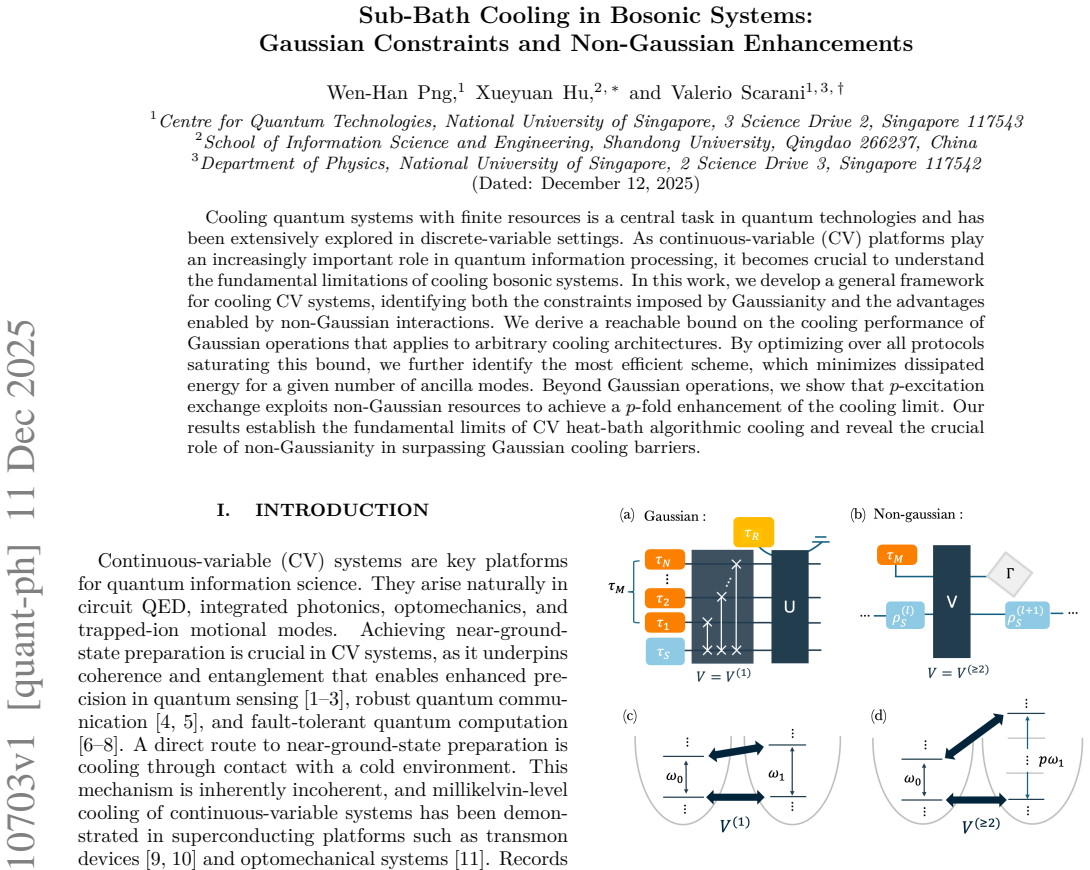
We establish the necessary and sufficient condi- tion for sub-bath cooling enabled by a specific non- Gaussian operation, the p-excitation exchange in- teraction (Theorem 3). Using the HBAC frame- work, we prove that this operation yields a p-fold cooling enhancement in the large iteration limit (Theorem 4). II. PRELIMINAR Y We consider a generic framework...
-
[4]
V. Giovannetti, S. Lloyd, and L. Maccone, Advances in quantum metrology, Nature photonics 5, 222 (2011)
work page 2011
-
[5]
G. Tóth and I. Apellaniz, Quantum metrology from a quantum information science perspective, Journal of Physics A: Mathematical and Theoretical 47, 424006 (2014)
work page 2014
-
[6]
R. Demkowicz-Dobrzański, M. Jarzyna, and J. Kołodyński, Quantum limits in optical interfer- ometry, Progress in Optics 60, 345 (2015)
work page 2015
- [7]
-
[8]
S. Pirandola, U. L. Andersen, L. Banchi, M. Berta, D. Bunandar, R. Colbeck, D. Englund, T. Gehring, C. Lupo, C. Ottaviani, et al., Advances in quantum cryp- tography, Advances in optics and photonics 12, 1012 (2020)
work page 2020
-
[9]
J. Preskill, Fault-tolerant quantum computation, Intro- duction to quantum computation and information 213 (1998). 8
work page 1998
-
[10]
Preskill, Quantum computing in the nisq era and be- yond, Quantum 2, 79 (2018)
J. Preskill, Quantum computing in the nisq era and be- yond, Quantum 2, 79 (2018)
work page 2018
- [11]
-
[12]
M. Kjaergaard, M. E. Schwartz, J. Braumüller, P. Krantz, J. I.-J. Wang, S. Gustavsson, and W. D. Oliver, Superconducting qubits: Current state of play, Annual Review of Condensed Matter Physics 11, 369 (2020)
work page 2020
- [13]
-
[14]
H. H. Diamandi, Y. Luo, D. Mason, T. B. Kanmaz, S. Ghosh, M. Pavlovich, T. Yoon, R. Behunin, S. Puri, J. G. Harris, et al. , Optomechanical control of long-lived bulk acoustic phonons in the quantum regime, Nature Physics , 1 (2025)
work page 2025
-
[15]
J. D. Teufel, T. Donner, D. Li, J. W. Harlow, M. Allman, K. Cicak, A. J. Sirois, J. D. Whittaker, K. W. Lehnert, and R. W. Simmonds, Sideband cooling of micromechan- ical motion to the quantum ground state, Nature 475, 359 (2011)
work page 2011
-
[16]
S. Nimmrichter, J. Dai, A. Roulet, and V. Scarani, Quan- tum and classical dynamics of a three-mode absorption refrigerator, Quantum 1, 37 (2017)
work page 2017
-
[17]
G. Maslennikov, S. Ding, R. Hablützel, J. Gan, A. Roulet, S. Nimmrichter, J. Dai, V. Scarani, and D. Matsukevich, Quantum absorption refrigerator with trapped ions, Nature communications 10, 202 (2019)
work page 2019
-
[18]
A. Serafini, M. Lostaglio, S. Longden, U. Shackerley- Bennett, C.-Y. Hsieh, and G. Adesso, Gaussian thermal operations and the limits of algorithmic cooling, Phys. Rev. Lett. 124, 010602 (2020)
work page 2020
-
[19]
S. Lloyd and S. L. Braunstein, Quantum computation over continuous variables, Physical Review Letters 82, 1784 (1999)
work page 1999
- [20]
-
[21]
J. Fiurášek, Gaussian transformations and distillation of entangled gaussian states, Physical review letters 89, 137904 (2002)
work page 2002
-
[22]
Y. Wang and S. Zhou, Limitations of gaussian measure- ments in quantum imaging, Physical Review Letters 135, 120201 (2025)
work page 2025
-
[23]
M. Gessner, A. Smerzi, and L. Pezzè, Metrological non- linear squeezing parameter, Physical review letters 122, 090503 (2019)
work page 2019
-
[24]
D. R. Arvidsson-Shukur, N. Yunger Halpern, H. V. Lep- age, A. A. Lasek, C. H. Barnes, and S. Lloyd, Quantum advantage in postselected metrology, Nature communi- cations 11, 3775 (2020)
work page 2020
-
[25]
N. A. Rodríguez-Briones and R. Laflamme, Achievable polarization for heat-bath algorithmic cooling, Phys. Rev. Lett. 116, 170501 (2016)
work page 2016
- [26]
-
[27]
P. Taranto, F. Bakhshinezhad, A. Bluhm, R. Silva, N. Friis, M. P. Lock, G. Vitagliano, F. C. Binder, T. De- barba, E. Schwarzhans, F. Clivaz, and M. Huber, Lan- dauer versus nernst: What is the true cost of cooling a quantum system?, PRX Quantum 4, 010332 (2023)
work page 2023
-
[28]
P. Taranto, P. Lipka-Bartosik, N. A. Rodríguez- Briones, M. Perarnau-Llobet, N. Friis, M. Huber, and P. Bakhshinezhad, Efficiently cooling quantum systems with finite resources: Insights from thermodynamic ge- ometry, Phys. Rev. Lett. 134, 070401 (2025)
work page 2025
- [29]
-
[30]
L. J. Schulman, T. Mor, and Y. Weinstein, Physical limits of heat‐bath algorithmic cooling, SIAM Journal on Computing 36, 1729 (2007), https://doi.org/10.1137/050666023
-
[31]
N. A. Rodriguez-Briones, J. Li, X. Peng, T. Mor, Y. We- instein, and R. Laflamme, Heat-bath algorithmic cool- ing with correlated qubit-environment interactions, New Journal of Physics 19, 113047 (2017)
work page 2017
-
[32]
N. A. Rodríguez-Briones, J. Li, X. Peng, T. Mor, Y. We- instein, and R. Laflamme, Heat-bath algorithmic cool- ing with correlated qubit-environment interactions, New Journal of Physics 19, 113047 (2017)
work page 2017
-
[33]
Á. M. Alhambra, M. Lostaglio, and C. Perry, Heat-Bath Algorithmic Cooling with optimal thermalization strate- gies, Quantum 3, 188 (2019)
work page 2019
-
[34]
C. Weedbrook, S. Pirandola, R. García-Patrón, N. J. Cerf, T. C. Ralph, J. H. Shapiro, and S. Lloyd, Gaus- sian quantum information, Reviews of Modern Physics 84, 621 (2012)
work page 2012
-
[35]
J. Lin, N. A. Rodríguez-Briones, E. Martín-Martínez, and R. Laflamme, Thermodynamic analysis of algorith- mic cooling protocols: Efficiency metrics and improved designs, Phys. Rev. A 110, 022215 (2024)
work page 2024
- [36]
-
[37]
P. Taranto, F. Bakhshinezhad, P. Schüttelkopf, F. Clivaz, and M. Huber, Exponential improvement for quantum cooling through finite-memory effects, Phys. Rev. Appl. 14, 054005 (2020)
work page 2020
-
[38]
A. Rolandi, P. Abiuso, and M. Perarnau-Llobet, Col- lective advantages in finite-time thermodynamics, Phys. Rev. Lett. 131, 210401 (2023)
work page 2023
- [39]
-
[40]
S. Ding, G. Maslennikov, R. Hablützel, H. Loh, and D. Matsukevich, Quantum parametric oscillator with trapped ions, Physical Review Letters 119, 150404 (2017)
work page 2017
-
[41]
C. S. Chang, C. Sabín, P. Forn-Díaz, F. Quijandría, A. Vadiraj, I. Nsanzineza, G. Johansson, and C. Wil- son, Observation of three-photon spontaneous paramet- ric down-conversion in a superconducting parametric cavity, Physical Review X 10, 011011 (2020)
work page 2020
-
[42]
L. A. Correa, J. P. Palao, D. Alonso, and G. Adesso, Quantum-enhanced absorption refrigerators, Scientific reports 4, 3949 (2014)
work page 2014
-
[43]
R. J. Birrittella, P. M. Alsing, and C. C. Gerry, Phase effects in coherently stimulated down-conversion with a quantized pump field, Physical Review A 101, 013813 (2020). 9
work page 2020
-
[44]
T. Hiroshima, Additivity and multiplicativity properties of some gaussian channels for gaussian inputs, Phys. Rev. A 73, 012330 (2006). Appendix A: Appendices for Gaussian cooling
work page 2006
-
[45]
Preliminaries: Gaussian states and Gaussian unitary operations Consider a J-mode bosonic system, whose Hamiltonian is written as H = PJ j=1 ωj ˆa† j ˆaj, where ˆaj, ˆa† j, and ωj are the annihilation and creation operators, and the frequency of the jth mode. A Gaussian state of this system is fully characterized by its first and second moments defined as ...
-
[46]
The first is Lemma 1 in the main text, which we restated below
The cooling limit of the Gaussian HBAC Two consequences of Lemma 3 are observed. The first is Lemma 1 in the main text, which we restated below. Lemma 4. Consider a J-mode system initially in a Gaussian product state ρJ = ⊗J j=1ρj. After the action of a global unitary, the minimum of the thermal excitation of Mode 1 in the output is min W ∈U G J n tr\1(W ...
-
[47]
The most efficient protocols of Gaussian HBAC The second consequence of Lemma 3 is the following. Lemma 5. Consider a J-mode Gibbs state τ = ⊗J j=1τj with the mean excitation number of each mode in the descending order {¯n↓ j }, and a J-mode Gaussian state ρ = U Gτ UG† obtained from τ via a Gaussian unitary U G with the mean excitation numbers ¯nρ j = tr( ...
-
[48]
Evolution of mean excitation number under Heisenberg picture The mean excitation number of target after single operation of V (p)(t) is given by ¯nS(t) = tr h V (p)(t)(ρS ⊗ ρM )V (p)†(t)(ˆnS ⊗ I) i = tr [ Et(ρS)ˆnS] (B1) where Et(ρS) = tr M [V (p)(t)(ρS ⊗ ρM )V (p)†(t)]. Equivalently in Heisenberg picture, we have ¯nS(t) = tr h τSE † t (ˆnS) i (B2) where ...
-
[49]
Cooling limit for iterative cooling (matrix algebra) The cooling protocol in previous section is then repeated with L iteration. In each iteration, the target is interact with reset qubit τS ⊗ τM with fixed machine gap ωS, ωM and interaction duration t. The mean photon number after L iterations is given by ¯n(L) S = tr 2 4Et ◦ ... ◦ Et| {z } Ltimes (ρS)ˆn...
-
[50]
Thermality of the system after many iterations It’s apparent that the system evolves into a transient state after a single collision which is not Gaussian nor thermal. In previous section, we found that the the mean excitation of the system converge to a thermal excitation. This raises a question whether this is coincidence or the final state actually equ...
discussion (0)
Sign in with ORCID, Apple, or X to comment. Anyone can read and Pith papers without signing in.