Hybrid quantum-classical matrix-product state and Lanczos methods for electron-phonon systems with strong electronic correlations: Application to disordered systems coupled to Einstein phonons
Pith reviewed 2026-05-16 23:05 UTC · model grok-4.3
The pith
Coupling strongly disordered systems to classical oscillators leads to delocalization and destabilizes finite-size many-body localization
A machine-rendered reading of the paper's core claim, the machinery that carries it, and where it could break.
Core claim
The authors present two hybrid methods that treat electrons with exact quantum techniques (time-dependent Lanczos or matrix-product states) while approximating phonons classically via multi-trajectory Ehrenfest dynamics. For a chain of interacting spinless fermions with disorder coupled to Einstein oscillators, they provide numerical evidence that electron-phonon coupling induces delocalization, leading to decay of charge-density-wave order and destabilization of the finite-size many-body localized phase.
What carries the argument
Hybrid combination of quantum electron solvers (Lanczos or MPS) with classical multi-trajectory Ehrenfest dynamics for phonon oscillators
Load-bearing premise
Phonons can be treated as classical oscillators in the adiabatic regime of small frequencies.
What would settle it
A fully quantum treatment of the phonons at the same small frequencies that shows persistent many-body localization without delocalization would falsify the claim.
Figures



read the original abstract
We present two quantum-classical hybrid methods for simulating the time-dependence of electron-phonon systems that treat electronic correlations numerically exactly and optical-phonon degrees of freedom classically. These are a time-dependent Lanczos and a matrix-product state method, each combined with the multi-trajectory Ehrenfest approach. Due to the approximations, reliable results are expected for the adiabatic regime of small phonon frequencies. We discuss the convergence properties of both methods for a system of interacting spinless fermions in one dimension and provide a benchmark for the Holstein chain. As a first application, we study the decay of charge density wave order in a system of interacting spinless fermions coupled to Einstein oscillators and in the presence of quenched disorder. We investigate the dependence of the relaxation dynamics on the electron-phonon coupling strength and provide numerical evidence that the coupling of strongly disordered systems to classical oscillators leads to delocalization, thus destabilizing the (finite-size) many-body localization in this system.
Editorial analysis
A structured set of objections, weighed in public.
Referee Report
Summary. The manuscript presents two hybrid quantum-classical methods—a time-dependent Lanczos approach and a matrix-product state method, each combined with multi-trajectory Ehrenfest dynamics—for simulating the real-time evolution of electron-phonon systems with strong electronic correlations. Electronic degrees of freedom are treated numerically exactly while optical phonons are handled classically; the methods are expected to be reliable in the adiabatic regime of small phonon frequencies. Convergence is discussed for interacting spinless fermions in one dimension, with benchmarks on the clean Holstein chain. As an application, the authors examine the decay of charge-density-wave order in a disordered system of interacting spinless fermions coupled to Einstein oscillators and report numerical evidence that this coupling induces delocalization, thereby destabilizing finite-size many-body localization.
Significance. If the classical phonon treatment is validated, the work supplies concrete numerical evidence that electron-phonon coupling can destabilize many-body localization in disordered systems, which is relevant to ongoing debates on MBL stability. The hybrid methods themselves represent a practical advance for treating correlated electron-phonon dynamics beyond small-system exact diagonalization.
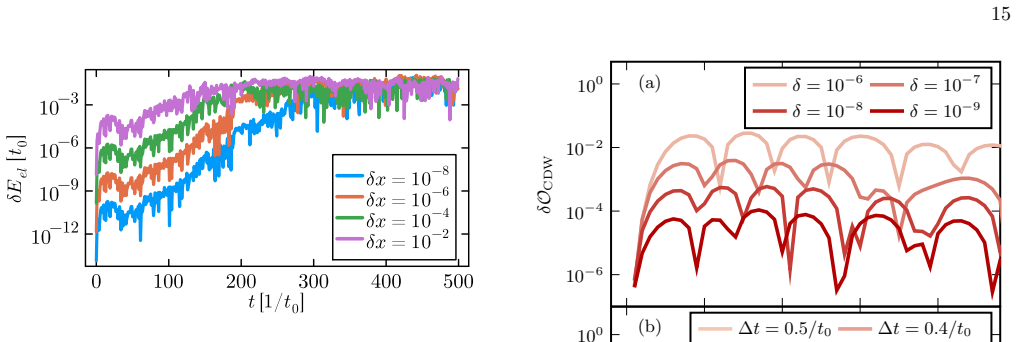
major comments (2)
- [Application to disordered systems] Application section (disordered CDW decay): The headline claim that coupling to classical oscillators leads to delocalization and destabilizes finite-size MBL is based on multi-trajectory Ehrenfest results. The manuscript benchmarks convergence on the clean Holstein chain but does not report a direct comparison (even on small clusters) against a fully quantized phonon treatment at the same small ω. Without this control, it remains unclear whether the observed CDW decay arises from physical phonon-assisted processes or from uncontrolled averaging over classical trajectories that acts as an effective dephasing channel.
- [Methods and convergence] Methods and convergence discussion: The text states that reliable results are expected only in the adiabatic regime, yet the MBL phenomenology is known to be sensitive to quantum fluctuations. Additional quantitative tests—such as the dependence of the relaxation rate on the number of Ehrenfest trajectories or on the phonon frequency cutoff—would be needed to establish that the delocalization is not an artifact of the classical approximation.
minor comments (2)
- [Abstract] The abstract and introduction could explicitly list the disorder strength, electron-phonon coupling values, and phonon frequency range used in the disordered-system simulations.
- [Figures] Figures showing CDW order parameter decay should include error bars or standard deviations arising from disorder averaging and trajectory sampling.
Simulated Author's Rebuttal
We thank the referee for the careful reading of our manuscript and the constructive comments. We address the two major concerns point by point below, indicating the revisions we plan to implement.
read point-by-point responses
-
Referee: [Application to disordered systems] Application section (disordered CDW decay): The headline claim that coupling to classical oscillators leads to delocalization and destabilizes finite-size MBL is based on multi-trajectory Ehrenfest results. The manuscript benchmarks convergence on the clean Holstein chain but does not report a direct comparison (even on small clusters) against a fully quantized phonon treatment at the same small ω. Without this control, it remains unclear whether the observed CDW decay arises from physical phonon-assisted processes or from uncontrolled averaging over classical trajectories that acts as an effective dephasing channel.
Authors: We agree that a direct comparison to a fully quantized phonon treatment on small disordered clusters would provide stronger validation. Such benchmarks are computationally intensive even for small systems because of the enlarged Hilbert space from quantized phonons. Our existing benchmarks on the clean Holstein chain already show good agreement with exact results in the adiabatic limit. In that regime the multi-trajectory Ehrenfest approach captures the leading phonon-assisted delocalization physics, consistent with known mechanisms in the literature. We will add an explicit discussion of this limitation together with a small-cluster comparison (disorder without interactions) where feasible, and we will tone down the headline claim to emphasize that the evidence is within the classical-phonon approximation. revision: partial
-
Referee: [Methods and convergence] Methods and convergence discussion: The text states that reliable results are expected only in the adiabatic regime, yet the MBL phenomenology is known to be sensitive to quantum fluctuations. Additional quantitative tests—such as the dependence of the relaxation rate on the number of Ehrenfest trajectories or on the phonon frequency cutoff—would be needed to establish that the delocalization is not an artifact of the classical approximation.
Authors: We accept the need for additional quantitative convergence data. We have already verified that the relaxation dynamics stabilize with increasing trajectory number; we will include explicit plots of the CDW decay rate versus number of trajectories. We will also add results for several smaller phonon frequencies to demonstrate that the delocalization effect remains robust inside the adiabatic regime. These figures and accompanying text will be inserted in the methods and application sections. revision: yes
Circularity Check
No circularity: results from direct numerical simulation
full rationale
The paper introduces hybrid quantum-classical methods (time-dependent Lanczos and MPS combined with multi-trajectory Ehrenfest) and applies them to compute time-dependent observables in electron-phonon models. All reported results, including the decay of CDW order and the destabilization of finite-size MBL, are obtained from explicit numerical propagation of the equations of motion under the stated approximations. No derivation chain exists that reduces a claimed prediction to a fitted parameter, self-definition, or self-citation load-bearing step. Benchmarks on the clean Holstein chain and convergence checks are independent of the disordered-system conclusions. The central claim is therefore an output of the simulation protocol rather than a tautology.
Axiom & Free-Parameter Ledger
axioms (1)
- domain assumption Phonons can be treated classically for small frequencies in the adiabatic regime
Reference graph
Works this paper leans on
-
[1]
Basic idea and algorithm The multi-trajectory Ehrenfest method (MTE) can be derived as a special case of the quantum–classical Liouville (QCL) equation [ 31, 33], with two essential approximations: The coupling between the electronic subsystem and the phonon environment is treated in a mean-field approximation and the phonon dynamics is treated classicall...
work page 2000
-
[2]
Time propagation The standard way to solve the quantum and classical equations of motion numerically is an alternating time propagation of each subsystem from time t→t+ ∆t (∆t is the time step), with the other subsystem, i.e., |ψ(t)⟩ or{xℓ,pℓ}kept constant, i.e., a version of a splitting method [ 72]. This scheme can be viewed as a Trotter- Suzuki breakup...
-
[3]
Some limitations can be understood in the Born- Oppenheimer picture
Discussion of strength and weaknesses of MTE MTE is one of the simplest trajectory based meth- ods [ 32, 73, 74], stable, and straightforward to imple- ment. Some limitations can be understood in the Born- Oppenheimer picture. For instance, in MTE, electrons ex- perience the average force from several Born-Oppenheimer surfaces and do not see the effects o...
-
[4]
0 t [1/t 0] t [1/t 0] OCDW MTE, ten Brink et al. Lanczos-MTE TEBD-MTE 0 10 20 30 4010−6 10−4 10−2 δOCDW Figure 2: Comparison of TEBD-MTE ( δ= 10−8), Lanczos-MTE (ϵ= 10−9/tf), and regular MTE as imple- mented in Ref. [ 36] for a non-interacting system (L = 13, V = 0, ω0 = 0.1 t0, γ= 0.4 t0, W = 0). Lanczos-MTE and TEBD use ∆ t = 0.01 t0−1and all methods ar...
-
[5]
Algorithm Our goal is to deal with quantum systems having di- rect electron–electron interactions which warrants using a many-body quantum state to represent the electronic subsystem. For this, we can draw from well-known many- body techniques such as the time-dependent Lanczos 6 method [79]. In the time-dependent Lanczos method, a Krylov subspace is cons...
-
[6]
Algorithm In TEBD-MTE, the quantum many-body state |ψ(t)⟩ of the electronic sub-system is described by a matrix product state (MPS). The combined state of the whole system (|ψ{xℓ,pℓ}(t)⟩,{xℓ, pℓ}) is graphically represented in the bottom layer of Fig. 1(b). Figure 1(c) describes one graph element associated with a site ℓ, which contains information about ...
-
[7]
0 t [1/t 0] t [1/t 0] OCDW Lanczos-MTE TEBD-MTE 0 100 200 300 400 500 10−6 10−4 10−2 δOCDW Figure 5: Comparison of the TEBD-MTE method (δ= 10−8) and Lanczos-MTE method ( ϵ= 10−8/tf) in an interacting system ( L = 14, V = 2 t0, ω0 = 0.1 t0, γ= 0.4 t0) for the case without disorder (W = 0). The in- set shows the difference of the observable OCDW between the...
work page 2000
-
[8]
J. Bardeen, L. N. Cooper, and J. R. Schrieffer, Theory of superconductivity, Phys. Rev.108, 1175 (1957)
work page 1957
-
[9]
Fr¨ ohlich, Electrons in lattice fields, Advances in Physics3, 325 (1954)
H. Fr¨ ohlich, Electrons in lattice fields, Advances in Physics3, 325 (1954)
work page 1954
-
[10]
C. Giannetti, M. Capone, D. Fausti, M. Fabrizio, F. Parmigiani, and D. Mihailovic, Ultrafast optical spectroscopy of strongly correlated materials and high- temperature superconductors: a non-equilibrium ap- proach, Adv. Phys.65, 58 (2016)
work page 2016
-
[11]
E. Pastor, M. Sachs, S. Selim, J. R. Durrant, A. A. Bakulin, and A. Walsh, Electronic defects in metal oxide photocatalysts, Nature Reviews Materials7, 503 (2022). 15 Figure 13: Dynamics in a single trajectory: Decay of the CDW in the non-interacting system (L= 100 , V= 0 , γ= 0.5t0, W= 8t 0, ω0 = 0.1t0). We compare trajecto- ries with slightly different ...
work page 2022
- [12]
-
[13]
M. Rini, R. Tobey, N. Dean, J. Itatani, Y. Tomioka, Y. Tokura, R. W. Schoenlein, and A. Cavalleri, Control of the electronic phase of a manganite by mode-selective vibrational excitation, Nature449, 72 (2007)
work page 2007
-
[14]
R. I. Tobey, D. Prabhakaran, A. T. Boothroyd, and A. Cavalleri, Ultrafast electronic phase transition in La1/2Sr3/2MnO4 by coherent vibrational excitation: Ev- idence for nonthermal melting of orbital order, Phys. Rev. Lett.101, 197404 (2008)
work page 2008
-
[15]
E. T. Nibbering, H. Fidder, and E. Pines, Ultrafast chemistry: Using time-resolved vibrational spectroscopy for interrogation of structural dynamics, Annual Review of Physical Chemistry56, 337 (2005)
work page 2005
-
[16]
E. Dagotto, T. Hotta, and A. Moreo, Colossal magne- toresistant materials: The key role of phase separation, Physics Reports344, 1 (2001)
work page 2001
-
[17]
Y. Tokura, Critical features of colossal magnetoresistive manganites, Reports on Progress in Physics69, 797 (2006)
work page 2006
-
[18]
M. Weber and J. K. Freericks, Real-time evolution of static electron–phonon models in time-dependent electric fields, Phys. Rev. E105, 025301 (2022)
work page 2022
-
[19]
B. Cohen-Stead, S. M. Costa, J. Neuhaus, A. T. Ly, Y. Zhang, R. Scalettar, K. Barros, and S. Johnston, Smo- QyDQMC.jl: A flexible implementation of determinant quantum Monte Carlo for Hubbard and electron–phonon interactions, SciPost Phys. Codebases , 29 (2024)
work page 2024
- [20]
-
[21]
V. Jankovi´ c and N. Vukmirovi´ c, Spectral and thermody- namic properties of the Holstein polaron: Hierarchical equations of motion approach, Phys. Rev. B105, 054311 (2022). 0 1 2 3 4 10−6 10−4 10−2 100 (a) δOCDW δ = 10 −6 δ = 10 −7 δ = 10 −8 δ = 10 −9 0 1 2 3 4 10−4 10−2 100 (b) t [1/t 0] δOCDW ∆ t = 0. 5/t 0 ∆ t = 0. 4/t 0 ∆ t = 0. 3/t 0 ∆ t = 0. 2/t 0...
work page 2022
-
[22]
J. Bonˇ ca, S. A. Trugman, and I. Batisti´ c, Holstein po- laron, Phys. Rev. B60, 1633 (1999)
work page 1999
-
[23]
F. Dorfner, L. Vidmar, C. Brockt, E. Jeckelmann, and F. Heidrich-Meisner, Real-time decay of a highly excited charge carrier in the one-dimensional Holstein model, Phys. Rev. B91, 104302 (2015)
work page 2015
-
[24]
G. L. Goodvin and M. Berciu, Momentum average ap- proximation for models with electron–phonon coupling dependent on the phonon momentum, Phys. Rev. B78, 235120 (2008)
work page 2008
-
[25]
E. Jeckelmann and S. R. White, Density-matrix renormalization-group study of the polaron problem in the Holstein model, Phys. Rev. B57, 6376 (1998)
work page 1998
-
[26]
C. Guo, A. Weichselbaum, J. von Delft, and M. Vojta, Critical and strong-coupling phases in one- and two-bath spin-boson models, Phys. Rev. Lett.108, 160401 (2012)
work page 2012
- [27]
-
[28]
S. Paeckel, T. K¨ ohler, and S. R. Manmana, Automated construction of U(1)-invariant matrix-product operators from graph representations, SciPost Phys.3, 035 (2017)
work page 2017
- [29]
-
[30]
J. Stolpp, T. K¨ ohler, S. R. Manmana, E. Jeckelmann, F. Heidrich-Meisner, and S. Paeckel, Comparative study of state-of-the-art matrix-product-state methods for lat- tice models with large local Hilbert spaces without U(1) symmetry, Computer Physics Communications269, 108106 (2021)
work page 2021
- [31]
-
[32]
D. Jansen and F. Heidrich-Meisner, Thermal and optical conductivity in the Holstein model at half filling and finite temperature in the Luttinger-liquid and charge- density-wave regime, Phys. Rev. B108, L081114 (2023)
work page 2023
-
[33]
S. R. Manmana, R. Noack, and A. Muramatsu, Time evo- lution of one-dimensional quantum many body systems, AIP Conf. Proc.789, 269 (2005)
work page 2005
-
[34]
Schollw¨ ock, The density-matrix renormalization group in the age of matrix product states, Ann
U. Schollw¨ ock, The density-matrix renormalization group in the age of matrix product states, Ann. Phys. (N. Y.)326, 96 (2011)
work page 2011
- [35]
-
[36]
Giustino, Electron–phonon interactions from first prin- ciples, Rev
F. Giustino, Electron–phonon interactions from first prin- ciples, Rev. Mod. Phys.89, 015003 (2017)
work page 2017
- [37]
-
[38]
I. V. Aleksandrov, The statistical dynamics of a sys- tem consisting of a classical and a quantum subsystem, Zeitschrift f¨ ur Naturforschung A36, 902 (1981)
work page 1981
-
[39]
J. C. Tully, Mixed quantum–classical dynamics, Faraday Discussions110, 407 (1998)
work page 1998
-
[40]
S. Nielsen, R. Kapral, and G. Ciccotti, Statistical me- chanics of quantum-classical systems, The Journal of Chemical Physics115, 5805 (2001)
work page 2001
-
[41]
X. Li, J. C. Tully, H. B. Schlegel, and M. J. Frisch, Ab initio Ehrenfest dynamics, The Journal of Chemical Physics123, 084106 (2005)
work page 2005
-
[42]
Polkovnikov, Phase space representation of quantum dynamics, Annals of Physics325, 1790 (2010)
A. Polkovnikov, Phase space representation of quantum dynamics, Annals of Physics325, 1790 (2010)
work page 2010
-
[43]
M. ten Brink, S. Gr¨ aber, M. Hopjan, D. Jansen, J. Stolpp, F. Heidrich-Meisner, and P. E. Bl¨ ochl, Real-time non- adiabatic dynamics in the one-dimensional Holstein model: Trajectory-based vs exact methods, The Journal of Chemical Physics156, 234109 (2022)
work page 2022
-
[44]
D. Manawadu, D. J. Valentine, M. Marcus, and W. Bar- ford, Singlet triplet-pair production and possible singlet- fission in carotenoids, The Journal of Physical Chemistry Letters13, 1344 (2022)
work page 2022
-
[45]
D. Manawadu, D. J. Valentine, and W. Barford, Dy- namical simulations of carotenoid photoexcited states using density matrix renormalization group techniques, The Journal of Physical Chemistry A127, 3714 (2023), pMID: 37054397
work page 2023
-
[46]
S. R. White, Density matrix formulation for quan- tum renormalization groups, Phys. Rev. Lett.69, 2863 (1992)
work page 1992
-
[47]
S. R. White, Density-matrix algorithms for quantum renormalization groups, Phys. Rev. B48, 10345 (1993)
work page 1993
-
[48]
S. Paeckel, T. K¨ ohler, A. Swoboda, S. R. Manmana, U. Schollw¨ ock, and C. Hubig, Time-evolution meth- ods for matrix-product states, Ann. Phys. (N. Y.)411, 167998 (2019)
work page 2019
-
[49]
J. E. Subotnik, A. Jain, B. Landry, A. Petit, W. Ouyang, and N. Bellonzi, Understanding the surface hopping view of electronic transitions and decoherence, Annual Review of Physical Chemistry67, 387 (2016)
work page 2016
-
[50]
D. V. Shalashilin, Quantum mechanics with the basis set guided by Ehrenfest trajectories: Theory and application to spin-boson model, The Journal of Chemical Physics 130, 244101 (2009)
work page 2009
-
[51]
D. V. Shalashilin, Nonadiabatic dynamics with the help of multiconfigurational ehrenfest method: Improved the- ory and fully quantum 24d simulation of pyrazine, The Journal of Chemical Physics132, 244111 (2010)
work page 2010
- [52]
-
[53]
H. Hashimoto and S. Ishihara, Photoinduced charge- order melting dynamics in a one-dimensional interacting Holstein model, Phys. Rev. B96, 035154 (2017)
work page 2017
- [54]
-
[55]
Nandkishore, Many-body localization proximity effect, Phys
R. Nandkishore, Many-body localization proximity effect, Phys. Rev. B92, 245141 (2015)
work page 2015
-
[56]
D. A. Abanin, E. Altman, I. Bloch, and M. Serbyn, Colloquium: Many-body localization, thermalization, and entanglement, Rev. Mod. Phys.91, 021001 (2019)
work page 2019
-
[57]
F. X. Bronold and H. Fehske, Anderson localization of polaron states, Phys. Rev. B66, 073102 (2002)
work page 2002
-
[58]
A. A. Franz X. Bronold and H. Fehske, Anderson local- ization in strongly coupled disordered electron–phonon systems, Philosophical Magazine84, 673 (2004)
work page 2004
-
[59]
A. N. Das and S. Sil, Thermodynamic properties of Holstein polarons and the effects of disorder, Journal of Physics: Condensed Matter20, 345222 (2008)
work page 2008
- [60]
-
[61]
H. Ebrahimnejad and M. Berciu, Perturbational study of the lifetime of a Holstein polaron in the presence of weak disorder, Phys. Rev. B86, 205109 (2012)
work page 2012
-
[62]
O. R. Tozer and W. Barford, Localization of large po- larons in the disordered Holstein model, Phys. Rev. B 89, 155434 (2014)
work page 2014
- [63]
-
[64]
P. Prelovˇ sek, J. Bonˇ ca, and M. Mierzejewski, Transient and persistent particle subdiffusion in a disordered chain coupled to bosons, Phys. Rev. B98, 125119 (2018)
work page 2018
-
[65]
Y. Murakami, P. Werner, N. Tsuji, and H. Aoki, Inter- action quench in the Holstein model: Thermalization crossover from electron- to phonon-dominated relaxation, Phys. Rev. B91, 045128 (2015). 17
work page 2015
-
[66]
D. Di Sante, S. Fratini, V. Dobrosavljevi´ c, and S. Ciuchi, Disorder-driven metal-insulator transitions in deformable lattices, Phys. Rev. Lett.118, 036602 (2017)
work page 2017
-
[67]
L. Fleishman, D. C. Licciardello, and P. W. Anderson, Elementary excitations in the Fermi glass, Phys. Rev. Lett.40, 1340 (1978)
work page 1978
-
[68]
D. A. Huse, R. Nandkishore, F. Pietracaprina, V. Ros, and A. Scardicchio, Localized systems coupled to small baths: From Anderson to Zeno, Phys. Rev. B92, 014203 (2015)
work page 2015
-
[69]
S. Gopalakrishnan, K. R. Islam, and M. Knap, Noise- induced subdiffusion in strongly localized quantum sys- tems, Phys. Rev. Lett.119, 046601 (2017)
work page 2017
-
[70]
T. L. M. Lezama and Y. B. Lev, Logarithmic, noise- induced dynamics in the Anderson insulator, SciPost Phys.12, 174 (2022)
work page 2022
- [71]
- [72]
-
[73]
P. Sierant, M. Lewenstein, A. Scardicchio, and J. Za- krzewski, Stability of many-body localization in Floquet systems, Phys. Rev. B107, 115132 (2023)
work page 2023
-
[74]
M. Schreiber, S. S. Hodgman, P. Bordia, H. P. L¨ uschen, M. H. Fischer, R. Vosk, E. Altman, U. Schneider, and I. Bloch, Observation of many-body localization of inter- acting fermions in a quasi-random optical lattice, Science 349, 842 (2015)
work page 2015
-
[75]
Vidal, Efficient simulation of one-dimensional quan- tum many-body systems, Phys
G. Vidal, Efficient simulation of one-dimensional quan- tum many-body systems, Phys. Rev. Lett.93, 040502 (2004)
work page 2004
-
[76]
R. Grunwald, A. Kelly, and R. Kapral, Quantum dy- namics in almost classical environments (Springer Berlin Heidelberg, 2009) pp. 383–413
work page 2009
-
[77]
Wigner, On the quantum correction for thermody- namic equilibrium, Physical Review40, 749 (1932)
E. Wigner, On the quantum correction for thermody- namic equilibrium, Physical Review40, 749 (1932)
work page 1932
- [78]
-
[79]
R. I. McLachlan and G. Reinout W. Quispel, Splitting methods, Acta Numerica11, 341 (2002)
work page 2002
-
[80]
P. Ehrenfest, Bemerkung ¨ uber die angen¨ aherte G¨ ultigkeit der klassischen Mechanik innerhalb der Quanten- mechanik, Zeitschrift f¨ ur Physik45, 455 (1927)
work page 1927
discussion (0)
Sign in with ORCID, Apple, or X to comment. Anyone can read and Pith papers without signing in.