REVIEW 3 major objections 5 minor 1 cited by
Multiloop functional renormalization group from single bosons
T0 review · 3 major / 5 minor · reviewed 2026-08-03 · deepseek-v4-flash
Pith's one-line read Neglecting multi-boson exchange contributions, the multiloop single-boson exchange fRG reproduces the parquet approximation to within a few percent in the 2D Hubbard model.
desk verdict A careful, useful multiloop SBE fRG derivation and benchmark; the few-percent agreement with parquet is real but is partly a test of two approximations sharing a form-factor truncation. read the letter →
The pith
A machine-rendered reading of the paper's core claim, the machinery that carries it, and where it could break.
The reading
What carries the argument
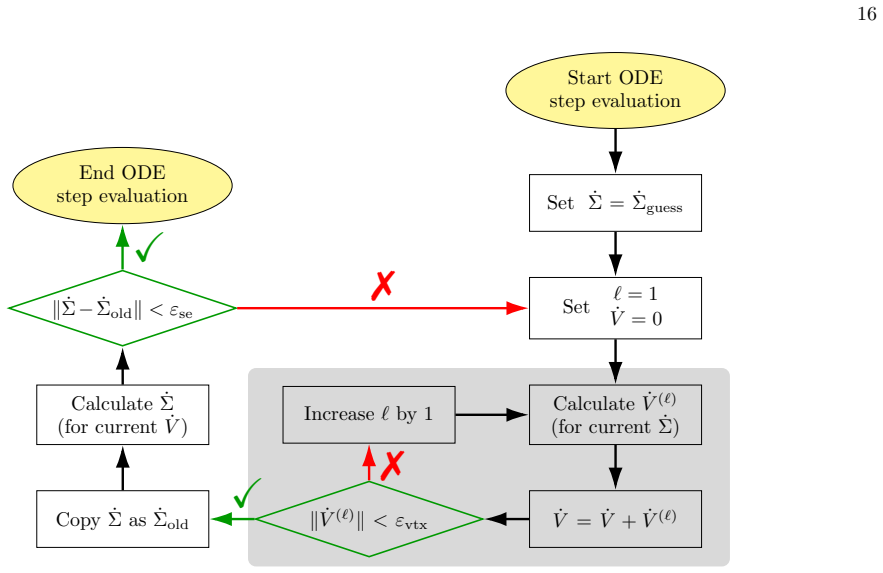
The central machinery is the single-boson exchange (SBE) decomposition of the two-particle vertex, which rewrites the vertex in terms of bosonic propagators w_X(Q), Yukawa couplings λ_X(Q,k), and rest functions M_X(Q,k,k') in three physical channels (magnetic, density, superconducting). The multiloop fRG flow equations for these objects are derived from the parquet/Bethe-Salpeter structure and are solved with a loop expansion (ℓ=1,2,3,...) together with a self-energy flow equation for the self-energy. The SBE approximation consists of discarding the flow equations for the rest functions M_X, thereby removing the most expensive part of the computation.
What would settle it
Compute the magnitude of the neglected mixed form-factor bubble contributions Π_{X,nm}(Q) at the finite incommensurate wave vector that dominates the magnetic susceptibility at finite doping, or repeat the calculation without the truncation and compare the SBE approximation to parquet; if the mixed-bubble terms are not negligible at these Q, the claimed ≤3% agreement is unlikely to survive.
Extended reading notes
Core claim
The central claim is that the SBE approximation—setting the flow of the multi-boson exchange rest functions M_X to zero while keeping the flow of bosonic propagators and Yukawa couplings—accurately reproduces the parquet approximation at loop convergence in the weak-coupling 2D Hubbard model. Quantitatively, the relative difference in the magnetic susceptibility peak is at most 5% at half filling and ≤3% at finite doping, with frequency- and momentum-dependent vertices showing similar accuracy. Since the converged multiloop SBE fRG with the rest functions included is equivalent to the parquet approximation, this shows that the computationally expensive rest-function flow can be discarded wit
Load-bearing premise
The numerical comparison relies on setting all mixed form-factor bubble contributions to zero at every momentum, although the stated justification only guarantees they vanish at q=0; if those terms are sizable at the finite momenta that dominate the response, the claimed few-percent agreement with parquet could degrade.
Editorial extensions
If this is right
- Multiloop fRG calculations for correlated electron systems become substantially cheaper, since the rest functions M_X, the most costly objects, no longer need to be flowed.
- The SBE approximation provides a physically transparent picture in which the dominant fluctuations are carried by single-boson exchange processes, with multi-boson effects implicitly resummed through the flow.
- The method opens the route to more challenging parameter regimes and more realistic models, where full parquet-equivalent multiloop fRG would be prohibitively expensive.
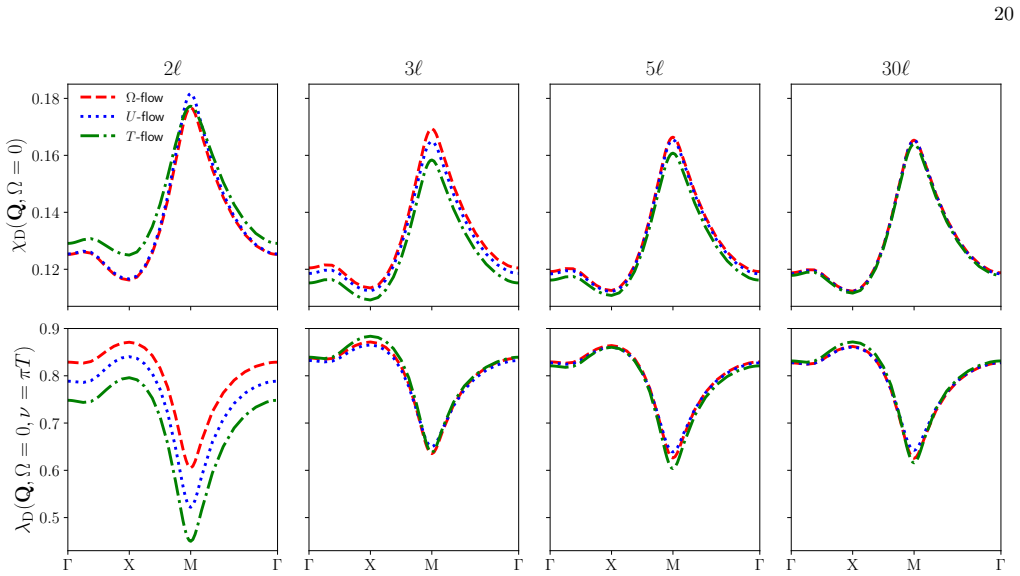
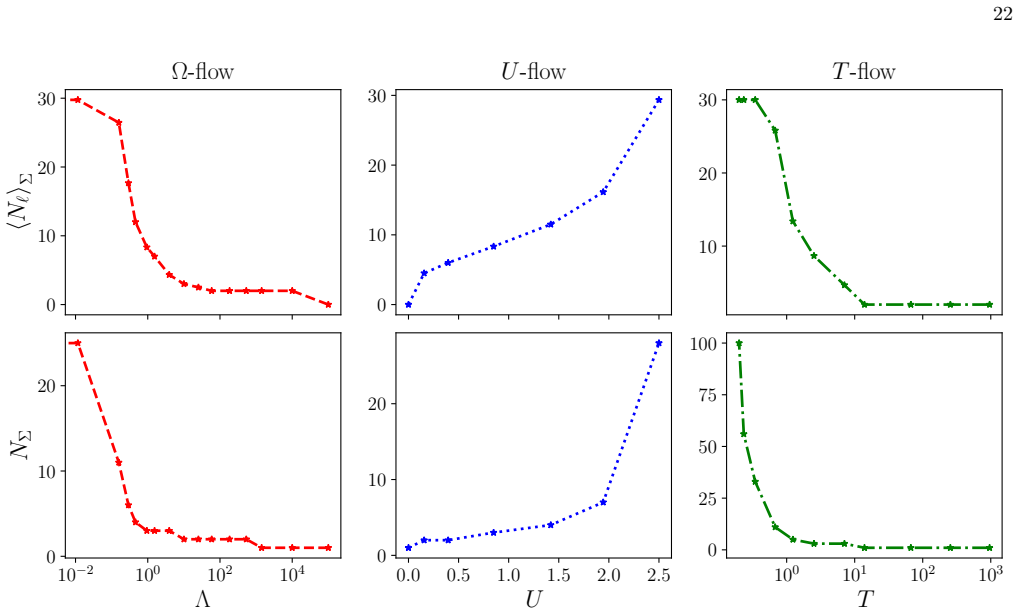
- The residual cutoff dependence of the SBE approximation is small at loop convergence (few percent), and the Ω-flow converges fastest among the tested schemes.
- The approach correctly captures the interplay of magnetic and d-wave superconducting fluctuations as temperature is lowered.
Reading between the lines
- Because the SBE approximation already matches parquet at weak coupling, one might expect it to become less accurate at intermediate to strong coupling, where multi-boson exchange processes (the dropped rest functions) are more important; the paper does not test this regime, and the claim should not be extrapolated there.
- The numerical implementation sets all mixed form-factor bubble contributions to zero at all momenta, not just at q=0 where they vanish; since the parquet comparison uses the same truncation, the observed agreement may in part reflect a shared systematic error rather than the intrinsic accuracy of the SBE approximation.
- A testable extension would be to include the mixed-bubble terms selectively at the dominant finite-momentum wave vectors (or to compute their magnitude) to see whether the few-percent agreement persists; if it does, the truncation is innocent; if not, the reported accuracy is partly accidental.
- Since the SBE approximation is a differential-equation-based resummation that generates rest-function-like contributions implicitly, it may be the basis for a cheaper parquet solver for models where the full parquet solution is numerically out of reach.
Editorial analysis
A structured set of objections, weighed in public.
Referee Report
Summary. The paper develops a multiloop extension of the single-boson-exchange (SBE) functional renormalization group (fRG) in physical channels and applies it to the two-dimensional Hubbard model at weak coupling. The central claim is that the "SBE approximation" — obtained by neglecting the flow of the multi-boson rest functions M_X in Eqs. (81c), (82c), (83c) — reproduces the parquet approximation at loop convergence. This is supported by direct numerical comparisons for U=2.5, β=5 at half filling and at finite doping (n=0.41), with reported differences of at most 5% in the magnetic susceptibility peak at half filling and at most 3% at finite doping. The paper also provides a detailed derivation of the flow equations, discusses cutoff dependence across three flow schemes, and presents temperature-dependent results at β=5,10,20.
Significance. If the central claim holds, the paper offers a substantial computational simplification: the expensive flow of the SBE rest functions can be omitted without sacrificing quantitative accuracy in the weak-coupling regime, enabling applications to more challenging parameter regimes and more realistic models. The manuscript's strengths are its self-contained derivation of the multiloop SBE equations in physical channels, the direct parameter-free comparison with a parquet solver rather than a fitted benchmark, the explicit treatment of loop and self-energy convergence, and the systematic cutoff-dependence analysis. The main caveat is that the parquet benchmark itself is computed within a truncated form-factor space with off-diagonal bubble contributions set to zero; the headline claim therefore needs to be qualified accordingly.
major comments (3)
- [Section III.E and Appendix A (Eqs. A1–A3)] The mixed-form-factor bubble truncation Π_{X,nm}=Π̇_{X,nm}=0 for n≠m is justified by the statement that these contributions 'anyway at q=0 vanish,' but the flow is evaluated for all bosonic momenta Q, including the incommensurate magnetic peaks at finite doping shown in Figs. 14–15. Since the parquet benchmark is computed with the same truncation, the reported ≤3–5% agreement demonstrates that dropping M_X is accurate within this truncated form-factor space, not necessarily that the SBE approximation reproduces the full parquet approximation. The abstract and conclusion should be qualified to avoid overstating the claim. If feasible, a numerical test with mixed-bubble terms retained, or at least an estimate of their size at finite Q, would strengthen the conclusion.
- [Section IV.A and Fig. 10] The text explicitly states that 'none of the three flow schemes are actually fully converged at U=2.5, β=5, and half filling for ℓ=30.' Yet Figs. 11–13 compare 'converged' SBE fRG results with the parquet approximation, using up to 36 loop corrections per self-energy iteration. The paper should quantify the difference between the 30ℓ results and the converged results for the susceptibility peaks. Without this number, the reader cannot judge whether the reported 3–5% differences between the SBE approximation and parquet are contaminated by residual loop-convergence error.
- [Section IV.B–IV.C and Abstract] The central claim that the SBE approximation 'accurately reproduces the parquet approximation at loop convergence' is benchmarked only at β=5 (for half filling and n=0.41) and for U up to 2.5 at β=5. The temperature-dependent results at β=10 and β=20 in Sec. IV.C are not compared with the parquet approximation. The abstract and conclusion should either restrict the validation statement to the computed parameter window or add parquet benchmarks at the lower temperatures shown in Figs. 15–17.
minor comments (5)
- [Section III.E] The phrase 'since that their contributions anyway at q=0 vanish' is grammatically awkward and should be rephrased, e.g., 'since these contributions vanish at Q=0.' Also clarify that the truncation is applied for all Q, not only Q=0.
- [Section IV.A] Typo: 'hilf-filled' should be 'half-filled' in the text preceding Fig. 7.
- [Fig. 11 caption] Typo: 'fom' should be 'from' in the caption.
- [Section V] The phrase 'rest function like contributions' should be hyphenated: 'rest-function-like contributions.'
- [Fig. 6 caption] The phrase 'enclose the reduced Brillouin zone' is unclear; consider 'enclosed by the Γ-X-M-Γ symmetry path.'
Circularity Check
No significant circularity: the SBE approximation is a genuine truncation compared against an independent parquet benchmark, with no fitted parameters.
full rationale
The central claim of the paper is that the SBE approximation—operationally defined by discarding the flow equations for the multi-boson rest functions M_X (Eqs. (81c), (82c), (83c))—reproduces the parquet approximation at loop convergence. This is a numerical comparison between two distinct approximations within the same fRG framework: including the M_X flow is equivalent to the parquet approximation, whereas the SBE approximation is a truncation of that same system. No parameter is fitted to the parquet benchmark. The only auxiliary quantity fixed by the model is the chemical-potential shift, determined by the filling via Eq. (108), not by the benchmark. The agreement (≤5% at U=2.5, half filling; ≤3% at finite doping) is therefore a nontrivial numerical finding. The formalism in Sec. II is built on the prior derivation in Ref. [64] (whose authors do not overlap with the present paper) and on the authors' earlier SBE-fRG works (Refs. [60,61,109]); those citations supply the equation structure, but the accuracy claim is not justified by citing them—it is substantiated by the direct comparison to the parquet approximation in Figs. 11–14. The paper also explicitly discloses the shared mixed-form-factor bubble truncation in Sec. III.E and the residual cutoff dependence in Sec. IV.A. These are limitations and correctness risks (the benchmark and the SBE approximation share a systematic truncation), but they are not circularity: the derivation chain does not reduce a prediction to a fitted input, a self-citation, or a definitional equivalence. No self-definitional reduction, fitted-input-as-prediction, imported uniqueness, or renamed known result is present.
Assumptions & free parameters
free parameters (4)
- Momentum grid size N_k =
16
- Frequency box size N_w =
6 for β=5,7.5; 8 for β=10,20
- Form-factor set =
s-wave (half filling); s+d-wave (finite doping)
- Convergence tolerances =
ε_se=10^-3, ε_vtx=10^-4
assumptions (6)
- standard math Standard Bethe-Salpeter/parquet decomposition and the equivalence of converged multiloop fRG to the parquet approximation
- domain assumption SU(2) spin symmetry and translational invariance of the Hubbard model
- domain assumption Time-reversal symmetry (λ_X = λ̄_X)
- domain assumption Truncated-unity form-factor expansion (s-wave at half filling; s+d at finite doping) is quantitatively sufficient at weak coupling
- ad hoc to paper Mixed-bubble contributions Π_{X,nm}=0 for n≠m
- domain assumption High-frequency asymptotics of Ref. [63] outside the frequency box
Cite this review
Pith. "Pith review of Multiloop functional renormalization group from single bosons." pith.science (2026). https://pith.science/paper/6R5FBBZR
@misc{pith2026251211190,
  author       = {Pith},
  title        = {Pith review of: Multiloop functional renormalization group from single bosons},
  year         = {2026},
  howpublished = {\url{https://pith.science/paper/6R5FBBZR}},
  note         = {Machine review of arXiv:2512.11190}
}
read the original abstract
The functional renormalization group (fRG) is an established tool in the treatment of correlated electron systems, notably for the description of competing instabilities. In recent years, methodological advancements led to the multiloop extension of the fRG, which systematically includes loop corrections beyond the conventional one-loop truncation and yields a quantitatively accurate description of two-dimensional lattice systems. At the same time, the single-boson exchange (SBE) decomposition of the two-particle vertex has been shown to offer both computational and interpretative advantages paving the way to more affordable approximation schemes. We here apply their combination coined as multiloop SBE fRG to the two-dimensional Hubbard model at weak coupling. After providing a detailed account of the underlying formalism in physical channels, we analyze the results for the frequency- and momentum-dependent vertex functions. We find that the SBE approximation, i.e., neglecting the flow of the multi-boson exchange contributions, accurately reproduces the parquet approximation at loop convergence. The presented algorithmic improvement opens the route for the treatment of more challenging parameter regimes and more realistic models.
Figures


Figures from the paper (16 more)






Forward citations
Cited by 1 Pith paper
-
On Degeneracies of Density, Magnetic, and Pairing Responses: How Competing Orders Echo Underlying Symmetries in the Hubbard Model
Analytical derivation shows mutual relations between density, magnetic, and pairing susceptibilities in the Hubbard model, revealing a degeneracy between d-wave pairing and d-density wave instabilities near the metal-...
Reference graph
Works this paper leans on
-
[1]
[52], this flow scheme implements a multiplicative soft frequency cutoff GΛ 0 (k, ν) := ΘΛ(ν) G−1 0 (k, ν) +δµΛ ,(104) with ΘΛ(ν) = ν2 ν2 + Λ2 (105) a low-frequency cutoff function
Ω-flow.Introduced in Ref. [52], this flow scheme implements a multiplicative soft frequency cutoff GΛ 0 (k, ν) := ΘΛ(ν) G−1 0 (k, ν) +δµΛ ,(104) with ΘΛ(ν) = ν2 ν2 + Λ2 (105) a low-frequency cutoff function. Here, the flow pa- rameter Λ flows from Λ init =∞to Λ final = 0 re- covering the fullG 0. 2.TheU-flow.This flow scheme [118] is implemented by consid...
-
[2]
F. Krien, A. I. Lichtenstein, and G. Rohringer, Fluc- tuation diagnostic of the nodal/antinodal dichotomy in the Hubbard model at weak coupling: A parquet dual fermion approach, Phys. Rev. B102, 10.1103/phys- revb.102.235133 (2020)
doi:10.1103/phys- 2020
-
[3]
C. J. Eckhardt, C. Honerkamp, K. Held, and A. Kauch, Truncated unity parquet solver, Phys. Rev. B101, 155104 (2020)
2020
-
[4]
Astleithner, A
K. Astleithner, A. Kauch, T. Ribic, and K. Held, Par- quet dual fermion approach for the Falicov-Kimball model, Phys. Rev. B101, 165101 (2020)
2020
-
[5]
G. V. Astretsov, G. Rohringer, and A. N. Rubtsov, Dual parquet scheme for the two-dimensional Hubbard model: Modeling low-energy physics of high-Tc cuprates with high momentum resolution, Phys. Rev. B101, 075109 (2020)
2020
-
[6]
Krien and A
F. Krien and A. Kauch, The plain and simple parquet approximation: single-and multi-boson exchange in the two-dimensional Hubbard model, Eur. Phys. J. B95, 69 (2022)
2022
-
[7]
Rohringer, Spectra of correlated many-electron sys- tems: From a one- to a two-particle description, Journal of Electron Spectroscopy and Related Phenomena241, 146804 (2020)
G. Rohringer, Spectra of correlated many-electron sys- tems: From a one- to a two-particle description, Journal of Electron Spectroscopy and Related Phenomena241, 146804 (2020)
2020
-
[8]
Ellwanger, Flow equations forNpoint functions and bound states, Z
U. Ellwanger, Flow equations forNpoint functions and bound states, Z. Phys. C - Particles and Fields62, 503 (1994)
1994
Show all 140 references
-
[9]
Wetterich, Exact evolution equation for the effective potential, Physics Letters B301, 90 (1993)
C. Wetterich, Exact evolution equation for the effective potential, Physics Letters B301, 90 (1993)
1993
-
[10]
Metzner, M
W. Metzner, M. Salmhofer, C. Honerkamp, V. Meden, and K. Sch¨ onhammer, Functional renormalization group approach to correlated fermion systems, Rev. Mod. Phys.84, 299 (2012)
2012
-
[11]
T. R. Morris, The Exact Renormalization Group and Approximate Solutions, International Journal of Mod- ern Physics A09, 2411 (1994)
1994
-
[12]
Krien, A
F. Krien, A. Valli, and M. Capone, Single-boson ex- change decomposition of the vertex function, Phys. Rev. B100, 155149 (2019)
2019
-
[13]
Dupuis, L
N. Dupuis, L. Canet, A. Eichhorn, W. Metzner, J. M. Pawlowski, M. Tissier, and N. Wschebor, The nonper- turbative functional renormalization group and its ap- plications, Physics Reports910, 1 (2021), the nonper- turbative functional renormalization group and its ap- plications
2021
-
[14]
De Dominicis and P
C. De Dominicis and P. C. Martin, Stationary Entropy Principle and Renormalization in Normal and Super- fluid Systems. II. Diagrammatic Formulation, J. Math. Phys.5, 31 (1964)
1964
-
[15]
De Dominicis and P
C. De Dominicis and P. C. Martin, Stationary Entropy Principle and Renormalization in Normal and Super- fluid Systems. I. Algebraic Formulation, J. Math. Phys. 5, 14 (1964)
1964
-
[16]
S. X. Yang, H. Fotso, J. Liu, T. A. Maier, K. Tomko, E. F. D’Azevedo, R. T. Scalettar, T. Pruschke, and M. Jarrell, Parquet approximation for the 4×4 Hub- bard cluster, Phys. Rev. E80, 046706 (2009)
2009
-
[17]
N. E. Bickers, Self-Consistent Many-Body Theory for Condensed Matter Systems, inS´ en´ echal D., Tremblay A.-M., Bourbonnais C. (eds), Theoretical Methods for Strongly Correlated Electrons, CRM Series in Mathe- matical Physics(Springer, New York, 2004)
2004
-
[18]
Rohringer, A
G. Rohringer, A. Valli, and A. Toschi, Local electronic correlation at the two-particle level, Phys. Rev. B86, 125114 (2012)
2012
-
[19]
K.-M. Tam, H. Fotso, S.-X. Yang, T.-W. Lee, J. Moreno, J. Ramanujam, and M. Jarrell, Solving the parquet equations for the Hubbard model beyond weak coupling, Phys. Rev. E87, 013311 (2013)
2013
-
[20]
Kauch, F
A. Kauch, F. H¨ orbinger, G. Li, and K. Held, Interplay between magnetic and superconducting fluctuations in the doped 2d Hubbard model (2019), arXiv:1901.09743
2019 arXiv
-
[21]
Valli, T
A. Valli, T. Sch¨ afer, P. Thunstr¨ om, G. Rohringer, S. An- dergassen, G. Sangiovanni, K. Held, and A. Toschi, Dy- namical vertex approximation in its parquet implemen- tation: Application to Hubbard nanorings, Phys. Rev. B91, 115115 (2015)
2015
-
[22]
Sch¨ afer, G
T. Sch¨ afer, G. Rohringer, O. Gunnarsson, S. Ciuchi, G. Sangiovanni, and A. Toschi, Divergent Precursors of the Mott-Hubbard Transition at the Two-Particle Level, Phys. Rev. Lett.110, 246405 (2013)
2013
-
[23]
G. Li, A. Kauch, P. Pudleiner, and K. Held, The vic- tory project v1.0: An efficient parquet equations solver, Comput. Phys. Commun.241, 146 (2019)
2019
-
[24]
Gunnarsson, T
O. Gunnarsson, T. Sch¨ afer, J. P. F. LeBlanc, J. Merino, G. Sangiovanni, G. Rohringer, and A. Toschi, Parquet decomposition calculations of the electronic self-energy, Phys. Rev. B93, 245102 (2016)
2016
-
[25]
Janiˇ s and V
V. Janiˇ s and V. Pokorn´ y, Critical metal-insulator tran- sition and divergence in a two-particle irreducible vertex in disordered and interacting electron systems, Phys. Rev. B90, 045143 (2014)
2014
-
[26]
Ribic, G
T. Ribic, G. Rohringer, and K. Held, Nonlocal corre- lations and spectral properties of the Falicov-Kimball model, Phys. Rev. B93, 195105 (2016)
2016
-
[27]
Sch¨ afer, S
T. Sch¨ afer, S. Ciuchi, M. Wallerberger, P. Thunstr¨ om, O. Gunnarsson, G. Sangiovanni, G. Rohringer, and A. Toschi, Nonperturbative landscape of the mott- hubbard transition: Multiple divergence lines around the critical endpoint, Phys. Rev. B94, 235108 (2016)
2016
-
[28]
Vuˇ ciˇ cevi´ c, N
J. Vuˇ ciˇ cevi´ c, N. Wentzell, M. Ferrero, and O. Par- collet, Practical consequences of the Luttinger-Ward functional multivaluedness for cluster DMFT methods, Phys. Rev. B97, 125141 (2018)
2018
-
[29]
Gunnarsson, G
O. Gunnarsson, G. Rohringer, T. Sch¨ afer, G. Sangio- vanni, and A. Toschi, Breakdown of Traditional Many- Body Theories for Correlated Electrons, Phys. Rev. Lett.119, 056402 (2017)
2017
-
[30]
Springer, P
D. Springer, P. Chalupa, S. Ciuchi, G. Sangiovanni, and A. Toschi, Interplay between local response and vertex divergences in many-fermion systems with on-site at- traction, Phys. Rev. B101, 155148 (2020)
2020
-
[31]
Chalupa, P
P. Chalupa, P. Gunacker, T. Sch¨ afer, K. Held, and A. Toschi, Divergences of the irreducible vertex func- tions in correlated metallic systems: Insights from the Anderson impurity model, Phys. Rev. B97, 245136 (2018)
2018
-
[32]
Metzner and D
W. Metzner and D. Vollhardt, Correlated Lattice Fermions ind=∞Dimensions, Phys. Rev. Lett.62, 324 (1989)
1989
-
[33]
Chalupa, T
P. Chalupa, T. Sch¨ afer, M. Reitner, D. Springer, S. An- dergassen, and A. Toschi, Fingerprints of the Local Mo- ment Formation and its Kondo Screening in the Gen- eralized Susceptibilities of Many-Electron Problems, Phys. Rev. Lett.126, 056403 (2021). 32
2021
-
[34]
Krien and A
F. Krien and A. Valli, Parquetlike equations for the Hedin three-leg vertex, Physical Review B100, 10.1103/physrevb.100.245147 (2019)
2019 doi
-
[35]
Georges, G
A. Georges, G. Kotliar, W. Krauth, and M. J. Rozen- berg, Dynamical mean-field theory of strongly corre- lated fermion systems and the limit of infinite dimen- sions, Rev. Mod. Phys.68, 13 (1996)
1996
-
[36]
Krien, A
F. Krien, A. Valli, P. Chalupa, M. Capone, A. I. Licht- enstein, and A. Toschi, Boson-exchange parquet solver for dual fermions, Phys. Rev. B102, 195131 (2020)
2020
-
[37]
Krien, A
F. Krien, A. Kauch, and K. Held, Tiling with triangles: parquet andGW γmethods unified, Phys. Rev. Res.3, 013149 (2021)
2021
-
[38]
smoking gun
S. Adler, F. Krien, P. Chalupa-Gantner, G. Sangio- vanni, and A. Toschi, Non-perturbative intertwining be- tween spin and charge correlations: A “smoking gun” single-boson-exchange result, SciPost Phys.16, 054 (2024)
2024
-
[39]
A. N. Rubtsov, M. I. Katsnelson, and A. I. Lichtenstein, Dual fermion approach to nonlocal correlations in the Hubbard model, Phys. Rev. B77, 033101 (2008)
2008
-
[40]
Kiese, N
D. Kiese, N. Wentzell, I. Krivenko, O. Parcollet, K. Held, and F. Krien, Embedded multi-boson ex- change: A step beyond quantum cluster theories, Phys. Rev. Res.6, 043159 (2024)
2024
-
[41]
Kozik, M
E. Kozik, M. Ferrero, and A. Georges, Nonexistence of the Luttinger-Ward Functional and Misleading Con- vergence of Skeleton Diagrammatic Series for Hubbard- Like Models, Phys. Rev. Lett.114, 156402 (2015)
2015
-
[42]
Krahl and C
H. Krahl and C. Wetterich, Functional renormalization group for d-wave superconductivity, Phys. Lett. A367, 263–267 (2007)
2007
-
[43]
Baier, E
T. Baier, E. Bick, and C. Wetterich, Temperature de- pendence of antiferromagnetic order in the Hubbard model, Phys. Rev. B70, 125111 (2004)
2004
-
[44]
Diehl, H
S. Diehl, H. Gies, J. M. Pawlowski, and C. Wet- terich, Renormalization flow and universality for ultra- cold fermionic atoms, Phys. Rev. A76, 053627 (2007)
2007
-
[45]
Diehl, H
S. Diehl, H. Gies, J. M. Pawlowski, and C. Wetterich, Flow equations for the BCS-BEC crossover, Phys. Rev. A76, 021602 (2007)
2007
-
[46]
Bartosch, H
L. Bartosch, H. Freire, J. J. R. Cardenas, and P. Kopi- etz, A functional renormalization group approach to the Anderson impurity model, Journal of Physics: Con- densed Matter21, 305602 (2009)
2009
-
[47]
Strack, R
P. Strack, R. Gersch, and W. Metzner, Renormalization group flow for fermionic superfluids at zero temperature, Phys. Rev. B78, 014522 (2008)
2008
-
[48]
Friederich, H
S. Friederich, H. C. Krahl, and C. Wetterich, Functional renormalization for spontaneous symmetry breaking in the Hubbard model, Phys. Rev. B83, 155125 (2011)
2011
-
[49]
Friederich, H
S. Friederich, H. C. Krahl, and C. Wetterich, Four-point vertex in the Hubbard model and partial bosonization, Phys. Rev. B81, 235108 (2010)
2010
-
[50]
T. Denz, M. Mitter, J. M. Pawlowski, C. Wetterich, and M. Yamada, Partial bosonization for the two- dimensional Hubbard model, Phys. Rev. B101, 155115 (2020)
2020
-
[51]
Obert, C
B. Obert, C. Husemann, and W. Metzner, Low-energy singularities in the ground state of fermionic superfluids, Phys. Rev. B88, 144508 (2013)
2013
-
[52]
Husemann and M
C. Husemann and M. Salmhofer, Efficient parametriza- tion of the vertex function, Ω scheme, and thet, t ′ Hub- bard model at van Hove filling, Phys. Rev. B79, 195125 (2009)
2009
-
[53]
Karrasch, R
C. Karrasch, R. Hedden, R. Peters, T. Pruschke, K. Sch¨ onhammer, and V. Meden, A finite-frequency functional renormalization group approach to the sin- gle impurity Anderson model, J. Phys. Condens. Matter 20, 345205 (2008)
2008
-
[54]
Vilardi, C
D. Vilardi, C. Taranto, and W. Metzner, Nonsepara- ble frequency dependence of the two-particle vertex in interacting fermion systems, Phys. Rev. B96, 235110 (2017)
2017
-
[55]
Wang, Y.-Y
W.-S. Wang, Y.-Y. Xiang, Q.-H. Wang, F. Wang, F. Yang, and D.-H. Lee, Functional renormalization group and variational Monte Carlo studies of the elec- tronic instabilities in graphene near 1 4 doping, Phys. Rev. B85, 035414 (2012)
2012
-
[56]
Vilardi, C
D. Vilardi, C. Taranto, and W. Metzner, Antiferromag- netic andd-wave pairing correlations in the strongly interacting two-dimensional Hubbard model from the functional renormalization group, Phys. Rev. B99, 104501 (2019)
2019
-
[57]
Tagliavini, C
A. Tagliavini, C. Hille, F. B. Kugler, S. Andergassen, A. Toschi, and C. Honerkamp, Multiloop functional renormalization group for the two-dimensional Hubbard model: Loop convergence of the response functions, Sci- Post Phys.6, 009 (2019)
2019
-
[58]
Hille, F
C. Hille, F. B. Kugler, C. J. Eckhardt, Y.-Y. He, A. Kauch, C. Honerkamp, A. Toschi, and S. Ander- gassen, Quantitative functional renormalization group description of the two-dimensional Hubbard model, Phys. Rev. Res.2, 033372 (2020)
2020
-
[59]
E. A. Stepanov, V. Harkov, and A. I. Lichtenstein, Con- sistent partial bosonization of the extended Hubbard model, Phys. Rev. B100, 205115 (2019)
2019
-
[60]
P. M. Bonetti, A. Toschi, C. Hille, S. Andergassen, and D. Vilardi, Single-boson exchange representation of the functional renormalization group for strongly inter- acting many-electron systems, Phys. Rev. Research4, 013034 (2022)
2022
-
[61]
Harkov, A
V. Harkov, A. I. Lichtenstein, and F. Krien, Parametrizations of local vertex corrections from weak to strong coupling: Importance of the Hedin three-leg vertex, Phys. Rev. B104, 125141 (2021)
2021
-
[62]
[138] for a recent overview of computational results for the 2D Hubbard model
See Ref. [138] for a recent overview of computational results for the 2D Hubbard model
-
[63]
Fraboulet, S
K. Fraboulet, S. Heinzelmann, P. M. Bonetti, A. Al- Eryani, D. Vilardi, A. Toschi, and S. Andergassen, Single-boson exchange functional renormalization group application to the two-dimensional Hubbard model at weak coupling, Eur. Phys. J. B95, 202 (2022)
2022
-
[64]
Gievers, E
M. Gievers, E. Walter, A. Ge, J. von Delft, and F. B. Kugler, Multiloop flow equations for single-boson ex- change fRG, Eur. Phys. J. B95, 108 (2022)
2022
-
[65]
Wentzell, G
N. Wentzell, G. Li, A. Tagliavini, C. Taranto, G. Rohringer, K. Held, A. Toschi, and S. Andergassen, High-frequency asymptotics of the vertex function: Dia- grammatic parametrization and algorithmic implemen- tation, Physical Review B102(2020)
2020
-
[66]
N. E. Bickers and S. R. White, Conserving approxima- tions for strongly fluctuating electron systems. II. Nu- merical results and parquet extension, Phys. Rev. B43, 8044 (1991)
1991
-
[67]
Rohringer, H
G. Rohringer, H. Hafermann, A. Toschi, A. A. Katanin, A. E. Antipov, M. I. Katsnelson, A. I. Lichtenstein, A. N. Rubtsov, and K. Held, Diagrammatic routes to 33 nonlocal correlations beyond dynamical mean field the- ory, Rev. Mod. Phys.90, 025003 (2018)
2018
-
[68]
Gievers,Functional approaches to Fermi polarons in cold atomic gases and solid-state systems, Ph.D
M. Gievers,Functional approaches to Fermi polarons in cold atomic gases and solid-state systems, Ph.D. thesis, Ludwig-Maximilians-Universit¨ at M¨ unchen (2025)
2025
-
[69]
F. B. Kugler,Renormalization group approaches to strongly correlated electron systems, Ph.D. thesis, Ludwig-Maximilians-Universit¨ at M¨ unchen (2019)
2019
-
[70]
Schmalian, D
J. Schmalian, D. Pines, and B. Stojkovi´ c, Microscopic theory of weak pseudogap behavior in the underdoped cuprate superconductors: General theory and quasipar- ticle properties, Phys. Rev. B60, 667 (1999)
1999
-
[71]
Sadovskii, Exact numerical calculation of the den- sity of states of the fluctuating gap model, Journal of Experimental and Theoretical Physics50, 989 (1979)
M. Sadovskii, Exact numerical calculation of the den- sity of states of the fluctuating gap model, Journal of Experimental and Theoretical Physics50, 989 (1979)
1979
-
[72]
implicitly
By “implicitly”, we mean here that no bosons were in- troduced at the level of the path-integral by means of a Hubbard-Stratonovich transformation, i.e., we are in principle still dealing with a purely fermionic theory
-
[73]
Hedin, New Method for Calculating the One-Particle Green’s Function with Application to the Electron-Gas Problem, Phys
L. Hedin, New Method for Calculating the One-Particle Green’s Function with Application to the Electron-Gas Problem, Phys. Rev.139, A796 (1965)
1965
-
[74]
Al-Eryani, S
A. Al-Eryani, S. Heinzelmann, K. Fraboulet, F. Krien, and S. Andergassen, Screening and effective RPA-like charge susceptibility in the extended Hubbard model (2024), arXiv:2412.07323
2024 arXiv
-
[75]
Fukushima, J
K. Fukushima, J. M. Pawlowski, and N. Strodthoff, Emergent hadrons and diquarks, Annals of Physics446, 169106 (2022)
2022
-
[76]
Zhang and J
Y. Zhang and J. Callaway, Extended Hubbard model in two dimensions, Phys. Rev. B39, 9397 (1989)
1989
-
[77]
Al-Eryani, S
A. Al-Eryani, S. Andergassen, and M. M. Scherer, Inter- twined fluctuations and isotope effects in the Hubbard- Holstein model on the square lattice from functional renormalization, Phys. Rev. Res.7, 043052 (2025)
2025
-
[78]
Terletska, T
H. Terletska, T. Chen, J. Paki, and E. Gull, Charge or- dering and nonlocal correlations in the doped extended Hubbard model, Phys. Rev. B97, 115117 (2018)
2018
-
[79]
Terletska, T
H. Terletska, T. Chen, and E. Gull, Charge ordering and correlation effects in the extended Hubbard model, Phys. Rev. B95, 115149 (2017)
2017
-
[80]
Holstein, Studies of polaron motion: Part I
T. Holstein, Studies of polaron motion: Part I. The molecular-crystal model, Annals of Physics8, 325 (1959)
1959
-
[81]
J. Paki, H. Terletska, S. Iskakov, and E. Gull, Charge order and antiferromagnetism in the extended Hubbard model, Phys. Rev. B99, 245146 (2019)
2019
-
[82]
Capone, G
M. Capone, G. Sangiovanni, C. Castellani, C. Di Castro, and M. Grilli, Phase Separation Close to the Density- Driven Mott Transition in the Hubbard-Holstein Model, Phys. Rev. Lett.92, 106401 (2004)
2004
-
[83]
J. K. Freericks and M. Jarrell, Competition between Electron-Phonon Attraction and Weak Coulomb Repul- sion, Phys. Rev. Lett.75, 2570 (1995)
1995
-
[84]
F. B. Kugler and J. von Delft, Multiloop functional renormalization group for general models, Phys. Rev. B97, 035162 (2018)
2018
-
[85]
As an example, we can mention that the bosonic prop- agatorsw (B) r must be set toB r, instead ofUforw r, for the initial conditions of conventional implementations of the fRG flow [52]
-
[86]
Blaizot, J
J.-P. Blaizot, J. M. Pawlowski, and U. Reinosa, Exact renormalization group and Φ-derivable approximations, Physics Letters B696, 523 (2011)
2011
-
[87]
F. B. Kugler and J. von Delft, Multiloop Functional Renormalization Group That Sums Up All Parquet Di- agrams, Phys. Rev. Lett.120, 057403 (2018)
2018
-
[88]
F. B. Kugler and J. von Delft, Derivation of exact flow equations from the self-consistent parquet relations, New Journal of Physics20, 123029 (2018)
2018
-
[89]
Blaizot, J
J.-P. Blaizot, J. M. Pawlowski, and U. Reinosa, Func- tional renormalization group and 2PI effective action formalism, Annals of Physics431, 168549 (2021)
2021
-
[90]
G. Li, N. Wentzell, P. Pudleiner, P. Thunstr¨ om, and K. Held, Efficient implementation of the parquet equa- tions: Role of the reducible vertex function and its ker- nel approximation, Phys. Rev. B93, 165103 (2016)
2016
-
[91]
Chen and N
C.-X. Chen and N. Bickers, Numerical solution of par- quet equations for the Anderson impurity model, Solid State Communications82, 311 (1992)
1992
-
[92]
Pudleiner, A
P. Pudleiner, A. Kauch, K. Held, and G. Li, Competi- tion between antiferromagnetic and charge density wave fluctuations in the extended Hubbard model, Phys. Rev. B100, 075108 (2019)
2019
-
[93]
Janiˇ s, A
V. Janiˇ s, A. Kauch, and V. Pokorn´ y, Thermodynam- ically consistent description of criticality in models of correlated electrons, Phys. Rev. B95, 045108 (2017)
2017
-
[94]
Thoenniss, M
J. Thoenniss, M. K. Ritter, F. B. Kugler, J. von Delft, and M. Punk, Multiloop pseudofermion func- tional renormalization for quantum spin systems: Ap- plication to the spin-1 2 kagome Heisenberg model (2020), arXiv:2011.01268
2020 arXiv
-
[95]
Kauch, P
A. Kauch, P. Pudleiner, K. Astleithner, P. Thunstr¨ om, T. Ribic, and K. Held, Generic Optical Excitations of Correlated Systems:π-tons, Phys. Rev. Lett.124, 047401 (2020)
2020
-
[96]
M. K. Ritter, D. Kiese, T. M¨ uller, F. B. Kugler, R. Thomale, S. Trebst, and J. von Delft, Benchmark cal- culations of multiloop pseudofermion fRG, Eur. Phys. J. B95, 102 (2022)
2022
-
[97]
Kiese, T
D. Kiese, T. M¨ uller, Y. Iqbal, R. Thomale, and S. Trebst, Multiloop functional renormalization group approach to quantum spin systems, Phys. Rev. Res.4, 023185 (2022)
2022
-
[98]
A. Ge, N. Ritz, E. Walter, S. Aguirre, J. von Delft, and F. B. Kugler, Real-frequency quantum field theory applied to the single-impurity Anderson model, Phys. Rev. B109, 115128 (2024)
2024
-
[99]
Chalupa-Gantner, F
P. Chalupa-Gantner, F. B. Kugler, C. Hille, J. von Delft, S. Andergassen, and A. Toschi, Fulfillment of sum rules and Ward identities in the multiloop functional renormalization group solution of the Anderson impu- rity model, Phys. Rev. Res.4, 023050 (2022)
2022
-
[100]
Hille, D
C. Hille, D. Rohe, C. Honerkamp, and S. Andergassen, Pseudogap opening in the two-dimensional Hubbard model: A functional renormalization group analysis, 34 Phys. Rev. Res.2, 033068 (2020)
2020
-
[101]
N. Ritz, A. Ge, E. Walter, S. Aguirre, J. von Delft, and F. B. Kugler, KeldyshQFT: A C++ codebase for real- frequency multiloop functional renormalization group and parquet computations of the single-impurity An- derson model, The Journal of Chemical Physics161, 054118 (2024)
2024
-
[102]
Hille,The role of the self-energy in the functional renormalization group description of interacting Fermi systems, Ph.D
C. Hille,The role of the self-energy in the functional renormalization group description of interacting Fermi systems, Ph.D. thesis, Universit¨ at T¨ ubingen (2020)
2020
-
[103]
Heinzelmann, A
S. Heinzelmann, A. Toschi, and S. Andergassen, En- tangled magnetic, charge, and superconducting pair- ing correlations in the two-dimensional Hubbard model: a functional renormalization-group analysis (2023), arXiv:2308.06497
2023 arXiv
-
[104]
Taranto, S
C. Taranto, S. Andergassen, J. Bauer, K. Held, A. Katanin, W. Metzner, G. Rohringer, and A. Toschi, From Infinite to Two Dimensions through the Func- tional Renormalization Group, Phys. Rev. Lett.112, 196402 (2014)
2014
-
[105]
More details on the construction of the identity vertices 1r and1 r can be found in Appendix C.2 of Ref. [64]
-
[106]
(52b) forA ph yieldsA ↑↑ ph =A ↑↓ ph +A c↑↓ ph, while the crossing symmetry ofA ph imposes thatA c↑↓ ph = −A↑↓ ph
Formulating Eq. (52b) forA ph yieldsA ↑↑ ph =A ↑↓ ph +A c↑↓ ph, while the crossing symmetry ofA ph imposes thatA c↑↓ ph = −A↑↓ ph. By combining these two equalities, we obtain the relationA ↑↑ ph −A ↑↓ ph =−A ↑↓ ph used in Eq. (56a)
-
[107]
Salmhofer and C
M. Salmhofer and C. Honerkamp, Fermionic Renormal- ization Group Flows: Technique and Theory, Progress of Theoretical Physics105, 1 (2001)
2001
-
[108]
(66) is notably dis- cussed in detail in Appendix A of Ref
The procedure to derive Eqs. (66) is notably dis- cussed in detail in Appendix A of Ref. [109]. Regard- ing those equations, it can also be noted that our fre- quency and momentum conventions in theppchannel defined in Fig. 1 can be modified in such a way that the right-hand s...
-
[109]
(4.31a) in Ref
The equalityλ c↑↓ ph = +λ↑↓ ph holds (see, e.g., Eq. (4.31a) in Ref. [64]), which is to be compared withA c↑↓ ph =−A ↑↓ ph for Eq. (56a). The definitionλ M = +λ ↑↓ ph of Eq. (59a) directly follows from the relationsλ c↑↓ ph = +λ ↑↓ ph and λ↑↑ ph =λ ↑↓ ph +λ c↑↓ ph
-
[110]
Lichtenstein, D
J. Lichtenstein, D. S´ anchez de la Pe˜ na, D. Rohe, E. Di Napoli, C. Honerkamp, and S. Maier, High-performance functional Renormalization Group calculations for in- teracting fermions, Computer Physics Communications 213, 100 (2017)
2017
-
[111]
Patricolo, M
M. Patricolo, M. Gievers, K. Fraboulet, A. Al-Eryani, S. Heinzelmann, P. M. Bonetti, A. Toschi, D. Vilardi, and S. Andergassen, Single-boson exchange formulation of the Schwinger-Dyson equation and its application to the functional renormalization group, SciPost Phys.18, 078 (2025)
2025
-
[112]
J. B. Profe and D. M. Kennes, TU 2FRG: a scalable approach for truncated unity functional renormalization group in generic fermionic models, Eur. Phys. J. B95, 60 (2022)
2022
-
[113]
G. A. H. Schober, J. Ehrlich, T. Reckling, and C. Hon- erkamp, Truncated-Unity Functional Renormalization Group for Multiband Systems With Spin-Orbit Cou- pling, Front. Phys.6, 32 (2018)
2018
-
[114]
Beyer, J
J. Beyer, J. B. Profe, L. Klebl, T. Schwemmer, D. M. Kennes, R. Thomale, C. Honerkamp, and S. Rachel, Rashba spin-orbit coupling in the square-lattice Hub- bard model: A truncated-unity functional renormaliza- tion group study, Phys. Rev. B107, 125115 (2023)
2023
-
[115]
Gneist, L
N. Gneist, L. Classen, and M. M. Scherer, Competing instabilities of the extended Hubbard model on the tri- angular lattice: Truncated-unity functional renormal- ization group and application to moir´ e materials, Phys. Rev. B106, 125141 (2022)
2022
-
[116]
While the flow equations forw X(Q),λ X(Q, k), and MX(Q, k, k′) are also valid for non-local interactions, i.e., for a non-zero fermionic bare interactionF r in Eq. (12), as long as the SBE parametrization ∇r(Q, k, k′) =λ r(Q, k)wr(Q)λr(Q, k′) applies to the B-reducible part of...
-
[117]
J. B. Profe, D. M. Kennes, and L. Klebl, diverge im- plements various exact renormalization group examples, SciPost Physics Codebases26(2024)
2024
-
[118]
Honerkamp, D
C. Honerkamp, D. Rohe, S. Andergassen, and T. Enss, Interaction flow method for many-fermion systems, Phys. Rev. B70, 235115 (2004)
2004
-
[119]
What we are describing here amounts to neglecting the SBE rest functionafterderiving the flow equations, and is defined as SBEa approximation in Ref. [61]. It has to be distinguished from the SBEb approximation ob- tained by neglecting the rest functionbeforederiving the flow ...
-
[120]
For the Hubbard model with a local interaction only, this occurs exclusively at finite doping
-
[121]
Thus, it is possible to de- termineδµ Λ by a root finding algorithm such that the filling remains fixed at each step Λ of the flow
and therefore invertible. Thus, it is possible to de- termineδµ Λ by a root finding algorithm such that the filling remains fixed at each step Λ of the flow. The total scale derivative ofG Λ becomes ˙GΛ(k, ν) = dGΛ dΛ δµΛ=const + dGΛ dδµΛ dδµΛ dΛ (109) in the multiloop flow eq...
-
[122]
Honerkamp and M
C. Honerkamp and M. Salmhofer, Temperature-flow renormalization group and the competition between su- perconductivity and ferromagnetism, Phys. Rev. B64, 184516 (2001)
2001
-
[123]
Salmhofer,Renormalization, Theoretical and Math- ematical Physics (Springer Berlin Heidelberg, 1999)
M. Salmhofer,Renormalization, Theoretical and Math- ematical Physics (Springer Berlin Heidelberg, 1999)
1999
-
[124]
A. A. Katanin, Fulfillment of Ward identities in the functional renormalization group approach, Phys. Rev. B70, 115109 (2004)
2004
-
[125]
D. F. Litim, Optimisation of the exact renormalisation group, Physics Letters B486, 92 (2000)
2000
-
[126]
D. F. Litim, Optimized renormalization group flows, Phys. Rev. D64, 105007 (2001)
2001
-
[127]
D. F. Litim, Derivative expansion and renormalisation group flows, Journal of High Energy Physics2001, 059 (2001)
2001
-
[128]
D. F. Litim, Critical exponents from optimised renor- malisation group flows, Nuclear Physics B631, 128 35 (2002)
2002
-
[129]
J. M. Pawlowski, Aspects of the functional renormali- sation group, Annals of Physics322, 2831 (2007)
2007
-
[130]
Zorbach, J
N. Zorbach, J. Stoll, and J. Braun, Optimization and Stabilization of Functional Renormalization Group Flows (2024), arXiv:2401.12854
2024 arXiv
-
[131]
H. Eßl, M. Reitner, G. Sangiovanni, and A. Toschi, Gen- eral Shiba mapping for on-site four-point correlation functions, Phys. Rev. Res.6, 033061 (2024)
2024
-
[132]
N. D. Mermin and H. Wagner, Absence of Ferro- magnetism or Antiferromagnetism in One- or Two- Dimensional Isotropic Heisenberg Models, Phys. Rev. Lett.17, 1133 (1966)
1966
-
[133]
N. E. Bickers and D. J. Scalapino, Critical behavior of electronic parquet solutions, Phys. Rev. B46, 8050 (1992)
1992
-
[134]
Y. M. Vilk and A.-M. Tremblay, Non-Perturbative Many-Body Approach to the Hubbard Model and Single-Particle Pseudogap, J. Phys.7, 1309 (1997)
1997
-
[135]
Al-Eryani, Diagrammatic bosonisation, aspects of criticality, and the Hohenberg-Mermin-Wagner Theo- rem in parquet approaches (2025), arXiv:2509.15094
A. Al-Eryani, Diagrammatic bosonisation, aspects of criticality, and the Hohenberg-Mermin-Wagner Theo- rem in parquet approaches (2025), arXiv:2509.15094
2025
-
[136]
Kanamori, Electron Correlation and Ferromagnetism of Transition Metals, Progress of Theoretical Physics 30, 275 (1963)
J. Kanamori, Electron Correlation and Ferromagnetism of Transition Metals, Progress of Theoretical Physics 30, 275 (1963)
1963
-
[137]
A. A. Katanin, A. Toschi, and K. Held, Comparing per- tinent effects of antiferromagnetic fluctuations in the two- and three-dimensional Hubbard model, Phys. Rev. B80, 075104 (2009)
2009
-
[138]
The (1ℓ) fRG scheme reproduces the RPA if only the flow of the bosonic propagatorsw X is considered, with λX(Q,Ω, ν) = 1 for all X and neglecting the self-energy flow
-
[139]
Heinzelmann,The single-boson exchange formalism and its application to the functional renormalization group, Ph.D
S. Heinzelmann,The single-boson exchange formalism and its application to the functional renormalization group, Ph.D. thesis, Universit¨ at T¨ ubingen (2023)
2023
-
[140]
M. Qin, T. Sch¨ afer, S. Andergassen, P. Corboz, and E. Gull, The Hubbard Model: A Computational Per- spective, Annual Review of Condensed Matter Physics 13, 275 (2022)
2022
Reviewed August 3, 2026 · model on record in the stance chip above.
Discussion (0). Continue with ORCID to comment.