REVIEW 4 major objections 5 minor 21 references
Differentiability and Other Properties of the Cosmological Volume Function
T0 review · 4 major / 5 minor · reviewed 2026-08-03 · deepseek-v4-flash
Pith's one-line read The cosmological volume function τ_V(p) = vol_g(I^−(p)) is continuously differentiable and has past-directed timelike gradient (a C^1 temporal function) whenever the spacetime is the future Cauchy development of a Cauchy surface, or more ge
desk verdict The unweighted volume time function is C^1 temporal in two nice settings—genuinely new, but the proof leaves two analysis details unproved that a referee should chase. read the letter →
The pith
A machine-rendered reading of the paper's core claim, the machinery that carries it, and where it could break.
The reading
What carries the argument
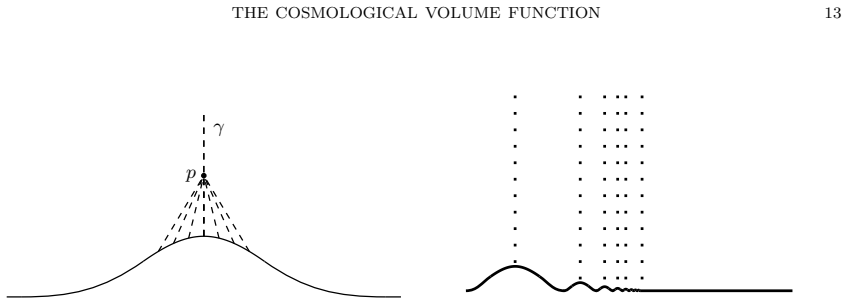
The central object is the candidate differential L^: T I^+(S) → R defined by Z ↦ ∫_{E˚^−(π(Z))∩I^+(S)} L(Z)⌟dvol_g, where L(Z) is the Jacobi field along null generators of the past boundary with initial value Z and vanishing initial derivative. This is the boundary term expected from the Leibniz rule when the past set I^−(p) moves with velocity Z. The paper shows L^ is continuous and exactly equals the derivative of τ_V, using the continuity of the null geodesic hitting time t_S and a reduction to the cutoff-regularized integrals of previous work.
What would settle it
Perform an explicit finite-difference check of τ_V in a globally hyperbolic spacetime with a nontrivial null cut locus (for example, a warped product as in Example 3.7 with a(t) chosen to create crossing null geodesics). Compute (τ_V(p + εv) − τ_V(p))/ε for small ε and compare with L^(v) from Lemma 3.2; if they do not converge to the same limit, the derivative formula fails. Alternatively, verify in a concrete example that dτ_V is discontinuous at a point where the null cut locus accumulates—this would contradict Corollary 1.2.
Extended reading notes
Core claim
On the paper's own terms, the central claim is that the cosmological volume function τ_V(p) = vol_g(I^−(p)), previously known to be continuous, strictly increasing along causal curves, and regular under broad conditions, is in fact C^1 with past-directed timelike gradient in the settings of Theorem 1.1 and Corollary 1.2. The proof works by differentiating an integral over the past light cone: the candidate derivative is obtained by solving the Jacobi equation along null generators of the boundary of the past set and integrating the resulting vector-field contraction over the regular part of the cone (excluding the null cut locus). The continuity of this candidate derivative is established vi
Load-bearing premise
The proof that the derivative of τ_V is given by the integral L^ relies on the null cut locus having measure zero and contributing no boundary term in the Leibniz integral rule, and on the cutoff functions satisfying a technical lemma from prior work; these analytic hypotheses are invoked or delegated rather than fully proven here.
Editorial extensions
If this is right
- For any future Cauchy surface S, τ_V of the spacetime (I^+(S), g) is regular, C^1, and temporal, so its level sets are future Cauchy surfaces.
- Any causal spacetime with finite τ_V and no past observer horizons is globally hyperbolic with compact Cauchy surfaces, and τ_V is C^1 with past-directed timelike gradient at every point.
- The metric splits canonically as g = −β(dτ_V)² + h, with β > 0 continuous and h a continuous Riemannian metric on the level sets; flipping the sign gives a canonical Wick-rotated Riemannian metric g_R = β(dτ_V)² + h.
- This canonical g_R, requiring no arbitrary choices, is well suited for studying convergence of spacetimes through Riemannian metric-space convergence, complementing but distinct from the null distance approach.
- The paper also shows τ_V can fail to be Lipschitz in general (Example 3.9) and can be C^1 but not C^2 (Example 3.10), so the differentiability threshold is sharp.
Reading between the lines
- The NPOH result might extend to spacetimes with lower-regularity metrics (continuous or C^{0,1}), where smooth temporal functions are not always available, making τ_V a canonical clock in rougher settings.
- The continuity of the hitting time t_S in Lemma 3.1 could allow a similar differentiability theorem for volume-like functions built from continuously varying weighted measures, not just the unweighted volume.
- The C^1-not-C^2 example suggests that any curvature estimates or second-order expansions built on the τ_V foliation will encounter discontinuities; convergence results using g_R may need to handle this lack of higher regularity.
- A natural testable extension: in the NPOH setting, is the Riemannian distance induced by g_R bi-Lipschitz equivalent to the null distance of a compatible time function? If so, it would give a concrete link between the two convergence programs.
Editorial analysis
A structured set of objections, weighed in public.
Referee Report
Summary. The paper studies the differentiability of the cosmological volume function τ_V(p) = vol(I^-(p)), previously introduced by the author. The main results are Theorem 1.1 and Corollary 1.2. Theorem 1.1 states that if S is a future Cauchy surface in a spacetime (M,g), then τ_V on I^+(S) is regular and is a C^1 temporal function. Corollary 1.2 extends this to causal spacetimes with no past observer horizons and finite τ_V. The proof adapts the Chruściel–Grant–Minguzzi approach for weighted volume time functions: one differentiates the integral defining τ_V over the moving region I^-(p), identifies a candidate derivative L̂, and shows via cutoff functions that the fundamental theorem of calculus applies. The paper also provides several examples showing the optimality of the hypotheses (lightlike Cauchy surface, non-Lipschitz τ_V, C^1 but not C^2), compares τ_V with the cosmological time function, and discusses the cosmological cut locus.
Significance. If the proof is completed, the result is significant: it provides a canonical C^1 temporal function—and hence a canonical Wick-rotated Riemannian metric—constructed solely from the Lorentzian metric, with no arbitrary choices. This is directly relevant for studying convergence of sequences of spacetimes via metric-space techniques. The paper is clearly written, the examples are instructive, and the overall strategy of reducing to the framework of [8] is credible. However, the central differentiability proof relies on three analytic assertions that are not fully justified in the text, and one of the two corollaries depends on an unpublished preprint. These issues are load-bearing for the advertised conclusions and require attention before the paper can be accepted.
major comments (4)
- [Lemma 3.3, p. 6] The passage to the limit ε→0 inside the s-integral is not justified. The equality obtained after 'Take the limit ε→0' requires a dominated convergence argument. Such an argument is likely available: after the WLOG reduction, γ([s1,s2])⊂I^-(p'), and J^-(p')∩J^+(S) is compact, so the integrand (s,q)↦L(γ̇(s))⌟dvol_g is bounded on a fixed compact set independently of ε. But the argument must be written. As it stands, the displayed equality is not established and the C^1 conclusion in Theorem 1.1 does not follow from the preceding steps.
- [Lemma 3.2 and Lemma 3.3, pp. 5–6] The proof asserts without proof or citation that the null cut locus has measure zero and 'ultimately does not contribute' to the boundary term in the Leibniz rule. This is the central bridge between the geometric definition of τ_V and the candidate derivative L̂: if the cut-locus boundary term were nonzero, dτ_V would contain an additional term and the metric splitting in Theorem 1.1 would fail. The paper needs either a direct proof or a precise reference establishing that (i) the cut locus has the relevant measure zero property in the needed generality (C^{2,1} metric, future Cauchy surface possibly of low regularity), and (ii) the Leibniz rule can be applied in the presence of this singular boundary.
- [Lemma 3.3, p. 6] The cutoff functions φ_ε are defined from a merely continuous function f: [0,∞)→[0,1]. The invocation of [8, Lem. 3.1] requires that each φ_ε satisfy the hypotheses of that lemma, which are not stated in the paper. If [8, Lem. 3.1] requires C^1 or Lipschitz cutoffs, then the proof must be modified (e.g. by smoothing f). The paper should at minimum quote the exact hypotheses of [8, Lem. 3.1] and verify them for the constructed φ_ε.
- [Corollary 1.2 and Lemma 3.5, p. 7] Corollary 1.2, one of the two main advertised results, relies on Lemma 3.5, which is imported from the preprint [13] (García-Heveling & Zeghib). The lemma asserts that NPOH implies global hyperbolicity with compact Cauchy surfaces and supplies the specific past-containment property. Since this is load-bearing for the corollary, the paper should either prove Lemma 3.5 directly or quote the exact statement with all assumptions and a stable reference. A citation to an unpublished preprint is not sufficient for a key step of a main result unless its contents are reproduced or verified.
minor comments (5)
- [Lemma 3.5, p. 7] Typo: 'casual spacetime' should be 'causal spacetime'.
- [Lemma 3.2, p. 6] The notation (L(Z)⌟dvol_g)_{1...n} is undefined. Please explain the coordinate expression or define the notation.
- [Example 3.9, p. 8] In the displayed inequality, the constant π/4 appears: it would be helpful to briefly justify this geometric constant (area of the relevant quadrant of the set {t^2+x^2>r^2}∩A).
- [Example 3.10, p. 9] The switch from τ_V(t)=t^2 to τ_V(t)=2π(t−π)+π^2 after t=π is plausible, but a sentence explaining the geometry (the past cone wraps around the circle when t>π) would improve readability.
- [Section 4.4, Definition 4.5, p. 12] The definition of the cosmological cut locus C=M\I would benefit from a remark that I is open? The text later says I is dense and gives a proof, but the openness is not stated; it may be useful for the reader.
Circularity Check
No significant circularity: the C^1 result is derived via [8] as an external black box; same-author citations are auxiliary and do not smuggle in the conclusion.
full rationale
The central claim is not circular. τ_V is defined directly as vol(I^-(p)), and Theorem 1.1's proof constructs a candidate derivative L̂ from Jacobi fields along the null generators of E^-(p), then invokes [8, Lem. 3.1] as an external black box to differentiate cut-off integrals. It does not assume τ_V is C^1 in its inputs. The null cut-locus measure-zero assertion and the limit ε→0 steps are analytically delicate and are partly delegated to [8]; this is a rigor/correctness concern about Lemma 3.3, not an identity between premise and conclusion. The same-author citations — [12] for the definition and regularity of τ_V, [10] for Proposition 2.3, and [13] for the NPOH Lemma 3.5 — support auxiliary geometric facts whose assumptions do not include the C^1 temporality of τ_V. They are therefore independent support under the rubric, even where author overlap exists. No equation in the paper is equivalent to its own input by construction, and no fitted parameter is renamed as a prediction. The paper's own acknowledged analytic gaps, while load-bearing for the proof, are not circularity.
Assumptions & free parameters
assumptions (5)
- domain assumption Standard causality theory and the CGM volume-time results [8] apply for C^{2,1} Lorentzian metrics.
- ad hoc to paper The null cut locus of a point has n-dimensional Lebesgue measure zero and hence contributes no boundary term in the Leibniz rule.
- domain assumption Pointwise finiteness of τ_V plus global hyperbolicity implies regularity of τ_V (Prop. 2.3, from [10]).
- domain assumption NPOH implies global hyperbolicity with compact Cauchy surfaces and the existence of a past Cauchy surface below every level of any Cauchy temporal function (Lemma 3.5, from [13]).
- domain assumption [8, Prop. 2.1] gives continuity of the cut parameter t^- and [8, Lem. 3.1] gives C^1 volume time functions for weighted measures.
Cite this review
Pith. "Pith review of Differentiability and Other Properties of the Cosmological Volume Function." pith.science (2026). https://pith.science/paper/YZN4JJIX
@misc{pith2026251211626,
  author       = {Pith},
  title        = {Pith review of: Differentiability and Other Properties of the Cosmological Volume Function},
  year         = {2026},
  howpublished = {\url{https://pith.science/paper/YZN4JJIX}},
  note         = {Machine review of arXiv:2512.11626}
}
abstract
In a previous work, the regular cosmological volume function $\tau_V$ was introduced as an alternative to the regular cosmological time function of Andersson, Galloway, and Howard. Building on work by Chru\'sciel, Grant and Minguzzi, in this paper we show that in many cases of interest, $\tau_V$ is a continuously differentiable temporal function. This leads to a canonical splitting of the metric tensor, and induces a canonical ``Wick-rotated" Riemannian metric. We also provide some further results and examples related to the cosmological time and volume functions.
Figures


Figures from the paper (2 more)

Reference graph
Works this paper leans on
-
[8]
P. T. Chru´ sciel, J. D. E. Grant, and E. Minguzzi. On differentiability of volume time functions.Ann. Henri Poincar´ e, 17(10):2801–2824, 2016. 14 LEONARDO GARC ´IA-HEVELING
2016
-
[13]
L. Garc ´ ıa-Heveling and A. Zeghib. Isometries of spacetimes without observer horizons. Preprint arXiv:2502.13904, 2025
arXiv 2025
-
[1]
Andersson, G
L. Andersson, G. J. Galloway, and R. Howard. The cosmological time function.Classical Quantum Gravity, 15(2):309–322, 1998
1998
-
[2]
A. N. Bernal and M. S´ anchez. Smoothness of time functions and the metric splitting of globally hyperbolic spacetimes.Comm. Math. Phys., 257(1):43–50, 2005
2005
- [3]
-
[4]
Burtscher and L
A. Burtscher and L. Garc ´ ıa-Heveling. Global hyperbolicity through the eyes of the null distance. Comm. Math. Phys., 405(4):Paper No. 90, 35, 2024
2024
-
[5]
A. Y. Burtscher. Length structures on manifolds with continuous Riemannian metrics.New York J. Math., 21:273–296, 2015
2015
-
[6]
F. Cavalletti and A. Mondino. A sharp isoperimetric-type inequality for Lorentzian spaces satisfying timelike Ricci lower bounds. Preprint, arXiv:2401.03949, 2024
arXiv 2024
Show all 21 references
-
[7]
P. T. Chru´ sciel and J. D. E. Grant. On Lorentzian causality with continuous metrics.Classical Quan- tum Gravity, 29(14):145001, 32, 2012
2012
-
[9]
Flanders
H. Flanders. Differentiation under the integral sign.Amer. Math. Monthly, 80:615–627; correction, ibid. 81 (1974), 145, 1973
1974
-
[10]
G. J. Galloway and L. Garc ´ ıa-Heveling. Mean curvature, singularities, and time functions in cosmology. InProgress in Lorentzian geometry, volume 512 ofSpringer Proc. Math. Stat.Springer, New York, 2025
2025
-
[11]
G. J. Galloway and C. Vega. Achronal limits, Lorentzian spheres, and splitting.Ann. Henri Poincar´ e, 15(11):2241–2279, 2014
2014
-
[12]
Garc ´ ıa-Heveling
L. Garc ´ ıa-Heveling. Volume singularities in general relativity.Lett. Math. Phys., 114(3):71, 2024
2024
-
[14]
R. Geroch. Domain of dependence.J. Math. Phys., 11:437–449, 1970
1970
-
[15]
Graf and C
M. Graf and C. Sormani. Lorentzian area and volume estimates for integral mean curvature bounds. InDevelopments in Lorentzian geometry. Selected papers based on the presentations at the 10th inter- national meeting on Lorentzian geometry, GeLoCor 2021, Cordoba, Spain, February...
2021
-
[16]
S. W. Hawking and G. F. R. Ellis.The large scale structure of space-time. Cambridge Monographs on Mathematical Physics. Cambridge University Press, 1973
1973
-
[17]
Sakovich and C
A. Sakovich and C. Sormani. The null distance encodes causality.J. Math. Phys., 64(1):Paper No. 012502, 18, 2023
2023
-
[18]
Sakovich and C
A. Sakovich and C. Sormani. Introducing various notions of distances between space-times. Preprint arXiv:2410.16800, 2025
2025
-
[19]
Sbierski
J. Sbierski. TheC 0-inextendibility of a class of FLR W spacetimes. Preprint, arXiv:2312.07443, 2025
2025
-
[20]
Sormani and C
C. Sormani and C. Vega. Null distance on a spacetime.Classical Quantum Gravity, 33(8):085001, 29, 2016
2016
-
[21]
R. M. Wald and P. Yip. On the existence of simultaneous synchronous coordinates in spacetimes with spacelike singularities.J. Math. Phys., 22(11):2659–2665, 1981. F aculty of Mathematics, University of Vienna Oskar-Morgenstern-Platz 1, 1090 Wien, Austria Email address:leonardo...
1981
Reviewed August 3, 2026 · model on record in the stance chip above.
Discussion (0). Continue with ORCID to comment.