REVIEW 2 major objections 6 minor 28 references
This paper proposes Bench-Push, the first unified benchmark for pushing-based mobile robot navigation and manipulation, with new metrics for efficiency, effort, and partial success.
Reviewed by Pith at T0; open to challenge. T0 means a machine referee read the full paper against a public rubric. the ladder, T0–T4 →
T0 review · deepseek-v4-flash
2026-08-03 16:46 UTC pith:W4BLMPNL
load-bearing objection A genuinely useful, well-scoped benchmark for pushing-based navigation and manipulation, with one headline metric (E_manip) that needs rethinking but not fatal; worth a serious referee. the 2 major comments →
Bench-Push: Benchmarking Pushing-based Navigation and Manipulation Tasks for Mobile Robots
The pith
A machine-rendered reading of the paper's core claim, the machinery that carries it, and where it could break.
Core claim
The central claim is that a single benchmark can support both navigation-centric and manipulation-centric pushing tasks while measuring the qualities that matter for pushing: path efficiency, interaction effort, and partial completion. Bench-Push implements this with five metrics: for navigation, E_nav compares the robot's path length to the shortest collision-free path while I_nav is the ratio of work spent moving the robot to work spent moving all objects; for manipulation, S_manip is the fraction of objects successfully delivered or cleared, E_manip compares the executed path to an idealized minimum path, and I_manip is the ratio of necessary work to total work. By providing baselines and
What carries the argument
The carrying mechanism is the benchmark's metric design plus its environment abstraction. The navigation metrics use work ratios derived from masses, path lengths, and a constant friction coefficient; the manipulation metrics add a success fraction and a lower-bound path length L*(O') computed from a minimum spanning tree over a graph of object starts, goal contact points, and the robot. This MST estimate is what allows E_manip to approximate 'idealized' efficiency for a partially completed multi-object task, though the paper notes it is not a strict lower bound. Around this, the benchmark provides a standard reinforcement-learning interface, interchangeable bumpers, wheeled and unwheeled bo
Load-bearing premise
The manipulation efficiency score E_manip relies on a minimum-spanning-tree estimate of the ideal path length that the paper admits is not a strict lower bound, so if that estimate is not reliably tight, E_manip may no longer mean what it claims.
What would settle it
Build or simulate a box-delivery instance where the true optimal pushing path for the completed sub-tasks is shorter than the MST estimate; if E_manip then exceeds 1 or the estimate fails to lower-bound the actual path, the metric's interpretation breaks.
If this is right
- Researchers can compare pushing policies on identical tasks and score them on efficiency–effort trade-offs instead of success alone.
- The 2D simulation tier lets users prototype quickly before committing to expensive 3D or hardware experiments.
- Because interaction effort is scored separately from efficiency, policies that nudge obstacles lightly can be distinguished from those that bulldoze through them.
- Bench-Push's reported sim-to-real consistency in Maze and Box-Delivery suggests the benchmark can serve as a training-and-evaluation loop for real deployment.
Where Pith is reading between the lines
- A natural extension is to certify the L*(O') lower bound—for small instances one could solve exact shortest-push sequences and place a hard bound under E_manip; if the MST estimate can exceed 1 or fail to lower-bound, the metric would need renormalization.
- The work-ratio framing could generalize to other non-prehensile contact tasks, such as sweeping, towing, or excavating, where efficiency of the robot's own motion versus effort applied to the environment is the natural comparison.
- The current bird's-eye, known-pushable-object assumption implies the benchmark suits structured lab scenarios; adding egocentric perception and pushability estimation would extend it to partially known or cluttered real-world settings.
Editorial analysis
A structured set of objections, weighed in public.
Referee Report
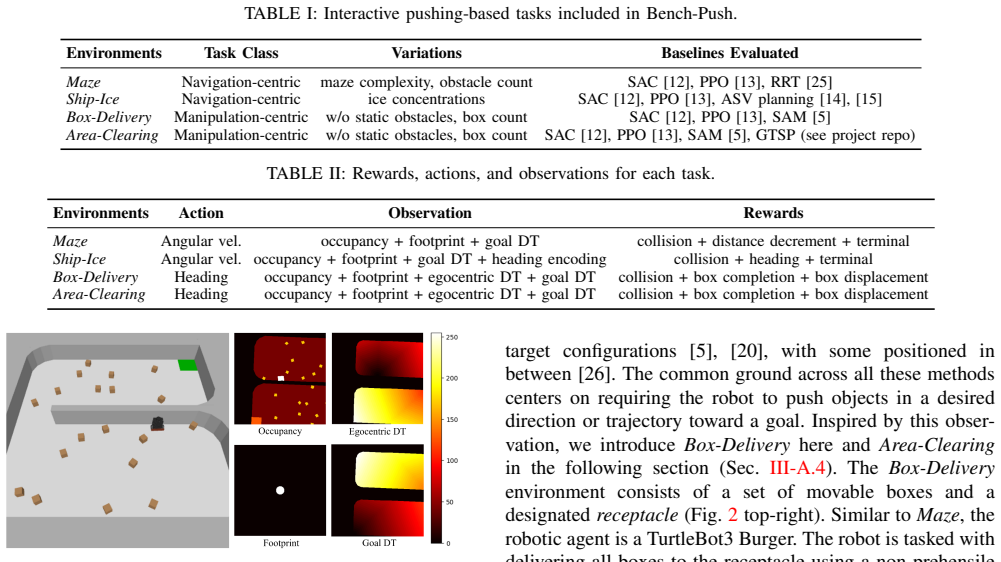
Summary. The paper introduces Bench-Push, a benchmark for pushing-based mobile robot navigation and manipulation. It provides four configurable environments in both 2D (Pymunk) and 3D (MuJoCo) simulation—Maze, Ship-Ice, Box-Delivery, and Area-Clearing—together with a set of novel evaluation metrics (E_nav, I_nav, S_manip, E_manip, I_manip). The benchmark includes reference baselines (SAC, PPO, RRT, SAM, ASV planners) and reports evaluations in simulation and on a physical TurtleBot testbed, claiming zero-shot sim-to-real transfer. The central claim is that this is the first unified benchmark for pushing-based mobile robot navigation and manipulation tasks.
Significance. If the metrics are sound, Bench-Push fills a recognized gap: the field of pushing-based robotics lacks standardized environments and evaluation protocols. The 2D/3D dual-simulation design, configurable environment variations, and bundled baseline implementations are practical contributions that could improve reproducibility and cross-comparison. The open-source Python library and the physical testbed demonstration are useful resources. The paper is transparent about limitations, and the environment descriptions are detailed enough for reimplementation. However, the significance of the contribution depends on the validity of the proposed metrics, particularly E_manip, whose reference path is computed with a heuristic that the authors admit is not a strict lower bound. The sim-to-real claim is also supported by limited data. These issues need to be addressed before the benchmark can be relied upon as a standard evaluation tool.
major comments (2)
- [Sec. III-C.2, Eq. (4)] The manipulation efficiency metric E_manip is defined as L*(O')/l0, where L*(O') is computed as the weight of an MST on a graph whose edges are restricted to object-object, robot-object, and object-own-goal pairs. As the authors state, this MST is not a strict lower bound on the true optimal path length, so E_manip can exceed 1 and its bias can vary with the object layout. This undermines the metric's comparability across episodes and its interpretation as an 'efficiency' score. Since novel metrics are a headline contribution, this is load-bearing. The authors should either replace L* with a true lower bound (e.g., solve an appropriate TSP/Steiner-tree problem on a graph with all relevant transitions) or redefine E_manip as a structural score with an established range, validating its behavior across random layouts. At minimum, an empirical study of E_manip's distribution over the benchma
- [Sec. IV-C/IV-D, Tables III-IV] The claim that 'policies trained in Bench-Push transfer well to real robots' is supported by only 3 physical episodes per condition, with no statistical tests. The reported rankings are not always consistent between simulation and testbed: in Table III, 10-Obs, RRT has the highest E_nav in simulation (0.758) but the lowest in testbed (0.681), whereas PPO is second in simulation and first in testbed. In Table IV, 5-Obs, SAM's E_manip is higher in the testbed (0.417) than in simulation (0.243), which is not a clear 'alignment'. The conclusion of consistent sim-to-real behavior is stronger than the evidence. Please temper the claim to a feasibility demonstration, or add more trials and appropriate statistical analysis (e.g., hypothesis tests or confidence intervals on rankings).
minor comments (6)
- [Sec. III-C.2] The phrase '(a lower bound on)' in the definition of L*(O') is misleading given the subsequent admission that the MST is not a strict lower bound. Clarify the wording.
- [Sec. IV-B] The physical testbed uses an overhead camera, but the policies expect egocentric observations (occupancy, distance transforms, heading encoding). The paper does not describe how the overhead detections are converted into these observations. This is necessary for reproducibility of the sim-to-real experiments.
- [Tables III and IV] The labels '3-Obs', '6-Obs', '10-Obs' are not defined in the captions or text. State explicitly that these denote the number of movable obstacles/boxes.
- [Sec. III-C.1, Eq. (2)] The denominator in Eq. (2) uses 'i=0' to include the robot, but the preceding text defines m_i and l_i only for objects i=1,...,K. Introduce m_0 and l_0 explicitly before the equation.
- [Sec. I] The abstract says the library 'will be open-sourced', while the body (Sec. I) says 'will also be made available' and the repository URL is given. Use consistent tense and clarify the current availability status of the code.
- [References] There are minor formatting inconsistencies in the bibliography, e.g., 'V .' instead of 'V.', and some entries lack page ranges or venue formatting. A thorough proofread of the references is advisable.
Circularity Check
No significant circularity: Bench-Push is a self-contained benchmark with metric definitions and external baselines.
full rationale
The paper's central contributions are new environments, metrics, and baseline evaluations. The metrics E_nav, I_nav, S_manip, E_manip, and I_manip are defined directly from path lengths, masses, and task-completion indicators, with no parameters fitted to the data being evaluated. The E_manip reference L*(O') is admittedly computed via an MST that is not a strict lower bound, but the paper explicitly acknowledges this limitation rather than disguising it as a proven quantity; this is a correctness/validity concern, not circularity. The Ship-Ice environment draws parameters from the authors' prior ASV work [14], [15], and their planners are used as task-specific baselines, but the benchmark's claims do not reduce to those citations: the baselines are independently implemented and evaluated, and the sim-to-real results compare trained policies against physical testbed outcomes. There is no fitted quantity being renamed as a prediction, no uniqueness theorem imported from the authors, and no ansatz smuggled in through self-citation. The derivation chain is open and externally checkable, so the appropriate finding is no circularity.
Axiom & Free-Parameter Ledger
axioms (5)
- domain assumption Rigid-body contact dynamics in Pymunk and MuJoCo approximate real robot-object pushing sufficiently for policy transfer.
- domain assumption Ship-Ice fluid effects can be approximated by combined linear and quadratic drag on bodies in the xy-plane.
- domain assumption The work to move an object i a distance l_i is μ m_i g l_i with a single constant coefficient of kinetic friction μ across the environment.
- ad hoc to paper The MST of the constructed graph is a practical lower bound on the minimum path length to complete the successful sub-tasks.
- ad hoc to paper The four selected environments (Maze, Ship-Ice, Box-Delivery, Area-Clearing) capture the fundamental challenges in pushing-based mobile robot navigation and manipulation.
read the original abstract
Mobile robots are increasingly deployed in cluttered environments with movable objects, posing challenges for traditional methods that prohibit interaction. In such settings, the mobile robot must go beyond traditional obstacle avoidance, leveraging pushing or nudging strategies to accomplish its goals. While research in pushing-based robotics is growing, evaluations rely on ad hoc setups, limiting reproducibility and cross-comparison. To address this, we present Bench-Push, the first unified benchmark for pushing-based mobile robot navigation and manipulation tasks. Bench-Push includes multiple components: 1) a comprehensive range of simulated environments that capture the fundamental challenges in pushing-based tasks, including navigating a maze with movable obstacles, autonomous ship navigation in ice-covered waters, box delivery, and area clearing, each with varying levels of complexity; 2) novel evaluation metrics to capture efficiency, interaction effort, and partial task completion; and 3) demonstrations using Bench-Push to evaluate example implementations of established baselines across environments. Bench-Push is open-sourced as a Python library with a modular design. The code, documentation, and trained models can be found at https://github.com/IvanIZ/BenchNPIN.
Figures




Reference graph
Works this paper leans on
-
[1]
Navigation among movable obstacles: Real-time reasoning in complex environments,
M. Stilman and J. J. Kuffner, “Navigation among movable obstacles: Real-time reasoning in complex environments,”International Journal of Humanoid Robotics, vol. 2, no. 04, pp. 479–503, 2005
2005
-
[2]
Probabilistic mobile manipulation in dynamic environments, with application to opening doors
A. Petrovskaya and A. Y . Ng, “Probabilistic mobile manipulation in dynamic environments, with application to opening doors.” inIJCAI, 2007, pp. 2178–2184
2007
-
[3]
Planning and executing navigation among movable obstacles,
M. Stilman, K. Nishiwaki, S. Kagami, and J. J. Kuffner, “Planning and executing navigation among movable obstacles,”Advanced Robotics, vol. 21, no. 14, pp. 1617–1634, 2007
2007
-
[4]
Local path planning among pushable objects based on reinforcement learning,
L. Yao, V . Modugno, A. M. Delfaki, Y . Liu, D. Stoyanov, and D. Kanoulas, “Local path planning among pushable objects based on reinforcement learning,” inIEEE/RSJ International Conference on Intelligent Robots and Systems, 2024, pp. 3062–3068
2024
-
[5]
Spatial action maps for mobile manipulation,
J. Wu, X. Sun, A. Zeng, S. Song, J. Lee, S. Rusinkiewicz, and T. Funkhouser, “Spatial action maps for mobile manipulation,”arXiv preprint arXiv:2004.09141, 2020
Pith/arXiv arXiv 2004
-
[6]
Pushing through clutter with movability awareness of blocking obstacles,
J. J. Weeda, S. Bakker, G. Chen, and J. Alonso-Mora, “Pushing through clutter with movability awareness of blocking obstacles,” arXiv preprint arXiv:2502.20106, 2025
Pith/arXiv arXiv 2025
-
[7]
The ycb object and model set: Towards common benchmarks for manipulation research,
B. Calli, A. Singh, A. Walsman, S. Srinivasa, P. Abbeel, and A. M. Dollar, “The ycb object and model set: Towards common benchmarks for manipulation research,” inIEEE International Conference on Advanced Robotics, 2015, pp. 510–517
2015
-
[8]
robosuite: A modular simulation framework and benchmark for robot learning,
Y . Zhu, J. Wong, A. Mandlekar, R. Mart´ın-Mart´ın, A. Joshi, S. Nasiri- any, and Y . Zhu, “robosuite: A modular simulation framework and benchmark for robot learning,”arXiv preprint arXiv:2009.12293, 2020
Pith/arXiv arXiv 2009
-
[9]
Interactive gibson benchmark: A benchmark for interactive navigation in cluttered environments,
F. Xia, W. B. Shen, C. Li, P. Kasimbeg, M. E. Tchapmi, A. Toshev, R. Mart´ın-Mart´ın, and S. Savarese, “Interactive gibson benchmark: A benchmark for interactive navigation in cluttered environments,”IEEE Robotics and Automation Letters, vol. 5, no. 2, pp. 713–720, 2020
2020
-
[10]
Mujoco: A physics engine for model-based control,
E. Todorov, T. Erez, and Y . Tassa, “Mujoco: A physics engine for model-based control,” inIEEE/RSJ International Conference on Intelligent Robots and Systems, 2012, pp. 5026–5033
2012
-
[11]
Pymunk: A easy-to-use pythonic rigid body 2d physics library. (version 6.7.0),
V . Blomqvist, “Pymunk: A easy-to-use pythonic rigid body 2d physics library. (version 6.7.0),” 2024. [Online]. Available: https://pymunk.org
2024
-
[12]
Soft actor-critic: Off- policy maximum entropy deep reinforcement learning with a stochastic actor,
T. Haarnoja, A. Zhou, P. Abbeel, and S. Levine, “Soft actor-critic: Off- policy maximum entropy deep reinforcement learning with a stochastic actor,” inInternational conference on machine learning. PMLR, 2018, pp. 1861–1870
2018
-
[13]
Proximal policy optimization algorithms,
J. Schulman, F. Wolski, P. Dhariwal, A. Radford, and O. Klimov, “Proximal policy optimization algorithms,”arXiv preprint arXiv:1707.06347, 2017
Pith/arXiv arXiv 2017
-
[14]
Auto-icenav: A local navigation strategy for autonomous surface ships in broken ice fields,
R. de Schaetzen, A. Botros, N. Zhong, K. Murrant, R. Gash, and S. L. Smith, “Auto-icenav: A local navigation strategy for autonomous surface ships in broken ice fields,”arXiv preprint arXiv:2411.17155, 2024
arXiv 2024
-
[15]
Autonomous navigation in ice-covered waters with learned predictions on ship-ice interactions,
N. Zhong, A. Potenza, and S. L. Smith, “Autonomous navigation in ice-covered waters with learned predictions on ship-ice interactions,” inIEEE International Conference on Robotics and Automation, 2025, pp. 10 157–10 163
2025
-
[16]
Interactive-far: Interactive, fast and adaptable routing for navigation among movable obstacles in complex unknown environments,
B. He, G. Chen, W. Wang, J. Zhang, C. Fermuller, and Y . Aloimonos, “Interactive-far: Interactive, fast and adaptable routing for navigation among movable obstacles in complex unknown environments,” in IEEE/RSJ International Conference on Intelligent Robots and Systems, 2024, pp. 5402–5409
2024
-
[17]
Search-based path planning in interactive environments among movable obstacles,
Z. Ren, B. Suvonov, G. Chen, B. He, Y . Liao, C. Fermuller, and J. Zhang, “Search-based path planning in interactive environments among movable obstacles,”arXiv preprint arXiv:2410.18333, 2024
Pith/arXiv arXiv 2024
-
[18]
Unwieldy object delivery with nonholonomic mobile base: A stable pushing approach,
Y . Tang, H. Zhu, S. Potters, M. Wisse, and W. Pan, “Unwieldy object delivery with nonholonomic mobile base: A stable pushing approach,” IEEE Robotics and Automation Letters, vol. 8, no. 11, pp. 7727–7734, 2023
2023
-
[19]
Unwieldy object delivery with nonholonomic mobile base: A free pushing approach,
Y . Tang, M. Wisse, and W. Pan, “Unwieldy object delivery with nonholonomic mobile base: A free pushing approach,”IEEE Robotics and Automation Letters, 2024
2024
-
[20]
Autonomous multiple-trolley collection system with nonholonomic robots: Design, control, and implementation,
P. Xie, B. Xia, A. Hu, Z. Zhao, L. Meng, Z. Sun, X. Gao, J. Wang, and M. Q.-H. Meng, “Autonomous multiple-trolley collection system with nonholonomic robots: Design, control, and implementation,”Journal of Field Robotics, vol. 42, no. 1, pp. 20–36, 2025
2025
-
[21]
Benchmarking metric ground navigation,
D. Perille, A. Truong, X. Xiao, and P. Stone, “Benchmarking metric ground navigation,” in2020 IEEE International Symposium on Safety, Security, and Rescue Robotics (SSRR). IEEE, 2020, pp. 116–121
2020
-
[22]
Benchmarking reinforcement learning techniques for autonomous navigation,
Z. Xu, B. Liu, X. Xiao, A. Nair, and P. Stone, “Benchmarking reinforcement learning techniques for autonomous navigation,” in IEEE International Conference on Robotics and Automation, 2023, pp. 9224–9230
2023
-
[23]
Arena-bench: A benchmarking suite for obstacle avoidance approaches in highly dynamic environments,
L. K ¨astner, T. Bhuiyan, T. A. Le, E. Treis, J. Cox, B. Meinardus, J. Kmiecik, R. Carstens, D. Pichel, B. Fatlounet al., “Arena-bench: A benchmarking suite for obstacle avoidance approaches in highly dynamic environments,”IEEE Robotics and Automation Letters, vol. 7, no. 4, pp. 9477–9484, 2022
2022
-
[24]
Gymnasium: A standard interface for reinforcement learning environments,
M. Towers, A. Kwiatkowski, J. Terry, J. U. Balis, G. De Cola, T. Deleu, M. Goul ˜ao, A. Kallinteris, M. Krimmel, A. KGet al., “Gymnasium: A standard interface for reinforcement learning environments,”arXiv preprint arXiv:2407.17032, 2024
Pith/arXiv arXiv 2024
-
[25]
Randomized Kinodynamic Planning,
S. M. LaValle and J. J. Kuffner, “Randomized Kinodynamic Planning,” The International Journal of Robotics Research, vol. 20, no. 5, pp. 378–400, May 2001
2001
-
[26]
Streamlining object pushing: Behavior tree-based coordination of control and planning,
F. Bertoncelli and L. Sabattini, “Streamlining object pushing: Behavior tree-based coordination of control and planning,” inIEEE/RSJ Interna- tional Conference on Intelligent Robots and Systems, 2024, pp. 5203– 5210
2024
-
[27]
Stable-baselines3: Reliable reinforcement learning im- plementations,
A. Raffin, A. Hill, A. Gleave, A. Kanervisto, M. Ernestus, and N. Dormann, “Stable-baselines3: Reliable reinforcement learning im- plementations,”Journal of Machine Learning Research, vol. 22, no. 268, pp. 1–8, 2021
2021
-
[28]
Deep residual learning for image recognition,
K. He, X. Zhang, S. Ren, and J. Sun, “Deep residual learning for image recognition,” inIEEE Conference on Computer Vision and Pattern Recognition, 2016, pp. 770–778
2016
discussion (0)
Sign in with ORCID, Apple, or X to comment. Anyone can read and Pith papers without signing in.