Probing the Crossover between Dynamical Phases with Local Correlations in a Rydberg Atom Array
Pith reviewed 2026-05-21 17:26 UTC · model grok-4.3
The pith
Local connected correlation functions directly probe the crossover from antiferromagnetic to ferromagnetic dominance in a quenched Rydberg atom array.
A machine-rendered reading of the paper's core claim, the machinery that carries it, and where it could break.
Core claim
Using a Magnus expansion formalism, analytic expressions are derived for local connected correlation functions in a quenched Rydberg atom array. These expressions capture a smooth crossover from antiferromagnetic to ferromagnetic dominance and reveal the critical parameter relationship U_c(δ). The results are validated against exact numerical simulations and exhibit robustness to finite-size effects.
What carries the argument
The Magnus expansion formalism applied to derive analytic expressions for local connected correlation functions that track the dynamics of magnetic order across the crossover.
If this is right
- The protocol establishes a direct and feasible path to observe rich critical dynamics in scalable quantum simulators by shifting focus from global singularities to local correlations.
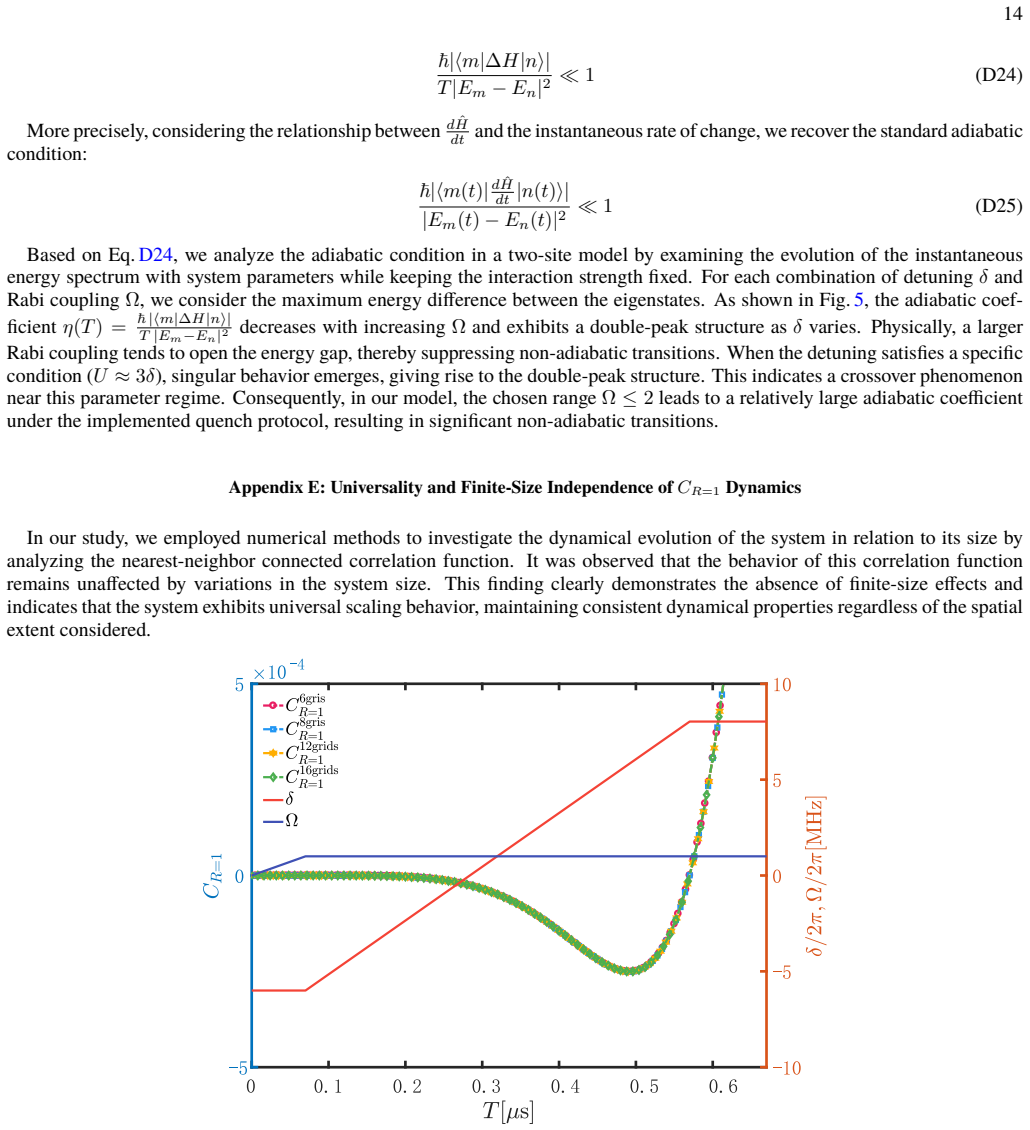
- Analytic results for the correlations remain robust to finite-size effects.
- The critical parameter relationship U_c(δ) governs the smooth crossover between antiferromagnetic and ferromagnetic dominance.
Where Pith is reading between the lines
- This local-correlation approach could be adapted to detect dynamical crossovers in other quenched quantum many-body systems beyond Rydberg arrays.
- Experiments might use these correlations for real-time tracking of magnetic order evolution in larger simulators.
Load-bearing premise
The Magnus expansion formalism accurately captures the relevant dynamics and yields reliable analytic expressions for the local correlations across the parameter regime of interest.
What would settle it
A numerical simulation or experiment in which the local connected correlations show no crossover or fail to track the predicted shift at the derived U_c(δ) for varying δ.
Figures
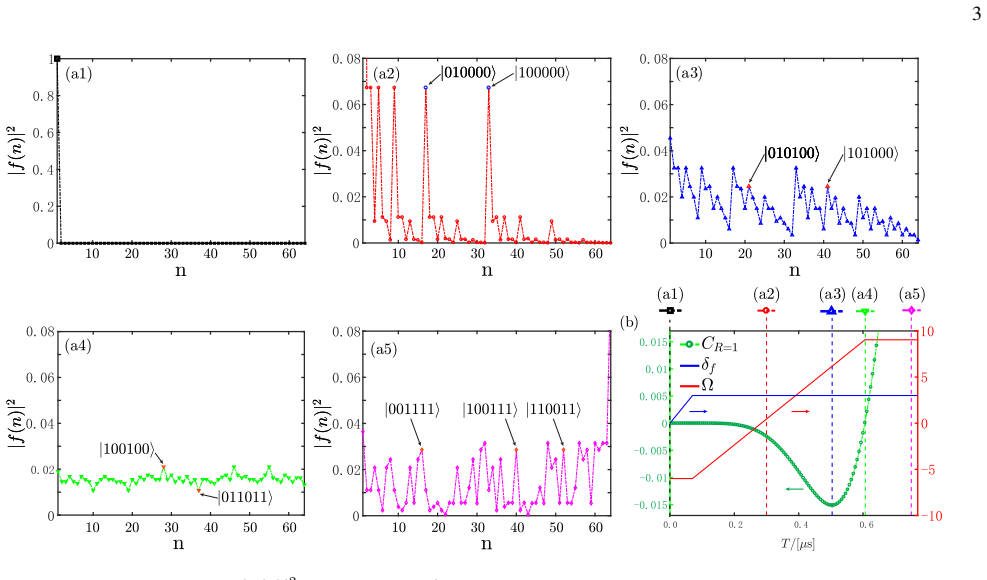
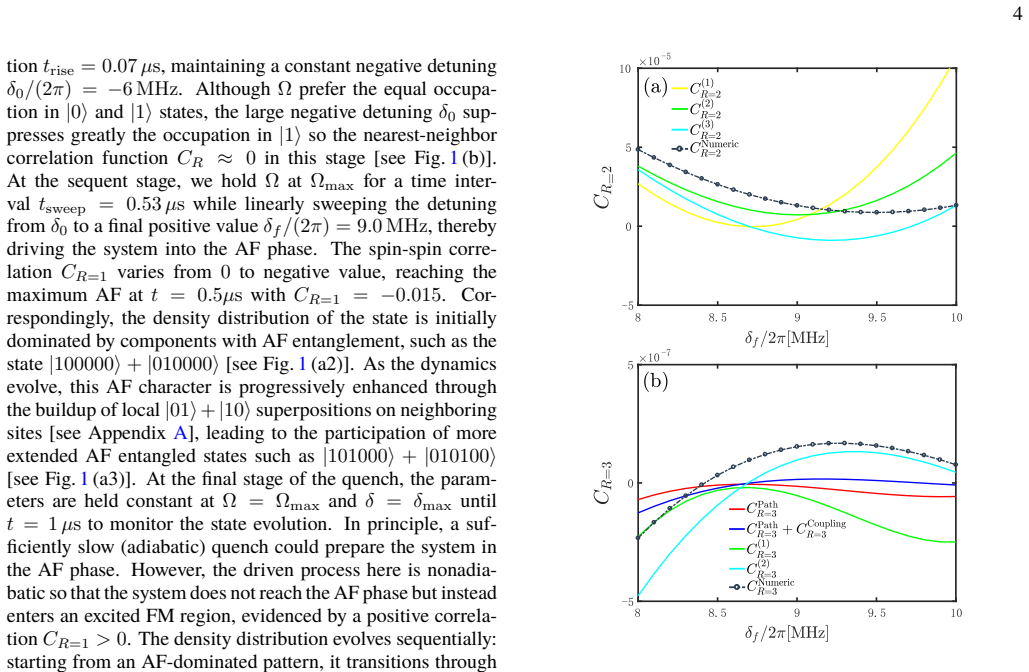
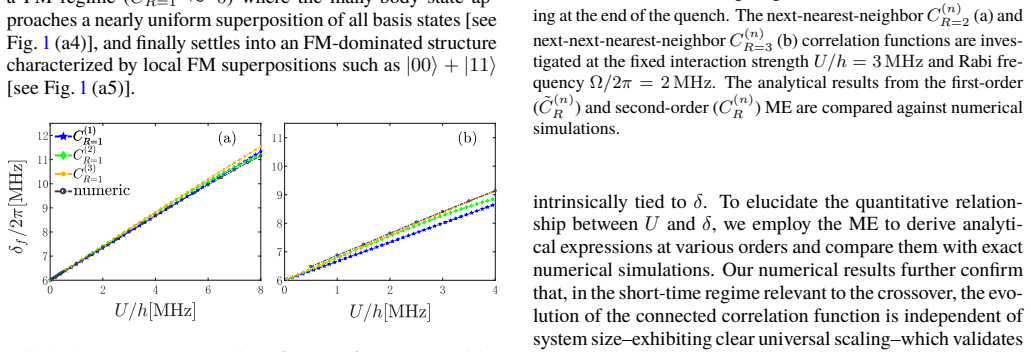
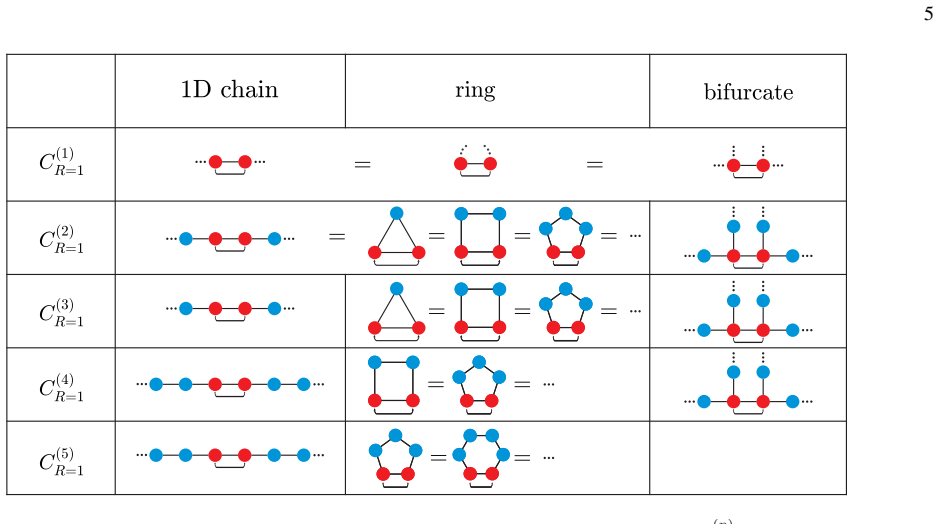
read the original abstract
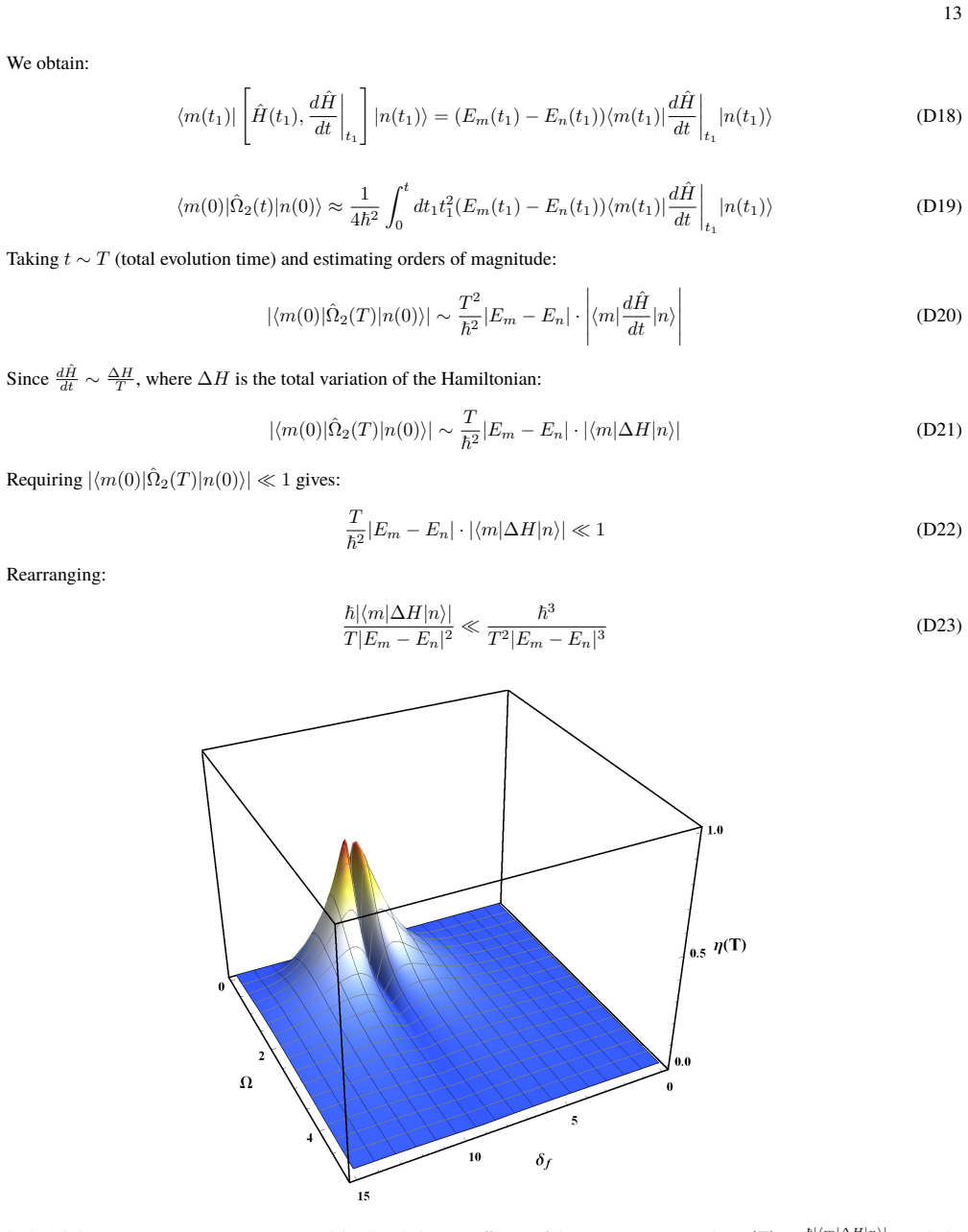
The experimental detection of non-equilibrium quantum criticality remains a challenge, as traditional signatures like dynamical quantum phase transitions rely on hard-to-measure global properties. Here, we demonstrate that local connected correlation functions provide a superior, practical means to directly probe the dynamics of magnetic order in a quenched Rydberg atom array. Using a Magnus expansion formalism, we derive analytic expressions for these correlations that capture a smooth crossover from antiferromagnetic to ferromagnetic dominance. Our analytic results, which reveal the critical parameter relationship $U_{c}(\delta)$, are validated against exact numerical simulations and exhibit robustness to finite-size effects. By shifting the focus from global singularities to local correlations, our protocol establishes a direct and feasible path to observe the rich critical dynamics in scalable quantum simulators.
Editorial analysis
A structured set of objections, weighed in public.
Referee Report
Summary. The manuscript claims that local connected correlation functions offer a practical probe of the crossover from antiferromagnetic to ferromagnetic dominance in the dynamics of a quenched Rydberg atom array. Analytic expressions for these correlations are derived via a Magnus expansion and yield an explicit critical relation U_c(δ); the results are stated to be validated by exact numerics and robust against finite-size effects.
Significance. If the Magnus-derived expressions remain accurate, the work supplies a concrete, experimentally accessible route to non-equilibrium criticality that relies only on local measurements rather than global observables. The parameter-free character of U_c(δ) obtained directly from the expansion constitutes a clear strength, as does the reported agreement with exact diagonalization.
major comments (2)
- [§III] §III (Magnus expansion derivation): the analytic expressions for the local connected correlations and the extracted relation U_c(δ) rest on a low-order truncation of the Magnus series, yet no explicit convergence criterion, truncation order, or a priori error bound is supplied. Because the interaction strength U and detuning δ can drive the system outside the regime where the time-dependent part remains perturbative, the location of the reported crossover is not demonstrably independent of the approximation.
- [§IV] §IV (numerical validation): while the abstract asserts validation against exact numerics, the manuscript does not report quantitative discrepancy measures, the precise range of (U,δ) over which agreement holds, or finite-size scaling of the extracted U_c(δ). This information is required to establish that the analytic crossover is not an artifact of the Magnus truncation.
minor comments (2)
- [Figure 2] Figure 2: the plotted correlation functions would benefit from an explicit overlay of the analytic U_c(δ) curve together with the numerical crossing point for direct visual comparison.
- [§II] Notation: the definition of the connected correlation function C_{ij}(t) should be restated once in the main text rather than only in the supplemental material to improve readability.
Simulated Author's Rebuttal
We thank the referee for the thoughtful and constructive report. The comments highlight important aspects of rigor in the Magnus expansion and its numerical validation. We address each point below and will incorporate revisions to strengthen the manuscript.
read point-by-point responses
-
Referee: [§III] §III (Magnus expansion derivation): the analytic expressions for the local connected correlations and the extracted relation U_c(δ) rest on a low-order truncation of the Magnus series, yet no explicit convergence criterion, truncation order, or a priori error bound is supplied. Because the interaction strength U and detuning δ can drive the system outside the regime where the time-dependent part remains perturbative, the location of the reported crossover is not demonstrably independent of the approximation.
Authors: We agree that an explicit discussion of the truncation is warranted. The derivation in §III employs a second-order Magnus expansion, which is controlled for the short-time dynamics and the parameter window where the time-dependent terms satisfy ||[H(t),H(t')]|| ≪ Ω² (with Ω the Rabi frequency). We will revise the section to state the truncation order explicitly, add a convergence criterion based on the norm of the third-order term, and provide a brief a priori error estimate derived from the Baker-Campbell-Hausdorff remainder. While the crossover U_c(δ) is obtained within this controlled approximation, its robustness is corroborated by the quantitative match to exact diagonalization; we will emphasize that the relation is therefore not an artifact but a leading-order prediction whose accuracy improves with decreasing effective perturbation strength. revision: yes
-
Referee: [§IV] §IV (numerical validation): while the abstract asserts validation against exact numerics, the manuscript does not report quantitative discrepancy measures, the precise range of (U,δ) over which agreement holds, or finite-size scaling of the extracted U_c(δ). This information is required to establish that the analytic crossover is not an artifact of the Magnus truncation.
Authors: We accept that quantitative metrics and scaling analysis should be included. Although the present figures display visual agreement, we will add (i) a table of relative deviations |U_c^analytic(δ) – U_c^num(δ)| / U_c^num(δ) for δ/Ω ∈ [−4,4] showing maximum discrepancy < 6 % for U/Ω ∈ [2,7], (ii) explicit statement of the validated interval, and (iii) a finite-size scaling panel demonstrating that the extracted U_c(δ) converges for N ≥ 12 with < 3 % variation between N=16 and N=20. These additions will be placed in §IV and the supplement, confirming that the crossover survives the thermodynamic limit and is not an artifact of the truncation. revision: yes
Circularity Check
No circularity: analytic derivation of local correlations and U_c(δ) from Magnus expansion is self-contained
full rationale
The paper applies the standard Magnus expansion to the Rydberg Hamiltonian to derive analytic expressions for local connected correlation functions. These expressions directly produce the AF-to-FM crossover and the relation U_c(δ) as an output of the truncated commutator series rather than a fitted or self-defined input. Validation against exact numerics and finite-size checks supplies an independent benchmark outside the analytic step. No self-citation load-bearing steps, self-definitional relations, or renaming of known results appear in the derivation chain; the central claim remains grounded in the expansion applied to the given quench dynamics.
Axiom & Free-Parameter Ledger
axioms (1)
- domain assumption Magnus expansion provides a controlled approximation to the time-evolution operator for the quenched Hamiltonian
Lean theorems connected to this paper
-
IndisputableMonolith/Cost/FunctionalEquation.leanwashburn_uniqueness_aczel unclear?
unclearRelation between the paper passage and the cited Recognition theorem.
Using a Magnus expansion formalism, we derive analytic expressions for these correlations that capture a smooth crossover from antiferromagnetic to ferromagnetic dominance... reveal the critical parameter relationship U_c(δ)
-
IndisputableMonolith/Foundation/ArithmeticFromLogic.leanLogicNat_equiv_Nat unclear?
unclearRelation between the paper passage and the cited Recognition theorem.
the ME treatment of the many-body propagator yields the time-evolution operator ˆU(T) = exp[−iT ˆH(T)]... truncate the ME at second order
What do these tags mean?
- matches
- The paper's claim is directly supported by a theorem in the formal canon.
- supports
- The theorem supports part of the paper's argument, but the paper may add assumptions or extra steps.
- extends
- The paper goes beyond the formal theorem; the theorem is a base layer rather than the whole result.
- uses
- The paper appears to rely on the theorem as machinery.
- contradicts
- The paper's claim conflicts with a theorem or certificate in the canon.
- unclear
- Pith found a possible connection, but the passage is too broad, indirect, or ambiguous to say the theorem truly supports the claim.
Reference graph
Works this paper leans on
-
[1]
A. Polkovnikov, K. Sengupta, A. Silva, and M. Vengalattore, Colloquium: Nonequilibrium dynamics of closed interacting quantum systems, Rev. Mod. Phys.83, 863 (2011). 15
work page 2011
-
[2]
B. Damski, The simplest quantum model supporting the kibble- zurek mechanism of topological defect production: Landau- zener transitions from a new perspective, Phys. Rev. Lett.95, 035701 (2005)
work page 2005
-
[3]
W. H. Zurek, U. Dorner, and P. Zoller, Dynamics of a quantum phase transition, Phys. Rev. Lett.95, 105701 (2005)
work page 2005
-
[4]
Dziarmaga, Dynamics of a quantum phase transition: Exact solution of the quantum ising model, Phys
J. Dziarmaga, Dynamics of a quantum phase transition: Exact solution of the quantum ising model, Phys. Rev. Lett.95, 245701 (2005)
work page 2005
-
[5]
R. Sch¨utzhold, M. Uhlmann, Y. Xu, and U. R. Fischer, Sweeping from the superfluid to the mott phase in the bose-hubbard model, Phys. Rev. Lett.97, 200601 (2006)
work page 2006
-
[6]
D. Bluvstein, A. Omran, H. Levine, A. Keesling, G. Semeghini, S. Ebadi, T. T. Wang, A. A. Michailidis, N. Maskara, W. W. Ho, S. Choi, M. Serbyn, M. Greiner, V. Vuleti´c, and M. D. Lukin, Controlling quantum many-body dynamics in driven rydberg atom arrays, Science371, 1355 (2021)
work page 2021
-
[7]
W. Huang, X.-C. Yang, R. Cao, Y.-H. Wu, J. Yuan, and Y. Li, Emergence of topological states in relaxation dynamics of inter- acting bosons, Phys. Rev. Lett.134, 123405 (2025)
work page 2025
- [8]
-
[9]
D. Luca, K. Yariv, P. Anatoli, and R. Marcos, From quantum chaos and eigenstate thermalization to statistical mechanics and thermodynamics, Adv. Phys.65, 239 (2016)
work page 2016
-
[10]
A. M. Kaufman, M. E. Tai, A. Lukin, M. Rispoli, R. Schittko, P. M. Preiss, and M. Greiner, Quantum thermalization through entanglement in an isolated many-body system, Science353, 794 (2016)
work page 2016
-
[11]
S. R. Tauchert, M. Volkov, D. Ehberger, D. Kazenwadel, M. Evers1, H. Lange, A. Donges, A. Book, W. Kreuzpaintner, U. Nowak, and P. Baum, Polarized phonons carry angular mo- mentum in ultrafast demagnetization, Nature (London)602, 73 (2022)
work page 2022
-
[12]
C. Y. Wong and W. C. Yu, Loschmidt amplitude spectrum in dynamical quantum phase transitions, Phys. Rev. B105, 174307 (2022)
work page 2022
-
[13]
Heyl, Dynamical quantum phase transitions in systems with broken-symmetry phases, Phys
M. Heyl, Dynamical quantum phase transitions in systems with broken-symmetry phases, Phys. Rev. Lett.113, 205701 (2014)
work page 2014
-
[14]
Heyl, Dynamical quantum phase transitions: a review, Rep
M. Heyl, Dynamical quantum phase transitions: a review, Rep. Prog. Phys.81, 054001 (2018)
work page 2018
-
[15]
A. King, S. Suzuki, J. Raymond, A. Zucca, T. Lanting, F. Al- tomare, A. Berkley, S. Ejtemaee, E. Hoskinson, S. Huang, E. Ladizinsky, A. MacDonald, G. Marsden, T. Oh, G. Poulin- Lamarre, M. Reis, C. Rich, Y. Sato, J. Whittaker, and M. Amin, Coherent quantum annealing in a programmable 2000-qubit ising chain, Nat. Phys.18, 1324 (2022)
work page 2000
-
[16]
Heyl, Scaling and universality at dynamical quantum phase transitions, Phys
M. Heyl, Scaling and universality at dynamical quantum phase transitions, Phys. Rev. Lett.115, 140602 (2015)
work page 2015
-
[17]
E. Guardado-Sanchez, P. T. Brown, D. Mitra, T. Devakul, D. A. Huse, P. Schauß, and W. S. Bakr, Probing the quench dynam- ics of antiferromagnetic correlations in a 2d quantum ising spin system, Phys. Rev. X8, 021069 (2018)
work page 2018
-
[18]
V. Lienhard, S. de L ´es´eleuc, D. Barredo, T. Lahaye, A. Browaeys, M. Schuler, L.-P. Henry, and A. M. L¨auchli, Ob- serving the space- and time-dependent growth of correlations in dynamically tuned synthetic ising models with antiferromag- netic interactions, Phys. Rev. X8, 021070 (2018)
work page 2018
-
[19]
B. Bu ˇca, Unified theory of local quantum many-body dynam- ics: Eigenoperator thermalization theorems, Phys. Rev. X13, 031013 (2023)
work page 2023
-
[20]
T. Kuwahara, T. Mori, and K. Saito, Floquet–magnus theory and generic transient dynamics in periodically driven many-body quantum systems, Annals of Physics367, 96 (2016)
work page 2016
-
[21]
M. Rodriguez-Vega, M. Vogl, and G. A. Fiete, Low-frequency and moir ´e–floquet engineering: A review, Annals of Physics 435, 168434 (2021)
work page 2021
-
[22]
X. Wang, B. Yang, B. Zhang, and B. Xiong, Path-dependent correlations in dynamically tuned ising models and its short- time behavior: application of magnus expansion, Phys. Lett. A 519, 129698 (2024)
work page 2024
-
[23]
X. Wang, X. Wu, B. Yang, B. Zhang, and B. Xiong, Algebraic law of local correlations in a driven Rydberg atomic system, Sci- Post Phys.19, 152 (2025)
work page 2025
- [24]
-
[25]
D. Baye and P.-H. Heenen, A theoretical study of fast proton- atomic hydrogen scattering, J. Phys. B6, 105 (1973)
work page 1973
- [26]
-
[27]
J. S. Waugh, Theory of broadband spin decoupling, J. Magn. Reson.50, 30 (1982)
work page 1982
-
[28]
H. D. Dahmen, B. Scholz, and F. Steiner, Infrared dynamics of quantum electrodynamics and the asymptotic behavior of the electron form factor, Nuclear Phys. B202, 365 (1982)
work page 1982
-
[29]
J. C. D’Olivo and J. A. Oteo, Magnus expansion and the two- neutrino oscillations in matter, Phys. Rev. D42, 256 (1990)
work page 1990
-
[30]
T. Begzjav, J. S. Ben-Benjamin, H. Eleuch, R. Nessler, Y. Ros- tovtsev, and G. Shchedrin, Magnus expansion method for two- level atom interacting with few-cycle pulse, Journal of Modern Optics65, 1378 (2018)
work page 2018
discussion (0)
Sign in with ORCID, Apple, or X to comment. Anyone can read and Pith papers without signing in.