REVIEW 1 major objections 5 minor 14 references
Dyson expansion for form-bounded perturbations and applications to the polaron problem
T0 review · 1 major / 5 minor · reviewed 2026-08-03 · deepseek-v4-flash
Pith's one-line read A Dyson expansion for form-bounded perturbations proves the polaron ground-state energy is concave in the squared total momentum.
desk verdict A genuinely new abstract Dyson expansion for form-bounded perturbations, applied to extend Polzer's concavity result; the Nelson-model claim in the abstract outruns what Assumption 2 actually covers. read the letter →
The pith
A machine-rendered reading of the paper's core claim, the machinery that carries it, and where it could break.
The reading
What carries the argument
The central object is the Dyson expansion (1.5) for ⟨Ω|e^{−tH(P)}Ω⟩, expressed as a sum over Wick pairings π of integrals of e^{−∑ t_j E_P^{(π,j)}(k)} ∏ |v(k_j)|² dk_j over a simplex. Its convergence is guaranteed by a contour-integral Neumann series that requires only form-boundedness of the interaction (Section 2). Under Assumption 2, each term is shown to be a Laplace transform in |P|² via Bernstein's theorem, yielding complete monotonicity. The renewal equation (1.6), built from interlacing pairings only, is the key to strict concavity.
What would settle it
For a polaron model with a sharp (non-Gaussian) ultraviolet cutoff that satisfies Assumption 1 but not Assumption 2, compute E₀(P) numerically or via other means. If E₀ is not concave in |P|², or if ⟨Ω|e^{−tH(P)}Ω⟩ is not completely monotone, then Assumption 2 is essential and the theorem cannot be extended without it.
Extended reading notes
Core claim
Under Assumptions 1 and 2, the map |P|² ↦ ⟨Ω|e^{−tH(P)}Ω⟩ is completely monotone for every t>0—meaning it and all its derivatives alternate in sign, equivalently it is the Laplace transform of a positive measure. Corollary 1 then gives that E₀(P) = inf spec H(P) is concave in |P|², and strictly concave on the set where H(P) has a ground state, provided v≢0. The proof goes through an explicit Dyson expansion (Theorem 1(a)) in which every term is positive, plus a renewal equation (Theorem 1(b)) isolating the indecomposable, interlacing Wick pairings. This gives an operator-theoretic derivation of a concavity property previously obtained for the Fröhlich model via probabilistic methods.
Load-bearing premise
The load-bearing premise is Assumption 2: for all r,s>0, the integral ∫|v(k)|² e^{−r|P−k|² − sω(k)} dk must be completely monotone as a function of |P|². If this fails, the positive Dyson series cannot be recognized as a Laplace transform in |P|², and the concavity conclusion does not follow.
Editorial extensions
If this is right
- Complete monotonicity of ⟨Ω|e^{−tH(P)}Ω⟩ in |P|² gives a positive-measure (stochastic) representation of the heat kernel as a function of momentum.
- The ground-state energy E₀(P) is concave in |P|² for all polaron models satisfying the two assumptions, including Fröhlich and (Gaussian-cutoff) Nelson models.
- The Dyson expansion converges uniformly in t>0 despite the interaction being merely form-bounded, opening the technique to other semigroup perturbation problems.
- The renewal equation provides an exact t→∞ identity that yields strict concavity on the set where a ground state exists.
- The abstract result of Section 2 is a standalone theorem: form-bounded perturbations admit a convergent expansion of e^{−t(A+B)}.
Reading between the lines
- The technique likely extends to any interaction whose squared form factor is a superposition of Gaussians and whose dispersion satisfies e^{−sω} has a Gaussian representation; this could cover more general ultraviolet cutoffs than the explicit ones treated here.
- The concavity of E₀ in |P|² may have consequences for the effective mass (negative second derivative at P=0 is a bound on the inverse mass), though the paper does not compute such quantities.
- The abstract Dyson expansion might be applied to other translation-invariant QFT models where the interaction is form-bounded but not operator-bounded, such as Pauli–Fierz-type systems.
- Assumption 2 is the only place where the radial symmetry and Gaussian-representability of the model enter; if it fails, the whole conclusion may break, which is why a sharp cutoff in the Nelson model would require separate treatment.
Editorial analysis
A structured set of objections, weighed in public.
Referee Report
Summary. The paper proves an abstract Dyson expansion for self-adjoint semigroups e^{-t(A+B)} when B is merely form-bounded with respect to A with relative bound less than one (Section 2). It then applies this expansion to the polaron-type Hamiltonian H(P)=|P-P_f|^2+dΓ(ω)+Φ(v) (Section 3), obtaining an explicit positive series for the vacuum expectation ⟨Ω|e^{-tH(P)}Ω⟩ (Theorem 1(a)) and a renewal equation (Theorem 1(b)). Under an additional hypothesis, Assumption 2, the authors conclude that |P|^2 ↦ ⟨Ω|e^{-tH(P)}Ω⟩ is completely monotone for every t>0, and hence that the ground-state energy E_0(P) is concave, and strictly concave where a ground state exists (Corollary 1). The applications are to Fröhlich-type models and to Nelson-type models with a Gaussian ultraviolet cutoff.
Significance. If the results stand, this is a valuable contribution: it gives an analytic, non-probabilistic proof of complete monotonicity and concavity of the polaron energy-momentum relation, complementing and extending the probabilistic renewal argument of Polzer. The abstract Dyson expansion for form-bounded perturbations is interesting in its own right and is proved with clean contour-integral and Neumann-series arguments. The paper is careful about the low regularity of the interaction: Lemma 1 supplies the uniform integrability needed to exchange z- and k-integrals, and Lemma 2 gives a rigorous justification of the Wick/pull-through computation. I regard the main conditional theorem as likely correct. The main weakness is that the advertised scope for the Nelson model is broader than what is actually verified, because Assumption 2 is only checked for Gaussian-type cutoffs; this needs to be corrected either by proving Assumption 2 for the standard sharp cutoff or by qualifying all claims.
major comments (1)
- [§4.2, Eq. (4.4)] The proof of Corollary 1(a) rests on the claim (4.4) that, for every rotation-invariant positive quadratic form Q, the integral in (4.4) is the Laplace transform of a positive measure. The induction argument is only sketched: after applying (4.3) to the last integration variable, the remaining quadratic form depends on the integration variable λ, and the induction hypothesis must be applied for each λ. One needs a precise construction of μ_{Q,s}, including measurability in λ, so that the final measure is obtained by integration over λ. This step is the bridge between Assumption 2 and the complete monotonicity of the Dyson series, so it is central. I believe the claim is true and the gap is fixable, but the proof should be written out in enough detail to make the induction and the measure-theoretic construction unambiguous.
minor comments (5)
- [§1, p.3] There is a typo: 'very usual' should be 'very useful' in the sentence after Theorem 1.
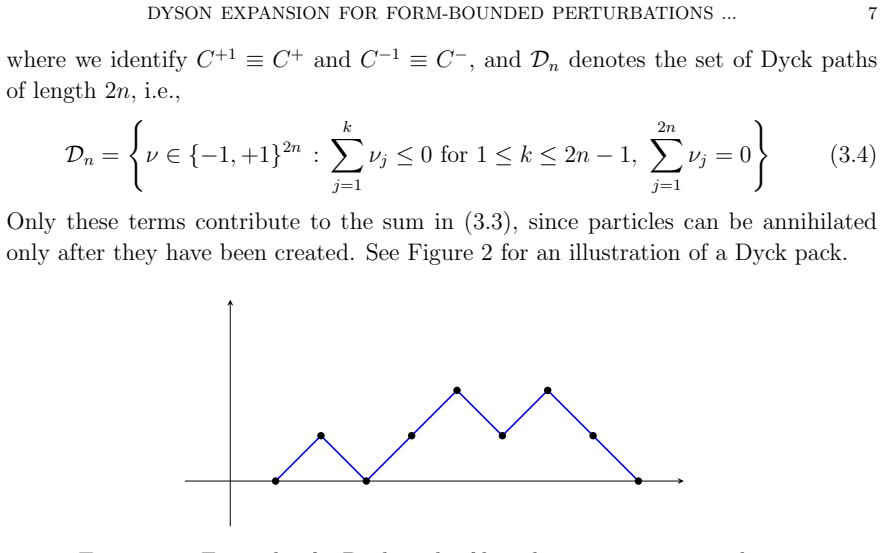
- [Figure 2 caption] The caption says 'Dyck pack'; this should presumably be 'Dyck path'.
- [§1, paragraph after (1.8)] The sentence 'for any β≥0' should be qualified: β must also satisfy Assumption 1, and for ω≡1 the relevant range is (d-2)/2<β<d/2. The case β=0 is not covered by Assumption 1 in d≥2.
- [§2, beginning] The sentence 'By absorbing a into A, we can set a=0 without loss of generality, and assume that A has a bounded inverse' is slightly misleading: one needs the shift by a to obtain invertibility. Wording such as 'after replacing A by A+a' would be clearer.
- [§4.2, Eq. (4.4)] The notation μ_{Q,s} is introduced informally. A precise definition of the measure, with its dependence on the quadratic form Q and the parameters s, would improve readability.
Circularity Check
No circularity: the derivation is self-contained; Assumption 2 is an independent hypothesis on (v,ω), not an output of the theorem.
full rationale
The central derivation is not circular. Theorem 1's Dyson expansion (1.5) is obtained by a contour-integral Neumann series for form-bounded perturbations (Section 2), with convergence proved via Lemma 1 and Lemma 2; it does not assume the semigroup expectation or the ground-state energy is concave. Corollary 1(a) uses Assumption 2 only as an input hypothesis about the one-particle integrals in (1.7), then applies Bernstein's theorem and the expansion to transfer complete monotonicity to the full expectation value. This is a genuine analytic implication, not a renaming or a fitted prediction. Corollary 1(b) follows from (1.10) via Perron–Frobenius/complete-monotonicity arguments, with the strict-concavity part proved from the renewal equation (1.6); again, the desired concavity is not assumed. The only external citations used ([8], [12], [5,6,9,4], [10], [14]) support standard tools or prior model facts, not the paper's central claim, and no load-bearing self-citation appears. The text itself flags the scope limitation for the Nelson model—'if in the latter case the ultraviolet cutoff is chosen in a suitable way to respect the complete positivity of (1.7), e.g., via a Gaussian factor'—but that is a qualification about applicability of Assumption 2 to specific cutoffs, not a circularity: the condition is verified independently for the examples rather than being derived from the target concavity. Accordingly, the honest finding is no significant circularity (score 0).
Assumptions & free parameters
assumptions (6)
- standard math KLMN/form-sum theorem: a semi-bounded quadratic form A+B with B form-bounded relative to A with relative bound <1 defines a unique self-adjoint operator.
- standard math Bernstein's theorem: completely monotone functions on (0,∞) are Laplace transforms of positive measures.
- domain assumption Assumption 1: ∫|v1|²/ω <∞ and ∫|v2|²(1+1/ω)/|k|² <∞.
- domain assumption Assumption 2: for all r,s>0, |P|² ↦ ∫|v(k)|² e^{-r|P-k|²-sω(k)} dk is completely monotone, with v,ω radial.
- standard math Wick rule and pull-through formula for CCR/Fock-space second quantization.
- standard math Perron–Frobenius/positivity-improving properties of e^{-tH(P)} and ground-state overlap positivity (cited [5,6,9]).
Cite this review
Pith. "Pith review of Dyson expansion for form-bounded perturbations and applications to the polaron problem." pith.science (2026). https://pith.science/paper/4N7XXCG6
@misc{pith2026251213443,
  author       = {Pith},
  title        = {Pith review of: Dyson expansion for form-bounded perturbations and applications to the polaron problem},
  year         = {2026},
  howpublished = {\url{https://pith.science/paper/4N7XXCG6}},
  note         = {Machine review of arXiv:2512.13443}
}
read the original abstract
We present an abstract Dyson expansion for perturbations that are merely relatively form-bounded, and apply it to the polaron problem. For a large class of polaron-type models, including the Fr\"ohlich and Nelson models, we prove that the vacuum expectation value of the heat semi-group is a completely monotone function of the square of the total momentum. Consequently, the ground state energy is a concave function of the square of the momentum, a result recently proved for the Fr\"ohlich model in \cite{polzer} using a probabilistic approach via Wiener integrals.
Figures

Reference graph
Works this paper leans on
-
[1]
Brendle,On the asymptotic behavior of perturbed strongly continuous semigroups, Math
S. Brendle,On the asymptotic behavior of perturbed strongly continuous semigroups, Math. Nachr.226, 35 (2001)
2001
-
[2]
Donoghue,Monotone Matrix Functions and Analytic Continuation, Springer (1974)
W.F. Donoghue,Monotone Matrix Functions and Analytic Continuation, Springer (1974)
1974
-
[3]
Fr¨ ohlich,Theory of electrical breakdown in ionic crystals, Proc
H. Fr¨ ohlich,Theory of electrical breakdown in ionic crystals, Proc. Roy. Soc. London, Ser. A 160, 230 (1937)
1937
-
[4]
B. Hinrichs and F. Hiroshima,On the ergodicity of renormalized translation-invariant Nelson- type semigroups, preprint arXiv:2412.09708
-
[5]
L˝ orinczi, R.A
J. L˝ orinczi, R.A. Minlos, and H. Spohn,The Infrared Behaviour in Nelson ’s Model of a Quantum Particle Coupled to a Massless Scalar Field, Annales H. Poincar´ e3, 269 (2002)
2002
-
[6]
Keller, D
M. Keller, D. Lenz, H. Vogt, and R. Wojciechowski,Note on basic features of large time behaviour of heat kernels, J. reine angew. Math.708, 73–95 (2015)
2015
-
[7]
Lee, F.E
T.D. Lee, F.E. Low, and D. Pines,The Motion of Slow Electrons in a Polar Crystal, Phys. Rev. 90, 297 (1953)
1953
-
[8]
Lieb and K
E.H. Lieb and K. Yamazaki,Ground-State Energy and Effective Mass of the Polaron, Phys. Rev. 111, 728 (1958)
1958
Show all 14 references
-
[9]
Miyao,Nondegeneracy of ground states in nonrelativistic quantum field theory, J
T. Miyao,Nondegeneracy of ground states in nonrelativistic quantum field theory, J. Oper. The- ory64, 207 (2010)
2010
-
[10]
Schach Møller,The Polaron revisited, Rev
J. Schach Møller,The Polaron revisited, Rev. Math. Phys.18, 485 (2006)
2006
-
[11]
Nelson,Interaction of nonrelativistic particles with a quantized scalar field, J
E. Nelson,Interaction of nonrelativistic particles with a quantized scalar field, J. Math. Phys.5, 1190 (1964)
1964
-
[12]
Polzer,Renewal approach for the energy-momentum relation of the Fr¨ ohlich polaron, Lett
S. Polzer,Renewal approach for the energy-momentum relation of the Fr¨ ohlich polaron, Lett. Math. Phys.113, 90 (2023)
2023
-
[13]
Rhandi,Dyson–Phillips expansion and unbounded perturbations of linearc 0-semigroups, J
A. Rhandi,Dyson–Phillips expansion and unbounded perturbations of linearc 0-semigroups, J. Comp. Appl. Math.44, 339 (1992)
1992
-
[14]
Reed and B
M. Reed and B. Simon,Methods of Modern Mathematical Physics II: Fourier Analysis, Self- Adjointness, Academic Press (1975). Institute of Science and Technology Austria, Am Campus 1, 3400 Klosterneuburg, Austria Email address:davide.desio@ist.ac.at Institute of Science and Tech...
1975
Reviewed August 3, 2026 · model on record in the stance chip above.
Discussion (0). Continue with ORCID to comment.