REVIEW 3 major objections 3 minor 46 references
Resonances in the early Universe
T0 review · 3 major / 3 minor · reviewed 2026-08-03 · deepseek-v4-flash
Pith's one-line read The paper claims that in a closed FLRW quantum cosmology, the WKB tunneling probability through a double-barrier effective potential develops sharp resonances in the radiation energy and in the strength of the ad hoc potential, selecting th
desk verdict The double-barrier WKB formula in Eq. (10) is misprinted — it exponentiates the phase — so the claimed resonance peaks are likely artifacts until corrected. read the letter →
The pith
A machine-rendered reading of the paper's core claim, the machinery that carries it, and where it could break.
The reading
What carries the argument
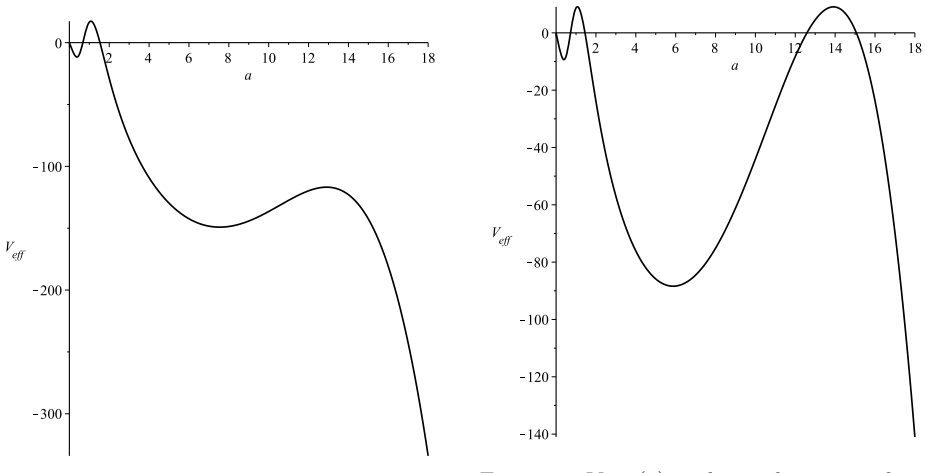
The central object is the WKB tunneling probability for a double-barrier potential, given in Eqs. (9) and (10). It is built from three factors: θ1 and θ2, the exponentials of the tunneling integrals under the two barriers, and J, the exponential of the integral of the local wave number in the well between the barriers. The cosine and sine terms with arguments involving J encode the phase of multiple reflections in the well, and matching those phases produces resonance peaks. The parameter-dependent effective potential V_eff(a), determined by A, B, σ, and the radiation energy E, fixes the turning points and therefore the numerical values of θ1, θ2, and J.
What would settle it
Recompute TP_WKB for the same parameters but with the well phase replaced by the integral of the local wave number (rather than its exponential) in the resonance formula, or solve the Wheeler-DeWitt equation numerically for the double-barrier effective potential and look for a peak near E = 8.614 and σ = −12.49; if no such peak appears, the claimed selection mechanism is an artifact of the printed formula.
Extended reading notes
Core claim
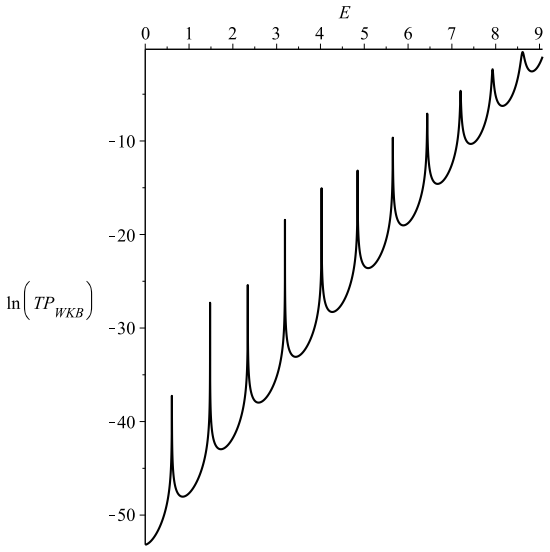
The paper's central claim, stated on its own terms, is the presence of resonance structure in the WKB tunneling probability of a double-barrier cosmological potential. Starting from the Wheeler-DeWitt equation for a closed FLRW universe with radiation, a Chaplygin gas, and an ad hoc potential, the authors solve it in the WKB approximation and evaluate the double-barrier tunneling formula. The resulting TP_WKB, plotted as a function of E and of σ, is sharply peaked at energies and potential strengths where the phase accumulated between the two barriers matches the condition for constructive interference of multiply-reflected wave components. For the fixed parameter set σ = −12.5, A = 0.000787
Load-bearing premise
Everything hinges on the printed double-barrier WKB formula, which takes the resonance phase in the cosine and sine terms to be the exponential of the internal integral; in the standard double-barrier formula it is the integral itself, and if the printed version is a misprint the resonances could disappear.
Editorial extensions
If this is right
- If the central claim is correct, the Universe is most likely to emerge with a specific radiation energy (E = 8.614 for the displayed parameters) rather than with a broad distribution, because the tunneling probability peaks there.
- The analogous resonance in σ selects the strength of the ad hoc geometric potential, so the early-universe wavefunction favors a particular value of that parameter.
- Varying A and B does not produce resonances, so the model still predicts the Universe tends to be born with higher values of the Chaplygin-gas parameters.
- The resonance arises from constructive interference of waves between the two barriers, so the double-barrier geometry itself, rather than the specific matter content, is the source of the selection mechanism.
Reading between the lines
- Beyond the paper: because the two barriers are asymmetric, the model's own formula gives peak tunneling below unity, so the resonance statement is best read as 'much more probable' rather than 'guaranteed'; a normalized probability over E and σ would quantify how sharply the Universe is selected.
- Beyond the paper: a direct numerical solution of the Wheeler-DeWitt equation that does not rely on the WKB approximation would show whether the sharp peaks survive or are washed out; this is a natural independent check.
- Beyond the paper: resonance-based selection should be generic to any cosmological model with a double-barrier effective potential, not just this particular matter content, so the mechanism may carry over to single-fluid or scalar-field models.
Editorial analysis
A structured set of objections, weighed in public.
Referee Report
Summary. The paper studies a closed FLRW quantum cosmology with radiation, a generalized Chaplygin gas, and an added 'ad hoc' potential. The effective potential can form a double barrier, and the authors solve the Wheeler-DeWitt equation in the WKB approximation, using a double-barrier tunneling formula to compute the transmission probability TP_WKB. They scan TP_WKB over E, A, B, and σ, and report sharp resonance peaks in E and σ. They conclude that resonant tunneling could select preferred values of the radiation energy or of the ad hoc potential strength for the birth of the universe.
Significance. If the reported effect is real, it would be a novel qualitative feature in quantum cosmology: barrier resonances selecting initial values of the model parameters. The paper has the merit of applying a well-known double-barrier resonance phenomenon to a cosmological minisuperspace, and the model setup is clearly presented. However, the significance currently depends entirely on the correctness of the WKB tunneling formula and the numerical evaluation. The manuscript provides no machine-checked derivation, code, or independent verification, and the printed Eq. (10) appears to contain a serious transcription or conceptual error. Until this is corrected and the figures recomputed, the central claim is unsupported.
major comments (3)
- [Section 2, Eq. (10)] The printed definition J/2 = exp(∫_{x2}^{x3} K(a) da) is incompatible with its use as the phase argument of the cos and sin in Eq. (9). In the standard double-barrier WKB formula (e.g., Bohm, Ref. [30]), the well phase is the action integral ∫ K da, not its exponential. With the printed definition, cos(J/2) and sin(J/2) oscillate with an exponentially large phase, producing spurious dense resonances in Figures 3 and 6. Please correct Eq. (10) to J/2 = ∫ K(a) da (or the appropriate convention) and recompute all numerical results. As published, the central numerical claims rest on an equation that is not a valid phase.
- [Section 2, Eq. (9) and WKB validity] The WKB approximation is applied for energies up to E=9.07 while Vmax_eff=9.08 (Section 3.1). Near the top of the barrier the turning points coalesce and the standard WKB connection formulas break down. The paper does not discuss this validity limitation or test the sensitivity of the resonance peaks to the treatment of the turning points. This is especially important because the highest claimed resonance (E=8.614) lies close to the barrier maximum; the peak may be an artifact of the WKB approximation near the classical turning points.
- [Abstract and Section 2] The abstract appears twice with contradictory content. The first version (page 1) states the effective potential depends on four parameters: 'A, B and α associated with the Generalized Chaplygin gas, and σ associated with the ad hoc potential.' The second abstract (page 2) and the body state only three parameters (A, B, σ). The parameter α never appears in the Hamiltonian (4)-(5), in the WKB equations, or in any figure. This inconsistency must be resolved; either α is a parameter that should appear in V_eff and the analysis is incomplete, or the mention is a typographical error that should be removed.
minor comments (3)
- [Section 1, Ref. [30]] The text says the double-barrier tunneling probability is given in Ref. [30] (Bohm, Quantum Theory). It would be helpful to state explicitly which equation in Bohm is being used, since the printed Eq. (9)-(10) does not appear to match the standard formula as discussed above.
- [Section 2, Eq. (5)] In Eq. (5) the term a^4/π √A is dimensionally odd in natural units (where ℏ=8πG=c=1 but no scale is set). The authors should clarify the conventions and the dimensions of A, B, and σ so that the potential and energy E are measured in the same units.
- [Section 3.3] In the sentence 'we fix the others in E = 4.012, A = 0.000787 and σ − 12.5 in Eq. (9)' there is a typo: 'σ − 12.5' should be 'σ = −12.5'.
Circularity Check
As published, the resonance peaks are forced by Eq. (10)'s exponential definition of J/2 inside the trigonometric phase of Eq. (9), so the central 'selected E or σ' claim is a definitional artifact rather than an independent WKB prediction.
-
other
[Section 2, Eqs. (9) and (10)]
"TP_WKB = 4 / [ ((θ1²+θ2²)/(θ1θ2))² cos²(−J/2+π/2) + (4θ1θ2 + 1/(4θ1θ2))² sin²(−J/2+π/2) ] ... J/2 = e^{∫_{x2}^{x3} K(a)da}"
Eq. (9) uses J/2 as the phase in cos² and sin², so TP_WKB oscillates in E and σ. Eq. (10) sets that phase to exp(∫K da), an exponentially large number. Inserting (10) into (9) makes the trigonometric arguments vary enormously and rapidly, manufacturing dense resonance peaks like those in Figs. 3 and 6. Standard double-barrier WKB (Bohm, Ref. [30]) uses ∫K da itself, not exp(∫K da), as the phase. Therefore the paper's headline 'significant occurrence of resonances ... may cause the universe to be born with selected values of E or σ' reduces, as printed, to this exponential-in-phase definition rather than being an independent prediction of the WKB analysis.
full rationale
The rest of the derivation chain is not circular in the statistical sense: parameters are fixed, not fitted to the claimed resonances; no uniqueness theorem is imported from the authors' own prior work; and the fact that double barriers generically show resonances is openly acknowledged with external references [30,31]. The ad hoc potential is an explicit assumption, not a disguised conclusion. The single load-bearing problem is Eq. (10), where J/2 is defined as exp(∫K da) but is then used as an oscillatory phase in Eq. (9). As published, this substitution forces the very oscillations the paper presents as a discovery, so the central claim is a definitional artifact until the phase is corrected and the figures are recomputed. This warrants a score of 6 rather than a fully circular 8-10.
Assumptions & free parameters
free parameters (4)
- A (Chaplygin gas parameter) =
0.000787 (chosen for visualization)
- B (Chaplygin gas parameter) =
11000
- σ (ad hoc potential strength) =
-12.5
- E (radiation energy) =
scanned 0 to 9.07
assumptions (5)
- standard math The WKB approximation provides an accurate solution to the Wheeler-DeWitt equation (8) for the tunneling probability.
- domain assumption The Schutz variational formalism yields the Hamiltonian (3) for radiation plus Chaplygin gas.
- ad hoc to paper The ad hoc potential (2) has a geometric origin and contributes additively to the Hamiltonian.
- domain assumption The universe's birth can be described as quantum tunneling from a=0 through the potential barrier.
- domain assumption The double-barrier WKB formula (9)-(10) from Bohm applies to this cosmological potential.
invented entities (1)
-
Ad hoc potential V_ah = -σ² a^4/(a³+1)²
Cite this review
Pith. "Pith review of Resonances in the early Universe." pith.science (2026). https://pith.science/paper/M2FOTIYL
@misc{pith2026251213621,
  author       = {Pith},
  title        = {Pith review of: Resonances in the early Universe},
  year         = {2026},
  howpublished = {\url{https://pith.science/paper/M2FOTIYL}},
  note         = {Machine review of arXiv:2512.13621}
}
abstract
In the present paper, we study a Friedmann-Lema\^itre-Robertson-Walker (FLRW) quantum cosmology model with positively curved spatial sections. The matter content of the model is given by a radiation fluid, a Generalized Chaplygin gas, and an ad hoc potential. After writing the Hamiltonian of the model, we notice that the effective potential ($V_{eff}$) depends on four parameters: $A$, $B$ and $\alpha$ associated with the Generalized Chaplygin gas, and $\sigma$ associated with the ad hoc potential. Depending on the values of these parameters $V_{eff}$ becomes a double barrier potential. We quantize the model and obtain the Wheeler-DeWitt equation. We solve that equation using the WKB approximation and compute the corresponding probability ($TP_{WKB}$) that the wavefunction of the universe tunnels through the double barrier potential $V_{eff}$. We study how $TP_{WKB}$ behaves as a function of the parameters $A$, $B$, $\alpha$, $\sigma$ and the radiation energy $E$. We notice the occurrence of resonances in $TP_{WKB}$ when we vary it as a function of $E$, $A$, $B$, $\alpha$ and $\sigma$. It is a very interesting phenomenon because it may cause the universe to be born with selected values of $E$, $A$, $B$, $\alpha$ and $\sigma$.
Figures

Figures from the paper (2 more)


Reference graph
Works this paper leans on
-
[30]
Quantum Theory
Bohm, D. Quantum Theory. Menzel, D.H., Ed., Prentice-Hall, Inc.: Englewood Cliffs, NJ, USA, 1951, Chapter 12
1951
-
[1]
A. H. Guth. Inflationary universe: A possible solution to the horiz on and flatness prob- lems. Phys. Rev. D 23, 347 (1981)
1981
-
[2]
A. G. Riess et al. Observational Evidence from Supernovae for a n Accelerating Universe and a Cosmological Constant. Astron. J. 116, 1009 (1998)
1998
-
[3]
Hawking, S. W. Occurrence of Singularities in Open Universes. Phy sical Review Letters, 15(17), 689–690 (1965)
1965
-
[4]
Hawking, S. W. Singularities in the Universe. Physical Review Lette rs, 17(8), 444–445 (1966)
1966
-
[5]
W., Penrose, R
Hawking, S. W., Penrose, R. The Singularities of Gravitational Colla pse and Cosmology. Proceedings of the Royal Society A: Mathematical, Physical and En gineering Sciences, 314(1519), 529–548 (1970)
1970
-
[6]
Quantum Structure of Space and Time; Duff, M., Isham, C., Eds.; Cambridge University Press: Cambridge, UK, 1982
Grishchuk, L.P.; Zeldovich, Y.B. Quantum Structure of Space and Time; Duff, M., Isham, C., Eds.; Cambridge University Press: Cambridge, UK, 1982
1982
-
[7]
Quantum Cosmology
Hawking, S.W. Quantum Cosmology. In Relativity, Groups and Topo logy II: Proceed- ings of the 1983 Les Houches Summer School, Session XL; DeWitt, B.S ., Stora, R., Eds.; North-Holland: Amsterdam, The Netherlands, 1984; pp. 333–379
1983
Show all 46 references
-
[8]
Quantum Cosmology—Beyond Minisuperspac e
Halliwell, J.; Hawking, S. Quantum Cosmology—Beyond Minisuperspac e. In Proceed- ings of the Fourth Marcel Grossmann Meeting on General Relativity , Rome, Italy, 1985; Ruffini, R., Ed.; North-Holland: Amsterdam, The Netherlands, 1986; Part A, pp. 65–83
1985
-
[9]
P. V. Moniz, Quantum Cosmology - The Supersymmetric Perspect ive - vol. 1: Funda- mentals, Lecture Notes in Physics, vol. 803, Springer, Berlin Heidelberg, 2010. 11
2010
-
[10]
Quantum Cosmology: A Fundamental Description o f the Universe; Lec- ture Notes in Physics; Springer: New York, NY, USA, 2011; Volume 8 35
Bojowald, M. Quantum Cosmology: A Fundamental Description o f the Universe; Lec- ture Notes in Physics; Springer: New York, NY, USA, 2011; Volume 8 35
2011
-
[11]
B. S. DeWitt, Quantum Theory of Gravity I. The Canonical Theo ry. Phys. Rev. 160, 1113 (1967)
1967
-
[12]
J. A. Wheeler, Superspace and the Nature of Quantum Geomet rodynamics. In Batelles Rencontres, eds. C. DeWitt and J. A. Wheeler (Benjamin, New York, 1968), 242
1968
-
[13]
Creation of universes from nothing
Vilenkin, A. Creation of universes from nothing. Phys. Lett. B, 117, 25 (1982)
1982
-
[14]
Vilenkin
A. Vilenkin. Birth of inflationary universes. Phys. Rev. D 27, 284 8–2855 (1983)
1983
-
[15]
Vilenkin
A. Vilenkin. Quantum creation of universes. Phys. Rev. D 30, 50 9–511 (1984)
1984
-
[16]
Quantum creation of the inflationary universe
Linde, A.D. Quantum creation of the inflationary universe. Lett . Nuovo Cim. 39, 401 (1984)
1984
-
[17]
Quantum mechanics in the tunneling universe
Rubakov, V.A. Quantum mechanics in the tunneling universe. Phy s. Lett. B, 148, 280 (1984)
1984
-
[18]
Vilenkin
A. Vilenkin. Quantum cosmology and the initial state of the Univer se. Phys. Lett. B 117, 25–28 (1988)
1988
-
[19]
FR W quantum cos mology with a gen- eralized Chaplygin gas
Mariam Bouhmadi-L´ opez, Paulo Vargas Moniz. FR W quantum cos mology with a gen- eralized Chaplygin gas. Phys. Rev. D 71, 063521 (2005)
2005
-
[20]
Acacio de Barros, E
J. Acacio de Barros, E. V. Corrˆ ea Silva, G. A. Monerat, G. Olive ira-Neto, L. G. Ferreira Filho and P. Romildo Jr.. Tunneling probability for the birth of an asympt otically de Sitter universe. Phys. Rev. D 75, 104004 (2007)
2007
-
[21]
Monerat, G
G.A. Monerat, G. Oliveira-Neto, E.V. Corrˆ ea Silva, L.G. Ferreira Filho, P. Romildo Jr., J.C. Fabris, R. Fracalossi, S.V.B. Gon¸ calves and F.G. Alvarenga. Dynamics of the early universe and the initial conditions for inflation in a model with rad iation and a Chaplygin gas. P...
2007
-
[22]
G. A. Monerat, C. G. M. Santos, G. Oliveira-Neto, E. V. Corrˆ e a Silva and L. G. Ferreira Filho. The dynamics of the early universe in a model with radiation and a generalized Chaplygin gas. Early universe with radiation and a generalized Chaplyg in gas. Eur. Phys. J. Plus 13...
2021
-
[23]
G. A. Monerat, F. G. Alvarenga, S. V. B. Gon¸ calves, G. Oliveira -Neto, C. G. M. Santos and E. V. Corrˆ ea Silva. The effects of dark energy on the early Univ erse with radiation and an ad hoc potential. Eur. Phys. J. Plus 137: 117 (2022)
2022
-
[24]
Tunneling probabilit ies for the birth of universes with radiation, cosmological constant and an ad hoc pote ntial
Oliveira-Neto, G., Canedo, D.L., Monerat, G.A. Tunneling probabilit ies for the birth of universes with radiation, cosmological constant and an ad hoc pote ntial. Eur. Phys. J. Plus 138, 400 (2023). 12
2023
-
[25]
N. M. N da Rocha, G. A. Monerat, F. G. Alvarenga, S. V. B. Gon¸ calves, G. Oliveira- Neto, E. V. Corrˆ ea Silva and C. G. M. Santos. Early universe with du st and Chaplygin gas. Eur. Phys. J. Plus 137: 1103 (2022)
2022
-
[26]
Chaplygin, Sci
S. Chaplygin, Sci. Mem. Moscow. Univ. Math. Phys. 21,1 (1904)
1904
-
[27]
An alternative to quintessence
Alexander Kamenshchik, Ugo Moschella and Vincent Pasquier. An alternative to quintessence. Physics Letters B 511 265–268 (2001)
2001
-
[28]
Gorini, A
V. Gorini, A. Kamenshchik, U. Moschella, V. Pasquier. The Chaply gin gas as a model for dark energy. The Tenth Marcel Grossmann Meeting (2006)
2006
-
[29]
R. Jackiw. A Particle Field Theorist’s Lectures on Supersymmetr ic, Non-Abelian Fluid Mechanics and d-Branes. arXiv 2000, arXiv:physics/0010042
2000 arXiv
-
[31]
Quantum Mechanics, 3rd ed.; John Wiley and Son s, Inc.: New York, NY, USA, 1998; Chapter 7
Merzbacher, E. Quantum Mechanics, 3rd ed.; John Wiley and Son s, Inc.: New York, NY, USA, 1998; Chapter 7
1998
-
[32]
Ricco, B., Azbel, M. Y. Physics of resonant tunneling. The one-d imensional double- barrier case. Physical Review B 29(4), 1970–1981 (1984)
1970
-
[33]
Bandara, K. M. S. V., Coon, D. D. (1988). Electron-electron in teractions and resonant tunneling in heterostructures. Applied Physics Letters, 53(19), 1865–1867 (1988)
1988
-
[34]
D. G. Polyakov and I. V. Gorny, Transport of interacting elect rons through a double barrier in quantum wires. Phy. Rev. B 68, 035421 (2003)
2003
-
[35]
M Villalba and L
V. M Villalba and L. A Gonz´ alez- ´Arraga1, Tunneling and transmission resonances of a Dirac particle by a double barrier. Phys. Scr. 81, 025010 (2010)
2010
-
[36]
Resonant tunneling dynamics and th e related tunneling time
Xiao, Z., Huang, H., Lu, X.-X. Resonant tunneling dynamics and th e related tunneling time. International Journal of Modern Physics B 29(08), 155005 2 (2015)
2015
-
[37]
W. Z. Shangguan, T. C. Au Yeung, Y. B. Yu, and C. H. Kam and Xu ean Zhao, Admit- tance of a one-dimensional double-barrier resonant tunneling nan ostructure. Phys. Rev. B 65, 235315 (2002)
2002
-
[38]
A., Posvyanskii, V
Kozhushner, M. A., Posvyanskii, V. S., Oleynik, I. I. Tunneling an d resonant conduc- tance in one-dimensional molecular structures. Chemical Physics, 319(1-3), 368–379 (2005)
2005
-
[39]
Bai and X
C. Bai and X. Zhang, Klein paradox and resonant tunneling in a gr aphene superlattice. Phys. Rev. B 76, 075430 (2007)
2007
-
[40]
Sun and Y
L. Sun and Y. Guo, Line-type resonance peaks and their suppr ession through graphene- based symmetric and asymmetric double barriers. J. Appl. Phys. 10 9, 123719 (2011). 13
2011
-
[41]
Rodr ´ ıguez-Vargas, J
I. Rodr ´ ıguez-Vargas, J. Madrigal-Melchor and O. Oubram, Resonant tunneling through double barrier graphene systems: A comparative study of Klein and non-Klein tunneling structures. J. Appl. Phys. 112, 073711 (2012)
2012
-
[42]
Wei-Yin, Z
D. Wei-Yin, Z. Rui, X. Yun-Chang and D. Wen-Ji, Resonant tunne ling through double- barrier structures on graphene. Chin. Phys. B 23, No. 1, 017202 (2014)
2014
-
[43]
V. E. Sakhnyuk, A. M. Shutovskyi, S. A. Fedosov and O. V. Zam uruyeva, The resonant condition of transmission in the graphene-based double-barrier st ructures. Low Temp. Phys. 48, 806 (2022)
2022
-
[44]
Gravitation; W
Misner, C.W.; Thorne, K.S.; Wheeler, J.A. Gravitation; W. H. Freem an: San Francisco, CA, USA, 1973
1973
-
[45]
Perfect Fluids in General Relativity: Velocity Poten tials and a Variational Principle
Schutz, B.F. Perfect Fluids in General Relativity: Velocity Poten tials and a Variational Principle. Phys. Rev. D 1970, 2, 2762
1970
-
[46]
Hamiltonian Theory of a Relativistic Perfect Fluid
Schutz, B.F. Hamiltonian Theory of a Relativistic Perfect Fluid. Ph ys. Rev. D 1971, 4, 3559. 14
1971
Reviewed August 3, 2026 · model on record in the stance chip above.
Discussion (0). Continue with ORCID to comment.