Geometric quantum thermodynamics: A fibre bundle approach
Pith reviewed 2026-05-16 21:50 UTC · model grok-4.3
The pith
Quantum thermodynamics is recast as a principal fibre bundle with the thermodynamic group as structure group.
A machine-rendered reading of the paper's core claim, the machinery that carries it, and where it could break.
Core claim
By building the principal fibre bundle associated with the thermodynamic group, the work shows that quantum thermodynamics admits two related geometric structures. These structures allow the entire theory to be written in the same mathematical language as gauge theories, thereby opening the possibility that geometric and topological properties of the bundle explain the fundamental features of thermodynamics.
What carries the argument
The principal fibre bundle whose base space is the manifold of thermodynamic states and whose structure group is the thermodynamic group of gauge transformations that discard redundant information.
If this is right
- Thermodynamic relations acquire a geometric interpretation identical to that of gauge fields.
- Topological invariants of the bundle become candidates for conserved or quantized thermodynamic quantities.
- Equilibrium states correspond to horizontal sections or flat connections on the bundle.
- The two geometric structures imply that classical and quantum thermodynamic descriptions are related by a change of bundle trivialization.
Where Pith is reading between the lines
- The same bundle construction might be used to geometrize fluctuation theorems or thermodynamic uncertainty relations.
- Singularities or non-trivial topology in the bundle could correspond to phase transitions or critical points.
- Connection forms on the bundle may supply a natural definition of thermodynamic work and heat in open quantum systems.
Load-bearing premise
The thermodynamic group supplies a complete and physically correct collection of gauge transformations that capture every piece of redundant microscopic information without requiring extra dynamical assumptions.
What would settle it
An explicit computation for a two-level system or harmonic oscillator showing that the curvature or connection of the constructed bundle fails to reproduce the first law or the entropy functional of standard quantum thermodynamics.
Figures


read the original abstract
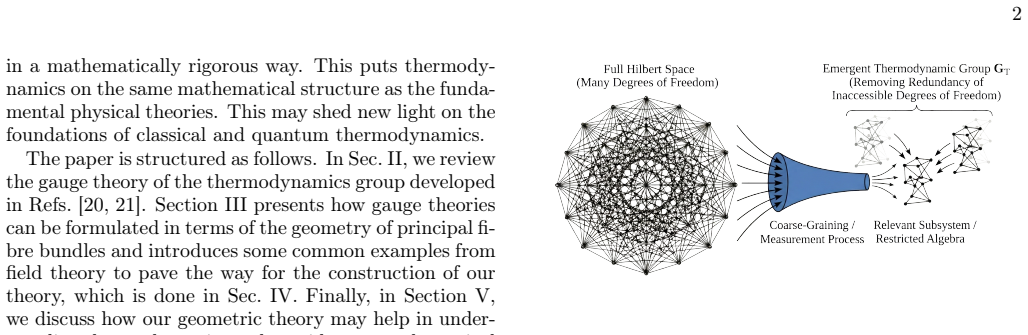
Classical thermodynamics is a theory based on coarse-graining, meaning that the thermodynamic variables arise from discarding information related to the microscopic features of the system at hand. In quantum mechanics, however, where one has a high degree of control over microscopic systems, information theory plays an important role in describing the thermal properties of quantum systems. Recently, a new approach has been proposed in the form of a quantum thermodynamic gauge theory, where the notion of redundant information arises from a group of physically motivated gauge transformations called the thermodynamic group. In this work, we explore the geometrical structure of quantum thermodynamics. Particularly, we do so by explicitly constructing the relevant principal fibre bundle. We then show that there are two distinct (albeit related) geometric structures associated with the gauge theory of quantum thermodynamics. In this way, we express thermodynamics in the same mathematical (geometric) language as the fundamental theories of physics. Finally, we discuss how the geometric and topological properties of these structures may help explain fundamental properties of thermodynamics.
Editorial analysis
A structured set of objections, weighed in public.
Referee Report
Summary. The paper claims to explicitly construct the principal fibre bundle associated with the thermodynamic group of gauge transformations in quantum thermodynamics, identify two distinct but related geometric structures arising from this gauge theory, and use the resulting geometric and topological properties to express thermodynamics in the same mathematical language as fundamental gauge theories.
Significance. If the central construction is made rigorous, the work would supply a differential-geometric realization of quantum thermodynamics that parallels the fibre-bundle formulation of gauge theories, potentially allowing topological invariants to constrain thermodynamic relations and offering a unified language for coarse-graining and information redundancy.
major comments (2)
- [Abstract; main construction (presumably §3–4)] The abstract and introduction assert an explicit construction of the principal fibre bundle, yet no definition of the total space, base manifold, projection map, or transition functions is supplied, nor is the thermodynamic group action shown to be free and proper on the space of density operators (required for the quotient to be a smooth manifold and the structure to be a principal G-bundle).
- [Section on geometric structures] The existence of two distinct geometric structures is stated without explicit derivations, local trivializations, or concrete examples demonstrating how each structure is induced from the bundle; this leaves the central claim that thermodynamics is thereby expressed in the language of gauge theory without load-bearing support.
minor comments (2)
- [Introduction] Clarify the precise definition of the thermodynamic group and its action on quantum states at the outset, including any assumptions on the underlying Hilbert space or density-operator manifold.
- [Discussion] Add a brief comparison with existing geometric approaches to quantum thermodynamics (e.g., information-geometric or symplectic formulations) to situate the fibre-bundle construction.
Simulated Author's Rebuttal
We thank the referee for the careful and constructive report. The comments correctly identify that the principal-bundle construction and the two geometric structures require more explicit definitions, derivations, and supporting details to meet the standards of a rigorous gauge-theoretic formulation. We will revise the manuscript to address both points fully.
read point-by-point responses
-
Referee: [Abstract; main construction (presumably §3–4)] The abstract and introduction assert an explicit construction of the principal fibre bundle, yet no definition of the total space, base manifold, projection map, or transition functions is supplied, nor is the thermodynamic group action shown to be free and proper on the space of density operators (required for the quotient to be a smooth manifold and the structure to be a principal G-bundle).
Authors: We agree that the current text does not supply the required definitions or the verification that the thermodynamic group action is free and proper. In the revised manuscript we will (i) explicitly define the total space as the appropriate space of density operators equipped with the thermodynamic group action, (ii) identify the base manifold as the space of thermodynamic equivalence classes, (iii) give the projection map, (iv) construct local trivializations and transition functions, and (v) prove that the action is free and proper so that the quotient is a smooth manifold and the structure is a principal G-bundle. revision: yes
-
Referee: [Section on geometric structures] The existence of two distinct geometric structures is stated without explicit derivations, local trivializations, or concrete examples demonstrating how each structure is induced from the bundle; this leaves the central claim that thermodynamics is thereby expressed in the language of gauge theory without load-bearing support.
Authors: We accept that the two geometric structures are asserted rather than derived in detail. The revised version will contain (i) explicit derivations showing how each structure arises from the principal bundle, (ii) the corresponding local trivializations, and (iii) at least one concrete low-dimensional example (e.g., a two-level system) that illustrates the induction of both structures and their relation to thermodynamic quantities. revision: yes
Circularity Check
No significant circularity: fibre-bundle construction is an independent geometric application
full rationale
The paper starts from the recently proposed thermodynamic gauge group (treated as an external input) and applies standard principal-bundle constructions from differential geometry. No derivation step reduces by construction to its own fitted parameters, self-defined quantities, or a load-bearing self-citation chain. The claim that the group action yields a principal bundle rests on the physical-motivation assumption rather than on any equation that tautologically reproduces its input. The two geometric structures are presented as realizations of that input, not as predictions forced by the input itself. This is the normal, non-circular case of importing a premise and then performing independent mathematical work on it.
Axiom & Free-Parameter Ledger
axioms (1)
- domain assumption The thermodynamic group is a well-defined collection of physically motivated gauge transformations that encode redundant information in quantum thermodynamic descriptions.
Lean theorems connected to this paper
-
IndisputableMonolith/Foundation/AbsoluteFloorClosure.lean; IndisputableMonolith/Cost/FunctionalEquation.leanreality_from_one_distinction; washburn_uniqueness_aczel unclear?
unclearRelation between the paper passage and the cited Recognition theorem.
we explicitly constructing the relevant principal fibre bundle... two distinct (albeit related) geometric structures associated with the gauge theory of quantum thermodynamics
-
IndisputableMonolith/Foundation/AlexanderDuality.lean; IndisputableMonolith/Foundation/DimensionForcing.leanalexander_duality_circle_linking; D3_admits_circle_linking unclear?
unclearRelation between the paper passage and the cited Recognition theorem.
principal U(d)-bundle ξ = (R × U(d), π, U(d), R) ... connection ... Maurer-Cartan form ... GT = U(n1_t) × ... × U(nk_t)
What do these tags mean?
- matches
- The paper's claim is directly supported by a theorem in the formal canon.
- supports
- The theorem supports part of the paper's argument, but the paper may add assumptions or extra steps.
- extends
- The paper goes beyond the formal theorem; the theorem is a base layer rather than the whole result.
- uses
- The paper appears to rely on the theorem as machinery.
- contradicts
- The paper's claim conflicts with a theorem or certificate in the canon.
- unclear
- Pith found a possible connection, but the passage is too broad, indirect, or ambiguous to say the theorem truly supports the claim.
Forward citations
Cited by 1 Pith paper
-
Geometry of restricted information: the case of quantum thermodynamics
A gauge-invariant formulation of quantum thermodynamics is constructed from restricted information, yielding a stochastic invariant entropy that obeys detailed fluctuation theorems and unifies the first and second law...
Reference graph
Works this paper leans on
-
[1]
H. B. Callen,Thermodynamics and an Introduction to Thermostatistics(Wiley, 1991)
work page 1991
-
[2]
P. Strasberg,Quantum Stochastic Thermodynamics: Foundations and Selected Applications(Oxford Univer- sity Press, 2022)
work page 2022
- [3]
-
[4]
R. Alicki. The quantum open system as a model of the heat engine. J. Phys. A: Math. Gen.12, L103 (1979)
work page 1979
-
[5]
R. Alicki and R. Kosloff, Introduction to quantum ther- modynamics: History and prospects, in F. Binder, L. A. Correa, C. Gogolin, J. Anders, and G. Adesso (editors), Thermodynamics in the Quantum Regime: Fundamental Aspects and New Directions, volume 195 ofFundamental Theories of Physics(Springer International Publishing, 2018)
work page 2018
-
[6]
S. Deffner and S. Campbell,Quantum Thermodynamics: An Introduction to the Thermodynamics of Quantum In- formation(IOP Concise Physics, 2019)
work page 2019
-
[7]
J. Baez and J. P. Muniain,Gauge Fields, Knots and Gravity: 4(World Scientific Publishing Company, 1994)
work page 1994
-
[8]
N. P. Konopleva, V. N. Popov, and N. M. Queen,Gauge Fields(Harwood Academic Publishers, 1981)
work page 1981
-
[9]
L. D. Faddeev and A. A. Slavnov,Gauge Fields: An Introduction To Quantum Theory, (Frontiers in physics. Basic Books, 1991)
work page 1991
-
[10]
C. Nash and S. Sen,Topology and Geometry for Physi- cists, (Dover Books on Mathematics, Dover Publications, 2013)
work page 2013
-
[11]
D. Bleecker,Gauge Theory and Variational Principles, (Dover Books on Mathematics, Dover Publications, In- corporated, 2013)
work page 2013
-
[12]
A. Shapere and F. Wilczek. Self-propulsion at low reynolds number. Phys. Rev. Lett.58, 2051 (1987)
work page 2051
-
[13]
A. Shapere and F. Wilczek. Geometry of self-propulsion at low reynolds number. J. Fluid Mech.198, 557 (1989)
work page 1989
-
[14]
Fradkin,Field Theories of Condensed Matter Physics (Cambridge University Press, 2013)
E. Fradkin,Field Theories of Condensed Matter Physics (Cambridge University Press, 2013)
work page 2013
-
[15]
D. Luo, G. Carleo, B. K. Clark, and J. Stokes. Gauge equivariant neural networks for quantum lattice gauge theories. Phys. Rev. Lett.127, 276402 (2021)
work page 2021
-
[16]
S. E. Vázquez and S. Farinelli. Gauge invariance, geom- etry and arbitrage. J. Invest. Strateg.1, 23 (2012)
work page 2012
- [17]
- [18]
- [19]
-
[20]
L. C. Céleri and Ł. Rudnicki. Gauge-invariant quantum thermodynamics: Consequences for the first law. En- tropy,26(2024)
work page 2024
-
[21]
G. F. Ferrari, Ł. Rudnicki, and L. C. Céleri. Quantum thermodynamics as a gauge theory. Phys. Rev. A111, 052209 (2025)
work page 2025
-
[22]
R. M. Araújo, T. Häffner, R. Bernardi, D. S. Tasca, M. P. J. Lavery, M. J. Padgett, A. Kanaan, L. C. Céleri, and P. H. Souto Ribeiro. Experimental study of quantum ther- modynamics using optical vortices. J. Phys. Commun.2, 035012 (2018)
work page 2018
-
[23]
L. W. Tu,Differential Geometry: Connections, Cur- vature, and Characteristic Classes(Graduate Texts in Mathematics, Springer International Publishing, 2017)
work page 2017
-
[24]
L. A. B. S. Martin,Lie Groups(Latin American Mathe- matics Series, Springer International Publishing, 2021). 8
work page 2021
-
[25]
M. E. Peskin and D. V. Schroeder,An Introduction To Quantum Field Theory(Frontiers in Physics, Avalon Publishing, 1995)
work page 1995
-
[26]
S. Kobayashi and K. Nomizu,Foundations of Differen- tial Geometry, Volume 1(Wiley Classics Library, Wiley, 1996)
work page 1996
-
[27]
A. Douady and M. Lazard, Espaces fibrés en algebres de lie et en groupes. Inven. Math.1, 133 (1966)
work page 1966
-
[28]
Husemöller,Fibre Bundles(Graduate Texts in Math- ematics, Springer New York, 2013)
D. Husemöller,Fibre Bundles(Graduate Texts in Math- ematics, Springer New York, 2013)
work page 2013
-
[29]
N. Steenrod,The Topology of Fibre Bundles(Princeton Landmarks in Mathematics and Physics, Princeton Uni- versity Press, 1999)
work page 1999
-
[30]
L. W. Tu,Introductory Lectures on Equivariant Coho- mology(Annals of Mathematics Studies, Princeton Uni- versity Press, 2020). Appendix A: Mathematical background We briefly review the notion of Lie groups and fibre bundles. We focus on the topics that we employed in the main part of the text. The goal is to make the article more self-contained and access...
work page 2020
-
[31]
A bundle is a mathematical structure that generalises the notion of a product space
Bundles and fibre bundles We provide a brief description of the main mathemat- ical structure that will be employed to build a geometric theory of quantum thermodynamics. A bundle is a mathematical structure that generalises the notion of a product space. More specifically, one can understand a bundle as a triple(E, π,B), withEbeing a topological space ca...
-
[32]
Lie Theory A Lie groupGis a group that is also a differentiable manifold in such a way that the map p: (g, h)∈G×G→gh∈G(A1) is smooth. In particular, as a consequence of the condi- tion above, the operation of taking an inverse in a Lie group is also differentiable (more precisely, it is a diffeo- morphism). Since both the operations of taking a prod- uct ...
-
[33]
Principal Bundles Principal bundles are among the most important bun- dles that arise in physics, as they provide the mathemat- ical structure on which one can formalise gauge theories as geometrical constructs. A principalG-bundle is a fibre bundle for which the structure group (a Lie groupG) and the fibre are one and the same. More specifically, given a...
-
[34]
The most important objects in the study of the ge- ometry of a principalG-bundle are connections
The local trivializationsϕ α :π −1(Oα)→O α ×G areG-equivariant, whereGactsonO α×Gby(b, h)· g= (b, hg). The most important objects in the study of the ge- ometry of a principalG-bundle are connections. More specifically, given a principalG-bundleξ= (E, π,G,B), we say that ag-valued1-formωonEis a connection if and only if 1.ωisG-equivariant; 2.ω(A ∗ p) =A, ...
discussion (0)
Sign in with ORCID, Apple, or X to comment. Anyone can read and Pith papers without signing in.