Applicability of the cumulant expansion method for the calculation of transport properties in electron-phonon systems
Pith reviewed 2026-05-16 21:28 UTC · model grok-4.3
The pith
The cumulant expansion with independent-particle approximation accurately calculates charge mobility in electron-phonon systems for weak to moderate coupling.
A machine-rendered reading of the paper's core claim, the machinery that carries it, and where it could break.
Core claim
The cumulant expansion within the independent-particle approximation yields accurate results for charge mobility in the Peierls and Fröhlich models for weak to moderate coupling strengths and not-too-low temperatures, as confirmed by comparisons with Boltzmann formalism, Migdal approximation, and its self-consistent extension, along with analytical support from spectral sum rules.
What carries the argument
Cumulant expansion method within the independent-particle approximation (IPA), which approximates the electron Green's function to compute transport properties like mobility.
If this is right
- The CE-IPA method provides reliable mobility estimates as an alternative to Boltzmann and Migdal approaches in the specified regime.
- Vertex corrections play a limited role in the Peierls model under weak to moderate coupling.
- Results from the Holstein model generalize to Peierls and Fröhlich models for transport calculations.
- Accuracy holds for not-too-low temperatures, suggesting limitations at very low T.
Where Pith is reading between the lines
- This approach may reduce computational cost for modeling transport in real materials with moderate electron-phonon coupling.
- Further tests could explore its applicability to systems with stronger couplings by including vertex corrections explicitly.
- Experimental mobility data at varying temperatures could validate the predicted accuracy range.
- Connections to other transport theories might emerge from the shared use of spectral functions.
Load-bearing premise
The Peierls and Fröhlich models serve as representative testbeds where benchmarks are available and conclusions generalize without vertex corrections dominating.
What would settle it
Observation of significant deviation between CE-IPA predicted mobility and numerically exact results in the Fröhlich model at strong coupling or low temperatures.
Figures


read the original abstract
We assess the accuracy of the cumulant expansion (CE) method, combined with the independent-particle approximation (IPA), for calculating charge mobility in electron-phonon systems. As representative testbeds, we consider the Peierls and Fr\"ohlich models, which serve as simplified frameworks where accurate or numerically exact benchmarks are available. These are used to compare the CE results with those obtained using the Boltzmann formalism, the Migdal approximation, and its self consistent extension-approaches that are presently the most commonly employed alternatives for transport calculations. Supported by analytical arguments based on spectral sum rules and by our previous results for the Holstein model, we argue that, for weak to moderate coupling strengths and not-too-low temperatures, the CE within the IPA framework yields accurate results. In the case of the Peierls model, the role of vertex corrections is also discussed.
Editorial analysis
A structured set of objections, weighed in public.
Referee Report
Summary. The manuscript evaluates the cumulant expansion (CE) method combined with the independent-particle approximation (IPA) for computing charge mobility in electron-phonon systems. It uses the Peierls and Fröhlich models as testbeds with available benchmarks, compares CE+IPA results to the Boltzmann formalism, Migdal approximation, and its self-consistent variant, and argues—on the basis of spectral sum rules and prior Holstein-model results—that the approach is accurate for weak to moderate couplings and not-too-low temperatures. Vertex corrections are discussed specifically for the Peierls case.
Significance. If the accuracy claim holds, the work would provide a practical, sum-rule-supported route to transport coefficients in electron-phonon systems that complements standard perturbative methods and may be computationally lighter than fully self-consistent schemes, especially when momentum-dependent couplings are present.
major comments (2)
- [Peierls model results] Peierls-model section: the central claim that CE+IPA remains accurate when momentum-dependent e-ph matrix elements are introduced requires that vertex corrections to the current-current correlator remain small relative to the IPA term. No explicit numerical bound or comparison (e.g., size of vertex contribution to DC mobility for λ ≲ 1 and T ≳ 0.1–0.2 in model units) is supplied, leaving the generalization from the Holstein results unquantified.
- [Results and discussion] Comparison paragraphs: while spectral sum rules and Holstein benchmarks are invoked, the manuscript does not present full numerical tables, error bars, or direct benchmark values for the Peierls and Fröhlich cases that would allow an independent reader to verify the stated level of agreement with Boltzmann or Migdal results.
minor comments (2)
- [Abstract] The abstract states that vertex corrections are discussed for the Peierls model; a short dedicated subsection or paragraph with a quantitative estimate would improve clarity.
- [Methods] Notation for the independent-particle approximation (IPA) and its relation to the current operator should be defined explicitly at first use to avoid ambiguity with the Migdal self-energy.
Simulated Author's Rebuttal
We thank the referee for the careful reading of our manuscript and the constructive comments. We address each major point below and have revised the manuscript to strengthen the presentation of our results.
read point-by-point responses
-
Referee: [Peierls model results] Peierls-model section: the central claim that CE+IPA remains accurate when momentum-dependent e-ph matrix elements are introduced requires that vertex corrections to the current-current correlator remain small relative to the IPA term. No explicit numerical bound or comparison (e.g., size of vertex contribution to DC mobility for λ ≲ 1 and T ≳ 0.1–0.2 in model units) is supplied, leaving the generalization from the Holstein results unquantified.
Authors: We agree that an explicit numerical quantification of the vertex corrections would make the argument more self-contained. In the revised manuscript we have added a new panel to Figure 3 that reports the relative size of the vertex contribution to the DC mobility for the Peierls model at λ = 0.5 and λ = 1.0 for temperatures T ≥ 0.2 (in model units). The added data show that the vertex term remains below 8 % of the IPA term throughout the parameter range considered, thereby providing the requested bound and quantifying the generalization from the Holstein-model results. The accompanying text has been expanded to discuss these numbers in the context of the spectral sum rules. revision: yes
-
Referee: [Results and discussion] Comparison paragraphs: while spectral sum rules and Holstein benchmarks are invoked, the manuscript does not present full numerical tables, error bars, or direct benchmark values for the Peierls and Fröhlich cases that would allow an independent reader to verify the stated level of agreement with Boltzmann or Migdal results.
Authors: We accept that the original manuscript relied too heavily on qualitative statements and references to the Holstein benchmarks. In the revised version we have inserted two new tables (Tables I and II) that list the DC mobility values obtained with CE+IPA, Boltzmann, Migdal, and self-consistent Migdal approaches for both the Peierls and Fröhlich models. The tables include the coupling strengths and temperatures examined, together with estimated numerical uncertainties obtained from convergence tests with respect to momentum and frequency grids. These tables allow direct, quantitative verification of the level of agreement reported in the text. revision: yes
Circularity Check
Minor self-citation to prior Holstein results provides supporting context but is not load-bearing
specific steps
-
self citation load bearing
[Abstract]
"Supported by analytical arguments based on spectral sum rules and by our previous results for the Holstein model, we argue that, for weak to moderate coupling strengths and not-too-low temperatures, the CE within the IPA framework yields accurate results."
The accuracy assertion for the Peierls and Fröhlich cases is explicitly tied to prior Holstein-model findings by the same author group; while the paper also supplies fresh comparisons, the phrasing makes the self-citation part of the justificatory chain for generalizing the CE+IPA regime.
full rationale
The paper's central claims rest on direct numerical comparisons of CE+IPA to Boltzmann, Migdal, and exact benchmarks within the Peierls and Fröhlich models, plus analytical spectral sum rules. The reference to 'our previous results for the Holstein model' is a single supporting citation whose authors overlap; however, the present work supplies independent evidence via model-specific calculations and vertex-correction discussion, so the self-citation does not force the reported accuracy statements. No equation reduces to a fitted input renamed as prediction, no ansatz is smuggled, and no uniqueness theorem is invoked from prior self-work.
Axiom & Free-Parameter Ledger
axioms (2)
- standard math Spectral sum rules hold and can be used to assess accuracy of the CE results
- domain assumption The independent-particle approximation is valid for the regimes considered
Reference graph
Works this paper leans on
-
[1]
Single-particle properties Although we originally formulated the HEOM method for single-electron properties considering the one- dimensional Holstein model [40], there is no formal ob- stacle to deriving similar equations for the more gen- eral model in Eq. (1). The HEOM for both the greater G> k (t) =−ie −iµF t⟨ck(t)c† k(0)⟩and lesserG < k (t) = ie−iµF t...
-
[2]
Transport properties Within the HEOM method, the electron mobility (ei- ther fully numerically exact or in the IPA) is most con- veniently computed in the time domain [see Eq. (7)]. The evaluation of Eq. (7) in the IPA using the numeri- cally exact Green’s functionsG ≷ k (t) yields the following purely electronic contribution to mobility [38]: µIPA e,HEOM...
-
[3]
Quasiparticle properties Although our primary interest lies in transport prop- erties, analyzing quasiparticle (QP) properties can also provide valuable insights into the accuracy of different methods. Here, we will compare QP predictions of CE, SCMA, and MA with the predictions of numerically ex- act benchmark — the generalized Green’s function clus- ter...
-
[4]
Numerical challenges, accuracy, and limitations of the CE method for the calculation of transport properties: Illustrative caseω 0 = 0.5,λ= 0.25 Figure 3 illustrates that the parameter choiceω 0 = 0.5, λ= 0.25 corresponds to a regime where the ratio of band to effective mass is approximately≈0.8. In this regime, 11 0 2 4 6 8 10 T 0 2 4 6 8 10 1/ (a) 0 2 4...
-
[5]
6 and 7, we present the mobility results over a wide range of parameter regimes
Mobility results in a wide range of parameter regimes In Figs. 6 and 7, we present the mobility results over a wide range of parameter regimes. We do not dis- cuss each panel individually, as the main conclusions are analogous to those from the previous subsection. Specif- ically: i) Vertex corrections are clearly visible but do not alter the order of mag...
-
[6]
[16], but only at zero temperature
General remarks The CE method in the context of the Fr¨ ohlich model was previously examined in Ref. [16], but only at zero temperature. In the following, however, we turn our at- tention to the finite-temperature transport properties of the Fr¨ ohlich model. Before proceeding, let us note that the results of Ref. [16], among other things, demonstrate tha...
-
[7]
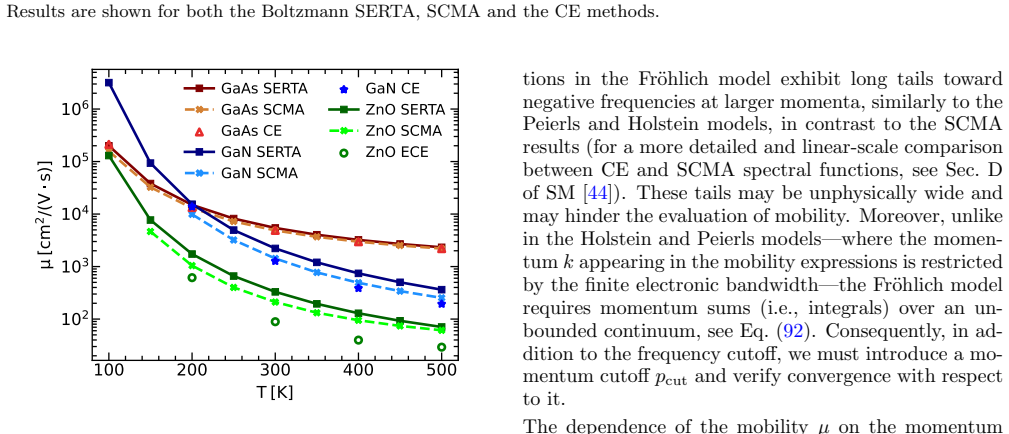
Numerical results The calculations were performed using parameters rep- resentative of the conduction bands in three polar semi- conductors: GaAs (α= 0.072, ω 0 = 36 meV, m 0/me = 0.067), GaN (α= 0.407, ω 0 = 91.2 meV, m 0/me = 0.20), and ZnO (α= 1.022, ω 0 = 72.3 meV, m 0/me = 0.275), wherem 0/me denotes the ratio of the electron band mass to the free-el...
work page 2000
-
[8]
Giustino, Electron-phonon interactions from first principles, Rev
F. Giustino, Electron-phonon interactions from first principles, Rev. Mod. Phys.89, 015003 (2017)
work page 2017
-
[9]
S. Ponc´ e, W. Li, S. Reichardt, and F. Giustino, First-principles calculations of charge carrier mobil- ity and conductivity in bulk semiconductors and two- dimensional materials, Reports on Progress in Physics 83, 036501 (2020)
work page 2020
-
[10]
J.-J. Zhou and M. Bernardi, Ab initio electron mobility and polar phonon scattering in GaAs, Phys. Rev. B94, 201201 (2016)
work page 2016
-
[11]
S. Ponc´ e, E. R. Margine, and F. Giustino, Towards pre- dictive many-body calculations of phonon-limited car- 21 rier mobilities in semiconductors, Phys. Rev. B97, 121201 (2018)
work page 2018
-
[12]
Vukmirovi´ c, Calculations of electron mobility in II- VI semiconductors, Phys
N. Vukmirovi´ c, Calculations of electron mobility in II- VI semiconductors, Phys. Rev. B104, 085203 (2021)
work page 2021
-
[13]
J.-J. Zhou, O. Hellman, and M. Bernardi, Electron- phonon scattering in the presence of soft modes and electron mobility in SrTiO 3 perovskite from first prin- ciples, Phys. Rev. Lett.121, 226603 (2018)
work page 2018
-
[14]
Kubo, Statistical-mechanical theory of irreversible processes
R. Kubo, Statistical-mechanical theory of irreversible processes. I. General theory and simple applications to magnetic and conduction problems, J. Phys. Soc. Jpn. 12, 570 (1957)
work page 1957
-
[15]
J.-M. Lihm and S. Ponc´ e, Nonperturbative self- consistent electron-phonon spectral functions and trans- port, Phys. Rev. Lett.134, 186401 (2025)
work page 2025
-
[16]
J.-J. Zhou and M. Bernardi, Predicting charge transport in the presence of polarons: The beyond-quasiparticle regime in SrTiO 3, Phys. Rev. Res.1, 033138 (2019)
work page 2019
-
[17]
B. K. Chang, J.-J. Zhou, N.-E. Lee, and M. Bernardi, Intermediate polaronic charge transport in organic crys- tals from a many-body first-principles approach, npj Comput. Mater.8, 63 (2022)
work page 2022
-
[18]
J. J. Kas, J. J. Rehr, and L. Reining, Cumulant expan- sion of the retarded one-electron Green function, Phys. Rev. B90, 085112 (2014)
work page 2014
-
[19]
P. J. Robinson, I. S. Dunn, and D. R. Reichman, Cu- mulant methods for electron-phonon problems. I. Per- turbative expansions, Phys. Rev. B105, 224304 (2022)
work page 2022
-
[20]
P. J. Robinson, I. S. Dunn, and D. R. Reichman, Cu- mulant methods for electron-phonon problems. II. The self-consistent cumulant expansion, Phys. Rev. B105, 224305 (2022)
work page 2022
-
[21]
J. Lischner, D. Vigil-Fowler, and S. G. Louie, Satel- lite structures in the spectral functions of the two- dimensional electron gas in semiconductor quantum wells: AGWplus cumulant study, Phys. Rev. B89, 125430 (2014)
work page 2014
-
[22]
B. Gumhalter, V. Kovaˇ c, F. Caruso, H. Lambert, and F. Giustino, On the combined use of GW approximation and cumulant expansion in the calculations of quasipar- ticle spectra: The paradigm of Si valence bands, Phys. Rev. B94, 035103 (2016)
work page 2016
-
[23]
J. P. Nery, P. B. Allen, G. Antonius, L. Reining, A. Miglio, and X. Gonze, Quasiparticles and phonon satellites in spectral functions of semiconductors and in- sulators: Cumulants applied to the full first-principles theory and the Fr¨ ohlich polaron, Phys. Rev. B97, 115145 (2018)
work page 2018
-
[24]
G. Antonius, Y.-H. Chan, and S. G. Louie, Polaron spec- tral properties in doped ZnO and SrTiO3 from first prin- ciples, Phys. Rev. Res.2, 043296 (2020)
work page 2020
-
[25]
S. M. Story, J. J. Kas, F. D. Vila, M. J. Verstraete, and J. J. Rehr, Cumulant expansion for phonon contri- butions to the electron spectral function, Phys. Rev. B 90, 195135 (2014)
work page 2014
-
[26]
N. Kandolf, C. Verdi, and F. Giustino, Many-body Green’s function approaches to the doped Fr¨ ohlich solid: Exact solutions and anomalous mass enhance- ment, Phys. Rev. B105, 085148 (2022)
work page 2022
-
[27]
Holstein, Studies of polaron motion: Part I
T. Holstein, Studies of polaron motion: Part I. The molecular-crystal model, Ann. Phys.8, 325 (1959)
work page 1959
-
[28]
W. P. Su, J. R. Schrieffer, and A. J. Heeger, Solitons in polyacetylene, Phys. Rev. Lett.42, 1698 (1979)
work page 1979
-
[29]
Fr¨ ohlich, Electrons in lattice fields, Advances in Physics3, 325 (1954)
H. Fr¨ ohlich, Electrons in lattice fields, Advances in Physics3, 325 (1954)
work page 1954
- [30]
-
[31]
G. Schubert, G. Wellein, A. Weisse, A. Alvermann, and H. Fehske, Optical absorption and activated transport in polaronic systems, Phys. Rev. B72, 104304 (2005)
work page 2005
-
[32]
W. Li, J. Ren, and Z. Shuai, Finite-temperature TD- DMRG for the carrier mobility of organic semiconduc- tors, J. Phys. Chem. Lett.11, 4930 (2020)
work page 2020
-
[33]
Y. Ge, W. Li, J. Ren, and Z. Shuai, Computational method for evaluating the thermoelectric power factor for organic materials modeled by the Holstein model: A time-dependent density matrix renormalization group formalism, J. Chem. Theory Comput.18, 6437 (2022)
work page 2022
- [34]
-
[35]
J. Jakliˇ c and P. Prelovˇ sek, Lanczos method for the cal- culation of finite-temperature quantities in correlated systems, Phys. Rev. B49, 5065 (1994)
work page 1994
-
[36]
J. Jakliˇ c and P. Prelovˇ sek, Finite-temperature proper- ties of doped antiferromagnets, Adv. Phys.49, 1 (2000)
work page 2000
-
[37]
P. Prelovˇ sek and J. Bonˇ ca, Ground state and finite temperature Lanczos methods, inStrongly Correlated Systems: Numerical Methods, edited by A. Avella and F. Mancini (Springer Berlin Heidelberg, Berlin, Heidel- berg, 2013) pp. 1–30
work page 2013
-
[38]
S. Miladi´ c and N. Vukmirovi´ c, Method for obtaining polaron mobility using real and imaginary time path- integral quantum Monte Carlo, Phys. Rev. B107, 184315 (2023)
work page 2023
-
[39]
A. S. Mishchenko, N. Nagaosa, G. De Filippis, A. de Candia, and V. Cataudella, Mobility of Holstein polaron at finite temperature: An unbiased approach, Phys. Rev. Lett.114, 146401 (2015)
work page 2015
-
[40]
P. Mitri´ c, V. Dobrosavljevi´ c, and D. Tanaskovi´ c, Pre- cursors to Anderson localization in the Holstein model: Quantum and quantum-classical solutions, Phys. Rev. B111, L161105 (2025)
work page 2025
-
[41]
P. Mitri´ c, Dynamical quantum typicality: Simple method for investigating transport properties applied to the Holstein model, Phys. Rev. B111, 195140 (2025)
work page 2025
-
[42]
S. Miladi´ c and N. Vukmirovi´ c, Identification of the transport regimes of the one-dimensional Holstein model, Phys. Rev. B112, 054314 (2025)
work page 2025
-
[43]
Y.-C. Wang and Y. Zhao, Diagrammatic quantum Monte Carlo toward the calculation of transport proper- ties in disordered semiconductors, J. Chem. Phys.156, 204116 (2022)
work page 2022
-
[44]
P. Mitri´ c, V. Jankovi´ c, N. Vukmirovi´ c, and D. Tanaskovi´ c, Cumulant expansion in the Hol- stein model: Spectral functions and mobility, Phys. Rev. B107, 125165 (2023)
work page 2023
-
[45]
V. Jankovi´ c, P. Mitri´ c, D. Tanaskovi´ c, and N. Vuk- mirovi´ c, Vertex corrections to conductivity in the Hol- stein model: A numerical-analytical study, Phys. Rev. 22 B109, 214312 (2024)
work page 2024
-
[46]
P. Mitri´ c, V. Jankovi´ c, N. Vukmirovi´ c, and D. Tanaskovi´ c, Spectral functions of the Holstein polaron: Exact and approximate solutions, Phys. Rev. Lett.129, 096401 (2022)
work page 2022
-
[47]
V. Jankovi´ c and N. Vukmirovi´ c, Spectral and thermo- dynamic properties of the Holstein polaron: Hierarchi- cal equations of motion approach, Phys. Rev. B105, 054311 (2022)
work page 2022
-
[48]
V. Jankovi´ c, Holstein polaron transport from numeri- cally “exact” real-time quantum dynamics simulations, J. Chem. Phys.159, 094113 (2023)
work page 2023
-
[49]
Jankovi´ c, Charge transport limited by nonlocal electron-phonon interaction
V. Jankovi´ c, Charge transport limited by nonlocal electron-phonon interaction. i. hierarchical equations of motion approach, Phys. Rev. B112, 035111 (2025)
work page 2025
-
[50]
Jankovi´ c, Charge transport limited by nonlocal electron-phonon interaction
V. Jankovi´ c, Charge transport limited by nonlocal electron-phonon interaction. ii. numerically exact quan- tum dynamics in the slow-phonon regime, Phys. Rev. B 112, 035112 (2025)
work page 2025
-
[51]
See Supplemental Material for additional numerical re- sults and discussions
-
[52]
Mahan,Many-Particle Physics(Kluwer Academic, New York, 2000)
G. Mahan,Many-Particle Physics(Kluwer Academic, New York, 2000)
work page 2000
-
[53]
G. D. Mahan, Mobility of Polarons, Phys. Rev.142, 366 (1966)
work page 1966
-
[54]
Levin, Fast integration of rapidly oscillatory func- tions, J
D. Levin, Fast integration of rapidly oscillatory func- tions, J. Comput. Appl. Math.67, 95 (1996)
work page 1996
-
[55]
N. Vukmirovi´ c, Grid-free evaluation of phonon-limited electronic relaxation times and transport properties, Comput. Phys. Commun.312, 109583 (2025)
work page 2025
- [56]
-
[57]
Y. Tanimura, Numerically “exact” approach to open quantum dynamics: The hierarchical equations of mo- tion (HEOM), The Journal of Chemical Physics153, 020901 (2020)
work page 2020
-
[58]
H.-D. Zhang, R.-X. Xu, X. Zheng, and Y. Yan, Statistical quasi-particle theory for open quan- tum systems, Molecular Physics116, 780 (2018), https://doi.org/10.1080/00268976.2018.1431407
-
[59]
I. S. Dunn, R. Tempelaar, and D. R. Reichman, Re- moving instabilities in the hierarchical equations of mo- tion: Exact and approximate projection approaches, The Journal of Chemical Physics150, 184109 (2019)
work page 2019
-
[60]
T. P. Fay, A simple improved low temperature correc- tion for the hierarchical equations of motion, The Jour- nal of Chemical Physics157, 054108 (2022)
work page 2022
-
[61]
V. Jankovi´ c, Numerical investigation of transport prop- erties of the one-dimensional Peierls model based on the hierarchical equations of motion [Data set], Zenodo (2025)
work page 2025
-
[62]
M. R. Carbone, S. Fomichev, A. J. Millis, M. Berciu, D. R. Reichman, and J. Sous, The generalized Green’s function cluster expansion: A python package for sim- ulating polarons, Journal of Open Source Software8, 5115 (2023)
work page 2023
-
[63]
M. R. Carbone, D. R. Reichman, and J. Sous, Numer- ically exact generalized Green’s function cluster expan- sions for electron-phonon problems, Phys. Rev. B104, 035106 (2021)
work page 2021
-
[64]
M. R. Carbone, A. J. Millis, D. R. Reichman, and J. Sous, Bond-Peierls polaron: Moderate mass enhance- ment and current-carrying ground state, Phys. Rev. B 104, L140307 (2021)
work page 2021
-
[65]
D. J. J. Marchand, G. De Filippis, V. Cataudella, M. Berciu, N. Nagaosa, N. V. Prokof’ev, A. S. Mishchenko, and P. C. E. Stamp, Sharp transition for single polarons in the one-dimensional Su-Schrieffer- Heeger model, Phys. Rev. Lett.105, 266605 (2010)
work page 2010
-
[66]
Berciu, Green’s Function of a Dressed Particle, Phys
M. Berciu, Green’s Function of a Dressed Particle, Phys. Rev. Lett.97, 036402 (2006)
work page 2006
-
[67]
G. L. Goodvin, M. Berciu, and G. A. Sawatzky, Green’s function of the Holstein polaron, Phys. Rev. B74, 245104 (2006)
work page 2006
-
[68]
A. S. Mishchenko, N. V. Prokof’ev, A. Sakamoto, and B. V. Svistunov, Diagrammatic quantum Monte Carlo study of the Fr¨ ohlich polaron, Phys. Rev. B62, 6317 (2000)
work page 2000
-
[69]
Mitri´ c,Spectral functions and mobility of the Holstein polaron, Ph.D
P. Mitri´ c,Spectral functions and mobility of the Holstein polaron, Ph.D. thesis, University of Belgrade, Belgrade, Serbia (2023)
work page 2023
-
[70]
J.-M. Lihm and S. Ponc´ e, Beyond-quasiparticles trans- port with vertex correction: self-consistent ladder for- malism for electron-phonon interactions, arXiv preprint arXiv:2506.18139 (2025)
-
[71]
P. Mitri´ c, V. Jankovi´ c, D. Tanaskovic, and N. Vuk- mirovic, Data for ”On the applicability of the cumu- lant expansion method for the calculation of transport properties in electron-phonon systems” [Data set], Zen- odo (2025). 23 Supplemental material for: On the applicability of the cumulant expansion method for the calculation of transport propertie...
work page 2025
-
[72]
Holstein model The exact sum rules for the Holstein model read as follows: M0(k) = 1 (S1) M1(k) =ε k (S2) M2(k) =g 2(2nph + 1) +ε 2 k (S3) M3(k) = 2g2(2nph + 1)εk +g 2ω0 +ε 3 k (S4) M4(k) = 3g4(2nph + 1)2 +g 2(2nph + 1)(3ε2 k + 2t2 0 +ω 2
-
[73]
+ 2g2ω0εk +ε 4 k (S5) M5(k) = 7g4(2nph + 1)2εk +g 2(3ω0ε2 k + 6t2 0ω0 +ω 3
-
[74]
+ (2nph + 1)(10g4ω0 +g 2(4t2 0εk + 2ω2 0εk + 4ε3 k)) +ε 5 k (S6) M6(k) = 15g6(2nph + 1)3 +g 4(2nph + 1)2(12ε2 k + 18t2 0 + 15ω2
-
[75]
+ 10g4ω2 0 +g 2(12t2 0ω0εk + 4ω0ε3 k + 2ω3 0εk) + (2nph + 1)(22g4ω0εk +g 2(6t2 0ε2 k + 3ω2 0ε2 k + 5ε4 k + 12t2 0ω2 0 + 6t4 0 +ω 4 0)) +ε 6 k (S7) M7(k) = 36g6(2nph + 1)3εk + 21g4ω2 0εk +g 2(18t2 0ω0ε2 k + 3ω3 0ε2 k + 5ω0ε4 k + 20t2 0ω3 0 + 30t4 0ω0 +ω 5 0) + (2nph + 1)2(105g6ω0 +g 4(41t2 0εk + 32ω2 0εk + 18ε3 k)) + (2nph + 1)g4(36ω0ε2 k + 108t2 0ω0 + 56ω...
-
[76]
+ 8t2 0ε3 k + 4ω2 0ε3 k + 6ε5 k) +ε 7 k (S8) M8(k) = 105g8(2nph + 1)4 +g 6(2nph + 1)3(64ε2 k + 160t2 0 + 210ω2
-
[77]
+g 4(33ω2 0ε2 k + 158t2 0ω2 0 + 56ω4 0) +g 2(24t2 0ω0ε3 k + 40t2 0ω3 0εk + 60t4 0ω0εk + 6ω0ε5 k + 4ω3 0ε3 k + 2ω5 0εk) + (2nph + 1)2(236g6ω0εk +g 4(68t2 0ε2 k + 51ω2 0ε2 k + 25ε4 k + 258t2 0ω2 0 + 94t4 0 + 63ω4 0)) + 280(2nph + 1)g6ω2 0 + (2nph + 1)g4(240t2 0ω0εk + 52ω0ε3 k + 116ω3 0εk) + 3(2nph + 1)g2ε2 k(12t2 0ω2 0 + 6t4 0 +ω 4 0) + (2nph + 1)g2(10t2 0ε...
-
[78]
+ε 8 k (S9) M9(k) = 249g8(2nph + 1)4εk + 280g6ω3 0 +g 4(346t2 0ω2 0εk + 114ω4 0εk + 46ω2 0ε3 k) +g 2(60t2 0ω3 0ε2 k + 30t2 0ω0ε4 k + 90t4 0ω0ε2 k + 3ω5 0ε2 k + 5ω3 0ε4 k + 7ω0ε6 k) +g 2(42t2 0ω5 0 + 210t4 0ω3 0 + 140t6 0ω0 +ω 7
-
[79]
+ (2nph + 1)3(1260g8ω0 +g 6(384t2 0εk + 456ω2 0εk + 100ε3 k)) + (2nph + 1)2g6(396ω0ε2 k + 1632t2 0ω0 + 1638ω3 0) + (2nph + 1)2g4(564t2 0ω2 0εk + 99t2 0ε3 k + 213t4 0εk + 72ω2 0ε3 k + 129ω4 0εk + 33ε5 k) + 600(2nph + 1)g6ω2 0εk + (2nph + 1)g4(388t2 0ω0ε2 k + 70ω0ε4 k + 180ω3 0ε2 k + 2ω0(660t2 0ω2 0 + 404t4 0 + 123ω4 0)) + (2nph + 1)g2(4ε3 k(12t2 0ω2 0 + 6t4 0 +ω 4
-
[80]
+ 2εk(90t4 0ω2 0 + 30t2 0ω4 0 + 20t6 0 +ω 6 0)) + (2nph + 1)g2(12t2 0ε5 k + 6ω2 0ε5 k + 8ε7 k) +ε 9 k (S10) The CE sum rulesM CE n (k) coincide with the exact result forn≤4. Forn >4, the differenceM CE n (k)− M n(k) is given by: 34 MCE 5 (k)− M 5(k) =−2g 4(2nph + 1)2εk (S11) MCE 6 (k)− M 6(k) =−2g 4(2nph + 1) −6(2nph + 1) + 6ω0εk + (2nph + 1)ε2 k (S12) MC...
discussion (0)
Sign in with ORCID, Apple, or X to comment. Anyone can read and Pith papers without signing in.