Dynamical Scarring from Scrambling in Two Dimensional Topological Materials
Pith reviewed 2026-05-16 21:32 UTC · model grok-4.3
The pith
Topological edge modes in two-dimensional materials create dynamical scars where information propagates without scrambling.
A machine-rendered reading of the paper's core claim, the machinery that carries it, and where it could break.
Core claim
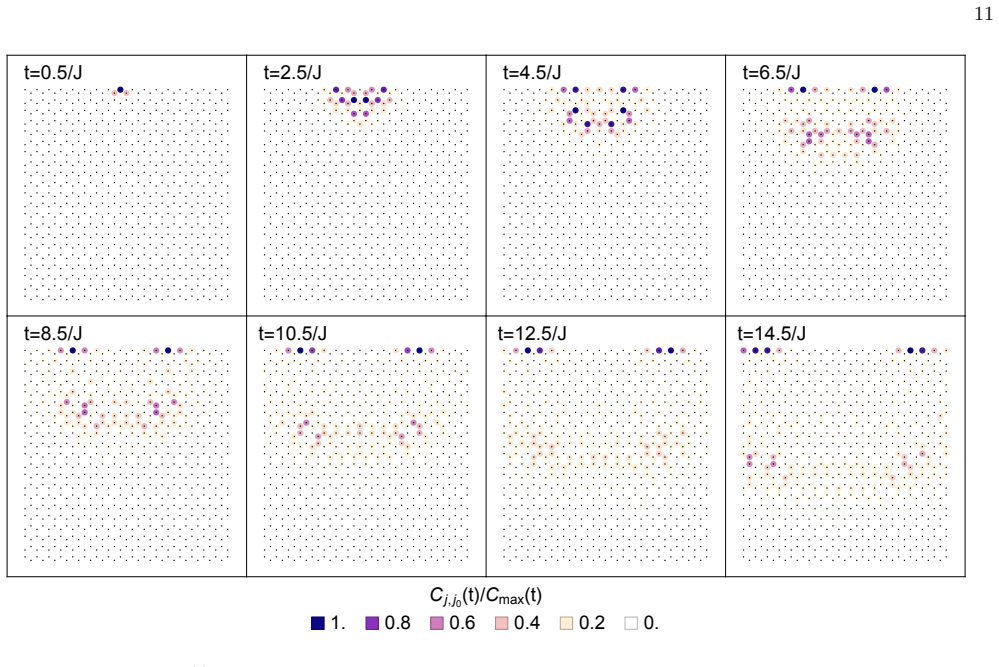
In two dimensional topological models, chiral or helical edge modes cause dynamical scarring where information from an initial boundary perturbation propagates around the edge without being scrambled over long timescales, with the direction and speed of the scars determined by the velocities of the linearly dispersing edge modes, and these scars do not interact with each other.
What carries the argument
Out-of-time ordered correlators that track the spreading of an initial perturbation, showing both lattice-dependent bulk butterfly velocities and persistent edge scars from topological modes.
If this is right
- Information remains trapped on the system boundary for extended periods rather than spreading into the bulk.
- The scars propagate at constant velocities matching those of the edge modes.
- Multiple scars can coexist and cross paths without interfering.
- Bulk information spreading acquires a directional bias from the underlying lattice.
Where Pith is reading between the lines
- This mechanism could allow topological edges to preserve quantum information against scrambling for practical timescales.
- Similar scarring might occur in other protected mode systems such as photonic or acoustic topological insulators.
- Experimental detection could use time-resolved measurements of correlation functions on material edges.
- The non-interaction of scars points to an effectively linear dynamics on the boundary despite bulk chaos.
Load-bearing premise
The edge modes continue to disperse linearly and remain non-interacting without scattering or decoherence effects over the long evolution times considered.
What would settle it
A numerical computation of the out-of-time ordered correlator on a finite topological lattice model showing whether the boundary signal decays or spreads into the bulk after a time much longer than the edge traversal time.
Figures



read the original abstract
Out-of-time ordered correlators are a probe of how the information of an initial perturbation is effectively scrambled under unitary time evolution, widely used to study quantum chaos. They have also been used to demonstrate that information is trapped in the zero dimensional edge modes of topological insulators and superconductors, and does not become scrambled. Here we study scrambling in two dimensional topological models. In the bulk the butterfly velocity, the speed at which the out-of-time ordered correlator spreads, gains a directional dependence from the underlying lattice. Furthermore when there are chiral or helical edge modes present these cause a form of dynamical scarring. The information about an initial perturbation on the boundary of the system travels around the edge, carried by the edge modes, but is not scrambled over very long time scales. The direction and speed of the scars are given by the velocities of the linearly dispersing edge modes. We further show that these scars do not interact, passing through each other. We back up these results with analytical and numerical calculations on exemplary models.
Editorial analysis
A structured set of objections, weighed in public.
Referee Report
Summary. The paper claims that out-of-time-ordered correlators (OTOCs) in two-dimensional topological models exhibit a lattice-induced directional dependence in the bulk butterfly velocity. When chiral or helical edge modes are present, they produce dynamical scarring: an initial boundary perturbation propagates along the edge without scrambling over long timescales, with scar direction and speed set by the linear dispersion of the edge modes. The scars are shown to be non-interacting and pass through each other. These findings are supported by analytical derivations and numerical calculations on exemplary models such as lattice Dirac and BHZ-type Hamiltonians.
Significance. If the central claims hold, the work demonstrates how topological protection suppresses scrambling along edges, yielding persistent, non-interacting information channels. This provides a concrete link between topology and quantum chaos diagnostics, with potential relevance to controlled information propagation in quantum devices. The parameter-free character of the edge-mode velocities and the explicit demonstration of non-interacting scars are notable strengths.
major comments (1)
- [Numerical results and discussion of long-time behavior] The finite-time nature of the non-scrambling claim is internally consistent with the gapped bulk and protected edge modes, but the manuscript should explicitly bound the timescale on which higher-order corrections (e.g., weak disorder or interactions) remain negligible; without this, the extrapolation to 'very long time scales' in the abstract risks overstatement.
minor comments (2)
- [Methods / Model Hamiltonians] The definition of the OTOC operator and the precise lattice regularization used for the edge-mode velocity should be stated once in the main text before the first numerical figure.
- [Figures] Figure captions for the OTOC snapshots should include the system size, time range, and any averaging procedure to allow direct comparison with the analytical edge-mode prediction.
Simulated Author's Rebuttal
We thank the referee for their positive assessment and constructive comment on our manuscript. We address the major comment below and will incorporate the suggested revision.
read point-by-point responses
-
Referee: [Numerical results and discussion of long-time behavior] The finite-time nature of the non-scrambling claim is internally consistent with the gapped bulk and protected edge modes, but the manuscript should explicitly bound the timescale on which higher-order corrections (e.g., weak disorder or interactions) remain negligible; without this, the extrapolation to 'very long time scales' in the abstract risks overstatement.
Authors: We agree that an explicit bound strengthens the presentation. In the revised manuscript we will add a paragraph (in the main text near the discussion of edge scars) providing a perturbative estimate: in the ideal gapped models the non-scrambling persists for all times, while for weak perturbations of strength ε ≪ Δ (where Δ is the bulk gap) the protection holds up to times ~ Δ/ε² from Fermi-golden-rule scattering rates. We will also revise the abstract phrasing from 'very long time scales' to 'timescales much longer than the inverse bulk gap, set by the strength of any weak perturbations'. This change is consistent with the existing analytical and numerical results. revision: yes
Circularity Check
Derivation is self-contained with no circular steps
full rationale
The paper's central claims follow from direct application of standard OTOC definitions to lattice Dirac and BHZ Hamiltonians whose edge modes are linearly dispersing by construction of the topological bulk gap. Analytical propagation of operator support along the boundary and numerical verification of non-interacting scars are obtained without fitted parameters, self-referential definitions, or load-bearing self-citations; the finite-time non-scrambling is a direct consequence of the protected linear dispersion and bulk suppression, making the derivation independent of its target results.
Axiom & Free-Parameter Ledger
axioms (2)
- standard math Unitary time evolution under a time-independent Hamiltonian governs the system dynamics
- domain assumption Topological edge modes in 2D lattices are chiral or helical and linearly dispersing
Lean theorems connected to this paper
-
IndisputableMonolith/Foundation/RealityFromDistinction.leanreality_from_one_distinction unclear?
unclearRelation between the paper passage and the cited Recognition theorem.
dynamical scarring ... scars do not interact, passing through each other ... velocity of the scars ... velocities of the linearly dispersing edge modes
What do these tags mean?
- matches
- The paper's claim is directly supported by a theorem in the formal canon.
- supports
- The theorem supports part of the paper's argument, but the paper may add assumptions or extra steps.
- extends
- The paper goes beyond the formal theorem; the theorem is a base layer rather than the whole result.
- uses
- The paper appears to rely on the theorem as machinery.
- contradicts
- The paper's claim conflicts with a theorem or certificate in the canon.
- unclear
- Pith found a possible connection, but the passage is too broad, indirect, or ambiguous to say the theorem truly supports the claim.
Reference graph
Works this paper leans on
-
[1]
0.8 0.6 0.4 0.2 0. FIG. 1. The OTOCC j,j0(t) at different time steps following a perturbation in the center, at site⃗ r 0 = (11,11)a, in the topologically trivial phase withν= 0, see main text for details. Each point is a lattice site. Note that the normalization of the color scheme is for each time step,C max(t) = max[Cj,j0(t)]. Here we check the bulk sc...
-
[2]
0.8 0.6 0.4 0.2 0. FIG. 2. The OTOCC j,j0(t) at different time steps following a perturbation in the center, at site⃗ r 0 = (11,11)a, in the topologically non-trivial phase withν= 1, see main text and fig. 1 for more details. After a timet≈6/Jthe correlations have hit the edge of the system and scatter back, resulting in a quickly scrambled system. presen...
-
[3]
0.8 0.6 0.4 0.2 0. FIG. 4. The OTOCC j,j0(t) at different time steps following a perturbation on the edge, at site⃗ r0 = (1,11)a, in the topologically non-trivial phase withν= 1, see main text and fig. 1 for more details. In theν= 1 phase the chiral edge modes propagate clockwise, as does the scar in the scrambling visible as a dark purple region on the b...
-
[4]
0.8 0.6 0.4 0.2 0. FIG. 5. The OTOCC j,j0(t) at different time steps following a perturbation on the edge, at site⃗ r0 = (1,11)a, in the topologically non-trivial phase withν=−1, see main text and fig. 1 for more details. In theν=−1 phase the chiral edge modes propagate counter-clockwise, as does the scar in the scrambling visible as a dark purple region ...
work page 2024
-
[5]
0.8 0.6 0.4 0.2 0. FIG. 8. The OTOCC j,j0(t) at different time steps in a system where there is a domain wall betweenν=−1 andν= 1 such that fory >11a ν= 1 and fory <12a ν=−1. Each phase is marked by a different color for the lattice site. See the main text and fig. 1 for more details. In panel (a) the perturbation is at⃗ r 0 = (11,11)alocated just inside ...
-
[6]
0.8 0.6 0.4 0.2 0. FIG. 9. The OTOCC j,j0(t) at different time steps following a perturbation on the top edge in the topologically non-trivial phase of aZ 2 topological insulator. In this phase counter propagating helical edge modes are present, see main text and fig. 1 for more details. As we predict two counter-propagating scars can be seen. t=0.5/J t=3...
-
[7]
0.8 0.6 0.4 0.2 0. FIG. 10. The OTOCC j,j0(t) at different time steps following a perturbation located at two sites on the top edge, see Eq. (24). This is for the topologically non-trivial phase of a topological insulator with counter propagating helical edge modes, see main text and fig. 1 for more details. We see the counter propagating scars which pass...
-
[8]
0.8 0.6 0.4 0.2 0. FIG. A.1. The OTOCC j,j0(t) at different time steps following a perturbation on the edge, at site⃗ r 0 = (1,11)a, in the topologically trivial phase withν= 0, see main text and fig. 1 for more details. No chiral edge modes are present and we see no scar in the scrambling visible on the boundary. -20 0 20 40 -5 -4 -3 -2 -1 0 positionalon...
-
[9]
0.8 0.6 0.4 0.2 0. FIG. A.3. The OTOCC j,j0(t) at different time steps for the topologically non-trivial phase of aZ 2 topological insulator with counter propagating helical edge modes, see main text and fig. 1 for more details. Locations of the perturbations can be seen in the early time plots. (a,b) show two different shapes for the same parameters demo...
-
[10]
M. Z. Hasan and C. L. Kane, Colloquium: Topological insulators, Reviews of Modern Physics82, 3045 (2010)
work page 2010
-
[11]
C. K. Chiu, J. C. Teo, A. P. Schnyder, and S. Ryu, Classi- fication of topological quantum matter with symmetries, Reviews of Modern Physics88, 035005 (2016)
work page 2016
-
[12]
M. Sato and Y. Ando, Topological superconductors: A review, Reports on Progress in Physics80, 076501 (2017)
work page 2017
-
[13]
S. Rachel, Interacting topological insulators: A review, Reports on Progress in Physics81, 116501 (2018)
work page 2018
- [14]
-
[15]
0.8 0.6 0.4 0.2 0. FIG. A.4. The semi-analytical OTOCC j,j0(t) from Eqs. (19) and (20) at different time steps following a perturbation in the center, at site⃗ r 0 = (11,11)a, in the topologically trivial phase withν= 0. See main text for details and fig. 1 for more details. Here we check the bulk scrambling which spreads throughout the system with a char...
work page 2021
-
[16]
K. Yang, Z. Li, J. L. K. K¨ onig, L. Rødland, M. St˚ alhammar, and E. J. Bergholtz, Homotopy, sym- metry, and non-Hermitian band topology, Reports on Progress in Physics87, 078002 (2024)
work page 2024
-
[17]
A. I. Larkin and Y. N. Ovchinnikov, Quasiclassical Method in the Theory of Superconductivity, Soviet Physics JETP28, 1200 (1969)
work page 1969
-
[18]
D. Chowdhury and B. Swingle, Onset of many-body chaos in the O ( N ) model, Physical Review D96, 065005 (2017)
work page 2017
-
[19]
T. Xu, T. Scaffidi, and X. Cao, Does Scrambling Equal Chaos?, Physical Review Letters124, 140602 (2020)
work page 2020
-
[20]
T. Kinoshita, T. Wenger, and D. S. Weiss, A quantum Newton’s cradle, Nature440, 900 (2006)
work page 2006
-
[21]
M. Cheneau, P. Barmettler, D. Poletti, M. Endres, P. Schauß, T. Fukuhara, C. Gross, I. Bloch, C. Kollath, and S. Kuhr, Light-cone-like spreading of correlations in a quantum many-body system, Nature481, 484 (2012)
work page 2012
-
[22]
K. A. Landsman, C. Figgatt, T. Schuster, N. M. Linke, B. Yoshida, N. Y. Yao, and C. Monroe, Verified quantum information scrambling, Nature567, 61 (2019)
work page 2019
-
[23]
B. Swingle, G. Bentsen, M. Schleier-Smith, and P. Hay- den, Measuring the scrambling of quantum information, Physical Review A94, 40302 (2016)
work page 2016
-
[24]
M. G¨ arttner, P. Hauke, and A. M. Rey, Relating out- of-time-order correlations to entanglement via multiple- quantum coherences, Physical Review Letters120, 40402 (2017)
work page 2017
-
[25]
J. Li, R. Fan, H. Wang, B. Ye, B. Zeng, H. Zhai, X. Peng, and J. Du, Measuring Out-of-Time-Order Correlators on a Nuclear Magnetic Resonance Quantum Simulator, Physical Review X7, 031011 (2017)
work page 2017
-
[26]
R. J. Lewis-Swan, A. Safavi-Naini, J. J. Bollinger, and A. M. Rey, Unifying scrambling, thermalization and en- tanglement through measurement of fidelity out-of-time- order correlators in the Dicke model, Nature Communi- cations10, 1581 (2019)
work page 2019
- [27]
-
[28]
M. S. Blok, V. V. Ramasesh, T. Schuster, K. O’Brien, J. M. Kreikebaum, D. Dahlen, A. Morvan, B. Yoshida, N. Y. Yao, and I. Siddiqi, Quantum Information Scram- bling on a Superconducting Qutrit Processor, Physical Review X11, 021010 (2021)
work page 2021
- [29]
-
[30]
Z. Weinstein, S. P. Kelly, J. Marino, and E. Altman, Scrambling Transition in a Radiative Random Unitary Circuit (2022), arXiv:2210.14242 [cond-mat, physics:hep- th, physics:quant-ph]. 15
-
[31]
J. Maldacena, S. H. Shenker, and D. Stanford, A bound on chaos, Journal of High Energy Physics2016, 106 (2016)
work page 2016
-
[32]
E. H. Lieb and D. W. Robinson, The finite group velocity of quantum spin systems, Communications in Mathemat- ical Physics28, 251 (1972)
work page 1972
-
[33]
D. A. Roberts and B. Swingle, Lieb-Robinson Bound and the Butterfly Effect in Quantum Field Theories, Physical Review Letters117, 091602 (2016)
work page 2016
-
[34]
M. McGinley, A. Nunnenkamp, and J. Knolle, Slow Growth of Out-of-Time-Order Correlators and Entangle- ment Entropy in Integrable Disordered Systems, Physical Review Letters122, 020603 (2019)
work page 2019
-
[35]
Z. Okv´ atovity and B. D´ ora, Out-of-time-ordered commu- tators in Dirac–Weyl systems, Physical Review B101, 10.1103/PhysRevB.101.245125 (2020)
-
[36]
R. Belyansky, P. Bienias, Y. A. Kharkov, A. V. Gor- shkov, and B. Swingle, Minimal Model for Fast Scram- bling, Physical Review Letters125, 130601 (2020)
work page 2020
-
[37]
J. M. Deutsch, Quantum statistical mechanics in a closed system, Physical Review A43, 2046 (1991)
work page 2046
-
[38]
Srednicki, Chaos and quantum thermalization, Phys- ical Review E50, 888 (1994)
M. Srednicki, Chaos and quantum thermalization, Phys- ical Review E50, 888 (1994)
work page 1994
- [39]
- [40]
-
[41]
J. M. Deutsch, Eigenstate Thermalization Hypothesis, Reports on Progress in Physics81, 082001 (2018)
work page 2018
-
[42]
C. W. Von Keyserlingk, T. Rakovszky, F. Pollmann, and S. L. Sondhi, Operator Hydrodynamics, OTOCs, and Entanglement Growth in Systems without Conservation Laws, Physical Review X8, 02103 (2018)
work page 2018
-
[43]
V. Alba and P. Calabrese, Quantum information scram- bling after a quantum quench, Physical Review B100, 115150 (2019)
work page 2019
- [44]
-
[45]
B. Swingle and D. Chowdhury, Slow scrambling in dis- ordered quantum systems, Physical Review B95, 60201 (2017)
work page 2017
- [46]
-
[47]
J. Maldacena and D. Stanford, Remarks on the Sachdev- Ye-Kitaev model, Physical Review D94, 106002 (2016)
work page 2016
-
[48]
A. A. Patel, D. Chowdhury, S. Sachdev, and B. Swingle, Quantum Butterfly Effect in Weakly Interacting Diffu- sive Metals, Physical Review X7, 031047 (2017)
work page 2017
- [49]
-
[50]
D. Tripathy, A. Touil, B. Gardas, and S. Deffner, Quan- tum information scrambling in two-dimensional Bose– Hubbard lattices, Chaos: An Interdisciplinary Journal of Nonlinear Science34, 043121 (2024)
work page 2024
-
[51]
J. Riddell and E. S. Sørensen, Out-of-time ordered corre- lators and entanglement growth in the random-field XX spin chain, Physical Review B99, 054205 (2019)
work page 2019
-
[52]
M. Sedlmayr, H. Cheraghi, and N. Sedlmayr, Information trapping by topologically protected edge states: Scram- bling and the butterfly velocity, Physical Review B108, 184303 (2023)
work page 2023
- [53]
-
[54]
W. Buijsman, V. Gritsev, and R. Sprik, Nonergodicity in the Anisotropic Dicke Model, Physical Review Letters 118, 080601 (2017)
work page 2017
- [55]
- [56]
-
[57]
Q. Wang and F. P´ erez-Bernal, Probing an excited-state quantum phase transition in a quantum many-body sys- tem via an out-of-time-order correlator, Physical Review A100, 062113 (2019)
work page 2019
-
[58]
M. Heyl, F. Pollmann, and B. D´ ora, Detecting equilib- rium and dynamical quantum phase transitions in Ising chains via out-of-time-ordered correlators, Physical Re- view Letters121, 016801 (2018)
work page 2018
-
[59]
M. Heyl, Dynamical quantum phase transitions: A re- view, Reports on Progress in Physics81, 054001 (2018)
work page 2018
-
[60]
C. J. Turner, A. A. Michailidis, D. A. Abanin, M. Serbyn, and Z. Papi´ c, Quantum scarred eigenstates in a Rydberg atom chain: Entanglement, breakdown of thermalization, and stability to perturbations, Physical Review B98, 155134 (2018)
work page 2018
- [61]
-
[62]
B. D´ ora and R. Moessner, Out-of-Time-Ordered Density Correlators in Luttinger Liquids, Physical Review Letters 119, 26802 (2017)
work page 2017
-
[63]
L. S. Levitov, H. Lee, and G. B. Lesovik, Electron count- ing statistics and coherent states of electric current, Jour- nal of Mathematical Physics37, 4845 (1996)
work page 1996
-
[64]
I. Klich, An Elementary Derivation of Levitov’s Formula, inQuantum Noise in Mesoscopic Physics, NATO Ad- vanced Science Series, Vol. 97, edited by Y. V. Nazarov (Kluwer Academic Press, Dordrecht, 2003) pp. 397–402
work page 2003
-
[65]
D. Rossini, T. Calarco, V. Giovannetti, S. Montangero, and R. Fazio, Decoherence induced by interacting quan- tum spin baths, Physical Review A75, 032333 (2007)
work page 2007
-
[66]
N. Sedlmayr, P. Jaeger, M. Maiti, and J. Sirker, Bulk- boundary correspondence for dynamical phase transi- tions in one-dimensional topological insulators and su- perconductors, Physical Review B97, 064304 (2018)
work page 2018
- [67]
- [68]
- [69]
-
[70]
N. Sedlmayr and C. Bena, Visualizing Majorana bound states in one and two dimensions using the generalized 16 Majorana polarization, Physical Review B92, 115115 (2015)
work page 2015
-
[71]
T. Mas lowski, H. Cheraghi, J. Sirker, and N. Sedlmayr, Fisher zeroes and dynamical quantum phase transitions for two- and three-dimensional models, Physical Review B110, 224302 (2024)
work page 2024
-
[72]
C. L. Kane and E. J. Mele, Quantum Spin hall effect in graphene, Physical Review Letters95, 226801 (2005)
work page 2005
- [73]
discussion (0)
Sign in with ORCID, Apple, or X to comment. Anyone can read and Pith papers without signing in.