Photoinduced phase heterogeneity and charge localization in SnSe
Pith reviewed 2026-05-16 21:19 UTC · model grok-4.3
The pith
Photoexcitation nucleates higher-symmetry semi-metallic domains in SnSe within 200 fs, creating phase heterogeneity that localizes carriers.
A machine-rendered reading of the paper's core claim, the machinery that carries it, and where it could break.
Core claim
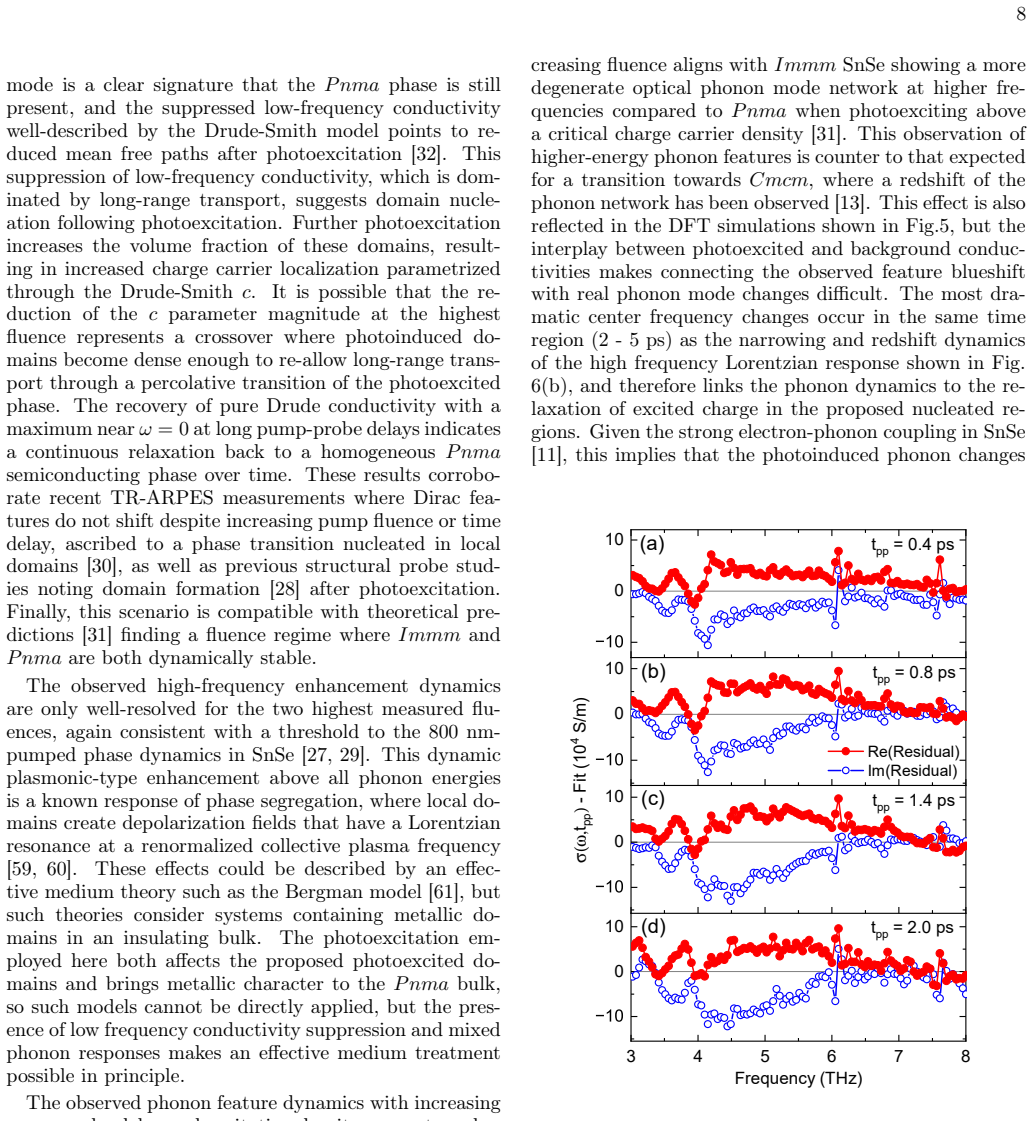
Time-resolved multi-terahertz spectroscopy reveals pump-fluence-dependent dynamics in the optical conductivity of photoexcited SnSe. Below 3 mJ/cm^{2} a free-carrier Drude spectrum coexists with equilibrium Pnma phonons. At higher fluences the DC photoconductivity is suppressed, the B^{2}_{1}u mode shifts and narrows, and a new mode emerges at ~3.0 THz. At intermediate fluences (~3.1 mJ/cm^{2}) an additional high-frequency Lorentzian component appears that redshifts after 2 ps and decays exponentially on a 90 ps timescale. Experimental spectra together with theoretical calculations indicate non-thermal nucleation of higher-symmetry semi-metallic phase domains within 200 fs.
What carries the argument
Nucleation of higher-symmetry semi-metallic phase domains inside the Pnma matrix, detected through emergence of a ~3.0 THz phonon mode, suppression of the Drude response, and transient high-frequency Lorentzian conductivity that signals phase heterogeneity.
If this is right
- Long-range charge transport is interrupted above a fluence threshold of ~3 mJ/cm^{2} due to phase disorder.
- The B^{2}_{1}u phonon mode shifts in frequency and narrows while a new mode appears at ~3.0 THz, indicating a structural transition to higher symmetry.
- A transient high-frequency Lorentzian component emerges at intermediate fluences and decays over 90 ps, consistent with evolving phase heterogeneity.
- The phase change occurs non-thermally within 200 fs, faster than lattice thermalization.
Where Pith is reading between the lines
- The transient semi-metallic domains could be exploited to create ultrafast optical switches that toggle between localized and conducting states in layered chalcogenides.
- Similar photo-induced heterogeneity may appear in isostructural compounds such as SnS, offering a route to engineer domain-wall conductivity without permanent structural damage.
- Mapping the spatial distribution of the new phase domains with nanoscale probes would test whether the observed conductivity suppression scales with domain size or density.
- The 200 fs nucleation timescale suggests the process could be driven by coherent phonon excitation rather than diffusive carrier heating, opening the possibility of selective mode excitation to control phase fractions.
Load-bearing premise
The new 3.0 THz mode and high-frequency Lorentzian component are assumed to arise from nucleation of a higher-symmetry phase rather than from defects, carrier localization without structural change, or artifacts in the conductivity model.
What would settle it
A time-resolved THz measurement at high fluence that shows neither a new mode near 3 THz nor suppression of DC conductivity, or that demonstrates all spectral changes are consistent with purely thermal heating, would falsify the claim of non-thermal photo-induced phase nucleation.
Figures




read the original abstract
Time-resolved multi-terahertz (THz) spectroscopy is used to observe pump fluence-dependent dynamics in the optical conductivity of photoexcited tin selenide (SnSe) over an ultrabroadband spectral range of 0.5 - 11 THz at fluences from 0.1 - 7.5 mJ/cm$^2$. A free carrier Drude spectrum is observed at pump fluences below 3 mJ/cm$^2$, with optical phonons well described by the equilibrium Pnma structural phase. With increasing fluence, a suppression of the DC photoconductivity is observed, indicating an interruption of long range transport due to phase disorder. Concomitantly, the optical phonons exhibit features that can no longer be explained by a pure Pnma phase, with a frequency shift and narrowing of the $B^2_{1u}$ mode and a new mode appearing at $\sim$3.0 THz consistent with a transition to a higher-symmetry structure. At an intermediate fluence of 3.1 mJ/cm$^2$, a high frequency Lorentzian component consistent with phase heterogeneity appears that rapidly redshifts after 2 ps and whose amplitude exponentially decays on a 90 ps time scale. Our experimental measurements and theoretical calculations provide evidence for a non-thermal, photo-induced nucleation of higher symmetry, semi-metallic phase domains in SnSe appearing within 200 fs.
Editorial analysis
A structured set of objections, weighed in public.
Referee Report
Summary. The manuscript uses time-resolved multi-THz spectroscopy (0.5-11 THz) on SnSe to track fluence-dependent (0.1-7.5 mJ/cm²) changes in optical conductivity. Below ~3 mJ/cm² a Drude response plus equilibrium Pnma phonons is reported; above this threshold DC conductivity is suppressed, the B²_{1u} phonon shifts and narrows, a new ~3.0 THz mode appears, and at 3.1 mJ/cm² a transient high-frequency Lorentzian emerges whose amplitude decays on a ~90 ps scale. These features, together with theoretical phonon calculations, are interpreted as evidence for non-thermal, photo-induced nucleation of higher-symmetry semi-metallic phase domains within 200 fs.
Significance. If the central assignment of the new mode and Lorentzian component to a distinct higher-symmetry phase holds, the work would demonstrate ultrafast, non-thermal structural heterogeneity in a layered thermoelectric material, with implications for light-controlled phase engineering. The broadband THz approach that simultaneously resolves carrier and phonon dynamics is a methodological strength, as is the inclusion of supporting theoretical calculations.
major comments (3)
- [Abstract / Results (fluence-dependent spectra)] The assignment of the new ~3.0 THz mode and the high-frequency Lorentzian at 3.1 mJ/cm² specifically to nucleation of a higher-symmetry phase (rather than defects, carrier localization, or multi-component fitting artifacts) is load-bearing for the central claim. The abstract states consistency with theory but provides no quantitative frequency matching between the observed 3.0 THz feature and calculated phonons of the proposed higher-symmetry structure, nor any explicit model-comparison tests that rule out alternative Drude-Lorentz parameterizations without structural change.
- [Time-resolved analysis / Data fitting] The 200 fs appearance time, the ~3 mJ/cm² fluence threshold for heterogeneity, and the 90 ps decay constant are extracted from time-resolved data, yet the manuscript does not detail the fitting procedure, baseline subtraction, or how post-hoc model choices affect these values. Without reported uncertainties or robustness checks, it is unclear whether the claimed non-thermal character and phase-disorder interpretation are robust.
- [Results (conductivity suppression)] Suppression of DC photoconductivity is interpreted as interruption of long-range transport due to phase disorder. This interpretation would be strengthened by showing that the observed conductivity spectra cannot be reproduced by equilibrium Pnma phonons plus fluence-dependent carrier scattering or localization terms alone.
minor comments (2)
- Ensure all figures display error bars on extracted parameters (frequencies, amplitudes, time constants) and clearly label fluence values and pump-probe delays.
- Standardize notation for the B²_{1u} phonon mode between the abstract and main text.
Simulated Author's Rebuttal
We thank the referee for the positive assessment of our work and the constructive comments, which have helped us improve the clarity and robustness of the manuscript. We address each major comment below and have made revisions to incorporate the suggested additions and clarifications.
read point-by-point responses
-
Referee: [Abstract / Results (fluence-dependent spectra)] The assignment of the new ~3.0 THz mode and the high-frequency Lorentzian at 3.1 mJ/cm² specifically to nucleation of a higher-symmetry phase (rather than defects, carrier localization, or multi-component fitting artifacts) is load-bearing for the central claim. The abstract states consistency with theory but provides no quantitative frequency matching between the observed 3.0 THz feature and calculated phonons of the proposed higher-symmetry structure, nor any explicit model-comparison tests that rule out alternative Drude-Lorentz parameterizations without structural change.
Authors: We agree that quantitative frequency matching and explicit model-comparison tests would strengthen the central claim. In the revised manuscript we have added a supplementary table directly comparing the observed ~3.0 THz mode to the calculated phonon frequencies of the higher-symmetry Cmcm structure (agreement within 0.2 THz). We have also included chi-squared comparisons of alternative Drude-Lorentz fits that exclude the structural phase change, showing that models without the new phase yield significantly poorer fits to both the phonon region and the high-frequency Lorentzian. The abstract has been updated to reference this quantitative agreement. revision: yes
-
Referee: [Time-resolved analysis / Data fitting] The 200 fs appearance time, the ~3 mJ/cm² fluence threshold for heterogeneity, and the 90 ps decay constant are extracted from time-resolved data, yet the manuscript does not detail the fitting procedure, baseline subtraction, or how post-hoc model choices affect these values. Without reported uncertainties or robustness checks, it is unclear whether the claimed non-thermal character and phase-disorder interpretation are robust.
Authors: We acknowledge that the fitting details were insufficiently described. The revised Methods section now provides a full description of the global fitting routine, baseline subtraction protocol, and model-selection criteria. We report uncertainties on the extracted 200 fs appearance time, ~3 mJ/cm² threshold, and 90 ps decay constant, obtained from the covariance matrix of the fits. Additional robustness tests (varying fitting windows and initial parameters) have been added, confirming that these values remain stable within 10 %. These revisions support the non-thermal and phase-disorder interpretations. revision: yes
-
Referee: [Results (conductivity suppression)] Suppression of DC photoconductivity is interpreted as interruption of long-range transport due to phase disorder. This interpretation would be strengthened by showing that the observed conductivity spectra cannot be reproduced by equilibrium Pnma phonons plus fluence-dependent carrier scattering or localization terms alone.
Authors: We agree that an explicit comparison to alternative models would strengthen the interpretation. We have added a new figure in the revised manuscript that overlays the measured high-fluence conductivity spectra with fits using only equilibrium Pnma phonons plus a fluence-dependent Drude term that incorporates increased scattering or a localization Lorentzian. These alternative models cannot simultaneously reproduce the DC suppression and the new phonon features, whereas inclusion of the higher-symmetry phase domains yields a consistent description across the fluence range. This supports our phase-disorder interpretation of the conductivity suppression. revision: yes
Circularity Check
No significant circularity; central claim rests on independent experimental spectra and external phonon calculations
full rationale
The paper interprets time-resolved THz conductivity data using standard Drude-Lorentz models and compares the new ~3.0 THz mode and B1u shifts to equilibrium Pnma phonon calculations from theory. No equation reduces an observed feature to a quantity defined by the same fit, no parameter is fitted on a subset and then relabeled as a prediction, and no load-bearing premise collapses to a self-citation chain. The assignment of spectral features to higher-symmetry domains is an interpretive step, not a self-definitional or fitted-input reduction, leaving the derivation self-contained against external benchmarks.
Axiom & Free-Parameter Ledger
free parameters (1)
- fluence threshold for heterogeneity
axioms (2)
- standard math Drude model accurately describes free-carrier response below 3 mJ/cm²
- domain assumption Pnma phonon frequencies are known from equilibrium calculations
invented entities (1)
-
higher-symmetry semi-metallic phase domains
no independent evidence
Reference graph
Works this paper leans on
-
[1]
At higher fluences, however, the phonon feature is seen to narrow considerably upon photoexcitation, which can be directly observed from the transmission map in Figure 1(e). This dynamic narrowing with increasing fluence is counter to the general expectation that phonon features broaden as excited photocarriers transfer their energy to the lattice [57]. W...
-
[2]
L. D. Zhao, S. H. Lo, Y. S. Zhang, H. Sun, G. J. Tan, C. Uher, C. Wolverton, V. P. Dravid, and M. G. Kanatzidis, Nature508, 373 (2014)
work page 2014
- [3]
-
[4]
M. M. Alsalama, H. Hamoudi, A. Abdala, Z. K. Ghouri, and K. M. Youssef, Rev. Adv. Mater. Sci.59, 371 (2020)
work page 2020
- [5]
-
[6]
J. Carrete, N. Mingo, and S. Curtarolo, Appl. Phys Lett. 105, 101907 (2014)
work page 2014
-
[7]
J. M. Skelton, L. A. Burton, S. C. Parker, A. Walsh, C.- E. Kim, A. Soon, J. Buckeridge, A. A. Sokol, C. R. A. Catlow, A. Togo, and I. Tanaka, Phys. Rev. Lett.117, 075502 (2016). 10
work page 2016
-
[8]
U. Aseginolaza, R. Bianco, L. Monacelli, L. Paulatto, M. Calandra, F. Mauri, A. Bergara, and I. Errea, Phys. Rev. Lett.122, 075901 (2019)
work page 2019
-
[9]
C. W. Li, J. Hong, A. F. May, D. Bansal, S. Chi, T. Hong, G. Ehlers, and O. Delaire, Nat. Phys.11, 1063 (2015)
work page 2015
- [10]
-
[11]
J. L. Ma, Y. N. Chen, and W. Li, Phys. Rev. B97, 205207 (2018)
work page 2018
- [12]
-
[13]
J. M. Skelton, L. A. Burton, S. C. Parker, A. Walsh, C. E. Kim, A. Soon, J. Buckeridge, A. A. Sokol, C. R. A. Catlow, A. Togo, and I. Tanaka, Phys. Rev. Lett.117, 075502 (2016)
work page 2016
- [14]
-
[15]
T. Lanigan-Atkins, S. Yang, J. L. Niedziela, D. Bansal, A.F.May, A.A.Puretzky, J.Y.Y.Lin, D.M.Pajerowski, T. Hong, S. Chi, G. Ehlers, and O. Delaire, Nat. Com- mun.11, 1 (2020)
work page 2020
-
[16]
Y.Huang, S.Teitelbaum, S.Yang, G.DelaPeña, T.Sato, M. Chollet, D. Zhu, J. L. Niedziela, D. Bansal, A. F. May, et al., Phys. Rev. Lett.131, 156902 (2023)
work page 2023
-
[17]
A. Das, A. Kumar, and P. Banerji, J. Phys. Condens. Matter32, 265502 (2020)
work page 2020
-
[18]
R. Q. Guo, X. J. Wang, Y. D. Kuang, and B. L. Huang, Phys. Rev. B92, 115202 (2015)
work page 2015
- [19]
-
[20]
J. J. Yan, F. Ke, C. L. Liu, L. Wang, Q. L. Wang, J. K. Zhang, G. H. Li, Y. H. Han, Y. Z. Ma, and C. X. Gao, Phys. Chem. Chem. Phys.18, 5012 (2016)
work page 2016
-
[21]
L.-D. Zhao, G. Tan, S. Hao, J. He, Y. Pei, H. Chi, H. Wang, S. Gong, H. Xu, and V. P. Dravid, Science 351, 141 (2016)
work page 2016
-
[22]
I. Efthimiopoulos, M. Berg, A. Bande, L. Puskar, E. Rit- ter, W. Xu, A. Marcelli, M. Ortolani, M. Harms, J. Muller, S. Speziale, M. Koch-Muller, Y. Liu, L. D. Zhao, and U. Schade, Phys. Chem. Chem. Phys.21, 8663 (2019)
work page 2019
-
[23]
T. Biesner, W. Li, A. A. Tsirlin, S. Roh, P.-C. Wei, E. Uykur, and M. Dressel, NPG Asia Mater.13, 1 (2021)
work page 2021
-
[24]
M. S. Gusmao, C. Mota, A. Ghosh, and H. O. Frota, Comput. Mater. Sci.152, 243 (2018)
work page 2018
-
[25]
T. Nishimura, H. Sakai, H. Mori, K. Akiba, H. Usui, M. Ochi, K. Kuroki, A. Miyake, M. Tokunaga, Y. Uwa- toko, K. Katayama, H. Murakawa, and N. Hanasaki, Phys. Rev. Lett.122, 226601 (2019)
work page 2019
-
[26]
S. Pal, R. Arora, S. Roychowdhury, L. Harnagea, K. Saurabh, S. Shenoy, D. V. S. Muthu, K. Biswas, U. V. Waghmare, and A. K. Sood, Phys. Rev. B101, 155202 (2020)
work page 2020
-
[27]
Y. Han, J. Yu, H. Zhang, F. Xu, K. Peng, X. Zhou, L. Qiao, O. V. Misochko, K. G. Nakamura, and G. M. Vanacore, J. Phys. Chem. Lett.13, 442 (2022)
work page 2022
-
[28]
Y.Huang, S.Yang, S.Teitelbaum, G.DelaPeña, T.Sato, M. Chollet, D. Zhu, J. L. Niedziela, D. Bansal, A. F. May, A. M. Lindenberg, O. Delaire, D. A. Reis, and M. Trigo, Phys. Rev. X12, 011029 (2022)
work page 2022
-
[29]
W. Wang, L. Wu, J. Li, N. Aryal, X. Jin, Y. Liu, M. Fe- durin, M. Babzien, R. Kupfer, and M. Palmer, npj Quan- tum Mater.6, 1 (2021)
work page 2021
-
[30]
B. J. Dringoli, M. Sutton, Z. Luo, M. G. Kanatzidis, and D. G. Cooke, Phys. Rev. Lett.132, 146901 (2024)
work page 2024
- [31]
-
[32]
S. Mocatti, G. Marini, and M. Calandra, J. Phys. Chem. Lett.14, 9329 (2023)
work page 2023
-
[33]
P. U. Jepsen, D. G. Cooke, and M. Koch, Laser Photonics Rev.5, 124 (2011)
work page 2011
-
[34]
K.-Y. Kim, J. H. Glownia, A. J. Taylor, and G. Ro- driguez, Opt. Express15, 4577 (2007)
work page 2007
-
[35]
J. Dai, X. Xie, and X.-C. Zhang, Phys. Rev. Lett.97, 103903 (2006)
work page 2006
-
[36]
F. D’Angelo, H. Němec, S. H. Parekh, P. Kužel, M. Bonn, and D. Turchinovich, Opt. Express24, 10157 (2016)
work page 2016
-
[37]
I.-C. Ho, X. Guo, and X.-C. Zhang, Opt. Express18, 2872 (2010)
work page 2010
-
[38]
L. P. René de Cotret, M. R. Otto, J.-H. Pöhls, Z. Luo, M. G. Kanatzidis, and B. J. Siwick, Proc. Natl. Acad. Sci. U.S.A.119, e2113967119 (2022)
work page 2022
-
[39]
T.Chattopadhyay, J.Pannetier, andH.G.Vonschnering, J. Phys. Chem. Solids47, 879 (1986)
work page 1986
-
[40]
F. A. Hegmann and K. P. Lui, inUltrafast Phenomena in Semiconductors VI, Vol. 4643 (SPIE, 2002) pp. 31–41
work page 2002
-
[41]
L. Makinistian and E. A. Albanesi, Phys. Status Solidi B 246, 183 (2009)
work page 2009
-
[42]
N. V. Smith, Phys. Rev. B64, 155106 (2001)
work page 2001
-
[43]
D. G. Cooke, A. N. MacDonald, A. Hryciw, J. Wang, Q. Li, A. Meldrum, and F. A. Hegmann, Phys. Rev. B 73, 193311 (2006)
work page 2006
-
[44]
T. L. Cocker, D. Baillie, M. Buruma, L. V. Titova, R. D. Sydora, F. Marsiglio, and F. A. Hegmann, Phys. Rev. B 96, 205439 (2017)
work page 2017
-
[45]
M. Walther, D. G. Cooke, C. Sherstan, M. Hajar, M. R. Freeman, and F. A. Hegmann, Phys. Rev. B76, 125408 (2007)
work page 2007
-
[46]
P. Giannozzi, S. Baroni, N. Bonini, M. Calandra, R. Car, C. Cavazzoni, D. Ceresoli, G. L. Chiarotti, M. Cococ- cioni, I. Dabo, A. D. Corso, S. de Gironcoli, S. Fab- ris, G. Fratesi, R. Gebauer, U. Gerstmann, C. Gougous- sis, A. Kokalj, M. Lazzeri, L. Martin-Samos, N. Marzari, F. Mauri, R. Mazzarello, S. Paolini, A. Pasquarello, L. Paulatto, C. Sbraccia, S...
work page 2009
-
[47]
P. Giannozzi, O. Andreussi, T. Brumme, O. Bunau, M. B. Nardelli, M. Calandra, R. Car, C. Cavazzoni, D. Ceresoli, M. Cococcioni, N. Colonna, I. Carnimeo, A. D. Corso, 11 S. de Gironcoli, P. Delugas, R. A. DiStasio, A. Ferretti, A. Floris, G. Fratesi, G. Fugallo, R. Gebauer, U. Gerst- mann, F. Giustino, T. Gorni, J. Jia, M. Kawamura, H.- Y. Ko, A. Kokalj, E...
work page 2017
-
[48]
D. R. Hamann, Phys. Rev. B88, 085117 (2013)
work page 2013
-
[49]
J. P. Perdew, K. Burke, and M. Ernzerhof, Phys. Rev. Lett.77, 3865 (1996)
work page 1996
-
[50]
S. Grimme, J. Antony, S. Ehrlich, and H. Krieg, J. Chem. Phys.132, 154104 (2010), https://doi.org/10.1063/1.3382344
-
[51]
H. J. Monkhorst and J. D. Pack, Phys. Rev. B13, 5188 (1976)
work page 1976
- [52]
-
[53]
N. Marzari, D. Vanderbilt, A. De Vita, and M. C. Payne, Phys. Rev. Lett.82, 3296 (1999)
work page 1999
-
[54]
L. Monacelli, R. Bianco, M. Cherubini, M. Calandra, I. Errea, and F. Mauri, J. Phys. Condens. Matter33, 363001 (2021)
work page 2021
-
[55]
X. Zhou, F. Deng, Y. Gao, Y. Wu, Y. Chan, S. Li, N. Wang, J. Liu, and J. Zhang, Phys. Rev. B112, L161107 (2025)
work page 2025
-
[56]
G. S. Shi and E. Kioupakis, J. Appl. Phys.117, 065103 (2015)
work page 2015
-
[57]
L. D. Zhao, C. Chang, G. J. Tan, and M. G. Kanatzidis, Energy Environ. Sci.9, 3044 (2016)
work page 2016
-
[58]
X. Tang, C. W. Li, and B. Fultz, Phys. Rev. B82, 184301 (2010)
work page 2010
-
[59]
Y. Lu, F.W. Zheng, Y.Yang, P.Zhang, andD. B.Zhang, Phys. Rev. B100, 054304 (2019)
work page 2019
- [60]
-
[61]
H. J. Joyce, J. L. Boland, C. L. Davies, S. A. Baig, and M. B. Johnston, Semicond. Sci. Tech.31, 103003 (2016)
work page 2016
-
[62]
D. J. Bergman, Phys. Rep.43, 377 (1978)
work page 1978
-
[63]
Z. Li, E. A. Henriksen, Z. Jiang, Z. Hao, M. C. Martin, P. Kim, H. L. Stormer, and D. N. Basov, Nat. Phys.4, 532 (2008)
work page 2008
-
[64]
D. Neubauer, J. P. Carbotte, A. Nateprov, A. Löhle, M. Dressel, and A. Pronin, Phys. Rev. B93, 121202 (2016)
work page 2016
-
[65]
J. Horng, C.-F. Chen, B. Geng, C. Girit, Y. Zhang, Z. Hao, H. A. Bechtel, M. Martin, A. Zettl, M. F. Crom- mie,et al., Phys. Rev. B83, 165113 (2011)
work page 2011
-
[67]
T. Cocker, V. Jelic, R. Hillenbrand, and F. Hegmann, Nat. Photon.15, 558 (2021). Photoinduced phase heterogeneity and charge localization in SnSe: Supplemental Information Benjamin J. Dringoli and David G. Cooke∗ Department of Physics, McGill University, Montreal, QC, Canada H3A2T8 Stefano Mocatti, Giovanni Marini, and Matteo Calandra Department of Physic...
work page 2021
-
[68]
Multiple line cuts show an average film thickness of approximately 500 nm. This measurement was performed on the diamond substrate used for THz spectroscopy measurements after exfoliation and transfer from the bulk crystal, and so is identical to what is measured in the THz experiments. (a) (b) Figure 6. (a) Atomic force microscopy image with line cuts sh...
-
[69]
L. A. Falkovsky and S. S. Pershoguba, Phys. Rev. B76, 153410 (2007)
work page 2007
discussion (0)
Sign in with ORCID, Apple, or X to comment. Anyone can read and Pith papers without signing in.