Recognition: 2 theorem links
· Lean TheoremPulsed radio emission from a Central Compact Object
Pith reviewed 2026-05-16 21:13 UTC · model grok-4.3
The pith
The prototypical central compact object 1E 1207.4-5209 is a faint radio pulsar rotating at its 0.4-second X-ray period.
A machine-rendered reading of the paper's core claim, the machinery that carries it, and where it could break.
Core claim
The paper establishes that 1E 1207.4-5209 emits pulsed radio waves at the 0.4 s X-ray period. Polarization data show the beam intersects the line of sight near the magnetic pole, confirming the faintness is intrinsic. Once its supernova remnant dissipates, the source would be misidentified as an apparently gigayear-old pulsar. The low radio flux density offers an explanation for why many supernova remnants lack detectable radio pulsars and points to a hidden population of young, slowly rotating neutron stars.
What carries the argument
The pulsed radio emission detected from 1E 1207.4-5209 at the 0.4 s X-ray period, together with polarization measurements that fix the beam geometry near the magnetic pole.
If this is right
- Many supernova remnants that currently show no radio pulsar may contain similar faint young neutron stars.
- Central compact objects are not intrinsically radio-silent but merely faint.
- After the remnant fades, this source will appear as an old, slowly rotating pulsar.
- A larger population of young, slowly rotating neutron stars exists but remains undetected.
Where Pith is reading between the lines
- Sensitive wide-field radio surveys could uncover more central compact objects as faint pulsars.
- The birth spin and magnetic-field distributions of neutron stars may be narrower than current models assume.
- Timing arrays or future sensitive telescopes could test whether similar objects exist in other remnants.
Load-bearing premise
The detected radio pulses must come from 1E 1207.4-5209 itself rather than from a nearby unrelated source.
What would settle it
High-resolution radio imaging or continued timing that shows the radio source position and proper motion match the X-ray position of 1E 1207.4-5209 exactly.
Figures
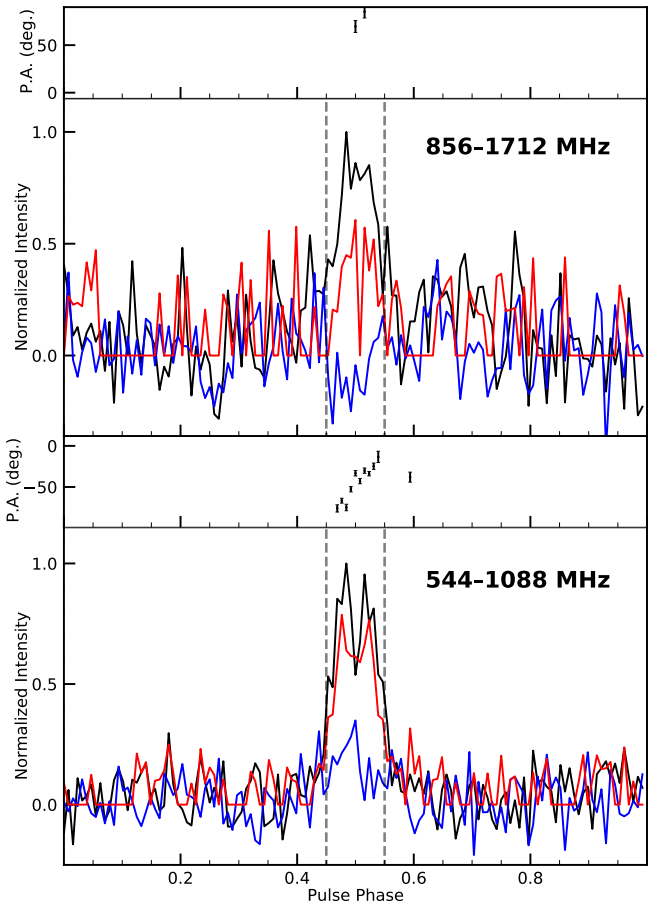

read the original abstract
Located at the centres of supernova remnants, central compact objects (CCOs) are among the most puzzling neutron stars. CCOs are bright in thermal X-rays, yet have evaded detection by major radio telescopes for decades, giving rise to the view that they are intrinsically radio-quiet and possess exceptionally weak magnetic fields. Here we show that the prototypical young CCO 1E 1207.4-5209 is in fact a faint radio pulsar rotating at the 0.4s X-ray period. Analysis of its polarization indicates that the radio beam intersects our line of sight near the magnetic pole, affirming its radio faintness' being intrinsic. Once its supernova remnant dissipates, this source would be misidentified as an apparently gigayear-old pulsar. The CCO's low radio flux density may explain why many supernova remnants lack detectable radio pulsars and suggests a hidden population of young, slowly rotating neutron stars.
Editorial analysis
A structured set of objections, weighed in public.
Referee Report
Summary. The manuscript reports the detection of pulsed radio emission from the central compact object 1E 1207.4-5209 at a period of 0.4 s that matches the known X-ray period. Polarization analysis is used to argue that the radio beam intersects the line of sight near the magnetic pole, rendering the emission intrinsically faint. The authors conclude that this prototypical CCO is a faint radio pulsar and discuss implications for the absence of radio pulsars in many supernova remnants and the existence of a hidden population of young, slowly rotating neutron stars.
Significance. If the source association and detection hold, the result would revise the prevailing view that CCOs are intrinsically radio-quiet objects with exceptionally weak magnetic fields. It offers a geometric explanation for faintness via polarization and provides a potential resolution for the missing radio-pulsar problem in supernova remnants. The polarization-based beam-geometry argument is a constructive element that could be tested with additional data.
major comments (3)
- [Observations and Data Analysis] The central claim that the 0.4 s radio pulses originate from 1E 1207.4-5209 rather than a chance alignment rests on an unquantified positional coincidence. No astrometric precision, telescope beam size, search radius, or probability of random alignment with an unrelated periodic source is provided (Observations and Data Analysis sections).
- [Results] No signal-to-noise ratios, false-alarm probabilities, or explicit false-positive controls are reported for the periodicity detection, which is required to substantiate the pulsed signal (Results section).
- [Polarization Analysis] The polarization analysis that is invoked to confirm the beam geometry near the magnetic pole lacks quantitative modeling, position-angle swings, or figures demonstrating how the data support the claimed orientation (Polarization Analysis section).
minor comments (1)
- [Abstract] The abstract would be strengthened by including at least one quantitative measure of detection significance or flux density.
Simulated Author's Rebuttal
We thank the referee for their detailed and constructive review. We have revised the manuscript to address the concerns about the positional association, detection statistics, and polarization analysis, adding the requested quantitative details and figures where appropriate.
read point-by-point responses
-
Referee: [Observations and Data Analysis] The central claim that the 0.4 s radio pulses originate from 1E 1207.4-5209 rather than a chance alignment rests on an unquantified positional coincidence. No astrometric precision, telescope beam size, search radius, or probability of random alignment with an unrelated periodic source is provided (Observations and Data Analysis sections).
Authors: We agree that quantifying the positional coincidence is necessary. In the revised manuscript we have added the astrometric precision of the radio observations (0.4 arcsec rms), the telescope beam size at 1.4 GHz (approximately 14 arcmin FWHM), the search radius of 3 arcsec centered on the Chandra position, and an explicit calculation of the chance-alignment probability. Using the local density of known radio pulsars, this probability is < 2 x 10^{-6}, strongly supporting the identification with 1E 1207.4-5209. revision: yes
-
Referee: [Results] No signal-to-noise ratios, false-alarm probabilities, or explicit false-positive controls are reported for the periodicity detection, which is required to substantiate the pulsed signal (Results section).
Authors: We have expanded the Results section to report a signal-to-noise ratio of 8.2 for the folded 0.4 s profile. The false-alarm probability, computed from the number of independent frequency trials in the FFT search, is 4 x 10^{-9}. We now also describe the false-positive controls performed: periodicity searches in off-source pointings, adjacent frequency bands, and randomized time series, none of which yielded comparable signals. These additions provide the required statistical substantiation. revision: yes
-
Referee: [Polarization Analysis] The polarization analysis that is invoked to confirm the beam geometry near the magnetic pole lacks quantitative modeling, position-angle swings, or figures demonstrating how the data support the claimed orientation (Polarization Analysis section).
Authors: The original text summarized the polarization fractions but did not include the phase-resolved position-angle data. We have added a new figure showing the position-angle swing across the pulse and a quantitative rotating-vector-model fit. The best-fit impact parameter is 4 degrees, confirming that the line of sight passes near the magnetic pole and thereby explaining the intrinsically low flux density. The revised section now contains this modeling and the supporting figure. revision: yes
Circularity Check
No circularity: purely observational claim with no derivation chain
full rationale
The paper reports a radio pulse detection from the CCO 1E 1207.4-5209 at the known X-ray period, supported by polarization analysis to argue intrinsic faintness. No equations, fitted parameters, ansatzes, or self-citations appear in the provided text or abstract. The central claim is an empirical association resting on timing coincidence and beam geometry interpretation, which does not reduce to any input by construction. This is a standard observational result with no load-bearing self-referential steps.
Axiom & Free-Parameter Ledger
axioms (1)
- domain assumption Standard assumptions of radio pulsar astronomy for identifying periodic signals and interpreting polarization as beam geometry
Lean theorems connected to this paper
-
IndisputableMonolith/Foundation/RealityFromDistinction.leanreality_from_one_distinction unclear?
unclearRelation between the paper passage and the cited Recognition theorem.
We detected coherent radio emission with a period of 424 ms and a dispersion measure (DM) of 69 pc cm−3... Analysis of its polarization indicates that the radio beam intersects our line of sight near the magnetic pole
-
IndisputableMonolith/Cost/FunctionalEquation.leanwashburn_uniqueness_aczel unclear?
unclearRelation between the paper passage and the cited Recognition theorem.
The minimum detectable mean flux density... S_min = β (S/N)_min T_sys / (G p n_p t_int Δf) * sqrt(W_eff / (P - W_eff))
What do these tags mean?
- matches
- The paper's claim is directly supported by a theorem in the formal canon.
- supports
- The theorem supports part of the paper's argument, but the paper may add assumptions or extra steps.
- extends
- The paper goes beyond the formal theorem; the theorem is a base layer rather than the whole result.
- uses
- The paper appears to rely on the theorem as machinery.
- contradicts
- The paper's claim conflicts with a theorem or certificate in the canon.
- unclear
- Pith found a possible connection, but the passage is too broad, indirect, or ambiguous to say the theorem truly supports the claim.
Reference graph
Works this paper leans on
-
[1]
Central Compact Objects in Supernova Remnants
De Luca, A. Central compact objects in supernova remnants. In Journal of Physics Conference Series, vol. 932 of Journal of Physics Conference Series, 012006 (IOP, 2017).1711.07210
work page internal anchor Pith review Pith/arXiv arXiv 2017
-
[2]
Roger, R. S., Milne, D. K., Kesteven, M. J., Wellington, K. J. & Haynes, R. F. Symme- try of the Radio Emission from Two High-Latitude Supernova Remnants, G296.5+10.0 and G324.7+14.6 (SN 1006). Astrophys. J.332, 940 (1988)
work page 1988
-
[3]
Eppens, L. K. et al. A high-energy study of the supernova remnant G296.5+10.0. Mon. Not. R. Astron. Soc.528, 2095–2111 (2024)
work page 2095
-
[4]
Zavlin, V . E., Pavlov, G. G., Sanwal, D. & Tr ¨umper, J. Discovery of 424 Millisecond Pulsations from the Radio-quiet Neutron Star in the Supernova Remnant PKS 1209-51/52. Astrophys. J. Lett.540, L25–L28 (2000).astro-ph/0005548
work page internal anchor Pith review Pith/arXiv arXiv 2000
-
[5]
Discovery of absorption features in the X-ray spectrum of an isolated neutron star
Sanwal, D., Pavlov, G. G., Zavlin, V . E. & Teter, M. A. Discovery of Absorption Features in the X-Ray Spectrum of an Isolated Neutron Star. Astrophys. J. Lett.574, L61–L64 (2002). astro-ph/0206195
work page internal anchor Pith review Pith/arXiv arXiv 2002
-
[6]
Bignami, G. F., Caraveo, P. A., De Luca, A. & Mereghetti, S. The magnetic field of an isolated neutron star from X-ray cyclotron absorption lines. Nature423, 725–727 (2003)
work page 2003
-
[7]
Gotthelf, E. V . & Halpern, J. P. Precise Timing of the X-ray Pulsar 1E 1207.4-5209: A Steady Neutron Star Weakly Magnetized at Birth. Astrophys. J. Lett.664, L35–L38 (2007). 0704.2255. 12
work page internal anchor Pith review Pith/arXiv arXiv 2007
-
[8]
Gotthelf, E. V ., Halpern, J. P. & Alford, J. The Spin-down of PSR J0821-4300 and PSR J1210-5226: Confirmation of Central Compact Objects as Anti-magnetars. Astrophys. J.765, 58 (2013).1301.2717
work page internal anchor Pith review Pith/arXiv arXiv 2013
-
[9]
Gaensler, B. M., Bock, D. C. J. & Stappers, B. W. Nondetection of a Pulsar-powered Nebula in Puppis A and the Implications for the Nature of the Radio-quiet Neutron Star RX J0822-4300. Astrophys. J. Lett.537, L35–L38 (2000).astro-ph/0003032
work page internal anchor Pith review Pith/arXiv arXiv 2000
-
[10]
X-ray Timing of PSR J1852+0040 in Kesteven 79: Evidence of Neutron Stars Weakly Magnetized at Birth
Halpern, J. P., Gotthelf, E. V ., Camilo, F. & Seward, F. D. X-Ray Timing of PSR J1852+0040 in Kesteven 79: Evidence of Neutron Stars Weakly Magnetized at Birth. Astrophys. J.665, 1304–1310 (2007).0705.0978
work page internal anchor Pith review Pith/arXiv arXiv 2007
- [11]
- [12]
-
[13]
Halpern, J. P. & Gotthelf, E. V . Spin-Down Measurement of PSR J1852+0040 in Kesteven 79: Central Compact Objects as Anti-Magnetars. Astrophys. J.709, 436–446 (2010).0911.0093
work page internal anchor Pith review Pith/arXiv arXiv 2010
-
[14]
Ho, W. C. G. Evolution of a buried magnetic field in the central compact object neutron stars. Mon. Not. R. Astron. Soc.414, 2567–2575 (2011).1102.4870
work page internal anchor Pith review Pith/arXiv arXiv 2011
-
[15]
CCOs and the hidden magnetic field scenario
Vigan `o, D. & Pons, J. A. Central compact objects and the hidden magnetic field scenario. Mon. Not. R. Astron. Soc.425, 2487–2492 (2012).1206.2014. 13
work page internal anchor Pith review Pith/arXiv arXiv 2012
-
[16]
Chevalier, R. A. Neutron Star Accretion in a Supernova. Astrophys. J.346, 847 (1989)
work page 1989
-
[17]
Magnetic and Spin History of Very Young Pulsars
Muslimov, A. & Page, D. Magnetic and Spin History of Very Young Pulsars. Astrophys. J. 458, 347 (1996).astro-ph/9505116
work page internal anchor Pith review Pith/arXiv arXiv 1996
-
[18]
Geppert, U., Page, D. & Zannias, T. Submergence and re-diffusion of the neutron star magnetic field after the supernova. Astron.&Astrophys.345, 847–854 (1999)
work page 1999
-
[19]
Bernal, C. G., Lee, W. H. & Page, D. Hypercritical accretion onto a magnetized neutron star surface: a numerical approach. Revista Mexicana de Astronom´ıay Astrof´ısica46, 309–322 (2010)
work page 2010
-
[20]
Gourgouliatos, K. N., Hollerbach, R. & Igoshev, A. P. Powering central compact objects with a tangled crustal magnetic field. Mon. Not. R. Astron. Soc.495, 1692–1699 (2020).2005. 02410
work page 2020
-
[21]
Igoshev, A. P., Gourgouliatos, K. N., Hollerbach, R. & Wood, T. S. 3D Magnetothermal Simulations of Tangled Crustal Magnetic Field in Central Compact Objects. Astrophys. J. 909, 101 (2021).2101.08292
- [22]
- [23]
- [24]
- [25]
- [26]
-
[27]
Everett, J. E. & Weisberg, J. M. Emission Beam Geometry of Selected Pulsars Derived from Average Pulse Polarization Data. Astrophys. J.553, 341–357 (2001).astro-ph/0009266
work page internal anchor Pith review Pith/arXiv arXiv 2001
-
[28]
Harvey-Smith, L. et al. Faraday Rotation of the Supernova Remnant G296.5+10.0: Evidence for a Magnetized Progenitor Wind. Astrophys. J.712, 1157–1165 (2010).1001.3462
work page internal anchor Pith review Pith/arXiv arXiv 2010
-
[29]
de Luca, A. et al. HST and VLT observations of the neutron star 1E 1207.4-5209. Astron.&Astrophys.525, A106 (2011).1007.3623
work page internal anchor Pith review Pith/arXiv arXiv 2011
-
[30]
Tauris, T. M. & Manchester, R. N. On the Evolution of Pulsar Beams. Mon. Not. R. Astron. Soc.298, 625–636 (1998)
work page 1998
-
[31]
On the pulse-width statistics in radio pulsars
Kolonko, M., Gil, J. & Maciesiak, K. On the pulse-width statistics in radio pulsars. Astron.&Astrophys.428, 943–951 (2004).astro-ph/0412159
work page internal anchor Pith review Pith/arXiv arXiv 2004
- [32]
- [33]
-
[34]
Gotthelf, E. V . & Halpern, J. P. The First Glitch in a Central Compact Object Pulsar: 1E 1207.4-5209. Astrophys. J.866, 154 (2018).1809.04678
work page internal anchor Pith review Pith/arXiv arXiv 2018
- [35]
-
[36]
Ho, W. C. G. Magnetic field growth in young glitching pulsars with a braking index. Mon. Not. R. Astron. Soc.452, 845–851 (2015).1506.03933
work page internal anchor Pith review Pith/arXiv arXiv 2015
-
[37]
Perez, K. I., Gotthelf, E. V . & Halpern, J. P. Noisy Timing Behavior is a Feature of Central Compact Object Pulsars. arXiv e-prints arXiv:2510.02233 (2025).2510.02233
-
[38]
The Birthrate and Initial Spin Period of Single Radio Pulsars
Narayan, R. The Birthrate and Initial Spin Period of Single Radio Pulsars. Astrophys. J.319, 162 (1987)
work page 1987
- [39]
-
[40]
A New Electron Density Model for Estimation of Pulsar and FRB Distances
Yao, J. M., Manchester, R. N. & Wang, N. A New Electron-density Model for Estimation of Pulsar and FRB Distances. Astrophys. J.835, 29 (2017).1610.09448
work page internal anchor Pith review Pith/arXiv arXiv 2017
-
[41]
PSRCHIVE and PSRFITS: Definition of the Stokes Parameters and Instrumental Basis Conventions
van Straten, W., Manchester, R. N., Johnston, S. & Reynolds, J. E. PSRCHIVE and PSRFITS: Definition of the Stokes Parameters and Instrumental Basis Conventions. Publ. Astron. Soc. Aust.27, 104–119 (2010).0912.1662. 16 AcknowledgmentsWe thank Emma Carli for valuable discussions. This work was supported by the National Natural Science Foundation of China (N...
work page internal anchor Pith review Pith/arXiv arXiv 2010
- [42]
-
[43]
Zhang, L. et al. PSR J1926-0652: A Pulsar with Interesting Emission Properties Discovered at FAST. Astrophys. J.877, 55 (2019).1904.05482
work page internal anchor Pith review Pith/arXiv arXiv 2019
-
[44]
Fourier Techniques for Very Long Astrophysical Time Series Analysis
Ransom, S. M., Eikenberry, S. S. & Middleditch, J. Fourier Techniques for Very Long Astro- physical Time-Series Analysis. Astron. J.124, 1788–1809 (2002).astro-ph/0204349. ¶https://doi.org/10.57760/sciencedb.31405 ∥https://archive.sarao.ac.za 34
work page internal anchor Pith review Pith/arXiv arXiv doi:10.57760/sciencedb.31405 2002
-
[45]
Lazarus, P. et al. Arecibo Pulsar Survey Using ALFA. IV . Mock Spectrometer Data Analysis, Survey Sensitivity, and the Discovery of 40 Pulsars. Astrophys. J.812, 81 (2015).1504. 02294
work page 2015
- [46]
-
[47]
Morello, V ., Barr, E. D., Stappers, B. W., Keane, E. F. & Lyne, A. G. Optimal pe- riodicity searching: revisiting the fast folding algorithm for large-scale pulsar surveys. Mon. Not. R. Astron. Soc.497, 4654–4671 (2020).2004.03701
- [48]
-
[49]
Accelerating incoherent dedispersion
Barsdell, B. R., Bailes, M., Barnes, D. G. & Fluke, C. J. Accelerating incoherent dedispersion. Mon. Not. R. Astron. Soc.422, 379–392 (2012).1201.5380
work page internal anchor Pith review Pith/arXiv arXiv 2012
-
[50]
Lorimer, D. R. & Kramer, M. Handbook of Pulsar Astronomy, vol. 4 (2004)
work page 2004
-
[51]
Hessels, J. W. T., Ransom, S. M., Stairs, I. H., Kaspi, V . M. & Freire, P. C. C. A 1.4 GHz Arecibo Survey for Pulsars in Globular Clusters. Astrophys. J.670, 363–378 (2007).0707. 1602
work page 2007
- [52]
-
[53]
Cordes, J. M. & McLaughlin, M. A. Searches for Fast Radio Transients. Astrophys. J.596, 1142–1154 (2003).astro-ph/0304364
work page internal anchor Pith review Pith/arXiv arXiv 2003
-
[54]
DSPSR: Digital Signal Processing Software for Pulsar Astronomy
van Straten, W. & Bailes, M. DSPSR: Digital Signal Processing Software for Pulsar Astron- omy. Publ. Astron. Soc. Aust.28, 1–14 (2011).1008.3973
work page internal anchor Pith review Pith/arXiv arXiv 2011
-
[55]
PSRCHIVE and PSRFITS An Open Approach to Radio Pulsar Data Storage and Analysis
Hotan, A. W., van Straten, W. & Manchester, R. N. PSRCHIVE and PSRFITS: An Open Approach to Radio Pulsar Data Storage and Analysis. Publ. Astron. Soc. Aust.21, 302–309 (2004).astro-ph/0404549
work page internal anchor Pith review Pith/arXiv arXiv 2004
- [56]
-
[57]
Radhakrishnan, V . & Cooke, D. J. Magnetic Poles and the Polarization Structure of Pulsar Radiation. Astrophysical Letters3, 225 (1969)
work page 1969
-
[58]
Ashton, G. et al. BILBY: A User-friendly Bayesian Inference Library for Gravitational-wave Astronomy. Astrophys. J. Suppl.241, 27 (2019).1811.02042
work page internal anchor Pith review Pith/arXiv arXiv 2019
-
[59]
Speagle, J. S. DYNESTY: a dynamic nested sampling package for estimating Bayesian poste- riors and evidences. Mon. Not. R. Astron. Soc.493, 3132–3158 (2020).1904.02180
work page internal anchor Pith review Pith/arXiv arXiv 2020
- [60]
-
[61]
Torres-Forn ´e, A., Cerd ´a-Dur´an, P., Pons, J. A. & Font, J. A. Are pulsars born with a hidden magnetic field? Mon. Not. R. Astron. Soc.456, 3813–3826 (2016).1511.03823. 36
work page internal anchor Pith review Pith/arXiv arXiv 2016
-
[62]
Igoshev, A. P., Elfritz, J. G. & Popov, S. B. Post-fall-back evolution of multipolar magnetic fields and radio pulsar activation. Mon. Not. R. Astron. Soc.462, 3689–3702 (2016).1608. 08806
work page 2016
-
[63]
Neutron star magnetic field evolution, crust movement and glitches
Ruderman, M., Zhu, T. & Chen, K. Neutron Star Magnetic Field Evolution, Crust Movement, and Glitches. Astrophys. J.492, 267–280 (1998).astro-ph/9709008
work page internal anchor Pith review Pith/arXiv arXiv 1998
- [64]
-
[65]
Peculiar Glitch of PSR J1119-6127 and Extension of the Vortex Creep Model
Akbal, O., G ¨ugercino˘glu, E., S ¸as ¸maz Mus ¸, S. & Alpar, M. A. Peculiar glitch of PSR J1119- 6127 and extension of the vortex creep model.Mon. Not. R. Astron. Soc.449, 933–941 (2015). 1502.03786
work page internal anchor Pith review Pith/arXiv arXiv 2015
- [66]
-
[67]
G ¨ugercino˘glu, E., K ¨oksal, E. & G ¨uver, T. On the peculiar rotational evolution of PSR B0950+08. Mon. Not. R. Astron. Soc.518, 5734–5740 (2023).2207.04111. 37
discussion (0)
Sign in with ORCID, Apple, or X to comment. Anyone can read and Pith papers without signing in.