REVIEW 3 major objections 4 minor 41 references
A simulation-based analysis of Planck and DESI data finds a slight preference for the normal neutrino mass hierarchy.
Reviewed by Pith at T0; open to challenge. T0 means a machine referee read the full paper against a public rubric. the ladder, T0–T4 →
T0 review · deepseek-v4-flash
2026-08-03 15:10 UTC pith:I2SCY2HV
load-bearing objection Reasonable SBI demonstration with a useful new parameterization, but internal inconsistencies and an imperfect forward model keep the reported hierarchy preference from being secure. the 3 major comments →
Implicit Likelihood Inference of the Neutrino Mass Hierarchy from Cosmological Data
The pith
A machine-rendered reading of the paper's core claim, the machinery that carries it, and where it could break.
Core claim
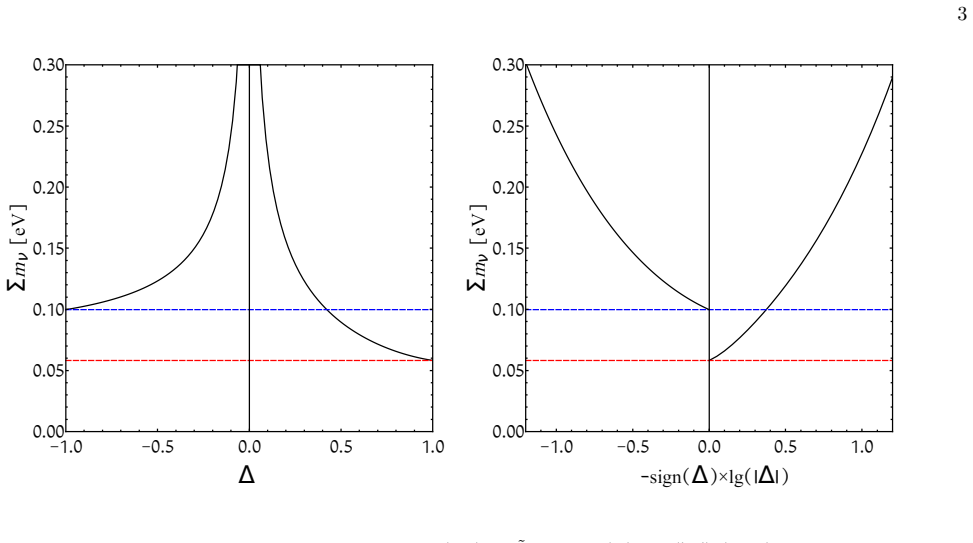
The paper claims the neutrino mass hierarchy can be constrained by simulation-based inference from Planck 2018 CMB spectra and DESI DR2 BAO distance ratios, using a forward model that simulates these observables from cosmological parameters. The key step replaces Δ = (m3−m1)/(m1+m3) with Δ̃ = −sign(Δ)·lg|Δ|, turning the U-shaped total-mass posterior into a T-shaped target that a neural density estimator learns more easily. After sequential training, the posterior gives Δ̃ = 0.12216^{+0.26193}_{−0.29243} (68% CL), a positive central value that slightly favors the normal hierarchy (m1 < m3). Validation on a held-out test set shows the learned posterior is globally consistent.
What carries the argument
The central object is the reparametrized hierarchy parameter Δ̃ = −sign(Δ)·log₁₀|Δ|, with Δ = (m₃−m₁)/(m₁+m₃). Because an upper limit on the total neutrino mass ∑mᵥ produces a U-shaped posterior in Δ, the paper maps it to a T-shaped parameter that is easier for a neural density estimator to capture near the origin. The inference engine is sequential neural likelihood estimation (SNLE): a masked autoregressive flow learns an approximate likelihood q_w(x|θ) from simulated data–parameter pairs, and the posterior for the observed data is then sampled by MCMC. The forward model combines a Boltzmann solver for CMB spectra with Planck-like white noise and a Gaussian beam, cosmic-variance realizatio
Load-bearing premise
The load-bearing assumption is that the approximate Planck forward model used here — Gaussian white noise plus a Gaussian beam, with the high-multipole cosmic-variance covariance evaluated at a fixed Planck best-fit cosmology and with no low-multipole or lensing likelihoods — is accurate enough that its imperfections do not bias the neutrino-hierarchy parameter beyond the quoted uncertainty. The paper's own finding of slightly biased A_s and τ values shows this approximation
What would settle it
Recompute the Δ̃ posterior using the official Planck 2018 likelihoods (low-ℓ Commander/SimAll, Plik, and lensing) together with DESI DR2 distance ratios, within the same simulation-based framework or with an explicit likelihood. If the resulting posterior is centered at or near zero, or if it excludes positive values at high probability, the mild preference for the normal hierarchy reported here would be an artifact of the simplified forward model. Alternatively, a direct comparison of the simulated spectra to the real Planck spectra at the inferred best fit could reveal whether the covariance
If this is right
- The reported positive Δ̃ gives a non-decisive but real statistical preference for the normal neutrino mass ordering, aligning with the direction favored by terrestrial oscillation data.
- The Δ̃ parametrization converts the two-mode structure of the mass-sum posterior into a near-Gaussian target, making it useful for any future neutrino-mass analysis, likelihood-free or not.
- Because the learned posterior is amortized, new observations can be incorporated by re-weighting or fine-tuning without re-simulating millions of spectra.
- Extending the same pipeline to CMB lensing, bispectra, or galaxy clustering should shrink the uncertainty on Δ̃ and could make the hierarchy preference decisive.
- The method reproduces Planck's constraints on the base ΛCDM parameters, supporting simulation-based inference as a viable alternative to explicit likelihoods for cosmological parameter estimation.
Where Pith is reading between the lines
- The paper's own validation notes that ln(10^10 A_s) and τ are biased relative to Planck 2018; if a similar small systematic affects Δ̃, the positive central value could be a mild artifact, so the normal-hierarchy preference should be checked with the full official likelihoods.
- The abstract states 6 rounds of 10,000 simulations while the main text describes 2 rounds of 5,000; this inconsistency should be clarified because the simulation budget affects the fidelity of the learned likelihood.
- The same reparametrization could be applied directly inside explicit likelihood analyses (e.g., nested sampling) to make the hierarchy posterior easier to sample and visualize.
- If future data keep pushing the total neutrino mass toward lower values, Δ̃ is expected to concentrate near zero and the sign may become decisive one way or the other; this parametrization offers a direct way to track that trend.
Editorial analysis
A structured set of objections, weighed in public.
Referee Report
Summary. The paper applies the LtU-ILI pipeline with Sequential Neural Likelihood Estimation (SNLE) to infer the neutrino mass hierarchy parameter \tilde{\Delta} from Planck 2018 TT/TE/EE power spectra and DESI DR2 BAO distance ratios. The forward model embeds CLASS in a simulator that adds Planck-like noise, a Gaussian beam, and cosmic-variance noise with the covariance evaluated at a fixed fiducial cosmology (Eq. 10). After sequential training and validation with rank statistics, P-P plots, and true-vs-predicted comparisons, the posterior for the observed data yields \tilde{\Delta}=0.12216^{+0.26193}_{-0.29243} (68% CL), which the authors interpret as a slight preference for the normal hierarchy.
Significance. If robust, this would be a useful demonstration of simulation-based inference for a cosmological parameter that is difficult to sample with explicit likelihoods, and it would add a mild, independent data preference for the normal neutrino mass ordering. The paper uses a standard, widely used ILI pipeline and includes appropriate internal validation checks (rank statistics, P-P coverage) that are often missing in applications of SBI. The approximate Planck simulator is clearly described, and the authors acknowledge its limitations. However, the central numerical claim is not yet supported to the standard required for a journal publication: the abstract and main text disagree on training configuration and on the central value/uncertainty, and the approximate forward model is shown to bias at least some parameters, with no calibration of the hierarchy parameter itself.
major comments (3)
- [Abstract vs. Section III] The abstract states that the analysis uses '6 rounds of 10000 simulations' and finds \tilde{\Delta}=0.12^{+0.21}_{-0.23} (68% CL), while Section III describes '2 rounds of training' with '5000 simulated data-parameter pairs' each and reports \tilde{\Delta}=0.12216^{+0.26193}_{-0.29243} (68% CL). These are materially different training configurations and different posterior summaries. The reader cannot tell which result is the one being claimed. This is a load-bearing reproducibility issue; please correct the inconsistency and report the actual configuration and result.
- [Section II, Eq. (10) and Section III] The covariance of the simulated high-\ell spectra is evaluated at a fixed Planck best-fit \theta_0 that does not include the neutrino hierarchy parameter, while the mean spectrum is evaluated at the sampled \theta. This discards the parameter dependence of cosmic variance, including the effect of massive neutrinos on C_\ell. The simulator also omits the low-\ell Commander/SimAll likelihoods and the CMB lensing likelihood. The authors themselves note (Section III) that the inferred \ln(10^{10}A_s) and \tau are 'a little larger' than in Planck 2018. Since A_s, \tau, and lensing are degenerate with neutrino mass and hence with \tilde{\Delta}, this misspecification could bias the reported \tilde{\Delta} posterior. The rank-statistic and P-P tests in Figs. 3-5 only check self-consistency of the learned posterior under the same simulator; they do not validate the simulator's fidelity. Please a
- [Section III, Fig. 6] The central claim is a 'slight preference' for \tilde{\Delta}>0, but the reported 68% interval, [-0.29243, +0.26193] around 0.12216, includes both positive and negative values. The posterior probability P(\tilde{\Delta}>0 | x_o) is not stated. A credible interval that crosses zero does not by itself establish a preference; the preference claim should be quantified by the posterior probability of the normal-hierarchy side, or by a Bayes factor with a specified prior. Please report this quantity and state whether it changes under the two training configurations.
minor comments (4)
- [Section II, Eq. (10)] The covariance-matrix expression in Eq. (10) is difficult to parse because of the layout and missing parentheses. Please rewrite it in explicit symmetric-matrix form with each element clearly labeled (e.g., Cov(TT,EE) = ...).
- [Section II, Eq. (5)] The parameter list uses '100\theta_s' but the text refers to '100\theta_s' and Figure 2 caption mentions '\theta_0 does not include the neutrino mass hierarchy parameter'. Please make the parameter naming consistent and specify the prior range for \tilde{\Delta} in the main text (currently only in Eq. (5)).
- [Section III] The observed data label is given both as 'x_o' and 'x_0'. Please use one symbol consistently.
- [Section III, Fig. 3-5] The validation figures are described qualitatively ('almost the case', 'good agreement'). Please add quantitative summary statistics, such as p-values for the uniformity of the rank statistics or the maximum deviation in the P-P plot, especially for \tilde{\Delta}.
Circularity Check
No significant circularity; the hierarchy inference is driven by external Planck and DESI data through a standard SBI forward model.
full rationale
The paper's derivation chain is: define the hierarchy variable tilde_Delta (Section II), simulate CMB power spectra with CLASS plus Planck noise and a cosmic-variance covariance evaluated at a fixed fiducial theta0 (Eqs. 6-10), train an SNLE amortized posterior on simulations (Section III), validate via rank/P-P tests, and finally condition on observed Planck 2018 TT/TE/EE and DESI DR2 distance ratios. No step reduces to its own input. The parameter tilde_Delta is a monotone reparameterization of the hierarchy variable Delta of refs. [24,25], which are not by the present authors; this is a coordinate choice, not a fitted prediction. The fixed theta0 in Eq. (10) is an external Planck best-fit cosmology, is not a parameter fitted in this paper, and does not include tilde_Delta, so the posterior of tilde_Delta is not equal to an input by construction. The result is conditioned on real observed data x_o, not on simulated data, and the rank/P-P tests are internal calibration of the learned likelihood rather than a claim that the forward model is exact. The paper's own admission of slightly biased ln(10^10 A_s) and tau (Section III) is a systematic/model-misspecification concern, i.e. a correctness risk, not circularity. There is no load-bearing self-citation: ref. [9] (which includes author K. Wang) is only a passing consistency remark, and no uniqueness theorem or ansatz is imported from the authors' own prior work to force the hierarchy preference. The abstract/full-text mismatch in the number of training rounds (6x10000 vs 2x5000) is an internal inconsistency, not circularity. Overall the central claim is self-contained against external data and standard simulation tools, so the circularity score is 0.
Axiom & Free-Parameter Ledger
free parameters (3)
- \tilde{\Delta} prior bounds =
U(-3, 3)
- high-\ell covariance split \ell=52 =
52
- fiducial cosmology \theta_0 for noise covariance =
{0.02237, 0.1200, 1.04092, 3.044, 0.9649, 0.0544}
axioms (5)
- domain assumption Known neutrino mass-squared differences \Delta m^2_{21} and |\Delta m^2_{31}| are fixed to oscillation measurements.
- domain assumption CLASS accurately computes linear CMB power spectra for massive neutrinos.
- domain assumption Planck noise is adequately modeled by a Gaussian beam plus white noise (Eq. 6).
- ad hoc to paper At \ell>52 the power-spectrum covariance can be evaluated at a fixed fiducial \theta_0 instead of the true \theta.
- ad hoc to paper The NLE posterior is converged after the stated training rounds.
read the original abstract
In this paper, we turn to the Learning the Universe Implicit Likelihood Inference (LtU-ILI) pipeline to perform a multi-round ILI of the neutrino mass hierarchy from cosmological data, including $TT$, $TE$, $EE$ power spectra of Planck 2018 and distance ratios of DESI DR2. More precisely, we first embed the CMB power spectra simulator $\mathtt{CLASS}$ into the LtU-ILI pipeline. And then, opting for Sequential Neural Likelihood Estimation (SNLE), we sequentially train neural networks using $6$ rounds of $10000$ simulations to target a ``black box'' likelihood of our forward model with one additional neutrino mass hierarchy parameter $\tilde{\Delta}$ and six base cosmological parameters. We find $\tilde{\Delta}=0.12^{+0.21}_{-0.23}~(68\%{\rm CL})$.
Figures


Reference graph
Works this paper leans on
-
[1]
Review of particle physics,
S. Navaset al.[Particle Data Group], “Review of particle physics,” Phys. Rev. D110, no.3, 030001 (2024)
2024
-
[2]
Massive neutrinos and cosmology,
J. Lesgourgues and S. Pastor, “Massive neutrinos and cosmology,” Phys. Rept.429, 307-379 (2006) [arXiv:astro-ph/0603494 [astro-ph]]
Pith/arXiv arXiv 2006
-
[3]
Planck 2018 results. VI. Cosmological parameters,
N. Aghanimet al.[Planck], “Planck 2018 results. VI. Cosmological parameters,” Astron. Astrophys.641, A6 (2020) [erratum: Astron. Astrophys.652, C4 (2021)] [arXiv:1807.06209 [astro-ph.CO]]
Pith/arXiv arXiv 2018
-
[4]
DESI DR2 results. II. Measurements of baryon acoustic oscillations and cos- mological constraints,
M. Abdul Karimet al.[DESI], “DESI DR2 results. II. Measurements of baryon acoustic oscillations and cos- mological constraints,” Phys. Rev. D112, no.8, 083515 (2025) [arXiv:2503.14738 [astro-ph.CO]]
Pith/arXiv arXiv 2025
-
[5]
Matter power spectrum: from Lyαforest to CMB scales,
S. Chabanier, M. Millea and N. Palanque-Delabrouille, “Matter power spectrum: from Lyαforest to CMB scales,” Mon. Not. Roy. Astron. Soc.489, no.2, 2247- 2253 (2019) [arXiv:1905.08103 [astro-ph.CO]]
Pith/arXiv arXiv 2019
-
[6]
The At- acama Cosmology Telescope: DR6 power spectra, likeli- hoods and ΛCDM parameters,
T. Louiset al.[Atacama Cosmology Telescope], “The At- acama Cosmology Telescope: DR6 power spectra, likeli- hoods and ΛCDM parameters,” JCAP11, 062 (2025) [arXiv:2503.14452 [astro-ph.CO]]
Pith/arXiv arXiv 2025
-
[7]
Cosmological impli- cations of DESI DR2 BAO measurements in light of the latest ACT DR6 CMB data,
C. Garcia-Quinteroet al.[DESI], “Cosmological impli- cations of DESI DR2 BAO measurements in light of the latest ACT DR6 CMB data,” Phys. Rev. D112, no.8, 083529 (2025) [arXiv:2504.18464 [astro-ph.CO]]
Pith/arXiv arXiv 2025
-
[8]
E. Camphuiset al.[SPT-3G], “SPT-3G D1: CMB tem- perature and polarization power spectra and cosmology from 2019 and 2020 observations of the SPT-3G Main field,” [arXiv:2506.20707 [astro-ph.CO]]
Pith/arXiv arXiv 2019
-
[9]
Constraints on the neutrino mass and mass hierarchy from cosmologi- cal observations,
Q. G. Huang, K. Wang and S. Wang, “Constraints on the neutrino mass and mass hierarchy from cosmologi- cal observations,” Eur. Phys. J. C76, no.9, 489 (2016) [arXiv:1512.05899 [astro-ph.CO]]
Pith/arXiv arXiv 2016
-
[10]
The frontier of simulation-based inference,
K. Cranmer, J. Brehmer and G. Louppe, “The frontier of simulation-based inference,” Proc. Nat. Acad. Sci.117, no.48, 30055-30062 (2020) [arXiv:1911.01429 [stat.ML]]
Pith/arXiv arXiv 2020
-
[11]
DEMNUni: The clustering of large-scale structures in the presence of massive neutrinos,
E. Castorina, C. Carbone, J. Bel, E. Sefusatti and K. Dolag, “DEMNUni: The clustering of large-scale structures in the presence of massive neutrinos,” JCAP 07, 043 (2015) [arXiv:1505.07148 [astro-ph.CO]]
Pith/arXiv arXiv 2015
-
[12]
Mas- siveNuS: Cosmological Massive Neutrino Simulations,
J. Liu, S. Bird, J. M. Z. Matilla, J. C. Hill, Z. Haiman, M. S. Madhavacheril, A. Petri and D. N. Spergel, “Mas- siveNuS: Cosmological Massive Neutrino Simulations,” JCAP03, 049 (2018) [arXiv:1711.10524 [astro-ph.CO]]
Pith/arXiv arXiv 2018
-
[13]
F. Villaescusa-Navarro, C. Hahn, E. Massara, A. Baner- jee, A. M. Delgado, D. K. Ramanah, T. Charnock, E. Giusarma, Y. Li and E. Allys,et al.“The Quijote simulations,” Astrophys. J. Suppl.250, no.1, 2 (2020) [arXiv:1909.05273 [astro-ph.CO]]
Pith/arXiv arXiv 2020
-
[14]
SimBIG: mock challenge for a forward modeling approach to galaxy clus- tering,
C. Hahn, M. Eickenberg, S. Ho, J. Hou, P. Lemos, E. Massara, C. Modi, A. Moradinezhad Dizgah, B. R. S. Blancard and M. M. Abidi, “SimBIG: mock challenge for a forward modeling approach to galaxy clus- tering,” JCAP04, 010 (2023) [arXiv:2211.00660 [astro- ph.CO]]
Pith/arXiv arXiv 2023
-
[15]
Cosmological constraints from the nonlinear galaxy bispectrum,
C. Hahnet al.[SimBIG], “Cosmological constraints from the nonlinear galaxy bispectrum,” Phys. Rev. D109, no.8, 083534 (2024) [arXiv:2310.15243 [astro-ph.CO]]
Pith/arXiv arXiv 2024
-
[16]
E. Massara, C. Hahn, M. Eickenberg, S. Ho, J. Hou, P. Lemos, C. Modi, A. Moradinezhad Dizgah, L. Parker and B. R. S. Blancard, “Cosmological constraints us- ing simulation-based inference of galaxy clustering with marked power spectra,” Phys. Rev. D112, no.8, 083507 (2025) [arXiv:2404.04228 [astro-ph.CO]]
Pith/arXiv arXiv 2025
-
[17]
Cosmological constraints from the redshift-space galaxy skew spectra,
J. Hou, A. Moradinezhad Dizgah, C. Hahn, M. Eicken- berg, S. Ho, P. Lemos, E. Massara, C. Modi, L. Parker and B. R. S. Blancard, “Cosmological constraints from the redshift-space galaxy skew spectra,” Phys. Rev. D109, no.10, 103528 (2024) [arXiv:2401.15074 [astro- ph.CO]]
Pith/arXiv arXiv 2024
-
[18]
Galaxy cluster- ing analysis with SimBIG and the wavelet scattering transform,
B. R. S. Blancardet al.[SimBIG], “Galaxy cluster- ing analysis with SimBIG and the wavelet scattering transform,” Phys. Rev. D109, no.8, 083535 (2024) [arXiv:2310.15250 [astro-ph.CO]]
Pith/arXiv arXiv 2024
-
[19]
Field-level simulation-based inference of galaxy clustering with convolutional neu- ral networks,
P. Lemoset al.[SimBIG], “Field-level simulation-based inference of galaxy clustering with convolutional neu- ral networks,” Phys. Rev. D109, no.8, 083536 (2024) [arXiv:2310.15256 [astro-ph.CO]]
Pith/arXiv arXiv 2024
-
[20]
The Cosmic Lin- ear Anisotropy Solving System (CLASS) II: Approxima- tion schemes,
D. Blas, J. Lesgourgues and T. Tram, “The Cosmic Lin- ear Anisotropy Solving System (CLASS) II: Approxima- tion schemes,” JCAP07, 034 (2011) [arXiv:1104.2933 [astro-ph.CO]]
Pith/arXiv arXiv 2011
-
[21]
Efficient compu- tation of CMB anisotropies in closed FR W models,
A. Lewis, A. Challinor and A. Lasenby, “Efficient compu- tation of CMB anisotropies in closed FR W models,” As- trophys. J.538, 473-476 (2000) [arXiv:astro-ph/9911177 [astro-ph]]
Pith/arXiv arXiv 2000
-
[22]
Fast and credible likelihood-free cosmology with truncated marginal neural ratio estimation,
A. Cole, B. K. Miller, S. J. Witte, M. X. Cai, M. W. Grootes, F. Nattino and C. Weniger, “Fast and credible likelihood-free cosmology with truncated marginal neural ratio estimation,” JCAP09, 004 (2022) [arXiv:2111.08030 [astro-ph.CO]]
Pith/arXiv arXiv 2022
-
[23]
Neutrino Mass Constraint from an Implicit Likelihood Analysis of BOSS Voids,
L. Thiele, E. Massara, A. Pisani, C. Hahn, D. N. Spergel, S. Ho and B. Wandelt, “Neutrino Mass Constraint from an Implicit Likelihood Analysis of BOSS Voids,” Astro- phys. J.969, no.2, 89 (2024) [arXiv:2307.07555 [astro- ph.CO]]
Pith/arXiv arXiv 2024
-
[24]
Can we measure the neutrino mass hierarchy in the 10 sky?,
R. Jimenez, T. Kitching, C. Pena-Garay and L. Verde, “Can we measure the neutrino mass hierarchy in the 10 sky?,” JCAP05, 035 (2010) [arXiv:1003.5918 [astro- ph.CO]]
Pith/arXiv arXiv 2010
-
[25]
Detecting the Neutrinos Mass Hierarchy from Cosmological Data,
L. Xu and Q. G. Huang, “Detecting the Neutrinos Mass Hierarchy from Cosmological Data,” Sci. China Phys. Mech. Astron.61, no.3, 039521 (2018) [arXiv:1611.05178 [astro-ph.CO]]
Pith/arXiv arXiv 2018
-
[26]
Exploring cosmic origins with CORE: Cosmological parameters,
E. Di Valentinoet al.[CORE], “Exploring cosmic origins with CORE: Cosmological parameters,” JCAP04, 017 (2018) [arXiv:1612.00021 [astro-ph.CO]]
Pith/arXiv arXiv 2018
-
[27]
B. Audren, J. Lesgourgues, K. Benabed and S. Prunet, “Conservative Constraints on Early Cosmology: an il- lustration of the Monte Python cosmological parameter inference code,” JCAP02, 001 (2013) [arXiv:1210.7183 [astro-ph.CO]]
Pith/arXiv arXiv 2013
-
[28]
Likelihood methods for the combined analysis of CMB temperature and polari- sation power spectra,
W. J. Percival and M. L. Brown, “Likelihood methods for the combined analysis of CMB temperature and polari- sation power spectra,” Mon. Not. Roy. Astron. Soc.372, 1104-1116 (2006) [arXiv:astro-ph/0604547 [astro-ph]]
Pith/arXiv arXiv 2006
-
[29]
https://pla.esac.esa.int/pla/#cosmology
-
[30]
LtU-ILI: An All-in-One Frame- work for Implicit Inference in Astrophysics and Cos- mology,
M. Ho, D. J. Bartlett, N. Chartier, C. Cuesta-Lazaro, S. Ding, A. Lapel, P. Lemos, C. C. Lovell, T. L. Maki- nen and C. Modi,et al.“LtU-ILI: An All-in-One Frame- work for Implicit Inference in Astrophysics and Cos- mology,” Open J. Astrophys.7, 001c.120559 (2024) [arXiv:2402.05137 [astro-ph.IM]]
Pith/arXiv arXiv 2024
-
[31]
sbi: A toolkit for simulation- based inference,
A. Tejero-Canteroet al., “sbi: A toolkit for simulation- based inference,” Journal of Open Source Software,5, no.52, 2505, (2020) [arXiv:2007.09114 [cs.LG]]
Pith/arXiv arXiv 2020
-
[32]
PyTorch: An Imperative Style, High- Performance Deep Learning Library,
A. Paszkeet al., “PyTorch: An Imperative Style, High- Performance Deep Learning Library,” [arXiv:1912.01703 [cs.LG]]
Pith/arXiv arXiv 1912
-
[33]
J. Alsing, B. Wandelt and S. Feeney, “Massive op- timal data compression and density estimation for scalable, likelihood-free inference in cosmology,” Mon. Not. Roy. Astron. Soc.477, no.3, 2874-2885 (2018) [arXiv:1801.01497 [astro-ph.CO]]
Pith/arXiv arXiv 2018
-
[34]
Neural Density Estimation and Likelihood-free Inference,
G. Papamakarios, “Neural Density Estimation and Likelihood-free Inference,” [arXiv:1910.13233 [stat.ML]]
Pith/arXiv arXiv 1910
-
[35]
Masked Autoregressive Flow for Density Estima- tion,
G. Papamakarios, T, Pavlakou and I. Murray, “Masked Autoregressive Flow for Density Estima- tion,” [arXiv:1705.07057 [stat.ML]]
-
[36]
D. Foreman-Mackey, D. W. Hogg, D. Lang and J. Good- man, “emcee: The MCMC Hammer,” Publ. Astron. Soc. Pac.125, 306-312 (2013) [arXiv:1202.3665 [astro- ph.IM]]
Pith/arXiv arXiv 2013
-
[37]
Planck 2018 results. VIII. Gravitational lensing,
N. Aghanimet al.[Planck], “Planck 2018 results. VIII. Gravitational lensing,” Astron. Astrophys.641, A8 (2020) [arXiv:1807.06210 [astro-ph.CO]]
Pith/arXiv arXiv 2018
-
[38]
Planck 2018 results. IX. Con- straints on primordial non-Gaussianity,
Y. Akramiet al.[Planck], “Planck 2018 results. IX. Con- straints on primordial non-Gaussianity,” Astron. Astro- phys.641, A9 (2020) [arXiv:1905.05697 [astro-ph.CO]]
Pith/arXiv arXiv 2018
-
[39]
M. White, R. Zhou, J. DeRose, S. Ferraro, S. F. Chen, N. Kokron, S. Bailey, D. Brooks, J. Garcia-Bellido and J. Guy,et al.“Cosmological constraints from the tomo- graphic cross-correlation of DESI Luminous Red Galaxies and Planck CMB lensing,” JCAP02, no.02, 007 (2022) [arXiv:2111.09898 [astro-ph.CO]]
Pith/arXiv arXiv 2022
-
[40]
F. Verdiani, L. Harscouet, M. Zennaro, D. Alonso and B. Hadzhiyska, “Cosmological constraints from the an- gular power spectrum and bispectrum of luminous red galaxies and CMB lensing,” [arXiv:2510.17796 [astro- ph.CO]]
-
[41]
G. Franco Abell´ an, N. Anau Montel, O. Savchenko and C. Weniger, “How to embed any likelihood into simulation-based inference: Application to Planck and stage IV galaxy surveys and dynamical dark energy,” Phys. Rev. D112, no.10, 10 (2025) [arXiv:2507.22990 [astro-ph.CO]]
arXiv 2025
discussion (0)
Sign in with ORCID, Apple, or X to comment. Anyone can read and Pith papers without signing in.