A Concept of Two-Point Propagation Field of a Single Photon: A Way to X-ray Picometer Displacement Detection and Nanometer Resolution 3D X-ray Micro-Tomography
Pith reviewed 2026-05-16 20:32 UTC · model grok-4.3
The pith
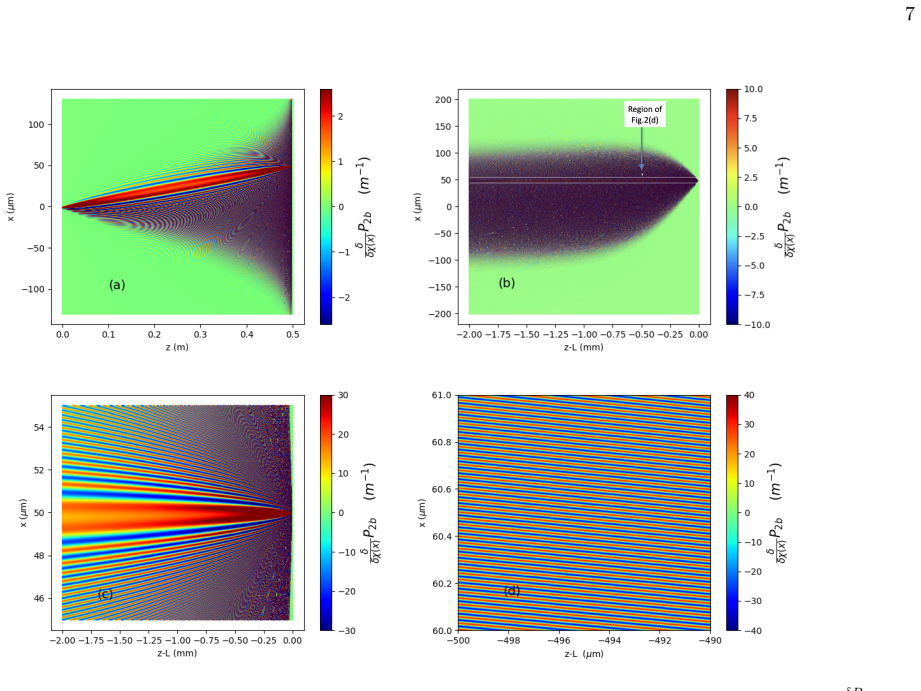
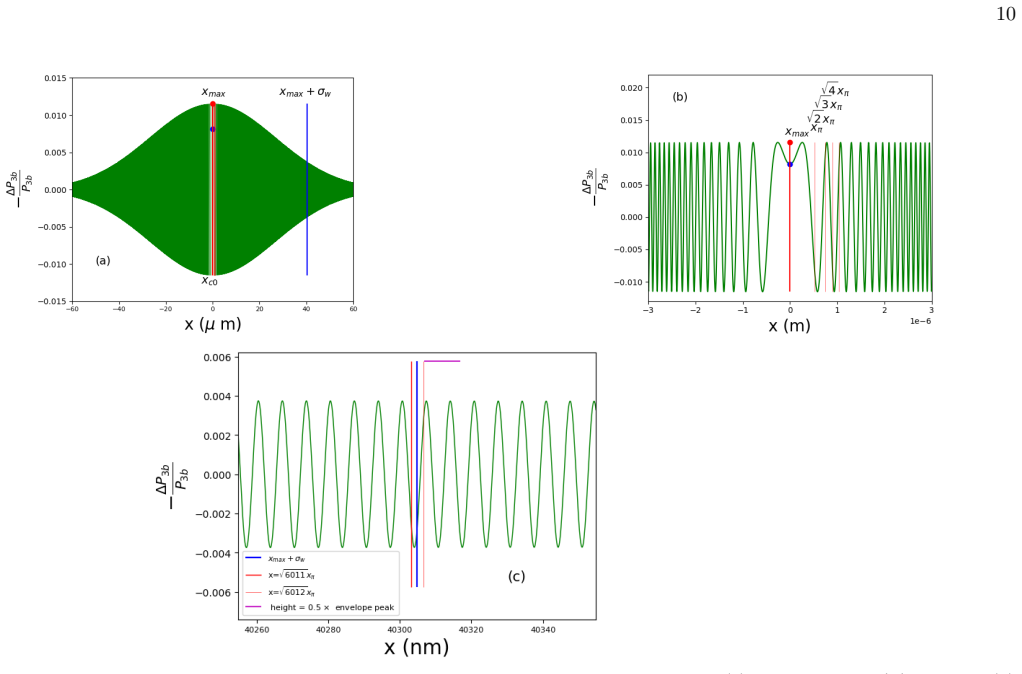
A two-point propagation field derived from single-photon detection probabilities creates a nanoscale sinusoidal pattern for 200 pm X-ray displacement detection.
A machine-rendered reading of the paper's core claim, the machinery that carries it, and where it could break.
Core claim
The central claim is that the two-point propagation field of a single photon, defined as the functional derivative of the detection probability with respect to an infinitesimal opaque perturbation placed between source and detection slit, exhibits a stable high-frequency sinusoidal structure with periods of 4 to 7 nm near the X-ray detection slit. This structure enables shot-noise-limited displacement detection with approximately 200 pm precision for 6 keV X-rays using total photon counts on the order of 1 times 10 to the 7 and detector photon counting as low as 287. The field physically performs a Fourier-Radon transformation of the projection data, providing a pathway to non-iterative 3D X
What carries the argument
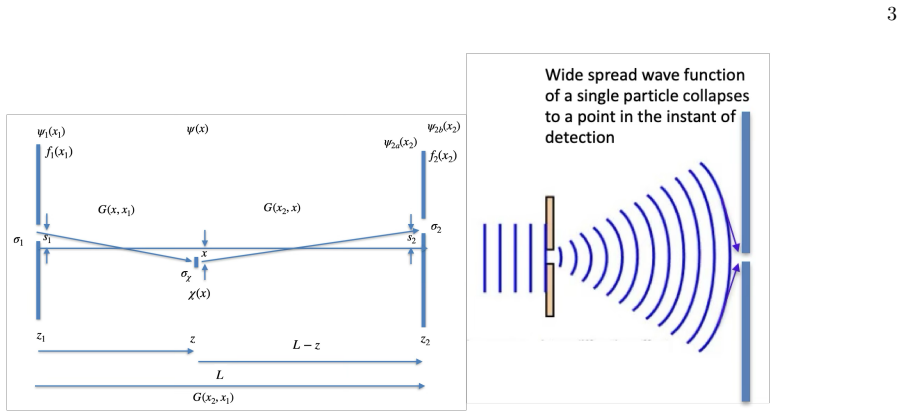
The two-point propagation field, a real-valued phase-sensitive quantity obtained as the functional derivative of single-photon detection probability with respect to an infinitesimal opaque perturbation between the source and the detection slit.
Load-bearing premise
The derivation assumes that an infinitesimal opaque perturbation in the single-photon regime produces a stable phase-sensitive sinusoidal structure without significant multi-photon effects or detector imperfections.
What would settle it
Place a known small opaque object at controlled positions near the detection slit, record the resulting change in single-photon detection probability, and check whether the spatial dependence matches the predicted sinusoidal pattern with 4-7 nm period and the expected phase sensitivity.
Figures
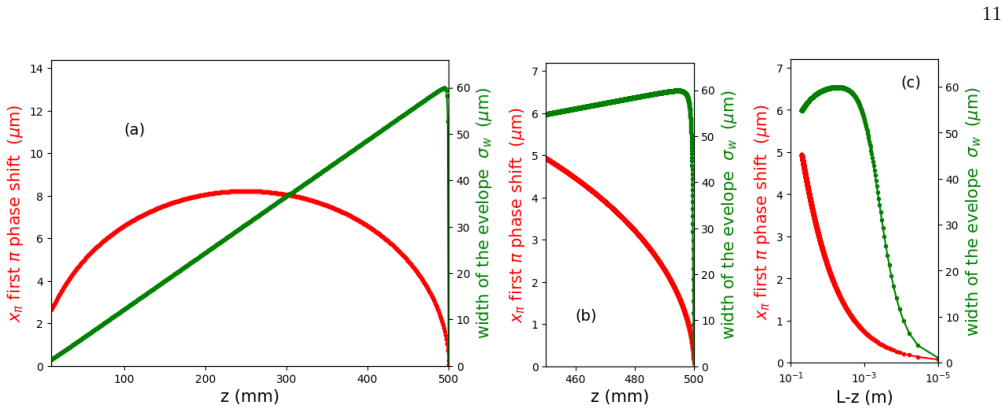
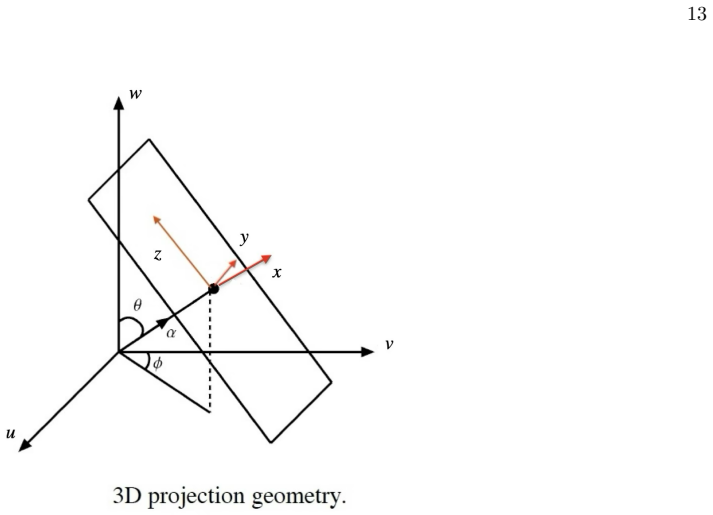
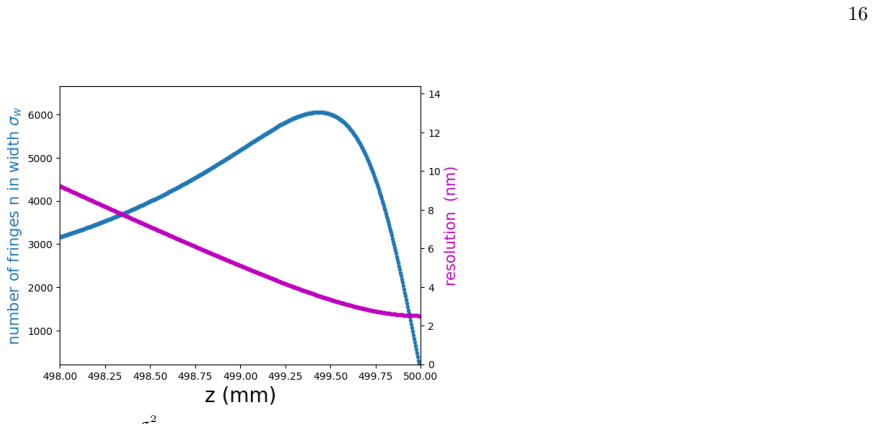
read the original abstract
We introduce the two-point propagation field (TPPF), a real-valued, phase-sensitive quantity defined as the functional derivative of the single-photon detection probability with respect to an infinitesimal opaque perturbation placed between the source and detection slits. The TPPF is analytically derived and shown to exhibit a stable, high-frequency sinusoidal structure with periods of 4~7 nm near the X-ray detection slit. This structure enables shot-noise-limited displacement detection with $\sim200 pm$ precision for 6 keV X-rays, using total photon counts on the order of $1\times10^{7}$ and detector photon counting as low as 287. Beyond displacement detection, the TPPF physically performs a Fourier-Radon transformation of the projection data, providing a pathway to non-iterative frequency-domain tomography. Two conceptual strategies, a central blocker and off-axis multi-slit arrays, are estimated to lower the required incident photon budget by more than one order of magnitude each, yielding combined reductions of two to three orders of magnitude with near-term detector development. The TPPF concept, originally developed in a perturbative study of single-particle propagation, bridges quantum measurement questions with practical high-resolution X-ray physics. This work provides the foundational physics required for future discrete sampling and 3D numerical reconstruction algorithms.
Editorial analysis
A structured set of objections, weighed in public.
Referee Report
Summary. The manuscript introduces the two-point propagation field (TPPF) as a real-valued, phase-sensitive quantity obtained from the functional derivative of single-photon detection probability with respect to an infinitesimal opaque perturbation between source and detection slits. It claims an analytical derivation showing a stable high-frequency sinusoidal structure with 4-7 nm periods near the slit for 6 keV X-rays, enabling shot-noise-limited displacement detection at ~200 pm precision with ~10^7 total photons (down to 287 counts at the detector). The TPPF is further asserted to perform a Fourier-Radon transform of projection data, opening a route to non-iterative frequency-domain 3D X-ray micro-tomography, with conceptual strategies (central blocker, off-axis multi-slit arrays) estimated to reduce photon budget by 2-3 orders of magnitude.
Significance. If the central analytical derivation is correct and the sinusoidal structure remains stable, the work could provide a new quantum-optics-based route to picometer-scale X-ray metrology and non-iterative tomography, with substantial photon-budget savings. The explicit linkage between single-photon functional derivatives and practical high-resolution imaging is a potentially valuable bridge, but its impact depends on rigorous verification of the perturbative assumptions and propagation model.
major comments (2)
- [Main derivation (post-abstract)] The central claim rests on an analytical derivation of the TPPF yielding a stable 4-7 nm sinusoidal structure, yet the manuscript provides no explicit steps, boundary conditions on the infinitesimal opaque perturbation, or choice of propagation kernel (Fresnel, angular-spectrum, or other). Without these, it is impossible to confirm that the sinusoid survives for finite perturbation widths or realistic partial coherence, directly undermining the ~200 pm precision and tomography claims.
- [Precision and photon-budget section] The shot-noise-limited precision estimate of ~200 pm for 6 keV photons with 1e7 total counts is stated without the supporting error-propagation formula, variance calculation, or stability analysis under non-ideal detector response; this is load-bearing for the displacement-sensing application.
minor comments (2)
- [Abstract] The abstract refers to 'near-term detector development' for the multi-slit strategy without quantitative estimates of required efficiency or timing resolution.
- [Introduction/Definition] Notation for the TPPF functional derivative should be introduced with an explicit equation number on first use to aid readability.
Simulated Author's Rebuttal
We thank the referee for the careful and constructive review of our manuscript. The comments highlight important areas where additional detail will strengthen the presentation. We respond to each major comment below and will revise the manuscript accordingly.
read point-by-point responses
-
Referee: The central claim rests on an analytical derivation of the TPPF yielding a stable 4-7 nm sinusoidal structure, yet the manuscript provides no explicit steps, boundary conditions on the infinitesimal opaque perturbation, or choice of propagation kernel (Fresnel, angular-spectrum, or other). Without these, it is impossible to confirm that the sinusoid survives for finite perturbation widths or realistic partial coherence, directly undermining the ~200 pm precision and tomography claims.
Authors: We agree that the derivation steps require explicit expansion for clarity. The TPPF is obtained via functional differentiation of the single-photon detection probability using the Fresnel propagation kernel under the paraxial approximation appropriate for 6 keV X-rays. The infinitesimal opaque perturbation is introduced in the limit of vanishing width as a multiplicative transmission factor of zero. We will add a dedicated subsection containing the complete analytical steps, boundary conditions, and kernel specification. A brief discussion of the regime of validity (perturbations much smaller than the local wavelength and high spatial coherence) will also be included, with the observation that the sinusoidal structure is a direct consequence of the quadratic phase term in the Fresnel kernel. revision: yes
-
Referee: The shot-noise-limited precision estimate of ~200 pm for 6 keV photons with 1e7 total counts is stated without the supporting error-propagation formula, variance calculation, or stability analysis under non-ideal detector response; this is load-bearing for the displacement-sensing application.
Authors: We concur that the supporting calculations were not shown explicitly. The ~200 pm figure follows from standard Gaussian error propagation applied to the phase-sensitive TPPF signal, where the variance is set by Poisson statistics of the detected counts (with the minimum of 287 counts corresponding to the highest-sensitivity region). We will insert the explicit propagation formula, the resulting variance expression, and a short paragraph addressing stability under finite detector quantum efficiency and dark counts in the revised manuscript. revision: yes
Circularity Check
No significant circularity; derivation is self-contained functional computation
full rationale
The paper defines the TPPF explicitly as the functional derivative of single-photon detection probability with respect to an infinitesimal opaque perturbation, then states that this quantity is analytically derived to exhibit a sinusoidal structure. This constitutes a direct mathematical evaluation of the defined functional rather than any reduction of the output to fitted parameters, self-referential equations, or load-bearing self-citations. No equations are shown that rename a fitted input as a prediction or smuggle an ansatz via prior work by the same authors. The central claim therefore remains independent of its inputs by construction and receives the default non-circularity finding.
Axiom & Free-Parameter Ledger
axioms (1)
- domain assumption Single-photon detection probability is governed by standard quantum mechanics in the perturbative limit
invented entities (1)
-
Two-point propagation field (TPPF)
no independent evidence
Lean theorems connected to this paper
-
IndisputableMonolith/Cost/FunctionalEquation.leanwashburn_uniqueness_aczel unclear?
unclearRelation between the paper passage and the cited Recognition theorem.
TPPF defined as functional derivative of single-photon detection probability w.r.t. infinitesimal opaque perturbation; yields stable 4–7 nm sinusoidal structure near slit via paraxial Green's function (Eq. 2, 8)
-
IndisputableMonolith/Foundation/RealityFromDistinction.leanreality_from_one_distinction unclear?
unclearRelation between the paper passage and the cited Recognition theorem.
Derivation uses 1D Schrödinger/paraxial equation and Fresnel kernel; no mention of recognition cost, golden-ratio identities, or 8-tick clock
What do these tags mean?
- matches
- The paper's claim is directly supported by a theorem in the formal canon.
- supports
- The theorem supports part of the paper's argument, but the paper may add assumptions or extra steps.
- extends
- The paper goes beyond the formal theorem; the theorem is a base layer rather than the whole result.
- uses
- The paper appears to rely on the theorem as machinery.
- contradicts
- The paper's claim conflicts with a theorem or certificate in the canon.
- unclear
- Pith found a possible connection, but the passage is too broad, indirect, or ambiguous to say the theorem truly supports the claim.
Reference graph
Works this paper leans on
-
[1]
RELATION BETWEEN TPPF AND RADON TRANSFORM 3.1 TPPF is related to the Fourier transform of the Radon transform in 3D tomography In the convolution form of Eq.(9), we can replace the perturbation of the pin represented by ´ ∆χ(x)dxwith a perturbation by a sample represented by attenuation− ´ f(x, y, z)dxdydzwheref(x, y, z) is a real function when we only co...
-
[2]
We will first take this as an estimate
=πσ 2 (see Appendix III for the approximation ofα χ), whereTis the period at the bandwidthσ ω. We will first take this as an estimate. At this cutoff, ˆG(c)(ω) is reduced by a factore − 1 2 ≈0.6, the noise of 20% would not significantly affect the image reconstruction. For comparison, in the case of the example in Section 2.4 the error bar would be 19%. T...
-
[3]
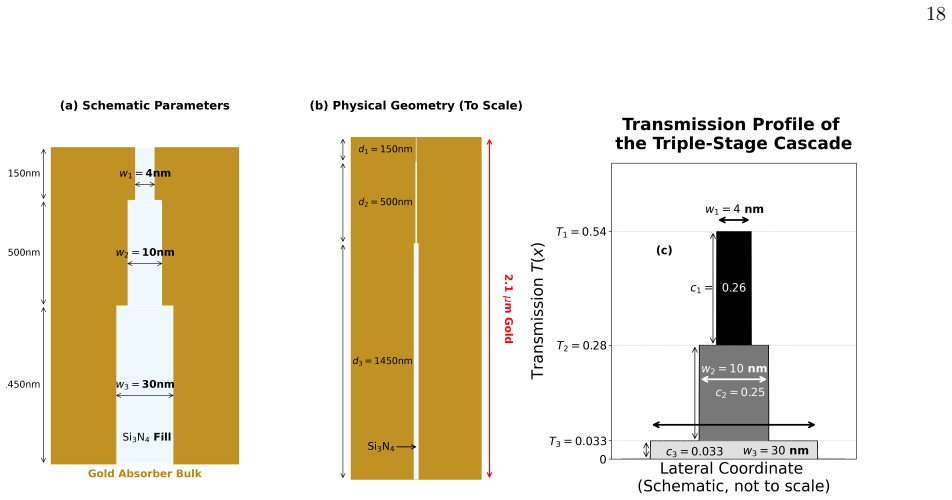
CASCADED TRIPLE-SLIT FOR NANOMETER RESOLUTION USING EXISTING TECHNOLOGY In Sections 1–3, we utilized a 2 nm wide slit with idealized complete attenuation outside the aperture to describe the theoretical performance of the TPPF. To realize this physically, we replace the idealized slit with a more practical cascaded triple-slit assembly: (a) 4 nm wide, 150...
-
[4]
=c 1 +c 2 +c 3 =T 1 = 0.544 is not normalized, and does not satisfy the condition required in the derivation of TPPF for the definition off 2(x2) in Eq.(7). Hence,f 2 2 (x2 = 0) is used to calculateP 2b as the additional coefficient of the formula forP 2b as the attenuation of the assembly. For a single idealized slit of widthw 1 = √ 2πσ {1} 2 = 4nm, the ...
-
[5]
PICOMETER X-RAY DISPLACEMENT SENSING VIA TWO-POINT PROPAGATION FIELD With the cascaded triple slit calculation ready, our next step in developing TPPF-based tomography is to apply the formula derived in sections 2,3, and 4 to provide the first step of testing the TPPF and its connection with tomography to show that the gold film pattern can be used as a l...
-
[6]
PROSPECTIVE PHOTON-BUDGET REDUCTION STRATEGIES FOR LENSLESS X-RAY PICOMETER SENSING AND RADON–FOURIER MICROTOMOGRAPHY The TPPF atx≈40µmhas a high spatial frequencyλ f ringe = 6.7nm. Low-spatial-frequency components of the TPPF, concentrated nearx≈0 , contribute negligibly to the 6.7 nm sinusoidal signal but dominate the total detected 23 photon countN 2 a...
-
[7]
RELATION TO QUANTUM MEASUREMENT DURING THE FREE SPACE PROPAGATION BETWEEN THE SOURCE AND DETECTOR SLIT The TPPF concept originates from a perturbative study of single-particle propagation and measurement [2]. The discussion in this section reflects our interpretation of the quantum-measurement aspects of free-space propagation between the source and detec...
-
[8]
CONCLUSION The analysis based on the TPPF and the cascaded triple slit configuration provides: (1) An experimental test bed for TPPF as a phase-sensitive wavefunction evolution process, in which fine interference fringes—without lenses or focusing—continuously converge toward a localized slit, enabling picometer-scale displace- ment sensitivity (∼200 pm)....
-
[9]
High-performance 4-nm-resolution X-ray tomography using burst ptychography,
Aidukas T, Phillips NW, Diaz A, Poghosyan E, M¨ uller E, Levi AFJ, et al., “High-performance 4-nm-resolution X-ray tomography using burst ptychography, ”Nature. 2024; 632(8023): 81-88
work page 2024
-
[10]
Li Hua Yu, “Perturbative study of wave function evolution from source to detection of a single particle and the measure- ment”, http://arxiv.org/abs/2412.15409 (2024)
-
[11]
Flannery, B. P., Deckman, H. W., & D’Amico, K. L. (1987). Three-Dimensional X-Ray Microtomography. Science, 237(4821), 1439-1443
work page 1987
-
[12]
J Pathol Actions Search in PubMed Search in NLM Catalog Add to Search . 2019 Aug;189(8):1608-1620. doi: 10.1016/j.ajpath.2019.05.004. Epub 2019 May 22. X-ray Micro-Computed Tomography for Nondestructive Three- Dimensional (3D) X-ray Histology Orestis L Katsamenis 1, Michael Olding 2, Jane A Warner 3, David S Chatelet 2, Mark G Jones 4, Giacomo Sgalla 5, B...
-
[13]
K. A. Milton, The Casimir Effect: Physical Manifestations of Zero-Point Energy, World Scientific (2001)
work page 2001
-
[14]
https://en.wikipedia.org/wiki/Hilbert transform
-
[15]
Manfrinato†Aaron Stein†Lihua Zhang†Chang-Yong Nam†OrcidKevin G
Vitor R. Manfrinato†Aaron Stein†Lihua Zhang†Chang-Yong Nam†OrcidKevin G. Yager†Eric A. Stach*†OrcidCharles T. Black*, “Aberration-Corrected Electron Beam Lithography at the One Nanometer Length Scale “, Nano Letters Vol 17/Issue 8 Article, Expand LetterApril 18, 2017
work page 2017
-
[16]
Fernando E. Camino1, Vitor R. Manfrinato1, Aaron Stein1, Lihua Zhang1, Ming Lu1, Eric A. Stach1, Charles T. Black1, JoVE Journal Engineering, “Single-Digit Nanometer Electron-Beam Lithography with an Aberration- Corrected Scanning Transmission Electron Microscope” Published: September 14, 2018 doi: 10.3791/58272, https://www.jove.com/t/58272/single-digit-...
-
[17]
Replicable Zero-Gap Fabrication of Sub-10 nm Metallic Gaps
Melli, M., et al. (2010)."Replicable Zero-Gap Fabrication of Sub-10 nm Metallic Gaps."Nano Letters
work page 2010
-
[18]
Sub-5 nm Nanogap Junctions by Self-Aligned Adhesion Lithog- raphy
Chen, Y., Xuan, Z., Gu, M., & Man-Pankaj, K. (2015)."Sub-5 nm Nanogap Junctions by Self-Aligned Adhesion Lithog- raphy."Nature Communications, 6, 7348. https://doi.org/10.1038/ncomms8348
-
[19]
https://physics.nist.gov/PhysRefData/XrayMassCoef/ElemTab/z79.html
-
[20]
Amir Averbuch and Yoel Shkolnisky, Appl. Comput. Harmon. Anal. 15 (2003) 33–69
work page 2003
-
[21]
W., Introduction to Fourier Optics, 4th ed., Roberts & Company Publishers, 2017
Goodman, J. W., Introduction to Fourier Optics, 4th ed., Roberts & Company Publishers, 2017
work page 2017
-
[22]
Algebraic Reconstruction Algorithms, Purdue University, https://engineering.purdue.edu/˜malcolm/pct/CTI Ch07.pdf
-
[23]
Hiramatsu, M., Itoh, K., Kondo, H., & Hori, M. (2004)."Fabrication of vertically aligned carbon nanowalls using novel plasma-enhanced chemical vapor deposition."Applied Physics Letters, 84(23), 4708-4710
work page 2004
-
[24]
(2014) Nano Letters, 14(8), 4406-4411
Manfrinato et al. (2014) Nano Letters, 14(8), 4406-4411
work page 2014
-
[25]
Xiaoshu Chen1*, Hyeong-Ryeol Park1*, Nathan C. Lindquist2, Jonah Shaver1, Matthew Pelton3 & Sang-Hyun Oh1, Squeezing Millimeter Waves through a Single, Nanometer-wide, Centimeter-long Slit, SCIENTIFIC REPORTS|4 : 6722 |DOI: 10.1038/srep06722,
-
[26]
(2011) Nature Nanotechnology, 6(7), 427-432
Im et al. (2011) Nature Nanotechnology, 6(7), 427-432
work page 2011
-
[27]
https://en.wikipedia.org/wiki/Weak measurement
-
[28]
Yakir Aharonov, David Z. Albert, and Lev Vaidman, VOLUME 60, NUMBER 14 PHYSICAL REVIEW LETTERS How the Result of a Measurement of a Component of the Spin of a Spin- 2 Particle Can Turn Out to be 100
-
[29]
Jeff S. Lundeen1, Brandon Sutherland1, Aabid Patel1, Corey Stewart1 & Charles Bamber1,”Direct measurement of the quantum wavefunction”, 1 8 8|N A T U R E|V O L 4 7 4|9 J U N E 2 0 1 1 30
-
[30]
bserving the Average Trajectories of Single Photons in a Two-Slit Interferometer
Sacha Kocsis,1,2* Boris Braverman,1* Sylvain Ravets,3* Martin J. Stevens,4 Richard P. Mirin,4 L. Krister Shalm,1,5 Aephraim M. Steinberg1†, “bserving the Average Trajectories of Single Photons in a Two-Slit Interferometer”, 3 JUNE 2011 VOL 332 SCIENCE,O
work page 2011
-
[31]
Density Multiplication and Improved Lithography by Directed Block Copolymer Assembly
Ruiz, R., et al. (2008)."Density Multiplication and Improved Lithography by Directed Block Copolymer Assembly." Science
work page 2008
-
[32]
Graphoepitaxy of Self-Assembled Block Copolymers on Rapid-Interferometric Nanopatterned Substrates
Bita, I., et al. (2008)."Graphoepitaxy of Self-Assembled Block Copolymers on Rapid-Interferometric Nanopatterned Substrates."Science
work page 2008
discussion (0)
Sign in with ORCID, Apple, or X to comment. Anyone can read and Pith papers without signing in.