Spectro-temporal unitary transformations for coherent modulation: design trade-offs and practical considerations
Pith reviewed 2026-05-16 20:25 UTC · model grok-4.3
The pith
Cascades of phase modulators and dispersive elements achieve signal-to-distortion ratios above 30 dB for coherent optical links above 200 GBd using fewer than six stages.
A machine-rendered reading of the paper's core claim, the machinery that carries it, and where it could break.
Core claim
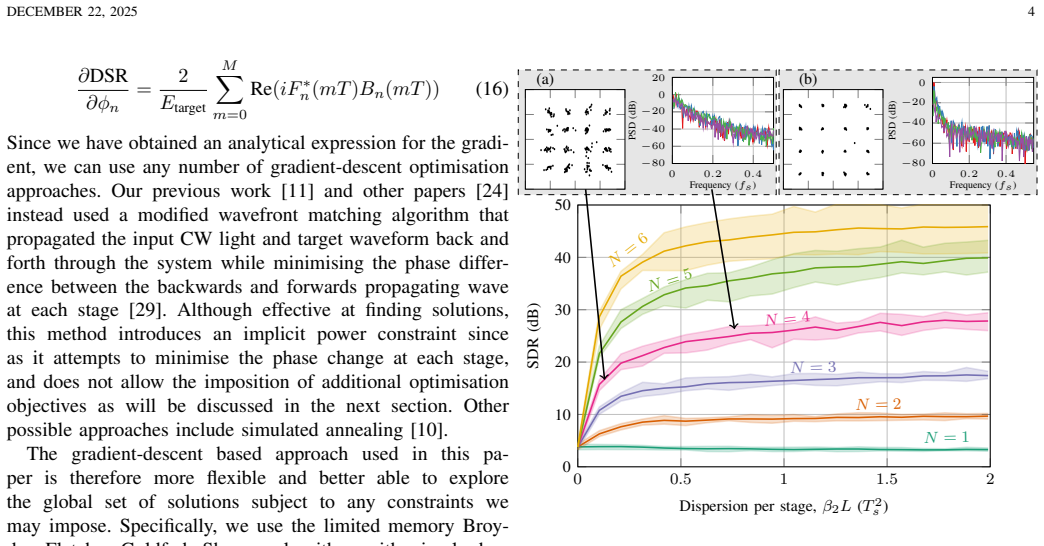
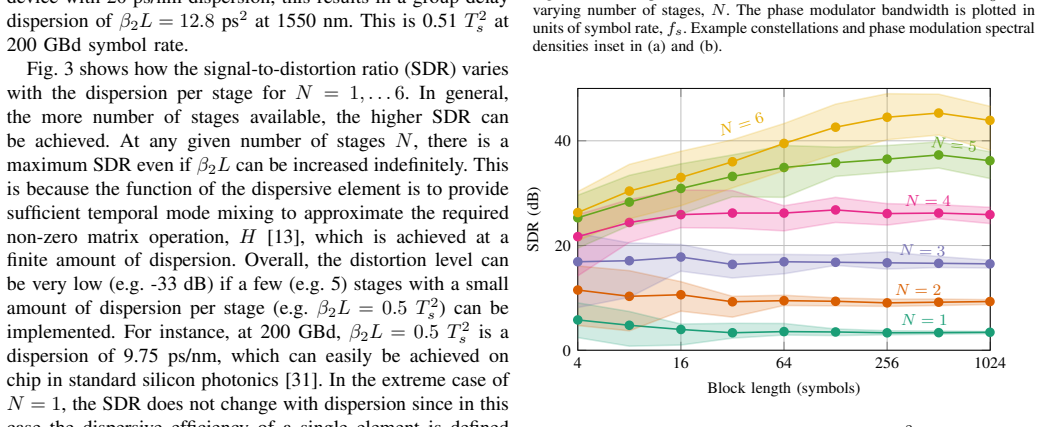
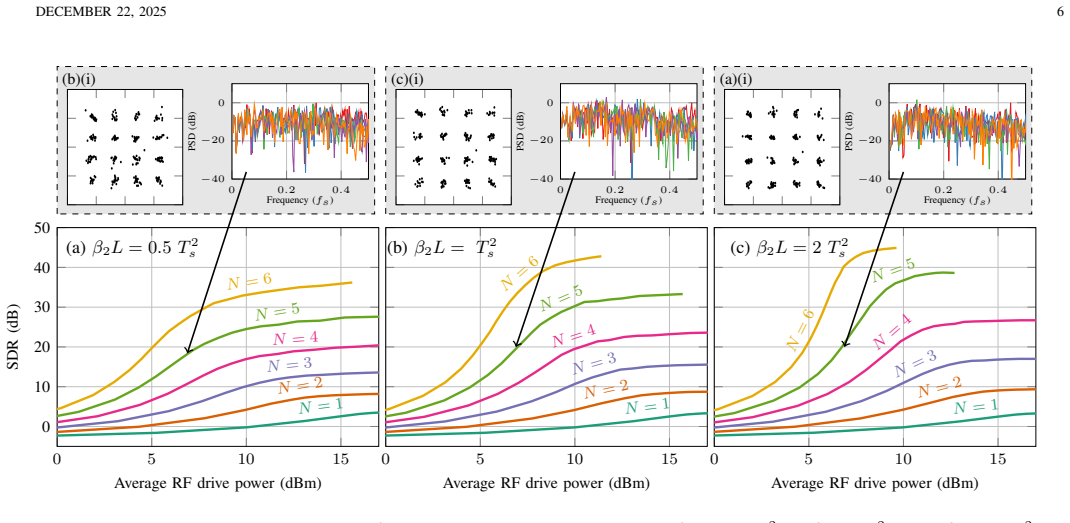
Spectro-temporal unitary transforms implemented through cascades of phase modulators and dispersive elements can reach signal-to-distortion ratios exceeding 30 dB using fewer than six stages, with realistic values of driver power, modulator bandwidth, and on-chip dispersion, while remaining suitable for coherent optical communications operating above 200 GBd.
What carries the argument
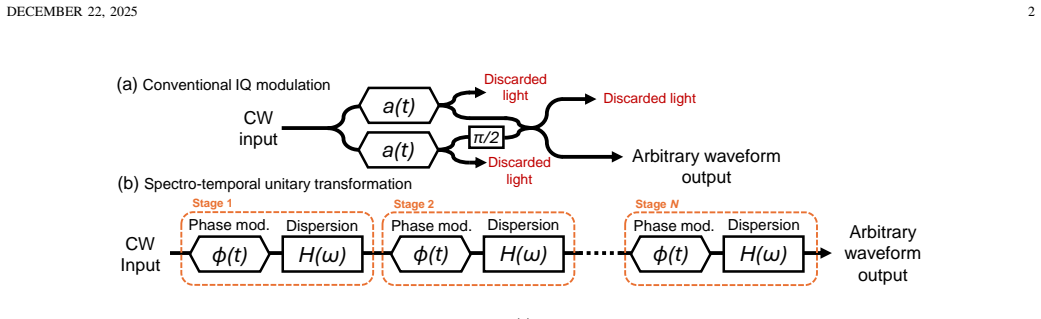
A cascade of phase modulators interleaved with dispersive elements that together realize a unitary spectro-temporal transformation across blocks of symbols.
If this is right
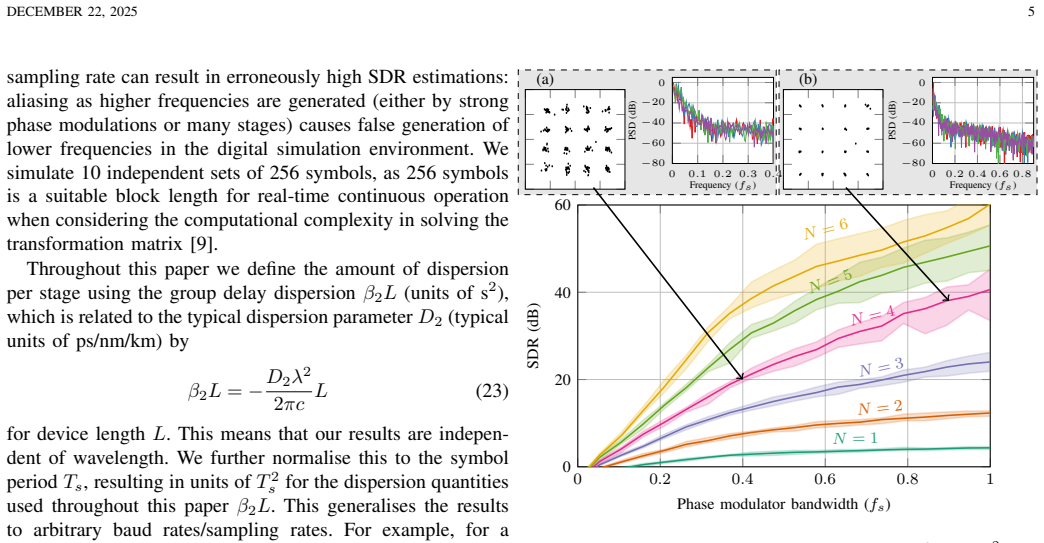
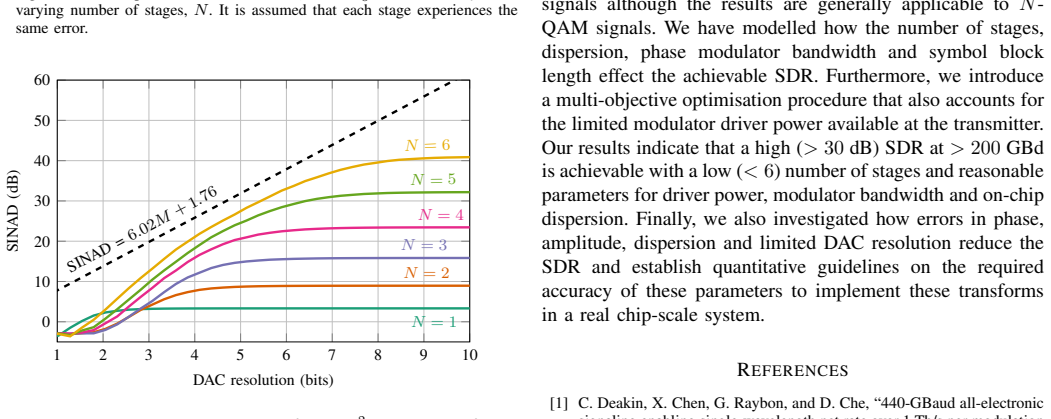
- SDR remains above 30 dB when finite modulator bandwidth and DAC resolution are included in the model.
- Increasing the number of stages or dispersion per stage improves SDR up to a saturation point set by other hardware limits.
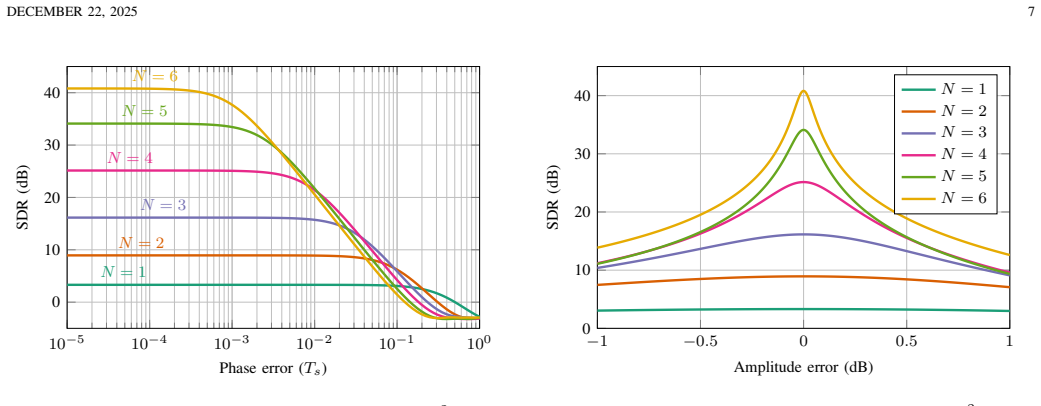
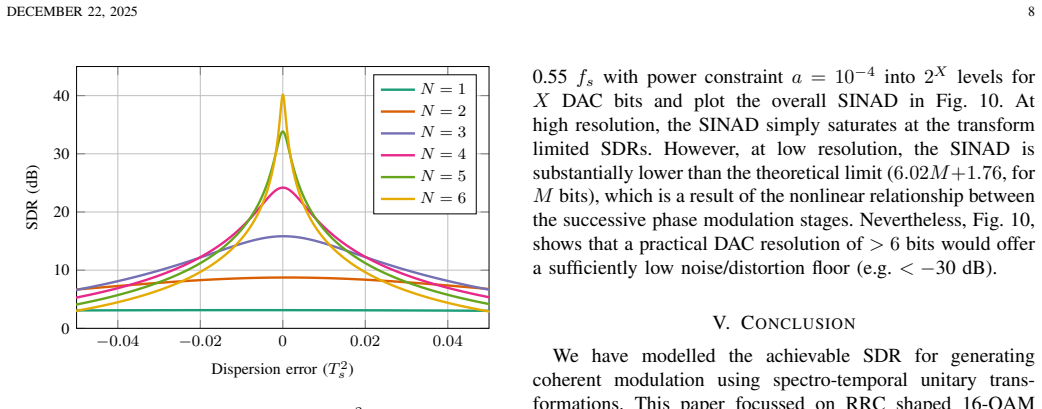
- Phase and amplitude errors in the modulators produce predictable, quantifiable reductions in final SDR.
- Longer symbol blocks can be processed without proportional growth in distortion under the unitary assumption.
Where Pith is reading between the lines
- The approach could remove modulator bandwidth as the primary bottleneck in scaling optical line rates beyond current limits.
- Calibration procedures that measure and correct the modeled error sources would be required for field deployment.
- The same unitary cascade structure might be repurposed for other coherent operations such as pulse shaping or format conversion.
- Integration with existing silicon-photonic platforms would need to verify that on-chip dispersion values match the simulated ranges.
Load-bearing premise
The cascade maintains perfect unitarity and the modeled phase, amplitude, dispersion, and DAC errors fully capture real hardware behavior without extra losses or nonlinearities.
What would settle it
A fabricated five-stage device measured at 200 GBd that delivers less than 25 dB SDR under the modeled driver power and bandwidth would falsify the claim of practical high-fidelity performance.
Figures
read the original abstract
This paper analyzes the performance of spectro-temporal unitary transforms for coherent optical modulation. Unlike conventional IQ modulation, such transforms are based on a cascade of phase modulators and dispersive elements, so are theoretically lossless and not limited by the bandwidth of the constituent modulators. We analyse the performance limits and design trade-offs of this scheme: estimating how the number of stages, amount of dispersion, modulator bandwidth, symbol block length and electrical signal power impacts the achievable signal-to-distortion ratio (SDR). Importantly, we show that high (>30 dB) SDRs suitable for modern >200 GBd class coherent optical communications are achievable with a low (<6) number of stages and reasonable parameters for driver power, modulator bandwidth and on-chip dispersion. Finally we address the SDR penalties associated with potential phase, amplitude, or dispersion errors, and limited DAC resolution.
Editorial analysis
A structured set of objections, weighed in public.
Referee Report
Summary. The manuscript analyzes spectro-temporal unitary transformations for coherent optical modulation implemented via cascades of phase modulators and dispersive elements. It models performance limits and design trade-offs, showing how the number of stages, dispersion amount, modulator bandwidth, symbol block length, and electrical signal power affect the achievable signal-to-distortion ratio (SDR). The central claim is that >30 dB SDRs suitable for >200 GBd coherent systems are attainable with fewer than 6 stages under reasonable driver power, modulator bandwidth, and on-chip dispersion values, while also quantifying SDR penalties from phase/amplitude/dispersion errors and finite DAC resolution.
Significance. If the modeling assumptions hold and the numerical results are reproducible, the work could enable a theoretically lossless, modulator-bandwidth-unconstrained alternative to conventional IQ modulation for high-speed coherent optics. The explicit trade-off analysis and error-sensitivity quantification provide actionable guidelines for practical implementation in >200 GBd systems.
major comments (2)
- [Abstract / performance-modeling section] Abstract and performance-modeling section: the headline claim of >30 dB SDR with <6 stages is obtained from a numerical model of cascaded operators; the manuscript must supply the explicit forward-model equations (including how additive phase/amplitude/dispersion errors and DAC quantization are incorporated) and the precise parameter values used to reach the reported SDR floor, as these are load-bearing for the central numerical result.
- [Error-modeling section] Error-modeling section: the analysis assumes the phase-modulator + dispersion cascade remains exactly unitary apart from the listed error sources; the paper should demonstrate that unmodeled physical mechanisms (voltage-dependent insertion loss, Kerr-induced nonlinear phase, or polarization-dependent dispersion) remain negligible at the stated drive powers and on-chip dispersion values, because even small deviations can accumulate after 5 stages and exceed the reported distortion floor.
minor comments (1)
- [Abstract] Define SDR on first use in the abstract and ensure consistent notation for dispersion amount and modulator bandwidth throughout.
Simulated Author's Rebuttal
We thank the referee for their thorough review and constructive feedback on our manuscript. We have revised the paper to address the concerns about explicit modeling details and practical error sources. Our point-by-point responses follow, with changes incorporated where feasible.
read point-by-point responses
-
Referee: [Abstract / performance-modeling section] Abstract and performance-modeling section: the headline claim of >30 dB SDR with <6 stages is obtained from a numerical model of cascaded operators; the manuscript must supply the explicit forward-model equations (including how additive phase/amplitude/dispersion errors and DAC quantization are incorporated) and the precise parameter values used to reach the reported SDR floor, as these are load-bearing for the central numerical result.
Authors: We agree that the explicit forward-model equations and parameter values are essential for reproducibility. In the revised manuscript, we have added a dedicated subsection titled 'Forward Model and Numerical Implementation' that provides the full mathematical description of the cascaded operators. This includes the unitary phase modulation operator exp(i * phi(t)) applied at each stage, the dispersion operator in the frequency domain exp(-i * beta2 * omega^2 * L / 2), and the incorporation of additive errors: phase errors as random perturbations delta_phi, amplitude errors as multiplicative factors (1 + epsilon), dispersion errors as delta_beta2, and DAC quantization modeled as additive uniform noise with variance determined by the bit resolution. We also include a table (Table I) listing all precise parameters used for the >30 dB SDR results, such as 5 stages, 5 ps/nm dispersion per stage, 40 GHz modulator bandwidth, 200 GBd symbol rate, 10 dBm electrical drive power, and 8-bit DAC resolution. These revisions make the central numerical claims fully transparent. revision: yes
-
Referee: [Error-modeling section] Error-modeling section: the analysis assumes the phase-modulator + dispersion cascade remains exactly unitary apart from the listed error sources; the paper should demonstrate that unmodeled physical mechanisms (voltage-dependent insertion loss, Kerr-induced nonlinear phase, or polarization-dependent dispersion) remain negligible at the stated drive powers and on-chip dispersion values, because even small deviations can accumulate after 5 stages and exceed the reported distortion floor.
Authors: We appreciate this point on unmodeled physical effects. In the revised error-modeling section, we have added quantitative estimates based on typical silicon photonic device parameters from the literature. Voltage-dependent insertion loss is estimated at <0.05 dB per stage for the drive powers used, accumulating to <0.25 dB over 5 stages and contributing <0.2 dB SDR penalty. Kerr-induced nonlinear phase shift is calculated as ~0.008 rad per stage using the on-chip dispersion and power levels, accumulating to <0.04 rad total and remaining below the 30 dB SDR floor. Polarization-dependent dispersion is shown to be negligible (<0.1 ps/nm) for the assumed single-polarization, low-birefringence waveguides. These additions demonstrate that the effects are small relative to the modeled distortion. However, we note that device-specific experimental validation would be needed for absolute confirmation, which exceeds the scope of this theoretical analysis paper. revision: partial
Circularity Check
No significant circularity; results from forward numerical modeling of unitary cascade
full rationale
The paper derives its performance claims (>30 dB SDR with <6 stages) via forward simulation of the cascaded phase-modulator + dispersive-element operators under stated error models (phase/amplitude/dispersion errors, DAC resolution). No equation reduces a prediction to a fitted parameter by construction, no self-citation supplies a load-bearing uniqueness theorem or ansatz, and the central SDR estimates are computed outputs rather than re-statements of inputs. The modeling assumptions are explicit and externally falsifiable; the derivation chain is therefore self-contained.
Axiom & Free-Parameter Ledger
free parameters (4)
- number of stages
- dispersion amount
- modulator bandwidth
- electrical signal power
axioms (2)
- domain assumption Cascade of phase modulators and dispersive elements realizes a spectro-temporal unitary transformation
- standard math Unitary transformations are lossless and preserve signal energy
Lean theorems connected to this paper
-
IndisputableMonolith/Foundation/AlexanderDuality.leanalexander_duality_circle_linking unclear?
unclearRelation between the paper passage and the cited Recognition theorem.
U = Λ1 H Λ2 H … Λn H where Λn are diagonal phase matrices and H is a fixed full mixer (e.g. DFT); dispersion condition |β2L| ≫ τw² for temporal mode mixing
-
IndisputableMonolith/Cost/FunctionalEquation.leanwashburn_uniqueness_aczel unclear?
unclearRelation between the paper passage and the cited Recognition theorem.
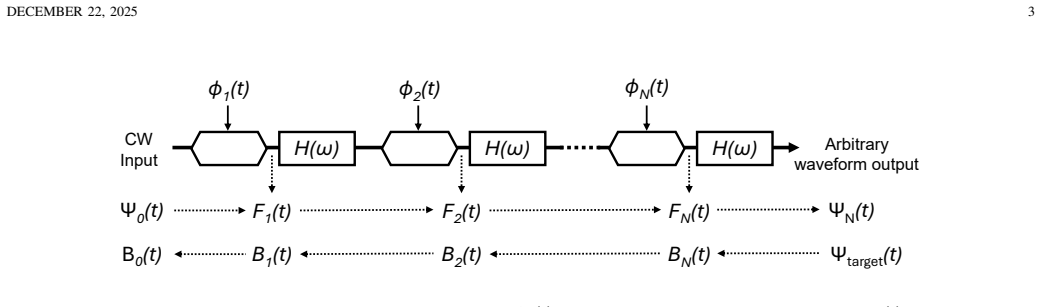
DSR gradient derived from forward/backward waves Fn, Bn with unitary preservation assumed
What do these tags mean?
- matches
- The paper's claim is directly supported by a theorem in the formal canon.
- supports
- The theorem supports part of the paper's argument, but the paper may add assumptions or extra steps.
- extends
- The paper goes beyond the formal theorem; the theorem is a base layer rather than the whole result.
- uses
- The paper appears to rely on the theorem as machinery.
- contradicts
- The paper's claim conflicts with a theorem or certificate in the canon.
- unclear
- Pith found a possible connection, but the passage is too broad, indirect, or ambiguous to say the theorem truly supports the claim.
Forward citations
Cited by 1 Pith paper
-
220-GBd optical coherent waveform generation using temporal unitary transforms
Demonstrates generation of 220-GBd 16-QAM waveforms via temporal unitary transforms that are claimed to be theoretically lossless and to exceed modulator bandwidth limits.
Reference graph
Works this paper leans on
-
[1]
C. Deakin, X. Chen, G. Raybon, and D. Che, “440-GBaud all-electronic signaling enabling single-wavelength net rate over 1 Tb/s per modulation dimension,” in2025 Optical Fiber Communications Conference and Exhibition (OFC), pp. 1–3, IEEE, 2025
work page 2025
-
[2]
From scaling disparities to integrated parallelism: A decathlon for a decade,
P. J. Winzeret al., “From scaling disparities to integrated parallelism: A decathlon for a decade,”JLT, vol. 35, no. 5, pp. 1099–1115, 2017
work page 2017
-
[3]
Solving for scalability from multi-band to multi-rail core networks,
R. Schmogrow, “Solving for scalability from multi-band to multi-rail core networks,”JLT, vol. 40, no. 11, pp. 3406–3414, 2022
work page 2022
-
[4]
InP HBT technologies for THz integrated circuits,
M. Urteagaet al., “InP HBT technologies for THz integrated circuits,” Proceedings of the IEEE, vol. 105, no. 6, pp. 1051–1067, 2017
work page 2017
-
[5]
Nonlinearity-free coherent transmission in hollow-core antiresonant fiber,
Z. Liu, ,et al., “Nonlinearity-free coherent transmission in hollow-core antiresonant fiber,”JLT, vol. 37, no. 3, pp. 909–916, 2018
work page 2018
-
[6]
Opportunities and challenges for long- distance transmission in hollow-core fibres,
P. Poggiolini and F. Poletti, “Opportunities and challenges for long- distance transmission in hollow-core fibres,”Journal of Lightwave Technology, vol. 40, no. 6, pp. 1605–1616, 2022
work page 2022
-
[7]
Programmable unitary transformation of spectro- temporal modes,
V . Thielet al., “Programmable unitary transformation of spectro- temporal modes,” inLaser Science, pp. JW4A–5, 2017
work page 2017
-
[8]
Optical arbitrary waveform generator based on time- domain multiplane light conversion,
M. Mazuret al., “Optical arbitrary waveform generator based on time- domain multiplane light conversion,” inOFC, p. M1B.3, 2019
work page 2019
-
[9]
Performance comparison between all-pass and IQ optical modulation,
B. Saxenaet al., “Performance comparison between all-pass and IQ optical modulation,”Journal of Lightwave Technology, vol. 42, no. 1, pp. 201–207, 2023
work page 2023
-
[10]
Temporal mode transformations by sequential time and frequency phase...,
J. Ashbyet al., “Temporal mode transformations by sequential time and frequency phase...,”Optics Express, vol. 28, no. 25, pp. 38376–38389, 2020
work page 2020
-
[11]
Performance limits of spectro-temporal unitary transformations for coherent modulation,
C. Deakinet al., “Performance limits of spectro-temporal unitary transformations for coherent modulation,” inOFC, p. Tu3C.1, 2025
work page 2025
-
[12]
Decomposing a matrix into circulant and diagonal factors,
M. Schmid, R. Steinwandt, J. M ¨uller-Quade, M. R ¨otteler, and T. Beth, “Decomposing a matrix into circulant and diagonal factors,”Linear Algebra and its Applications, vol. 306, no. 1-3, pp. 131–143, 2000
work page 2000
-
[13]
Subgroups of the unitary group that contain the group of diagonal matrices,
Z. Borevichet al., “Subgroups of the unitary group that contain the group of diagonal matrices,”Journal of Soviet Mathematics, vol. 17, pp. 1951–1959, 1981
work page 1951
-
[14]
Programmable unitary spatial mode manipulation,
J.-F. Morizuret al., “Programmable unitary spatial mode manipulation,” JOSA A, vol. 27, no. 11, pp. 2524–2531, 2010. DECEMBER 22, 2025 9
work page 2010
-
[15]
Universality and optimal architectures for layered programmable...,
J. ´Alvarez-Vizosoet al., “Universality and optimal architectures for layered programmable...,”arXiv preprint arXiv:2510.19397, 2025
-
[16]
Space-time duality and the theory of temporal imaging,
B. H. Kolner, “Space-time duality and the theory of temporal imaging,” IEEE Journal of Quantum Electronics, vol. 30, no. 8, pp. 1951–1963, 1994
work page 1951
-
[17]
Application of space–time duality to ultrahigh-speed optical signal processing,
R. Salem, M. A. Foster, and A. L. Gaeta, “Application of space–time duality to ultrahigh-speed optical signal processing,”Advances in Optics and Photonics, vol. 5, no. 3, pp. 274–317, 2013
work page 2013
-
[18]
Robust architecture for programmable universal unitaries,
M. Y . Saygin, I. Kondratyev, I. Dyakonov, S. Mironov, S. Straupe, and S. Kulik, “Robust architecture for programmable universal unitaries,” Physical review letters, vol. 124, no. 1, p. 010501, 2020
work page 2020
-
[19]
K. Zelaya, M. Markowitz, and M.-A. Miri, “The goldilocks principle of learning unitaries by interlacing fixed operators with programmable phase shifters on a photonic chip,”Scientific Reports, vol. 14, no. 1, p. 10950, 2024
work page 2024
-
[20]
Arbitrary optical wave evolution with fourier transforms and phase masks,
V . L ´opez Pastor, J. Lundeen, and F. Marquardt, “Arbitrary optical wave evolution with fourier transforms and phase masks,”Optics Express, vol. 29, no. 23, pp. 38441–38450, 2021
work page 2021
-
[21]
Near-optimal decomposition of unitary matrices using phase masks and the discrete fourier transform,
V . Girouard and N. Quesada, “Near-optimal decomposition of unitary matrices using phase masks and the discrete fourier transform,”arXiv preprint arXiv:2508.20010, 2025
-
[22]
The fractional fourier transform,
H. M. Ozaktas and M. A. Kutay, “The fractional fourier transform,” in 2001 European Control Conference (ECC), pp. 1477–1483, IEEE, 2001
work page 2001
-
[23]
M. Markowitz and M.-A. Miri, “Universal unitary photonic circuits by interlacing discrete fractional fourier transform and phase modulation,” arXiv preprint arXiv:2307.07101, 2023
-
[24]
Multi-wavelength arbitrary waveform generation through...,
M. Mazuret al., “Multi-wavelength arbitrary waveform generation through...,”arXiv preprint arXiv:1907.02595, 2019
-
[25]
Laguerre-gaussian mode sorter,
N. K. Fontaineet al., “Laguerre-gaussian mode sorter,”Nature commu- nications, vol. 10, no. 1, p. 1865, 2019
work page 2019
-
[26]
Compactifying linear optical unitaries using multiport beamsplitters,
P. Yasiret al., “Compactifying linear optical unitaries using multiport beamsplitters,”arXiv preprint arXiv:2505.11371, 2025
-
[27]
Upper bound of the diffraction efficiency of diffractive phase elements,
F. Wyrowski, “Upper bound of the diffraction efficiency of diffractive phase elements,”Optics letters, vol. 16, no. 24, pp. 1915–1917, 1991
work page 1915
-
[28]
Upper bound of signal-relevant efficiency of constrained diffractive elements,
A. Verhoevenet al., “Upper bound of signal-relevant efficiency of constrained diffractive elements,”JOSA A, vol. 33, no. 12, pp. 2425– 2430, 2016
work page 2016
-
[29]
New optical waveguide design based on wavefront matching method,
Y . Sakamakiet al., “New optical waveguide design based on wavefront matching method,”JLT, vol. 25, no. 11, pp. 3511–3518, 2007
work page 2007
-
[30]
A limited memory algo- rithm for bound constrained optimization,
R. H. Byrd, P. Lu, J. Nocedal, and C. Zhu, “A limited memory algo- rithm for bound constrained optimization,”SIAM Journal on scientific computing, vol. 16, no. 5, pp. 1190–1208, 1995
work page 1995
-
[31]
Silicon photonic direct-detection phase retrieval re- ceiver,
B. Sternet al., “Silicon photonic direct-detection phase retrieval re- ceiver,” inECOC 2023, p. M.A.2.2, 2023
work page 2023
-
[32]
Complexity of algorithms for digital coherent receivers,
B. Spinnler, “Complexity of algorithms for digital coherent receivers,” in2009 35th European Conference on Optical Communication, pp. 1–4, IEEE, 2009
work page 2009
-
[33]
High-speed sige bicmos circuits for optical communication,
G. Torfs, B. Moeneclaey, J. Lambrecht, C. Bruynsteen, J. Declerq, S. Niu, N. Singh, M. Verbeke, X. Yin, P. Ossieur,et al., “High-speed sige bicmos circuits for optical communication,” in2023 IEEE BiCMOS and Compound Semiconductor Integrated Circuits and Technology Sym- posium (BCICTS), pp. 153–158, IEEE, 2023
work page 2023
-
[34]
Integrated lithium niobate electro-optic modulators operating at cmos-compatible voltages,
C. Wang, M. Zhang, X. Chen, M. Bertrand, A. Shams-Ansari, S. Chan- drasekhar, P. Winzer, and M. Lon ˇcar, “Integrated lithium niobate electro-optic modulators operating at cmos-compatible voltages,”Na- ture, vol. 562, no. 7725, pp. 101–104, 2018
work page 2018
-
[35]
Upper bound on the capacity of a cascade of nonlinear and noisy channels,
G. Kramer, M. I. Yousefi, and F. R. Kschischang, “Upper bound on the capacity of a cascade of nonlinear and noisy channels,” in2015 IEEE Information Theory Workshop (ITW), pp. 1–4, IEEE, 2015
work page 2015
-
[36]
Capacity limits of optical fiber networks,
R.-J. Essiambre, G. Kramer, P. J. Winzer, G. J. Foschini, and B. Goebel, “Capacity limits of optical fiber networks,”Journal of Lightwave tech- nology, vol. 28, no. 4, pp. 662–701, 2010
work page 2010
-
[37]
Information transmission using the nonlinear fourier transform, part iii: Spectrum modulation,
M. I. Yousefi and F. R. Kschischang, “Information transmission using the nonlinear fourier transform, part iii: Spectrum modulation,”IEEE Transactions on Information Theory, vol. 60, no. 7, pp. 4346–4369, 2014
work page 2014
-
[38]
Review of silicon photonics tech- nology and platform development,
S. Y . Siew, B. Li, F. Gao, H. Y . Zheng, W. Zhang, P. Guo, S. W. Xie, A. Song, B. Dong, L. W. Luo,et al., “Review of silicon photonics tech- nology and platform development,”Journal of Lightwave Technology, vol. 39, no. 13, pp. 4374–4389, 2021
work page 2021
discussion (0)
Sign in with ORCID, Apple, or X to comment. Anyone can read and Pith papers without signing in.